The Mass Attenuation Coefficients of synthesized Nano Composite Material
Mg
0.2(Cu
xZn
0.8-x)Fe
2O
41 S. Thomas Reddy, 2 Y.Sandeep, 3 V. Nathanial, 4 B. Ramaiah 5 V. Ludhiya, 6 D.V. Krishna Reddy 1 & 6 Department of Physics, Kakatiya University, Warangal – 506 009,
2, 3, 4, 5Department of Physics, University College of Science, Saifabad. Osmania University,
Hyderabad – 500 007.
Corresponding author email: 1 [email protected], 2 [email protected],
1. INTRODUCTION:
The photon mass attenuation coefficients have tremendous applications in the fields like agriculturalindustrial, biological and medical applications. The basic quantities required in determining the penetration of X and gamma ray in the matter is the mass attenuation coefficient, electron density and effective atomic number. The mass attenuation coefficient is a measure of the probability of the matter of the unit mass per unit area. Additionally, to know about fundamental properties of the matter in the atomic and molecular level the mass attenuation coefficient is the best tool. To get good results in the specified applications, we needed accurate values of photon mass attenuation coefficient.
According to Hine [1], in the case of pure elements, the photon interaction in the composite materials, the atomic number cannot be represented uniquely by a single number across the entire energy region. Following Hines suggestions, many attempts have been made to determine the effective atomic number (Zeff) for partial and total interactions in alloys
and compounds [2-7]. Berger and Hubbell [8, 9] have developed a computer program, XCOM, which calculates photon cross-sections and attenuation coefficients for pure elements and mixtures in the energy range of 1KeV to 100 GeV.
In this present study, we report accurate values of the mass attenuation coefficients of synthesized nanomaterial general formula is Mg0.2(CuxZn 0.8-x)Fe2O4.
2. EXPERIMENTAL METHODS AND MATERIALS:
Good geometrical setup and scintillation method has been employed to carry out the experiment. To prepare the samples what we required, we have been used citrate gel auto combustion [10-13]. This process is more convenient to prepare a sample and cheap in cost. After successfully synthesized the samples were ground to the nano in size later it was taken to make pellets as for our requirement. These samples are 2mm x 13 mm diameter in size.
The synthesized material with the general formula is Mg0.2(CuxZn 0.8-x)Fe2O4has used as material and the
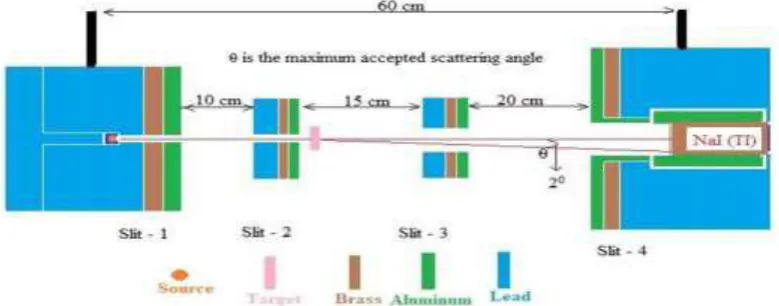
experiment has been carried at the particular energies, that is 30.85 KeV, 42 KeV, 59.54 KeV, 512 KeV and 661.6 KeV. The experimental setup is shown in figure 1.
Figure 1: Diagram showing θ maximum in the good geometry setup.
Abstract: By using well-developed technique citrate gel auto combustion, we synthesized the material as samples which is used to extract the mass attenuation coefficients. After that the samples were taken to gamma ray scintillation process. In this study, the energies 30.85 KeV, 42 KeV, 59.54 KeV, 512 KeV and 661.6 KeV are used. A well-shielded gamma-ray spectrometry based on NaI (Tl) scintillation detector measures the intensity of the transmitted beam.The mass attenuation coefficient values are measured from the experiment and compared with theoretical values by using the XCOM program and the result is all obtained data perfectly matched each other.
Available online on - WWW.IJRCS.ORG Page 121
To evaluate the experimental data we have used fundamental formulas. The well-known Mixture rule [14] will represent the total mass attenuation coefficient of all composed elements as the sum of the appropriately weighted proportions of the individual atoms.
𝜇𝑚 = ∑ 𝑤𝑖 𝑖(𝜇𝑚)𝑖 --- (1)
Where wi is the weight fraction (the proportion by weight) (µm)i is the mass attenuation coefficient of the ith
element.
The process of transmission experiment will be described by the following formula 2.
I=I0 exp (−𝜇𝑚𝑡) --- (2)
Where: I0is the un-attenuated photon intensity and I is the attenuated photon intensity.
𝜇𝑚= 𝜇/ρ(cm2/g) is the linear attenuation coefficient, t is the sample thickness.
By using the following relation we can obtain the total atomic cross-section (σt) of materials from the measured
values of µm.
𝜎𝑡=
𝜇𝑚𝑁
𝑁𝐴 --- (3)
Where, 𝑁 = ∑ 𝑛𝑖 𝑖𝐴𝑖 is the atomic mass of materials, NA is the Avagadro’s number.
From the following equation, the total electronic cross-section (σe) for the element is calculated.
𝜎𝑒= 1 𝑁𝐴∑ 𝑓𝑖𝑁𝑖 𝑍𝑖 (𝜇𝑚)𝑖= 𝜎𝑖
𝑍𝑒𝑓𝑓 --- (4)
Where fi denotes the fractional abundance of the element 1with respect to the number of atoms such that
f1+f2+f3+f4+….fi =1 Ziis the atomic number of the ith element
The relation for the effective atomic number (Zeff) of the material through the following expression,
𝑍𝑒𝑓𝑓 =
𝜎𝑡
𝜎𝑒 --- (5)
The photon mean free path (λ) that can say the average distance between two successive interactions, is given
by
𝜆 = ∫ 𝑥 exp(−𝜇𝑥)𝑑𝑧
∞ 0
∫ exp(−𝜇𝑥)𝑑𝑥0∞ = 1
𝜇 --- (6)
Where (µx) is the linear attenuation coefficient and x is the absorber thickness.
3. RESULTS AND DISCUSSION:
The mass attenuation coefficient of synthesized material general formula can be represented as Mg0.2(CuxZn
0.8-x)Fe2O4 and the changing composition rate of mixture is X= 0, 0.2, 0.4, 0.6, 0.8 has wrought the experiment at the
energies 30.85 KeV, 42 KeV, 59.54 KeV, 512 KeV, 661.6 KeV. The obtained experimental data which are obtained from the scintillation NaI(TI) detector, compared with the theoretical values of XCOM. The obtained data and theoretical data has been represented in the table, also drown a graph for the energy versus resulting data. Here, in the graph, we observed that theoretical and experimental results are in good agreement.
The resulting data has been shown in the below table and drown graphs for each table as an individual.
Table1: Mass Attenuation Coefficients of synthesized Nano Material Mg0.2(Cu0.0Zn 0.8)Fe2O4.
S.No Energy in KeV Mass Attenuation Coefficients in (gm/cm
2) X 102
Theoretical Values from XCOM Practical Values
1 30.85 701.7 695.8
2 42 297.4 284.9
3 59.54 117.1 109.7
4 512 8.413 8.36
Graph 1: Graphical representation of the table 1.
Table.2: Mass Attenuation Coefficients of synthesized Nano Material Mg0.2(Cu0.2Zn 0.6)Fe2O4
S.No Energy in KeV Mass Attenuation Coefficients in (gm/cm
2) X 102
Theoretical Values from XCOM Practical Values
1 30.85 691.0 682.7
2 42 292.9 287.8
3 59.54 115.3 115.3
4 512 8.404 8.404
5 661.6 7.431 7.431
Available online on - WWW.IJRCS.ORG Page 123
Table.3: Mass Attenuation Coefficients of synthesized Nano Material Mg0.2(Cu0.4Zn 0.4)Fe2O4.
S.No Energy in KeV Mass Attenuation Coefficients in (gm/cm
2) X 102
Theoretical Values from XCOM Practical Values
1 30.85 680.3 679.5
2 42 288.3 287.6
3 59.54 113.6 112.5
4 512 8.396 8.347
5 661.6 7.425 7.316
Graph 3: Graphical representation of Table 3.
Table.4: Mass Attenuation Coefficients of synthesized Nano Material Mg0.2(Cu0.6Zn 0.2)Fe2O4.
S.No Energy in KeV Mass Attenuation Coefficients in (gm/cm
2) X 102
Theoretical Values from XCOM Practical Values
1 30.85 669.6 668.5
2 42 283.8 278.4
3 59.54 111.9 107.8
4 512 8.387 8.268
Graph 4: Graphical representation of Table 4.
Table.5: Mass Attenuation Coefficients of synthesized Nano Material Mg0.2(Cu0.8Zn 0.0)Fe2O4.
S.No Energy in KeV Mass Attenuation Coefficients in (gm/cm
2) X 102
Theoretical Values from XCOM Practical Values
1 30.85 658.9 654.8
2 42 279.2 278.4
3 59.54 110.2 109.8
4 512 8.379 8.231
5 661.6 7.412 7.372
Available online on - WWW.IJRCS.ORG Page 125
4. CONCLUSION:
The properties of gamma ray radiation extracted for five composite materials. This study, mass attenuation coefficients are the most important for the application of shielding. The results of the present study were represented as a graph in between mass attenuations and photon energy’s. We can conclude that the mass attenuation coefficients of composites are high at low photon energies and gradually decreased according to the increasing photon energies. From the graph of all composite material we can observe that decreasing rate of mass attenuations were dramatically changed at high photon energies. The results were obtained from experiment are perfectly matched with theoretical values which are obtained from XCOM programme.
REFERENCE:
1. G. J. Hine, Phys. Rev. 85, 725 (1952).
2. A. H. El-Kateb and A S Abdul Hamid, Int. J. Appl. Radiat. Isotopes 42, 303 (1991). 3. K. Parthasaradhi, Ind. J. Pure Appl. Phys. 6, 609 (1968).
4. D. V. Krishna Reddy, K Suresh Babu and S Chandra Lingam, Can. J. Phys. 63, 1421, (1985). 5. A. Perumallu, A S Nageshwara Rao and G Krishna Rao, Can. J. Phys. 62, 454 (1984)
6. S. Chandra Lingam, K Suresh Babu and D V Krishna Reddy, Indian J. Phys. A53,285 (1984). 7. K. Singh, Rajinderjit Kumar, Vandana and Vijay Kumar, Radiat. Phys. Chem. 47, 535 (1995). 8. J. H. Hubbell and S M Seltzer, Report, NISTIR-5632 (1995).
9. M. J. Berger and J H Hubbell, Report, NBSIR 87, XCOM: Photon cross sections on a personal computer (1987) p. 3597.
10. G.Aravind, D.Ravinder,V.Nathanial, Advanced Material Letters-VBRI Press-2015, 6(2), 179-185.
11. Structural and Electrical Properties of Li-Ni nano ferrites Synthesized by citrate gel auto combustion method, G.Aravind, D.Ravinder, V.Nathanial, Physics Research International, Vol 2014, Article ID 672739,11.
12. Haihong Fang et.all., Preparation of nanometerMgO by sol-gel auto-combustion, Frontiers of Chemistry in China,June 2008, Volume 3, Issue 2, pp 193–197.
13. M. Raghasudha1, D. Ravinder2, P. Veerasomaiah3, Characterization of Chromium Substituted Cobalt Nano Ferrites Synthesized by Citrate-Gel Auto Combustion Method, Advances in Materials Physics and Chemistry, 2013, 3, 89-96.
14. R. D. Deslattes, Acta Crystallogr. A25, 89 (1969)