Turkish Journal of Fisheries and Aquatic Sciences 10: 53-60 (2010)
www.trjfas.org ISSN 1303-2712 DOI: 10.4194/trjfas.2010.0108
© Published by Central Fisheries Research Institute (CFRI) Trabzon, Turkey in cooperation with Japan International Cooperation Agency (JICA), Japan
Functional Classification and Composition of Phytoplankton in Liman
Lake
Introduction
In order to more precisely describe the
periodicity of phytoplankton assemblages in different
kinds of water bodies, Reynolds (1984) described a
number of species groups consisting of species that
tend to have similar seasonal sequences. This
approach was further evolved in to a comprehensive
list of phytoplankton functional associations or
functional groups (Reynolds
et al
., 2002; Reynolds,
2006). Then the application of functional
classification, description of the typical
misplacements and modification of the original
habitat templates and species allocations were
discussed by Padisak
et al
. (2009) by searching 67
articles closely related to the application of functional
approach to phytoplankton. In this review, it is
defined that this approach proved to be more useful
for ecological purposes than the previously applied
taxonomic grouping (Kruk
et al
., 2002; Salmoso and
Padisak, 2007; Padisak
et al
., 2009).
Adapting the C-S-R concept was proposed by
Grime (1979) for terrestial vegetation; Reynolds
(1988) classified the phytoplankton species into three
basic adaptive strategies based on their susceptibiliy
to habitat disturbance, stress and utilisation of limited
resources (Table 1): C (colonist-invasives), S
(stress-tolerants) and R (ruderals). In this model, the C-
Strategists dominate in lakes with low intensity of
disturbance and stress. The C-Strategists comprise
species adapted to rapid reproduction and a superior
ability to dominate the environment, as soon as the
Elif Neyran Soylu
1,*, Arif Gönülol
21Giresun University, Faculty of Arts and Science, Department of Biology, 28049, Giresun, Turkey. 2Ondokuz Mayıs University, Faculty of Arts and Science, Department of Biology, 55139, Samsun, Turkey.
* Corresponding Author: Tel.: +90.454 2161255; Fax: +90.454 2164518;
E-mail: [email protected] Received 07 January 2009 Accepted 24 August 2009
Abstract
Functional classification and composition of phytoplankton of Liman Lake were studied between January 2002 and December 2003. A total of 109 taxa belonging to Bacillariophyta, Chlorophyta, Cyanophyta, Dinophyta, Xantophyta, Chrysophyta and Cryptophyta were identified. The succession during 2002 began with R-Strategists (with a high surface to volume ratio, including blue-green algae with filaments like Pseudanabaena limnetica Lemmermann). This group was followed by C-Strategists (small green algae characterised with fast nutrient absorption, assimilation and replication ratios). This group was again followed by R-Strategists and at last C-Strategists became dominant.
Keywords: Liman Lake, phytoplankton, functional group, composition, C-S-R Strategists.
Liman Gölü Fitoplankton Kompozisyonu ve Fonksiyonel Sınıflandırması
Özet
Liman Gölü fitoplankton kompozisyonu ve fonksiyonel sınıflandırılması Ocak 2002 ve Aralık 2003 tarihleri arasında araştırılmıştır. Bacillariophyta, Chlorophyta, Cyanophyta, Dinophyta, Xantophyta, Chrysophyta ve Cryptophyta divizyolarına ait toplam 109 takson belirlenmiştir. Süksesyon 2002 yılında R-Stratejileri (yüksek yüzey alanı/hacim oranına sahip, Pseudanabaena limnetica Lemmermann gibi filamentli mavi yeşil algleri içeren) ile başlamıştır. Daha sonra bu grubu C-Stratejileri (hızlı besin absorpsiyonu asimilasyon ve ve replikasyon oranları ile karekterize edilen küçük yeşil algler) takip etmiştir. Sonra yine R-Stratejileri, onu takiben son olarak C-Stratejileri hakim olmuştur.
conditions become sustainable, partial exploiting
environments saturated with light and nutrients. The
R-Strategists, which are predominant in environments
with great vertical mixing, low stress are specialised
tolerate turbulent transportation and light gradients.
The S-Strategists species tolerate stress or survive in
environments with a severe restriction of essential
nutrients and develop in situations of low disturbance.
Functional groups consist of species with similar
morphology and environmental requirements, but
they do not necessarily belong to the same
phylogenetic group. In contrast to long species lists or
usage of dominant taxonomical groups, functional
groups make it much easier to examine and compare
the seasonal changes in various lake types and to
evaluate the responses to environmental conditions
and changes (Weithoff
et al
., 2001; Kruk
et al
., 2002;
Naselli-Flores
et al
., 2003). The alphanumeric
ascriptions help define the characteristics of the
respondent phytoplankton but do not improve on
dynamic resolution. Although there are many studies
based on phytoplankton seasonality and ecology, little
is known about the phytoplankton as regards
functional approach. Therefore, the goal of the study
is to evaluate the applicability of the C, S, R strategies
and functional classification approach to freshwater
phytoplankton assemblages and better understand the
survival strategies of the most abundant species.
Materials and Methods
Model Development Methodology
K
ı
z
ı
l
ı
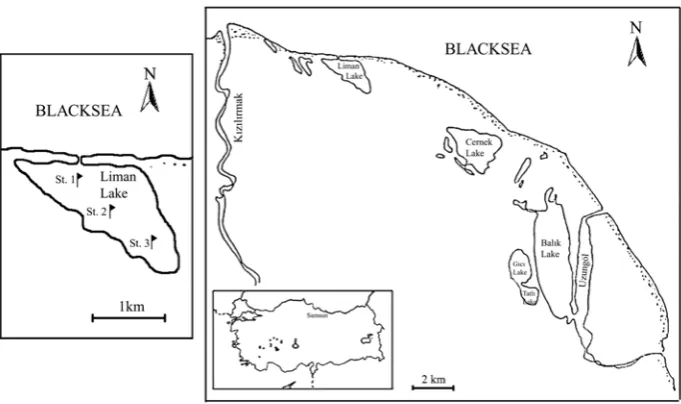
rmak Delta is situated along the Black Sea
coast of Turkey (latitude: 41°30' to 41°45' N;
longitude: 35°43' to 36°08' E. Liman Lake is 10-20
km away from Bafra town in the K
ı
z
ı
l
ı
rmak Delta.
The lake’s surface area is 270 ha. The three sites
sampled are shown on Figure 1. St. 1 is located near
the North edge of the Lake. The lake sediment is
covered with sand and stones. St. 2 is located at the
centre of the lake. The lake sediment is sandy. St. 3 is
located in the Southeast of the lake. This site is
covered with
Juncus
sp (Figure 1).
Samples were collected monthly with 2-litre
capacity Hydro-Bios water sampler from surface and
depth (1 m) to determine the density of the algae from
January 2002 to November 2003 at three stations.
Phytoplankton determinations were carried out on
subsamples preserved in acetic Lugol’s solution; a
constant volume of 10 ml was sedimented in the
counting chambers. Algal cells were counted on a
Prior inverted microscope at 400 x magnification,
following Lund
et al
. (1958). At least 200 individuals
were counted. In the evaluations, the average of three
countings from each stations was used. The remaining
part of the water sample was filtered using Whatman
GF/A fibre filter paper to identify the algae except
Bacillariophyta, were identified in permanent slides
under oil immersion at 1000 x magnification which
had been prepared according to Round (1953).
Taxonomic identifications were performed following
John
et al
. (2003), Krammer and Lange-Bertalot
(1991a; 1991b; 1999a; 1999b).
The functional groups of phytoplankton were
classified according to the ecological concept of
adaptive strategist (Grime, 1979; Reynolds, 1988;
Olrik 1994) (Table 1) and the trait-separated
functional groups (Reynolds
et al
., 2002; Padisak
et
al
., 2009). In this classification system according to
Reynolds
et al
. (2002) phytoplankton species are
grouped into 33 functional groups nominated by
alphanumeric codes and based on their survival
strategies, tolerances and sensitivities. The functional
groups of phytoplankton in Liman Lake were given at
Table 2.
Table 1. Basis for evaluation of three primary strategies in the evaluation of plants and phytoplankton (Grime, 1979;
Reynolds, 2006)
Habitat Productivity
Habitat Duration High Low
Long Competitors, invasive (C) stress-tolerant (S) Short Disturbance-tolerant ruderals (R) No viable strategy
Table 2. Trait-separated functional groups of phytoplankton in Liman Lake
Group Habitat Typical Representatives Tolerances Sensitivities B Vertically mixed,
mesothrophic small medium lakes
Cyclotella ocellata Light deficiency pH rise, Si depletion stratification
D Shallow, enriched turbid
waters, including rivers NitzschiaFragilaria ulna spp.
Flushing Nutrient depletion
N Mesotrophic epilimnia Cosmarium venustum Nutrient deficiency Stratification, pH rise P Eutrophic epilimnia Closterium spp.
Staurastrum gracile
Mild light and C
deficiency Stratification, Si depletion S1 Turbid mixed layers Pseudanabaena limnetica Highly light deficient Flushing S2 Shallow, turbid mixed layers Spirulina laxa light deficient Flushing SN Warm mixed layers Cylindrospermum stagnale Light-, nitrogen- deficient Flushing X1 Shallow mixed layers in
enriched conditions
Monoraphidium spp. Ankistrodesmus spp.
stratification Nutrient depletion
Y Usually, small, enriched lakes
Cryptomonas ovata Low light phagothrophs
E Usually small, oligotrophic, base poor lakes or
heterothrophic ponds
Dinobyron sertularia Low nutrients CO2 deficiency
F Clear epilimnia Botryococcus braunii, Oocystis pusilla Kirchneriella lunaris Kirchneriella obesa
Low nutrients High turbidity
CO2 deficiency
G Short, nutrient-rich water columns
Eudorina elegans High light Flushing, low total light
J Shallow, enriched lakes ponds and rivers
Pediastrum dublex Scenedesmus communis Tetraedron minimum
Settling into low light
Lo Summer epilimnia in
mesotrophic lakes Peridinium cinctum Merismopedia punctata
Segregated nutrients Prolonged or deep mixing
M Dielly mixed layers of small
eutrophic, low latitude lakes Microcystis spp. High insolation Mixing, poor stratification light W1 Small organic ponds Euglena proxima
Euglena oxyuris
High BOD Grazing
W2 Shallow mesotrophic lakes Trachelomonas spp. - -
Results
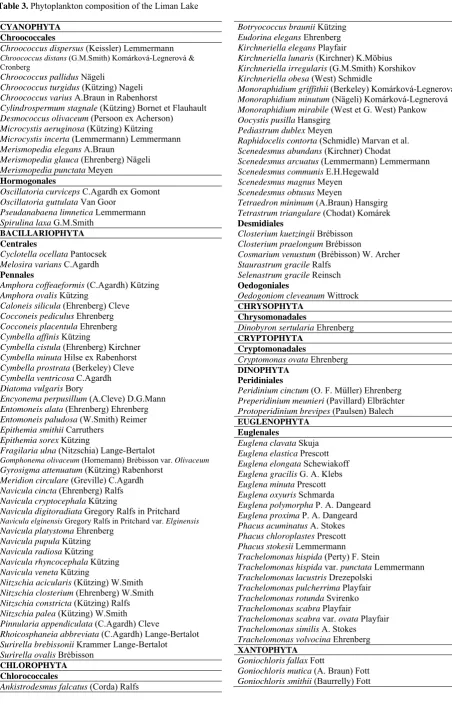
A total of 109 planktonic algae were found: 39
Bacillariophyta, 27 Chlorophyta, 20 Euglenophyta, 15
Cyanophyta, 3 Dinophyta, 3 Xantophyta, 1
Chrysophyta and 1 Cryptophyta (Table 3). The
succession during 2002 began with R-Strategists
(with a high surface to volume ratio, including
blue-green algae with filaments like
Pseudanabaena
limnetica (
Lemmermann) Komárek. This group was
followed by C-Strategists (small green algae
characterised with fast nutrient absorption,
assimilation and replication ratios). This group was
again followed by R-Strategists and at last,
C-Strategists became dominant.
Cyanophyta and Chlorophyta type
phytoplankton were registered in Liman Lake.
Pseudanabena limnetica
,
Merismopedia punctata
,
Ankistrodesmus falcatus
and
Kirchneriella lunaris
were found to be dominant and subdominant in some
months one by one. Bacillariophyta reached its the
highest level contributing 53% of total organism
numbers in May 2003 at St. 3. In this month, centric
diatoms
Cyclotella ocellata
and
Melosira varians
were highly detected species with, 3975 ind/ml and
1125 ind/ml respectively (Figure 2).
Table 3. Phytoplankton composition of the Liman Lake
CYANOPHYTA
Chroococcales
Chroococcus dispersus (Keissler) Lemmermann
Chroococcus distans (G.M.Smith) Komárková-Legnerová &
Cronberg
Chroococcus pallidus Nägeli
Chroococcus turgidus (Kützing) Nageli Chroococcus varius A.Braun in Rabenhorst
Cylindrospermum stagnale (Kützing) Bornet et Flauhault Desmococcus olivaceum (Persoon ex Acherson) Microcystis aeruginosa (Kützing) Kützing Microcystis incerta (Lemmermann) Lemmermann Merismopedia elegans A.Braun
Merismopedia glauca (Ehrenberg) Nägeli Merismopedia punctata Meyen
Hormogonales
Oscillatoria curviceps C.Agardh ex Gomont Oscillatoria guttulata Van Goor
Pseudanabaena limnetica Lemmermann Spirulina laxa G.M.Smith
BACILLARIOPHYTA
Centrales
Cyclotella ocellata Pantocsek Melosira varians C.Agardh
Pennales
Amphora coffeaeformis (C.Agardh) Kützing Amphora ovalis Kützing
Caloneis silicula (Ehrenberg) Cleve Cocconeis pediculus Ehrenberg Cocconeis placentula Ehrenberg Cymbella affinis Kützing
Cymbella cistula (Ehrenberg) Kirchner Cymbella minuta Hilse ex Rabenhorst Cymbella prostrata (Berkeley) Cleve Cymbella ventricosa C.Agardh Diatoma vulgaris Bory
Encyonema perpusillum (A.Cleve) D.G.Mann Entomoneis alata (Ehrenberg) Ehrenberg Entomoneis paludosa (W.Smith) Reimer Epithemia smithii Carruthers
Epithemia sorex Kützing
Fragilaria ulna (Nitzschia) Lange-Bertalot
Gomphonema olivaceum (Hornemann) Brėbisson var. Olivaceum
Gyrosigma attenuatum (Kützing) Rabenhorst Meridion circulare (Greville) C.Agardh Navicula cincta (Ehrenberg) Ralfs Navicula cryptocephala Kützing
Navicula digitoradiata Gregory Ralfs in Pritchard
Navicula elginensis Gregory Ralfs in Pritchard var. Elginensis
Navicula platystoma Ehrenberg Navicula pupula Kützing Navicula radiosa Kützing Navicula rhyncocephala Kützing Navicula veneta Kützing
Nitzschia acicularis (Kützing) W.Smith Nitzschia closterium (Ehrenberg) W.Smith Nitzschia constricta (Kützing) Ralfs Nitzschia palea (Kützing) W.Smith Pinnularia appendiculata (C.Agardh) Cleve
Rhoicosphaneia abbreviata (C.Agardh) Lange-Bertalot Surirella brebissonii Krammer Lange-Bertalot Surirella ovalis Brėbisson
CHLOROPHYTA
Chlorococcales
Ankistrodesmus falcatus (Corda) Ralfs
Botryococcus braunii Kützing Eudorina elegans Ehrenberg Kirchneriella elegans Playfair
Kirchneriella lunaris (Kirchner) K.Möbius Kirchneriella irregularis (G.M.Smith) Korshikov Kirchneriella obesa (West) Schmidle
Monoraphidium griffithii (Berkeley) Komárková-Legnerová Monoraphidium minutum (Nägeli) Komárková-Legnerová Monoraphidium mirabile (West et G. West) Pankow Oocystis pusilla Hansgirg
Pediastrum dublex Meyen
Raphidocelis contorta (Schmidle) Marvan et al. Scenedesmus abundans (Kirchner) Chodat
Scenedesmus arcuatus (Lemmermann) Lemmermann Scenedesmus communis E.H.Hegewald
Scenedesmus magnus Meyen Scenedesmus obtusus Meyen
Tetraedron minimum (A.Braun) Hansgirg Tetrastrum triangulare (Chodat) Komárek
Desmidiales
Closterium kuetzingii Brébisson Closterium praelongum Brébisson
Cosmarium venustum (Brébisson) W. Archer Staurastrum gracile Ralfs
Selenastrum gracile Reinsch
Oedogoniales
Oedogoniom cleveanum Wittrock CHRYSOPHYTA
Chrysomonadales
Dinobyron sertularia Ehrenberg CRYPTOPHYTA
Cryptomonadales
Cryptomonas ovata Ehrenberg DINOPHYTA
Peridiniales
Peridinium cinctum (O. F. Müller) Ehrenberg Preperidinium meunieri (Pavillard) Elbrächter Protoperidinium brevipes (Paulsen) Balech EUGLENOPHYTA
Euglenales
Euglena clavata Skuja Euglena elastica Prescott Euglena elongata Schewiakoff Euglena gracilis G. A. Klebs Euglena minuta Prescott Euglena oxyuris Schmarda
Euglena polymorpha P. A. Dangeard Euglena proxima P. A. Dangeard Phacus acuminatus A. Stokes Phacus chloroplastes Prescott Phacus stokesii Lemmermann
Trachelomonas hispida (Perty) F. Stein
Trachelomonas hispida var. punctata Lemmermann Trachelomonaslacustris Drezepolski
Trachelomonas pulcherrima Playfair Trachelomonas rotunda Svirenko Trachelomonas scabra Playfair
Trachelomonas scabra var. ovata Playfair Trachelomonas similis A. Stokes Trachelomonas volvocina Ehrenberg XANTOPHYTA
Goniochloris fallax Fott
Station 1
0 50 100 150 200
J F M A My J Jl Au S N D O J F M A My J Jl Au S N D
Indi
v
idual
s
(
1
0
3 ind.
m
l
-1)
surface 1m
Station 2
0 20 40 60 80 100 120 140 160
J F M A My J Jl Au S N D O J F M A My J Jl Au S N D
Ind
iv
idu
al
s
(
1
0
3 ind.
ml
-1)
surface 1m
Station 3
0 20 40 60 80 100 120
J F M A My J Jl Au S N D O J F M A My J Jl Au S N D
2002 2003
Indi
v
idua
ls
(
1
0
3 in
d
.m
l
-1)
surface 1m
Figure 2. Seasonal variation of phytoplankton density (ind. ml-1) at surface and 1 m depth sampled between January 2002
and December 2003.
Lake. Peaks of phytoplankton were recorded in April
and July 2002, July and September 2003. The
contributions of
Pseudanabena limnetica
was the
highest in these months. Additionally,
Merismopedia
punctata
was important contributing high to total
organism numbers in September 2003. Total number
of organisms reached the highest level with 173,343
ind/ml at St. 1 in September 2003 during the study
period.
Pseudanabena limnetica
were found to be
dominant,
Merismopedia punctata
were subdominant
at all stations in this month (Figure 3).
The functional groups represented by the algae
encountered in Liman Lake were B, D, N, P, S1, S2,
X1, Y, F, G, J, L
0, M, W1 and W2. In the
classification of trait-separated phytoplankton groups,
some characteristics of the S1, F and L
0Reynolds
associations describe the Liman Lake assemblages,
but they do not strictly match with them. The S1
assemblage (
Pseudanabaena limnetica
), which
constituted a great part of the phytoplankton, was
mostly found in turbid mixed layers and tolerant to
highly light deficient conditions. The members of F
group function best in clear water and are otherwise
tolerant of deep mixing, have a strong representation
among mesotrophic lakes. F assemblage, which can
develop in clear epilimnia, is tolerant to low nutrients,
high turbidity includes
Kirchneriella
spp. This species
is frequently recorded in the Liman Lake. L
0assemblage is tolerant to segregated nutrients,
sensitive to prolonged or deep mixing and includes
Merismopedia
spp.
Discussion
Although Bacillariophyta were dominant in
respect to species numbers, Cyanophyta and
Chlorophyta type phytoplankton were registered in
terms of population density in Liman Lake.
Pseudanabena limnetica
,
Merismopedia punctata
,
Ankistrodesmus falcatus
and
Kirchneriella lunaris
were found to be dominant and subdominant
organisms in certain months alternately.
Comin, 1999). During summer and winter the
assemblages were characterised by a high
development of
Pseudanabaena limnetica
in Donghu
Lake of China (Lei
et al
., 2005). The permanent
dominance of Oscillatoriales during summer and
autumn has often been reported for eutrophic lakes in
Central Europe (Berger and Sweers, 1988).
Cyanophyta dominance, and sometimes bloom
formation are among the most visible symptoms of
accelerated eutrophication of lakes and reservoirs
(Moss
et al
., 1997). The dominance of Oscillatoriales
in the lakes of K
ı
z
ı
l
ı
rmak Delta region is a result of
the anthropogenic induced eutrophication process.
The succession during 2002 began with
R-Strategists (
Pseudanabaena limnetica
). This group
was followed by C-Strategists (small green algae).
This group was again followed by R-Strategists and at
last C-Strategists became dominant in Liman Lake.
The same succession type was also seen in Tatl
ı
Lake
(Soylu
et al.
, 2007). In the phytoplankton of G
ı
c
ı
Lake, the succession began with R-Strategists
(Cryptophytes, tolerant to disturbance). This group
was followed by C-Strategists (Chlorophytes) and
S-Strategists (Euglenophytes and Cyanophytes) (Soylu
and Gönülol, 2006).
Nowadays, the phytoplankton functional groups
approach comprises more than 45 assemblages that
are identified by alphanumerical codes according to
their sensitivities and tolerances (Reynolds, 2006;
Padisak
et al
., 2009). In Liman Lake 16 functional
groups (B, D, N, P, S1, S2, X1, Y, F, G, J, L
0, M, W1
and W2) were identified. In the classification of
trait-separated phytoplankton groups (Reynolds
et al
.,
2002) some charactersitics of the S1, F and L
0Reynolds associations describe the Liman Lake
assemblages, but they don’t strictly match with them.
S1 group was also seen in Hungarian rivers (Borics
et
al
., 2007) and Hungarian shallow lakes (Padisak
et
Station 1
0% 20% 40% 60% 80% 100%
J F M A My J Jl Au S N D O J F M A My J Jl Au S N D
R
e
la
tiv
e
bi
om
as
s
Cyanophyta Bacillariophyta Chlorophyta
Station 2
0% 20% 40% 60% 80% 100%
J F M A My J Jl Au S N D O J F M A My J Jl Au S N D
R
e
la
tiv
e
bi
om
as
s
Cyanophyta Bacillariophyta Chlorophyta
Station 3
0% 20% 40% 60% 80% 100%
J F M A My J Jl Au S N D O J F M A My J Jl Au S N D
2002 2003
R
e
la
tiv
e
bi
om
as
s
Cyanophyta Bacillariophyta Chlorophyta
al
., 2003). M and P associations are the common
groups of Liman Lake and Ömerli Reservoir
(
İ
stanbul) (Albay and Akçaalan, 2003). In the
classification of trait-separated phytoplankton groups
(Reynolds
et al
., 2002) some characteristics of D
(
Nitzschia palea
), P (
Ulnaria ulna
) and N
(
Cosmarium denticulatum
) Reynolds associations
describe the G
ı
c
ı
Lake assemblages (Soylu and
Gönülol, 2006). The species found are placed
separately in groups S
N, H1 and L
Min Bulgarian
wetlands (Stoyneva, 2003). As in Bulgarian wetlands,
S
Nand H1 functional groups, which are tolerant to
mixing and poor light conditions, were found
dominant in Kastoria Lake, Greece. Additionally, M
and S1 groups were identified in the same lake
(Moustaka-Gouni
et al
., 2007).
Phytoplankton functional groups approach
applied to aquatic systems provides important
information for understanding the dynamic of species
selection in the pelagic communities in different
regions. This approach assumes that characteristics of
a community can be better understood and managed if
species are grouped into classes that possess similar
characteristics or behave similarly (Solbrig, 1993).
Finally, the functional group approach constitutes a
useful tool for understanding the phytoplankton
community in every system; but it is necessary to
check whether the grouping of species reflected the
autoecological features of organisms (Padisak
et al
.,
2009).
References
Albay, M. and Akçaalan, R. 2003. Factors influencing the phytoplankton steady-state assemblages in a drinking-water reservoir (Ömerli Reservoir, İstanbul). Hydrobiologia, 502: 85-95.
Berger, C. and Sweers, H.E. 1988. The IJsselmeer and its phytoplankton with special attention to the suitability of the lake as a habitat for Oscillatoria agardhii Gom. Journal of Plankton Research, 10: 579–599.
Borics, G., Varbiro, G., Grigorszky, I., Krasznai, E., Szabo, S. and Kiss, K.T. 2007. A new evaluation technique of potamoplankton fort he assessment of the ecological status of rivers. 17. Archiv für Hydrobiologie supplement, 161: 465-486.
Grime, J.P. 1979. Plant strategies and vegetation processes. John Wiley & Sons, New York, New York, 222 pp. John, D.M., Whitton, B.A. and Brook, A.J. 2003. The
Freshwater Algal Flora of the British Isles: An identification guide to freshwater and terrestrial algae. The Natural History Museum and The British Phycological Society, Cambridge University Press, Cambridge, 702 pp.
Hoyos, C. and Comin, F.A. 1999. The importance of inter-annual variability for management. Hydrobiologia, 395/396: 281-291.
Krammer, K. and Lange-Bertalot, H. 1991a. Süßwasserflora von Mitteleuropa. Bacillariophyceae, Band 2/3, 3. Teil: Centrales, Fragillariaceae, Eunoticeae, Stuttgart: Gustav Fischer Verlag. 1-576.
Krammer, K. and Lange-Bertalot, H. 1991b. Süßwasserflora von Mitteleuropa. Bacillariophyceae, Band 2/4, 4.
Teil: Achnanthaceae, Kritische Ergänzungen zu Navicula (Lineolatae) und Gomphonema Gesamtliteraturverzeichnis. Stuttgart: Gustav Fischer Verlag. 1-436.
Krammer, K. and Lange-Bertalot, H. 1999a. Süßwasserflora von Mitteleuropa. Bacillariophyceae, Band 2/1, 1. Teil: Naviculaceae, Berlin: Spectrum Academicher Verlag. 1-876.
Krammer, K. and Lange-Bertalot, H. 1999b. Süßwasserflora von Mitteleuropa. Bacillariophyceae, Band 2/2, 2. Teil: Bacillariaceae, Epithemiaceae, Surirellaceae, Berlin: Spectrum Academicher Verlag. 1-610.
Kruk, C., Mazzeo, N., Lacerot, G. and Reynolds, C.S. 2002. Classification schemes for phytoplankton: a local validation of a functional approach to the analysis of species temporal replacement. J. Plankton Res., 24: 901-912.
Lei, A., Hu, Z., Wang, J., Shi, Z. and Tam, F. 2005. Structure of the Phytoplankton Community and Its Relationship to water Quality in Donghu Lake, Wuhan, China. J. Integr. Plant Biol., 47(1): 27-37. Lund, J.W.G., Kipling, C.D. and Le Cren, E. 1958. The
Inverted microscope method of estimating algal numbers and statistical basis of estimations by counting. Hydrobiologia,11: 143-170.
Moustaka-Gouni, M., Vardaka, E. and Tryfon, E. 2007. Phytoplankton succession in a shallow Mediterranean Lake (L. Kastoria, Greece): Steady-state dominance of Limnothrix redekei, Microcystis aeruginosa and Cylindrospermopsis raciborskii. Hydrobiologia, 575: 129–140.
Moss, B., Madgwick, J. and Philips, G. 1997. A Guide to the Restoration of Nutrient-Enriched Shallow Lakes. W.W. Hawes, UK.
Naselli-Flores, L., Padisák, J., Dokulil, M. and Chorus, I. 2003. Equilibrium/steady-state concept in phytoplankton ecology. Hydrobiologia 502: (Dev. Hydrobiol. 172), 395-403.
Olrik, K. 1994. Phytoplankton-Ecology. Determining Factors for Distribution of Phytoplankton in Freshwater and the Sea, Ministry of the Environment, Denmark, Danish Environmental Protection Agency, Nofo Print, Elsinore, 183 pp.
Padisak, J. and Reynolds, C.S. 1998. Selection of phytoplankton associations in Lake Balaton, Hungary, in response to eutrophication and restoration measures, with special reference to the Cyanoprokaryotes. Hydrobiologia, 384: 41-53.
Padisak, J., Barbosa, F.A.R, Koschel, R. and Krienitz, L. 2003. Deep layer Cyanoprokaryota maxima are constitutional features of lakes: Examples from temperate and tropical regions. Archiv für Hydrobiologie, Special issues, Advances in Limnology, 58: 175-199.
Padisak, J., Crossetti, L. O. and Naselli-Flores, L. 2009. Use and misuse in the application of the phytoplankton functional classification: a critical review with updates. Hydrobiologia, 621: 1-19.
Reynolds, C.S. 1984. Phytoplankton periodicity: the interactions of form, function and environment variability. Freshwater Biol., 14: 111-142.
Reynolds, C.S. 1988. Functional morphology and the adaptive strategies of freshwater phytoplankton. In: C.D. Sandgren (Ed.), Growth and reproductive strategies of freshwater phytoplankton. Cambridge University Press, Cambridge: 388-433.
S. 2002. Towards a functional classification of the freshwater phytoplankton. J. Phytopl. Res.,24: 417-428.
Reynolds, C.S. 2006. The ecology of phytoplankton. Cambridge University Pres, Cambridge, 535 pp. Round, F.E. 1953. An investigation of two bentic algal
communities in Malharm Tarn, Yorkshire. J. Ecol., 41: 97-174.
Salmaso, N. and Padisak, J. 2007. Morpho-functional groups and phytoplankton development in two deep lakes (Lake Garda, Italy and Lake Stechlin, Germany). Hydrobiologia, 578: 97-112.
Solbrig, O.T. 1993. Plant traits and adaptive strategies: their role in ecosystem function. In: E.D. Schulze and H.A. Money (Eds), Biodiversity and Ecosystem Function Ecological Studies. Springer-Verlag, Berlin: 97-116.
Soylu, E.N. and Gönülol, A. 2006. Seasonal variation in the diversity, species richness and composition of the phytoplankton assemblages in a shallow lake. Cryptogamie Algologie, 27(1): 85-101.
Soylu, E.N., Maraşlıoğlu, F. and Gönülol, A. 2007. Phytoplankton seasonality of a shallow turbid lake. Algological Studies, 123: 95-110.
Stoyneva, M.P. 2003. Steady-state phytoplankton assemblage in shallow Bulgarian wetlands. Hydrobiologia, 502: 169-176.