81
Microbial and Physicochemical qualities of selected Co-trimoxazole and
Metronidazole formulations in South Eastern Nigerian
Calistus Dozie Nwakile1*, Uduma Eke Osonwa1, Ogechukwu Calista Okechi2, Christian Chibuzor Opurum3, Christopher Ezeh Nwanyanwu3
1. Department of Pharmaceutics and Pharmaceutical Technology, Faculty of
Pharmaceutical Sciences Nnamdi Azikiwe University Awka Anambra State Nigeria.
2. Department of Medical Laboratory Science, Faculty of Health Science and
Technology, University of Nigeria, Enugu Campus Enugu State Nigeria.
3. Department of Microbiology, School of Sciences, Federal University of Technology,
Owerri, Imo State Nigeria.
*Corresponding author: [email protected]
ABSTRACT:
The physical, chemical and microbiological qualities of nine brands of co-trimoxazole
suspensions (C1…9) and eight brands of metronidazole syrups (M1…8) sourced from
different locations in South-Eastern Nigeria were evaluated to determine their
conformity with stipulated standards. The microbiological qualities of 87.5% of the
metronidazole brands tested contain viable microbial load within acceptable limit while
that of one brand (M1) fell below stipulated standard. Out of the nine brands of
co-trimoxazole suspension tested, 66.7 % have bacteria loads within acceptable limit while
those of C1, C3 and C4 are above acceptable limit. Only one brand out of the eight
brands of the metronidazole syrup tested (M6) contained objectionable microbe;
Salmonella sp, while only one brand out of the nine brands of the co-trimoxazole syrup
(C1) tested contained an objectionable microbe; Escherichia coli. Brands M5, M6 and M7
of the metronidazole syrup contained moulds, but these are within acceptable limits.
None of the brands of the co-trimoxazole contained moulds. The physical and chemical
properties of the analyzed drug samples complied with BP standards.
Key words: Physicochemical quality, Microbial quality, Co-trimoxazole, Metronidazole,
INTRODUCTION:
Drugs and pharmaceutical products are manufactured based on stipulated standards.
82
achieved through well articulated Current Good Manufacturing Practice (CGMP).
Maintaining CGMP will ensure the formulation of products of acceptable standards in
contents of active ingredients, good physical and chemical stability and acceptable
microbiological quality. For oral dosage formulations, official standards required that
viable microbial counts should not exceed 1.0x10³cfu/ml and the products should not
contain enteric microorganisms. [1] Deviation from these standards attracts serious
sanctions from the regulatory authorities.
Adulterated and substandard pharmaceutical products which pose serious challenge to
good health are often produced in compromised environments. These environments
predispose the products to risks of contamination. Microbial contamination of
pharmaceutical dosage forms may lead to spoilage resulting in physical and chemical
changes and risk of infection to the user. [2, 3]
Paediatric Co-trimoxazole suspensions and Metronidazole syrups represent two
important medicaments used in paediatrics for the control and treatment of bacteria
and protozoan infections. [4, 5] Their high demand make them targets for adulteration
and faking by dubious manufacturers with attendant physical, chemical and
microbiological qualities being compromised. Frequent surveillance and quality
evaluation of these pharmaceutical products will indicate if the fight against
adulteration and production of unwholesome products is succeeding or otherwise.
In this research therefore, the physical, chemical and microbiological qualities of
selected Co-trimoxazole suspensions and Metronidazole syrups sourced from local
markets in selected states of South-East Nigeria; Anambra, Enugu and Imo States are
evaluated. The findings of the research will help to redirect the regulatory bodies
properly towards checking adulterated and unwholesome drugs.
MATERIALS AND METHODOLOGY:
A total of eight brands of metronidazole syrups and nine brands of co-trimoxazole
suspensions were sourced from the local outlets between October 2009 and February
2010. The samples were taken to the laboratory and stored in a dry place and analyses
performed within 24 hours of sample collection. Standard microbiological media for
isolation of bacteria and fungi were used.
Physical examinations of the samples were performed. The organoleptic characters were
83
appearance/colour. The pH of the samples was evaluated using standard procedures
after calibration of the digital pH meter with potassium dihydrogen phosphate buffer.
[6] The contents of active ingredients of the samples was evaluated
spectrophotometrically (Unicon UV-2102 PC, USA) using a standard calibration curve
prepared from the respective pure drug samples.
One (1) ml of each drug sample was introduced into 5 ml of the sterile peptone water for
enrichment. Thereafter, 1 ml of these enriched samples was dispensed into a sterile
Petri-dish and 20 ml of sterile Nutrient agar maintained at 45oC was introduced into the
plates, mixed by gentle rocking and the inoculation allowed to solidify. The plates were
incubated at 37oC for 24 hours and total number of discrete colonies counted.
Similarly, 1 ml of the enriched drug samples was inoculated into 20 ml of the
MacConkey (Coliforms) and Sabouraud’s dextrose agar (mould and yeast). The
MacConkey agar inoculation was allowed to solidify and then incubated at 37oC for 24
hours. The Sabouraud’s dextrose agar inoculation was also allowed to solidify and
incubation done at room temperature for seven days. Total colonies count was also
performed on these incubated samples.
Sub-culturing of the incubated samples was done. Isolates from the MacConkey agar
plates were inoculated into Salmonella-Shigella agar while isolates from the nutrient
agar plates was inoculated into Mannitol salt agar ( Staphylococcus spp) and the plates
incubated for 24 hours. Microscopic and biochemical characterization of the isolates
were performed using standard procedures. [7-9]
RESULTS AND DISCUSSIONS:
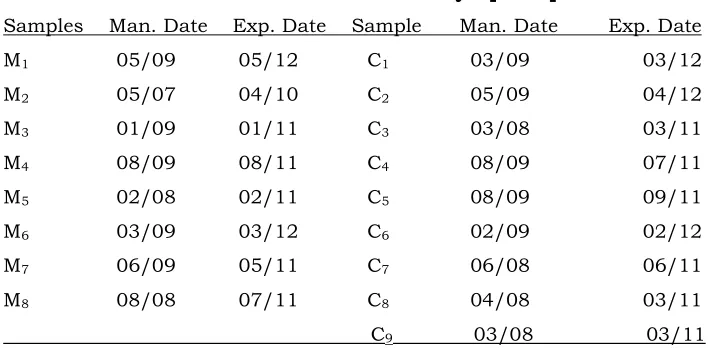
The manufacturing and expiry date of the Metronidazole syrups and Co-trimoxazole
suspensions were as shown in table 1. There were growths of organisms in five out of
eight brands of metronidazole tested. The total viable count for the five brands M1, M4,
M6, M7 and M8 were 20.0x10², 10.0, 30.0, 27.0 and 1.0x10³ cfu/ml respectively. There
were no growths in M2, M3 and M5 brands of the metronidazole syrups. Coliforms
growth was recorded in only one out of the eight brands evaluated (M6), with the count
being 7.0 cfu/ml. Three out of the eight brands showed yeast growth, with counts of
1.0 cfu/ml for M5, 3.0 cfu/ml for M6 and 1.0 cfu/ml for M7 as shown in table 2. The
total viable counts for the Co-trimoxazole brands showed that brand C1 had 4.4 x10³
cfu/ml. There are no growths in C2, C5, C6, and C7 while in brands C3, C4, C8 and C9, the
counts were 2.2 x 10⁴, 3.0 x 10³, 22.0 and 14.0 cfu/ml respectively. Coliforms counts
84
are no Coliforms growths in the rest of the brands. Yeast counts were not observed in
any of the brands of the Co-trimoxazole suspensions as shown in table 3. The
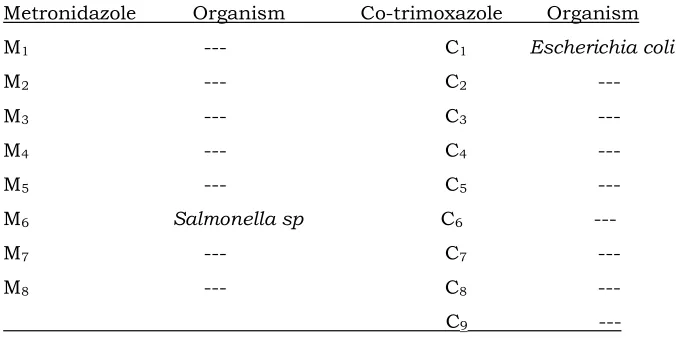
organisms obtained from the sub-culturing into various selective media and identified
by standard biochemical test were shown in table 4 for the Metronidazole syrups and
Co-trimoxazole suspensions. In the Metronidazole syrup, only brand M6 contains
Salmonella sp, while in the Co-trimoxazole suspensions, only brand C1 showed presence
of Escherichia coli.
The brands appearances range from light yellow through yellow to light brown. The pH
values range from 3.9 to 4.2, while the specific gravities range from 1.8516 to 1.9965.
The content of active ingredients for the brands of Metronidazole ranges from 197.42 to
198.20 mg/5 ml of the syrup as shown in table 5.
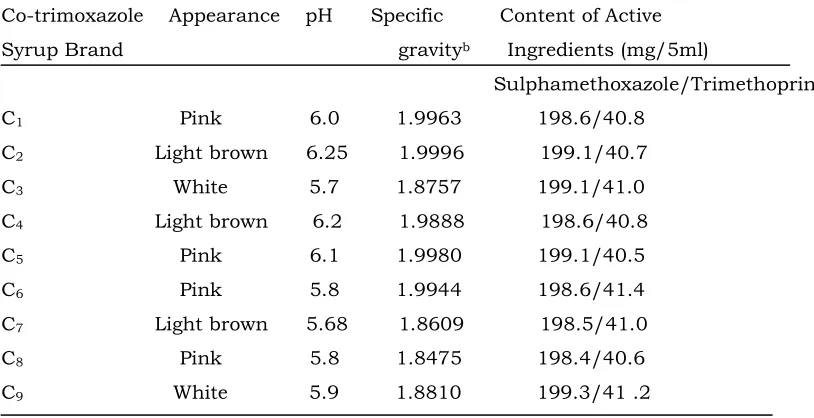
The appearances of the Co-trimoxazole brands varied from pink, light brown to white.
The pH ranges from 5.7 to 6.25, while the specific gravities range from 1.8475 to
1.9996. The content of active ingredients ranges from 198.4/40.6 to 199.3/41.2 mg/5
ml of the syrups as shown in table 6.
The current fight against adulterated and unwholesome drugs warrants frequent
evaluation of marketed pharmaceutical products to ensure their conformation to
stipulated standards. Quality of drugs can be compromised in their content of active
ingredients, inappropriate physical characters and contamination with non permissible
microbial bioloads.
Microbial contamination of pharmaceutical products has been recorded in tablet dosage
forms [10], suppositories [11] and anti-malarial, cough paediatric liquid preparations [1]
and water for injection. [12]
Consequently, out of the eight brands of Metronidazole tested, seven brands (87.5%)
had bacteria loads of less than 1.0x10³cfu/ml. In the Co-trimoxazole suspension, six
out of the nine brands (66.7%) tested had bacteria loads less than 1.0x10³cfu/ml. This
implies that less than half of the tested samples (12.5 % for Metronidazole and 33.3 %
for Co-trimoxazole) are contaminated with microbial bioloads higher than the stipulated
standards. Pharmaceutical oral formulations with bioloads of 1.0x10³cfu/ml or less
conform to official requirements for the microbiological quality of oral liquid dosage
forms. [1] The presence of these microbes has the potential to reduce or even inactivate
85
indicated that paracetamol and cough syrups tested in Northern Nigeria all scaled
through the microbiological standard tests. [13]
Thus, the results suggest inappropriate Current Good Manufacturing Practice (CGMP)
on the part of the Pharmaceutical Company. Pharmaceutical products can be
contaminated during handling and storage. [14] The presence of Coliforms; Salmonella
sp in brand M6, Escherichia coli in brand C1, is suggestive of contaminations from
improper water treatment systems and contaminated raw materials. [15] Adeshina et al,
[2009] after Committee of Official Laboratory and Drug Control Services and a section of
the International Pharmaceutical Federation 1975, has noted that the existence of these
Coliforms make such preparation unfit for human consumption. [1]The presence of
fungi in some of the brands; M5 M6 and M7, however, suggest contamination from air
and packaging materials. [15] The results showed that more of the Co-trimoxazole
suspension brands contain greater units of total viable bacteria counts than the
Metronidazole syrup brands, suggesting that the high sugar content of the syrups may
have contributed to the microbial reduction. Moreover, the suspensions contain
suspending agents of natural origin which may harbour microbes. The important
physical (pH) and chemical property (content of active ingredients) measured conform to
the stipulated standards [6], except for slight difference in pH of the Co-trimoxazole
which will not pose any danger to the consumer.
Table 1: Co-trimoxazole and Metronidazole syrup sample
Samples Man. Date Exp. Date Sample Man. Date Exp. Date
M1 05/09 05/12 C1 03/09 03/12
M2 05/07 04/10 C2 05/09 04/12
M3 01/09 01/11 C3 03/08 03/11
M4 08/09 08/11 C4 08/09 07/11
M5 02/08 02/11 C5 08/09 09/11
M6 03/09 03/12 C6 02/09 02/12
M7 06/09 05/11 C7 06/08 06/11
M8 08/08 07/11 C8 04/08 03/11
86
Table 2: Growth of Isolates from different brands of Metronidazole
Metronidazole Total count Coliform count Yeast/Mold count
Brand (cfu/ml) (cfu/ml) (cfu/ml)
M1 20.0 x 10² --- ---
M2 --- ---- ---
M3 --- --- ---
M4 10 --- ---
M5 --- --- 1
M6 30 7 3
M7 27 --- 1
M8 1.0 x 10³ --- --- Table 3: Growth of Isolates from different brands of Co-trimoxazole Co-trimoxazole Total count Coliform count Yeast/Mold count Brand (cfu/ml) (cfu/ml) (cfu/ml) C1 4.4 x 10³ 1.5 x 10³ --- C2 --- --- --- C3 2.2 x 10⁴ --- --- C4 3.0 x 10³ --- --- C5 --- --- --- C6 --- --- --- C7 --- --- --- C8 22 --- ---
C9 14 --- ---
Table 4: Coliforms isolates from different brands of Metronidazole Syrups and
Co-timoxazole suspensions
Metronidazole Organism Co-trimoxazole Organism
M1 --- C1 Escherichia coli
M2 --- C2 ---
M3 --- C3 ---
M4 --- C4
---M5 --- C5
---M6 Salmonella sp C6 ---
M7 --- C7 ---
M8 --- C8 ---
87
Table 5: Physicochemical analyses of different brands of Metronidazole Syrup
Metronidazole Appearance pH Specific Content of Active
Syrup Brand gravitya Ingredients (mg/5ml)
M1 Yellow 3.9 1.8588 197.42
M2 Light yellow 4.2 1.9714 197.42
M3 Yellow 3.9 1.9893 197.58
M4 Yellow 3.9 1.9965 198.18
M5 Yellow 4.2 1.9685 197.52
M6 Yellow 4.1 1.8516 198.20
M7 Light brown 3.9 1.8516 197.92
M8 Light yellow 3.9 1.8532 197.76
a Measured at 25oC
Table 6: Physicochemical analyses of different brands of Co-trimoxazole
Co-trimoxazole Appearance pH Specific Content of Active
Syrup Brand gravityb Ingredients (mg/5ml)
Sulphamethoxazole/Trimethoprine
C1 Pink 6.0 1.9963 198.6/40.8
C2 Light brown 6.25 1.9996 199.1/40.7
C3 White 5.7 1.8757 199.1/41.0
C4 Light brown 6.2 1.9888 198.6/40.8
C5 Pink 6.1 1.9980 199.1/40.5
C6 Pink 5.8 1.9944 198.6/41.4
C7 Light brown 5.68 1.8609 198.5/41.0
C8 Pink 5.8 1.8475 198.4/40.6
C9 White 5.9 1.8810 199.3/41 .2
b Measured at 25oC
CONCLUSION:
Some of the brands of Metronidazole syrups and Co-trimoxazole suspensions evaluated
contain microbiological bioloads well above stipulated limit of 1.0x10³cfu/ml (M1 and
M8, C1, C3 and C4). Very few contain objectionable micro organisms (Salmonella spp in
M6 and Escherichia coli in C1). Also few of the Metronidazole syrups contain moulds (M5,
M6 and M7) while none of the Co-timoxazole suspensions contain moulds. All the
evaluated brands conform to the stipulated standards physically and chemically. The
implication is that the production of these brands of pharmaceutical dosages is done
88
stated brands is likely as a result of breach in standard operating procedure and non
validation of some of the resources involved in the production.
REFERENCES:
1. Adeshina G.O., Ajayi S., Onaolapo J.A. Microbial quality of some commercially
available paediatric anti-malarial and cough preparations in Ilorin Nigeria. Nig. J.
Pharm. Sci. 2009; 8 (1): 109-117.
2. Dilnawaz S., Tasawar A. J., Rafi S. Microbial contamination of pharmaceutical
preparations. Pakistan J. Pharm. Sci. 1988; 61-66.
3. Ibezim E.C., Esimone C.O., Ofoefule S. I., Chah K. F. Evaluation of the
microbiological quality of some commercially available syrups and suspensions in
Nigeria. J. Phytomed.Therap.2002; 7(1&2): 18-25.
4. Davis A.T., Shulman S.T. Other infectious disease. In: Green T.P., Franklin W.H.,
Tanz R. R. Editors. Paediatrics: just the Facts. USA: McGraw-Hill; 2005.
5. Tan T.Q. Infectious disease. In: Green T.P., Franklin W.H., Tanz R. R. Editors.
Paediatrics: just the facts. USA: McGraw-Hill; 2005.
6. British Pharmacopoeia. London: The stationary office; 2011.
7. Cheesebrough M. District laboratory practice in tropical countries, Part 11.United
Kingdom: Syndicate of the University of Cambridge, United Kingdom and tropical
health Technology; 2000.
8. Ochei J., Kolhatkar A. Medical laboratory science: theory and practice. New Delhi:
Tata McGraw-Hill; 2000.
9. Ramnik, S. Textbook of medical Laboratory science. New Delhi: Jaypee brothers;
2006.
10.Obuekwe C.O., Obuekwe I.F., Rafiq M. Surface microbial contamination in some
commercially available tablet dosage forms. Med. Princ. Pract. 2000; 9 (4): 290-299.
11.Bukhartseva, E. V., Kivman, G. Y. and Shub, T. A. Microbial contamination of
suppositories, possibility of their decontamination. Pharm. Chem. J. 1995; 29 (11):
61-64.
12.Mwambete K. D. Justin-Temu M, Fazleabbas F. S. Microbiological assessment of
commercially available quinine syrup and water for injections in Dar Es Salaam,
Tanzania. Trop J Pharm Res. 2009; 8 (5): 4 41-447.
13.Muhammed A., Umoh V. J. Incidence and effects of microorganisms on the quality
of some pharmaceutical mixtures in zaria – Nigeria. Nig. J Pharm. Sci. 2009;
89
14.Takon A.I., Antai S.P. Microbial contamination of expired and unexpired aqueous
and suspension drugs sold in some patent medicine stores in Calabar. Nig. J.
Microbio. 2006; 20(2): 1096-1103.
15.Okore V.C. Principles of pharmaceutical microbiology. 2nd ed. Enugu Nigeria: