Nitish Maini, Hindu College of Pharmacy, Sonipat E-mail: [email protected]
Address for correspondence
Access this article online www.japer.in
Process Validation of Liquid Lyophillized Formulation: A Review
INTRODUCTION
“Quality assurance” is a wide ranging concept covering all matters that individually or collectively influence the quality of a product. It is the totality of the arrangements made with the object of ensuring that pharmaceutical products are of the quality required for their intended use. Quality assurance therefore incorporates GMP and other factors, including those outside the scope of this guide such as product design and development. [1]
The principal objective of dosage form design is to achieve a predictable therapeutic response to a drug included in a formulation which is capable of large scale manufacture with reproducible product quality. To ensure product quality numerous features are required, like chemical and physical stability, suitable preservation against microbial contamination if appropriate, uniformity of dose of drug, acceptability to users including prescriber and patient, as well as suitable packing, labeling and validation. [2]
Validation has become one of the pharmaceutical industry’s most recognized and discussed subject. It is a critical success factor in product approval and
ongoing commercialization. Quality is always an imperative prerequisite when we consider any product. Therefore, drugs must be manufactured to the highest quality levels. End-product testing itself does not guarantee the quality of the product, so each step of manufacturing should be observed for quality. The same is performed in validation of product. [3] Validation often includes the qualification of systems and equipment. It is a requirement for good manufacturing practices and other regulatory requirements. Since a wide variety of procedures, processes, and activities need to be validated, the field of validation is divided into a number of subsections including the following:
Cleaning validation Process validation
Analytical method validation Computer system validation
Similarly, the activity of qualifying systems and equipment is divided into a number of subsections including the following:
Design qualification (DQ) Component qualification (CQ) Installation qualification (IQ) Operational qualification (OQ) Performance qualification (PQ) ReviewReview
Review ArticleArticleArticle Article
Drugs are critical elements in health care. They must be manufactured to the highest quality levels. End-product testing by itself does not guarantee the quality of the product. Quality assurance techniques must be used. In pharmaceutical industry, process validation performs this task, ensuring that the process does what it purports to do. Validation is one of the important steps in achieving and maintaining the quality of the final product. If each step of production process is validated we can assure that the final product is of the best quality. This paper presents an introduction and general overview on process validation of pharmaceutical manufacturing process of liquid lyophillized formulation with special reference to the requirements stipulated by the United States Food and Drug Administration (USFDA).
Keywords: Process validation, validation protocol, pharmaceutical process control.
ABSTRACT ABSTRACT ABSTRACT ABSTRACT Nitish Maini*, Saroj Jain, Satish
Sardana
Hindu College of Pharmacy, Department of Pharmaceutics, Sonipat, Haryana, India
Terminology of Validation:
The definitions given in the two regulatory documents European Commission (EC) & Food and Drug Administration (FDA) may be compared as follows
Validation: Establishing documented evidence which provides a high degree of assurance that a specific process will consistently produce a product meeting its pre-determined specifications and quality attributes. (FDA) Process validation:The documented evidence
that the process operated within established parameters can perform effectively and reproducibly to produce a medicinal product meeting its predetermined specifications and quality attributes.
Prospective validation: Validation conducted prior to the distribution of either a new product, or product made under a revised manufacturing process, where the revisions may affect the product’s characteristics. (FDA) Validation carried out before routine production of products intended for sale. (EC)
Concurrent validation: Validation carried out during routine production of products intended for sale. (EC - not specifically defined in FDA) Retrospective validation: Validation of a
process for a product already in distribution based upon accumulated production, testing, and control data. (FDA)
Validation of a process for a product which has been marketed based upon accumulated manufacturing, testing and control batch data.
Re-Validation: A repeat of the process validation to provide an assurance that changes in the process/equipment introduced in accordance with change control procedures do not adversely affect process characteristics and product quality. (EC - not specifically defined in FDA)
Design qualification (DQ): It should ensure that instruments have all the necessary functions and performance that will enable them to be successfully
implemented for the intended application and meet business requirements. It also verifies that the equipment has been developed in a quality control environment.
The main purpose of DQ is to ensure that
The right type of equipment is selected for specific tasks.
The equipment will have the right functional and performance specification.
The vendor meets the user firm’s qualifications and support criteria.
DQ should be performed – when
A new instrument is being purchased or An existing instrument is being used for a new
application not previously specified.
Installation qualification (IQ):- It establishes that the instrument is delivered as designed and specified, that it is properly installed in the selected environment and that this environment is suitable for the operation and use of instrument.
The main purpose of IQ are to ensure that the- Equipment has been received as purchased. The equipment meets the physical hardware
specification.
Individual hardware modules and all accessories are properly installed and connected to each other.
The software is completely installed on the designated storage device.
The instrument functions in the selected environment.
Operational qualification (OQ): - Operational qualification is process of demonstrating that an instrument will function according to its operational specifications in the selected environment. The main purpose of OQ is to ensure that the equipment’s hardware as well as software meets functional and performance specifications as required for the intended application and as specified in the DQ document.
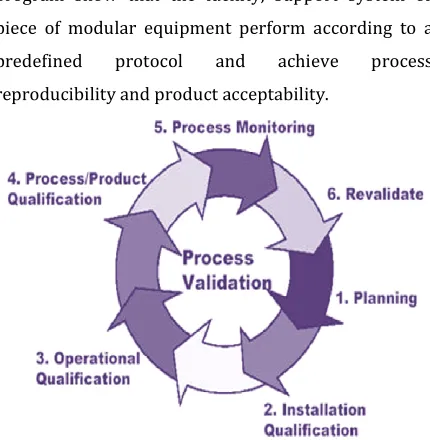
program show that the facility, support system or piece of modular equipment perform according to a predefined protocol and achieve process reproducibility and product acceptability.
Figure 1: General view of process validation
Validation Protocol:
A written plan stating how validation will be conducted including test parameters, product characteristics, production equipment and decision points on what constitutes acceptable test results. (FDA - not specifically defined in EC) [4, 5]
Significance of Validation:
Assurance of quality: Without validation, which implies a process that is well understood and in state of control, confidence in the quality of product manufactured is impossible. GMP’s and validation, two concepts that cannot be separated are essential to quality assurance. Frequently the validation of a process will lead to quality improvement in addition to better quality assurance.
Process optimization: To optimize the process for maximum efficiency while maintaining quality standards is a natural consequence of this scientific study of process variables and their control.
Cost reduction: Experience and common sense indicate that a validated process is a more efficient process and a process that produces less reworks, rejects, wastage and so
on. Validation is fundamentally good business practice.
Government regulation: Validation is considered to be an integral part of GMP’s essentially worldwide compliance with validation requirements is necessary for obtaining approval to manufacture and to introduce new products. [6]
Preliminary considerations of process validation:
A manufacturer should evaluate all factors that affect product quality when designing and undertaking a process validation study. These factors may vary considerably among different products and manufacturing technologies and could include e.g., component specifications, air and water handling systems, environmental controls, equipment functions and process control operations. No single approach to process validation will be appropriate and complete in all cases however, the following quality activities should be undertaken in most situations.
During the research and development (R&D) phase, the desired product should be carefully defined in terms of its characteristics, such as physical, chemical, electrical and performance characteristics. It is important to translate the product characteristics into specifications as a basis for description and control of the product. The product’s end use should be a determining factor in the development of product and component characteristics with specifications. These aspects include performance, reliability and stability. Acceptable ranges or limits should be established for each characteristic to set up allowable variations. The validity of acceptance specifications should be verified through testing and challenge of the product on a sound scientific basis during the initial development and production phase.
Relationship between validation and qualification:
Validation and qualification are essentially components of the same concept. The term qualification is normally used for equipment, utilities and systems, and validation for processes. In this sense, qualification is part of validation.
There are two basic approaches to validation: one based on evidence obtained through testing (prospective and concurrent validation), and one based on the analysis of accumulated (historical) data (retrospective validation). Whenever possible, prospective validation is preferred. Retrospective validation is no longer encouraged and is, in any case, not applicable to the manufacturing of sterile products.
Both prospective and concurrent validation, may include:
Extensive product testing, which may involve extensive sample testing (with the estimation of confidence limits for individual results) and the demonstration of intra- and inter-batch homogeneity;
Simulation process trials;
Challenge/worst case tests, which determine the robustness of the process; and
Control of process parameters being monitored during normal production runs to obtain additional information on the reliability of the process. [7]
Goal of Validation
The goal of the validation is to ensure that quality is built into the system at every step, and not just tested for at the end, as such validation activities will commonly include training on production material and operating procedures, training of people involved and monitoring of the system whilst in production. In general, an entire process is validated and a particular object within that process is verified. The regulations also set out an expectation that the different parts of the production process are well defined and controlled, such that the results of that production will not substantially change over time.
Homogeneity within a batch and consistency between batches are goals of process validation activities. Validation offers assurance that a process is reasonably protected against sources of variability that could affect production output, cause supply problems, and negatively affect public health.
Process validation and Drug quality:
Effective process validation contributes significantly to assuring drug quality. The basic principle of quality assurance is that a drug should be produced that is fit for its intended use. This principle incorporates the understanding that the following conditions exist:
Quality, safety, and efficacy are designed or built into the product.
Quality cannot be adequately assured merely by in-process and finished-product inspection or testing.
Each step of a manufacturing process is controlled to assure that the finished product meets all quality attributes including specifications.
Approach to Process Validation:
Process Validation is defined as the collection and evaluation of data, from the process design stage through commercial production, which establishes scientific evidence that a process is capable of consistently delivering quality product. Process validation involves a series of activities taking place over the lifecycle of the product and process. This guidance describes process validation activities in three stages.
Stage 1 – Process Design: The commercial manufacturing process is defined during this stage based on knowledge gained through development and scale-up activities.
Stage 2 – Process Qualification: During this stage, the process design is evaluated to determine if the process is capable of reproducible commercial manufacturing. Stage 3 – Continued Process Verification:
production that the process remains in a state of control. [8]
Figure 2: Process Validation Sequence
Validation Team:
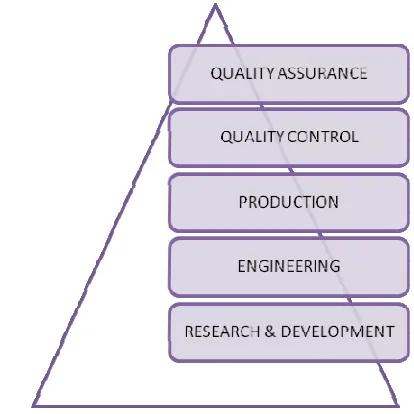
Figure 3: Validation Team Structure
Responsibilities:
Head Quality Assurance: Quality Assurance is responsible for preparation and evaluation of the validation data as well as deviations during execution of process validation protocol.
Head Quality Control: QC department is responsible for analysis and evaluation of the analytical results for in-process and finished product samples as per validation sampling plan.
Head Production: Production department is responsible to hand over data generated during manufacturing of validation batches to QA for execution and filing.
Engineering: Engineering department is responsible for qualification and calibration of all the processing equipment/instrument/utilities and maintain its efficacy during the manufacturing.
Research & Development: R & D is responsible to provide necessary support in the validation activity. [9]
Contents of Validation Protocol:
General information Objective
Background/Pre-validation Activities
List of equipment and their qualification status Facilities qualification
Process flow charts
Manufacturing procedure narrative
List of critical processing parameters and critical excipients
Sampling, tests and specifications Acceptance criteria [10]
Contents of Process Validation program:
The following points should be included in the Process Validation Program:
History of development and a description of the product(if available, the development report would be useful)
A manufacturing procedure and flowchart of the manufacturing process.
A list of all equipment required for production. A list of production stages that may be critical
for product quality.
A schedule for PV test procedures.
A detailed description for all test procedures, including:
Sampling procedure Labeling of the samples Test procedure Evaluation procedure
Specification for the intermediate and finished products
Important points selected for Process Validation of formulations:
Batches should run in succession and on different days and shifts (later condition, if apparent).
Batches should be manufactured in the equipment and facilities designed for eventual commercial production.
Critical process variables should be set within the operating ranges and should not exceed their upper and lower control limits during process operation. Output responses should be well within the finished product specifications. Failure to meet the requirements of the
validation protocol with respect to process input and output control should be subjected to process requalification and subsequent revalidation following a thorough analysis of process data followed by discussion with validation team.
Lyophillized Product:
Lyophillization is a process which extracts the water from food and other products so that the foods or products remain stable and are easier to store at room temperature (ambient air temperature).
Lyophillized is carried out using a simple principle of physics called sublimation. Sublimation is the transition of a substance from the solid to vapour state, without first passing through an intermediate liquid phase. To extract water from foods and other products, the process of lyophillization consists of:
Freezing the food so that the water in the food become ice;
Under a vacuum, sublimating the ice directly into water vapour;
Drawing off the water vapour;
Once the ice is sublimated, the foods are freeze-dried and can be removed from the machine. [11]
Advantages of Lyophillized product:
The advantages of lyophilization include:
1. Ease of processing a liquid, which simplifies aseptic handling
2. Enhanced stability of a dry powder
3. Removal of water without excessive heating of the product
4. Enhanced product stability in a dry state 5. Rapid and easy dissolution of reconstituted
product [12]
Excipients of Lyophillized Formulation:
1. Buffers: Buffers are required in pharmaceutical formulations to stabilized pH. Examples are: Phosphate buffers, Tris, Citrate and histidine buffers.
2. Bulking agents: The purpose of bulking agent is to provide bulk to the formulation. This is important in cases in which very low concentrations of the active ingredient are used. Crystalline buliking agents produce an elegant cake structure with good mechanical properties.
3. Stabilizers: Sucrose, trehalose, glucose, lactose, maltose and more are used as stabilizing agents.
4. Tonicity adjusters: Mannitol, sucrose, glycine, glycerol and sodium chloride are good tonicity adjusters. [13]
Examples of drugs which are available as liquid lyophilized products:
Anticancer: Bleomycin, Carboplatin, Cisplatin, Cyclophosphamide, Docetaxel. [14] Bortezomib [15], Pemetrexed disodium [16], Dactinomycin [17], Daunarubicin, Epirubicin, Topotecan.
Antifungal: Amphotericin B.
Human Platelets and various hormones like Human Chronic Gonadotropin injection, Follicle Stimulating Hormone injections are also supplied as lyophilized products.
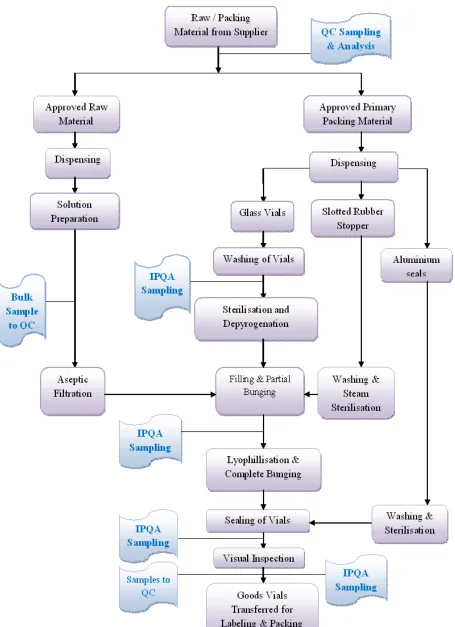
Manufacturing Process Flow of Liquid Lyophillized Formulation:
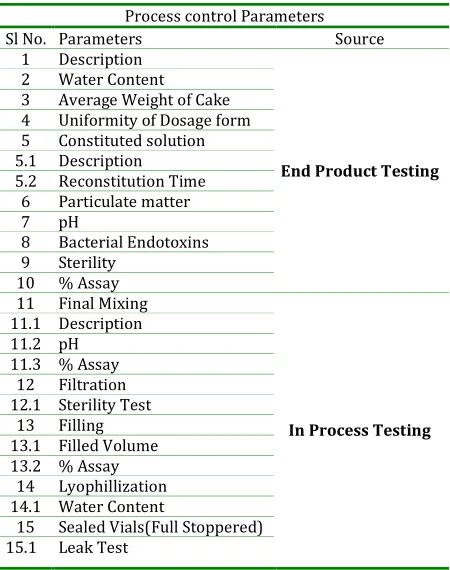
Process control Parameters
Sl No. Parameters Source
1 Description
End Product Testing
2 Water Content
3 Average Weight of Cake 4 Uniformity of Dosage form 5 Constituted solution 5.1 Description 5.2 Reconstitution Time
6 Particulate matter
7 pH
8 Bacterial Endotoxins 9 Sterility
10 % Assay
11 Final Mixing
In Process Testing
11.1 Description 11.2 pH 11.3 % Assay
12 Filtration 12.1 Sterility Test
13 Filling 13.1 Filled Volume 13.2 % Assay
14 Lyophillization 14.1 Water Content
15 Sealed Vials(Full Stoppered) 15.1 Leak Test
Table 1: Process Control Parameters
Process Validation Parameters:
Manufacturing of liquid lyophillized formulation is a sequential operation involving many steps and sub stages. To establish the consistency of total process, various steps and sub steps involved are considered and studied as per the predefined protocol. At each step parameters are defined and categorized into:
1) Variable parameters:
Variable parameters are all critical process parameters, which directly affect the quality/productivity of any process.
2) Evaluation parameters:
Evaluation parameters are all significant characters at each process sub steps, which determines the final quality/productivity of the product.
3) Acceptance criteria:
Validation protocol describes the acceptance criteria at each sub steps of validation in order to achieve final establishment of validation process. Validation holds good only if the results obtained are within the acceptance limit as specified in the protocol.
PROCESS OBJECTIVE VARIABLE
( MONITOR) TEST (RESPONSE)
Solution Preparation
To ensure a colorless/specified color solution with specified pH and % assay(specified % of
labeled amount)
Load, Mixing time,
Mixing Speed Assay, Clarity, pH
Filtration To comply the sterility test Filtration Rate,
Pressure Sterility
Filling & Partial Stoppering
To ensure uniformity in filled volume and % assay
Filling Rate,
Pressure, Fill volume, % Assay
Lyophillization & Stoppering
To ensure uniformity in appearance of lyophillized cake and reconstitution time
Load, Vaccum, Time, Temp.
Water content, Cake formation, Reconstitution time, pH, weight,
Appearance
Sealing To ensure integrity of seal Leak test, Seal Integrated
Table 2: Process with Monitor and Test
Identification of Critical Process Parameters in Liquid Lyophillized Formulation Preparation
Probable causes that may affect final product:
CONCLUSION
This study of Process Validation of Liquid Lyophillized Formulation involves validating the process variables of this product to show that the process was under control. The study was conducted on a three batches, which includes the validation of critical steps of manufacturing such as Final Mixing, Filtration, Filling, Partial Stoppering, Lyophillization, Full stoppering, Sealing and packing. Overall manufacturing process and packing process was concluded as validated at the parameters mentioned above as per BMR and BPR. The process validation data reveals that there was no significant variation between batch to batch and all the process variables were studied. Therefore, it can be concluded that the process of Liquid Lyophillized Formulation for the three batches stands Validated.
REFERENCES
1. Quality assurance of pharmaceuticals. A compendium
of guidelines and related materials. 2nd ed. Geneva
27: WHO Press; 2006. P. 16-7.
2. Deshmukh OJ, Lahoti SR, Rajendra VB, Gulecha BS,
Rawat PK, Kulkarni SA. Prospective process
validation of gliclazide tablet. AJPTR
2011;1(3):244-54.
3. Srivastava A. Process validation an essential step for
pharmaceutical industry. Int J Pharma Sci Tech
2012;7(2):2.
4. Glossary of quality system and development
technology. Division of field investigation’s office of
regional operations, office of regulatory affairs. FDA
1995. www.fda.gov/gloss.html
5. Sharp J. Validation – How much is required? J
Pharm sci and tech. 1995; 49(3): 111-18.
6. Good manufacturing practices for pharmaceutical
products: main principles: In WHO expert committee
on specifications for pharmaceutical operations. 37
report, Geneva. WHO - 2003 (WHO technical report
series number 908).
7. Supplementary guidelines on good manufacturing
practices: Validation. In WHO expert committee on
specifications for pharmaceutical preparations. 40
report, Genava. WHO – 2006(WHO technical report
series number 937).
8. http://www.fda.gov/downloads/Drugs/.../Guidances/
UCM070336.pdf
9. Gupta GD, Garg R and Aggarwal S. Guidelines on
General Principles of Validation: Solid, Liquid and
Sterile dosage forms. www.pharminfo.net. 6: 28-33
(2008).
10.Thaduvai R, Rao BS, Jeybaskaran M. Process validation
of pantoprazole 40 mg tablets. The Pharma Innovation
2012;1(5):53-73.
11.http://www.lyo-san.ca/english/lyophilisation.html
12.www.fda.gov/ICECI/Inspections/InspectionGuides/uc
m074909.htm
13.http://www.pharmtech.com/pharmtech/data/articles
tandard/pharmtech/072004/84717/article.pdf
14.http://www.cancermedicare.com/injection.html
15.Stephen RB, Patrick AT, Mark JM, Hegi V. Analysis of
two commercially available bortezomib products:
Differences in assay of active agent and impurity
profile. AAPS PharmaSciTech 2011 June; 12(2):
461-67. Available from: URL:
http://www.ncbi.nlm.nih.gov/pmc/articles/PMC3134
677
16.Smit EF, Mattson K, Pawel JV, Manegold C, Clarke S and
Postmus PE. ALMITA® (pemetrexed disodium) as
second-line treatment of non-small-cell lung cancer: a
phaseII study. Ann Oncol 2003; 14(3):455-60.
Available from: URL:
http://annonc.oxfordjournals.org/content/14/3/455.f
ull
17.http://dailymed.nlm.nih.gov/dailymed/archives/fdaD
rugInfo.cfm?archiveid=19247
How to cite this article: Nitish Maini*, Saroj Jain, Satish Sardana; Process Validation of Liquid Lyophillized Formulation: A Review; J. Adv. Pharm. Edu. & Res. 2013: 3(2): 46-54.