www.astesj.com
Proceedings of International Conference on Applied Mathematics (ICAM’2017), Taza, Morocco
ISSN: 2415-6698
Threshold Multi Split-Row algorithm for decoding irregular
LDPC codes
Chakir Aqil*,1, Rachid El Alami2, Ismail Akharraz1, Abdelaziz Ahaitouf1
1Sidi Mohamed Ben Abdellah University, Mathematics Physics and Computer Science, LSI, FP, Taza, Morocco 2Sidi Mohamed Ben Abdellah University, LESSI Laboratory, FSDM, Fez, Morocco
A R T I C L E I N F O A B S T R A C T Article history:
Received: 10 June, 2017 Accepted: 15 July, 2017 Online: 26 December, 2017
Inthiswork,weproposeanewthresholdmultisplit-rowalgorithmin order to improve the multi split-row algorithm for LDPC irregular codesdecoding.Wegiveacompletedescriptionofouralgorithmaswell asits advantages for theLDPC codes. The simulation results over an additive white gaussian channel show that an improvement in code errorperformance between 0.4 dB and 0.6 dBcompared to the multi split-rowalgorithm.
Keywords: LDPC codes
Threshold Multi Split-Row algorithm
Multi Split-Row algorithm
1
Introduction
Low-density parity check (LDPC) codes are a class of linear block codes, which were first, introduced by gallager in 1963 [1]. As soon as they were re-invented in 1996 by mackay [2], LDPC codes have received a lot of attention because their error performance is very close to the shannon limit when decoded using itera-tive methods [3]. They have emerged as a viable op-tion for forward error correcop-tion (FEC) systems and have been adopted by many advanced standards, such as 10 gigabit ethernet (10GBASET) [4], [5] and digi-tal video broadcasting (DVB-S2) [6], [7]. In addition, the generations of WiFi and WiMAX are considering LDPC codes as part of their error correction systems [8], [9].
In the present paper, we propose the threshold multi split-row method for decoding irregular low-density parity-check (LDPC) codes [10], to have better performance in terms of bit error rate. We will apply the thresholding algorithm in [11] for multi split row of irregular LDPC codes[10].
The proposed split-row decoder [10],[11] splits the row processing into two or multiple nearly indepen-dent partitions. Each block is simultaneously pro-cessed using minimal information from an adjacent partition. The key idea of split-row is to reduce communication between row and column processors which has a major role in the interconnect
complex-ity of existing LDPC decoding algorithms such as sum product (SPA) [3] and minsum (MS) [12].
This paper introduces threshold multi split-row decoding which significantly reduces wire intercon-nect complexity and considerably improves the er-ror performance compared to non-threshold multi-split decoding [10]. The paper is organized as fol-lows: Section II reviews the sum product and min-sum, split-row and split-row threshold decoding al-gorithms. Threshold multi-split-row and its error per-formance result is presented in section III. Finally, the conclusion is in section IV.
2
Previous algorithms
2.1
Sum Product Decoding(SPD)
The SPD assumes a binary code word (x1, x2, ..., xN) transmitted using a binary phase-shift keying (BPSK) modulation. The sequence is transmitted over an ad-ditive white gaussian noise (AWGN) channel and the received symbol is (y1, y2, ..., yN).
We define:
V(i) ={j :Hij = 1}as the set of variable nodes which participate in the check equation i.
C(j)={i:Hij= 1}as the set of check nodes which par-ticipate in the variable node j update.
Also
V(i)\jdenote all variable nodes inV(i)except node j. *Corresponding Author: Chakir Aqil , FP , Taza, Morocco & aqil [email protected]
C(j)\i denote all check nodes inC(j) except node i. Moreover, we define the following variables used in this paper.
λj: is defined as the information derived from the log-likelihood ratio of received symbolyj.
λj=log(P(xi= 0|yj)/P(xi= 1|yj)) = (2yj)/σ2 (1)
whereσ2 is the noise variance. αij is the message from check node i to variable node j. This is the row processing output. βij is the message from variable node j to check node i. This is the column processing output.
The sum product algorithm decoding as described by mohsenin and Baas [13], can be summarized in the following four steps:
2.1.1 Initialization
For each i and j, initializeβij to the value of the log-likelihood ratio of the received symbol yj, which is λj. During each iteration,αβmessages are computed and exchanged between variables and check nodes through the graph edges according to the following steps numbered 2-4.
2. Row processing or check node update
Computeαijmessages usingβmessages coming from all other variable nodes connected to check nodeCi, excluding theβinformation fromVj:
αij=
Y
j0∈V(i)\j
sign(βij0)×φ(Σ
j0∈V(i)\jφ(|βij0|)) (2)
where the non-linear function
φ(x) =−log(tanh(|x|/2)) (3)
The first product term in the equation that update the parameter, is called the parity (sign) update and the second product term is the reliability (magnitude) update.
3. Column processing or variable node update Computeβij messages using channel informationλj and incoming, messagesα; from all other check nodes connected to variable nodeVj, excluding check node Ci.
βij=λj+Σi0
∈C(j)\iα(i0j) (4)
4. Syndrome check and early termination
When the column processing is finished, every bit in column j is updated by adding the channel infor-mation λj and α, messages from neighboring check nodes.
zj=λj+Σi0
∈C(j)α(i0j) (5)
From the updated vector, an estimated code vector b
X={
b
x1,bx2, ...,bxN}is calculated by:
b
xi=
(
1if zi≤0
0if zi>0 (6)
IfH×
bx
t= 0 then b
Xis a valid codeword and there-fore the iterative process has converged and decoding stops. Otherwise, the decoding repeats from step 2 until a valid codeword is obtained or the number of iterations reaches a maximum number, which termi-nates the decoding process.
2.2
MinSum Decoding
The check node or row processing stage of SP decod-ing can be simplified by approximatdecod-ing the magni-tude computation in Eq. 2 with a minimum function. The algorithm using this approximation is called min-sum (MS):
αij=
Y
j0∈V(i)\j
sign(βij0)×Min
j0∈V(i)\j(|βij0|) (7)
In MS decoding, the column operation is the same as in SP decoding. The error performance loss of MS decoding can be improved by scaling the check (α) values in Eq. 7 with a scale factorS ≤1 which
nor-malizes the approximations [14], [15].
αij=S×
Y
j0∈V(i)\j
sign(βij0)×Min
j0∈V(i)\j(|βij0|) (8)
2.3
Split Row and Split Row Threshold
Decoding
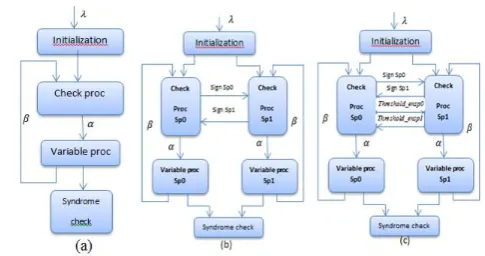
Recall that a standard message passing two-phase al-gorithm consists of a check node update followed by a variable node update as shown in Fig. 1 (a). The ba-sic idea in split-row [10], [16] and split-row threshold [11], is to divide the check node processing into two or multiple nearly-independent partitions. Each check node processor, simultaneously, computes a new mes-sage while using minimal information from its ad-jacent partitions. Split-row is illustrated in Fig. 1 (b) showing how the check node processing is partitioned into two blocks. A single bit of information (Sign) for each check node processor must be sent between par-titions to improve the error performance.
The loss error performance is 0.5-0.7 dB of split-row that is the major drawback, when compared to min-sum normalized and SPA decoders. This performance degradation is dependent on the number of check node partitions. For minsum split-row each partition has no information of the minimum value of the other partition, and a Sign signal is sent to minimize the er-ror due to incorrect sign information of the true check node outputα.
The split-row threshold algorithm mitigates the er-ror caused by incorrect magnitude by providing a sig-nal, threshold en, which indicates whether a partition has a minimum less than a given threshold (T).This causes all check nodes to take the min of their own lo-cal minimum or T. Thus, any large deviations from the true minimum because of the partitioning are reduced, which then makes multi-split implementa-tions feasible.
Figure 1 (c) shows the additional single bit sig-nal (threshold en ) added to the origisig-nal split-row ar-chitecture by the split-row threshold algorithm. This signal allows the split-row to remain essentially un-changed while adding some extra logic and minimal wiring to improve error significantly [11].
Therefore, the split-row architectures reduce the communication between check node and variable node processors, which is the major cause of the inter-connect complexity found in existing LDPC decoder implementations.In addition, the area of each check node processor will be reduced. However, note that the variable node operation in the SPA, minsum, split-row and split-split-row threshold algorithms are all identi-cal. Thus, the logic of the variable node processor is left unchanged.
3
Threshold Mutli Split Row
De-coding
3.1
Threshold Mutli Split Row Algorithm
In order to increase the parallelism and reduce the complexity of the decoder, the multi-split-row
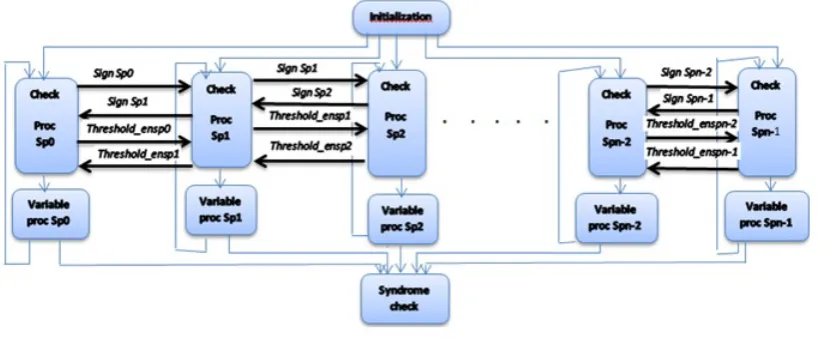
method divides the lines of the systematic submatrix Hs into Spn blocks called split-Spn. This approxi-mation requires of the wire to correctly process the sign bits between the blocks. For the threshold multi split-row method, Each partition sends the status of its local minimum against a threshold to the next par-tition with a single wire, calledT hreshold ensp.
The block diagram of threshold multi split-row decoding with Spn partitions, highlighting the sign
andT hreshold ensppassing signals, is shown in Fig.
2. These are the only wires passing between the par-titions [17]. In each partition, local minimums are generated and compared with a threshold T simulta-neously. If the local minimum is smaller than T then
theT hreshold enspsignal is asserted high. The
mag-nitudes of the check node outputs are finally com-puted using local minimums and theT hreshold ensp signal from neighboring partitions.
If a local partition0s minimums are larger than T , and at least one of theT hreshold enspsignals is high, then T is used to update its check node outputs. Other-wise, local minimums are used to update check node outputs.
in the threshold multi split-row algorithm, as shown in Eq. (10) and (11), the first and second Mins are compared with a predefined threshold, and a single-bit threshold-enable (T hreshold en out) global signal is sent to indicate the presence of a potential global minimum to other partitions.
3.1.1 Initialization
The first and second minimums are determined for each partition according to the following relation-ships:
Minj0
∈V(i)\j(|βij0|) =
(
Min1i;if ;j,argmin(Min1i)
Min2i;if ;j=argmin(Min1i)
(9)
Min1i =minj∈V(i)(|βij0|) (10) Min2i=minj00∈V(i)\argmin(min1i)(|βij00|) (11)
to execute the algorithm one needs the number of partitions and the threshold value T. Finds
T hreshold ensp(i) out(i∓1) for the ith partition of a
spn-decoder.
Algorithm 1 Threshold Multi Split-Row Algorithm
1-if Min1i≤T and Min2i≤Tthen
T hreshold ensp(i)out(i∓1) = 1
Minj0
∈V(i)\j(|βij0|) =
(
Min1i if j,argmin(Min1i)
Min2i if j=argmin(Min1i) (12)
2- if Min1i≤T and Min2i≥Tthen
T hreshold ensp(i)out(i∓1) = 1
T hreshold ensp(i+ 1) == 1 or
T hreshold ensp(i−1) == 1 then
Minj0
∈V(i)\j(|βij0|) =
(
Min1i if j,argmin(Min1i)
T if j=argmin(Min1i) (13)
else
Minj0
∈V(i)\j(|βij0|) =
(
Min1i if j,argmin(Min1i)
Min2i if j=argmin(Min1i) end if
3- else if Min1i≥T and (T hreshold ensp(i+ 1) == 1 or
T hreshold ensp(i−1) == 1) then
T hreshold ensp(i)out(i∓1) = 0
Minj0
∈V(i)\j(|βij0|) =T (14)
4- else
T hreshold ensp(i)ou(i∓1) = 0
Minj0
∈V(i)\j(|βij0|) =
(
Min1i if j,argmin(Min1i)
Min2i if j=argmin(Min1i) (15)
end if.
The kernel of the threshold multi split-row algo-rithm is given in Algoalgo-rithm 1. As shown, four condi-tions will occur:
Condition 1: both Min1 and Min2 are less than thresholdT. In this case these 2 parameters are used to calculateα messages according to Eq.(12). In ad-dition, T hreshold ensp(i)out(i∓1), which represents
the general threshold-enable signal of a partition with two neighbors, is asserted high indicating that the least minimum(Min1)in this partition is smaller than T.
Condition 2: only Min1 is less than T. As Condi-tion 1 T hreshold ensp(i) out(i∓1)= 1. If at least one
T hreshold ensp(i∓1) signal from the nearest
neigh-boring partitions is high, indicating that the local minimum in the other partition is less than T, then we useMin1andTto calculateαmessages according to Eq.(13). Otherwise, we use Eq.(12).
Condition 3: when the localMin1is larger thanTand at least oneT hreshold ensp(i∓1) signal from the
near-est neighboring partitions is high; thus, we only use T to compute all α messages for the partition using Eq.(14).
Condition 4: when the localMin1is larger thanTand if theT hreshold ensp(i∓1) signals are all low; thus, we
again use Eq.(12).
The variable node operation in minsum threshold multi split-row algorithm is identical to the minsum normalized and minsum multi split-row algorithms.
3.2
BER Simulation Results
The error performance simulations presented here as-sume an additive white gaussian noise (AWGN) chan-nel with binary phase-shift keying (BPSK) modula-tion. The maximum number of iterations is set to Imax = 7 or earlier when the decoder converged [11]. We fix the threshold Imax to satisfy a tradeoffbetween the performance correction and the speed of the de-coder.
The following labelings are used for the figures: “MS Standard” for normalized minsum, “MS Multi Split-Row” for the method minsum multi split-row al-gorithm, and “S” for the scaling factor. The perfor-mances of irregular LDPC codes are illustrated in the figure given below.
The error performance depends strongly on the choice of thresholdTvalues and the scaling factorS. The optimum values forTandSare obtained by em-pirical simulations as illustrated in the following fig-ures.
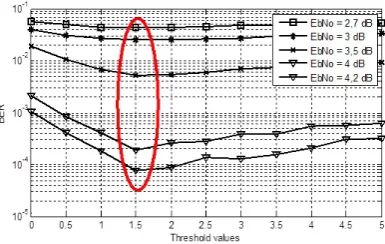
The figure 3 shows the simulation to determine experimentally the threshold for minsum threshold multi split-row of the LDPC code (6,18) (1536,1152). with:
Code length N= 1536. Information length K=1152.
Column weight Wc = 6 which is the number of ones per column.
Row weight Wr =18 which is the number of ones per row.
The threshold optimum value for an SNR ranging from 2.7 dB to 4.2 dB, with the value of the normal-ization factor S = 0.25 obtained in figure 6, is 1.5.
Figure 3. BER (Bit error rate) performance in function of the threshold for different SNR (Signal to noise ratio) values.
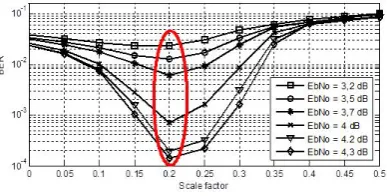
for normalized minsum, is 0.6. And optimal scale fac-tor, for minsum multi split-row, is 0.2.
Figure 4. BER (Bit error rate) performance in function of the scale factor using normalized minsum for different SNR (Signal to Noise Ratio) values.
Figure 5. BER (Bit error rate) performance in function of the Scale factor using minsum multi split-row for different SNR (Signal to noise ratio) values.
Figure 6 shows the simulation to determine exper-imentally the scaling factor for minsum threshold multi split-row of the LDPC code (6,18)(1536,1152). Optimal scale factor is 0.25 with the threshold T=1.5.
Figure 6. BER (Bit error rate) performance in function of the scale factor using minsum threshold multi split-row for different SNR (Signal to noise ratio) values.
Figure 7 shows the error performance results for a (6,18) (1536,1152) LDPC code for different decoding algorithms (minsum normalized, minsum multi split-row and minsum threshold multi split-split-row). The code rate is R=0.75 and the maximum number of iteration is set toImax = 7, with threshold values obtained in Fig.3 and scale factors obtained in Fig.4, Fig.5 and Fig.6.
Figure 7. BER performance of (6,18) (1536,1152) irregular code using various decoding algorithms.
As shown in the figure, minsum threshold multi split-row with optimal threshold T = 1.5 performs about 0.6 dB better than minsum multi split-row and is only 0.7 dB away from MinSum normalized atBER= 6.10−7
.
The minsum threshold multi split-row algorithm utilizes a threshold-enable signal to compensate for the loss of min() interpretation information in multi-split-row algorithm. It provides at least 0.6 dB error performance over the multi-split-row algorithm with Spn = 4. Partitioning the parity matrix in Spn blocs allows us to increase the decoder’s parallelism. There-fore, the partitions are performed simultaneously and we obtained a parallel decoder. That means,the com-plexity decreases and the decoding becomes faster.
As shown in Figure 7, the better performance gap indicated between the minsum threshold multi split-row and minsum multi split-split-row algorithm revert to the information passed from one partition to another (Threshold ensp) in algorithm threshold multi split-row, which reduces difference between the local mini-mum in each partition and the first and second global minimums.
4
Conclusion
In this paper we have extended threshold multi split-row decoding method used for regular LDPC code to the irregular LDPC code. The aims was to improve the errors performances of the decoder. Simulation re-sults show that the threshold multi split-row outper-forms the multi split-row algorithm for 0.6 dB while maintaining the same level of complexity (only the comparison between the threshold and the first and second minimums is added). Our simulation results show that for a given LDPC code keeping threshold T constant at any SNR does not cause any error perfor-mance degradation.
References
1. R. G. Gallager, “Low-Density-Parity-Check,”,IRE
Trans. Information Theory, vol. II, no. 8, pp. 21-28, Jan 1962.
3. D. J. C. MacKay, “Good error-correcting codes based on very sparse matrices,”,IEEE Trans. Inform. Theory, vol. 45, p. 399-432, Mar. 1999.
4. “IEEE 802.3an, standard for information technology-telecommunications and information exchange be-tween systems”.
5. Cohen, A.E., Parhi and K.K,“A Low-Complexity Hy-brid LDPC Code Encoder for IEEE 802.3an (10GBase-T) Ethernet,”,IEEE Transactions on Signal Processing, vol. 57, no. 10, pp. 4085-4094, 2009.
6. “T.T.S.I. digital video broadcasting (DVB) second gen-eration framing structure for broadband satellite ap-plications,”[Online].
7. S.-M. Kim, C.-S. Park and S.-Y. Hwang,“A Novel Partially Parallel Architecture for High-Throughput LDPC Decoder for DVB-S2,”,IEEE Transactions on Con-sumer Electronics, vol. 56, no. 2, pp. 820-825, May 2010.
8. Y.-L. Wang, Y.-L. Ueng, C.-L. Peng and C.-J. Yang, “A Low-Complexity LDPC Decoder Architecture for WiMAX Applications,”,in Proc. of the Int. Symp on VLSI Design, Automation and Test, Hsinchu, April 2011.
9. K.-W. Shin and H.-J. Kim,“A Multi-Mode LDPC De-coder for IEEE 802.16e Mobile WiMAX,”, Journal of Semiconductor Technology and Science, vol. 12, no. 1, pp. 24-33, Mar. 2012.
10. R. ElAlami and M. Mrabti,“Reduced Complexity of Decoding Algorithm for Irregular LDPC Codes Using a Multiple Split Row Method,”, International Journal of Research and Reviews in Mechatronic Design and Simulation, vol. 1, no. 1, pp. 12-17, March 2011.
11. R. ElAlami, H. Qjidaa, Y. Mehdaoui and M. Mrabti,“A Thresholding Algorithm for Improved Split-Row De-coding Method of Irregular LDPC Codes,”,in Proc. of the The IEEE International Conference on Intelligent Systems and Computer Vision 2015, Fez, Morocco, March 2015.
12. M. Fossorier, M. Mihaljevic and H. Imai,“Reduced Complexity Iterative Decoding of Low-Density Parity-Check Codes Based on Belief Propagation,”, IEEE Transactions on Communications, vol. 47, no. 5, pp. 673-680, May 1999.
13. Mohsenin T, Baas B.“Split-row: a reduced
com-plexity, high throughput LDPCdecoder architec-ture,”,Proceedings of the ICCD, October. 2006.
14. J. Chen and M. Fossorier,“Near optimum universal belief propagation based decoding of low-density par-ity check codes,”, IEEE Transaction Communications, vol. 50, pp. 406-414, Mar. 2002.
15. J. Chen, A. Dholakia, E. Eleftheriou, and M. Fossorier,“Reduced complexity decoding of LDPC codes,”,IEEE Transaction Communications, vol. 53, pp. 1288-1299, Aug. 2005.
16. R. ElAlami, M. Mrabti and C. B. Gueye,“Reduced Complexity of Decoding Algorithm for Irregular LDPC Codes Using a Split Row Method,”,Journal of Wireless Networking and Communications, vol. 4, no. 2, pp. 29-34, 2012.