333
Int. J. Data Envelopment Analysis (ISSN 2345-458X)
Vol.2, No.1, Year 2014 Article ID IJDEA-00215, 9 pagesResearch Article
International Journal of Data Envelopment
The Calculation of Unit's Efficiency by Using the
Interval
𝒍
𝟏
norm
B. Babazadeha, E. Najafib, M. AhadzadehNaminc, Y. jafarid, Z. Ebrahimia
(a) Department of Industrial Engineering, Science and Research Branch, Islamic Azad University, Saveh, Iran
(b) Department of Industrial Engineering, Science and Research Branch, Islamic Azad University, Tehran, Iran
(c) Department of mathematics, Shahr-e-QodsBranch, Islamic Azad University, Tehran, Iran (d) Department of Mathematics, Shabestar Branch, Islamic Azad University, Shabestar, Iran
Received 5 August 2013, Revised 9 December 2013, Accepted 24 January 2014
Abstract
Data Envelopment Analysis )DEA( is a technique for measuring the efficiency of decision making units. In all models of the DEA, for each unit under assessment, the numerical efficiency which may be less than or equal to one is obtained. Given the possible large number of efficiency units for evaluating units, we use various methods of ranking. 𝑙1-norm is one of the methods of ranking. This
method has been used for categorical data. In this paper, we assume data as interval and introduce𝑙1
-norm andrun it on a single example.
Keyword: DEA, Ranking, Interval data, 𝑙1-norm
1. Introduction
DEA, which was developed to evaluate the relative efficiency of the decision-making units by Charnes et al in 1978 [1], is a non-parametric method and is based on the linear programming. In1957, Farrell [2] was the first to construct the production possibility set in a non-parametric method. Charnes et al developed Farrell’s approach and presented a model called CCR. Then, in 1984 Banker et al [3] offered BCC model. Cooper et al [4] (1999) placed DEA Technique by the uncertain data. In 2004, Jahanshahloo et al [5] ranked DMUs by the norm1 method. In this paper, we intend to obtain the efficiency in a range of intervals and calculate the unit's efficiency by the interval 𝑙1-norm method.
Considering ranking is not completely specified in the interval efficiency, we attempt to rank
Corresponding author, Email address :[email protected]
decision-making units as well as interval data by Jahanshahloo et al’s [6] method and determine the actual position of data in comparison with each other with respect to their distance from the efficiency boundary after removing the unit.
Furthermore, this paper will be as follows: InSection2, the necessary introductions for the next sections will be presented. In Section 3, ranking data by the norm1 method will be offered. InSection4, ranking interval data by the interval norm1method will be provided. In Section5, a numerical example will be offered to illustrate the method and in the final section we will have conclusions.
2. Background
Norm1 is on the basis that we remove the DMU under evaluation and we want to see the minimum distance from the boundary of the new PPS to their moved DMU.
We assume that there are n DMUs to be evaluated, indexed by j = 1,.., n.
In addition, each DMU is assumed to produce s different outputs from m different inputs. Let the observed input and output vectors of 𝐷𝑀𝑈𝐽 be (j 1,,n) xj (x1j,...,xmj)
and(j 1,,n) yj (y1j,...,ysj) respectively, that all components of vectors 𝑥𝑗and 𝑦𝑗 for all
DMUs are non-negative and each DMU has at least one strictly positive input and output. The production possibility sets 𝑇𝐶 and 𝑇𝑉 are defined as
𝑇𝑐= {(𝑥, 𝑦)𝑡|𝑥 ≥ ∑𝑗=1𝑛 𝜆𝑗𝑥𝑗 , 𝑦 ≤ ∑𝑛𝑗=1𝜆𝑗𝑦𝑗, 𝜆𝑗≥ 0 , 𝑗 = 1, … , 𝑛}
𝑇𝑣= {(𝑥, 𝑦)𝑡|𝑥 ≥ ∑𝑗=1𝑛 𝜆𝑗𝑥𝑗 , 𝑦 ≤ ∑𝑛𝑗=1𝜆𝑗𝑦𝑗, ∑𝑛𝑗=1𝜆𝑗= 1 , 𝜆𝑗≥ 0 , 𝑗 = 1, … , 𝑛}
In this section, we assume that the DMUO is extreme efficient. By omitting
(xo, yo)t from 𝑇𝑐,we define the production possibility setTCˊas
𝑇𝐶ˊ = {(𝑥, 𝑦)𝑡|𝑥 ≥ ∑ 𝜆𝑗𝑥𝑗 , 𝑦 ≤ ∑𝑛𝑗=1𝜆𝑗𝑦𝑗 𝐽≠0 𝑛
𝑗=1 𝐽≠0
, 𝜆𝑗≥ 0 , 𝑗 = 1, … , 𝑛 , 𝐽 ≠ 0}
) 0 , , , 1 ( ,
0
) , , 1 ( ,
0
) , , 1 ( ,
0
) 1 ( )
,.., 1 ( 0
1
) ,..., 1 ( 0
1 .
.
1 1
) , (
j n j
j
s r
r y
m i
i x
s r r y n
j
j rj
y j
m i
i x n
j
j ij x j t
s
s
r ro
y r y m
i io
x i x y
x O C Min
where x(x1,...,xm), y(y1,...,ys)and (1,...,01,01,...,n)are the variables of the above model and O(x,y)
C
is the distance (xo, yo)tfrom (x , y )tby using l1-norm.It is obvious that the above model is non-linear. In order to convert this model to a linear model and state Theorem 1, the Tc˝ set is defined as
𝑇𝑐˝= 𝑇𝑐ˊ ∩ {(𝑥, 𝑦)𝑡|𝑥 ≥ 𝑥𝑜 , 𝑦 ≤ 𝑦𝑜}
In Figure1, the polyhedral ROX, ZOX and UCBAX are 𝑇𝐶, Tcˊ and Tc˝, respectively
Fig.1.The polyhedralsare 𝑇𝐶, Tcˊ and Tc˝
Theorem 1: Suppose (xo, yo)t∈ Tcis extreme efficient. For each (x̂, ŷ)t∈ Tcˊ− Tc˝ there exists at least
are member of Tc˝, say (x̅, y̅)t, such that (x,y) O C
< O(xˆ,yˆ) C
C
T
C
T
𝑌
𝑍
●
●
●
●
●
●
●
●
(x
o, y
o)
t𝑈
𝐵
C
C T
T
●
●
●
●
●
●
●
●
●
●
●
𝑥
Now, suppose (x∗, y∗, λ∗) is an optimal solution of the model (1). Given Theorem 1, we find out that
(x∗, y∗)t∈ Tc˝. Therefore, for converting the model (1) into the linear form, we add the constraints
x ≥ xo and y ≤ yo to the model (1). Therefore, we will have:
) 0 , , , 1 ( , 0 ) , , 1 ( , 0 ) , , 1 ( , ) 2 ( ) ,.., 1 ( 0 1 ) ,..., 1 ( 0 1 . . 1 1 ) , ( j n j j s r ro y r y m i io x i x s r r y n j j rj y j m i i x n j j ij x j t s s r r y m i i x y x O C Min
α =
s r ro y 1 −
m i io x 1is a constant number.
3. Ranking by Using 𝒍𝟏-Norm for Interval Data
After presenting a certain mode of norm1, we want to express its interval mode.
Assume that in the following model the data are interval and the levels of inputs and outputs are
known to lie within the bounded intervals, i.e.xij
xijl,xiju
(i1,...,m)(j1,...,n)and
y ,y
(r 1,...,s)(j 1,...,n)yrj lrj urj , with the upper and lower bounds of intervals given as constant and
assumed strictly positive. So by the use of model 1, we consider the following model for interval data:
Using Model 3, we can obtain DMU’s interval efficiency through models 4 and 5 as following.
The worst case for DMUo(unit under evaluation) is when DMUo in the worst case with the highest input (xuo), produces the lowest output (yol ) and the rest of DMUs
j = 1. . . n and (jo)in their best conditions with lowest input (xlj),produces the highest output (yuj), so:
) 0 , , , 1 ( , 0 ) , , 1 ( , 0 ) , , 1 ( , 0 ) 4 ( ) ,.., 1 ( 0 1 ) ,..., 1 ( 0 1 . . 1 1 ) , ( j n j j s r r y m i i x s r r y n j j u rj y j m i i x n j j l ij x j t s s r l ro y r y m i u io x i x L y x O C Min
And also best case for DMUo(unit under evaluation) is when DMUo in the best case, i.e. with the lowest input (xol ) produces the highest output (you) and the rest of DMUs (j1,...,n)and (jo)in the worst conditions. i.e. with highest input (xuj) produces the lowest output (ylj), so
) 0 , , , 1 ( , 0 ) , , 1 ( , 0 ) , , 1 ( , 0 ) 5 ( ) ,.., 1 ( 0 1 ) ,..., 1 ( 0 1 . . 1 1 ) , ( j n j j s r r y m i i x s r r y n j j l rj y j m i i x n j j u ij x j t s s r u ro y r y m i l io x i x U y x O C Min
Thus, for converting the model to the linear form, we add xi≥ xoiu and yr≤ yor l constraints to the
worst-case model and xi≥ xoil and yr≤ yoru constraints are added to the best-case model. So we will
have model 6 for the worst case:
) 0 , , , 1 ( , 0 ) , , 1 ( , 0 ) , , 1 ( , ) 6 ( ) ,.., 1 ( 0 1 ) ,..., 1 ( 0 1 . . 1 1 1 1 ) , ( j n j j s r l ro y r y m i u io x i x s r r y n j j u rj y j m i i x n j j l ij x j t s m r u io x s r l ro y s r r y m i i x L y x O C Min
And so we have model 7 for the best case:
) 0 , , , 1 ( , 0 ) , , 1 ( , 0 ) , , 1 ( , ) 7 ( ) ,.., 1 ( 0 1 ) ,..., 1 ( 0 1 . . 1 1 1 1 ) , ( j n j j s r u ro y r y m i l io x i x s r r y n j j l rj y j m i i x n j j u ij x j t s m r l io x s r u ro y s r r y m i i x U y x O C Min
Then it is implied that for each
u
ij l ijij x x
x , and
u
rj l rj
rj y y
y , we hav :
U
O C L O C O
C(x,y) (x,y) , (x,y)
where x and y are input and output matrices respectively.
4. Numerical Example:
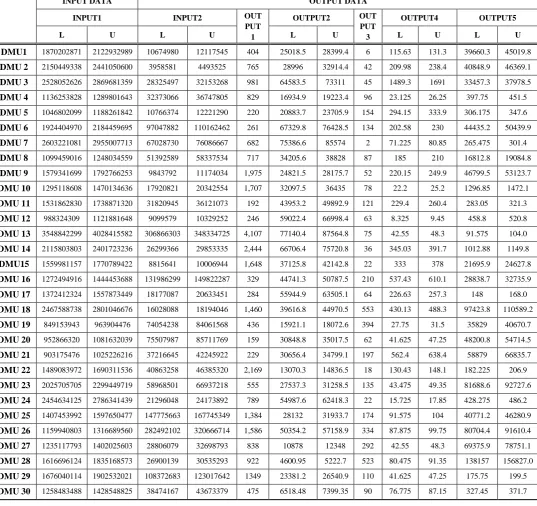
In this paper, the performance of electronic services in 30 branches of Refah bank in 1389 will be assessed. The variables, which are to be studied, will be introduced In terms of two input and five output. Then we will solve a range of data in the form of gams software using the interval norm 1 method and finally after obtaining the upper and lower limits for the model, we will rank the bank branches by using the method mentioned in Jahanshahloo et al’s paper.
Table 1:
The data of the inputs and outputs
INPUT DATA OUTPUT DATA
INPUT1 INPUT2 OUT
PUT 1
OUTPUT2 OUT
PUT 3
OUTPUT4 OUTPUT5
L U L U L U L U L U
DMU1 1870202871 2122932989 10674980 12117545 404 25018.5 28399.4 6 115.63 131.3 39660.3 45019.8
DMU 2 2150449338 2441050600 3958581 4493525 765 28996 32914.4 42 209.98 238.4 40848.9 46369.1
DMU 3 2528052626 2869681359 28325497 32153268 981 64583.5 73311 45 1489.3 1691 33457.3 37978.5
DMU 4 1136253828 1289801643 32373066 36747805 829 16934.9 19223.4 96 23.125 26.25 397.75 451.5
DMU 5 1046802099 1188261842 10766374 12221290 220 20883.7 23705.9 154 294.15 333.9 306.175 347.6
DMU 6 1924404970 2184459695 97047882 110162462 261 67329.8 76428.5 134 202.58 230 44435.2 50439.9
DMU 7 2603221081 2955007713 67028730 76086667 682 75386.6 85574 2 71.225 80.85 265.475 301.4
DMU 8 1099459016 1248034559 51392589 58337534 717 34205.6 38828 87 185 210 16812.8 19084.8
DMU 9 1579341699 1792766253 9843792 11174034 1,975 24821.5 28175.7 52 220.15 249.9 46799.5 53123.7
DMU 10 1295118608 1470134636 17920821 20342554 1,707 32097.5 36435 78 22.2 25.2 1296.85 1472.1
DMU 11 1531862830 1738871320 31820945 36121073 192 43953.2 49892.9 121 229.4 260.4 283.05 321.3
DMU 12 988324309 1121881648 9099579 10329252 246 59022.4 66998.4 63 8.325 9.45 458.8 520.8
DMU 13 3548842299 4028415582 306866303 348334725 4,107 77140.4 87564.8 75 42.55 48.3 91.575 104.0
DMU 14 2115803803 2401723236 26299366 29853335 2,444 66706.4 75720.8 36 345.03 391.7 1012.88 1149.8
DMU15 1559981157 1770789422 8815641 10006944 1,648 37125.8 42142.8 22 333 378 21695.9 24627.8
DMU 16 1272494916 1444453688 131986299 149822287 329 44741.3 50787.5 210 537.43 610.1 28838.7 32735.9
DMU 17 1372412324 1557873449 18177087 20633451 284 55944.9 63505.1 64 226.63 257.3 148 168.0
DMU 18 2467588738 2801046676 16028088 18194046 1,460 39616.8 44970.5 553 430.13 488.3 97423.8 110589.2
DMU 19 849153943 963904476 74054238 84061568 436 15921.1 18072.6 394 27.75 31.5 35829 40670.7
DMU 20 952866320 1081632039 75507987 85711769 159 30848.8 35017.5 62 41.625 47.25 48200.8 54714.5
DMU 21 903175476 1025226216 37216645 42245922 229 30656.4 34799.1 197 562.4 638.4 58879 66835.7
DMU 22 1489083972 1690311536 40863258 46385320 2,169 13070.3 14836.5 18 130.43 148.1 182.225 206.9
DMU 23 2025705705 2299449719 58968501 66937218 555 27537.3 31258.5 135 43.475 49.35 81688.6 92727.6
DMU 24 2454634125 2786341439 21296048 24173892 789 54987.6 62418.3 22 15.725 17.85 428.275 486.2
DMU 25 1407453992 1597650477 147775663 167745349 1,384 28132 31933.7 174 91.575 104 40771.2 46280.9
DMU 26 1159940803 1316689560 282492102 320666714 1,586 50354.2 57158.9 334 87.875 99.75 80704.4 91610.4
DMU 27 1235117793 1402025603 28806079 32698793 838 10878 12348 292 42.55 48.3 69375.9 78751.1
DMU 28 1616696124 1835168573 26900139 30535293 922 4600.95 5222.7 523 80.475 91.35 138157 156827.0
DMU 29 1676040114 1902532021 108372683 123017642 1349 23381.2 26540.9 110 41.625 47.25 175.75 199.5
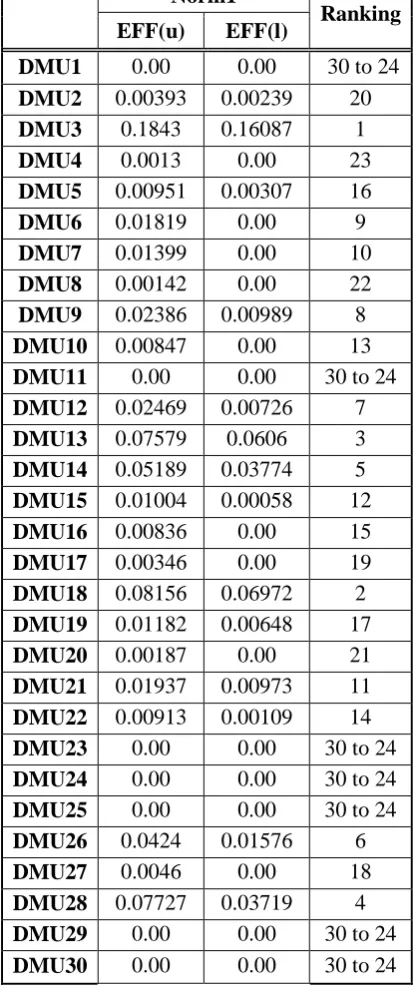
Finally, the upper and lower bounds obtained from solving model and the final Ranking have been presented.
Table 2:
Final ranking of DMUs
Norm1 Ranking
EFF(u) EFF(l)
DMU1 0.00 0.00 30 to 24
DMU2 0.00393 0.00239 20
DMU3 0.1843 0.16087 1
DMU4 0.0013 0.00 23
DMU5 0.00951 0.00307 16
DMU6 0.01819 0.00 9
DMU7 0.01399 0.00 10
DMU8 0.00142 0.00 22
DMU9 0.02386 0.00989 8
DMU10 0.00847 0.00 13
DMU11 0.00 0.00 30 to 24
DMU12 0.02469 0.00726 7
DMU13 0.07579 0.0606 3
DMU14 0.05189 0.03774 5
DMU15 0.01004 0.00058 12
DMU16 0.00836 0.00 15
DMU17 0.00346 0.00 19
DMU18 0.08156 0.06972 2
DMU19 0.01182 0.00648 17
DMU20 0.00187 0.00 21
DMU21 0.01937 0.00973 11
DMU22 0.00913 0.00109 14
DMU23 0.00 0.00 30 to 24
DMU24 0.00 0.00 30 to 24
DMU25 0.00 0.00 30 to 24
DMU26 0.0424 0.01576 6
DMU27 0.0046 0.00 18
DMU28 0.07727 0.03719 4
DMU29 0.00 0.00 30 to 24
DMU30 0.00 0.00 30 to 24
5. Conclusion
optimal solution is obtained independently of ranking. Moreover, not only score but ranking also has a key role as evaluation. In this paper, we ranked the units using interval norm1 method, and learned that this method is useful for ranking extreme efficiency units.
References
[1] A. Charnes, W.W. Cooper, E. Rodes, Measuring the efficiency of decision making units, European Journal of Operational Research, 2 (6) (1978) 429-444
.
[2] M.J. Farrell,The measurement of productive efficiency, Journal of the Royal Statistical Society, Series A, General 120 (3) (1957) 253-281.
[3] R.D. Banker, A. Charens, W.W. Cooper, Some models for estimating technical and scale inefficiencies in Data Envelopment Analysis, Management Science, 30 (1984) 1078-1092.
[4] W.W. Cooper, K.S. Park, G. Yu, IDEA and AR-IDEA: Models for dealing with imprecise data in DEA, Management Science 45 (1999) 597–607.
[5] G.R. Jahanshahloo, F. HosseinzadehLotfi, N. Shoja, G. Tohidi and S. Razavyan, Ranking by Using l1-Norm in Data Envelopment Analysis, Applied Mathematics and Computation, 153, (2004) 215-224.