Effect of Cobalt’s Chloride on the Electrical Properties of
Poly (O-Toluidine)
R. K. Fakher Alfahed
*, K. I. Ajeel
Physics Department, College of Education for Pure Sciences, University of Basrah, Iraq.
* Corresponding author. Tel.: oo9647804373779; email: [email protected] Manuscript submitted October 10, 2015; accepted December 28, 2015.
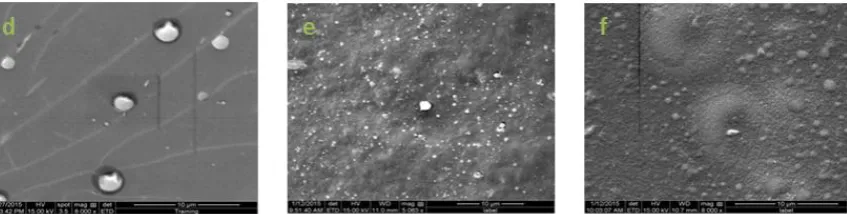
Abstract: The effect of cobalt’s chloride on the prepared polymer by chemical polymerization is clear in surface morphology of thin film, surface conductivity in addition to activation energy of the POT. The roughness of surface morphology is increased with increasing the volume ratio of dopant which also noted that, the conductivity is increased from1.70E-04 S/cm for pure POT to be 1.459E-3 S/cm at dopant ratio of 30% cobalt’s chloride.
Key words: Poly (O-Toluidine), cobalt’s chloride, surface conductivity.
1.
Introduction
The electrical properties of polymers are considered as important studies due to their applications in different fields in today life. The poly (O-Toluidine) is one of promised polymer because of used it in various aria of applications such as light emitted diode, filed effect transistor, schottky diode, solar cell and sensors [1-5]. The Polymeric materials have many physical properties which make them mostly used in microelectronic devices, in addition to inexpensiveness, environmental stability, easy of fabrication as thin films on a large area substrate, rods and disk according to the required applications [6, 7]. In scientific research area it is possible to control the electrical conductivity of polymers over the range from insulating to metallic as needed in the field of technological applications. Electrical conductivity of the polymer materials can be investigated either by the synthesis of a polymer of definite chemical structure ( such as polymer with a system of conjugated bounds and their doping ) or by the introduction of an electrically conductive filler ( i.e. metal powders, carbon black, graphite )[8]. According to above futures the POT is doped by different volume ratios of cobalt’s chloride as attempt to get better electrical properties.
2.
Procedure and Experimental Work
Preparation of Poly (o-Toluidine) (POT)
2.1.
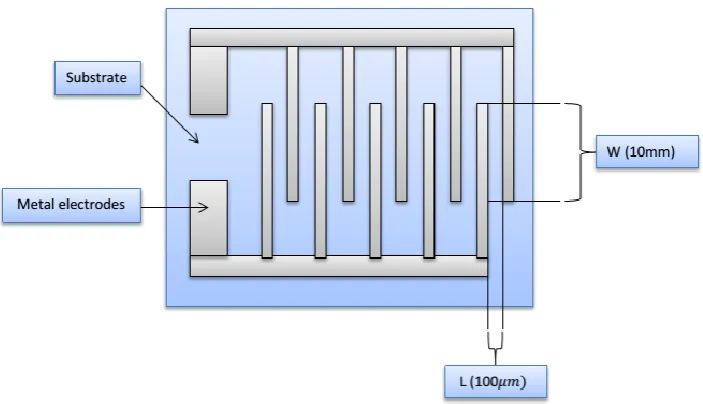
The samples are prepared by spin coating method. The glass substrate is used for the SEM analysis and thickness measurement and also the interdigitated finger substrate (see figure 1) is used for the study of electrical properties. The thin film thicknesses which are prepared for this study are (45.86, 55.7, 55.75, 55.94, 56.69, and 58.2 nm) for pure POT and doped POT by ratios (5%, 10%, 20%, 30%, and 40%) of cobalt’s chloride respectively.
Fig. 1. A schematic diagram of interdigitated finger electrode.
The two probe method is used to study electrical properties of prepared polymer and the circuit used in this method including on the Keithley electrometer instrument (Model 65174) and Digital hot plate (IKA RET basic) for measure a current as a function of applied voltage in the range of (1-40 V) in steps of (2 V) and to provide heating in the range of (308-378 K) in steps of (10 K) respectively.
3.
Results and Discussion
FT-IR Spectroscopy Analysis
3.1.
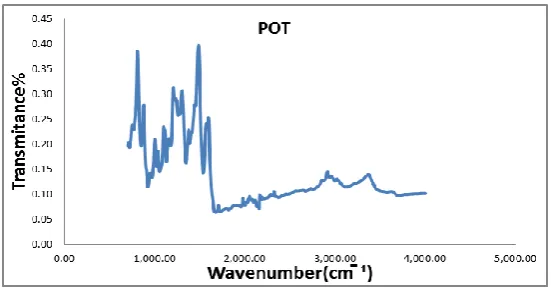
Fig. 2. FT-IR absorption spectra of POT.
XRD Analysis
3.2.
The Fig. 3 shows X-ray diffraction pattern of the POT and exhibits an amorphous structure with two small peaks at 16.78° and 25.5° which are iterplanar distance of o-Toluidine-o-Toluidine. The result of structure of POT is agreed with previous study which shows that the conducting polymers have semicrystalline or amorphous structure [12-13].
Fig. 3. XRD scattering pattern of poly (o-toluidine) POT.
SEM Analysis
3.3.
20% cobalt’s chloride, (e) 30% cobalt’s chloride, (f) 40% cobalt’s chloride.
Electrical Properties of POT and Doped POT
3.4.
The current-voltage (I-V) characterizations of preparation samples, as shown in Fig. 5, are displayed ohmic behaviour in addition to semiconductor material which is clear from the increments in the surface conductivity (which is calculated according to equation 2) with the increasing in temperatures due to the increase of efficiency of charge transfer [7, 16-17]. The increasing in volume ratio of dopants leads to an increase the conductivity which is increased with the temperatures also, as tabulated in the Table 1
σ𝘴 = [I/V] [L/Wtl] (1)
where, L is the space between electrodes (100 𝜇m), W is the distance fingers (10 mm), l is the number of the fingers is to be (10) and t is the thickness of the film [18].
So that;
σ𝘴 = 𝐼 𝑉𝑡 (
100×10−6
10×10×10−3) =
𝐼
𝑉𝑡(10
−3 𝑆
𝑀) (2)
Table 1. The Electrical Conductivity of Pure and Doped POT at Different Temperature Degrees.
T (K) 𝝈𝒔(S/cm)
pure
𝝈𝒔(S/cm)
5%doped
𝝈𝒔(S/cm)
10%doped
𝝈𝒔(S/cm)
20%doped
𝝈𝒔(S/cm)
30%doped
𝝈𝒔(S/cm)
40%doped 308 1.70E-04 1.780E-4 2.011E-4 2.459E-4 1.459E-3 2.577E-4
318 1.794E-4 1.876E-4 2.163E-4 2.655E-4 1.629E-3 2.878E-4
328 1.83E-04 1.965E-4 2.252E-4 2.8867E-4 1.761E-3 3.075E-4
338 1.86E-04 2.037E-4 2.332E-4 3.1361E-4 1.825E-3 3.265E-4
348 1.97E-04 2.127E-4 2.404E-4 3.4212E-4 1.931E-3 3.453E-4
358 2.09E-04 2.244E-4 2.503E-4 3.8133E-4 1.975E-3 3.539E-4
368 2.31E-04 2.343E-4 2.574E-4 4.232E-4 1.958E-3 3.685E-4
Fig. 5. I-V characterization of POT and doped POT (a) pure POT, (b) 5% cobalt’s chloride, (c) 10% cobalt’s chloride, (d) 20% cobalt’s chloride, (e) 30% cobalt’s chloride, (f) 40% cobalt’s chloride.
There are many factors influencing on the conductivity of polymer like, size of cations which means the smaller size of cations that increase the conductivity in addition to PH of prepared samples [19]. Accordingly, we can interpret those results because of the small size of cobalt cations increases the electron delocalization length as the interchain distance increased. Furthermore, the cobalt cations have maximum positive doping effects [20].When viscosity reaching to certain limited, that influence on the conductivity of the polymer because of the fluidity of the doping polymer will be decreased with increasing the viscosity or because of the interfacial resistance between electrode/electrolyte is increased. Salt networks in polymer become in contact with electrode which reduce the affective surface area for electron transfer between polymer and electrode that explains the decrease in the conductivity with 40% doped [21-22].
The conductivity of polymer with different ratios of dopants suggests that the conductivity of polymer with low dopants ratio results from polaron (radical cations) due to ionized chain of polymer by dopants and these cations contribute in conductivity but not significantly. While in high ratio of dopants like 30% cobalt’s chloride, the bipolarons (spinless dications) are produced as a result of combine polarons or ionize and also, the bipolarons are extended over rings of polymer. The doping process results dopants associated with alternation of aromatic configuration even to quinoid configuration (has high energy) and then confines the charge localized along the chain which increases the conductivity [10].
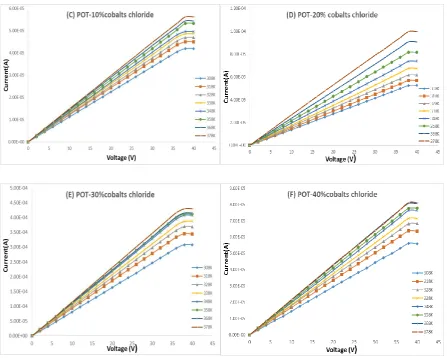
other which means that, the localized state in this ratio was greater than other ratios which refer to need lower energy for transition [24].
Fig. 6. Plot of Ln σ versus 1/T for POT and doped POT: (A) pure POT, (B) POT-5%cobalts chloride, (C) POT-10%cobalts chloride, (D) POT-20%cobalts chloride, (E) POT-30%cobalts chloride, (F)
POT-40%cobalts chloride.
4.
Conclusion
The chemical polymerization method is used to prepare POT and then doped it by different volume ratios of cobalt’s chloride as (5%, 10%, 20%, 30%, and 40%).
The prepared POT is characterized by XRD which shows amorphous structure.
The FT-IR spectroscopy shows that the prepared material is POT according to previous study.
The electrical properties of prepared samples are studied and show that, all samples displayed ohmic behavior in addition to semiconductor materials. The electric conductivity at 308 K is increased from1.70E-04 S/cm for pure POT to be 1.459E-3 S/cm at dopant ratio of 30% cobalt’s chloride.
The activation energy of prepared samples is calculated also.
Acknowledgment
I would like to thank Sheffield Hallam University/UK for support us during this research by provide us required equipment’s.
References
Energy Mater. Sol. Cells, 128, 198-203.
[2] Elmansouri, A., Outzourhit, A., Lachkar, A., Hadik, N., Abouelaoualim, A., Achourc, M. E. O., & Ameziane, A. E. L. (2009). Influence of the counter ion on the properties of poly (o-toluidine) thin films and their Schottky diodes. Synthetic Metals, 159, 292–297.
[3] Nguyen, T. P., Lee, C. W., Hassen, S., & Le, H. C. (2009). Hybrid nanocomposites for optical applications.
Solid State Sciences, 11, 1810-1814.
[4] Jeongwoo, L., Eun, J. P., Jaewon, C., Jinho, H., & Sang, E. S. (2010). Polyurethane/PEG-modified MWCNT composite film for the chemical vapours sensor application. Synthetic Metals, 160, 566–574.
[5] Kareema, M. Z., Hussein, F. H., Aseel, K. H., & Ageel, K. I. (2013). Study of the electrical characteristics of poly (o-toluidine) doped with para-Toluene sulphonic acid/N-type silicon heterojunction solar cells.
Solar Asia, CIUM.
[6] Anand, K., Vazid, A., Sushil, K., & Husain, M. (2011). Studies on conductivity and optical properties of poly (o-Toluidine)-ferrous sulfate composites. International Journal of Polymer Anal. Charact., 16, 298– 306.
[7] Adam, E. C., & Roderick, R. K. (2000). Large-area interdigitated array microelectrodes for electrochemical sensing, Sensors and Actuators B, 62, 23–29.
[8] Bredas, J. L., & Street, G. B. (1985). Polaron, bipolaron, and solitons in conducting polymers. Acc. Chem.
Res., 18, 309-315.
[9] Alfahed, R. K. F., & Ajeel, K. I. (2015). Electrical properties of blend polymers of polyvinyl alcohol/ poly (otoluidine). IJSBAR, 23, 173-182.
[10]Kareema, M. Z., Hussein, F. H., & Ajeel, K. I. (2012). Study of the electrical characteristics of poly (o-toluidine) and application in solar cell. Energy Procedia, 18, 157–164.
[11]Ding, S. H., Lu, X. F., Zheng, J. N., & Zhang, W. J. (2006). Synthesis, characterization and electrical properties of poly(o-toluidine)/multi-walled carbon nanotube composites. Materials Science and
Engineering, B135, 10–14.
[12]Oliveira, S., Luis, P. N. R., & Isabel M. M., (2015). Influence of different inorganic salts on the iconicity and thermophysical properties of 1-Ethyl-3-methylimidazolium acetate ionic liquid. J. Chem. Eng. Data, 60, 781-789.
[13]Mohammad, F. (2007). Specialty Polymers: Materials and Applications. New Delhi: I.K. International Pub. House, 40-75.
[14]Elmansouri, A., Outzourhit, A. Lachkar, N. H., Abouelaoualim, A., Achourc, M. E., Oueriagli, A., & Ameziane, E. L. (2009). Influence of the counter ion on the properties of poly (o-toluidine) thin films and their Schottky diodes. Synthetic Metals, 159, 292–297.
[15]Walsh, D. J., Higgins, J. S., & Maconnachie, A. (1985). Polymer Blends and Mixtures, 89.
[16]Zaidan, K. M., Talib, R. A., Rahma, M. A., & Khaleel F. H. (2012). Synthesis and characterization of poly (o-toluidine) POT blend with polyethylene oxide PEO as conducting polymer alloys. Der Chemica Sinica, 3(4), 841-848.
[17]Adam, E. C., & Roderick, R. K. (2000). Large-area interdigitated array microelectrodes for electrochemical sensing. Sensors and Actuators B, 62, 23–29.
[18]Frank, A. Jr., Dorielle T. P., & Shekhar B. (2010). Optimization of Interdigitated Electrode (IDE) Arrays for impedance based evaluation of Hs 578T cancer cells. Journal of Physics: Conference Series 224, 012134.
[19]Mucuk, Z., Karakisla, M., & Sacak, M. (2009). Synthesis of Poly (O-Toluidine) in DMF/ water mixture using benzoyl peroxide. International Journal of polymer Anal, Charact, 14, 403-417.