Experimental Study on the Mechanical Characterization of
Glass-Basalt Fiber Reinforced Polymer (Frp) Composites
Mohamed BakK
1*, Kalaichelvan K
21 Department of Mechanical Engineering, Ilahia School of Science and Technology, Muvattupuzha, Ernakulam, Kerala, India-686673.
2 Department of Ceramic Technology, Anna University (ACT Campus), Chennai, India-600025.
* Corresponding author. email: [email protected]
Manuscript submitted January 22, 2016; accepted March 28, 2016.
Abstract: The present study is conducted with standard test methods for determining the mechanical behavior of the FRP composites as well as with developing new materials for use in engineering applications. In the tensile tests for tensile strengthening evaluation, the tensile properties of basalt-fiber reinforced polymers (BFRP) are found to be equivalent to glass-fiber reinforced polymers (GFRP). For flexural strengthening values, the basalt fiber strengthening improved both the ultimate flexural strength and residual strength in the flexural tests at different temperatures. In contrast to GFRP, BFRP flexural strength reduction is very minimal at higher temperatures. From the impact results, basalt fiber appears to be a good material for high temperature applications than glass-fiber. This work confirms the applicability of basalt fiber as a reinforcing agent in polymer composites, and also suggested the application of basalt laminate as a strengthening material to be useful for joining of composite structures. The fractured surfaces of tested specimens are examined using Scanning Electron Microscopy (SEM) to identify the failure modes of FRP specimens.
Key words: Basalt-Epoxy specimens, Glass-Epoxy specimens, Mechanical tests, Scanning Electron Microscopy.
1.
Introduction
properties and the durability of the basalt fiber and evaluated the flexural strengthening performance for concrete structures. They concluded that basalt fiber is to be useful in civil engineering applications and good alternative methodology among other fiber reinforced polymer (FRP) strengthening applications. Glogar et al. [10] studied the mechanical properties of unidirectional composites polysiloxane-derived matrix and continuous basalt- fiber reinforced plastics (BFRPs) using hot-air treatment (650°C–750°C). Park et al. [11] conducted the fragmentation test on epoxy-based reinforced (basalt fibers and SiC fibers) composites to investigate the strength and failure mechanisms. Experimental investigations were carried out on FRP by Mohamed bak et al. [12-13] to explore the feasibility of identifying the failure modes under tensile loading and also SEM was used to characterize the failure modes such as matrix cracking, interfacial failure and fiber failure.
Glass fiber and basalt fiber were selected to be used due to their widespread applications in various industries. The type of fibers is selected depending on the applications and the fiber characteristics with respect to zero degree fiber orientation. The experimental study is conducted to investigate the applicability of the basalt fiber as a strengthening material compared with glass fiber for joining of composite structures.
2.
Specimen Preparation for Mechanical Characterization Studies
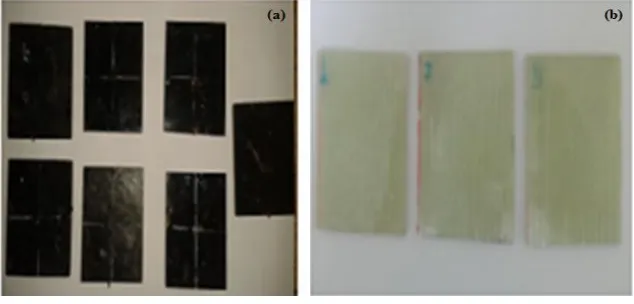
Fig. 1. ASTM D3039 standard tensile specimen: (a) GFRP (b) BFRP
Fig. 2. ASTM D790 standard flexural test specimens: (a) BFRP (b) GFRP
Fig. 3. ASTM D5628 standard impact test specimens: (a) BFRP (b) GFRP
D3039 standard [14] tensile specimens of size 280 × 18 × 3 mm3are shown in Fig. 1. ASTM D790 standard [15] flexural test specimens of size 130 × 18 × 3 mm3 are shown in Fig. 2, were cut from the fabricated laminates using a water jet cutting machine to avoid machining defects and to maintain good surface finish. Aluminum tabs of size 25 mm × 25 mm × 3 mm were used in the specimen to reduce the noise produced during testing and prevent the unexpected failures on grip length of the specimens. The impact test specimens (60mm × 60mm × 3 mm) are fabricated according to ASTM D5628 standard [16] as shown in Fig. 3.
3.
Experimental Set-up
3.1.
Tension and Flexural Testing Setup
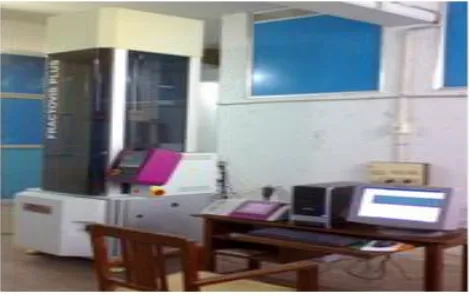
The basic mechanical properties of materials are generally determined by applying tensile, flexural and impact loadings. Three mechanical tests are carried out, according to the ASTM specifications, on both basalt-fiber reinforced plastic (BFRP) and glass-fiber reinforced plastic (GFRP) specimens: tensile, flexural and low-velocity impact tests. The ASTM standard specimens were subjected to uni-axial tension in an INSTRON 3367 universal testing machine (UTM). The UTM fixture for gripping the specimen was designed to make sure that the loading direction passes through the centre line of test specimen. The UTM fixture was fabricated with help of supplier and guided by Centre for Aerospace Research, MIT campus, and used for flat specimens. The tensile tests were conducted at a crosshead speed of 0.5 mm/min. Figs. 4(a) and (b) show the photographs of tensile and flexural test setup.
Fig. 4. (a) Tensile test setup (b) flexural test setup
3.2.
Impact Test Setup
The impact test specimen(60mm × 60mm × 3 mm)are fabricated according to ASTM D5628 standard and were subjected to drop impact at three different temperatures using a fractovis drop impact tower as shown in Fig. 5. The parameters such as impact energy (5 J) and velocity (2 m/s) are recorded. The specimens were impacted from heights of 250 mm with corresponding energy level. Therefore, it is important to develop a good understanding of impact-induced damage with varying temperature (ambient/50°C/75°C) effects in basalt fiber composite laminates constant in impact energy.
4.
Results and Discussion of Mechanical Characterization for Composite Laminate
4.1.
Tensile Test
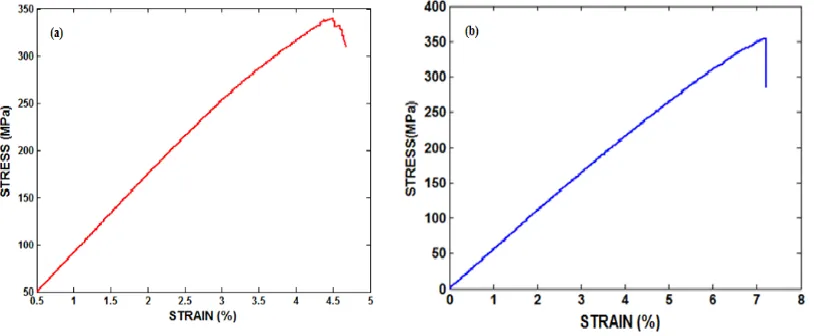
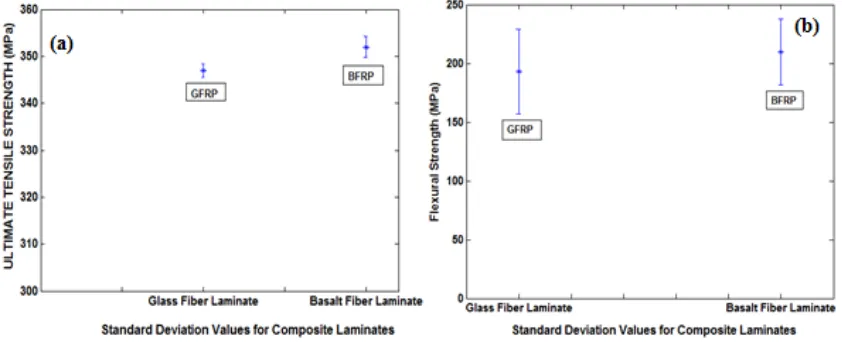
Tensile test is used to measure the tensile properties of GFRP and BFRP laminates. The specimen was mounted on the Universal Testing Machine (UTM) and dimension of the specimens were entered into the software. The tensile test experiments were conducted at the crosshead speed of 0.5 mm/min by computer-controlled INSTRON 3367 UTM. The specimens were subjected to uni-axial tension until specimens failed. Figs. 6 (a) and (b) show the stress–strain graph for GFRP and BFRP test specimen. The applied load increases steadily as the displacement increases until specimen fails. Tensile tests of three specimens each were carried out with GFRP and BFRP laminates and standard values of ultimate tensile strength of specimens were found as shown in Fig. 7(a)and Table 1. From the results, it was found that BFRP composites have marginally higher tensile strength compared to GFRP composites [6-7].
Fig. 6. Stress-strain behavior of tensile test (a) GFRP specimens (b) BFRP specimens
Table 1. Standard Deviation Values of Ultimate Tensile Strength and Flexural Strength of GFRP And BFRP Test Specimens
Strength Material
GFRP BFRP
Ultimate tensile strength (MPa) 345 ± 10 355 ± 5
Flexural strength (MPa) 195 ± 30 210 ± 20
4.2.
Flexural Test at Different Temperatures
speed 0.5 mm/min was maintained. For this study, GFRP composite laminates and BFRP composite laminates were used to trigger the flexural strength when subjected to flexural test (three-point bending) at different temperatures. Flexural test were carried out in impacted specimen at different temperatures (30°C, 50°C, 70°C). Fig. 7 (b) and Table 2 show that, in contrast to GFRP, BFRP flexural strength reduction is very minimal at higher temperatures. GFRP strength reduced to more than 30%, whereas BFRP strength reduction is less than 10% at 75°C. Due to the high temperature, at 70°C, there are significant changes on flexural strength for glass composites. When the fibers were exposed to a high temperature at over 70°C, only the basalt fiber maintained its volumetric integrity and strength. In fact, basalt fiber composite showed a 5–10% higher tensile strength as well as a better residual flexural strength and flexural behavior compared to glass fiber composite.
Fig. 7. Standard deviation values of (a) ultimate tensile strength (b) flexural strength for composite laminates
Table 2. Flexural Test Results at Different Temperatures
Material Temperature test specimen Flexural Force (N) Deformation (mm) Flexural strength (MPa)
Glass/ epoxy
30°C GF1 413.5 12.7 242
50°C GF2 380.7 11.25 179
75°C GF3 228.2 10.34 158
Basalt/ epoxy
30°C BF1 524.7 13.4 246
50°C BF2 504.5 12.77 205
75°C BF3 438.9 12.25 178
4.3.
Impact Test Results at Different Temperatures
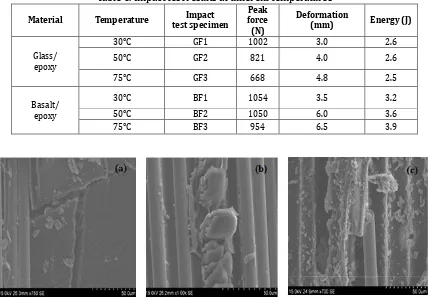
important to develop a good understanding of impact-induced damage with varying temperature effects in BFRP laminates. The compliance of the BFRP laminates increases with rise in temperature compared to GFRP laminates. The basalt fiber attained good energy absorption and improved deformation due to higher interfacial bonding strength and less fracture energy at high temperature.
Scanning Electron Microscopy (SEM) was performed on the failure surfaces to characterize the failure modes such as matrix cracking, fiber-matrix debonding and delamination fracture as shown in Fig. 9. SEM was used to categorize the defects in the specimen post yielding, and identify them. SEM as complementary, post-test inspection method was used to find microscopic evidence for the assumed assignment of failure modes.
Fig. 8. (a) Temperature (°C) vs impact energy (b) Temperature (°C) vs Peak deformation for GFRP and BFRP specimens
Table 3. Impact test results at different temperatures
Material Temperature test specimen Impact force Peak (N)
Deformation
(mm) Energy (J)
Glass/ epoxy
30°C GF1 1002 3.0 2.6
50°C GF2 821 4.0 2.6
75°C GF3 668 4.8 2.5
Basalt/ epoxy
30°C BF1 1054 3.5 3.2
50°C BF2 1050 6.0 3.6
75°C BF3 954 6.5 3.9
5.
Conclusion
The present work conducted to investigate the applicability of basalt fiber as a strengthening material to be useful for composite structural applications compared with glass fiber.
(i) On the basis of the data presented in Tables 1, 2 and 3, the mechanical behaviors of the two materials were found through the three mechanical tests. In the tensile tests for tensile strengthening evaluation, the tensile properties of basalt-fiber reinforced composites are found to be equivalent to glass-fiber reinforced composites.
(ii) For flexural strengthening values, the basalt fiber strengthening improved both the ultimate strength and residual strength in the flexural tests at different temperatures. In contrast to GFRP, BFRP flexural strength reduction is very minimal at higher temperatures.
(iii) From the impact results, basalt fiber appears to be a good material for high temperature applications than glass-fiber reinforced polymer. During impact tests at different temperatures, 28% more energy was absorbed by BFRP laminates compared to GFRP laminates.
(iv) This work confirms the applicability of basalt fiber as a reinforcing agent in polymer composites, and also suggested the application of basalt laminate as a strengthening material to be useful for composite structural applications. This is due to the higher interfacial bonding strength of basalt fiber/epoxy specimens compared to glass fiber/epoxy specimens.
The fractured surface areas of the specimens were examined directly using a scanning electron microscope and also identified the failure modes of FRP composites.
Acknowledgment
The authors thank Mr. Balaji, Technical Assistant, and Mr. Aswin Raj, Department of Aerospace Engineering, MIT Campus, Anna University for assisting the test setup.
References
[1] Wambua, P, J., I & Ignaas, V. (2003). Natural fibres: can they replace glass in fiber reinforced plastics.
Composites Science and Technology, 63, 1259–64.
[2] Czigany, T. (2005). Basalt fiber reinforced hybrid polymer composites. Material Science Forum, 473–474, 59–66.
[3] Carmignato, S., DeRosa, I. M., Sarasini, F., & Valente, M. (2009). Characterisation of basalt fiber reinforced vinylpolyester composite: An overview. Proceedings of the 2nd International Conference on Innovative Natural Fibre Composites for Industrial Applications, Rome, 15-18 April.
[4] Lisakovski, A. N., Tsybulya, Y. L., & Medvedyev, A. A. (2001). Yarns of basalt continuous fibers.
Proceedings of the Fiber Society Spring 2001 Meeting, Raleigh, NC, May 23–25.
[5] Jancar, J. (2006). Effect of interfacial shear strength on the mechanical response of polycarbonate and PP reinforced with basalt fibres. Journal of Composite Interface, 13(8), 853–864.
[6] Lopresto, V., Leone, C., & De Iorio, I. (2011). Mechanical characterization of basalt fiber reinforced plastics. Composites: Part B, 42, 717–723.
[7] Liu, Q., Shaw, T. M., & Parnas, R. S. (2006). Investigation of basalt fiber composite mechanical properties for applications in transportation. Journal of Polymer Composites, 10, 41-48.
[8] Liu, Q., Shaw, M. T., Parnas, R. S., & McDonnell, A. M. (2006). Investigation of basalt fiber composite aging behaviour for applications in transportation. Journal of Polymer Composites, 27(5), 475–483. [9] Sim, J. S., Park, C., & Moon, D. Y. (2005). Characteristics of basalt fiber as a strengthening material for
concrete structures. Composites: Part B, 36, 504–512.
with polysiloxane derived matrix. Journal of Acta Geodyn Geo Mater, 4, 27-37.
[11]Park, J. M., Shin, W. G., & Yoon, D. J. (1999). A study of interfacial aspects of epoxy-based composites reinforced with dual basalt and SiC fibersby means of the fragmentation and acoustic emission techniques. Composites Science and Technology, 59, 355-370.
[12]Mohamed, B., Kalaichelvan, K., Vijayaraghavan, K. G. K., & Sridhar, B. T. N. (2013). Acoustic emission wavelet transform on adhesively bonded single-lap joints of composite laminate during tensile test.
Journal of Reinforced Plastics and Composites, 32, 87-95.
[13]Mohamed, Bak., Kalaichelvan, K., & Arumugam, V. (2014). A Novel approach for classification of failure modes on single lap joints using acoustic emission data, Journal of Composite Materials, 48 (24),
3003-3017.
[14]ASTM D3039. (2008). Standard test method for tensile properties of polymer matrix composite materials. American Society for Testing and Materials. West Conshohocken, PA, United States.
[15]ASTM D790–10. (2010). Standard test methods for flexural properties of unreinforced and reinforced plastics and electrical insulating materials. West Conshohocken, PA, United states.
[16]ASTM D5628–10. (2010). Standard test method for impact resistance of flat, rigid plastic specimens by means of a falling dart. ASTM International, West Conshohocken, PA,USA.
Prof. Mohamed Bak Kamaludeen is working as Professor of Department of Mechanical Engineering in Ilahia School of Science and Technology, Muvattupuzha, Kerala, India. He had secured university first rank at UG level in Madurai Kamarajar University, India. He has received best academic awards from Tagore Engineering College during 2010-2011 and DSCET, Chennai during 2011-2012.He had served in various engineering colleges in various capacities such as project coordinator, faculty advisor, conference and symposium convener, NBA and ISO coordinator etc. He has served as reviewer of Journal of Reinforced Plastics and Composites, Journal of Non Destructive and Evaluation. He has proposed a research topic that acoustic emission characterization of failure modes on lap joints, which is used to identify the frequency ranges for different lap joints in composite materials. He has published twelve research papers in international and national reputed journals. He has received the best young faculty award (YFA/Engg./Mech./VIFFA 2015) from Venus international foundation, Chennai, India. He has served a life member of Aeronautical Society of India and International Association of Engineers.