Journal of Sciences, Islamic Republic of Iran 24(4): 355 - 359 (2013) http://jsciences.ut.ac.ir
University of Tehran, ISSN 1016-1104
RAWSN: A Routing Algorithm Based on Auxiliary Nodes to
Reduce Energy Consumption in Wireless Sensor Networks
A.A. Baradaran
*Department of Computer sciences ,Factualy of sciences, Islamic Azad university,Natanz, Islamic Republic of Iran
Received: 8 June 2013 / Revised: 8 October 2013 / Accepted: 22 October 2013
Abstract
In this paper, an algorithm , based on genetics and auxiliary nodes, to reduce
energy consumption in wireless sensor networks has been presented. In this
research, by considering some parameters as energy and distance, a target
function has been created, which is more optimum comparing to other methods.
In this research cluster head is selected by genetic algorithm. In RAWSN
algorithm a new technique of replacing auxiliary nodes when some CHs
’energies come to an end, is presented. The results of simulation show that the
number of alive nodes at the end of each round increases comparing to other
methods and this has led to prolongation of network lifetime.
Keywords: wireless sensor network, Genetic algorithm, routing, reduce energy consumption
* Corresponding author: Tel: +989133623329; Fax: +983624248735; Email: [email protected]
Introduction
In computer networks, routing is to find a route from source node to destination node[1,12].In a computer network, there may be several routes from source node to destination node, but optimum route is a route which is optimum based on some factors . For example , in some networks one factor is the distance of one node from its previous node. therefore, optimum route is the shortest route . We can refer to routing in wireless sensor networks, as one important thing of routing in networks [2]. Wireless sensor networks constitute some nodes which receive data from their surrounding environment and transmit those data to a Base Station (BS) [3] .One important problem, in this kind of network, is finding an optimum route from common nodes to Cluster Head(CH) and from CH to BS, to transmit data [4]. In these networks, receiving data from common nodes to cluster head (CH) and from cluster head to BS causes energy consumption leading to
reduce network lifetime [5,12]. This problem can be solved by using an optimum route . One way to find the optimum route in wireless sensor networks is the use of genetic algorithms(GA) [6,13]. Using GA to find optimum route leads to including all optimum and non-optimum points in each round of running an algorithm[8,6,4]. In GA, bit strands namely chromosomes are used for optimization[7]. In each round of running GA, the existent chromosomes take a genetic operation. By this operation , next generations are created and after running several generations, optimum solution is produced. In this research, a routing algorithm based on genetic and auxiliary nodes has been presented to reduce energy consumption in the networks and then to prolong the network lifetime.
Related Works
Vol. 24 No. 4 Autumn 2013 A.A. Baradaran J. Sci. I. R. Iran
LEACH[4,8,9]. In this algorithm, to be a Cluster head (CH) or not to be a Cluster Head is based on the following threshold:
∈
∗ − =
otherwise G n if k r k
k
n T
0
, )
1 mod ( 1 ) (
K: the percentage of CH decision(the percentage of being CH),e.g. k=0.05.
r: current round
G: all the nodes which have not been CH in recent 1/p round.
One other algorithm can be referred to as RGWSN[4]. In this method, clustering route and finding an optimum route are done by genetic algorithm. One other way of finding an optimum route in wireless sensor networks is CRCWSN[8]. In this method, a new technique of re-clustering by GA has been used. Also, one other way of energy optimization in genetic- based sensor networks , is a method presented by Jianming Zhang, Yaping Lin, Cuihong Zhou, Jingcheng and Ouyang[10]. In this method, by considering energy parameters by GA, the network lifetime has been significantly extended.
Genetic Algorithm
Genetic algorithm uses a multi- purpose search[1,4,8]. The routine work of GA is based on natural inspiration and in each round of running the algorithm, non-optimum points in the previous rounds are also included. In GA , after running each round, a generation appears. A set of solutions is called population[4,8,12]. Generations are produced by genetic operators. The genetic operators include: selection, composition and mutation .In each generation, after the operation of genetic operators on bit chromosomes a fitness value is calculated for obtained measures (populations), and then the obtained measure is compared to fitness value. By the termination of each generation , the best measure is selected as optimum population based on fitness value and it will be included in the next generation . In each generation and in selection stage, two chromosomes having higher fitness are selected as parents and in composition phase, the two selected parents compose and produce new children .Then the fitness value for children is calculated. The child having the more fitness is calculated in initial population to produce the next generation. This process is run, for several generations, to obtain an optimum solution. In general, GA can terminate under the following conditions:
•The generations reach a fixed value.
•By running GA, no recovery is obtained.
•The average fitness for several generations reaches a fixed value.
•The most fitness value shall be obtained for children.
•A combination of the above-mentioned cases occur.
Network Model and Radio Model
All the nodes in environment and base station(BS) are fixed and they can not be added or removed . The nodes’ primary energies are various. The standard radio model , used in WSN, is based on the distance between sender and receiver. Within this distance the shortest distance is crossover distance. Also the transmission power equals:[12,13]
In which:
t
p
: transmit powert
G
: gain of transmit antennaλ
: wave length of carrier signal (in meter).When the receiver distance is longer than
d
crossover, transmission power is[9,13]:t
h
: height of sender antenna (in meter).r
h
: height of receiver antenna (in meter).To transmit a n-bit message in a d meter distance , the radio energy consumption equals:[4,8,9]
crossover mp
elect TX
crossover fs
elect TX
d d d E
n d n E
d d d E
n d n E
≥ ∈
+ =
< ∈
+ =
) (
) , (
) (
) , (
4 2
Also to receive an n-bit message radio energy equals[4,8,9]:
elect
rx n nE
E ( )=
fs
∈
and∈
mp are the parameters which are dependent on receiver’s sensitivity and noise shape and Eelectis electric energy and dependent on digital code, modulation, filtering .2 2
)
4
(
)
(
d
G
G
p
d
p
t t rr
π
λ
=
4 2 2
) ( )
(
d h h G G p d
p t t r t r
RAWSN: A Routing Algorithm Based on Auxiliary Nodes to Reduce Energy Consumption in…
The New Presented Algorithm RAWSN
Each round of the new proposed algorithm composes of two steady and setup phases. In setup phase, clusters are shaped and auxiliary nodes of each grid , are introduced. In steady phase, data are transmitted to BS. The start of setup phase is by an initial message from BS accompanied by the introduction of auxiliary nodes. Initial message shows the nodes’ initial energy. In the proposed method, two auxiliary nodes are considered for each grid. The environment in which the nodes are distributed are gridded and after each grid, some nodes which are likely to be optimum CHs, are selected .The selection of each grid’s node is based on the nodes 'closeness to gravity center and higher energy. the closer the nodes to gravity center , the higher its initial energy and the sooner their selection . Then the selected nodes are used to include in GA as chromosome bits. In GA , a binary coding system is used. The chromosome attended in GA has 15 bits. After specifying chromosome bits, 50 populations are created randomly from initial chromosome and then we select populations randomly and binarily and compose them to produce new children. In the selection process, two populations having the highest fitness value are selected. The operations of selection, composition and mutation operators result in 100 populations. Then we apply fitness function on the created population and select several populations as optimum populations. We proceed with this process for several generations until GA stops. In the proposed method, fitness value equals mean energy consumption of the entire network which is calculated by Heinzleman model. Heinzleman has suggested , in a model, that each node, to transmit L bits of data in d distance from itself, consumes Etenergy.
0 4
0 2
d
d
d
L
LE
E
d
d
d
L
LE
E
mp elect
t
fs elect
t
≥
∈
+
=
<
∈
+
=
In which:
0
d
: the shortest crossover distance.elect
E
: energy required to activate electronic circuits.mp
∈
,∈
fs: parameters related to receiver’s sensitivity and noise shape.The energy necessary to receive L-bits data equal :
elect r
LE
E
=
In this phase (setup phase), the fitness value is calculated for final population’s bits and it is suggested that bits 1 indicate cluster heads(CHs) and bits 0 indicate common nodes. The fitness function or mean
energy consumption of the entire network equals:
4 3 2
1
E
E
E
E
E
total=
+
+
+
In which:
1
E
: energy necessary to send from common node to Cluster Head(CH)2
E
: Energy necessary to receive Cluster Head data from common nodes.3
E
: Aggregation energy in Cluster Head4
E
: Energy necessary to send from Cluster Head to Base Station (BS)In this phase, after applying fitness function on the selected optimum population and specifying common nodes and CHs, E1is calculated for common nodes or bits 0 and E2, E3, and E4are calculated for CHs or bits
1 . In steady phase, the data transmission from common nodes to CHs is conducted in every grid and based on the transmissions, the initial energy reduces. This is done for several rounds and if in a round a CH’s energy comes to an end, auxiliary nodes will be replaced . It is worthy to note that each grid can use only two auxiliary nodes to replace two CHs that their initial energy had terminated. It means that if there is more than one CH in a grid, auxiliary nodes will replace the two CHs whose energy, for the first time, comes to an end and if a CH’s energy terminates again in the process of running algorithm, its value(measure) will be 0 and transmit no data. Algorithm 1 shows how to implement the proposed GA. Algorithm 2 shows the GA-proposed method.
Algorithm 3 shows how to implement the proposed Method (transfer phase).
Algorithm 1. Proposed GA Function Prop_GA
0. START
1. Nodes= Random Value of Zero and One for Nodes. 2. Num = Number of Generation.
3. Crom= Create Random Populations of Nodes 4. Sets[ ]= Rand_of(Combination(Crom)) _ single_point \\ sets is array.
5. For i=0 to set[ ]
6. Best_Value= Fitness(Set[i]) 7. End
8. If num!=0 goto 5 9. else
10. Return Best_Value 11. End.
Vol. 24 No.
Simulation
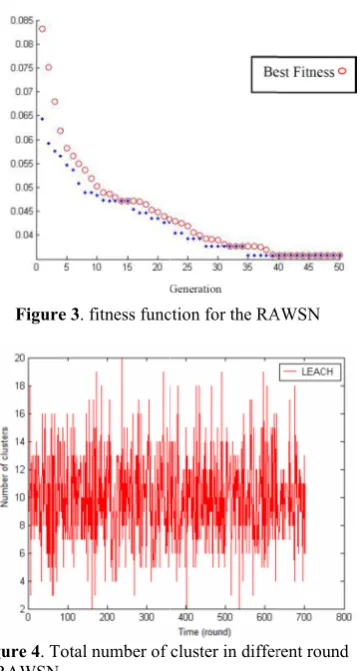
The prop MALTAB so alive nodes likely CHs in The prop GSAGA, LE Figure 2 sh shows the n rounds and proposed me
According been cleared of alive node
Algorithm 2 Function CH
0. START
1. Definition 2. Networke 3. Node Sele 4. Create ini 5. Create a r 6. Running 7. Selection 8. running S 9. if round Else if if ( nu Replace else go to End if End if 10. End
Algorithm 3 Function To 0. Call Pro 1. Call CH algorithm. R=Round nu 2. R=Round 3. for i=1 to 4. if ( transfe 5. Calculate 6. Else 7. Calculate 8. END if 9. END Fo 10. END F
4 Autumn 20
posed algorit oftware . In t in each roun n each grid ,et
posed metho EACH and RG
hows commo number of aliv
figure 4 sho ethod.
g to the abov that after run es in RAWSN
2 CH selection H_Selection_C
n of primary en ed environment
ection of each g itial population random populat g Prop_GA\\ c
optimum gener Steady phase d==0 go to 10
f (CH_energy = umber of auxilia ement of the au
10 f
3 transfer phase otal_Transfer p_GA;//call of H_Selection_C
umbers; d numbers;
R
er_Type = = Sin e( E1);
e(E2);
or Function
013
thm has bee this analysis, nd, the numb tc, have been c od has been GWSN meth on nodes and ve nodes at t ows fitness f
ve- mentioned nning 1400 rou N methods is m
and cluster for Cluster_Forma
ergy and auxili
grid
tion of initial p call of algorith ration
==0) ary nodes)!=0 uxiliary nodes a
e
f 1-algorithm. Cluster_Forma
ngle_Hop) The
A
en analyzed some factors ber of grids
considered. n compared hods. Figure 1
d CHs. Figur the end of 14 function for
diagrams, it unds, the num more than tha
rmation ation
ary nodes
population m 1 .
and go to 6
ation//call of
en
A.A. Baradara
by s as and
to and re 3
400 the
has mber at in
LE net num
for the
fro be
2-
Ta Pa Ne Ba Ini Eel
fs
ε
m
ε Da d0
No No Gr
Fig LE
an
EACH ,GSAG twork lifetim mber of cluste
As shown rmation in dif e LEACH Alg
In this resea om the existen
en proposed.
able 1. Simulati arameter etwork size ase station locat
itial energy for n
lec
fs
mp
ata aggregation
odes number of odes number
ids number
Figu
gure 2. Total nu EACH,GSAGA
GA and RG e extends. A ers in LEACH
by diagrams fferent rounds gorithm.
Res
arch, a new t nt nodes in th
In this meth
on Parameters
ion node
energy
each grid
ure 1. common n
umber of alive n ,RCSDN and R
J.
GWSN meth Also Figures 4
H and propose ms, in RAW s is more bala
sults
technique to he environme hod, a techni
Val 100*1 0,0 rand [0.2
50nJ 10pj/bi 0.0013pj 5nj/bit/ 87m
5 10 8
nodes and CHs
nodes in the RG RAWSN
Sci. I. R. Iran
hods. So the 4,5 show the ed methods. WSN, clusters
anced than in
transmit data ent to BS has ique of using
ue 00 m
m 2,0.5] J J/bit
it/ m2
j/bit/m4
/signal m
0
s
GWSN,
n
e e
s n
RA
auxiliary nod applied. By proposed tec
Figure
Figure 4. To in RAWSN
Figure 5. To in RAWSN
AWSN: A Ro
des when CH y various sim
chnique is dif
e 3. fitness func
otal number of
otal number of
outing Algorith
’s energy term mulations we fferent from p
ction for the RA
cluster in differ
cluster in differ
hm Based on
minates, has b show that previous meth
AWSN
rent round
rent round
Auxiliary No
been the hods
an lif
1.
2.
3.
4.
5.
6.
7.
8.
9.
10.
11.
12.
13.
des to Reduc
nd can signi fetime.
.Purushotham Coarse-Graine Shortest Pa operators.I.J.C
.Rahmani E., F Based Energy Parallel Gen Conference on .Zhou Z., Xia
network desig
Comput. Netw
.Delavar A. G
Presenting a energy cons
I.J.Computer S
.Chamam A.,
clustering pro
Electr.Eng.,36
.Yussof S., R
Algorithm f International Communicatio
.Bari A.,Waze
genetic algor routing in tw 7:665-676 (20
.Chamam A.,
clustering pro
Electr. Eng. ,3 .Heinzelman
H.,Energy eff sensor netwo
International
.Zhang J.,Lin Energy-Efficie Using Global
Int. symposiu application:65
.Dimokas N.,
efficient distri
J. Parallel and
.Delavar A.G. An effective Wireless Sen Algorithms, I.
.Baradaran A. Routing Algo Energy Consu
Comput. Com
ce Energy Co
ficantly prol
Refer
reddy V., Mich ed ParallelGen
th Routing
C.S.E , 2:39-42 Fakhraie S. M., -Efficient Rout netic Algorithm
n Microelectron ng X., Wang X gn for energy
w., 55 :131-146 G., Baradaran
genetic-based sumption in
Sci, 8:54-58 (20 Pierre S., A otocol for wirel 6:303-312 (2010 Razali R.Z., S
for Shortest Conference on, 5:268-273 ( ed S., Jaekel
ithm based ap wo-tiered senso
008).
Pierre S.,A tocol for wirele 36:303-312 (20
W.R., Chand ficient commun
orks. Proceed
Conference on
Y.,Zhou C., O ent Clustering l Simulated An
um on intellig
56-660 (2008). Katsaros D. buted clusterin
d distributed co
, alirezaie A., way to Redu nsor Networks
J.C.A JOUR , 4 A., delavar A orithm by Usi umption in Wire
mun. , 8:61-69
onsumption in
long the sen
rences
hael G., Umam neticAlgorithm problem u (2008). , Kamarei M., F ting in Sensor N m. The 18th nics:119-122 (2 X., Pan J., A y conservation
(2010). A. A., Artin routing algorit wireless sen 011).
A distributed e less sensor Ne 0).
See O.H.,A Pa Path Routi on Future C (2009).
A., Bandyop pproach for en or networks,AD
distributed e ess sensor netw 10).
drakasan A., nication protoc
dings of the System Science
Ouyang J.,Optim in Wireless Se Annealing Gene
gent informati
, Manolopoul ng in wireless se
omputing, 70:37 Baradaran A.A uce Energy C
by K-means 48:26-32 (2012 A.G., CRCWSN
ing Re- cluster reless Sensor N
(2013).
n…
nsor network
maheshwari M., to solve the sing Genetic
Finding Agent-Networks using h International 2006).
holistic sensor and efficient.
n j., RGWSN: thm to reduce nsor network.
energy-efficient etwork.Comput.
arallel Genetic ing Problem. Computer and
adhyay S., A nergy efficient
D. Hoc. Netw.,
energy-efficient works, Comput.
Balakrishnan ol for wireless
33rd Hawaii e, 2: (2000).
mal Model for ensor Networks etic Algorithm.
on technology
os Y.,Energy-ensor networks, 71-383(2010).
A., KGAWSN: onsumption in s and Genetic 2).
N: Presenting a ring to Reduce etworks. Int. J.
k
, e c
-g
l
r .
:
.
t
.
c . d
A t ,
t
.
n s
i
r s .
y
-,
: n c
a e