53
International Journal of Applied Exercise Physiology 2322-3537 www.ijaep.com
Vol.6 No2
Received: April 2017, Accepted: July 2017, Available online: August 2017
Heart rate and lactate response of junior handball players (Under 18) during competitive match play
Subir Gupta1, Asis Goswami2
1(Corresponding Author) Lecturer in Physiology, Faculty of Medical Sciences, University of West Indies, Cave Hill,
Barbados. Email: [email protected]. +1246-8205028
2 Scientific Officer (Exercise Physiology) (Retired), NSEC, Sports Authority of India, Salt Lake City, Kolkata, India. (Present
position: Professor, Dept. of Sports Science, Ramakrishna Mission Vivekananda University, Belur Math, Howrah, WB, India)
ABSTRACT:
Background: This study highlights the heart rate (HR) and blood lactate (La) response of junior handball players of two positions: wings and backs, during competitive matches.
Methods: Heart rate and blood lactate of twelve handball players: 6 Backs (B) and 6 Wingers
(W)] – were recorded in quarter- and semifinal matches of the tournament. HR was recorded continuously by heart rate telemeter whereas La was measured at rest, after warm up and immediately after the end of first- and second halves of the matches. Results: Average HR and Heart Rate Reserve (HRR) of the players were similar in each half of play. No significant difference (p<0.05) in average HR and HRR were observed between B (169±17.5 beats/min and 74.3±9.4%) and W (169.5±16.3 beats/min and 74.1±8.5%). W and B played about 1/5th of their playing time above the Anaerobic Threshold level. Average HR of the players in each 5 min of play could vary significantly but no such difference per 15 min of play was found. Lactate levels of W and B after the first half of play were 7.4±1.6 and 7.2±1.5 mM and after the end of the matches were 7.9±0.4 and 7.6±1.4 mM respectively. No significant difference in lactate levels was found between W and B. Conclusion: (a) Handball play is a high intensity game, (b) the workload does not vary between W and B, (c) the intensity of play could vary in every 5 min of play but there is no difference in average intensity for each 15 min, and (d) handball is played aerobically for majority of the time.
54
The sport of handball has gained tremendous popularity in the last three decades. Like other team games, physiological stress in a handball game also varies according to the tactics, level of fitness, skill of the player and their position of play or the level of the games. There are, however, some consistencies in the movement profile and total demand of the game irrespective of the match’s level or position of play. The physical exertion level of the handballers has increased considerably in the last decade partly because of the development of the game rules [1].
Heart rate (HR) and blood lactate levels (La) during handball game has been measured to evaluate cardiovascular stress and anaerobic contribution to metabolism [1,2,3]. Unlike other team games (e.g., soccer, field hockey), such studies are regrettably scanty and not found on Indian handball players. Measurement of HR and La during real game situation are also important from the training point of view. Moreover, these physiological parameters have enormous value because of their relation with the level of performance [1]. This study was designed to address the cardiovascular stress in positional roles and aerobic-anaerobic contribution in handball game.
METHODS
Twelve junior handballers (under eighteen), from three state teams (4 members from each), served as the volunteers in the present study. Their age, height, and weight were 16.9±0.6 years, 174.2±4.1 cm and 67.2±3.4 kg respectively. They were participating in a junior national championship at Chandigarh, India, and had competitive experience of 1 to 3 years. Among the participants 6 were Backs (B) and 6 were Wingers (W).
The whole study was conducted in two phases. In the first phase, VO2max and maximum heart rate (HRmax) and HR at the level of anaerobic threshold (HRAT) were determined. VO2max was evaluated on a treadmill (Venky, India) by incremental
was 8 km/h and increased by 2 km/h at every 2 min interval until volitional exhaustion. Respiratory gas exchange was analyzed continuously and computed every 15 s, until the end, using an Oxygen Analyzer (OM-14, Sensormedics, USA) and Carbon dioxide Analyzer (Ergopneumotest, Erich Jaeger, Germany). Anaerobic threshold (AT) was recorded from the nonlinear rise in VE against VO2 [4]. HR was monitored continuously by telemetry (Sports Tester PE3000, Polar Electro, Finland). HR at AT was considered as the HRAT. The highest HR attained at the end of the VO2max test was considered as Maximum heart rate (HRmax). Lowest heart rate at the resting state, before starting incremental exercise, was noted as the resting heart rate in this study.
In the second phase, HR and La of the players were measured during four important matches of the tournament. A total of 10 players volunteered in the three quarter final matches. The data of 2 players were collected during one of the semifinal matches. The matches were played in two halves pausing with a 10 min interval. Each half had the duration of 25 min. However, including ‘loss time’ and ‘time out’, the duration of each half was 29.1±1.2 min. All the matches were played in the late afternoon and about 3 to 4 hours after lunch. The players warmed up for about 20 to 30 min before the matches.
Recording of Heart Rate
LACTATE RESPONSE OF JUNIOR HANDBALL PLAYERS VOL. 6 (2)
55
International Journal of Applied Exercise Physiology www.ijaep.com HRR = [Exercise HR –Resting HR] x
100/[HRmax – Resting HR]
Collection and analysis of blood samples
Blood samples were drawn four times from each volunteer – at rest, within 1 min after the end of warm up, and immediately after the end of each half (within 1 min) of the matches. Precautions were taken not to dilute blood samples by perspiration or mixing with tissue fluid [6]. Lactate levels were measured by an automated lactate analyzer (1500 Sport, YSI, USA).
Statistical analysis
To examine the differences among the mean values, repeated measures of ANOVA were applied with Schaffe’s post-hoc analysis. The acceptance level of significance, in all the cases, was set at p<0.05.
RESULTS
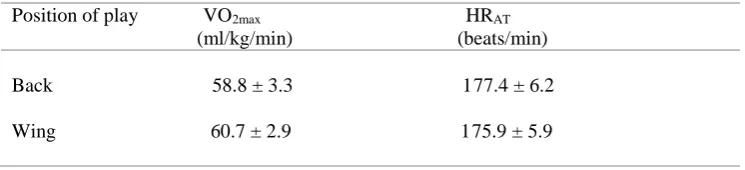
VO2max and HRAT of the handballers are shown in Table 1. No significant difference in VO2max and HRAT exists between B and W. HR variations, average HR, and HRR of the handballers are presented in Table 2. Table 2 also shows HRmax of the players. No significant difference in average HR of the players between the two halves of play was found irrespective of their positions. Both average HR and HRR of W and B were found to
vary only marginally and the differences were not significant. During play, HR fluctuates largely in the players. Although peak HR attained during play, were very high but these were still less than their HRmax by 4 to 9 beats/min.
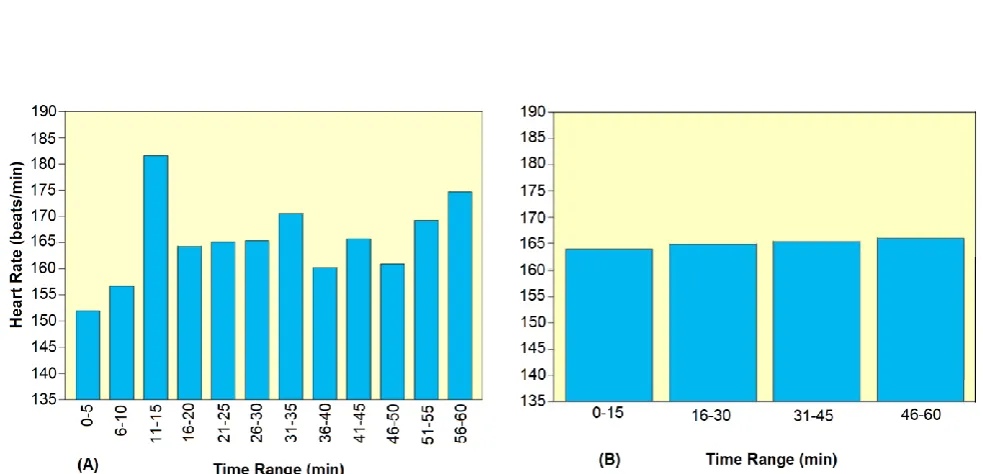
Figure 1 illustrates the average HR of a player in each 5 min and 15 min of play. Mean HR of the handballer for every 5 minute of play may vary significantly (p<0.05) but no such difference exists for every 15 min of play. Time of play above and below the AT level is depicted in Table 3. Both W and B played about 1/5th of the total playing time above the AT leveland no significant difference was noted.
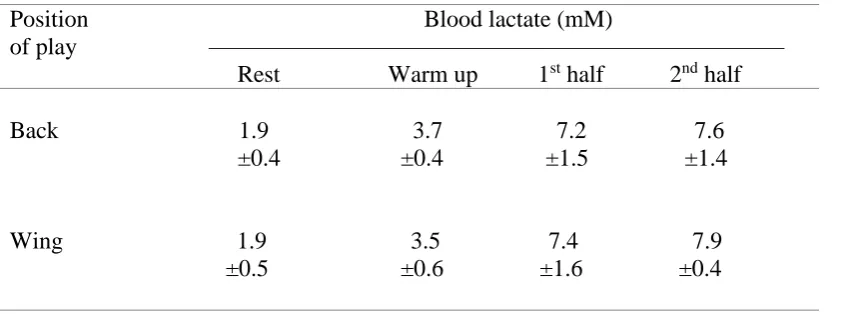
Lactate levels of the players at rest, following warm up and each half of matches are shown in Table 4. Rest and warm up La of the players do not indicate any significant difference when their positions of play are considered. However, warm up lactate is significantly higher than the respective resting values. Mean La of W and B in the second half of play are higher in the first half, however, no significant difference is noted. The La levels after each half of play are also similar.
Table 1: VO2max and anaerobic threshold of the handballers
Position of play VO2max HRAT (ml/kg/min) (beats/min)
Back 58.8 ± 3.3 177.4 ± 6.2
Table 2: Heart rate of the handballers of different playing positions
Position HRmax HR variation Average HR HRR (beats/min) (beats/min) (beats/min) (%)
————————— ————————— Minimum Peak 1st half 2nd half
Back 199.5 139.8 192.2 168.9 169.0 74.3 ±2.9 ±4.8 ±4.0 ±18.5 ±18.2 ±9.4%
Wing 199.8 135.2 193.3 170.1 169.5 74.1 ±4.9 ±9.1 ±4.6 ±17.9 ±18.3 ±8.5%
Figure 1: Average heart rate of a player in every (a) 5 minute of play and (b) 15 minute of play.
Table 3: Time of play below and above the anaerobic threshold level
Position of play Percentage of the total time of play _______________________________________
Below HRAT Above HRAT
Back 78.8 21.3 ±4.8 ±4.8
LACTATE RESPONSE OF JUNIOR HANDBALL PLAYERS VOL. 6 (2)
57
International Journal of Applied Exercise Physiology www.ijaep.com Table 4: Blood lactate levels of the handballers
Position Blood lactate (mM)
of play ———————————————————————— Rest Warm up 1st half 2nd half
Back 1.9 3.7 7.2 7.6 ±0.4 ±0.4 ±1.5 ±1.4
Wing 1.9 3.5 7.4 7.9 ±0.5 ±0.6 ±1.6 ±0.4
DISCUSSION
Studies on physiological characteristics of handballers are few compared with athletes of other team games like soccer and field hockey. VO2max of the handballers in the present study is similar to that of junior French handballers [1], but is higher than Tunisian elite male handballers [7] and junior field hockey players [6]. Thus VO2max of the handballers reflects a medium level of aerobic power.
HR response of the handballers suggests intense activity level during handball game. A study [8] on elite male handballers indicate that backcourt players (B) cover 17% more distance and spend less time in low intensity movement zone than W. In this study, however, this difference does not exist and both the average HR and HRR are almost identical in players of both positions. Probably, inexperience and relatively poor training status of the handballers in the present study are responsible for this difference from elite handballers. Average HR of B and W are similar to that of outfield football player [9] but are higher than outfield hockey players [6]. In spite of intense activity level, the circulatory load never reached its limiting value. This is, however, not in accordance to the findings of Delamarche et al [1] who showed that peak HR (192.6 beats/min) of handballers attained almost to their upper limit (194 beats/min).
It is evident from the HR variation of the players that HR remains elevated for a prolonged period and decreased below 150 beats/min, occasionally. Careful observation on two players showed that during the active
period minimum HR were 151 and 158 beats/min; during rest pauses such as foul play or ‘time out’, HR came down to as low as 139 and 148 beats/min respectively. Relatively shorter rest pauses cause elevation of HR during match play.
The present data also show that intensity of handball game is extremely erratic and results from the frequent changes in rhythm per 5 min of play. But the average workload per 15 min of play remains unchanged. Thus the intensity is also nearly equal in each half of the games. Probably the number of attacks, dribbling, jumping, and distance covered per 15 min of play do not change considerably and that results an identical stress per 15 min of play. It has been suggested [9,10] that the work rate during second half of a game is affected mainly by two factors – (a) feeling of fatigue by the players and (b) result of the game in the first half. All the matches in this study were highly competitive. The teams (consisting of the volunteers) were leading by narrow margins (16 – 13, 11 – 10, and 19 – 17 goals in the first three quarter final matches and 14 – 10 in the semifinal). So it was expected that all the players played at their best and exhausted themselves at the end.
consists of frequent unorthodox movements, such as, moving sideways and backwards, dribbling and jumping, where energy expenditure is higher than simple running forward. So, the physiological demand of handball may be an underestimation if it is expressed in HR and/or VO2 only.
Being an intermittent high intensity team game, a handball game requires warm up for manifold physiological benefits and also to minimize injuries. It also indicates that warm up La prior to handball game is higher than warm up La in field hockey [6].
Lactate levels of the players suggest that the glycolytic demand was similar in the players and remained almost unchanged in each half of the matches. Delamarche et al [1] reported La concentration of 4 to 9.3 mM with the mean value of 6.7 mM in handball players. Slightly higher La in the present study may be due to the highly competitive nature of the game that would probably have raised the exertion level of the handballers. However, in comparison to the La concentration in handballers at international meet (7–10 mM) [2] the present values are slightly lower. In comparison to La of junior hockey players [6] the value was definitely higher but less than football players in a real match play [9,11]. Average running speed during handball game is lower than most other team games, including football. However, a relatively higher lactate concentration likely results from frequent jump, throw, and more body contact than many others [12]. The La values were also higher than most of the court games like basketball [13] or volleyball [14]. In intermittent games, La concentration depends not only on the intensity and activity level of the players, but also on the duration and dimensions of the court. Greater dimensions of the handball court probably allows longer sprint running of the players than basketball and volleyball players. This may also contribute to higher La in handball matches.In spite of high intensity in nature, elevation of HR above the AT level (HRAT) for 21% of the total time played supports the fact that a handball match play is mainly aerobic in nature.
Conclusion
The findings of the above study conclude that:
(1) The intensity of competitive handball match play is very high where the circulatory load remains elevated throughout the game. (2) Although the intensity of play changes frequently, even per 5 min of play, but it remains fairly unchanged per 15 min of play. (3) The total workload during handball game does not vary markedly between W and B. (4) Handball is played aerobically for majority of the time and only 1/5 of the playing time is anaerobic.
ACKNOWLEDGEMENT
LACTATE RESPONSE OF JUNIOR HANDBALL PLAYERS VOL. 6 (2)
59
International Journal of Applied Exercise Physiology www.ijaep.com REFERENCES
1. Delamarche, P., Gratas, A., Belliot, J., Dassonville, J., Rochcongar, P., and Lessgard, Y. Extent of lactate ametabolism in handballers. International Journal of Sports Medicine, 1987. 8(1):p. 55–59.
2. Bolek, E., and Liska, O., Intenzita zatizeni haenkaru pri southezich turnazoveko typu. Trener 1981; 7(4):323– 326.
3. Soars, JMC, Telemetric study of handball goalkeepers’ heart rate during official and non-official competitions in the attack and defense phases. Journal of Sports Medicine and Physical Fitness. 1988. 28(3): p. 220–223. 4. Ghosh, AK, Mazumder, P, Goswami, A, Khanna, GL. Aerobic-anerobic transition level of Indian middle and
long distance runners. Indian Journal of Medical Research, 1988. 88(3):p. 371-375.
5. American College of Sports Medicine position statement. The recommended quantity and quality of exercise for developing and maintaining fitness in healthy adults. Medicine and Science in Sports and Exercise, 1978. 10(2):vii –x.
6. Ghosh, AK, Goswami, A, Mazumder, P, Mathur, DN, Heart rate and blood lactate response in field hockey players. Indian Journal of Medical Research, 1991. 94(3):p. 351-356.
7. Moncef, C., Said, M., Olfa, N., and Dagbaji, G, Influence of morphological characteristics on physical and physiological performances of Tunisian elite male handball players. Asian Journal of Sports Medicine. 2012. 3(2): p. 74-80.
8. Póvoas, SC, Ascensão, AA, Magalhães, J, Seabra, AF, Krustrup P, Soares JM, Rebelo, AN,Physiological demands of elite team handball with special referenceto playing position. Journal of Strength and Conditioning Research, 2014. 28(2):p. 430-42.
9. Ekblom, B, Applied physiology of soccer. Sports Medicine, 1986. 3(1):p. 50-60.
10. Ali, A, Farrally, M, Recording of soccer players’ heart rate during matches. Journal of Sports Science, 1991. 9(2):p. 183-189.
11. Reilly, T, Football. In Reilly T, Secher NH, Snell P, Williams C (editors) Physiology of Sports, London: E & FN Spon, 1990.
12. Karcher C, Buchheit M. On-court demands of elite handball, with special reference to playing positions. Sports Medicine, 2014. 44(6):p. 797-814
13. Winger, HA, Reed, AT, Metabolic factors associated with muscular fatigue in aerobic and anerobic work. Canadian Journal of Sports Science. 1976. 1(1):p. 43-48.