A Novel Adaptive Resolution Enhancement
Algorithm using ETF and DTCWT
1
C.Geetha,
2Dr. K.Manjunathachari,
3Dr. M.N.Giri Prasad
1Dept. of ECE, MTIET, Palamaner, Chittoor(dt), AP, India
2Dept. of ECE, GITAMS, Hyderabad, AP, India
3Dept of ECE, JNTUACE, Ananthapuramu, AP, India
Abstract
Diverse applications of current area frequently demands a loss less transmission of bulk sensitive data across bandwidth limited channels. All ongoing applications have a need of strong transforms with shrinking bandwidth prerequisites. Image processing algorithms exploit quantization to give generous lossy compression proportions to the expense of resolution. Late research shows that genetic algorithms advance filters beating standard discrete wavelet changes in conditions subject to high quantization mistake. While developed filters enhance general image quality, wavelet filters normally give an unrivaled high recurrence reaction, showing enhanced remaking close to the edges of items inside of an image. In this paper, we propose a calculation to produce Edge Targeted Filters (ETF) with an Adaptive Resolution Enhancement Algorithm (AREA) using a near shift-invariant, directionally selective,quadrature distinct dyadic decomposition tree based Dual Tree Complex Wavelet Transform (DTCWT).The ETF focuses on advanced edge remaking and enhances object edge determination remarkably up to 17%. Accepting the ETF output as input AREA will comes into action and calculates the complex wavelet spectrum with an aid of DTCWT. Sub band spectral coefficients are cautiously examined to detect flaw areas; accordingly a high degree coefficient interpolation is carried out to obtain the required quality enhancement.
Keywords
Resolution, Edge Targeted Filter, AREA, DTCWT and Enhance-ment.
I. Introduction
Image and signal processing are dynamic ranges of guard and experimental exploration. Satellites and UAVs abbreviated as unmanned aerial vehicles conceivably gather and transmit immense volumes of information amid surveillance missions. Sonar and radar systems process colossal measures of sensor information continuously. Profound space tests require strong information encoding calculations to make up for commotion incited by electromagnetic impedance or sun powered radiation.
With these specifications in mind, quantization is necessary for industrial, military and scientific Digital Signal Processing (DSP) applications. Shannon’s theorem imposes boundaries on amount of compression that can be produced by lossless encoding algorithms [1]. To get enhanced rates of compression with enhanced vitality compaction than lossless encoders accepts, algorithm must accept some loss of information. Quantization reduces capacity necessities by mapping all values in signal x to a small alphabet values Q(x) [2]. Smaller alphabet gives higher compression but result in higher data loss. Perfect reconstruction of x from Q(x) is impossible due to the loss of data in low-order bits.
Wavelets [4] are a standard method for signal compression techniques. The DWT (discrete wavelet transform) redistributes the energy in a signal by transforming a time signal into a time-frequency domain. DWT is applied first to compress the signal,
followed by quantization, and then entropy coding. The compressed signals are recovered in a reverse manner. Quantization gives most information loss. Note that wavelets have become popular techniques for image coding and gives the algorithmic basis for the JPEG 2000 image compression standard [3].
II. Background
The fundamental functional blocks of this work are Evolutionary Algorithms and Transforms, ETF and DTCWT. Each of which are briefly discussed as follows.
A. Evolutionary Algorithms and Image Transforms
Evolutionary Algorithms (EAs) are a main paradigm for numerical improvement. By applying Darwinian standards of recombination and common choice over various algorithmic eras, at first poor arrangements are soon refined into a populace of solutions that might be hard to distinguish utilizing customary numeric enhancement methods. As of late, transformative algorithms have been utilized as a part of conjunction with wavelets for an assortment of signal preparing applications, including signal estimation, signal characterization, and signal compression and recovering.
Images got at observation missions ordinarily require analysis by insight specialists. Objects inside pictures must be related to a high level of certainty, requiring the most noteworthy determination conceivable. Mission conditions might bring about lost determination because of transmission capacity confinements requiring quantization or information misfortune because of commotion impelled by impedance. The improvement of picture changes preserving object resolution to the most ideal degree requires preparing pictures that might be acquired by satellites, UAVs or other perception stages. We utilize an arrangement of 50 openly accessible high resolution satellite pictures downloaded from the Google Earth database. This picture set is adequately expansive to give a hearty preparing and approval tested for the picture reproduction techniques created in this examination. Every picture is a 512 by 512 pixel high contrast picture that has been balanced for greatest contrast.
B. Edge Targeted Filter (ETF):
To outline change over existing circulated frameworks, this examination does the certified coded innate count portrayed in [6], realized using Matlab’s Genetic Algorithm and Direct Search Toolbox.
worth taken from a Gaussian transport centered at a discretionarily picked watchman with a distinction of 0.5 at the first. The change pulls back in dynamic eras. At era k, the fluctuation is:
(5)
where Gens is the maximum generation. Initially, huge difference allows quick investigation of the pursuit space. As the fluctuation recoils, and the change makes little refinements with expanding likelihood. The underlying populace incorporates one chromosome comprising of unique Daub4 remaking coefficients. The remaining people are duplicates of the first wavelet coefficients increased by a little arbitrary factor. Additionally, 5% of the Daub4 coefficients are negated.
At the time of fitness evaluation previously decomposed images are recovered with a candidate filter utilizing a function for 2- dimensional recovery found in Matlab’s Wavelet Toolbox. The fitness function calculates the similarity of a reconstructed image to the original via mean squared error (MSE) Let x = {xi |i = 1,2, …,N} and y = {yi|i = 1, 2,..,Ng) denote original and recovered images. The MSE between x and y is:
(2)
III. Dual Tree CWT
The dual tree Complex Wavelet Transform (CWT) has as of late gotten noteworthy enthusiasm for the wavelet group, owing principally to its directional particular and close move invariant properties. It has been demonstrated that with two separate maximally obliterated and dyadic deterioration where channels are counterbalanced by a half example, the subsequent CWT wavelet bases shape a rough Hilbert change pair. It accomplishes this with a repetition element of 2d for d-dimensional signs, which is generously lower than the un-devastated DWT. The multidimensional (M-D) double tree CWT is non-detachable however depends on a computationally productive, distinct channel bank (FB).The double tree complex wavelet change permits the ideal remaking utilizing short straight stage channels. Additionally give proficient request N calculation just double the basic DWT for 1-D.
Fig. 1: Kingsbury’s Dual-Tree CWT.
In formulation the dual tree complex wavelet transform of course a complex pair of real and imaginary discrete wavelet transform trees. Since the single tree wavelet structure is disaster in required directional selectivity in two or multiple directions and also due
to its shift sensitive. Lack of phase information created a need for dual tree structure.
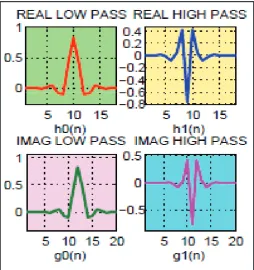
Fig. 2: Transfer Functions of Analysis Filter Pair for Both Real and Imaginary Wavelet Expansion
The outline procedure of double tree structure includes its inborn genuine tree structure as a basic stride, configuration of which includes the parallel configuration of both investigation and union stages both of which comprises of a couple of low and high pass channels basically for both deterioration and recreation. Remembering the same perspective we first now continue with outline of investigation stage for genuine wavelet development moving with a configuration of channel pair required for examination stage with a choice of a suitable wavelet sort be bior6.8. With a chose wavelet for genuine wavelet extension the exchange capacities h0(n) and h1(n)of examination channel pair are plotted as appeared in figure 2 and the related investigation genuine tree decay structure is appeared in fig. 4. Similarly, the exchange elements of low pass and high pass channel pair for quadrature genuine wavelet development, i.e., nonexistent tree are plotted as appeared in fig. 2 and the comparing examination fanciful wavelet deterioration tree structure is appeared in fig. 4. From fig. 2 it clear that the low pass and high pass channel move capacities in genuine wavelet development vary with those in nonexistent wavelet extension with a half example delay. Henceforth they are superbly limited with Hilbert change pair relationship. The connection between the channel trees in both trees can be delineated as takes after. By and large let us consider that the wavelets connected with genuine and nonexistent channel banks are signified withφ_r and φ_i with fourier transformsѱ_ randѱ_i respectively.Since the low pass and high pass channel pair in one tree will contrast with another tree with a counterbalance of a half specimen, Hence in this way they will fulfill the Hilbert change conditions delineated as takes after. For low pass channels G0 (w)≃H0 (w)×e-jθ(w), Where θ(w)=w/2
For high pass filters
Where θ(w) = w/2 and then
The condition for perfect reconstruction implies that For real tree
(1) (2)
And for imaginary tree
(3) (4)
All the filters are assumed to be causal for simplicity and is the cause for introducing the term z-d. In polyphase notation, these
filters can be written in terms of their even and odd phases according to the following relations
(5) (6) (7) (8)
Let Hp (z) and Gp (z) be the polyphase matrices of {H0 (z), H1 (z)} and {G0 (z), G1 (z)} pairs respectively Hp (z) and Gp (z) are usually written in terms of even and odd phases of these filters, for instance the polyphase matrix of Gp (z) is
(9)
The 2x2 identity matrix is denoted with a symbol ‘I’ and the symbol ‘J’ denotes 2x2 anti-diagonal matrix such that
and finally we define a matrix A(z) as the delay matrix of high pass subband such that and A-1 (z) = A(z-1). Assume
that length of filters {h0 (n), f1 (n)}is Lo. while the length of {h1 (n), f0 (n)} is L1. Incase if the filters are orthogonal and power-complimentary, all filters have same length L(i.e., L0 = L1=L). Orthogonality implies that the resulting polyphase matrices are paraunitory, thus
(10)
(11)
And the high pass filters are alternate time reversals of the low pass filters
(12) (13)
For the case when filters are bi-orthogonal, the length of filters may be different. One interesting class of bi-orthogonal solutions is one in which the low pass filters{g0 (n),p0 (n)} are related to {h0 (n),f0 (n)} by a time reversal, thus
(14)
(15)
The bi-orthogonal filters that are presented in this paper will confirm to the above constraint.
IV. Proposed Work
In this work we have composed and actualized a novel Adaptive Resolution Enhancement Algorithm utilizing ETF and DTCWT, which goes for enhancing the visual determination and data
substance of the low quality, low determination pictures. As a most importantly undertaking of this calculation the ETF accepts the input image of low resolution and performs the operation of edge detection, with which it explores the basic edge and ridge structures of the input image. In fact, in any digital image the edges and boundaries will be key contributors of image quality. For this reason the ETF will first computes the edge structures of the test image and analyses them. Depending upon the edge processing results, The ETF will generate a mask for edge processing.
Error in images remade with advanced channels happens close protest edges. The underlying stride to counter this effect is to separate these edges using an edge revelation computation to recognize areas containing critical moves in pixel intensities. Great edge location Algorithms (GA) incorporates the Sobel finder and the 3x3 distinction vector indicator, among numerous others. These algorithms take an assortment of methodologies for edge recognizable proof. The exemplary Sobel edge locator performs a 2-D Spatial slope convolution utilizing a couple of 3x3 convolution portions reacting edges running vertically and on a level plane with respect to the pixel grid.
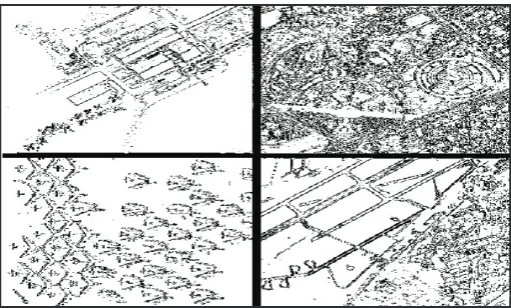
Once the edges of a picture have been disconnected, the GA advances a channel to remake the bits of a picture close edges. A twofold cover picture is made from the edge picture by setting a pixel edge. Pixels darker than the given edge in the edge picture are set to dark in the cover, wrapping the remaining pixels are white. The dark bits of the mask are utilized to choose a part of the first preparing picture to consider amid wellness assessment. These covers are utilized as portrayed in the accompanying area to control the advancement of picture channels intended to enhance the resolution of recreated images either close question edges or in the remaining segments of images.
Fig. 3: Edge Detection Algorithm Applied on Fig. 6.
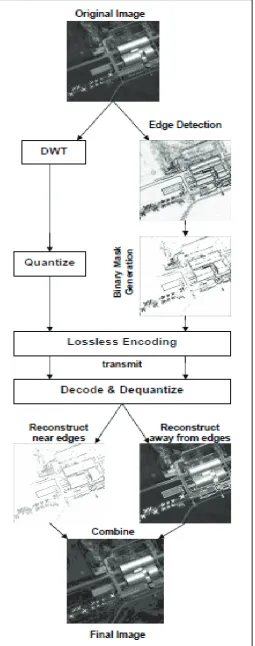
Fig. 5: Image Decomposition and Reconstruction With Evolved Filters.
Amid headway of the channel planned to reduction goof close edges, the entire get ready picture is reproduced, however wellbeing is simply determined at the pixel positions arranged inside the dim fragments of the spread encasing the edges recognized by the
edge acknowledgment computation for the gave get ready picture. This approach obliges the GA to build up a channel that upgrades picture propagation close question edges. Section 5 depicts the change of this channels.
The edge parts of the preparation picture are segregated using double cover. This limit coordinates the required nature of the edge area yield for a given pixel position to be considered part of an edge for the spread. In the span [0 - 255], the base limits select least domains of the photo as edges. More prominent edges encase a more noteworthy piece of the arrangement picture. To discover comparing setting for the edge, numerous GA runs are directed using the U.S. Aviation based armed forces exhibition hall picture from fig. 2. At a quantization level of 64 and one level of disintegration, the MSE of the picture recuperated using the Daub4 DWT-1 is 138.13. An overall propelled channel, used as a gage for examination, fulfills a proliferation MSE of 106.108 talking to a decrease of 23.18%. Neighborhood filters for the reproduction of item edges are advanced utilizing edge veils produced at different limit settings running from 48 up to 192, showed by the cover made at the given edge. At every threshold, the locally evolved filter response is compared to the Daub4 DWT -1 response and the globally evolved filter response for the edge portions of the training image isolated by the mask.
Now the output of the ETF process is propagated to the DTCWT process block which calculates the complex wavelet spectra of the ETF output. The Sub band spectral frequency coefficients are carefully inspected to reveal the flaw areas and the adequate coefficient interpolation is carried out to enhance the spectral resolution of the DTCWT coefficients. After performing the necessary adaptive spectral resolution, the coefficients are subjected to the inverse DTCWT process to reflect the similar changes in the spatial domain and to get the resolution enhanced image in the spatial domain.
Fig. 6: USAF Museum Satellite Image
V. Results and Discussion
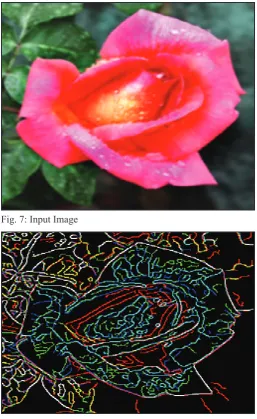
Fig. 7: Input Image
Fig. 8: Computed Edge Structures
Fig. 9: ETF Output
Fig. 10. Final Improved Output of AREA Algorithm
Table 1: Performance Comparison of the Proposed Algorithm With the Existing Technique
Method PSNR RMSE MAXERR L2RAT Resolution %
Existing 30.3876 29.7089 889 0.0334 15.9925 Proposed 42.8543 18.9057 254 0.0095 19.5915
VI. Conclusion
In this project we have designed, coded, implemented and tested a novel Adaptive Resolution Enhancement Algorithm (AREA) using the ETF and DTCWT. The proposed algorithm is implemented in hierarchical processing steps, which are aimed at improving the visual resolution of the poor quality, low-resoluted images. The AREA enhances the performance of ETF and provided results. The simulation results obtained from this algorithm adjudged that the proposed algorithm is best in all aspects and out-performs all other existing techniques.
References
[1] B. E. Usevitch,“A tutorial on modern lossy wavelet image compression: foundations of jpeg 2000,” IEEE Signal Processing Magazine, pp. 22–35, September 2001.
[2] I. Daubechies, Ten Lectures on Wavelets. SIAM, 1992. [3] A. Gersho, M. Gray,"Vectors Quantization and Signal
Compression", Kulwer Academic Publishers, 1991. [4] I. Daubechies, Ten Lectures on Wavelets. SIAM, 1992. [5] M. R. Peterson, G. B. Lamont, F. Moore’s,“Improved
evolutioanry search for image reconstruction transforms,” In Proceedings of the IEEE World Congress on Computational Intelligence, 2006, pp. 9785–9792.
[6] J. Walker,"A Primer on Wavelets and Their Scientific Applications", CRC Press, 1999.
[7] M. Lankhorst, M. van der Lann,“Wavelet-based signal approximations with genetic algorithms,” In Proceedings of the 4th Annual Conference on Evolutionary Programming, 1995, pp. 237–255.
[8] D. A. Huffman,“A methods for the construction of minimum redundancy code”, In Proceedings of the IRE, Vol. 40, 1952, pp. 1098–1101.
[9] E. Jones, P. Runkle, N. Dasgupta, L. Couchman, L. Carin, “Genetic algorithm wavelet design for signal classification,” IEEE Transactions on Pattern Analysis and Machine Intelligence, Vol. 23, No. 8, pp. 890–895, August 2001.
C.Geetha, Associate professor & HOD Dept of ECE, in Mother Theresa Institute of Engineering and Technology, palamener, chittoor(dt), AP, India. She is doing research in the area of Image Processing, and she attended one international and five national conferences. She has work experience of 10 years in teaching.
Dr. K.Manjunathachari, Working as professor & HOD Dept of ECE, in Gandhi Institute of Technology and Management, Hyderabad, AP, India. He has completed Ph.D and he has work experience of 23 years, in teaching and 3 years of industrial experience and total 26 years experience