A
pplied
R
esearch on
E
nglish Language
V. 7 N. 2 2018 pp: 171-194
http://uijs.ui.ac.ir/are
DOI: http://dx.doi.org/10.22108/are.2018.104481.1123
___________________________________________
*
Corresponding Author. Authors’ Email Address:
1 Mahmood Reza Atai ([email protected]),2 Esmat Babaii ([email protected]),
Evaluation of EAP Programs in Iran: Document Analysis and Expert
Perspectives
Abutaleb Iranmehr
1*, Mahmood Reza Atai
2and Esmat Babaii
31
Ph.D., Applied Linguistics, English Language Department, Shahrood University of Technology, Iran
2
Professor of Applied Linguistics, English Language Department, Kharazmi University, Iran
3
Associate Professor of Applied Linguistics, English Language Department, Kharazmi University, Iran
Received: 2017/05/31 Accepted: 2018/01/08
Abstract: This study aimed to examine the policies in the Iranian English for Academic
Purposes (EAP) education and the extent to which objectives match the policies and are
materialized in practice. To this end, course descriptions in the syllabi for the EAP programs
were evaluated through document analysis and triangulated with the experts‟ perspectives
through interviews to examine the current status of EAP policy-making and practice in Iran.
Seven policy areas from Kaplan and Baldauf‟s (2005) language-in-education planning were
chosen as the framework of the study. Based on document analysis and interviews with the
experts, the similarities and discrepancies in micro and macro levels were investigated. The
results showed that EAP course descriptions do not include any comments on policy and there
were discrepancies in policy and practice due to such factors as lack of communication channel
between the EAP stakeholders and policy-makers. Finally, the study revealed that due to
deficiencies in both policy and practice and in order to reach an acceptable status, EAP
programs are in dire need for reconceptualizing policy-making and practice. The findings of
this study have significant implications for EAP policies and practice in the academic system of
Iran.
Keywords: EAP, Language-in-education Planning, EAP Documents, Experts, Evaluation,
172 Applied Research on English Language, V. 7 N. 2 2018
ARE
L
Introduction
English for academic purposes (EAP) has been taken seriously in the last fifty years
(Hutchinson & Waters, 1991). Consequently, the number of research studies in this area has
flourished in recent decades (see Hyland, 2006). The trend has also expanded in Iran in the
last two decades (e.g., Atai, 2002a, 2013; Atai & Mazlum, 2013; Hayati, 2008; Khany &
Tarlani-Aliabadi, 2016). The research findings reveal that the top-down trend in EAP
curriculum policy-making is still dominant in Iran in the sense that EAP policies are issued to
systematize EAP programs and objectives are set to operationalize these policies
(Soodmand-Afshar & Movassagh, 2016). In fact, in Iran, EAP practice lags behind EAP research as the
policies, decisions, and objectives set for EAP programs are not based on research findings
(Hayati, 2008). In the same way, the EAP research has not explored the broader educational
system; instead, it has decontextualized micro elements of EAP programs for investigation.
Reviewing the literature on the topic reveals that few studies (e.g., Atai & Tahririan, 2003;
Soodmand-Afshar & Movassagh, 2016) have been carried out to evaluate the status of
policies in EAP programs from policy-planning to implementation level as currently
practiced in Iranian academic settings.
On the other hand, Kaplan and Baldaulf (2005) introduced their language-in-education
planning (LEP) framework for designing and evaluating language programs to the field of
language studies, a framework vigorously welcome by research in different subfields
(Baldauf, Li, & Zhao, 2008). As a subfield, foreign language teaching has had its own share
of research based on this innovative framework (Zein, 2017). The LEP framework comprises
seven policy areas, including access policy, personnel policy, curriculum policy, methods and
materials policy, resourcing policy, community policy, and evaluation policy (Baldauf et al.
2008). Access policy addresses 'who learns what languages'. Personnel policy deals with the
requirements of teacher selection. Curriculum policy addresses the issue of whether the
language policy is centrally defined or not. Methods and materials policy deals with methods,
materials and textbooks. Resourcing policy concerns the impacts of the policies and their
funding. Community policy addresses the issue of whether community has any freedom for
choosing the language of instruction, and evaluation policy assesses whether the goals
targeted by the program are achieved. Due to the importance of EAP programs in Iran, the
present study was conducted to evaluate the current EAP policies and practice in Iran based
Evaluation of EAP Programs in Iran: Document Analysis and Expert Perspectives 173
former research on EAP in Iran though it has potentials for EAP policies and programs and is
able to present a systematic evaluative design for such policies and programs (Zein, 2017).
EAP in Iranian Higher Education
EAP programs in Iran are designed to prepare the students to communicate easily in their
academic and occupational situations nationally and internationally and have become a major
part of the curricula (Atai & Tahririan, 2003). The main objective of the EAP programs is
claimed to be "bridging the gap between the students' General English Proficiency (GEP) and
their ability to read authentic discipline-specific texts" (Atai, 2006, p. 28). Based on various
EAP curricula in different academic fields, students are required to pass between one and
three optional/obligatory EAP courses planned by Ministry of Science, Research, and
Technology (MSRT), while students possess a substandard level of GEP required for entering
EAP courses (Atai & Tahririan, 2003).
In terms of EAP programs as an indispensable part of English language Teaching
(ELT) in Iran, the legislative system and MSRT are the major sources of promoting language
acquisition policy and planning. They exert their influence through choosing the language of
instruction, deciding on EAP curriculum development and implementation, deciding on the
type of teaching instruction, determining the type of textbooks and materials needed to be
published mostly through government-led publications.
Contrary to the importance of EAP courses in the university curricula, the findings
reveal that students typically lack the adequate proficiency and communication skills needed
to satisfy their needs. According to Atai (2002a), EAP courses in Iran have been developed
unsystematically and EAP program policy-makers have based their decisions on intuitions
and general statements of the goals. Under such circumstances, accountability and
developmental purposes of the local national programs have not been evaluated. Furthermore,
the incoherent EAP curriculum development in Iran and the ambitious goals set by the
policy-makers have made the realization of the course primary objectives rather
unmanageable.
After three decades of practice of EAP as an area within the Iranian higher educational
system, it is time for a thorough evaluation to see how much EAP programs have achieved
the expected goals and objectives. As Hutchinson and Waters (1991) believe, “any language
teaching course has evaluation requirements, but in ESP, these are sharply brought into focus
174 Applied Research on English Language, V. 7 N. 2 2018
ARE
L
insufficiency of EAP programs was widely reported in various studies and in different
domains as materials development, evaluation, methodology, curriculum development, and
needs analysis (Loghmani, Biria, & Khaki, 2016). Therefore, evaluation, as the missing link
in the chain process of planning, implementation, evaluation and renewal seems necessary to
tap on those flaws of the EAP academic programs (Atai, 2002a; Atai, 2002b; Hayati, 2008).
Thus, to probe into the current EAP programs in Iran, seven research questions were
formulated based on the policy areas of Kaplan and Baldauf‟s (2005) LEP framework:
1. Is the access policy observed in the Iranian EAP programs?
2. Do the qualifications of Iranian EAP teachers –selection, employment and training–
correspond with the stated policies?
3. Is the current Iranian EAP curriculum centrally or locally defined?
4. To what extent do methods, materials and textbooks taught in Iranian EAP programs
suit the policy?
5. Is EAP program development, implementation and evaluation in Iran budgeted
sufficiently?
6. Does community (i.e. involved stakeholders) have any share in choosing the EAP
programs for instruction?
7. Are the goals targeted by the EAP program achieved?
The study
In this study, the researchers intended to collect data through document analysis and experts‟
views. To this purpose, the constant comparative method of analysis (see Leech and
Onwuegbuzie, 2007) was used. That is, the data on the experts‟ attitudes and perceptions
towards EAP programs were constantly compared to the data collected in the document
analysis in order to achieve interpretations that would explain the similarities and contrast
between the two sets of data. The process of data collection is described below.
Document analysis
Document analysis is a fruitful data collection and analysis tool particularly when we are
dealing with policies made at higher-order levels of the educational system and with whether
these policies have been met and practiced at lower-order levels of the system (Bowen,
2009). In accordance with this argument, a document analysis protocol was adopted in the
Evaluation of EAP Programs in Iran: Document Analysis and Expert Perspectives 175
consisted of analyzing the existing official written materials which related to EAP program
development and evaluation in Iran. The documents, considered as objective statements of
social fact (Atkinson & Coffey, 2004), included national policies documents within MSRT,
curriculum documents, and the EAP-specific documents.
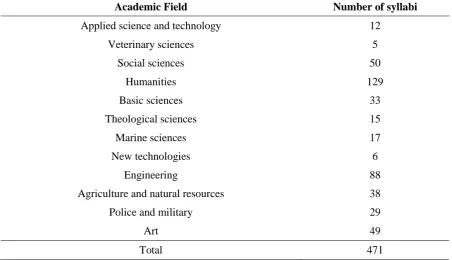
The only EAP documents found in the present study were a corpus of EAP course
description documents in various academic curricula which were retrieved from the website
of Office of Planning in Higher Education. Table 1 shows the academic curricula for
undergraduate programs used in the present study. The classification of the curricula was
based on MSRT website information.
Table 1. The Corpus of academic course descriptions for undergraduate programs in Iran
Academic Field Number of syllabi
Applied science and technology 12
Veterinary sciences 5
Social sciences 50
Humanities 129
Basic sciences 33
Theological sciences 15
Marine sciences 17
New technologies 6
Engineering 88
Agriculture and natural resources 38
Police and military 29
Art 49
Total 471
Of 471 obtained curricula for undergraduate levels in the above-mentioned
classifications, all the sub-disciplines in a discipline contained the same EAP syllabi. That is,
the syllabus designers used one EAP syllabus as a cliché for all sub-disciplines. Therefore, all
EAP syllabi of sub-disciplines in one discipline were considered as one syllabus. Moreover,
some curricula did not contain any EAP syllabus and were omitted from the corpus
accordingly. Therefore, only 266 syllabi from the obtained curricula were considered as the
corpus of the study. Then the EAP syllabi were extracted from the academic curricula and
were coded based on the information found in the syllabi. The syllabi were then subjected to
176 Applied Research on English Language, V. 7 N. 2 2018
ARE
L
assessment procedures, teaching methodology, teacher specifications, and other items
included in the present study.
Interviews with the experts
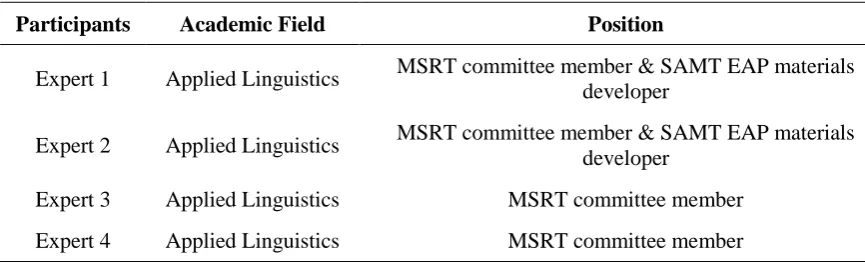
A series of semi-structured interviews were conducted with those involved with EAP
programs in Iran at the macro level. Interviews were conducted with 4 experts who were
chosen from among ELT specialists who had years of experience in teaching English and
were known as distinguished scientific experts in the community. These specialists were
involved in EAP policy-making/program designing and EAP textbooks development and
were members of influential committees in MSRT (from Literature and Foreign Languages
Committee for Higher Education, Committee for the Evaluation of Iran‟s University
Textbooks for Humanities, and SAMT publication).The interviews were conducted based on
a list of ready questions constructed based on Kaplan and Baldaulf‟s (2005) LEP framework.
However, as the interviews were intended to be semi-structured, the questions asked in them
were not limited to the ones in the list as new questions were asked from the interviewees as
a result of communication between the interviewer (one of the researchers) and the
interviewees. The data were collected and transcribed verbatim and coded for further analysis
following Dörnyei‟s (2007) guidelines.
The data from both the documents and the interviews were coded independently by two
of the researchers to make sure about the reliability of the coding process. A panel was held
with the third researcher in which the discrepancies in the coding process between the coders
were discussed and agreed upon.
Table 2. Demographic information for the EAP policy-makers/program designers and EAP
materials developers
Participants Academic Field Position
Expert 1 Applied Linguistics MSRT committee member & SAMT EAP materials
developer
Expert 2 Applied Linguistics MSRT committee member & SAMT EAP materials
developer
Expert 3 Applied Linguistics MSRT committee member
Evaluation of EAP Programs in Iran: Document Analysis and Expert Perspectives 177
Results Access Policy
Access Policy addresses the issues related to learner, levels of language proficiency, and the
duration of learning (Kaplan & Baldauf, 2005). The only proposition included in the EAP
syllabi was related to the specifications made about the number of units and hours that should
be devoted to EAP programs. Regarding the first issue related to the access policy (i.e. course
units and hours), the obtained data were rather restricted. The only information in this regard
was related to how many these units and hours for each academic major should be. In the
analysis of the collected EAP syllabi, two course classifications were strongly predominant in
the document analysis; i.e. „one course of two units‟ (54.5%) and „two courses of two units‟ (28.9%). The other classifications were as the following: „three courses of two units‟ (4.9%), „four courses of two units‟ (2.3%), „one course of three units‟ (3%). „two courses of three units‟ (0.8%) and, identically, „four courses of one unit‟ (0.8%), „one course of four units‟ (1.1%), and „one course of one unit‟ (1.1%). The rare classifications (i.e. those with only one case, e.g. „two courses of four units‟, „two courses of one unit‟, „a course of three units plus a course of two units‟, etc.) were specified only by 2.6% of the syllabi. These frequencies of
course units and hours seem sporadic. There was no justification mentioned in the syllabi as
to why particular decisions on such course units had been made.
A second issue related to the access policy was concerned with the levels required of
the participants before they entered EAP classrooms. In the context of EAP programs in Iran,
an entailment of this issue is the question of whether English for General Purposes (EGP)
should be considered as a prerequisite for EAP courses or the two programs are independent
of each other. In fact, the specification of this prerequisite in the syllabi was rather categorical
rather than descriptive. Of the documents collected, 62.8% of the syllabi (N = 167) explicitly
obligated EGP (a course of three units) as the perquisite for EAP course while the remaining
37.2% of the syllabi (N = 99) did not mention the prerequisite for the EAP course.
Expert 1 believed that certain levels of English proficiency would be needed for
entering EAP programs.
When the student doesn’t know the basics of English, doesn’t have a functioning repertoire of English words, and doesn’t know the basics of English structures,
and when he believes EAP texts are beyond his English proficiency knowledge,
this can be considered as a needs analysis to show student’s deficiency in English
178 Applied Research on English Language, V. 7 N. 2 2018
ARE
L
Personnel Policy
Personnel Policy addresses the requirements for teacher selection, employment, and training,
and their language proficiency standards (Kaplan & Baldauf, 2005). The analysis of the
collected syllabi indicated that setting criteria for selection, evaluation, and training of EAP
instructors had been largely neglected in the documents. Of all the EAP syllabi traced in the
present study, only two syllabi specified some requirements for EAP teachers, and these are
those which have been recently revised.
Quranic Science and Hadith (integrated and revised) approved in 2016: teachers who
have mastery in teaching English as well as mastery in Quranic Sciences and Hadith
Teaching Islamic Thoughts (revised) approved in 2016: Having at least a master's
degree related to the field with 3 years of teaching experience, ability to use teaching aids
and visual aids and educational software
Similarly, only two academic syllabi specified who should teach EAP. The two majors
of Geography and Teaching Geography required that EAP courses be taught by content
teachers of geography.
Teaching Geography (revised) approved in 2015: This course should be taught by teachers of Human or Physical Geography.
Geography (3 branches of Tourism planning, Urban planning and Regional planning)
approved in 2008: [EAP] teachers should be specialists from among the related fields.
The problem is that, no matter how much emphasis we put on setting criteria for
selection and evaluation of EAP instructors and designing teacher education programs for
them, the document writers and policy-makers have been negligent of the importance of these
criteria, resulting in a „chaotic situation‟, to use Expert 1‟s terms,
They do not even have a department for assessment or evaluation, let alone for
the more minor issues such as teacher training, teacher retraining, new teaching
methods, new teaching technology, or the interaction between them.
Unfortunately, there is a complete visible chaos both in policy-making and
practice. (Expert 1)
Curriculum Policy
Curriculum Policy delves into the issues of what curriculum should be mandated and who
determines it (Baldauf et al. 2008). The coding of the syllabi indicated that policies and
Evaluation of EAP Programs in Iran: Document Analysis and Expert Perspectives 179
taught were prescriptively issued by top-down policy-makers. Table 3 presents the
information found in the syllabi about the language skills that should be focused on and
taught in EAP programs in Iran. A point is in order here. The prescription of the English
skills had not been exclusive in the syllabi as there were syllabi which required the instructors
to focus on and teach more than one English skill in their EAP classrooms. All of the syllabi
(100%) emphasized the importance of reading comprehension and teaching students to read
academic and technical texts in English. Of the 266 syllabi, 10.5% (N = 28) prescribed
English writing and 7.9% (N = 21) prescribed that English speaking should also be taught.
Finally, 4.9% of the syllabi (N = 13) prescribed that English listening should also be taught to
EAP students in Iranian universities.
Table 3. Language skills prescribed in EAP Syllabi
Language Skills Listening Speaking Reading Writing
Frequency (%)
13 (4.9%)
21 (7.9%)
266 (100%)
28 (10.5%)
Expert 3 agreed with the proposition, saying that EAP classrooms were the place
learners needed to read in English, the kind of reading necessary in academic and
professional contexts.
Reading texts has been the traditional and common purpose of EAP courses over
the years because the EAP textbooks usually start with a text. Of course, there
are various activities that serve reading the text such as translation, finding
equivalents or reading comprehension. Other skills are paid little or no
considerable attention. (Expert 3)
According to Expert 4‟s comments, EAP students‟ needs were not necessarily restricted
to English reading comprehension; however, instructors do not have any other choice but to
compromise to be able to address the practical challenges faced by EAP programs.
If we consider the needs of students, we can see their needs are diverse. In EAP,
they may be able to read texts in their field to some extent, but this is not the only
need. One may wish to attend a conference, have presentation, write a paper, or
communicate with professors from other countries, or have interaction with
various experts in the community. Needs analysis should be carried out to find
the needs of each specific field, but due to time constraints, it is limited to reading
180 Applied Research on English Language, V. 7 N. 2 2018
ARE
L
The coding of the syllabi also indicated that vocabulary was the language component
mainly prescribed in them. It would be of paramount importance to point out that whenever
the term „vocabulary‟ or „words‟ was used in a syllabus, it was always accompanied by the term „technical‟, or the term „terminologies‟ stood alone in the syllabus to emphasize „technical‟ vocabulary which is the register for the academic major for which the syllabus has
been written. Table 4 presents the information found in the syllabi about the language
components to be taught in EAP programs in Iran.
Table 4. Language components prescribed in EAP Syllabi
Language Component
Vocabulary
(Technical Terms) Grammar Pronunciation
Frequency (%) 121 (45.5%) 19 (7.1%) 3 (1.1%)
45.5% of the syllabi (N = 121) emphasized the importance of English vocabulary and
7.1% (N = 19) emphasized the importance of grammatical structures for EAP students. Also,
1.1% of the syllabi (N = 3) emphasized the importance of pronunciation for EAP classrooms.
Along with a traditional view that language learning, in both academic and
non-academic settings, is about reading English texts and learning and memorizing English
words, a large number of syllabi (38.3%) prescribed that Iranian learners should learn to
translate academic texts from English into Persian (Table 5). Related to this prescription was
the requirement made by 3.8% of the syllabi that students acquire the ability to translate in
the opposite direction; i.e. from Persian into English. Report writing, which is defined as the
ability to write report of technical procedures undertaken in academics and professions, was
prescribed by 9.4% of the syllabi. In addition, the academic skills of essay writing, dictionary
use, academic text search, and text editing were each prescribed by 3%, 2.6%, 1.1%, and
0.8% of the syllabi, respectively.
Table 5. Academic skills mentioned in EAP syllabi
Evaluation of EAP Programs in Iran: Document Analysis and Expert Perspectives 181
Methods and Materials Policy
Methods and Materials Policy addresses the regulation of teaching methods and materials in
the educational system (Kaplan & Baldauf, 2005). Of the 266 syllabi, only 3.8% of the
syllabi (N = 10) prescribed methods for teaching EAP in classrooms while the remaining
96.2% of the syllabi (N = 256) did not have any comment on this issue. Table 6 presents the
information in the syllabi about the methods for teaching EAP in Iranian universities. The
methods specified in the EAP syllabi were not exclusive in that some syllabi specified more
than one method for teaching EAP. 2.6% of the syllabi (N = 7) specified „Cooperative Learning‟ and 1.9% of the syllabi (N = 5) specified „Communicative Approach‟ for teaching EAP. In addition, the teaching methods, or more correctly, techniques of „Lecturing‟ and „Practice and Drilling‟ were specified by 1.1% (N = 4) and 0.4% (N = 1) of the syllabi.
Table 6. Methods suggested for methods of teaching EAP in the Syllabi
Cooperative Learning Communicative Approach Lecturing Practice and Drilling
7 (2.6%) 5 (1.9%) 4 (1.1%) 1 (0.4%)
Broad prescriptions were included in them as to which source the EAP textbooks
should be chosen from or if the instructor is allowed to sample the EAP materials (Table 7).
25.2% (N = 67) prescribed the use of the materials published by the SAMT publication,
which was considered as an independent category in the analyses because of its dominance in
the publication of university materials for Iranian universities; 19.2% prescribed the use of
EAP publications from other in-house publishers; 17.7% prescribed the use of materials
including both textbooks and scientific articles from international publishers. On the other
hand, 3.0%, 2.6%, and 1.5% of the syllabi prescribed the use of dictionaries and
encyclopedias, internet sources, and teacher-selected materials for EAP classrooms,
respectively.
Table 7. Materials suggested in syllabi to be used in the EAP classrooms
182 Applied Research on English Language, V. 7 N. 2 2018
ARE
L
In the interviews, the experts argued that the EAP publication system should move towards
decentralization.
The educational system in Iran has not supported any publication except SAMT
and has created a monopoly, perhaps based on some considerations which are
not scientific. It is not good to monopolize all academic textbook publication just
to SAMT. Some of its textbooks are 20 years old. (Expert 3)
This change would allow for the entrance of more efficient publishers into the EAP
market, publishers which would be able to prepare more updated and scientific EAP
materials.
The book is like goods on which the customers have a choice. They cannot be
denied of their choice. Whatever done centrally in the preparation of educational
textbooks, in the secondary education, higher education, or in SAMT, is
considered a monopoly. However, in today's world, there is easy exchange of
information and access to various materials produced at the international level.
The government should stop monopoly to let other textbook publishers grow.
(Expert 4)
Resourcing Policy
Resourcing Policy is particularly concerned with the provision of equipment and financial
budgets for an educational system (Kaplan & Baldauf, 2005). The coding of the syllabi
indicated that the syllabi were highly deficient in this respect. As Table 8 shows, 9% (N = 24)
prescribed the use of audiovisual equipment (video projectors, educational films, slides, etc.),
0.8% (N = 2) prescribed the use of dictionaries, encyclopaedias, and library resources, and
another 0.8% (N = 2) prescribed the use of the Internet and educational software in
classrooms.
Table 8. Use of audiovisual equipment suggested in the syllabi
Audiovisual Equipment
Dictionaries/ Encyclopaedias/ Library Resources
Internet and Educational Software
24 (9%)
2 (0.8%)
2 (0.8%)
On the other hand, the syllabus did not include any specifications as to whether, and
how much, financial budgets should be allocated to designing EAP courses, supporting
Evaluation of EAP Programs in Iran: Document Analysis and Expert Perspectives 183
positive changes that technological advancements might bring to EAP instruction and EAP
classrooms. Expert 4 took a step further to discuss that nowadays the use of technological
advancements in EAP classrooms is not an option, but rather it is an urge.
The curricula were planned when there was not such a development in
technology. Computers were not available, and the Internet access was not
universal yet. Technology is so essential in today’s world that it should be
incorporated into the curriculum. One benefit of revising the syllabi will be
paying due attention to technology. (Expert 4)
In addition, allocation of financial budgets to an educational system is an issue of
paramount significance which keeps the system moving. Supporting research and
establishing a responsible organization to improve the status of EAP agenda are issues that
should be seriously addressed.
Writing syllabi and compiling syllabi is a very specialized task that should be defined as a research project, i.e. defined as output of an institution. The issue is
so important and fundamental that it should be brought up as a national issue.
Because millions of dollars are wasted on it, and on the basis of few sporadic
investigations, its efficiency is less than 10%. Nearly 90% of it is a waste of
money and resources. (Expert 1)
Community Policy
Community Policy elicits information about whether stakeholders from the micro layers of
the EAP system (i.e. students and instructors) are consulted, and whether feedback from these
individuals is received, and how the quality of EAP programs can be improved (Kaplan &
Baldauf, 2005). Unfortunately, the collected documents had nothing to say if feedback from
the micro layer in EAP programs in Iran would be welcome. In addition, no communication
channels for this purpose have been predicted in the first place.
They may give agency to a group or individual to evaluate a curriculum, but
when the curriculum was evaluated, results are not very effective because the
feedback is not fed back into the system. Consequently, the research will only be
archived and will have no impact on the program itself. (Expert 4)
The situation seems even worse when we come to know that no analysis (across and
within policy-making and practice layers in EAP) has been done in the first place as to why
184 Applied Research on English Language, V. 7 N. 2 2018
ARE
L
should be included in the course. In addition, no opportunity for communication between the
EAP stakeholders is predicted, at least over the near future.
But the issue is that decisions on having such courses or omitting them, and being
selective or obligatory were made on the basis of a tradition. For example, 20 or
30 years ago experts determined EAP course to be required for a certain field.
They [MSRT] neither decentralize power to the universities nor establish
institutions or organizations as an intermediary layer to adjust policies, get the
feedback from the implementation, conduct supervision, or do re-modification.
(Expert 1)
Evaluation Policy
Evaluation Policy constitutes a holistic assessment of a language education program to
determine whether the goals of the program have been achieved (Kaplan & Baldauf, 2005).
In this study, the experts emphasized that EAP in Iran is in a dire need of what Baldauf
(2005) call Language Acquisition Management (LAM) system. Such a system would provide
a platform for the planning, integration, accommodation, and evaluation of different language
planning areas (including both L1 and L2). Baldauf et al. (2008) argue that “[p]olicy
decisions in each of these areas contribute to LAM and the question of where the agency for
that policy resides is important in understanding how language acquisition is managed” (p.
234). The analysis of the interviews indicated that a number of issues were more of
significance to the current and future EAP agenda in Iran as the following.
The fact that current EAP curriculum development and syllabus writing in Iran have been highly defective
The need for a coherent language educational system incorporating both EGP and
EAP
An urge for research-based EAP practice, teacher education, and textbook preparation
and evaluation
The need for communication among stakeholders involved in EAP in Iran
(policy-makers, syllabus writers, textbook developers, teachers, and students)
The need for an organization responsible for the LAM system in Iran‟s education
Evaluation of EAP Programs in Iran: Document Analysis and Expert Perspectives 185
In the interviews, the experts went to discuss that EAP curricula in Iran are not based
on rigorous research or needs-analysis studies. It seems that the syllabi have been written for
an “imagined community of practice” which, most of the time, never materialize, leaving the
functioning results of EAP postponed to an unknown time in the future when the need arises.
The current syllabi are outdated; some belong to the Cultural Revolution period,
and has not changed so far. In writing syllabi, many points have not been
clarified and left unexplained and the objectives are broad and sweeping. The
objectives are subject to different interpretations based on one’s scientific
background. The aim of the program is to create a common language. To do this,
they must reach a level of specifications so that it decreases the chance for
different interpretations. (Expert 4)
The experts argued that we should take one step back and reconceptualize EAP
policy-making and practice. Specifically, there is a need for a LAM system which would regulate
foreign language acquisition as a coherent investment. According to Expert 4, if ELT in Iran
wishes to be successful during academic lifetime of students from high school to university,
EGP and EAP should be unified into the LAM system. This means that each educational
section becomes complementary to the other to the final desired goal, which is the mastery of
the English language.
In fact, EGP and EAP are discussed under the umbrella term of ELT. Language
learning occurs at different levels, both in high schools (junior and senior), and in universities. If any development is going to occur concerning English learning
in high schools and universities, there must be a unified management to regard
these two sections of education as a single interrelated framework, and not as
two disparate separate bodies. (Expert 4)
Expert 2 contended that any organization devoted to EAP in Iran should be inevitably
research-oriented; Expert 4 argued about the need to train efficient EAP teachers based on
theoretical models and research findings and, finally, Expert 3 talked about the need to fund
research on EAP textbook preparation and evaluation.
If there is a specialized center in the country that is supposed to decide for EAP
programs of all disciplines, then English teaching should be research-based, and
this cannot happen based only on the teacher’s mere understanding. It should be
186 Applied Research on English Language, V. 7 N. 2 2018
ARE
L
Theoretical models developed and research work done in this regard should be
utilized to make a balance [between language and content] in EAP courses and
train competent teachers. We should use language specialists and content
specialists to provide a coherent program so that EAP instructors can be trained
in both of these respects. In this way, the problem of teaching language as well as
the integration of content and language as a medium of instruction can be
resolved. (Expert 4)
Expert 1 believed that the prospect is bright in this direction though it is far from ideal,
meaning that the improvements are yet shaky as they are not systematic and rooted in
higher-order language polices. Perhaps, this implicit fear is the reason why Expert 2 believed in the
importance of establishing a common discourse between language and content departments
through Teaching English for Academic Purposes (TEAP).
A consensus should be achieved. I think the starting point is the Council for
Development. First, TEAP should be defined in the Office for Development, and
then there will be universities presenting the course. As I said before, we still do
not have a common discourse in this field. In the past, we brought up the issue. It
could be continued again. An organization such as SAMT may take the
responsibility and bring up the issue as a national discourse. Also, new talks with
the Council for Development can be resumed. (Expert 2)
Discussion
Regarding Access Policy in EAP in Iran, while the analyzed syllabi made prescriptions about
how many units and hours could serve the objectives set for EAP programs in Iran, the
interviewees were conservative about this issue. Probably because the experts knew one size
does not fit all; the decision depends on a number of local factors and it cannot be made in
void. The interviewees rejected the idea that EGP and EAP were independent of each other
and also contended that EGP should be considered as a requisite to EAP as we cannot make a
border between the two. Similarly, Atai (2006) believes that EGP and EAP are governed by
the same principles of learning and teaching. In addition, the analyzed syllabi had little to say
about Personnel Policy for EAP courses in Iran; i.e., these courses suffer from a complete
chaos which would not allow for the specification of criteria related to the teacher
employment, training, and evaluation (Atai, 2002b; Soodmand-Afshar & Movassagh, 2016).
Evaluation of EAP Programs in Iran: Document Analysis and Expert Perspectives 187
administrating the programs, there is little hope for effective EAP teacher education programs
(see Atai, 2006; Soodmand-Afshar & Movassagh, 2016).
Regarding Curriculum Policy, it seems that the discrepancy between what is ideal and
what is practically possible has also stricken to the EAP syllabus writers in Iran. All the
analyzed syllabi prescribed the teaching of reading skills while other language skills
(listening, speaking, and writing) were largely overlooked. In addition, more than half of the
syllabi prescribed the teaching of academic and technical vocabulary, and the academic skills
prescribed to be taught were all written in nature. This shows that practicality issues of EAP
classrooms in Iran have prevented the EAP syllabus writers from prescribing the teaching of
communicative, oral EAP skills in EAP classrooms. Soodmand-Afshar and Movassagh
(2016) describe this status of EAP programs in Iran: “The units in the textbooks usually
follow a very rigid and consistent format. The cycle might look something like pre-reading,
reading, homework (being mainly a translation exercise), and some grammatical exercises”
(p. 134). According to Camiciottoli and Querol-Julián (2016), the use of traditional,
teacher-centered techniques in EAP classrooms around the world, which are usually represented
through teacher lectures, is a matter of obligation rather than choice driven by the large
number of students in EAP classrooms.
Regarding Methods and Materials Policy, the results indicated that there is not an open
market for EAP materials and the materials prepared by the in-house publishers are often the
first choice of EAP teachers. However, the EAP policy-making agencies and in-house
publishers are not thoroughly to blame. The interviewees complained about this situation
since they believed that, if we desired reforms to EAP in Iran, we had to support other
publishers and teachers had to take their own responsibility. Internationally published EAP
materials are available in the market and the internet is replete with academic articles and
authentic materials that could be beneficially used in EAP classrooms (Stoller, 2016).
EAP practitioners often bring additional materials into class (from magazines,
newspapers, academic journals, introductory academic-textbook chapters, or
YouTube) to meet students‟ needs. When seeking supplementary materials, EAP
practitioners face the challenge of locating materials that build upon textbook
content, lend themselves to academic tasks, and complement students‟ needs,
proficiency levels, and interests. (Stoller, 2016, p. 580)
In contrast to the materials to be used, the methods to teach these materials have been
188 Applied Research on English Language, V. 7 N. 2 2018
ARE
L
techniques for the purpose, leaving teachers on their own to decide how to teach EAP.
However, there is not much variation in this area as the common practice involves the
reading of academic and technical passages followed by the use of translation, true-false,
multiple-choice reading comprehension tests; i.e., the structure of the existing materials does
not allow for communicative practice of the language knowledge and, thus, policy-makers
should have second thoughts about materials and methods for EAP programs in Iran
(Soodmand-Afshar & Movassagh, 2016).
Regarding Resourcing Policy, less than 10% of the syllabi prescribed the use of
supplementary resources and technology. This is disappointing as there is a wealth of
literature indicating that the use of technology can benefit EAP students‟ learning and can
also serve an effective function in the classroom (Jiménez-Muñoz, 2016). In addition, the use
of supplementary materials increases the exposure that students would have with the English
lexical items and grammatical structures and would help them improve their language
learning metacognitions (Tomlinson, 2011). The experts were aware of the benefits that
supplementary materials and technology would have for EAP classrooms in Iran. They
believed that it would be necessary to equip EAP classroom with these resources. The experts
also talked about the need for budget and financial support to be devoted to EAP research,
pre-service and in-service teacher education, and design and development of EAP materials,
teaching methods, and evaluation methods. However, they believed that these could only be
done through a coherent LAM system as the majority of the resources and budget devoted in
the past wasted (see Atai, 2002; Hayati, 2008; Soodmand-Afshar & Movassagh, 2016).
As for Community Policy, the interviewees strongly believed EAP community
members in Iran should be given a chance to express their ideas. However, no channels were
predicted in the syllabi for letting the stakeholders at the micro level communicate their ideas
with the stakeholders at the meso and macro levels of EAP. The classical distinction between
policy-making and practice in education is evident here (Salas, Mercado, Ouedraogo, &
Musetti, 2013). This situation would harm both the needs and rights of the stakeholders at the
micro level (Salas et al., 2013). From a needs-analysis perspective, educational contexts are
characterized by the interests that the stakeholders hold in their educational pursuits. Thus, it
is necessary for the educational system to be sensitive about these interests and the sensitivity
Evaluation of EAP Programs in Iran: Document Analysis and Expert Perspectives 189
completely undemocratic. According to Benesch (2001), EAP are all about power relations
between different layers in the educational system through which EAP rights are more
socially constructed. She contends that, in undemocratic EAP, rules are externally imposed
on those who are allowed no voice in the process of policy- and decision-making. In a critical
analysis of EAP in Iran, Ahmadvand, Barati, and Ketabi (2013) talk about the need for “a
negotiation between different players regarding decisions on ESP learning, teaching, and
testing practices covering needs and wants of all sides in a discourse community” (p. 8).
As for Evaluation Policy, the analysis of the syllabi indicated that EAP in Iran suffers
from poor documentation, incoherent policy-making, and lack of supervisory mechanisms.
The poor documentation is not only characteristic of EAP but also the whole language
educational system in Iran, which has led Aghagolzadeh and Davari (2017) to criticize that
“shortcomings and inconsistencies among the available educational and developmental documents that deal with English education are quite evident” (p. 58). In addition, it would
be very difficult to assess the success of a language education agenda if the policies and
objectives are not efficiently conveyed to the stakeholders at the lower levels of the agenda
and if evaluative and supervisory mechanisms are not predicted.
While Mirza-Suzani, Yarmohammadi & Yamini (2011, p. 182) contend that EAP
programs in Iran are “quite at a loss about what they have been expected to achieve during
the course period and what they are supposed to achieve as the ultimate objective”, some
other researchers (e.g. Atai, 2006; Hayati, 2008; Soodmand-Afshar & Movassagh, 2016)
argue that the programs are in fact successful in teaching reading comprehension skills,
technical vocabulary, and English grammatical structures. Given time constraints, classrooms
with a large number of students, and outdated materials and teaching methods, it would be
untenable to expect more. This reality was confirmed in the interviews with the experts in the
present study. No matter which of the aforementioned positions about the success/failure of
the EAP programs we accept, it seems that EAP needs substantial reforms. The solution
seems to be a LAM system (Spolsky, 2009) which would serve several functions. Firstly, the
system would supply the channels for communication which are very necessary in an era of
student-centered education when it is required that “students be consulted about their felt
needs and interests, which, in turn, results in higher motivation on the part of the learners”
(Soodmand-Afshar & Movassagh, 2016, p. 133). These channels would also give a “voice to
the teacher who is the closest to students” (Dahbi, 2017; p. 149). In addition, it would
190 Applied Research on English Language, V. 7 N. 2 2018
ARE
L
during academic lifetime of students from the high school into the university as defining EAP
based on an imagined community of practice would not be useful. Campion (2012) poses the
argument that when we see language education as a continuum rather than a dichotomy or
separate modules, EAP has already begun in the students‟ academic life before entering the
university though it may be arbitrarily called as EGP. Lastly, it would contribute to a mutual
understanding between content and language departments at universities (see Ding &
Campion, 2016).
Implications and suggestions for further research
This study would make its own contributions to the construction of a localized framework for
evaluating EAP programs in Iran. Such a localized framework would be strongly useful and
can be tuned so that it will include evaluation criteria for the specifications of the Iranian
EAP context. In addition, the study would help the current research on EAP in Iran be more
sensitive to issues that might have significant percussions for the ultimate success of EAP
agenda in Iran. More importantly, the findings would make the EAP Iranian researchers more
conscious about the caveats that current EAP programs in Iran would suffer from at different
layers of policy-making, development, and practice and help them adopt critical research
designs to address pseudo-scientific positions that might have been accepted at these different
layers. On the other hand, some ideas are suggested for further research. The present study
only investigated the perceptions of EAP experts regarding EAP policies and practice in
Iranian higher education. It is suggested to probe into other EAP stakeholders‟ (i.e. EAP
teachers and students) perceptions to provide a more comprehensive view of the issue. It
would be also fruitful if studies are undertaken to compare EAP policy-making and
implementation in Iran with those in other countries so that informed decisions on how to
improve EAP practice in Iran can be made. Such comparisons should be based on common
grounds between Iran and other countries‟ educational systems such as culture, religion, and
geography.
References
Aghagolzadeh, F., & Davari, H. (2017). English Education in Iran: From Ambivalent Policies
to Paradoxical Practices. In R. Kirkpatrick (Ed.) English Language Education Policy in
Evaluation of EAP Programs in Iran: Document Analysis and Expert Perspectives 191
Ahmadvand, M., Barati, H., & Ketabi, S. (2013). Rights Analysis of ESP Courses: Towards
Democratizing ESP Education. English for Specific Purposes World, 46, 1-13.
Atai, M.R. (2002a). ESAP curriculum Development in Iran: An incoherent educational
experience. Special Issue of the Journal of Persian Literature and Human Sciences of
Tehran Teacher Training University, 1(3), 17-34.
Atai, M.R. (2002b). Iranian EAP programs in practice: A study of key methodological
aspects. Sheikh-Bahaee Research Bulletin, 1(1), 1-15.
Atai, M.R. (2006). EAP Teacher Education: Searching for an effective model integrating
Content & language teachers‟ schemes. Proceedings of PAAL Conference, (pp.23-41).
Kangwong National University, Chuncheon, Korea. Retreived from: http://www.
paaljapan. org/resources/proceedings/PAAL11/pdfs/03.
Atai, M.R. (2013). English for Specific Purposes: International trends and Middle East
concerns. In R. Akbari & C. Coombe (Eds.), The Middle East Handbook of Applied
Linguistics. Dubai, United Arab Emirates: TESOL Arabia.
Atai, M.R., & Mazlum, F. (2013). English language teaching curriculum in Iran: planning
and practice, The Curriculum Journal, 24 (3) 389-411.
Atai, M.R., & Tahririan, M.H. (2003). Assessment of the Status of ESP in the Current Iranian
Higher Education System. Proceedings of the 14th European Symposium on Language
for Special Purposes: Communication, culture, and knowledge. University of Surrey,
Guildford, UK.
Atkinson, P.A. & Coffey, A. (2004). Analysing documentary realities. In D. Silverman (Ed.),
Qualitative Research: Theory, Method and Practice (2nd ed.) (pp. 56–75). London:
SAGE Publications.
Baldauf Jr, R.B. (2005). Micro language planning. In P. Bruthiaux, D. Atkinson, WG
Eggington, W. Grabe, V. Ramanathan (Eds.), Directions in Applied Linguistics: Essays
in Honor of Robert B. Kaplan (Vol. 133, pp. 227-239). UK, Clevedon: Multilingual
Matters.
Baldauf Jr, R.B., Li, M. & Zhao, S. (2008). Language Acquisition Management inside and
outside the School, In B. Spolsky & F.M. Hult (Eds.) The Handbook of Educational
Linguistics (pp. 233-250). Oxford, UK: Blackwell Publishing Ltd.
Benesch, S. (2001). Critical English for academic purposes: theory, politics, and practice.
192 Applied Research on English Language, V. 7 N. 2 2018
ARE
L
Bowen, G.A. (2009). Document analysis as a qualitative research method. Qualitative
Research, 9(2), 27-40.
Camiciottoli, B.C., & Querol-Julián, M. (2016). Lectures. In K. Hyland, & P. Shaw (Eds.)
The Routledge Handbook of English for Academic Purposes (pp. 309-322). London:
Routledge.
Campion, G. (2012). ‘The learning never ends’ Investigating teachers’ experiences of moving
from English for General Purposes to English for Academic Purposes in the UK
context; What are the main challenges associated with beginning to teach EAP, and
how can these challenges be overcome?(Unpublished MA thesis). The University of
Nottingham.
Dahbi, M. (2017). A call for English teachers in Morocco to practice agency through action
research. In P.C.L. Ng, & E.F. Boucher-Yip (Eds.) Teacher Agency and Policy
Response in English Language Teaching (pp. 148-159). London: Routledge.
Ding, A. & Campion, G. (2016). EAP Teacher Development. In K. Hyland, & P. Shaw,
(Eds.). The Routledge Handbook of English for Academic Purposes. (pp.547-559),
London: Routledge.
Dörnyei, Z. (2007). Research methods in applied linguistics: quantitative, qualitative, and
mixed methodologies. Oxford: Oxford University Press.
Hutchinson, T., & Waters, A. (1991). English for specific purposes: a learning-centered
approach (6th printing). Cambridge: Cambridge University Press.
Hyland, K. (2006). English for academic purposes: An advanced resource book. Routledge.
Hayati, A.M. (2008). Teaching English for special purposes in Iran: Problems and
suggestions. Arts and Humanities in Higher Education, 7, 149-165.
Jiménez Muñoz, A. J. (2016). Content and Language: the Impact of Pedagogical Designs on
Academic Performance within Tertiary English as a Medium of Instruction. Porta
Linguarum, 111-123.
Kaplan, R.B., & Baldauf Jr, R.B. (2005). Language-in-education policy and planning. In E.
Hinkel (Ed.) Handbook of Research in Second Language Teaching and Learning (pp.
1013-1034), Mahwah, NJ: Lawrence Erlbaum Associates.
Khany, R., & Tarlani-Aliabadi, H. (2016). Studying power relations in an academic setting:
Teachers' and students' perceptions of EAP classes in Iran. Journal of English for
Evaluation of EAP Programs in Iran: Document Analysis and Expert Perspectives 193
Leech, N.L., & Onwuegbuzie, A.J. (2007). An array of qualitative data analysis tools: A call
for data analysis triangulation. School Psychology Quarterly, 22(4), 557-584.
Loghmani, N., Biria, R., & Khaki, M. (2016). Instructional Efficacy of Task-Based Approach
in Teaching Micro-Skills to Iranian EFL Learners Coping with English for Academic
Purposes (EAP) Reading Texts. Journal of Applied Linguistics and Language
Research, 3(4), 24-37.
Mirza-Suzani, S.M., Yarmohammadi, L., & Yamini, M. (2011). A Critical Review of the
Current Situation of Teaching ESP in the Iranian Higher Education Institutions. The
Iranian EFL Journal, 36(3), 179-204.
Salas, S., Mercado, L.A., Ouedraogo, L.H., & Musetti, B. (2013). English for Specific
Purposes: Negotiating Needs, Possibilities, and Promises. English Teaching Forum,
51(4), 12-19.
Soodmand-Afshar, H. S., & Movassagh, H. (2016). EAP education in Iran: Where does the
problem lie? Where are we heading? Journal of English for Academic Purposes, 22,
132-151.
Spolsky, B. (2009). Language management. Cambridge: Cambridge University Press.
Stoller, F.L. (2016). EAP Materials and Tasks. In K. Hyland, & P. Shaw (Eds.) The
Routledge Handbook of English for Academic Purposes (pp. 577-591). London:
Routledge.
Tomlinson, B. (2011). Materials development in language teaching. Cambridge: Cambridge
University Press.
Zein, M. S. (2017). To Postpone or not to Postpone? Examining Access Policy on Early
Foreign Language Learning from Second Language Acquisition and Language
194 Applied Research on English Language, V. 7 N. 2 2018