© 2016, IRJET | Impact Factor value: 4.45 | ISO 9001:2008 Certified Journal | Page 859
Linear Phase High Pass FIR Filter Using Bare Bones Particle Swarm
Optimization
HARJASKARAN SINGH
1Mrs. MANDEEP KAUR
21
Assistant Prof. Dept. of ECE, Sai Institute of Eng. & Tech, Amritsar, Punjab, India.
2
Assistant Prof. Dept. of ECE, Beant College of Engineering & Technology, Gurdaspur. Punjab, India.
---***---
Abstract
-The paper proposes a robust and stable Bare Bones particle swarm optimization based design procedure for digital Finite impulse response (FIR) filters. The proposed BBPSO method enhances the capability to explore and exploit the search space to obtain the optimal filter design parameters. The BBPSO uses Gaussian sampling strategy to modify positions and has the capability to operate in multidimensional search space with less number of control parameters. The proposed method is effectively applied to the design of high-pass digital FIR filters of 20thand 30th order. The computational experiments show that
the proposed BBPSO method is superior or at least comparable to basic PSO algorithm and can be efficiently applied to higher order filter design.
Key Words
:
-
FIR filter design, Bare bones particle swarm optimization, Least square method, Particle swarm optimization, High pass filter1. INTRODUCTION
The digital filters are used for signal separation and signal restoration operation. A digital filter is a mathematical algorithm that modifies the input signal for specific characteristics of amplitude, frequency and phase. Image processing, speech synthesis, secure communication, instrumentation, control engineering and biomedical instrumentation, smart cites, internet of things etc. are some of the prominent application. In contrast to analog filter the digital filters can process filter online and/or offline. The main advantages of digital filters are summarized as: stable performance, adjustable frequency response, versatility, lower pass band ripple, faster transition, and higher stop band attenuation. The point of concern of digital filters is: finite
word length effects and long design process. Among the Digital filters, FIR filter is a lucrative choice due to stability, possibility of exact linear phase characteristics at frequency band and digital implementation as non-recursive structures. Linear phase FIR filters are also required when time domain design features are specified. The digital FIR filter can be structured such as cascade, parallel, or lattice. FIR filter can be realized efficiently in hardware. To design FIR digital filters, the windowing method [1] approach is fast, convenient, robust but has large computational time, in-optimal design, lack of generality[2] etc. , The window design method provides the mean-square error approximation. Recent advances in technology, results in better procedures to design digital filters[3]. The Frequency sampling method involves frequency response sampling and IDFT technique to obtain FIR filter design. This method has advantages of transition band width control. However frequency response obtained by interpolation is equal to the desired frequency response only at the sampled points and at the other points, there will be always a finite error present[4].
The objective of optimal digital filters design problem is to accurately control various parameters of frequency spectrum and thus the design problem is highly uniform, non-linear, non-differentiable and multimodal in nature. Classical optimization methods cannot converge to the global minimum solution. Nonlinear optimization methods based on neural networks are used to design different types of discrete time FIR filters [4-7]. For real-time processing Hopfield neural network has been applied to implement the least-square design of discrete-time FIR filter [5]. The methods often results in slow convergence rate.
© 2016, IRJET | Impact Factor value: 4.45 | ISO 9001:2008 Certified Journal | Page 860 time. Alternatively genetic algorithms, Particle swarm
optimization (PSO) [6],simulated annealing [7], tabu search[8] etc. are used to design digital filters. To design digital FIR filters genetic algorithm has been applied by Tang et al. [9]. The evolutionary optimization methods have been implemented for the design of optimal digital filters with better control of parameters and better stop band attenuation[10]. Different stochastic population based optimization methods have proved themselves quite efficient for the design of digital filter.
Evolutionary algorithms (EAs) are based on the mechanics of natural selection and genetics. The well-known Evolutionary algorithm, Genetic Algorithm(GA) [11-13] Particle swam optimization(PSO), Predator-prey optimization (PPO) ,simulated annealing [14], Tabu Search [15], Differential evolution (DE) [16,17] etc. GA is efficient in terms of obtaining local optimum has moderate computational complexity, but is unsuccessful in determining the global minima for multimodal, multidimensional problem and has slow convergence.
The Particle swarm optimization is simple in concept, easy in implementation and requires less computation effort. In PSO, the social evolvement knowledge is simulated through, probing the optimum by evolving the population which may include candidate solutions. In comparison to other EAs, PSO has shown in comparable advantages of searching speed and precision [18]. Robust search ability and Irrespective of advantages of PSO, it has some shortcomings such as convergence behavior is parameter dependent trapping into local minimum [19]. When PSO is applied to high-dimensional optimization problems, it can result in premature convergence problem and even failure [20].
The attempt to improve the performance of PSO, include an mathematical analysis and improvement PSO mechanism[1,6]. From the individual particle’s point of view the working of PSO has been explored by Clerc and Kennedy [16]. The Bergh and Engel brecht [21] concludes algorithm does not guarantee to converge to the global optimum by fixing the parameters. The effort to improve PSO are classified as inertial weight varying strategy, parameter selection and convergence analysis [22], swarm topology structure, discrete PSO and hybrid PSO combined with some evolutionary computation operators and other methods. All these proposals modify position, without changing the structure of the algorithm. On the basis of variation of particle swarm optimization, the
quantum-behaved particle swarm optimization, with diversity-guided is applied to design of 2-D FIR digital filters by Sun et. al. [23]. A successful modification to overcome the drawback of basic PSO is Bare Bones PSO method.
2. FIR filter design problem
Digital filter design problem’s aim to determine a set of filter coefficients to satisfy performance certain specifications satisfy. These performance specifications are (i) pass band width and its corresponding gain (ii)width of the stop-band and attenuation (iii) band edge frequencies and (iv) Tolerable peak ripple in the pass band and stop-band. Mathematically a filter in its basic form can be represented by its impulse
response sequence .
The frequency response of a linear-phase FIR filter is given by: (1)
Where h (n) is the real-valued impulse response of filter, (N+1) is the length of the filter and ω is the angular frequency.
In general, for frequency response H(ejω) of linear phase filter can be expressed in the form:
(2)
Thus the magnitude frequency response is:
= A ( ) (3)
& the phase response is:
(4)
when β=0, h (n) is symmetrical and for β = π/2, h (n) is asymmetrical.
The amplitude response[24] of type-I linear phase FIR filter is obtained by substituting N = 2Mand is expressed as:
(5)
Where a(0) = h(M) and a(k) =2h (M - k) for 1 ≤ k ≤ M
© 2016, IRJET | Impact Factor value: 4.45 | ISO 9001:2008 Certified Journal | Page 861 (coefficients a(k)) , i. e. in such a way that the
difference between the desired frequency response, D(ω) and the realized amplitude frequency response, A(ω) is minimized. Generally this difference is specified as a weighted error function E(ω) is expressed as:
(6)
Where W(ω) is a non-negative weighting function and is accepted for the given pass band attenuation δp and stop band attenuation δs, as:
And D(ω), the desired magnitude response for the high
pass filter given by:
(8)
The least-squares, or, norm; which considers error
energy, is defined in the integral form [25]as:
In practice, the discrete version of integral scalar error used in L2 norm is approximated by a finite sum given by:
where, is the magnitude of the frequency response of
the filter, (Eq. (3), for the suitable set of frequencies ωi. where is norm approximation error determined for
a vector is suitably chosen grid of digital angular
frequencies for the range 0≤ ω ≤ π for 1 ≤ i ≤ K.
Thus the objective function F(x) with search algorithm given as
(13)
where is error norm for p = 2, applied over a vector
3. Design of FIR filter using BBPSO
Bare bones PSO (BBPSO) is a swarm algorithm originally introduced by James Kennedy proposed by changing the position of a particle according to a probability distribution rather than to use a velocity in the current position, as is done in PSO. The swarm in BBPSO explores the search space of a given problem by sampling of explicit probabilistic models constructed from the information associated with promising candidate solutions. BBPSO is a swarm algorithm that has shown potential for solving single objective unconstrained optimization problems over continuous search spaces. BBPSO is originally formulated as a mean of studying the Particle distribution of standard PSO. In standard PSO, each particle is attracted by its local best position (pBest) and global best position (gBest) found so far. Some theoretical studies proved that each particle converges
To weighted average of pBest and gBestas
(14)
© 2016, IRJET | Impact Factor value: 4.45 | ISO 9001:2008 Certified Journal | Page 862 and simply generates normal distributed random numbers
around the mean of personal best and neighborhood best on each dimension, using some information from the neighborhood to scale the standard deviation of the distribution. The BBPSO algorithm simply generates normal distributed random number around the mean of personal best and neighborhood best on each dimension and replaces the particle updating rule with a Gaussian distribution. Mathematically, BBPSO update the position according to following equations:
(15)
);
σ =
where, N(µ,σ) is a Gaussian random number with mean of µ and deviation of σ. (17)
The algorithm of Bare Bones Particle Swarm Optimization is described as follows:
1) set the number of particle m and maximum iteration count t;
2) Initializes particles Xi, i = 1; 2; _ _ _, n. 3) For i = 1; 2; _ _ _, n, evaluate Xi
and set
= Xi.
4) Set = best of Xi and t = 1. 5) For i = 1; 2; _ _ _,n do steps 6 to 11. 6) For i = 1; 2; _ _ _, d do steps 7 to 8.
7) Compute µ and σ using equation (16) and (17). 8) Evaluate particle positions by equation 5. 9) If f( )< f( ) then = .
10) If f( ) < ( ) then = . 11) Set iteration count t = t + 1.
12) Repeat steps 2 to 11 until the stopping criteria are achieved.
13) is the solution of the problem.
4. Solution approach
In order to design an even order linear phase low pass FIR filter the stepwise approach is shown as follows.
1) Initialize the BBPSO algorithm parameters.
2) Initialize the filter coefficients within specified limits. 3) Find the best solution (X) by using BBPSO algorithm.
4) is the best set of filter coefficient
5) Plot the frequency response using as filter
coefficients
6) Analyze various filter characteristics from the frequency response.
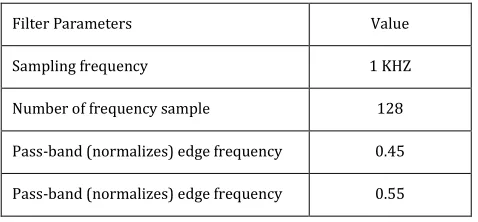
[image:4.612.313.552.342.453.2]To verify the application of the proposed solution approach to design FIR filter the considered filter specification are presented in the Table 1.
Table 1: FIR filter parameters
Filter Parameters Value
Sampling frequency 1 KHZ
Number of frequency sample 128
Pass-band (normalizes) edge frequency 0.45
Pass-band (normalizes) edge frequency 0.55
Table 2: PSO and BBPSO parameters
Parameters PSO BBPSO
Inertia weight () - [0:4; 0:9]
C1 - 2
C2 - 2
X min -2 -2
X max 2 2
V min 0.1
V max - 1
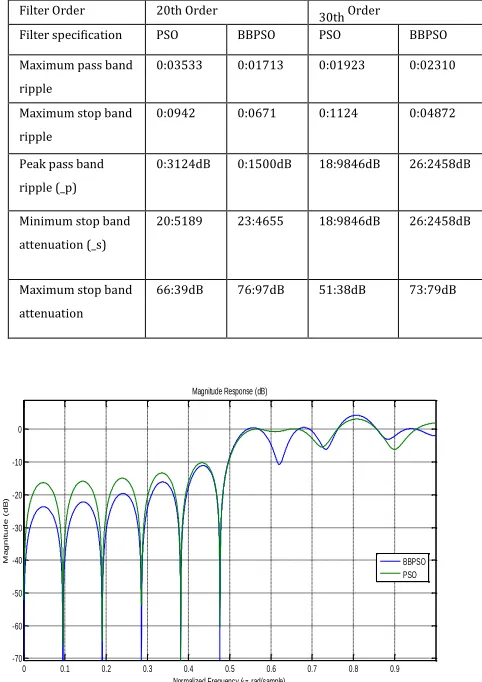
© 2016, IRJET | Impact Factor value: 4.45 | ISO 9001:2008 Certified Journal | Page 863 Table 3.Designed 20th and 30th order filter attributes comparison
Filter Order 20th Order 30th Order
Filter specification PSO BBPSO PSO BBPSO
Maximum pass band ripple
0:03533 0:01713 0:01923 0:02310
Maximum stop band ripple
0:0942 0:0671 0:1124 0:04872
Peak pass band ripple (_p)
0:3124dB 0:1500dB 18:9846dB 26:2458dB
Minimum stop band attenuation (_s)
20:5189 23:4655 18:9846dB 26:2458dB
Maximum stop band attenuation
66:39dB 76:97dB 51:38dB 73:79dB
5. Results
The BBPSO algorithm is used to design the high pass FIR filter coefficients of 20th and 30th order as filter specification Table 2 and the performance is compared to PSO algorithm's results. The Fig. 1 shows the normalized magnitude plot of 20th and 30th order high-pass FIR filter respectively using PSO and BBPSO algorithms. The ripple and attenuation attributes in various bands tabulated in Table 3, which depicts that BBPSO algorithm gives better attenuation in stop band and pass band.
Table 3: Designed 20th and 30th order filter attributes comparison
0 0.1 0.2 0.3 0.4 0.5 0.6 0.7 0.8 0.9
-70 -60 -50 -40 -30 -20 -10 0
Normalized Frequency ( rad/sample)
M
a
g
n
it
u
d
e
(
d
B
)
Magnitude Response (dB)
BBPSO PSO
Fig.1 (a ) Magnitude plot of 20th order high pass FIR filter.
0 0.1 0.2 0.3 0.4 0.5 0.6 0.7 0.8 0.9
-60 -50 -40 -30 -20 -10 0
Normalized Frequency ( rad/sample)
M
a
g
n
i
t
u
d
e
(
d
B
)
Magnitude Response (dB)
BBPSO PSO
(b)Magnitude plot of 30th order high pass FIR filter
To compare the effectiveness of BBPSO and PSO algorithms in terms of convergence behavior the fitness error value plot of
20th and 30th order high-pass FIR filter (Fig. 1) shows that BBPSO converges to a much higher fitness in lesser number of iterations. From Fig. 1(a) and (b) it is observed that BBPSO algorithm converge quickly in both the cases but in case of PSO, convergence profile is affected and takes more iteration to converge also PSO
Stagnation problem is revealed in both the figures. It is seen that when filter order is increased the PSO convergence rate becomes slow but there is almost no effect on the convergence behavior of BBPSO. This implies that BBPSO algorithm is more efficient for designing higher order filters.
6. Conclusions
Two cases of filter design with order 20th and 30th have been realized using BBPSO based solution approach. PSO algorithm is also simulated for performing comparison. The comparison result shows that BBPSO algorithm minimize the stop band and pass band ripples efficiently, and gives better magnitude response. It is observed that convergence speed of BBPSO is better and gives best optimized result in very less time irrespective the dimension of problem. The simulation results also show that when order of filter increases the PSO result is affected but at the same time BBPSO gives the best result. So, BBPSO has capability for handling other related design problems.
References
[image:5.612.46.278.492.671.2]© 2016, IRJET | Impact Factor value: 4.45 | ISO 9001:2008 Certified Journal | Page 864 [2]Bagchi, S. and Matra, S. K. , "The Nonuniform Discrete
Fourier Transform and Its Applications in Filter Design. 1-1D. ," IEEE Trans. Circuits System. 2, Vol. 43 pp. 422-433, 1996. [3]Zhao, H. and juebany, yu. , "A Novel Neural Network-based approach for Designing Digital Filters ," IEEE International
Symposium on Circuits and Systems, pp. 3583-3597, 1977.
[4]Sharma, S. , Arya, L. , and Katiyal, S. , "Design of linear-phase digital fir filter using differential evolution optimization with ripple constraint", International Conference on Computing for
Sustainable Global Development (INDIACom), pp. 474-480,
2014.
[5]Renders, J. M. and Flasse, S. P. , "Hybrid methods using genetic algorithms for global optimization", pp. 243-258, 1996.
[6]Sun, j. , Xu, W. B. , and Feng, B. , " A global search strategy of quantum behaved particle swarm optimization, Systems", pp. 111-116, 2004.
[7]Chen, S. , Istepanian, R. H. , and Luk, B. L. , "Digital IIR filter design using adaptive simulated annealing", pp. 241-251, 2001.
[8]Kalinli, A. and Karaboga, N. , "A new method for adaptive IIR filter design based on Tabu search algorithm," International Journal of Electronics and Communication (AEÜ), Vol. 59(2), pp. 111-117, 2005.
[9]Tang, K. S. and others, "Design and optimization of IIR filter structure using hierarchical genetic algorithms,"
IEEETransactions on Industrial Electronics, Vol. 45(3), pp.
481-487, 1998.
[10]Parks, T. W. and Burrus, C. S. , Digital Filter Design,Wiley, 1987.
[11]Mastorakis, N. E. , Gonos, I. F. , and Swamy, M. N. S. , "Design of Two Dimensional Recursive Filters Using Genetic Algorithms," IEEE Trans. on Circuits and Systems I -
Fundamental Theory and Applications, Vol. 50 pp. 634-639,
2003.
[12]Ahmad, S. U. and Antoniou, A. , "A genetic algorithm approach for fractional delay FIR filters," IEEE International
Symposium on Circuits and Systems, pp. 2520-2006, 2006.
[13]Lu, H. C. and Tzeng, S. T. , "Design of arbitrary FIR log filters by genetic algorithm approach," Signal Processing, Vol. 80 pp. 497-505, 2000.
[14]Hime, A. and others, "Frequency Domain FIR Filter Design using Fuzzy Adaptive Simulated Annealing", Circuits,Sys. ,and Signal Processing," Elsevier, Vol. 28 pp. 899-911, 2009.
[15]Karaboga, D. and others, "Designing digital FIR filters using Tabu search algorithm," IEEE International Symposium
on Circuits and Systems, Vol. 4 pp. 2236-2239, 1997.
[16]Karaboga, N. and Cetinkayal, B. , "Design of digital FIR filters using differential Evolution algorithm," Circuits Systems
Signal Processing, Vol. 25(5), pp. 649-660, 2006.
[17]Liu, G. , Li, Y. X. , and He, G. , "Design of Digital FIR Filters Using Differential Evolution Algorithm Based on Reserved Gene," IEEECongress on Evolutionary Computation, pp. 1-7, 2010.
[18]Park, J. B. and others, "A particle swarm optimization for economic dispatch with non-smooth cost functions. ," IEEE
Transactions on Power Systems, Vol. 20(1), pp. 34-42, 2005.
[19]Omran, M. , Engelbreacht, A. , and Salman, A. , "Bare bones differential evolution," EuropeanJournal of Operational
Research; Vol. 196(1), pp. 128-139, 2009.
[20]Mo, Y. , Liu, H. , and Wang, Q. , "Conjugate direction particle swarm optimization solving Systems of Nonlinear Equations", pp. 1877-1882, 2009.
[21]Van Den Bergh F and Engelbrecht AP, "A study of particle swarm optimization particle trajectories. ", pp. 937-971, 2006.
[22]Ratnaweera, A. , Halgamuge, S. K. , and Watson, H. C. , "Self-organizing hierarchical particle swarm optimizer with time-varying acceleration coefficients", pp. 240-255, 2004. [23]Sun, J. , Wei, F. , and Xu, W. , "A Quantum-Behaved Particle Swarm Optimization with diversity-guided mutationfor the design of two-dimensional IIR digital filters," IEEE
Transactions on Circuits andSystems-II, Vol. 57(2), pp.
141-145, 2010.
[24]Oppenheim, A. V. and Schafer, R. W. , Discrete-Time Signal
Processing,New Delhi: Prentice-Hall of India, 1989.
[25]Proakis, J. G. and Manolakis, D. G. , Digital Signal
Processing:Principles,Algorithms,and Applications,Prentice