http://www.sciencepublishinggroup.com/j/ijamtp doi: 10.11648/j.ijamtp.20170303.12
Vector Addition of Light’s Velocity Versus the
Hafele-Keating Time Dilation Test
Steven D. Deines
Donatech Corporation, Inc., Fairfield, USA
Email address:
To cite this article:
Steven D. Deines. Vector Addition of Light’s Velocity Versus the Hafele-Keating Time Dilation Test. International Journal of Applied Mathematics and Theoretical Physics. Vol. 3, No. 3, 2017, pp. 50-55. doi: 10.11648/j.ijamtp.20170303.12
Received: August 21, 2016; Accepted: November 26, 2016; Published: May 6, 2017
Abstract:
The equivalence between the constancy of light in all inertial, nongravitated frames and time dilation is derived in this paper. Length contraction is not part of this equivalence and is eliminated by Occam’s razor. The null result of the Mickelson-Morley experiment requires a different explanation for the same intensity of the recombination of split light beams as originally transmitted, especially in the perpendicular component. Vector addition of velocities applies to light’s behavior in both parallel and perpendicular components of the moving Mickelson-Morley and Kennedy-Thorndike experiments. If the one-way speed of light is not a universal constant in all directions for moving inertial frames, then the time dilation formula is incorrect. One must question any time dilation experiments, particularly the claims in the Hafele-Keating report, which contains several inaccuracies and data manipulation. Another time dilation experiment with better atomic clock and rigorous testing is warranted.Keywords:
Relativity, Light Speed, Time Dilation, Interferometer, Length Contraction1. Introduction
When the observed phenomena is velocity dependent, such as Doppler measurements of an electromagnetic source, the inertial observer must convert recorded data to replicate the other inertial observer’s data by the correct transformation, because the observer’s velocity will alter the recorded frequency from a broadcasted source. Electromagnetic measurement in various inertial frames confirm Maxwell’s four equations maintain the same form with the same speed of light, but electromagnetism usually requires closed circuits to return electricity to the starting source.
It has been shown that the Mickelson-Morley interferometer experiment with equal arms, as well as the Kennedy-Thorndike interferometer with unequal arms, can not prove or disprove a hypothetical aether to convey the transmission of light [1]. The output intensity from combining the split beams remains constant in a nongravitated environment, despite the velocity of either interferometer. The roundtrip transmission of light along the parallel arm oriented to the supposed velocity is identical in time elapsed with an absolutely stationary interferometer. The transmission of light along the arm perpendicular to the
supposed velocity will be analyzed in a diagram of displacements and velocities in this paper. That diagram will also be used to prove the mathematical equivalence between time dilation and the constancy of light’s speed in all directions. Time dilation will be used to predict the numerical measurement of light speed between two inertial frames.
Over the last several years, there has been a resurgence to perform precise Michelson-Morley experiments using lasers, masers, cryogenic optical resonators, etc. This has been due mostly to predictions of quantum gravity that suggest the speed of light may vary at microscopic lengths accessible to experiment. The first of these highly accurate experiments was conducted by Brillet and Hall, who analyzed a laser frequency stabilized to a resonance of a rotating optical Fabry-Pérot cavity [2]. Their null result for the varying speed of light between the X and Y axes, which were set perpendicular to the local gravity, was ∆c/c ≈ 10-15 from Earth’s motion. A more recent Michelson-Morley experiment still obtained a null result of ∆c/c ≈ 10-17 [3].
moving along the arm perpendicular to the interferometer’s constant velocity follows such a vector sum of velocities, the constant output intensity within interferometers will require a new explanation. This will be analyzed in more detail in this paper. If light obeys vector addition of velocities, then time dilation is not valid. So, time dilation tests as the Hafele-Keating clock transport will be scrutinized.
2. Universal Speed of Light and Time
Dilation
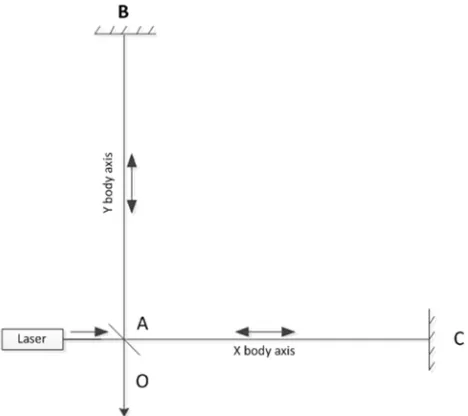
The basic Mickelson-Morley setup is shown in Figure 1, where the half-silvered mirror at A splits the laser beam into two separate beams heading to Mirrors B and C.
Figure 1. Mickelson-Morley Apparatus in Inertial Lab Frame.
Figure 2. Moving Mickelson-Morley Experiment Relative to Inertial Observer.
The reflected beams recombine at A, and output is monitored at O. With equal lengths L = AB = AC, the combined beams show constructive interference to the laboratory observer, which indicates the split beams arrive at A at the same time. If the lengths changed or the arrival times were different, destructive interference would have been expected. This was the classic test
for the theoretical ether as the medium to propagate light waves, which resulted in a null result [4]. Figure 2 depicts the moving apparatus with one arm parallel to its constant velocity relative to an external inertial observer.
Here, A′ is the point where the beam is split into two beams by Mirror A. One beam travels from A′ to Mirror B at B′, reflects back to Mirror A, and recombines at point A″. A second beam moves from A′ to Mirror C at C′, is reflected to Mirror A, and arrives at point A″. The entire apparatus travels at a uniform velocity v along the x-axis during the test. For clarity in Figure 2, the output to the observer is not shown, and the arrows A′C′ and C′A″ are displaced laterally apart. The external observer of Figure 2 is fixed while the apparatus is moving uniformly to the right at velocity v, and the laboratory observer would witness the apparatus operate as in Figure 1. The perpendicular arm AB moves constantly to the right in Figure 2, and the triangle AA′B′ in Figure 3 demonstrates the equivalence between the universal constancy of light speed and time dilation.
Figure 3. Constancy of Light and Time Dilation.
The split beam of light originates at point A′ and the perpendicular arm moves sideways to the right at a constant velocity v. Light reaches the end of the arm at B. Light would travel the length AB in the laboratory frame in the time interval of ∆t, but light travels the longer distance of the hypotenuse in c′ ∆τ in the external frame. Light reaches B when the base A′ is directly below B at point A after the time interval ∆τ. The Pythagorean theorem [5] leads to the equation:
∆τ ∆ (1)
Immediately, c′ = c ⇔ ∆τ = ∆t/ 1 v /c . Thus, the universal speed of light in all directions for all inertial frames is equivalent when the time dilation equation is true. Length contraction is not involved.
length units of a meter (∆L1) and time unit of a second (∆τ1)
to measure the real number c. Observer 2 has the identical length units and time units when at rest in Frame 1. Then Observer 2 was accelerated until achieving a fixed relative velocity v moving perpendicular to the length AB that Observer 1 used to measure c. Observer 2 measures the length AB and the time duration that light traveled along AB in Frame 2. The length AB is perpendicular to the relative velocity between the observers. “There is no length
contraction perpendicular to the direction of relative motion.” [6] Observer 2 determines the speed of light and compares it numerically to Observer 1’s value. Defining γ = 1/ 1 v /c , time dilation requires ∆τ ∆τ /γ between second units of ∆τ1 and ∆τ2, respectively, in frames 1 and 2.
Also, length contraction predicts ∆L γ ∆L between meter units of ∆L1 and ∆L2, respectively, in frames 1 and 2.
c c ! # # $ % & ' ' & ' (∆)*
∆+*
# # $ % & ' ' & ' (
∆)
∆+ /, c
-∆)
∆+ c. ∆)∆+ c (2)
The numerical value for the measured speed of light is in parentheses in Equation (2), which illustrates c ≠ c′. Length contraction makes the situation worse with γ2c = c′ ≠ c. The problem is that light’s speed as emitted in the source’s reference frame is different numerically than light’s speed in the moving observer’s reference frame. Physics equations make no allowance for this difference in light speeds. Time dilation alone should cause a variation in the numerical value for the one-way speed of light by Equation (2), which appears to contradict all roundtrip measurements for the speed of light being the same constant. This conundrum will be resolved in the next section.
3. Velocity Addition with Speed of Light
The external observer records light along the parallel arm of the interferometer in Figure 2. When that light travels along the arm L from A′ to C′, the mirror at C′ is a further distance of ξ(1) = v × L/c.. When that light travels the extra distance ξ(1), the mirror has moved a further distance ξ(2) over the same time interval of ξ(1)/c. Over n repetitions of this, the mirror has moved a distance of L + ξ(1) + ξ(2) + … + ξ(n) where ξ(1) = v × (L/c) and ξ(i+1) = v × ξ(i)/c. Substitute the individual terms, and the series is:
L / vLc / vLv/cc / ⋯ / vLv c/c L / Lc / Lv vc / ⋯ / Lvc L 1 v1 v c⁄⁄c
L2 3 lim →8) 9
: :⁄
9⁄
)
9⁄ L ;1 /
9⁄ <
(3)
After reflection, the light travels a shorter distance along the arm than L as the merging point A″ moves toward it. Shorten the distance by removing increments of distance ξ(i) instead of adding. The time from C′ to the merging point A″
is less than L/c as A″ moved ξ(1) = v × L/c toward the oncoming light. In the time it took light to travel L - ξ(1), the merging point A″ moved ξ(2) closer. Continue the argument to get the infinite series:
L =1 vc vc ⋯ > L =2 1 vc vc ⋯ > L =2 @1 vc vc ⋯ A>
L ;2 < L 9⁄9⁄ L3 2B L ;1 9⁄ < (4)
To calculate the time of transmission for each traverse, divide by c where T = L/c in an absolutely stationary frame.
∆T2 3 );1 /9⁄ < T ;1 /9⁄ <, and (5)
∆T3 2B ) 9⁄9⁄ T ;1 9⁄ <. (6)
∆T2 3 2B ∆T2 3 /∆T3 2B 2T
Thus, the roundtrip measurement for the speed of light is 2T for either the absolutely stationary frame or moving inertial frame as long as v < c. For the moving apparatus, ∆T in (5) > T > ∆T in (6). The light moving along the perpendicular arm of Figure 2 creates the isosceles triangle A′BA″, which is split in half by symmetry for Figure 4. Light’s velocity c′ > c by the Pythagorean theorem [5]. When light from A′ reaches the mirror at B, the base of the arm is
under B at point A.
Figure 4. Vector Addition of Light.
total time to traverse the distance A′BA″ is 2∆τ. For the Mickelson-Morley interferometer, the arms are equal, so the times of transmission on both arms are equal where 2∆τ = 2T, which guarantees maximum constructive interference when the split beams are recombined. For the Kennedy-Thorndike experiment with unequal arms, the ratio of 2∆τ/2T remains the same to set the phase difference between the two split beams, which maintains the same destructive interference throughout the experiment.
The Pythagorean relation applied to Figure 4 reveals c′2 = v2 + c2, which is the vector addition formula. Another form is given as:
c.= c 1 +9 . (7)
For any perpendicular velocity of the inertial frame relative to a transmitted light, Equation (7) applies. For any velocity of the inertial frame parallel to the light, Equations
(5) and (6) apply when divided into the length L in the inertial frame as c is the velocity of light in an absolutely stationary, nongravitated frame. Because D/c′ = ∆τ = L/c, there is no time dilation. The same interval of time, ∆τ, applies to both inertial frames in Figure 4, provided both use the same master clock to measure time. To synchronize remote clocks to a master clock, the velocity of the moving frame is necessary to define the elapsed time of transmission according to (5) and (6) to add with the broadcast time and ensure the remote clocks are synchronized to the master clock. That issue is beyond the scope of this topic and will be addressed in a subsequent paper.
Verify that the effective speed of light in the moving inertial frame is the result of vector addition of velocities. Divide the length L by the time it takes light to traverse between the ends of L. For parallel and antiparallel velocities to the light ray, the equations are:
c2 3 =D )
= E*F >= c ; < = c
9 = c − v
(8)
c3 2B = ) D=
*F >
= c = > = c =1 + > ≈ c ;1 + < = c + v if v << c (9)
Thus, the speed of light obeys vector addition of velocities, which reaffirms the author’s paper [1]. The one-way speed of light varies according to vector addition of velocities of light and the moving inertial frame, but that the roundtrip measurements of light’s speed in a moving inertial frame will be the same constant speed, c, in an absolutely stationary, nongravitated frame. The only condition is the moving inertial frame’s velocity, v, must be less than c so that light can be reflected to conduct the roundtrip measurements.
4. Time Dilation Claims in the
Hafele-Keating Test Results
If the speed of light is not an absolute constant in all directions, time dilation should not exist due to the equivalence shown by Equation (1). Figure 4 shows that the speed of light obeys vector addition of velocities and that the time interval, ∆τ, is common to all legs of the triangle. The distance light traveled and the speed of light is D and c′ in the moving inertial frame and L and c in the absolutely stationary frame, respectively. The relation D/c′ = ∆τ = L/c shows that the time interval is common to both inertial frames.
Hafele and Keating [7] claim time dilation was verified with 4 cesium clocks transported on commercial aircraft in an eastward and westward circumnavigation. No raw data were listed in that report, and the reader is deprived of the critical information to ascertain whether the processed test results really proved the claims.
There are several serious doubts about their test results. First, cesium clocks have irregular, short-term excursions,
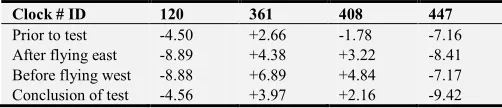
which take almost a day to average out, compared to more precise, stable clocks, such as hydrogen masers. A weaker gravity will cause the frequency to increase as proven by Pound and Rebka [8], and integration of a higher frequency without gravitational compensation to count cycles will cause a clock to gain time. So, commercial flying at around 30,000 feet above sea level for a few hours creates shorter cycles and faster running clocks, but this will be masked by the cesium’s random frequency excursions. Hafele [9] presented drift rates (ns/hr) of the 4 cesium clocks from the US Naval Observatory (USNO):
Table 1. Cesium Clock Drift Rates (ns/hr).
Clock # ID 120 361 408 447
Prior to test -4.50 +2.66 -1.78 -7.16 After flying east -8.89 +4.38 +3.22 -8.41 Before flying west -8.88 +6.89 +4.84 -7.17 Conclusion of test -4.56 +3.97 +2.16 -9.42
The changes in drift rates are calculated by the author in the following table:
Table 2. Changes in Cesium Clock Drift Rates (ns/hr).
Clock # ID 120 361 408 447
Eastward Circumnavigation -4.39 +1.72 +5.00 -1.25 Westward Circumnavigation +4.31 -2.93 -2.68 -2.25
tests. Hafele [9, p. 277] admitted that rate changes were noticeably larger in flight that in the laboratory except for Clock #447. “Most people (myself included) would be reluctant to agree that the time gained by any one of these clocks is indicative of anything….” [9, p. 273]. By averaging the time gain with 4 clocks, Hafele did get the eastward circumnavigation with error bounds to agree with the predicted theoretical result, but there was no such fit between theory and the westward time gain [9, p. 282].
These clocks were commercial Hewlett-Packard 5061A models, which were not built intentionally for rugged conditions. A simple vibration, shock or temperature test before flying these clocks would have established their ruggedness, but no such evaluations were done. Hafele admitted that environmental studies demonstrate “cesium beam clocks are susceptible to such effects as temperature changes and AC magnetic fields, [but]…no known effect consistently increases or decreases the rates for those clocks” [9, p. 275]. Manufacturing did not have the required precision or ability of today due to variations in electrical length, soldering, switching, transistors, etc., that affected each cesium beam clock uniquely. Heat may cause one cesium clock to run faster, while another would have a slower time, but the temperature increment would be predictable and repeatable for that particular unit (assuming no other influences such as vibration concurrently exist). Hafele admitted to Ruger that no accelerometers were used [9, p. 284]. Rueger pointed out that orientation of quartz clocks affected time accuracy, which may well affect the cesium clocks when accelerated if not held vertical. Hafele admitted, “I’m not the expert on how these clocks perform under various environmental conditions” [9, p. 286]. It is clear that not much effort was given to isolate the cesium clocks from most environmental influences, and the drift rates do not show the relativity effects claimed in the final 1972 report [7].
Many claims made by Hafele and Keating are unsubstantiated concerning clock behavior [7]. “Although temperature or pressure changes sometimes cause individual random and unpredictable changes (10), such random and uncorrelated changes in rate do not contribute to systematic errors. The clocks are highly resistant to impulse accelerations (10).” [7, p. 177]. Hafele’s and Keating’s reference (10) is the Hafele 1971 paper [9]. Environmental changes affect clocks individually with nonrandom deviations, so the average effect is not zero. The claim that clocks are highly resistant to impulse accelerations is totally unsupported, because no evidence of acceleration testing is found in [9] as admitted by Hafele in the above quotations [9]. Such unfounded claims cast serious doubts about their processed data.
A. G. Kelly [10] reviewed the raw USNO data from that experiment and compared it to the Hafele-Keating paper [7]. His analysis from Hafele [9] is identical with the author’s findings in Tables 1 and 2. Kelly wrote, “The wild swings in drift rate should have resulted in the whole test being declared a failure.” Kelly calculated that the theoretical
eastward drift rate would be -0.6 ns per hour and a westward drift of +3.4 ns per hour, which Table 2 gives little confidence [10]. Kelly believed that Clock #120 should have been discarded initially due to its poor performance. He wrote, “Discounting this one totally unreliable clock, the results would have been within 5ns and 28ns of zero on the Eastward and Westward tests respectively. This is a result that could not be interpreted as proving any difference whatever between the two directions of flight” [10]. In a final discussion, Kelly wrote, “Earlier attempts to deduce the changes in drift rates from the graphs in the 1972 H & K paper were made by this author [11] and later found to have been done [earlier] by Essen [12]. Both concluded that the alterations in drift rates of the clocks made the results useless.” [10].
Kelly’s analysis did not condemn relativity, but it critically examined whether the Hafele and Keating results actually verified the relativistic predictions. Kelly [10] found that the data from Clock #447 was deliberately manipulated from +26 ns to +266 ns, a factor of 10, to get agreement with the westward relativity prediction. The author agrees with Kelly that the overall cesium testing did not verify anything. Hafele and Keating were possibly overzealous where they exaggerated clock performance and justified arbitrary data manipulation to confirm relativity.
Kelly may have uncovered an unexpected null result from the stable data. If Clock #120 was eliminated from the test, the eastward and westward results would have been within 5 ns and 28 ns respectively from zero, meaning no statistical difference in time units exists between the two directions of flight. Surprisingly, if light does obey vector addition from Section 3 in this paper, then the same time unit applies for both the stationary, nongravitated frame and a moving inertial frame per Figure 4. If light speed varies in different directions in a reference frame, the time dilation equation is invalid by Equation (1). Discarding Clock #120 entirely as Kelly recommended, the Hafle-Keating test may have proven there is no time dilation, because test results were very close to zero for either direction of circumnavigation. The author believes the time dilation experiment should be repeated with more careful handling of the equipment, more rigorous data analysis, and more precise atomic clocks.
5. Conclusion
velocities. Vector addition is shown to apply for the different time intervals when light travels one-way parallel versus antiparallel to the arm parallel to the supposed velocity, but the roundtrip elapsed time span is still the same for the moving or stationary apparatus. In Figure 4, the result of vector addition shows how light moves along the perpendicular arm compared to the supposed velocity of the apparatus. For the Mickelson-Morley interferometer, the transmission time is 2∆τ for both equal arms, giving constructive interference with maximum output intensity. For the Kennedy-Thorndike interferometer with unequal arms, 2∆τ ≠ 2∆T with a fixed ratio 2∆τ/2∆T, which results in a fixed decreased output intensity from destructive interference. This reaffirms the results indicated in an earlier paper by the author [1].
This paper demonstrates that the one-way speed of light varies according to vector addition of velocities between light and the moving inertial frame, but that the roundtrip measurements of light’s speed in a moving inertial frame will be the same constant speed, c, in an absolutely stationary, nongravitated frame. The only condition is the moving inertial frame’s velocity, v, must be less than c so that light can be reflected to conduct the roundtrip measurements.
If light’s one-way velocity does obey vector addition in a moving inertial frame, then the time dilation formula is incorrect by Equation (2). Hafele-Keating [7] claimed time dilation was verified with 4 moving cesium clocks. On closer examination, Hafele’s earlier report [9] casts serious doubts about the handling and ruggedness of those clocks and the actual results in the raw data. Kelly [10] examined that USNO raw data and concluded that the data could not verify any relativity predictions. Without Clock #120 that was totally unreliable, the eastward and westward circumnavigation was 5 ns and 28 ns from zero, respectively [10]. Discounting that totally unreliable clock, the remaining eastward and westward data showed no effective difference between the two directions of flight, which may have uncovered an unexpected null result showing the same time unit is maintained for both circumnavigations. If light does obey vector addition, then the same time unit exists for both the stationary, nongravitated frame and a moving inertial frame per Figure 4. Due to the many issues, the author
believes that the Hafele-Keating experiment should be discounted and a more meticulous test be redone for time dilation, which may give a null result. Only time will tell.
References
[1] Deines, S. D., Dichotomy between length contraction and null results from all interferometer experiments, International Journal of Applied Mathematics and Theoretical Physics, 2, (1), (2016) p?
[2] Brillet, A. and Hall, J. L. “Improved laser test of the isotropy of space” (1979) Phys. Rev. Lett., 42 (9), p. 549-552, Bibcode 1979PhRvL..42..549B. doi: 10.1103/PhysRevLett. 42. 549. [3] Herrmann, S., Senger, A., Möhle, K., Nagel, M., Kovalchuk,
E. V. and Peters, A., “Rotating optical cavity experiment testing Lorentz invariance at the 10-17 level” (2009) Phys. Rev. D., 80 (100):105011, arXiv: 1002.1284. Bibcode: 2009PhRvD..80j5011H. doi:10.1103/PhysRevD.80.105011. [4] Serway, R. A. and Jewett Jr., J. W., Physics for Scientists and
Engineers, Cengage Learning (2014), p. 1196-1198. [5] Euclid, Elements, Book 1, proposition 47.
[6] Young, H. D., Adams, P. W. and Chastain, R. J., Sears and Zemansky’s College Physics, Pearson (2016), 10th ed., p. 872. [7] Hafele, J. C. and Keating, R. E., “Around-the-World Atomic
Clocks: Predicted Relativistic Time Gains”, Science, (1972) 177, p. 166-177.
[8] Pound, R. V.; Rebka Jr. G. A. "Gravitational Red-Shift in Nuclear Resonance". Physical Review Letters (November 1, 1959) 3 (9), p. 439–441.
[9] Hafele, J. C., “Performance and Results of Portable Clocks in Aircraft”, Third Annual Department of Defense (DOD) Precise Time and Time Interval (PTTI) Strategic Planning Meeting, 16-18 Nov 1971, Washington, DC, p. 261-288. [10] Kelly, A. G., “Hafele and Keating Tests: Did They Prove
Anything?”, Physics Essays, (2000) 13, Issue 4, p. 616, DOI: 10.4006/1.3025451.
[11] Kelly, A. G., Monograph No 3, The Institution of Engineers of Ireland (1996) ISBN 1-898012-22-9.