Structural and Morphological Characterizations of Poly
(P-Phenylene Vinylene) Thin Film by Spin Coating
Application of Polymer LED
S. Sakthivel and A. Boopathi
Assistant Prof. of Physics & Research Scholar, Thin film Physics and Nano Science Laboratory
PG and Research Department of Physics
Rajah Serfoji Govt. College, Thanjavur - 613 005, Tamilnadu, INDIA. email:[email protected]; [email protected].
(Received on: March 23, 2016)
ABSTRACT
The conjugated polymer of Poly (p-phenylene vinylene) and its derivatives are most studied material in applications of numerous photonic devices such as organic solar cells, organic light emitting diodes (OLEDs). In this study we gave prepared PPV thin film in glass substrate at deposition of spin coating technique for rotational speed of 3000 rpm in vacuum condition. After that PPV thin film were characterized by structural characterization of X-ray diffraction spectroscopy reveal that film as a fully amorphous nature of bands present and surface morphological characterization of scanning electron microscopy clearly showing porous structure particles presenting on the substrate.
Keywords: OLEDs, conductive polymers, Poly Phenylene Vinylene (PPV), FTIR, XRD, PL study of PPV.
1. INTRODUCTION
Poly (p-phenylene vinylene) (PPV) is a conducting or conjugated type of polymer which combines electrical and optical properties of semiconducting polymers1. In this type of
conducting polymer is an electro-luminescent material for organic light emitting diode2,7.
polymer these problems have solved by two different kinds of approaches in previous reported first one is the delocalization of π bonds in PPV with high dielectric constants and thus renders them insoluble in solvents that have small dielectric constants namely most organic solvents. This insolubility can be reduced by adding side chains to the polymer backbone these chains provide an extra organic layer around the polymer, reducing its melting point and making it more soluble in organic solvent which in reduces coiling and improves the electronic order of the molecule1. In another approach is PPV was synthesized through a soluble precursor route
used by Wessling and its modifications3. The wessling route of polymerization gives a
polyelectrolyte precursor solution that soluble in water and methanol. A thin film of this precursor under a thermal treatment in the absence of oxygen gives an PPV thin layer on substrates.
In this present work we have prepared PPV thin film under the wessling method of precursor polymerization. The precursor solution coated on glass substrate by spin coating method of 3000 rpm of disc rotational speed and after that film coated glass substrate annealing at 2500C for 120 minutes under the low vacuum condition. The finally prepared PPV thin film
was characterized by structural, optical and morphological characterized.
2. EXPERIMENTAL SECTIONS
2.1 Materials
α,α’,-dichloro-p-xylene (Assay98%, C6H6Cl2, MW: 175.06), Tetrahydrothiophene
(Assay 99%, C4H4S, MW: 88.17g/mol) were used as source materials from Aldrich. Double
distilled (DD) water was used as a solvent. Methanol (MeOH) and Sodium hydroxide (NaOH) analytical research grade obtained from Merck. All chemicals are used in this work as received.
2.2 Preparation of PPV Thin film
The Spin coater drop of precursor polymer have been synthesised method briefly discussed in our previous report4 PPV The precursor polymer is converted into PPV by using
spin coating technique at spinner rotation 3000 rpm. The prepared PPV precursor coated substrate was under thermal conversion method of standard temperature of 2500C for 120
minutes we got PPV thin film. After that PPV thin film cooled down and further characterizations.
2.3 Characterization of PPV Thin film
The crystalline structural study of PPV thin film were determined using Rigaku X- ray diffractometer (XRD) [2θ = 10-900, Cu-Kα = 40 kV, 15 mA]. The top view surface
3. RESULTS AND DISCUSSION
3.1 X-Ray Diffraction Spectroscopy Analysis
Figure 1 show as an X-ray diffraction spectrum of PPV thin film. The XRD spectral line showed a broad and amorphous nature of polymer film present in the substrate surface. The two small intensity peaks present diffraction angle at 2θ = 32.20 and 44.360 and these two
diffraction peaks crystalline size were calculated by using scherrer’s formula. The crystalline sizes are 28.45 nm and 34.04 nm respectively6.
Fig 1. XRD Spectrum of PPV Thin film
3.2 Scanning Electron Microscopy Analysis
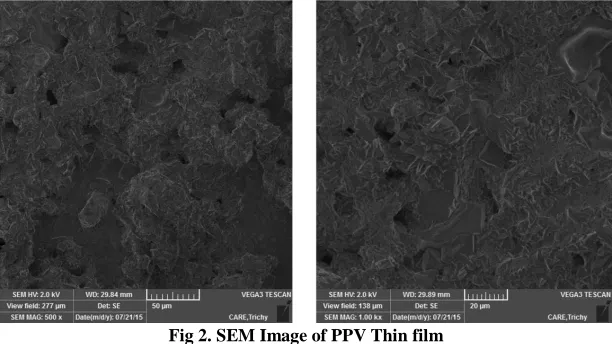
Figure 2 shows as a surface morphological image of two different magnification of micro meter scale of PPV thin film. The figure clearly revel that PPV thin film surface as a porous structure at presenting over the surface and no evidence for any other particular shape of particle presenting. This porous structure provides conducting behaviour to the PPV thin film.
3.3 UV-Vis Absorption Spectroscopy Analysis
Figure 3 shows as a UV-Vis absorption spectrum of PPV thin film prepared by spin coating method at 3000 rpm. The absorption spectral range between 300 nm to 700 nm the maximum absorption peak (λmax) present at 480 nm in blue shift of visible light5. The
calculated optical band gap energy of 2.05 eV onset position at 580 nm of absorption peak. The spectra shows a narrow low intensity peaks at 302 nm, 312 nm, and 328 nm presenting for PPV thin film prepared by spin coating method using as a water solvent of precursor polymer7.
Fig 3.UV-Vis Absorption Spectrum of PPV Thin film
3.4 Photoluminescence Spectroscopy Analysis
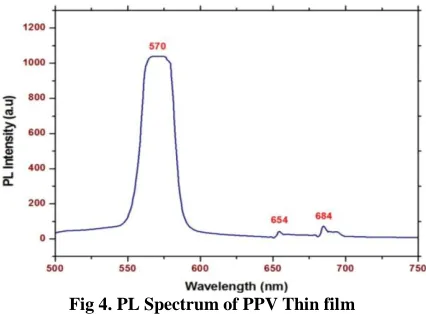
Figure 4 show as an Photoluminescence spectral line of PPV thin film at 2500 thermal
conversion of precursor polymer solution. The PL emissive spectrum showing three position of emissions at around the positions of 570 nm and two small packs of 654 and 684 nm ranges at this positions indicating PPV layers as a green emissive as strong8.
4. CONCLUSION
The thin layer of PPV has been successfully prepared by spin coding method, precursor polymer solution as a source material temperature conversion of polymerisation suitable for this conducting polymer. The prepared PPV thin film structure of amorphous nature clearly showed by XRD study and surface morphology of porous examine by SEM study and optical characterisation of UV-vis characterisations indicating at low absorptions of blue shift and low energy gap. The PL study showed PPV film as a green luminescent polymer.
REFERENCES
1. Gettinger, C.L.; Heeger, A.J.; Drake, J.M.; Pine, D.J. J. Chem. Phys., 101 (2), P-1673-1678 (1994).
2. Burroughes J H, Bradley D D C, Brown A R, Marks R N et., Nature, 347, P- 539 (1990). 3. R. A. Wessling, Journal of Polymer Science, Polym. Symp. 72, P- 55-66, (1985).
4. S. Sakthivel, A. Boopathi, M. Iswarya and A. Elakkiya, Journal of Chemistry and Chemical Sciences, Vol.5 (10), 563-568, October (2015).
5. Bushra Mohamed Omer, International journal on organic electronics (IJOE) vol. 2, No. 2, April (2013).
6. Tajima, K.; Li, L.-S.; Stupp, S. I. J. Am. Chem. Soc., 128,5488-5495 (2006).
7. A. Sakai, S.H. Wang, L.O. Peres, L. Caseli, Controlling the luminescence properties of poly(p-phenylene vinylene) entrapped in Langmuir and Langmuir–Blodgett films of stearic acid, Synth. Met. 161, 15–16 (2011).