Optimization-Based Methodology for the
Exploration of Cyber-Physical System
Architectures
Doctoral Dissertation
Candidate Dmitrii Kirov, University of Trento, Italy
Advisor Prof. Roberto Passerone, University of Trento, Italy
Committee Prof. Luciano Lavagno, Politecnico di Torino, Italy
Prof. Pierluigi Nuzzo, University of Southern California, USA Prof. Luigi Palopoli, University of Trento, Italy
Copyright ©2018, by the author. All rights reserved.
The shortest distance between two points is often unbearable.
Acknowledgements
According to my personal statistics, not many students are given much freedom in their research without being completely abandoned at the same time. Likewise, few students have this rare possibility of randomly dropping by their advisor’s office at almost any time to ask their questions (often minor or stupid or both). During this PhD adventure, I was lucky to be among these “few” and “not many”. For this, I feel very thankful toRoberto Passerone. For this, as well as for guiding me through these 4.5 academic years, some of them more and some of them less lucky. For his support, especially during these last months of the PhD, and for offering me future opportunities. Finally, for providing me a great internship possibility, which turned my world upside down, in a sense, and ended up with the work that you, the reader, probably plan to comprehend (or scroll) after looking at this first page. Don’t you?
I deeply acknowledgePierluigi Nuzzo, an extraordinary person and a great mentor, for his inherent contribution to this work, and for our fruitful collaboration - current, past and, hopefully, future. I learned a lot from Pierluigi during these two years after we first met in Berkeley in 2016, and our weekly Skype calls, which almost never stopped since then, are still one of the most valuable things for me.
I would like to thankLuciano Lavagnoand Pierluigi for reviewing this thesis and providing me their feedback. I am glad that it was an interesting read.
Listing friends in this section is perhaps the thing I do not like. I am lucky to have quite many of them. But what if I forget someone? So, instead, I would like to acknowledge one very special place in Trento, which is calledZorba’s. A place, where most, if not all, of the friends that I wish to thank have been at least once. Sharing drinks and talks, playing table football, talking to the owner lady with all her crazy stories, or listening to me playing guitar and singing (yes, once I did even that). A place, which shared with me some happiest and some saddest moments, some best memories and few very important decisions.
Maybe you thought that I will avoid the canonical ending part of this text, but here I go. I thank myparentsfor their constant support in every possible sense. For getting worried with and, mostly, without a reason. AndLena, I dedicate this thing to you and thank you for your love and support, and for the path that we walk together. I am sure you would prefer to have another kind of dedication, like a song or a novel. In fact, I am working on that, even though at a slower pace with respect to research. But who said that the acknowledgements cannot have a future work part?
Abstract
Embedded electronics becomes pervasive, and its tight integration with modern mechanical, thermal, chemical, biological, and other systems shows promise of making the resulting cyber-physical systems (CPS) more capable and efficient, outperforming their predecessors. Existing engineering practices, however, often fall short of coping with the complexity of CPS design. One of the dominant reasons is the inability of foreseeing the impact of the decisions made in the early stages of the design process, i.e., in the concept design phase, on the final implementation. A major bottleneck is the lack of abstractions and formalisms that are able to capture heterogeneous system requirements and enable efficient co-design. Therefore, methodologies and tools that provide such abstractions and generate high-level cyber-physical system architectures with correctness guarantees become highly desirable. This dissertation seeks to advance the state of the art in cyber-physical system design by proposing a novel exploration methodology for system architectures at a high level of abstrac-tion. We leverage optimization techniques to select correct-by-construction configuration and interconnection of components taken from predefined libraries, while meeting a set of system requirements and minimizing a cost function. Using a graph-based representation of the system architecture, we identify a generic basis of the exploration problem as a common semantic domain that includes a set of decision variables and mixed integer linear constraints over graph vertices, edges and paths. On top of this basis, we are able to instantiate a variety of CPS design requirements, such as interconnection, flow balance, timing, reliability, workload, routing and energy. Our resulting mathematical formulation includes the topology selection problem, i.e., whether a “virtual” component should be used in the final configuration and how it is connected to other components, and the mapping problem, i.e., which “real” library component best implements the “virtual” one.
progress towards a feasible solution.
We have implemented ARCHEX2.0, an extensible framework that supports all steps of the proposed methodology. Its software structure is modular and amenable to extensibility and design reuse. To simplify the problem specification, we propose a pattern-based formal language. It allows for automatic translation of high-level requirements into appropriate mixed integer linear constraints, which provides large savings in terms of development time and guarantees the correctness of the generated specification. Provided requirement patterns have clear semantics and support a rich set of cyber-physical system properties, thus ensuring the expressiveness of the framework.
We perform an extensive numerical evaluation of the proposed methodology on a set of CPS applications of industrial relevance. In particular, we demonstrate the efficiency of ARCHEX2.0 on reliability-driven designs of aircraft electrical power distribution networks and reconfigurable manufacturing systems. We then investigate the capabilities of the approach in the wireless networking domain by synthesizing topologies and node placements for data collection and localization networks of realistic size. Our results confirm the expressiveness, extensibility, usability and scalability of the proposed techniques and tools. These important characteristics allow the methodology to effectively address the challenges of the concept design stage of cyber-physical systems.
Key words:design space exploration, architecture exploration, optimization, design method-ology, cyber-physical systems, embedded systems, wireless sensor networks, internet of things.
Contents
Abstract iii
List of Figures ix
List of Tables xi
1 Introduction 1
1.1 Cyber-Physical System Architecture . . . 1
1.2 Motivation and Objectives . . . 3
1.3 Main Contributions . . . 5
1.3.1 Theory and Algorithms . . . 6
1.3.2 Tools . . . 7
1.3.3 Applications . . . 8
1.4 Related Work . . . 10
1.4.1 CPS Design Methodologies . . . 10
1.4.2 Architecture Exploration . . . 11
1.5 Outline of the Dissertation . . . 18
2 Preliminaries 21 2.1 Terminology . . . 21
2.1.1 Architecture, Template, Topology Configuration . . . 21
2.1.2 Mapping . . . 22
2.1.3 Paths, Routing, Functional Flow . . . 24
2.2 Basis of the Exploration Problem . . . 28
2.2.1 Mapping Constraints . . . 28
2.2.2 Path Constraints . . . 29
2.3 Using the Basis . . . 32
2.3.1 Associating Template and Library Attributes . . . 32
2.3.2 Formalizing Application Requirements on Top of the Basis . . . 33
2.3.3 Objective Functions . . . 35
2.4 Linearization . . . 36
2.4.1 Standard Techniques . . . 36
2.4.2 Approximate Encodings . . . 37
3 Exploration Methodology 41
3.1 Overview . . . 41
3.2 Application Requirements . . . 45
3.2.1 Number of Components . . . 45
3.2.2 Interconnection . . . 46
3.2.3 Balance and Workload . . . 48
3.2.4 Reliability . . . 49
3.2.5 Timing . . . 50
3.2.6 Routing . . . 51
3.2.7 Link Quality . . . 53
3.2.8 Energy Consumption . . . 55
3.2.9 Localization . . . 58
3.3 Mapping Specifications to Implementations . . . 60
3.4 Solving and Analysis . . . 61
3.5 Algorithms . . . 63
3.5.1 Approximate Encoding of Network Paths . . . 63
3.5.2 Iterative Optimization and Learning . . . 65
4 ARCHEX2.0: Architecture Exploration Framework 69 4.1 Overview . . . 69
4.2 Pattern-Based Requirement Specification . . . 74
4.3 Structure of the Toolbox . . . 79
4.3.1 Main Components and Data Structures . . . 79
4.3.2 Extension for Wireless Networks . . . 83
4.4 Using ARCHEX: Design Flow . . . 87
4.4.1 Creating the Specification . . . 87
4.4.2 Solving the Exploration Problem . . . 91
4.4.3 Additional Functionalities . . . 94
5 Reliability-Driven Design of Industrial Cyber-Physical Systems 97 5.1 Aircraft Electrical Power Distribution Network . . . 97
5.1.1 Overview and Problem Statement . . . 97
5.1.2 Specification . . . 100
5.1.3 Iterative Optimization: MILP Modulo Reliability . . . 102
5.1.4 Numerical Evaluation . . . 106
5.1.5 Scalability . . . 108
5.2 Reconfigurable Manufacturing System . . . 110
5.2.1 Overview and Problem Statement . . . 110
5.2.2 Specification . . . 112
5.2.3 Optimization Results and Performance Analysis . . . 114
5.3 Related Work . . . 117
Contents
6 Optimized Topology Selection and Component Sizing for Wireless Networks 123
6.1 Overview . . . 123
6.2 Specification and Evaluation . . . 126
6.2.1 Data Collection Network . . . 126
6.2.2 Localization Network . . . 129
6.2.3 Scalability and Optimality . . . 130
6.3 Improving the Wireless Channel Model . . . 132
6.3.1 Motivation . . . 132
6.3.2 Received Signal Strength Measurements in Indoor Environments . . . . 133
6.3.3 Statistical Characterization of the 2.4 GHz Radio Channel . . . 137
6.3.4 Proposed Improvements for the Channel Model . . . 138
6.4 Related Work . . . 140
6.5 Conclusions . . . 142
7 Conclusions and Future Work 145 7.1 Conclusions . . . 145
7.2 Future Work . . . 148
7.2.1 Theory and Algorithms . . . 148
7.2.2 Tools . . . 149
7.2.3 Applications . . . 150
List of Figures
1.1 Examples of complex cyber-physical systems. . . 2 1.2 Summary of the contributions provided by the dissertation. . . 9 1.3 Impact of the proposed architecture exploration methodology. . . 11 1.4 Proposed architecture exploration approach positioned within the cross-layer
cyber-physical system design methodology. . . 12 2.1 Topology selection example: from reconfigurable templateTto topology
config-urationE∗. . . 23 2.2 Mapping of “virtual” components from templateTof the architecture to “real”
devices from a libraryL. . . 24 2.3 Example of a network pathπq, and corresponding path variableswπqandyπq
for nodes and edges of the graph. . . 25 2.4 Examples of (a) functional linkFand (b) functional flowF. . . 27 2.5 Examples of correct and invalid mapping scenarios. . . 30 2.6 Path constraints: (a) Using balance equationC(yπ)T=zπfor generating paths;
(b) Examples of paths with loops satisfying the balance equation. . . 32 2.7 Examples of defining application constraintsRAusing variables from the basis
of the exploration problem: (a) Flow balance constraint; (b) Timing constraint. 35 3.1 Separation of concerns within the proposed architecture exploration
methodol-ogy: topology selection problem, mapping problem and final architecture. . . . 42 3.2 Flow of the proposed architecture exploration methodology: specification,
en-coding, solving, analysis. . . 44 3.3 Example of path difference constraints: (a) Single difference; (b) Disjoint edges;
(c) Disjoint nodes. . . 53 3.4 Example of reachability constraints in a wireless network. . . 59 4.1 Overview of the ARCHEX2.0 framework. . . 70 4.2 Execution flow of ARCHEX: inputs, outputs, sequence of main method calls and
related dependencies. . . 72 4.3 Pattern-based formal language as an intermediate level between requirements
expressed in a natural language and the underlying MILP representation. . . . 75 4.4 Simplified class diagram of ARCHEXhighlighting the relations between the main
4.5 Wireless extension of ARCHEX. . . 84 4.6 A simplified FMS of a high-wing, twin-engine aircraft. . . 88 4.7 Visualization of the solution (architecture graph) in ARCHEX. . . 92 5.1 (a) Power distribution of Boeing 787; (b) Simplified single-line diagram of an
electrical power distribution network (EPN). . . 98 5.2 EPN architectures generated by ARCHEXusing monolithic and iterative
opti-mization techniques. . . 107 5.3 Example of a reconfigurable manufacturing system (RMS). . . 111 5.4 RMS architectures generated by ARCHEX: (a) No reliability or timing constraints;
(b) Same reliability constraint forΩ1andΩ2; (c) Tighter reliability constraint for
Ω2; (d) Timing constraint. . . 115
6.1 TemplateT(a) and generated topology (b) of the data collection WSN. . . 128 6.2 TemplateT(a) and generated node placement (b) for the localization network. 130 6.3 WSN node mutual placement scenarios (exemplified in a corridor). . . 135 6.4 Comparing analytical and empirical log-distance curves for WSN data. (a)
Corri-dor1, “Single wall” scenario (b) Hall, “Single wall” scenario (c) CorriCorri-dor1, “Com-bined” scenario (d) Corridor2, “Middle” scenario (e) Corridor1, “Middle” sce-nario (f ) Corridor2, “Two walls” scesce-nario. . . 137 6.5 Comparison of log-distance empirical curves for WSN data. (a) “Single wall”
List of Tables
4.1 List of requirement patterns supported by ARCHEX2.0 grouped by type. . . 79 5.1 Summary of templateTand libraryLfor the aircraft electrical power distribution
network example. . . 102 5.2 Number of MILP constraints and variables, number of iterations, reliability
analysis and solver time for different EPN architecture sizes generated using integer linear programming modulo reliability (MILP-MR). . . 109 5.3 Number of MILP constraints and variables, problem generation (setup) and
solver times for different EPN architecture sizes generated using monolithic optimization with approximate reliability constraints. . . 109 5.4 Problem complexity (number of constraints and variables) and solver time for
exploration problems with different sizes of libraryLand a fixed-size template T(20 nodes) solved using monolithic and iterative optimization approaches. . 109 5.5 Summary of template and library for the RMS example. . . 113 5.6 Numerical results for generated RMS architectures: cost, reliabilities, idle rate. 116 5.7 Problem complexity and solver time for RMS design examples. . . 116 6.1 Summary of the WSN platform libraryL. . . 127 6.2 Final number of nodes, dollar cost, average node lifetime and solver time for a
data collection WSN optimized for different objectives. . . 129 6.3 Final number of nodes, dollar cost, average number of reachable anchors by the
mobile node, and solver time for a localization network optimized for different objectives. . . 129 6.4 Number of constraints and solver time for different network architecture sizes
generated by using the approximate path encoding algorithm (K∗=10) com-pared to full enumeration of paths. . . 132 6.5 Costs and solver times for data collection networks synthesized for different
1
Introduction
This chapter unveils the motivation for the work presented in this dissertation, outlines the objectives and the main results. We first identify the role of architecture exploration in a hierar-chical design flow of cyber-physical systems and discuss its main challenges. We then summarize the optimization-based approach that we apply to tackle the architecture exploration problem, highlight the main contributions and put them in the context of related work. Finally, we outline the structure of the dissertation and preview the contents of subsequent chapters.
1.1 Cyber-Physical System Architecture
(a)
(b) (c)
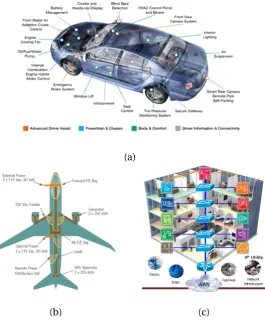
Figure 1.1 – Examples1of complex cyber-physical systems: (a) There are almost 100 electronic control units (ECUs) in a premium car, while millions of lines of code are required to program them, and several kilometers of wiring are needed to interconnect them; (b) Many subsystems of modern passenger aircrafts (e.g., power distribution, fuel management, environmental control) are tightly coupled with an increasing number of electronic components; (c) In a “smart” building, a large number of systems (e.g., adaptive lighting, HVAC, firefighting, security)
are built on networked sense-and-control platforms.
The heterogeneous nature of cyber-physical systems has immediately revealed the lack of interoperability between existing design instrumentation (e.g., simulators, verification tools, requirement engineering tools) that captures different cyber and physical aspects of the system. Moreover, it drastically raised the need of mathematical formalisms and abstractions that could serve as a “common ground” for different system aspects - functional and non-functional, static and dynamic, electronic and physical. Consequently, methodologies and tools that can provide these abstractions for efficient synthesis, verification and performance evaluation of such heterogeneous, hybrid CPSs become highly desirable. Indeed, as the systems get more and more complex, especially with respect to stringent reliability and safety requirements, a major productivity gain in CPS design becomes essential for many industries.
1.2. Motivation and Objectives
Therefore, systems companies (e.g., avionics and automotive) are increasingly aiming at automating their design processes using the novel computer-aided design (CAD) tools for CPS, same as semiconductor industry did several decades ago to cope with complexity of VLSI design. In turn, electronic design automation (EDA) vendors today pay more attention to system design.
Another concern is the level of interdisciplinary experience required in cyber-physical system design. Today, being asystem designerrequires lots of cross-domain knowledge and simultane-ous reasoning about different heterogenesimultane-ous requirements. That is, embedded and physical system engineers have to go beyond their primary domains in order to understand each other, cooperate, create design specifications, run the design space exploration, synthesis, performance analysis, verification and validation of CPSs. Apart from gaining new necessary skills, this also prompts the development of novel methodologies and supporting tools for facilitating specification, solving and debugging of CPS design problems, as well as easing up the communication between different working groups and companies.
It has been argued in the recent decades that the design of complex heterogeneous systems has to be carried out in a hierarchical,compositionalway as a sequence of refinement steps between different levels of abstraction [114, 115, 98, 96]. This dissertation focuses on high-levelarchitecturalaspects of CPS design. In this context, we regard thecyber-physical system architectureas a network of interconnected components that represent both electronic and physical parts of the system. We tackle theconcept designstage that deals with the selection of these components and connections, while meeting a set of system requirements, such as timing, reliability or power consumption. This stage is essential, because being able to capture important system aspects as early as possible in the design flow allows us to provide certain correctness guarantees to subsequent steps, thus reducing the chances of errors, requirement violations and lengthy redesign cycles. At the same time,architecture explorationis a search over a huge space of potential configurations, which grows with the number of requirement types being captured. Therefore, it asks for finding proper abstractions and formalisms to express the requirements, meaningful partitioning of design concerns, so that exploration problems are tractable, and efficient tools to conduct the search.
1.2 Motivation and Objectives
to achieve reasonable accuracy in performance and cost estimations of an architecture that has been already worked out. However, using these approaches for design exploration and synthesis can become very time-consuming and, therefore, limited in the number of evaluated configurations. Clearly, CPS design would substantially benefit from methodologies and tools for automatic generation of system architectures with correctness guarantees.
In general, one can classify architecture exploration approaches to three groups that can be distinguished by the ability of their members to tackle the following questions:
1. Does the current architecture meet the requirements?These approaches do not conduct the actual search, but only evaluate the performance of a given architecture. The most typical techniques are simulation, prototyping and system description languages (e.g., [100, 9]). The exploration can be performed pointwise, i.e., by evaluating a set of selected points in the design space.
2. Is there any architecture that meets the requirements?This group targetsfeasible solu-tions that satisfy the given constraints. It is mainly represented by symbolic constraint safisfaction techniques, further discussed in Section 1.4.
3. Which is the best feasible architecture with respect to a cost function?In contrast with the previous group, the ultimate goal of these methods is to identify theoptimalarchitecture which satisfies the given requirements, while minimizing a cost function. Therefore, corresponding approaches deal with optimization problems.
The first group includes a number of widely adopted languages and instruments (e.g., [100, 119, 107, 30, 86]), that are able to capture a variety of high-level concerns, both from cyber and physical realms. However, they are commonly focused on high-accuracy performance evaluation and analysis and have limited design exploration capabilities. In contrast, the two remaining groups rather focus on design space exploration and automated synthesis. However, there are still only few tools that target feasible [101, 90] and optimized [12, 108, 40, 87] conceptual designs in the CPS domain. Being efficient in one particular application, some of these tools suggest limited extension capabilities to other classes of systems. Furthermore, very few of them focus onusability, i.e., on providing languages and interfaces for low-effort specification of complex design problems. This is a significant concern, since it aims at keeping the underlying formalisms transparent to the designers and allows them to focus on the problem domain.
1.3. Main Contributions
Considering all aforementioned points together, the goal of this dissertation is to devise an optimization-based methodology for the exploration of cyber-physical system architec-tures.In particular, we aim to provide a representation of a CPS architecture and a general mathematical formulation that would capture different system-level requirements (e.g., con-nectivity, timing, energy consumption, routing, reliability) and allow designers to cast explo-ration problems in different application domains. We further intend to develop anextensible framework to incorporate the proposed formulation and algorithms, thus facilitating the use of the methodology among system designers.
Our approach is inspired by the seminal work on reliability-driven optimized architecture design in the avionics domain [99, 12]. In these works, the authors leverage the mixed integer linear programming (MILP) techniques for encoding and solving exploration problems. Our purpose in this thesis is togeneralizethe techniques and the algorithms from [99, 12] to make them applicable todifferentCPS domains. Furthermore, we aim to make existing formulations richerso that more complex designs are supported, without making the exploration process expensive. This requires the development of newscalableencoding algorithms and efficient approximation techniques.
Apart from the static properties, CPS architectures inherently possess various characteristics that have to be evaluated in their dynamics. Such characteristics can be related both to the physical part (e.g., thermal flows, mass flows) and to the cyber part (e.g., timing behaviors), as well as to the environment (e.g., signal attenuation). Dynamic properties have to be evaluated in the continuous domain, which entails using different computation models in the same design. While state-of-the-art simulators for CPS [107, 30, 47] offer the capabilities of combining versatile models of computation, the situation is different for optimization problems. Expressions of dynamic properties, that are typically nonlinear, are possible in some formulations. Yet, despite the higher accuracy of design capture, the corresponding problems may soon become exceedingly complex and, consequently, impractical. Therefore, in this work wepartitionthe architectural space and study its part related to static properties of a CPS. We abstract the dynamic properties (e.g., flow rates, voltage levels, delays) by using approppriate metrics and approximations, such as steady-state and worst-case values, and intend to provide efficient algorithms for their encoding as a part of the exploration problem. Being motivated by existing composite, holistic design methodologies proposed for CPS, such as [96] or [2], we offer a complementary approach that can be applied in the early design stages, i.e., at high levels of abstraction and at first steps in the hierarchy of the design process. Further evaluation, sizing and optimization of dynamic properties can be done on one of the subsequent stages and/or levels of abstraction.
1.3 Main Contributions
a result, we develop a methodology for high-level architecture exploration of cyber-physical systems that performs an efficient search within a space of candidate CPS architectures to find a feasible one with respect to a set of requirements while minimizing an objective function. We fortify the methodology with a supporting framework and demonstrate the efficiency and the scalability of the two on the case studies from different CPS domains. Therefore, as summarized on Figure 1.2, our contributions can be classified to three groups: Theory and Algorithms, Tools, and Applications. Each of them is discussed below.
1.3.1 Theory and Algorithms
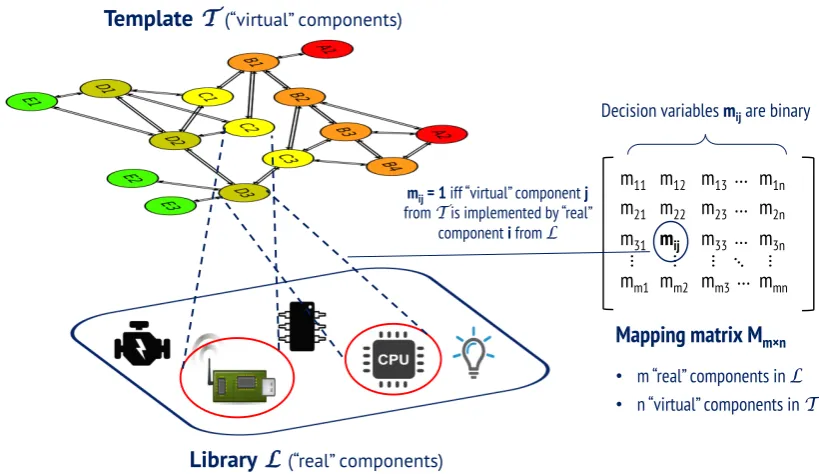
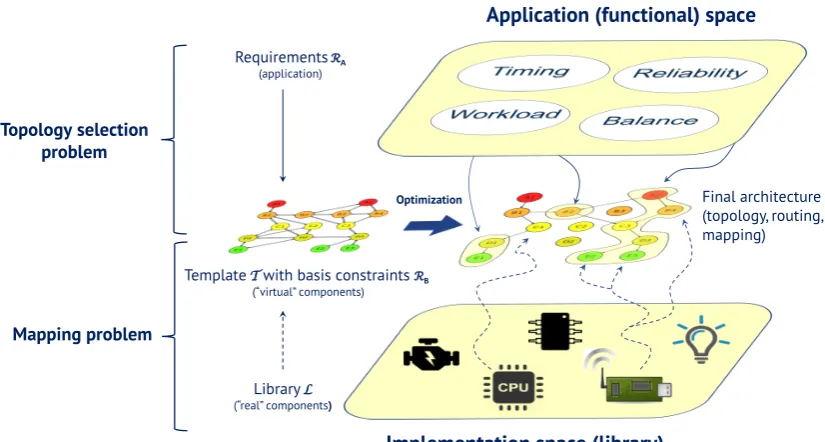
We provide a mathematical formulation of the exploration problem as an optimized mapping problem, in which all components and interconnections of the system architecture are asso-ciated with (mapped to) corresponding entities (e.g., devices, wires, links) from pre-defined libraries. Similarly to the seminal works [99, 12], we employ a generic graph-based represen-tation of an architecture as a network of components. However, we significantly extend and generalize previous works in the following directions. First, we offer a newproblem formula-tionthat separates thetopology selection problem, i.e., whether a “virtual” component should be used in the architecture and how it is connected to others, from themapping problem, i.e., which “real” library component best implements the “virtual” one [62]. This separation of concerns results in a mixed integer linear program encoding of the exploration problem that is more general and more efficient than the previously proposed one [99, 12].
We further introduce ageneric basisof the exploration problem - a common semantic domain that includes a set of binary decision variables denoting the presence/absence of edges and paths between the nodes of the architecture graph, and the mapping of graph elements to library components. We then associate these variables to each other with a set of generic MILP constraints and show how they can be used to instantiate a variety of CPS requirements, such as interconnection, reliability, timing, flow, workload, energy consumption, routing and others. In other words, exploration problem formulations for different CPS domains can be built and customized atop the proposed basis. It is also used to establish the dependency between the two problems (topology selection and mapping), i.e., both of them are expressed using the same decision variables and can be jointly solved as a single optimization problem. On the algorithmic part, we generalize the two techniques proposed in [12] for solving opti-mization problems to use them in different applications. The first technique is a monolithic optimization with all specified constraints (and possible approximations). The second one is an iterative scheme, in which smaller sub-problems are solved at every iteration and heuristic functions are applied for exact analysis and learning new constraints.
1.3. Main Contributions
most promising solutions and leads to savings of orders of magnitude in terms of problem complexity and optimization time, at a small cost in terms of optimality. Differently from the works that apply heuristic approaches for synthesizing large-scale architectures [108, 104], our algorithm allows to leverage the empirical advances of state-of-the-art MILP solvers for dealing with otherwise impractical problems.
Finally, based on the proposed separation of concerns, the generic basis of the exploration problem and the algorithms, we form up a methodology for CPS architecture exploration. The methodology allows us to jointly select system topology and its implementation, and consists of four main steps. On the first step, architecture requirements are written down using an extensible set of patterns, which significantly simplifies the specification. Also the structure of the exploration problem and the platform library are initialized. Second step deals withencodingthe specification into a mixed integer linear program. The architecture template, i.e., the set of all possible topology implementations, the library of components and the association between the two are all established using the aforementioned generic basis. The formulation is then filled in with the application constraints and the cost function, all in the form of MILP expressions on top of the basis. Thesolvingstage then leverages one of the algorithms mentioned above (monolithic or iterative) to generate the system architecture. After the optimization process (and also between the iterations),analysistechniques (e.g., reliability, timing, workload) are applied for static verification and performance evaluation. All steps of the methodology are further detailed in Chapter 3.
1.3.2 Tools
We introduce ARCHEX2.0 [62], an extensible framework for formulating and solving CPS archi-tecture exploration problems with the proposed methodology. It builds on a prototype toolbox for optimized selection of reliable architectures of aircraft electrical power systems proposed in [12]. With respect to its predecessor, ARCHEX2.0 has been significantly re-engineered, and a number of novel features have been added. In particular, its software infrastructure now relies on a set of abstract classes and reusable data structures that can be customized to instantiate architecture exploration problems in different domains of CPS. Existing concepts (e.g., reliability constraints, interconnection constraints) have been generalized, moreover, many other design concerns (e.g., timing, workload, energy) are now also supported, all based on the aforementioned generic basis. The framework is also augmented with new encoding algorithms (e.g., for network path encoding) and analysis techniques.
One notable application domain of ARCHEX2.0 is wireless networking, which is becoming the primary communication infrastructure in networked CPS. In [63] we have implemented and evaluated a large extension of the framework to support topology synthesis problems for wireless networks. This extension leverages the same semantic domain (basis), in particular, by actively using network paths in the formulation, a map of network deployment area and a set of channel models to accurately determine the operating conditions of network designs. In the scope of wireless design problems, we also contribute to the improvement of conven-tional channel models used in network simulators and other related tools. In [64] we have conducted a statistical characterization of the 2.4 GHz radio channel in indoor office envi-ronments in order to verify the accuracy of the log-distance [110] channel model. Based on a huge measurement campaign of collecting the signal strength data in different realistic indoor spaces and node placement scenarios, we were able to propose a set of improvements for the log-distance model (and other affiliated ones) that could improve the accuracy of signal path loss estimation. We report on the results in Chapter 6 and implement them in ARCHEX2.0. To a greater extent, the impact of these improvements can be observed in simulation tools, which is future work.
1.3.3 Applications
We apply our methodology and framework to several different case studies to demonstrate the expressiveness, the usability, the extensibility and the scalability of our approach. Two of them refer to the avionics domain. We first try out a simplified example of an aircraft fuel management system to demonstrate the design flow with ARCHEX2.0. We then run an extensive numerical evaluation on a case study of aircraft electrical power distribution network with stringent safety and reliability constraints, previously introduced in [99]. With respect to previous work, we are able to efficiently generate more complex and realistic architectures, while achieving a better performance and smaller complexity of the problem formulation. The methodology is then applied to another industrial domain, factory automation. We use our approach to generate architectures for reconfigurable manufacturing systems subject to balance, workload, timing and reliability constraints. Same as for the power distribution net-work case study, we evaluate both monolithic and iterative techniques of solving optimization problems, discussing their advantages and drawbacks in the scope of the factory automation case study and related design requirements.
1.3. Main Contributions
Tools Applications
Theory Algorithms Aircraft electrical power
distribution network
Aircraft fuel management system (draft)
Reconfigurable manufacturing
system
• MILP with approximate reliability (monolithic) • MILP modulo reliability
(iterative)
Algorithms Constraints • Interconnection • Balance • Reliability • Workload • Timing
• Energy consumption • Routing
• Link quality • Localization
Constraints
Algorithms
Approximate encoding of network paths
Generic basis
(common semantic domain)
• Set of variables that define the architecture: links, paths, mapping • Constraints for network
paths
• Mapping to a library of components
ArchEx 2.0
ArchEx
• Reliability analysis • Monolithic and iterative
solving techniques • Learning new
constraints to improve
reliability of the system Pattern-based
language
Wireless extension
• Protocol models • Floor plan support • Channel models • Experimental studies
of the channel and improved models Framework • Re-engineered • Reusable • Extensible Extended version
(support of more
complex topologies) Wireless sensor networks:
• Data collection • Localization Topology selection problem Mapping problem Topology selection + mapping
- Previous work by Nuzzo et al. [99], Bajaj et al. [12].
- Contributions of this dissertation, published in [62-64].
1.4 Related Work
The term “cyber-physical system architecture” can assume different meanings in different contexts, i.e., it can include a variety of aspects, ranging from the number, type and dimensions of components, including both the embedded system and the physical plant, to software, e.g., control algorithms. As mentioned above, in this dissertation we are taming the concept architecture design of CPS, while relying on the notion of the architecture that only involves components and their interconnections, as formally defined in Chapter 2. Therefore, this section is dedicated to the discussion of existing techniques and tools adapted to or suitable for the exploration of these high-level architectures, while some other aspects, e.g., control design, are out of scope of this work. Yet, some techniques that we touch upon are applicable to different design phases, however, we only discuss them in the context of architecture exploration.
1.4.1 CPS Design Methodologies
System architecture selection and evaluation is pivotal in well-known design methodologies for embedded systems [114, 16, 72], which were recently extended to CPS design [98, 59, 2]. Indeed, in platform-based design [114], the set of all architectures that can be built out of a library (collection) of components forms a designplatform, while the exploration is carried out as a mapping of functional requirements onto available implementations at each level of abstraction. In turn, contract-based design [16, 115] provides a formal framework of assume-guarantee contracts that is used for verifying the compatibility of components in an architecture as well as the consistency of the specification. Actor-oriented design [72] advocates for co-simulation of different aspects of the architecture and the control algorithm defined using a set of computation models, at different abstraction layers.
More recently, a compositional design methodology for CPS has been proposed [98, 96], based on platform- and contract-based paradigms. In this approach, requirements for system architecture and control protocol are partitioned according to their contractsCT andCC, and
then separately designed, while it has been shown in [99] that if bothCTareCCare satisfied,
then the assembled system is guaranteed to satisfy the system contractCS. A
simulation-based design space exploration is then performed using continuous-time or hybrid behavioral models to jointly assess the architecture and the controller at a lower abstraction level. The exploration methodology presented in this thesis can be directly applied at the corresponding design stage (architecture selection) to search for the optimal implementation that satisfies the contractCT of the architecture. In other words, it is proposed as one step in the hierarchy
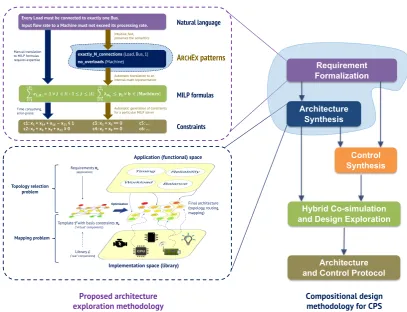
of a holistic cross-layer design flows, as illustrated on Figure 1.3 and Figure 1.4.
1.4. Related Work
Requirement Formalization
Hybrid Co-simulation and Design Exploration Control Synthesis
Architecture and Control Protocol Architecture
Synthesis
System architecture
Functional
Space Architectural Space
Subsystem design Component design Component testing Subsystem testing System-level verification validation
Compositional design methodology for CPS using contracts (P. Nuzzo et al. in Proc. IEEE’15 [98]) The V-model
(http://v-modell.iabg.de) Platform-Based Design (PBD)
(Alberto Sangiovanni-Vincentelli in Proc. IEEE’07 [114])
Development Decomposition
Testing Integration Interconnection and
sizing of high-level components
Allocation of tasks to components HW/SW co-design … Level of abstraction … Proposed methodology (high level of abstraction)
Figure 1.3 – Impact of the proposed architecture exploration methodology: our techniques can be applied at a high level of abstraction within holistic flows used in CPS design.
individual components. These steps are followed by a bottom-up integration and verification process, i.e., the last step is verifying the system as a whole. Different subsystems (e.g., mechatronic, electronic) are typically designed and manufactured by different suppliers. To ensure their correct integration at later stages and to avoid possible errors, requirements for these subsystems have to be provided early in the design by synthesizing a high-level architecture with correctness guarantees. They can then independently follow their own technology-oriented design processes, with certain design decisions being constrained by the capabilities of the top-level architecture.
A holistic model-based design methodology for CPS, proposed in [59], suggests a set of code-pendent steps that could be iteratively taken to progress towards the final implementation of the system. Although the approach primarily focuses on hierarchical modeling of hetero-geneous components for analyzing the behavior and the performance of CPS architectures, automated synthesis of the latter is also anticipated. Starting from a concept design phase, the authors propose to select a proper set of computation models, assemble the models of physical processes and hardware and evaluate the two via simulation. The process is followed by software synthesis and formal verification of the system at each level of abstrac-tion. Our techniques can augment several steps of the proposed design flow with generating correct-by-construction architectures at top levels of abstraction. This is beneficial for the proposed simulation-based design exploration since the architectural models would have formal guarantees and bounds on a set of system-level properties.
1.4.2 Architecture Exploration
state-Requirement Formalization
Hybrid Co-simulation and Design Exploration
Control Synthesis
Architecture and Control Protocol Architecture
Synthesis
Application (functional) space
Implementation space (library)
Topology selection problem
Mapping problem
TemplateT with basis constraints ℛB (“virtual” components)
LibraryL
(“real” components) RequirementsℛA
(application)
Optimization Final architecture (topology, routing, mapping) c1: x1+ x14+ x16– x21≤ 1
c2: x2+ x4+ x9+ x11≥ 0
c3: x1+ x3== 0 c4: x2+ x8== 0
c5: … c6: …
! "#$%& |%|
&()
= ) ∀ $ ∈ ℕ ∶ ) ≤ $ ≤ |#| ! 1234 ≤ 54 ∀ 3 ∈ {789:2;<=} |?|
2() Every Load must be connected to exactly one Bus. Input flow rate to a Machine must not exceed its processing rate.
exactly_N_connections(Load, Bus, 1)
no_overloads(Machine)
Natural language
ARCHEXpatterns
MILP formulas
Constraints
Manual translation to MILP formulas requires expertise
Time consuming, error-prone
Intuitive, fast, preserves the semantics
Automatic translation to an internal math representation
Automatic generation of constraints for a particular MILP solver
Compositional design methodology for CPS Proposed architecture
exploration methodology
Figure 1.4 – Proposed architecture exploration approach positioned within the cross-layer cyber-physical system design methodology proposed by P. Nuzzo et al. [98, 99]. Following the platform-based design paradigm, topology selection and mapping problems are jointly solved to synthesize the optimal architecture, while the requirement formalization stage is enhanced by the pattern-based language.
of-the-artsatisfiability-basedapproaches is twofold: they can be applied both for verifying the architecture with respect to certain properties, i.e., for analysis, as well as for locating a feasible solution in the design space, i.e., forsynthesis. Finally,optimization-basedtechniques rather focus on synthesis. They intend to explore the feasible space in order to find an optimal architecture with respect to a given objective. In the following, we overview existing approaches and tools that belong to one or more of these groups.
Simulation-based approaches. Several modeling languages have been proposed for
1.4. Related Work
checking. MODELICAis a multi-domain modeling language containing different types of subcomponents (e.g., mechanical, hydraulical, electrical, thermal, electronic and others). CPS models written in the MODELICAlanguage can be simulated in many available toolboxes, such as JMODELICA[60] or DYMOLA[36].
CPS architectures can be designed and evaluated with simulation-based tools. In particular, the ones that are capable of capturing both the properties of the embedded systems and of the physical plant, are favorable. For example, in Ptolemy II [107] designers can construct and simulate actor-based models with heterogeneous components by using one of the many provided computation models, e.g., discrete-event, continuous time, synchronous dataflow, finite-state machines, and others. The models can be mixed in a hierarchy controlled by a global scheduler (director). The METROII framework [30] has been designed based on the PBD methodology with the intent of addressing the challenges posed by heterogeneous CPS. It introduces the techniques of representing non-functional quantities and coordinating different models for performance evaluation. The capabilities of expressing both discrete and continuous systems are also provided by widely adopted commercial toolboxes, such as Simulink [119] and LabVIEW [70].
In general, simulation tools are typically focused on performance evaluation of CPS archi-tectures, rather than on design space exploration. Yet, some approaches are taming the simulation-based exploration. For example, Metronomy [47] integrates the functional mod-eling capabilities of Ptolemy II and architectural modmod-eling from METROII via a mapping interface and performs design exploration via co-simulation. Finn et al. combine discrete op-timization routine (MILP) that generates architecture candidates of an aircraft environmental control system with continuous sizing and optimization, performed using MODELICA [40]. In [87], topologies for body area networks are synthesized by solving a MILP problem in a loop with running network simulation using the Castalia toolbox [19]. Simulations are used to verify the candidate topologies and to generate (learn) additional constraints for augmenting the original formulation and guiding the MILP solver towards a satisfying solution. This is a kind of “lazy MILP modulo simulation” approach, where the latter is used as a background theory for verifying the correctness of the topology.
Our approach is, in general, complementary to aforementioned simulation-based techniques for CPS design, since it intends to generate correct-by-construction architecture candidates that can be analyzed and verified using simulation models. For example, it can be used in [40] or [87], since it can fully capture the system requirements from these works. At the same time, the proposed methodology is more expressive and reusable across different CPS domains, while MILP formulations from [40, 87] are problem-specific.
consistency of a set of high-levelarchitecturalmodels that capture different viewpoints of a CPS. In contrast, Canedo et al. [23] address thefunctionalspace, i.e., they evaluate different implementations of the same high-level functionality. They propose a functional modeling compiler that automatically generates a set of architectural models from a functional model, which are further converted to simulation models and executed by a dedicated toolbox for performance analysis. In other words, [23] is a simulation-based design space exploration technique. Still, in many application domains, such exploration may become very expensive due to a huge number of candidate architectures to be simulated. In this work we opt, instead, for techniques that perform an efficient search over large high-level design spaces (e.g., wire-less network topologies, interconnection networks of production machines) to find optimal solution to be further evaluated and refined, in particular, with simulation models.
Satisfiability-based approaches. Many approaches leverage symbolic constraint satisfaction techniques, such as Satisfiability Modulo Theories (SMT) [15, 31], for architecture exploration. The expressiveness of SMT allows it to be applied to rapidly search feasible system config-urations. For example, Reimann et al. [112] propose an SMT-based approach for efficient exploration and pruning of the high-level CPS design space under stringent timing constraints. Kumar et al. [68] address the problem of assigning speeds to resources in a real-time system with timing and energy constraints by developing an SMT solver with real-time calculus [123] as a background theory. A number of efficient SMT solvers, such as Z3 [31], openSMT [21] or Yices [35], as well as a standardized description language, SMT-LIB [14], are available. SMT typically use first-order, linear background theories, e.g., difference logic or linear arith-metic overs reals or integers. Some alternative approaches, however, extend the existing paradigm with non-linear convex theories. For instance, the CalCS toolbox [95] exploits the information from the solution of convex optimization problems to establish the satisfiability of conjunctions of convex constraints. CalCS also provides a formulation that allows it to generate counterexamples, perform conflict-driven learning and approximate non-convex constraints. Gao et al. [41] developed an SMT solver,dReal, for nonlinear theories (e.g., trigonometric, exponential) over the reals using efficient relaxation mechanisms. These two approaches are very attractive to be used for capturing various nonlinear properties of cyber-physical systems, however, none of them has been applied to CPS design exploration problems as yet.
More recently, aSatisfiability Modulo Convex Optimization (SMC), was proposed by Shoukry et al. [118]. It uses a lazy combination of SAT solving and convex programming to search for a satisfying assignment. Even though it uses convex optimization as a background theory, it is not an optimization technique, since it rather focuses on feasibility problems. Instead, it intends to leverage state-of-the-art algorithms from both Boolean and convex analysis domains to extend the application of SMT to nonlinear problems. No case studies in the CPS domain have yet been proposed for this novel technique, however, we find the approach attractive, in particular, for architecture exploration problems.
architec-1.4. Related Work
tural requirements can be naturally captured by an SMT program. Advanced techniques, such as [95, 41] provide even more capabilities by allowing designers to use nonlinear formulas, which is very typical for physical processes and phenomena. The performance of SMT, how-ever, highly depends on the structure of the design exploration problem. For example, if the majority of the variables is Boolean, few calls are made to the theory solvers, and the SAT solver can explore the search space very efficiently. On the other hand, SMT techniques can demon-strate limited scalability on the formulations with large number of real constraints, where they can be outperformed by state-of-the-art optimization algorithms, such as branch-and-cut and its extensions.
The SMT formulation of architecture exploration problems is still a non-trivial process, which requires deep knowledge of underlying mathematical abstractions and understanding the principles of SMT solvers. The problem has been recently addressed by Peter and Givargis [101], who proposed a component-based synthesis method for embedded and cyber-physical system architectures using SMT. They have developed CoDeL, a description language that facilitates the design specification and automatic translation into an SMT program. The main idea of CoDeL is similar to our pattern-based language, provided by ARCHEX, since it also significantly lowers the burden of formulating exploration problems. The main difference is that ARCHEX usesoptimizationto findcost-effectivesolutions, while CoDeL and SMT-based techniques in general aim at determining afeasibleone without minimizing a cost function. Recent research efforts of applying SMT for solving optimization problems are discussed in the next section. Other symbolic techniques, in particular, ordered binary decision diagrams (OBDDs) [91], can be applied for rapidly pruning large high-level design spaces of CPS [90]. Also, symbolic model checking methods have been used for computing feasibility regions of system parameters by expanding unsatisfiable execution traces of the system model to cutting planes [27]. The latter approach has been applied to real-time scheduling, but is very promising also for CPS architecture design.
in [103] for aircraft electrical power systems. In particular, a generic nonlinear formulation is proposed for the exploration of power system architectures, i.e., for generator selection and distribution network synthesis. An approximate formulation as a binary optimization problem with all linear constraints, which can be handled by MILP solvers, is also provided. In [99] the design flow from [103] is extended to a more holistic approach, which enables the co-design and synthesis of electrical power system topology and control using contracts. In particular, the architecture selection problem formulation is augmented with reliability constraints. In [12] the authors tackle the exponential complexity of enumerating failure states of the system by proposing two algorithms for solving the exploration problem - MILP with approximate reliability constraints (a monolithic optimization problem) and MILPmodulo reliability, an iterative technique, in which calls to the optimizer alternate with a heuristic learning function. Our methodology supports generalized versions of both these algorithms, which is further discussed in Chapters 3 and 4.
Overall, as already mentioned in Section 1.2, the methodology presented in this dissertation builds on the works [99, 12] in many aspects. Our additions and extensions include a novel en-coding that separates the topology selection problem from the mapping problem (Section 3.1), more general and more efficient mapping mechanism (Section 2.2.1), more types of supported requirements (Section 3.2), extensible and customizable framework (Chapter 4) and improved usability facilitated by the pattern-based formal language (Section 4.2).
The authors of [50] proposed an approach of high-level CPS architecture synthesis that re-sembles an SMT solver, but with an ILP solver as a core instead of SAT. This allowed them to efficiently solve resource planning and scheduling problem of a large-scale system from the avionics domain. The key idea in [50] is to separate scheduling constraints from connectivity and balance constraints. The developedILP Modulo Schedulingsolver was able to quickly progress towards a feasible solution by solving smaller problems and leveraging a learning function for checking the schedulability, finding unsatisfiable cores and deriving new lemmas to be added to the original formulation. This approach was later generalized in [80] to a rigorousILP Modulo Theories (IMT)method. In IMT, certain terms in the MILP encoding can beinterfacesto background theories, so that theory solvers can be plugged in to verify them. IMT provides a sound and complete optimization procedure for the combination of MILP with stably-infinite theories [80]. The decision procedure, called Branch and Cut Modulo Theory or BC(T), is an extension of the classical branch and cut, which is the most established family of algorithms for solving ILP instances. An implementation of a BC(T)-based solver,Inez, has also been proposed [79]. In our methodology we use an iterative optimization algorithm, in particular for separation of reliability constraints (MILP modulo reliability, initially proposed in [12]), so that our approach is in part inspired by the IMT.
parame-1.4. Related Work
ters (e.g., types of ducts), while the latter runs a convex optimization over a continuous space by using the Nelder-Mead method [92]. The latter is a well known numerical method applied to nonlinear optimization problems, for which derivatives may not be known. Optimization with simulation in the loop has been also proposed by Moin et al. [87] for the optimized design of a human intranet network. A mixed integer linear program generates candidate network architectures under coarse energy constraints, which are then checked by a discrete-event network simulator under reliability constraints. Simulation results generate lower bounds on the power consumption, which are added to the MILP to prune the search space and achieve faster convergence compared to other state-of-the-art methods, such as simulated annealing [3].
Pinto et al. [106] proposed a generic MILP formulation for synthesizing wireless network architectures for building automation and control. The goal is the minimization of the cost of network nodes under a set of topological, link utilization and link quality (end-to-end delay, packet error rate) constraints. More recently, Puggelli et al. [108] extended the formulation from [106] by incorporating different routing patterns (e.g., unicast, multicast) and power consumption constraints for indoor wireless sensor networks. They explore a broader design space and solve a more complex optimization problem. However, according to the results provided in [108], the problem becomes impractical, i.e., no solution is found within a timeout, for networks of more than 50 end devices. Therefore, the authors also propose a polynomial-time heuristic algorithm in place of the NP-hard MILP problem that applies Dijkstra’s shortest path routine for synthesis of large networks. Instead, in our work we use an approximate algorithm for encoding network paths tosymbolicallygenerate compact MILP formulations that can scale to hundreds of nodes. Moreover, with respect to [106, 108], our approach is more general, i.e., it not only supports the formulations from [106, 108], but also other concerns (e.g., lifetime constraints, localization constraints). Overall, our approach is superior both in network size and the dimensionality of the design space, which now includes the sizing of network components (e.g., choosing the transmission power of devices, selecting external antennas and so on). We refer the reader to Section 6.4 for a more detailed comparison of our approach with other related techniques in the wireless network domain.
A platform-based framework for the design of interconnection networks, COSI [104], has been proposed for synthesizing high-level network-on-chip architectures. COSI leverages component-based model for representing system architectures and several quantity models for capturing various performance aspects. It allows designers to plug in domain-specific heuristic algorithms for solving mapping problems. A case study of synthesizing networked control systems in building automation using COSI has been presented in [105].
Recently, many efforts have been made in applying the SMT-based techniques to solving optimization problems [116, 28, 93, 117, 74]. For example, Cimatti et al. [28] presented aSatisfiability Modulo Costapproach by augmenting an SMT solver with pseudo-boolean constraints representing cost functions. The key idea is to iteratively use the SMT procedure and tighten the admissibility range of one or multiple objectives. Two algorithms have been proposed for running the optimization, one based on branch-and-bound and one based on binary search. The technique reflects the general principle ofOptimization Modulo Theories (OMT), i.e., solving SMT problems and updating the cost-related terms of the SMT formula until no better solution is found. The main difference from aforementioned ILP Modulo Theories techniques is, therefore, that in OMT the optimization is performedexternallyfrom the solver being used. The latter only checks the feasibility of every new solution. In contrast, in IMT optimization is performedinsidea MILP solver, while the theory solver is responsible for counterexample generation and learning. Finally, the branch-and-cut algorithm used in most of existing MILP solvers estimates the best achievable cost at every step (considering the linear relaxation of the solution). This lower bound can be compared to the best integral solution found so far in order to estimate a gap between the two, which can be used, for example, as a termination criteria for the solver (e.g., when a solution is found, which is only 10% worse than the bound). In OMT, it is not possible to estimate such optimization gap. Several optimizing SMT solvers have been proposed, for example, MathSAT [22] (implement-ing the approach from [28]), OptiMathSAT [117], SYMBA[74] andνZ [18]. They compete in supporting different theories (e.g., linear arithmetic over rationals or integers) and objective functions, conflict-driven learning techniques and performance. None of them currently supports nonlinear cost functions. While the exhaustive comparison of these existing tools is out of scope of this work, we note that none of them has been applied to cyber-physical system design problems so far. OMT techniques are still in their infancy, but we expect their future applications to architecture exploration problems and consider them an interesting direction of future work in the area of CPS design.
1.5 Outline of the Dissertation
1.5. Outline of the Dissertation
Chapters 5 and 6 of the dissertation.
InChapter 2we introduce the formal theoretical background of our methodology and the main definitions that we use throughout the thesis. We describe the graph-based representation of CPS architectures, which is employed in this work, and define the generic basis of architecture exploration problems in terms of variables and mixed integer linear constraints used in the proposed formulation. We further demonstrate and exemplify, how the basis can be used to instantiate system requirements.
Chapter 3presents the exploration methodology, in which the final architecture is a meet-in-the-middle of the two search spaces, i.e., application space (architecture requirements) and implementation space (library of components) and two respective problems, i.e., topology selection and mapping. We discuss the flow of the methodology, outlining the main steps: specification, encoding, solving and analysis. We then provide the formulations of a variety of CPS requirements that are currently captured in our formulation (e.g., timing, reliability, work-load, routing). We further elaborate on the mapping problem and on the solving and analysis techniques. Finally, the chapter is concluded with the algorithmic part of the methodology, including algorithms for approximate encoding of path constraints and iterative optimization techniques.
InChapter 4we introduce ARCHEX2.0, an extensible framework for CPS architecture explo-ration that we developed in support of the proposed methodology. We pay much attention to the pattern-based language, which plays an important role in the specification, since patterns significantly lower the burden of formulating exploration problems. We then explain the software structure of ARCHEXand its extension for wireless network design. Finally, we give a step-by-step example of using the framework for formulating and solving a simple problem for a fuel management system.
InChapter 5 we run the numerical evaluation of our approach on two reliability-driven industrial case studies: aircraft electrical power distribution network and reconfigurable man-ufacturing system. By solving these problems in ARCHEX, we demonstrate the efficiency and the scalability of the methodology and show the advantage of using patterns for formulating complex problems.
InChapter 6we focus on a significantly different domain, wireless networks. We then show, how our approach can be applied to topology synthesis and component sizing of wireless sensor networks on two case studies, data collection and localization networks. In addition, by reporting on the results of the channel measurement campaign, we propose several im-provements for conventional channel models that can be used in design tools including, but not limited to, network simulators. These models are included in our library in order to map virtual links of the architecture template to real (physical) ones.
2
Preliminaries
This chapter provides a background for the concepts introduced in this thesis. We give the main definitions related to system architecture and its graph-based representation. We then introduce a set of variables and generic mixed integer linear constraints that we call the “basis” of the exploration problem. This basis is a common semantic domain, in which it is possible to define a variety of requirements for different classes of cyber-physical systems. We further briefly review a set of techniques for expressing complex constraints in a linear form. Finally, we cast the architecture exploration problem as an optimized mapping problem on a reconfigurable graph, where “virtual” components of the architecture are mapped into “real” components from pre-defined libraries to minimize a cost function under correctness guarantees.
2.1 Terminology
2.1.1 Architecture, Template, Topology Configuration
We assume that a CPSarchitectureis represented by a network of interconnected components, which are selected from alibrary(collection)Land comply with a set ofcomposition rules. Each component inLhas a set ofattributescapturing its functional and extra-functional properties. Extra-functional properties include, for instance, energy consumption, processing delay, and cost. Each component has a set ofterminalsparameterized withterminal variables. Input and output terminals are used to send and receive signals or the values of terminal variables. Composition rules define which connections are allowed and how terminal variables may be assigned. Components can have differenttypes, i.e., different roles or functions in the system.We focus on networks whose components exchange entities or quantities viaflows (e.g., message flow, power flow, product flow). Therefore, certain components have the role of sources or sinks.
Definition 2.1(Architecture). A systemarchitectureis a directed graph G=(V,E), where V is a set of components (nodes) while an edge ei j∈E represents an interconnection from vito vj,
also written as evivj, with i,j∈{1, . . . ,|V|},|V|being the cardinality of V .
GraphGcan be represented by its adjacency matrix, and in the following we useEto denote this matrix unless specially noted thatE is a set. Edgesei j ∈E are interpreted as binary
between nodes. We say that an edge betweenvi andvj isinstantiated(or used) ifei j =1.
When at least one incoming edge variableei j or outgoing edge variableej i for a component
vievaluates to one, we say thatviisconnected. Trivially, connected nodes are instantiated, i.e.,
used in the final architecture, while the opposite may not hold. Instantiated components are those components that perform a certain function within the system, which is a more general definition with respect to being connected. This definition is futher explained later in this section.
A set of all possible architectures for a given system forms anarchitectural space, which design-ers explore to find a feasible (or optimal, sub-optimal) instance that meets the specification. To formalize the exploration problem, we resort to the definitions oftemplateandtopology configurationspecified as follows:
Definition 2.2(Template). AtemplateTis a reconfigurable architecture, i.e., a graph with a fixed set of nodes V but variable set of edges E , which can be altered by the use of the variables ei j. The size of the template is determined by the number of nodes in the graph, i.e.,|T| = |V|.
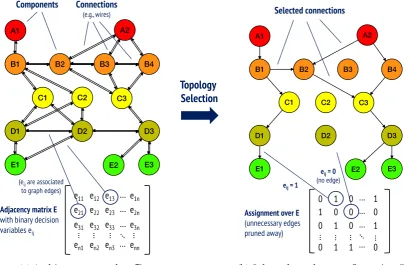
Definition 2.3(Topology configuration). Atopology configurationE∗is an assignment over the variables in E , marking the subset of edges fromTthat are instantiated. It can be seen as an instance of T.
Due to its reconfigurability, Tis one of the inputs of the exploration problem. It has the maximal number of nodes and all possible edges, i.e., those that are not restricted by the composition rules (a restriction is enforced, for example, if components of certain types cannot be directly connected). In turn, a topology configuration is a design decision, i.e., it defines which components are used in the final architecture and how they are connected. The number of nodes and edges in the topology configuration can be smaller than in the template. Some of them may not be necessary for the system to function correctly, i.e., unused, and, therefore, are pruned away to minimize some objective function.
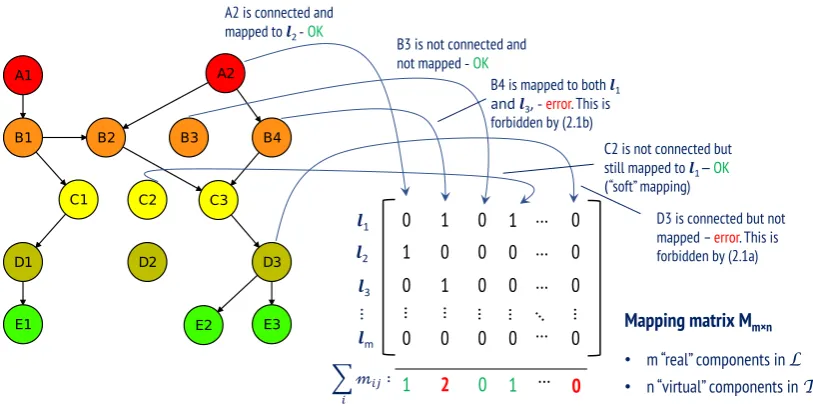
Example 1(Topology Selection). We assume a sample architecture that consists of 5 distinct component types: A,B,C,D and E. Template T of the architecture is shown on Figure 2.1a, where components of different types have different colors.Tincludes all possible connections, while the graph is not complete, because some edges are restricted by composition rules (e.g., direct connections between B and D are not permitted). The total number of nodes inTis 15. Figure 2.1b represents an assignment over E , i.e., a configuration E∗ of the system topology selected from the architectural space. Only 12 nodes are used (all but B3, C2 and D2), and all connections that are not essential for system function are removed.
2.1.2 Mapping
2.1. Terminology
e11 e12 e13 e21 e22 e23 e31 e32 e33 en1 en2 en3
e1n e2n e3n enn … … … … … … … … … A1 A2
B1 B2 B3 B4
C1 C2 C3
D1 D2 D3
E1 E2 E3
Architecture Selection
Components Connections
(e.g., wires)
Adjacency matrix E
with binary decision variables eij
(eijare associated
to graph edges)
A1 A2
B1 B2 B3 B4
C1 C2 C3
D1 D2 D3
E1 E2 E3
0 1 0 1 0 0 0 1 0 0 1 1
1 0 1 0 … … … … … … … … … Selected connections
Assignment over E
(unnecessary edges pruned away)
eij= 1
eij= 0
(no edge)
e11 e12 e13 e21 e22 e23 e31 e32 e33
en1 en2 en3 e1n e2n e3n enn … … … … … … … … … A1 A2
B1 B2 B3 B4
C1 C2 C3
D1 D2 D3
E1 E2 E3
Topology Selection
Components Connections
(e.g., wires)
Adjacency matrix E
with binary decision variables eij
(eijare associated
to graph edges)
A1 A2
B1 B2 B3 B4
C1 C2 C3
D1 D2 D3
E1 E2 E3
0 1 0 1 0 0 0 1 0
0 1 1 1 0 1 0 … … … … … … … … … Selected connections
Assignment over E
(unnecessary edges pruned away)
eij= 1
eij= 0
(no edge)
e11 e12 e13 e21 e22 e23 e31 e32 e33
en1 en2 en3 e1n e2n e3n enn … … … … … … … … … A1 A2
B1 B2 B3 B4
C1 C2 C3
D1 D2 D3
E1 E2 E3
Architecture Selection Components Connections
(e.g., wires)
Adjacency matrix E with binary decision variables eij
(eijare associated
to graph edges)
A1 A2
B1 B2 B3 B4
C1 C2 C3
D1 D2 D3
<