Journal of Teaching Language Skills (JTLS)
37(3), Fall 2018, pp. 169-210- ISSN: 2008-8191 DOI: 10.22099/jtls.2019.32064.2629
Developing and Validating a Model for Exploring Iranian EFL Teachers’ Perception of Professional
Development
Hassan Soodmand Afshar Shabnam Ghasemi **
Abstract
The present study aimed at exploring Iranian EFL teachers’ perception of professional development. To this end, 200 EFL teachers teaching at private language institutes in Iran were selected as the participants of the study. First, a semi-structured interview was conducted with 50 participants of the study based on which Professional Development Perception Questionnaire was developed and pilot-tested (i.e. subjected to exploratory factor analysis) with 82 similar EFL teachers. The questionnaire was then expert viewed and administered to all the 200 participants of the study and was subjected to another factor analysis to ensure its validity and reliability more comprehensively. The findings yielded a valid model or inventory for assessing EFL teachers’ perceptions of professional development. The results also revealed that the participants perceived professional development enhanced their pedagogical knowledge, improved students’ learning outcomes, and helped them understand their own pedagogical weak points and strong points and those of their colleagues. Furthermore, the results of chi-square analyses indicated that high-experienced teachers had significantly more positive
Received: 07/01/2019 Accepted: 27/08/2019
Associate Professor, Bu-Ali Sina University, Hamedan - Email: [email protected],
Corresponding author
perceptions of professional development than their low-experienced counterparts. The results of the current study yielded a valid and reliable model for measuring English teachers’ perception of professional development which can be adopted safely by other similar studies. The findings might also contribute to policymakers and managers of language institutes to establish proper professional development activities for their teachers which might consequently lead to learners’ improvement in learning.
Keywords: Professional development, perception, low-experienced
teachers, high-experienced teachers, model development and validation
One of the crucial factors in reinforcing standards of teaching and
learning is the teachers’ professional development (PD) since the goal of educational institutions is achieved by professionally well-prepared teachers (Day, 1999). He believes that teachers need to be bound to continuing professional development (CPD) in order to renew their knowledge and skills for effective teaching. As pointed out by Richards and Farrell (2005), teachers in general and language teachers in particular are basically supposed to stay up-to-date regarding PD in the field of education, think about and assess their progress in instructional abilities and practices, and also be prepared to use novel educational methodologies and styles as the requirements arise.
According to Day (1997), PD encompasses “all natural learning
experiences and those conscious and planned activities which are intended to be of direct or indirect benefit to the individual, group or school and which contribute, through these, to the quality of education in the
classroom” (p. 4). It is believed that teachers need to develop
professionally throughout their career lives to be effective (Billingsley,
2004). The nature of EFL teachers’ knowledge appears to be transient
used to bridge the gap between teachers’ need to update and their current
professional knowledge (Meng & Tajaroensuk, 2013).
Review of the Related Literature Theoretical Framework of the Study
PD is described as teachers’ continuing process of learning both as an
individual and as a member of an academic society (Crow, Milton,
Moomaw, & O’Connell, 1976). Broadly speaking, several studies on the
impact of PD have shown improvement in many areas, including pedagogy and instructional practices (Perez, McShannon, & Hynes, 2012), skills of using technology in classes (Shumack, 2007), and professional knowledge (Singer, Lotter, Feller & Gates, 2011). Teacher PD has been defined as “a
learning process resulting from meaningful interaction with the context
(both in time and space) and eventually leading to changes in teachers’ professional practice (actions) and in their thinking about that practice”
(Kelchtermans, 2004, p. 220).
Birman, Desimone, Porter, and Garet (2000) classify teachers’ PD
into two types: The traditional and the reform-type PD. Clarke and Hollingsworth (2002) maintain traditional teacher PD is boiled down to attending one-shot workshops through which the disparity in teachers’
knowledge and skills can be eliminated. The alternative approach to the
traditional type of teachers’ PD is the reform-type PD which is described
as “a variety of PD activities that accompany continuous inquiry into one's
instructional practice” (Huberman & Guskey, 1995, p.270). Kwakman
(2003) believes that since teachers can only acquire new teaching competencies in practice, the school is the most suitable place for teachers to develop themselves professionally. Accordingly, it can be concluded that the proponents of the reform-type model believe that the influence of teacher PD is most realizable when it is done within the teachers’ working
from learning separately to learning together, from replication to reflection, and from centralization to decentralization.
There are a large number of features reportedly impacting on the effectiveness of PD. Desimone’s (2009) study indicated that features of the effective PD included the content focus of the teachers’ knowledge,
active learning, coherence of the PD practice with the reality of the
classroom, duration of the PD activity, and teachers’ collective
participation to initiate PD with colleagues. Likewise, Darling-Hammond, Hyler, and Gardner (2017) identified the content focus, active learning, collaboration in job-embedded contexts, use of models of effective PD practices, coaching and expert support, feedback, and reflection, as well as sustained duration as seven characteristics of effective PD.
From a psychological point of view, it could be argued that PD could
reduce individuals’ burnout by focusing their attention on better practice
(Miller, 1999) because, as Miller maintains, teacher professional learning
programs can serve as “buffer against burnout” (p.156). Further research
on these effects has found that the outcome of PD on the teaching of the teachers and learning of the students remains for a long time and is effective even when the resources for further training get limited (Rutz, Condon, Iverson, Manduca & Willett, 2012). According to Powel, Terrel, Furey, and Scott-Evans (2003), PD gives educators the opportunity to scrutinize their theoretical bases and the way theory influences their actual teaching practice. It is believed that the in-service preparation of educators is as significant as their pre-service teaching, and consequently educators are required to take part in different in-service preparation programs either abroad or at home (Ozer, 2004).
Previous Research Findings
Several research studies have been conducted in order to investigate
the teachers’ PD from various perspectives such as teachers’ perception
implementation of a job-embedded online teacher PD was examined by Powell and Bodur (2019). The results of the data analysis of the interviews with six high-school teachers revealed six major themes including relevancy, authenticity, usefulness, interaction and collaboration, reflection, and context. Moreover, they found that the length of teaching experience and context might have played significant parts in the
participants’ perceptions of the online teacher PD experience.
Avidov-Ungar (2016) evaluated the manner in which teachers perceived their PD processes. A semi-structured interview was conducted with 43 teachers to understand their perceptions about their PD. Analyzing the quantitative data, the researcher identified two dimensions to which the teachers referred in their PD stories. One dimension included PD motivation, and the other included types of aspiration (lateral/ vertical). By lateral aspiration, she meant the teachers wished to develop within their role by developing their knowledge, their repertoire of skills, and scope of their responsibilities, while vertical aspiration referred to those wishes of the teachers to progress in order to take on more senior positions.
Nasser, Kidd, Burns, and Campbell (2015) investigated teachers and
assistant teachers’ perceptions of a one-year PD model with 27 teachers by engaging them in different types of interactions in a group and as individuals. For two years, they participated in on-site community meetings and in-classroom mentoring. Interviews were also conducted to
explore teachers’ perceptions regarding their varied mentoring
experiences. After analyzing the interviews, Nasser et al. found that focus on usable knowledge, opportunities for networking with colleagues, and
mentors’ positive interactions supporting their learning were the most
meaningful perceptions teachers had about the PD model.
semi-structured interviews conducted with 20 EFL teachers. The findings of the survey showed that for participants, PD was seen as an activity to improve skill development, continuous learning, remaining up-to-date, learning for interest, and professional revitalization. In addition to perception results, it was revealed that Iranian EFL teachers developed professionally through formal education and attending PD events.
Significance of the Study and Research Questions
It has been argued that developing teachers professionally is one of the central educational endeavors being supported in every program to increase learners’ instructional attainments (Richards & Farrell, 2005).
Consequently, educators are required to continuously improve and boost their competences in order to be prepared to provide the learners with the teaching they need for international competitive market place of contemporary times (Sorcinelli, Austin, Eddy, & Beach, 2006).
Dayoub and Bashiruddin (2012) state that a huge body of research in developed and developing countries have been devoted to improving the quality of teacher education since it is believed that improving teachers leads to improvement in teaching and learning, which in turn would increase the quality of education in the country. Following this global trend, Iran as a developing country has also made some efforts to provide teachers in general and EFL teachers in particular with opportunities for PD by holding different workshops, conferences, and in-service training education. Nevertheless, most of the efforts in this regard are devoted to public school teachers. Thus, there is a need to focus on EFL teachers of private language institutes.
The significance of this study would lie in the fact that it would develop a novel and essential instrument (i.e. a structured questionnaire)
inform EFL teachers, managers of private language institutes, supervisors, and researchers to become aware of the importance of PD.
Therefore, based on what was mentioned above, the following research questions were postulated for the present study.
1. What is a valid model of EFL teachers’ perception of PD?
2. What are Iranian EFL teachers’ perceptions of professional development?
3. Is there any significant difference between high-experienced and low experienced Iranian EFL teachers regarding their perception of professional development?
Methodology Participants
The participants of the study included 200 EFL teachers teaching at different private language institutes in Iran who were selected based on convenience sampling. They were both female (n=114) and male (n=86) teachers holding BA (n=118), MA (n=71), and Ph.D. (n=11) degrees in English Language Teaching, English Translation, and English Literature. Furthermore, their teaching experience varied from 1 to 20 years (47.5% below five years, 25% between five and ten years, and 27.5% above 10 years). The participants were teaching at different levels ranging from pre-intermediate to advanced levels. Moreover, 50 participants of the study were selected based on convenience sampling to attend an interview. The informed consent of the participants was also obtained.
Data Collection Semi-Structured Interview
of attending PD, the benefits of PD methods, and the appropriate methods felt to be needed by them to develop professionally. It is noteworthy that the questions of the interview were expert viewed by two scholars in the field for validity purposes. The interviews were conducted in the English language which included five main questions (see Appendix A). Each interview took approximately 30 minutes. The main purpose behind the interview was to explore the ideas and perceptions of EFL teachers regarding PD, the common patterns of the responses of whom acted as the basis of some of the items of the structured questionnaire. However, the interview findings also gave us a more comprehensive picture of the
participants’ perceptions of PD which helped us develop a more thorough and evidence-based discussion of the results obtained through the Likert-scale questionnaire.
Professional Development Perception Questionnaire (PDPQ)
A researcher-made questionnaire called PDPQ (see Appendix B) was
used in the present study in order to assess the EFL teachers’ perceptions
of PD. This PDPQ was constructed in English, the items of which were mainly derived from the results of the semi-structured interview mentioned above. The PDPQ consists of three parts including demographic information of teachers, their previous experience of attending PD activities, and 35 Likert-scale items ranging from strongly disagree=1 to
strongly agree=5 which elicited the participants’ perception of PD. The
questionnaire was pilot tested with 82 EFL institute teachers similar to the study participants in order to ensure its validity and reliability. It was then re-tested (i.e. subjected to factor analysis) with all the 200 participants of the present study after we made some minor changes on the items of the questionnaire based on the data gained from the pilot study. The results of
estimations are all presented in the Results section under Results of Question One.
Procedure
As mentioned earlier, a semi-structured interview was first conducted by the researchers with 50 EFL teachers. The interviews were transcribed to extract the main themes and common patterns. Based on the findings of the interview (which acted as the basis of nearly 50 percent of the questionnaire items) and also an extensive review of the literature in the field on the topic (which also acted as the basis of the other half of the questionnaire items), the questionnaire (i.e., PDPQ) was devised in order
to obtain the participants’ perception of PD. The PDPQ was then expert viewed. Afterward, it was piloted with 82 subjects similar to the participants of the study and was subjected to factor analysis for validation
purposes, and its reliability was ensured adopting Cronbach’s Alpha
internal consistency estimation. The questionnaire was then administered to 250 EFL teachers; however, only 200 of them returned it. Although the questionnaire proved to be valid and received the pre-requisite construct validation standards in the pilot study phase, it was subjected to another factor analysis with all the 200 participants of the study after some minor changes were made in some items of the questionnaire after pilot testing to enhance the item loadings and to receive sets of factors onto which the items would load more neatly. The reliability of the PDPQ was also
re-ensured adopting another Cronbach’s Alpha internal consistency estimation.
to 10 years of teaching experience were not considered in the analysis of the results of the last research question.
Data Analysis
Having collected the required data, the researchers carried out data analyses using both descriptive and inferential statistics. The semi-structured interviews were exposed to content analysis. That is, the interviews were audio-recorded after we obtained the consent of the participants and were then transcribed. Next, they were read and re-read and the recurring themes and the common patterns of the responses were identified, coded and subjected to frequency analysis (i.e. “quantified”).
To answer the first research question of the study, two exploratory principal component factor analyses with varimax rotations (one with the data obtained from the pilot study participants and one with the data gained
from the participants of the study) and two Cronbach’s Alpha internal consistency estimations (again one with the data gained from the pilot study participants and one with the data obtained from the participants of the study) were adopted. Concerning the second research question of the study, descriptive statistics including mean, standard deviation, and frequency analysis were adopted. To answer the third research question, a Chi-square Analysis was run to see if there existed any significant differences between the two groups of high- and low-experienced teachers. Chi-square analyses for individual items of PDPQ were then applied to see the difference between the two groups of teachers with regard to the individual items of the questionnaire.
Results Results for Question One
The first research question of the study sought to present a valid
model/inventory for measuring EFL teachers’ perception of PD. Following
EFL teachers’ perception of PD, the researchers initially carried out an
extensive review of the related literature and conducted a semi-structured interview with 50 participants similar to those of the study, the results of both of which presented a 35-item questionnaire with five components or sub-constructs for assessing the teachers’ perception of PD including a)
PD activity preferences, b) potential benefits of PD activities c) actual benefits of PD activities d) affective contributions of PD and e) practical contributions of PD. This questionnaire was piloted with 82 participants with characteristics similar to those of the present study as mentioned earlier. That is, the questionnaire was subjected to a principal component
factor analysis with varimax rotation and a Cronbach’s alpha internal
consistency reliability estimation to assess its validity and reliability respectively. First, Kaiser-Meyer-Olkin (KMO) Measure of Sampling Adequacy was calculated to be 0.74, above the recommended value of
0.60, and Bartlett’s Test of Sphericity was found to be statistically
significant (p=.000 < 0.05). In addition, using Cronbach’s Alpha internal
consistency index, the questionnaire was found to enjoy a good reliability index of 0.91. The results of principal component factor analysis for the pilot-study stage are presented in Table 1.
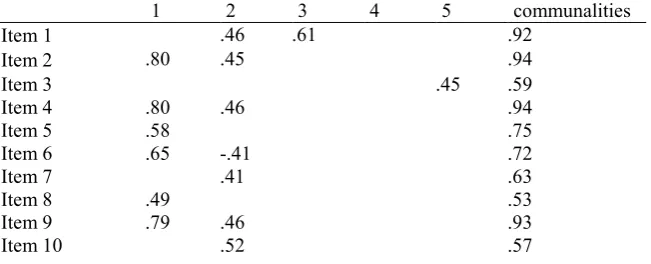
Table 1.
Factor Loadings for the Rotated Factors of the Pilot Study Participants’
Perception of PD
1 2 3 4 5 communalities
Item1 .46 .61 .92
Item 2 .80 .45 .94
Item 3 .45 .59
Item 4 .80 .46 .94
Item 5 .58 .75
Item 6 .65 -.41 .72
Item 7 .41 .63
Item 8 .49 .53
Item 9 .79 .46 .93
1 2 3 4 5 communalities
Item 11 .64 .59 .78
Item 12 -.42 .57
Item 13 .59 .61
Item 14 .43 .73
Item 15 .40 .55
Item 16 .41 .53
Item 17 .64 .69
Item 18 .78 .44 .92
Item 19 .49 .70
Item 20 .42 .77
Item 21 .77 .75
Item 22 .41 .57
Item 23 .46 .62 .94
Item 24 .70 .83
Item 25 .72 .78
Item 26 .56 .76
Item 27 .69 .80
Item 28 .63 -.41 .73
Item 29 .54 -.50 .75
Item 30 .55 -.47 .67
Item 31 .60 .45 .74
Item 32 .55 -.45 .79
Item 33 .69 .86
Item 34 .59 .59
Item 35 .66 .80
Eigenvalues 30.43 43.96 50.51 55.96 60.32 % of variance 30.43 13.52 6.55 5.44 4.36
As shown in Table 1, the first factor loads most strongly on 22 items, with loadings in the first column. The second factor comprised 18 items with loadings in column 2 of the Table. The third factor comprised four items with loadings in the third column. Item 1 had its highest loading from the third factor, but it also had a strong loading from the second factor. The fourth and fifth factors consisted of two items each with two loadings in columns 4 and 5 of the Table respectively. As it is demonstrated in Table 1, all the items enjoyed a high commonality over .50. The five factors, in total, accounted for nearly 60 percent of the total variance. Although KMO
was significant (p=.000) and the factor loadings and the commonalities were high enough (above .40 and .50 respectively), having scrutinized the factor loadings, we noticed that there was not a strong congruence between the five hypothesized sub-constructs or components already mentioned and the five sets of factor loadings, which might, partially at least, be due to the lower number of participants in the pilot study phase and/or the wording of some of the items of the questionnaire. To resolve the issue, some minor changes were made in some items of the questionnaire and it was exposed to another principal component factor analysis with varimax rotation with all the 200 participants of the study, the results of which are presented in Table 3. However, first, the results of KMO Measure of Sampling Adequacy and Bartlett’s Test of Sphericity are presented in
Table 2 below.
Table 2.
The Results of the KMO and Bartlett's Test for the Study Participants’
Perception of PD
Kaiser-Meyer-Olkin Measure of Sampling Adequacy. 0.78
Bartlett's Test of Sphericity Approx. Chi-Square Df 3699.14 595
Sig. 0.000
As it is evident in Table 2, KMO Measure of Sampling Adequacy was
0.78, above the recommended value of 0.60, and Bartlett’s Test of
Sphericity was statistically significant (X2 (595) = 3699.14, P < 0.05).
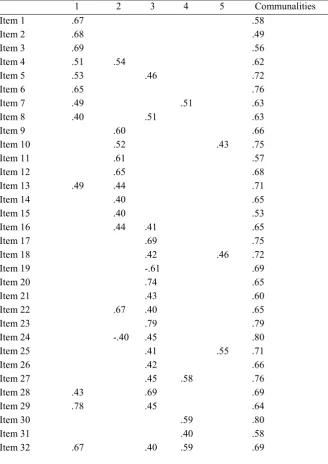
Table 3.
Factor Loadings for the Rotated Factors of the Study Participants’
Perception of PD
1 2 3 4 5 Communalities
Item1 .67 .58
Item 2 .68 .49
Item 3 .69 .56
Item 4 .51 .54 .62
Item 5 .53 .46 .72
Item 6 .65 .76
Item 7 .49 .51 .63
Item 8 .40 .51 .63
Item 9 .60 .66
Item 10 .52 .43 .75
Item 11 .61 .57
Item 12 .65 .68
Item 13 .49 .44 .71
Item 14 .40 .65
Item 15 .40 .53
Item 16 .44 .41 .65
Item 17 .69 .75
Item 18 .42 .46 .72
Item 19 -.61 .69
Item 20 .74 .65
Item 21 .43 .60
Item 22 .67 .40 .65
Item 23 .79 .79
Item 24 -.40 .45 .80
Item 25 .41 .55 .71
Item 26 .42 .66
Item 27 .45 .58 .76
Item 28 .43 .69 .69
Item 29 .78 .45 .64
Item 30 .59 .80
Item 31 .40 .58
As shown in Table 3, the first factor which seemed to index PD
activity preferences loads most strongly on items 1, 2, 3, 4, 5, 6, 7 and 8
with loadings in the first column. Although item 4 received a high loading from the first factor, it also received a cross-loading over .40 from the second factor. The second factor, which seemed to index potential benefits
of PD activities, mainly comprised eight items with loadings in column 2
of the Table. Item 13 had its highest loadings from the first factor, but it also had a cross-loading over .40 from the second factor i.e. potential benefits of PD activities. The third factor, which seemed to index actual
benefits of PD activities, comprised items 17 to 29 with loadings in the
third column. However, although a few items here (e.g., items 22 and 29) simultaneously received strong loadings from the other factors, they all had a cross-loading over .40 from the third factor. The fourth factor, which seemed to index affective contributions of PD, was composed of three items (i.e. items 30, 31 and 32) with loadings in column 4 of the Table. Item 32 had its highest loading from the first factor, but it also received a cross-loading over .40 from the fourth factor. Finally, the fifth factor, which seemed to mainly index practical contributions of PD comprised three items (i.e. items 33, 34, and 35) with loadings in the fifth column. Although item 34 had its highest loading from the first factor, it also received a very strong cross-loading from the fifth factor. As demonstrated in Table 3, almost all the items enjoyed a high commonality over .50. Also, as it is evident from Table 3, after rotation, the first, second, third, fourth and fifth factors accounted for 27.07, 7.79, 6.82, 5.43, and 5.09 percent of the total variance respectively. That is, overall, they accounted for more than 60 percent of the total variance.
Item 33 .45 .48 .64
Item 34 .81 .62 .73
Item 35 .72 .73
Moreover, adopting Cronbach’s Alpha internal consistency index, we
found the questionnaire to enjoy a good reliability index of 0.91, which is the same as what we achieved in the pilot-study stage reliability estimation.
Results for Question Two
The second research question of the study sought to identify the
Iranian EFL teachers’ perception of PD. To this end, a Likert-scale
questionnaire (i.e. PDPQ) was developed, the results of the participants’
responses to the items 9 to 35 of which are summarized in Table 4.
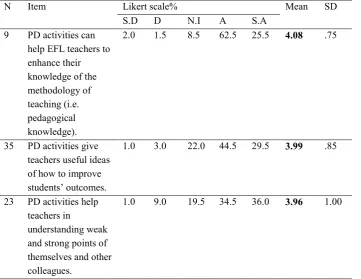
Table 4.
Descriptive Statistics for the EFL Teachers’ Perception of Individual Items
of the PD Questionnaire
N Item Likert scale% Mean SD
S.D D N.I A S.A
9 PD activities can help EFL teachers to enhance their knowledge of the methodology of teaching (i.e. pedagogical knowledge).
2.0 1.5 8.5 62.5 25.5 4.08 .75
35 PD activities give teachers useful ideas of how to improve students’ outcomes.
1.0 3.0 22.0 44.5 29.5 3.99 .85
23 PD activities help teachers in
understanding weak and strong points of themselves and other colleagues.
N Item Likert scale% Mean SD
S.D D N.I A S.A
22 PD activities help teachers in sharing ideas with
colleagues.
2.0 4.5 23.5 36.5 33.5 3.95 .96
26 PD activities help teachers in how to use their
observations to assess students’ learning needs.
1.5 5.0 32.0 27.0 34.5 3.88 .99
18 PD activities help teachers in how to deal with problems arising in the class.
--- 9.5 30.0 25.5 35.0 3.86 1.00
27 PD activities help teachers in better understanding of students’
problematic area in learning and help them.
3.5 16.5 8.5 34.5 37.0 3.85 1.18
30 PD activities encourage teachers to redesign their teaching to support various learners.
1.0 10.0 25.5 32.5 31.0 3.83 1.01
7 I prefer to participate in self-study of journals, sites, etc. as PD activity.
1.5 11.1 26.6 26.6 34.2 3.81 1.07
28 PD activities help teachers in implementing the realia and teaching
N Item Likert scale% Mean SD
S.D D N.I A S.A
aids more effectively in class.
8 I prefer to participate in graduate studies level at university as PD activity.
3.0 2.5 27.0 48.0 19.5 3.79 .89
17 PD activities help teachers in how to behave students.
1.0 12.0 19.0 43.5 24.5 3.79 .98
12 PD activities can help EFL teachers to enhance their knowledge of materials preparation.
2.5 12.0 22.0 34.0 29.5 3.76 1.08
24 PD activities help teachers in keeping themselves up-to-date
2.5 7.5 25.5 41.5 23.0 3.75 .97
10 PD activities can help EFL teachers to enhance their knowledge of student evaluation and assessment.
2.0 8.0 35.0 23.0 32.0 3.75 1.05
3 I prefer to participate in interactive workshops as PD activity.
2.5 15.0 19.5 31.5 31.5 3.75 1.13
20 PD activities help teachers in organizing a
N Item Likert scale% Mean SD
S.D D N.I A S.A
structured lesson plan.
11 PD activities can help EFL teachers to enhance their knowledge of the use of technology in teaching.
2.0 14.0 9.5 61.0 13.5 3.70 .94
15 PD activities can help EFL teachers to enhance their effectiveness in teaching in general.
2.5 11.5 22.0 45.5 18.5 3.66 .99
5 I prefer to participate in peer observation as PD activity.
2.0 22.0 12.5 35.5 28.0 3.66 1.16
34 PD activities renew teachers’ enthusiasm for teaching.
4.0 8.0 23.5 49.5 15.0 3.64 .96
32 PD activities promote reflective teaching.
3.5 8.0 33.0 36.0 19.5 3.60 1.00
31 PD activities suggest/enhance such positive psychological traits as motivation, self-confidence. etc.
1.0 15.0 24.5 42.0 17.5 3.60 .97
21 PD activities help teachers in sharing experiences with colleagues.
3.5 9.5 30.0 37.5 19.5 3.60 1.01
1 I prefer to participate in
N Item Likert scale% Mean SD
S.D D N.I A S.A
Teacher Training Course (TTC) as PD activity.
2 I prefer to participate in traditional workshop as PD activity.
3.5 6.5 35.0 38.0 17.0 3.59 .96
14 PD activities can help EFL teachers to enhance their knowledge of curriculum.
2.5 14.0 21.0 47.5 15.0 3.59 .98
16 PD activities can help EFL teachers to enhance their teaching in multi-cultural settings.
5.0 7.0 35.0 30.5 22.5 3.59 1.06
13 PD activities can help EFL teachers to enhance their knowledge of general English proficiency.
4.0 15.5 23.5 34.0 23.0 3.57 1.12
33 PD activities help connect theories to practice.
4.5 13.5 21.5 42.0 18.5 3.57 1.07
29 PD activities help teachers in working on developing new materials with colleagues.
5.5 10.0 26.5 40.5 17.5 3.55 1.06
19 PD activities help teachers in time management.
N Item Likert scale% Mean SD
S.D D N.I A S.A
25 PD activities help teachers in engaging students in learning rather than reciting.
1.0 25.0 21.0 26.0 27.0 3.53 1.16
6 I prefer to participate in self-monitoring as PD activity.
4.0 11.5 37.0 27.0 20.5 3.49 1.06
4 I prefer to participate in conference as PD activity.
4.0 13.5 29.0 42.5 11.0 3.43 .99
Note: S.D= strongly disagree, D= disagree, N.I= no idea, A= agree, S.A= strongly agree
As shown in Table 4, the means of the items ranged from 4.08 to 3.43 and this shows that all items enjoyed moderate and high means. The findings indicate that the respondents agreed or strongly agreed with most of the items. The highest mean belongs to item 9 (M=4.08), ‘PD activities can help EFL teachers to enhance their knowledge of methodology of
teaching (i.e. pedagogical knowledge)’ (Strongly Disagree=2%,
Disagree=1.5%, No Idea=8.5%, Agree=62.5%, Strongly Agree= 25.5%) followed by item 35 (M=3.99), ‘(PD activities give teachers useful ideas
of how to improve students’ outcomes)’ (Strongly Disagree=1%,
Disagree=3%, No Idea=22%, Agree=44.5%, Strongly Agree= 29.5%).
The lowest mean belongs to item 4 (M=3.43) ‘I prefer to participate in
conferences and seminars as PD activity’ (Strongly Disagree=4%,
Disagree=13.5%, No Idea=29%, Agree=42.5%, Strongly Agree= 11%). As it is evident from Table 4, 88% of the teachers reported that they
knowledge)’, while only 3.5% disagreed or strongly disagreed with this item. Also, similar results can be seen for item 35 wherein 74% of the teachers agreed or strongly agreed, whereas only 4% disagreed or strongly disagreed with this item.
Interview Results
As mentioned earlier, a semi-structured interview was also conducted with 50 EFL teachers to obtain their perception of PD. The purpose of conducting the interview was two-fold. Firstly, it acted as the basis of developing some of the items of the Likert-scale questionnaire. Secondly, since one of the research questions of the study was set out to explore the
participants’ perceptions of PD, the interview findings additionally provided us with more in-depth viewpoints and perceptions of the participants of PD, some of which are also presented in the Discussion section to shed more light on the issue. The common patterns of the
participants’ responses are summarized in Table 5.
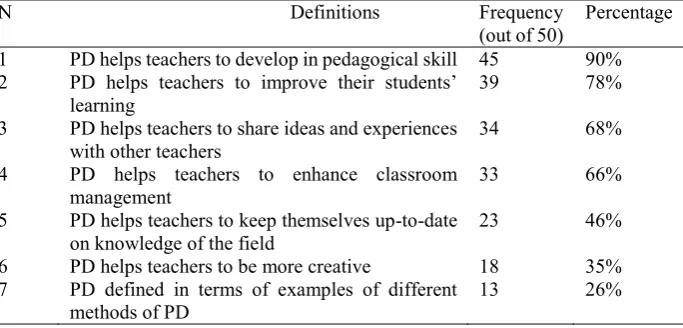
Table 5.
The EFL teachers’ responses to questions of the interview:
N Definitions Frequency
(out of 50) Percentage 1 PD helps teachers to develop in pedagogical skill 45 90% 2 PD helps teachers to improve their students’
learning 39 78%
3 PD helps teachers to share ideas and experiences
with other teachers 34 68%
4 PD helps teachers to enhance classroom
management 33 66%
5 PD helps teachers to keep themselves up-to-date
on knowledge of the field 23 46%
6 PD helps teachers to be more creative 18 35% 7 PD defined in terms of examples of different
As indicated in Table 5, the majority (90%) believed that PD was to develop their pedagogical skills. Furthermore, more than half of them
believed that PD helped them to improve their students’ learning (78%),
to share ideas with other teachers (68%) as well as to enhance their classroom management skills (66%). Also, less than half of the interviewees believed PD helped them to keep themselves up-to-date (46%), and to be creative (35%). Some of the teachers (26%) defined the concept (i.e. PD) by giving some examples of the activities or methods in which they had participated.
Results of Question Three
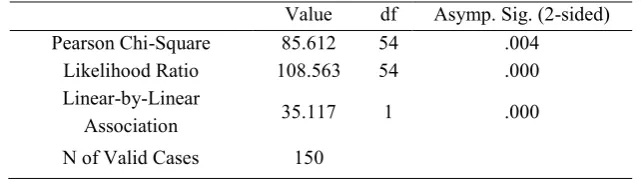
In order to answer the third research question as to whether there was any significant difference between high-experienced and low-experienced Iranian EFL teachers regarding their perception of PD overall, a Chi-square Analysis was run the results of which are summarized in Table 6.
Table 6.
Chi-Square Tests for High-Experienced and Low-Experienced Teachers Regarding their Perception of PD
Value df Asymp. Sig. (2-sided) Pearson Chi-Square 85.612 54 .004
Likelihood Ratio 108.563 54 .000 Linear-by-Linear
Association 35.117 1 .000
N of Valid Cases 150
high-experienced teachers had a significantly higher perception of PD than their low-experienced counterparts.
Furthermore, in order to identify whether there were any statistically significant differences between high-experienced and low experienced teachers regarding their perception of the individual items of the PDPQ, Chi-square analyses were run, the results of which are summarized in Table 7.
Table 7.
Chi-Square analyses for the participants’ perception of the individual
items of PDPQ
N0. Item Percent Pearson
Chi-Square Asymp. Sig. (2-sided) Effect Size Low-Experienced (Below 5) High-Experience (Above 10) 27 PD activities help
teachers in better understanding of students’
problematic area in learning and help them.
38.94% A
63.63% S.A
27.55 .00 0.42
13 PD activities can help EFL teachers to enhance their knowledge of general English proficiency.
29.47%
N.I 43.63% A 25.51 .00 0.41
19 PD activities help teachers in time management.
30.52% N.I
43.63% S.A
24.64 .00 0.40
15 PD activities can help EFL teachers to enhance their effectiveness in teaching in general.
41.05%
A 47.27% A 23.07 .00 0.39
21 PD activities help
N0. Item Percent Pearson Chi-Square Asymp. Sig. (2-sided) Effect Size Low-Experienced (Below 5) High-Experience (Above 10) experiences with colleagues. 25 PD activities help
teachers in engaging students in learning rather than reciting.
29.47% D
47.27% S.A
21.15 .00 0.37
4 I prefer to participate in conference as PD activity.
37.89% A
47.27% A
19.46 .00 0.36
26 PD activities help teachers in how to use their
observations to assess students’ learning needs.
43.15%
N.I 43.63% S.A 17.49 .00 0.34
8 I prefer to participate in self-study of journals, sites, etc. as PD activity.
45.26%
A 50.90% A 17.27 .00 0.33
17 PD activities help teachers in how to behave students.
37.89% A
43.63% A
17.13 .00 0.33
5 I prefer to participate in peer observation as PD activity.
28.42% D
28.42% A 43.63% S.A 15.62 .00 0.32
9 PD activities can help EFL teachers to enhance their knowledge of methodology of teaching (i.e. pedagogical knowledge). 29.47%
N.I 49.09% S.A 15.21 .00 0.32
22 PD activities help teachers in sharing
35.78% A
49.09% S.A
N0. Item Percent Pearson Chi-Square Asymp. Sig. (2-sided) Effect Size Low-Experienced (Below 5) High-Experience (Above 10) ideas with colleagues. 23 PD activities help
teachers in
understanding weak and strong points of themselves and other colleagues. 34.73% A 52.72% S.A
14.56 .00 0.31
11 PD activities can help EFL teachers to enhance their knowledge of the use of technology in teaching.
52.63%
A 72.72% A 14.33 .00 0.30
16 PD activities can help EFL teachers to enhance their teaching in multi-cultural settings.
37.89%
N.I 41.81% A 14.07 .00 0.30
10 PD activities can help EFL teachers to enhance their knowledge of student evaluation and assessment.
40%
N.I 43.63% S.A 13.50 .00 0.30
28 PD activities help teachers in implementing the realia and teaching aids more
effectively in class.
33.68%
A 43.63% S.A 13.05 .01 0.29
30 PD activities encourage teachers to redesign their teaching to support various learners.
41.05% A
47.27% S.A
12.18 .01 0.28
7 I prefer to participate in self-study of journals,
33.68% A
50.90% A
N0. Item Percent Pearson Chi-Square Asymp. Sig. (2-sided) Effect Size Low-Experienced (Below 5) High-Experience (Above 10) sites, etc. as PD
activity. 1 I prefer to
participate in Teacher Training Course (TTC) as PD activity.
35.78% N.I
54.54% A
11.47 .02 0.27
34 PD activities renew teachers’ enthusiasm for teaching. 52.63% A 52.72% A
11.15 .02 0.27
2 I prefer to participate in traditional workshop as PD activity.
35.78%
A 45.45% N.I 10.60 .03 0.26
29 PD activities help teachers in working on developing new materials with colleagues. 32.63% A 54.54% A
10.49 .03 0.26
12 PD activities can help EFL teachers to enhance their knowledge of materials preparation.
33.68%
A 47.72% S.A 10.48 .03 0.26
18 PD activities help teachers in how to deal with problems arising in the class.
37.89% N.I 50.90% S.A
10.23 .01 0.26
20 PD activities help teachers in organizing a structured lesson plan.
52.63%
A 69.09% A 9.61 .04 0.25
32 PD activities promote reflective teaching.
34.73%
Note: S.D= strongly disagree, D= disagree, N.I= no idea, A= agree, S.A= strongly agree
As shown in Table 7, significant differences were found between the high-experienced and low-high-experienced teachers in 28 items (i.e. items 27, 13, 19, 15, 21, 25, 4, 26, 8, 17, 5, 9 , 22, 23, 11, 16, 10, 28, 30, 7, 1, 34, 2, 29, 12, 18, 20, and 32) out of the 35 items of the questionnaire each focusing on a specific aspect of professional development. It is noteworthy that the rest of the items were found not to be significantly different between the two aforementioned groups.
Discussion
The first research question of the study was set out to present a valid
model/inventory for measuring EFL teachers’ perception of PD. For this
purpose, a model construction framework including exploratory factor analysis was used to assess the construct validity of a proposed five-factor model. The components or factors included PD activity preferences, potential benefits of PD activities, actual benefits of PD activities, affective contributions of PD, and practical contributions of PD. The results of several labor-intensive stages of instrument validation including extensive literature review, semi-structured interview, expert views, two rounds of exploratory factor analysis (one with the data gained from the pilot study participants and the other with the data obtained from the study participants) confirmed the validity of the instrument and revealed the
participants’ perception of PD by showing their awareness of its actual,
potential, affective, and practical benefits as well as the different PD activities in which they preferred to participate. Since such strong measures were already lacking, the inventory developed here in this study can be adopted safely by other scholars in the field, both home and abroad,
The second research question of the present study aimed to explore
Iranian EFL teachers’ perceptions of PD. As the results of the descriptive
statistics of the questionnaire as well as the interview findings indicated, Iranian EFL teachers perceived PD as a means to help them enhance different aspects of their teaching. The first perception commonly shared by Iranian EFL teachers was the benefit of PD in increasing their knowledge of the methodology of teaching. One possible reason or justification for this might be the fact that Iranian EFL teachers of private language institutes participate in TTC held by the language institutes before their employment, the main goal of which is to develop teaching skills. Accordingly, most of the teachers refer to the teaching methodology skills development as the first definition or perception of PD they can think about because of their personal experience of participating in TTC. The results revealed that most of the teachers perceived PD to increase their skill of teaching or pedagogical knowledge. It might thus be logical to conclude that teachers desired for more developed knowledge of teaching skills by engaging in PD activities. Corroborating this finding, Avidov-Ungar (2016) concluded that some of the teachers desired PD to expand their knowledge of teaching skills which was regarded as aspiration for lateral development which Berliner (2001) believes teachers who prefer it
(i.e. lateral development) have reached the pinnacle of teachers’ PD.
‘In my opinion, it can refer to many concepts namely academic
education or private classes designed for developing participants’ skills in language teaching, the aim of which is to bring about better teachers.’
Thus, improving pedagogical knowledge is believed to be the most perceived definition or use given for PD by EFL teachers.
The second perception or definition most commonly shared by the participants both in the results of the questionnaire and the findings of the interview was the effectiveness of PD in giving teachers useful ideas of
how to improve students’ outcomes. Some of the participants in the
interview stated that PD gave them some ideas on how to be an effective
teacher. One possible justification for this could be the fact that teachers’
effectiveness could be felt in the students’ outcome. Confirming this,
Stronge, et al. (2007) state that there is a clear and undeniable link between teacher effectiveness and student learning. The findings in this respect are in line with those of Ravhuhali et al. (2015) who also found that found the
majority of their participants agreed that teachers’ PD provided teachers
with ideas to improve how students learned.
Iranian EFL teachers also perceived PD to be beneficial in sharing ideas and experiences with colleagues. The findings in this respect are consistent with those of Nasser et al. (2015) who also found that teachers perceived PD as a way for networking with colleagues or receiving what
‘PD is formal training of teachers to improve their knowledge, skills, and effectiveness. In fact, PD may be a good opportunity for teachers to
share their experiences’.
Obviously, Iranian EFL teachers hold a range of perceptions of what PD is. As the findings of the interviews revealed, most of the teachers explained their definition of PD by referring to its possible advantages and by providing some examples of PD activities which is in accordance with that of Hortano (2016). One possible justification for this finding may be the fact that we usually give our ideas based on personal experiences and show our understanding by exemplifying concepts. In sum, the majority of Iranian EFL teachers had a clear understanding of PD. It is noteworthy to mention that most of the teachers were almost well-informed about the concept and perceived PD as a learning activity through which they would be provided with challenges to think about their teaching skills,
effectiveness, and students’ achievement more creatively and critically.
The third research question of the study aimed at exploring the differences between high-experienced and low-experienced teachers regarding their perception of PD. The results showed that highly experienced teachers had significantly higher perceptions of PD than their lower-experienced counterparts. That is, the results indicated that high-experienced teachers perceived PD activities to help them in better
understanding of students’ problematic areas, enhancing knowledge of
developing new materials, organizing structured lesson plan, and promoting reflective teaching. The two groups of teachers (i.e. high-experienced and low-high-experienced teachers) were also different regarding their preference for participation in conferences, the self-study of journals, peer observation, TTC, and traditional workshops.
The results showed that high-experienced teachers agreed or strongly agreed with most of the items relating to what PD meant to them, while their low-experienced colleagues mostly agreed or had no idea with the items. These marked differences in the perception of the helpfulness of PD between high- and low-experienced teachers might result from differences in their thinking. Supporting this justification, Brody and Hadar (2015) conclude that experienced teachers attend PD activities to achieve insight into their practice or to realize if their methods of teaching match current innovations, while novices only wish to learn new skills. It could thus be argued that high-experienced teachers, as once being novice teachers who had already participated in PD activities, have already experienced the effect of such activities on their thinking or perception of PD. The findings in this respect are in line with those of Sivan and Chan (2003) and Mahmoudi and Ozkan (2015).
With regard to high-experienced teachers’ perception of PD, the
evidence reveals that about half of them strongly agreed with the impact of PD on enhancing teachers’ knowledge of methodology of teaching,
helping them in time management, assessing students’ learning needs,
This finding (i.e. the fact that high-experienced teachers had higher levels of perception of PD compared to their low-experienced counterparts) might be due to the fact that they might have experienced the change in their profession caused by engaging in different PD activities. More support for this justification might come from Borg, Clifford, and Htut (2018) who concluded that their implemented PD method was
successful in improving teachers’ English proficiency, teaching ability,
knowledge of teaching methodology, and interactive teaching. Consequently, it might be logical to conclude that in comparison with low-experienced teachers, high-low-experienced teachers of the study realized the concept of PD and its benefits more deeply. Thus, according to the results of the study, it might be possible to recommend low-experienced and high-experienced teachers to attend such PD methods encouraging collaboration as peer observation because through collaboration with high-experienced colleagues, low-high-experienced teachers could benefit from scaffolding and learn the tricks of the profession.
Conclusion and Implications
The aim of the present study was three-fold. Firstly, it aimed at
developing a valid and reliable model/inventory to assess EFL teachers’ perception of PD. Secondly, it explored Iranian EFL teachers’ perceptions
of PD. Thirdly, it investigated the existence of a possible difference between the two groups of high and low experienced teachers of the study with regard to their perception of PD.
Based on a rather comprehensive set of measures taken, a valid and
reliable model/inventory for measuring EFL teachers’ perception of PD
was introduced. Also, as the results indicated, Iranian EFL teachers perceived PD mainly as a course to boost their knowledge of the methodology of teaching, to give them useful ideas of how to improve
students’ outcomes, and to understand weak and strong points of
attributed the gain in different aspects of their profession to participation in different PD activities especially, those which are more interactive in nature. Finally, a significant difference was found between low-experienced and high-experienced teachers’ perception of PD. The results
revealed that high-experienced teachers were more familiar with PD and realized its benefits to help them increase both their teaching quality and their students’ outcomes.
The findings of the current study could have some implications. First, the instrument (i.e. PDPQ-- developed and validated in the study through such various labor-intensive pains-taking processes as extensive review of the literature in the field on the topic, semi-structured interview, subjecting the proposed questionnaire items to expert judgment, and finally running two rounds of factor analyses as mentioned earlier-- can be safely utilized by other studies of the ilk conducted in the context of the present study or
other similar EFL contexts to delve into the EFL teachers’ perception of
PD more meticulously and comprehensively. Second, as far as the language institutes are concerned, the findings might imply that the managers of the institutes pay more attention to their teachers’ teaching
performance quality. They are suggested to provide their teachers with appropriate PD activities because, as the results of a parallel study showed, one of the barriers to PD was the institutes’ lack of organized plans for
introducing and stressing PD activities. Institutes can be a great place for teachers to learn and develop professionally with other colleagues. Indeed, colleagues are a good source of information to learn from. Thus, the institutes could provide a learning community through such PD activities as teacher support groups, peer observation, classroom action research which do not need a huge amount of budget. They could also support their teachers financially to allow them to attend different conferences or workshops to develop professionally.
them to be able to plan better PD activities and programs and motivate their teachers by a raise in their salaries. In addition to one-shot PD activities such as workshops, policymakers are recommended to plan more effective durable PD activities like peer observation or online teacher PD methods in order to see their effects in the long run. Finally, teachers are suggested to develop their teamwork spirit in order to perform such collaborative methods of PD as collegial support.
References
Alibakhshi, G., & Dehvari, N. (2015). EFL teachers’ perceptions of continuing professional development: A case of Iranian high school teachers. PROFILE Issues in Teachers' Professional
Development, 17 (2), 29-42.
Avidov-Ungar, O. (2016). A model of professional development:
Teachers’ perceptions of their professional development. Teachers
and Teaching, 22 (6), 653-669.
Berliner, D. C. (2001). Learning about and learning from expert teachers.
International Journal of Educational Research, 35 (5), 463–482.
Billingsley, B.S., (2004). Promoting teacher quality and retention in special education. Journal of Learning Disabilities, 37 (5), 370-376. Birman, B., Desimone, L., Porter, A., & Garet, M. (2000). Designing professional development that works. Educational Leadership, 57
(8), 28–33.
Borg, S., Clifford, I., & Htut, K. P. (2018). Having an effect: Professional development for teacher educators in Myanmar. Teaching and
Teacher Education, 72 (1), 75-86.
Clarke, D., & Hollingsworth, H. (2002). Elaborating a model of teacher professional growth. Teaching and Teacher Education, 18 (8), 947-967.
Cordingley, P., Bell, M., Thomason, S., & Firth, A. (2005). The impact of collaborative CPD on classroom teaching and learning. Review: How do collaborative and sustained CPD and sustained but not
collaborative CPD affect teaching and learning? London:
EPPI-Centre, Social Science Research Unit, Institute of Education, University ofLondon.
Crow, M. L., Milton, O., Moomaw, W. E., & O’Connell, W. R. (1976). Faculty development centers in southern universities. Atlanta, GA.
Southern Regional Education Board (ERIC Document Reproduction Service No. ED 129132).
Darling-Hammond, L., Hyler, M. E., & Gardner, M. (2017). Effective teacher professional development. Palo Alto, CA: Learning Policy Institute.
Day, C. (1997). In-service teacher education in Europe: conditions and themes for development in the 21st century. Journal of In-service
Education, 23 (1), 39-54.
Day, C. (1999). Developing teachers: The challenges of lifelong learning. London: Falmer.
Dayoub, R. & Bashiruddin, A. (2012). Exploring English-language
teachers’ professional development in developing countries: cases from Syria and Pakistan. Professional Development in Education, 38
(4), 589-611.
Desimone, L. M., (2009). Improving impact studies of teachers’
professional development: Toward better conceptualizations and measures. Educational Researcher, 38 (3), 181-199.
Hartono, R. (2016). Indonesian EFL teachers' perceptions and experiences of professional development. Unpublished master’s
Huberman, M., & Guskey, T. (1995). Professional development in
education: New paradigms and practices. New York: Teachers
College Press.
Kelchtermans, G. (2004). CPD for professional renewal: Moving beyond knowledge for practice. International handbook on the continuing
professional development of teachers, 217-237.
Kennedy, A. (2011). Collaborative continuing professional development (CPD) for teachers in Scotland: aspirations, opportunities and barriers. European Journal of Teacher Education, 34 (1), 25-41.
Kwakman, K. (2003). Factors affecting teachers’ participation in
professional learning activities. Teaching and Teacher Education, 19 (2), 149-170.
Mahmoudi, F., & Özkan, Y. (2015). Exploring experienced and novice
teachers’ perceptions about professional development activities. Procedia-Social and Behavioral Sciences, 199, 57-64. Meng, J., & Tajaroensuk, S. (2013). An investigation of tertiary EFL
teachers' problems in their in-service professional development.
Journal of Language Teaching and Research, 4 (6), 1356-1364.
Miller, L. (1999). Reframing teacher burnout in the context of school reform and teacher development in the United States. In R. Vandenberghe & A. M. Huberman (Eds.) Understanding and preventing teacher burnout: Asourcebook of international research
and practice(pp. 139−156). Cambridge: Cambridge Univ. Press.
Nasser, I., Kidd, J. K., Burns, M. S., & Campbell, T. (2015). Head Start
classroom teachers’ and assistant teachers’ perceptions of
professional development using a LEARN framework. Professional
Development in Education, 41 (2), 344-365.
Opfer, V. D., & Pedder, D. (2010). Benefits, status and effectiveness of continuous professional development for teachers in England. The
Ozer, B. (2004). In-service training of teachers in Turkey at the beginning of the 2000s. Journal of In-service Education, 30 (1), 89-100. Perez, A. M., McShannon, J., & Hynes, P. (2012). Community college
faculty development program and student achievement. Community
College Journal of Research and Practice, 36 (5), 379-385.
Powel, E., Terrel, I., Furey, S., & Scott-Evans, A. (2003). Teachers' perceptions of the impact of CPD: An institutional case study.
Journal of In-service Education, 29 (3), 389-404.
Powell, C.J., & Bodur, Y. (2019). Teachers’ perceptions of an online
professional development experience: Implications for a design and implementation framework. Teaching and Teacher Education, 77,
19-30.
Ravhuhali, F., Kutame, A. P., & Mutshaeni, H. N. (2015). Teachers’
perceptions of the impact of continuing professional development on promoting quality teaching and learning. International Journal of
Educational Sciences, 10 (1), 1-7.
Richards, J. C., & Farrell, T. S. C. (2005). Professional development for
language teachers. New York: Cambridge University Press.
Rutz, C., Condon, W., Iverson, E. R., Manduca, C. A., & Willett, G. (2012). Faculty professional development and student learning.
Change, 40-48.
Singer, J., Lotter, C., Feller, R., & Gates, H. (2011). Exploring a model of situated professional development: Impact on classroom practice. Journal of Science Teacher Education, 22 (3), 203-227. Sivan, A., & Chan, D. W. (2003). Supervised Teaching Practice as a
Partnership Process: Novice and experienced student-teachers' perceptions. Mentoring and Tutoring, 11 (2), 183-193.
Shumack, K. A. (2007). Professional development in business education:
Status, needs, motivators, and impact on instruction. Mississippi
Smylie, M. A., & Conyers, J. G. (1991). Changing conceptions of teaching influence the future of staff development. Journal of Staff
Development, 12 (1), 12-16.
Soodmand Afshar, H., & Doosti, M. (2016). An investigation into factors contributing to Iranian secondary school English teachers’ job
satisfaction and dissatisfaction. Research Papers in Education, 31
(3), 274-298.
Soodmand Afshar, H., Fazelimanie, A., & Doosti, M. (2017). Developing an inventory to investigate current professional development needs of Iranian EFL teachers. Teaching English Language, 11 (2), 161-194.
Sorcinelli, M.D., Austin, A. E., Eddy, P., & Beach, A. (2006). Creating the future of faculty development: Learning from the past,
understanding the present. Bolton, MA: Anker Press.
Stronge, J. H., Ward, T. J., Tucker, P. D., Hindman, J. L., McColsky, W., & Howard, B. (2007). National Board certified teachers and non-National Board certified teachers: Is there a difference in teacher effectiveness and student achievement? Journal of Personnel
Appendix
Appendix A: Interview Questions
1. What is your perception of professional development in teacher education? Have you ever heard about the concept? How do you define the concept?
2. Have you ever participated in professional development activities (e.g., workshops, self-monitoring, peer observation, team teaching, etc.)? If yes when was it? How long did it last? What was the purpose of the course?
3. Did the activities enhance your knowledge of teaching? How about your knowledge of the subject you teach (i.e., English)?
4. What do you think the benefits of professional development are for EFL teachers? Does it help to enhance pedagogical knowledge, knowledge of English, classroom management, etc.?
5. In what regards does professional development help to enhance teaching knowledge, knowledge of the language itself, class management, lesson planning?
Appendix B: Professional development perception questionnaire (PDPQ)
Dear teacher
Please take your time to fill up the following questionnaire, as it will help
us to explore the EFL teachers’ perception of professional development.
Thanks for your support.
Years of teaching experience: below 5years between 5 and 10 above 10 years
female or male / B.A , M.A , Ph.D.
PD stands for professional development
I.I have already participatedin ………… as PD activity. Yes No 1-Teacher Training Course (TTC)
2-Traditional workshop 3-interactive workshop 4- conference
5-peer observation 6-self-monitoring
7-self study of journals, sites, etc. 8-graduate studies level at university
II.I preferto participate in ………. as PD activity. 1 2 3 4 5 1-Teacher Training Course (TTC)
2-Traditional workshops 3-interactive workshops 4- conference
5-peer observation 6-self-monitoring
7-self study of journals, sites, etc. 8-graduate studies level at university
III. PD activities can help EFL teachers to enhance
their ……. 1 2 3 4 5
9-knowledge of the methodology of teaching (i.e. pedagogical knowledge).
10- knowledge of student evaluation and assessment.
11- knowledge of the use of technology in teaching.
PD activities can help EFL teachers to enhance their ……. 1 2 3 4 5
12- knowledge of materials preparation. 13- knowledge of general English proficiency.
14- knowledge of curriculum. 15-effectiveness in teaching in general. 16-teaching in multi-cultural settings.
IV. PD activities help teachers in …… 1 2 3 4 5
17- how to behave students.
18-how to deal with problems arising in the class.
19-time management.
20- organizing a structured lesson plan.
21- sharing experienceswith colleagues.
23- understanding weak and strong points of themselves and other colleagues.
24- keeping themselves up-to-date
25- engaging students in learning rather than reciting.
26- how to use their observations to assess students’
learning needs.
27- better understanding of students’ problematic area in
learning and help them.
28-implementing the realia and teaching aids more effectively in class.
29- working on developing new materials with colleagues.
V. PD activities….. 1 2 3 4 5
30-encourage teachers to redesign their teaching to support various learners.
31- suggest/enhance such positive psychological traits as motivation, self-confidence. etc.
32-promote reflective teaching.
VI. PD activities….. 1 2 3 4 5
33- help connect theories to practice.
34- renew teachers’ enthusiasm for teaching.
35-give teachers useful ideas of how to improve students’