Issues and Ideas in Education Vol- 4, No- 1 March 2016 pp. 37–50 DOI: 10.15415/iie.2016.41004
Problem Solving Ability & Locality as The
Influential Factors of Academic Achievement
Among High School Students
MADHU GUPTA1,* KAVITA2, POOjA PAsrIjA3
1Professor, Department of Education, M. D. University, rohtak, Haryana, India
2 research Fellow, Department of Education, Maharshi Dayanand University, rohtak, Haryana, India
3Assistant Professor, Vaish College of Education, rohtak, Haryana, India
*Email: [email protected]
received: january 10, 2016| revised: january 20, 2016| Accepted: February 10, 2016
Published online: March 07, 2016
The Author(s) 2016. This article is published with open access at www.chitkara.edu.in/publications
Abstract: Academic achievement of the pupil is the prime concern of educational process. The problem solving ability has been playing a significant role in determining student’s academic achievement. Keeping this in view, the present study was designed to examine empirically the effect of problem solving ability on the academic achievement of rural and urban school students. The research was conducted on 250 school students (118 rural & 132 urban) studying in 10th class CBsE affiliated private schools that were randomly selected from rohtak district of Haryana state. Descriptive survey method was used to elicit opinion of rural & urban school students about their problem solving ability and their academic achievement at school. The problem solving ability of sample was assessed by using Dubey’s Problem solving Ability Test (2006) & for academic achievement of students, the school records i.e. marks obtained by the students in previous (IXth) class was considered. The data was analyzed statistically by using ANOVA supplemented by t-test. The findings of the study revealed that problem solving ability had significant effect on the academic achievement of the students whereas significant difference was observed in the academic achievement of students studied in urban and rural schools. However, the significant interaction effects of locality and problem solving ability on the academic achievement of the students had been found.
Gupta, M. KDYLWD Pasrija, P.
1.
INTRODUCTIONThe progress of a nation in the world of today is more than ever depend upon the quantity as well as quality of the education received by the people of the country. Education has been considering the hallmark of a progressive society for ancient time. Education is closely linked to a person’s life chances, income and well-being [3]. The focus of educational process is to improve performance of the students. A good academic achievement record of students is an index of an effective educational system. One of the major features of contemporary educational thinking has been a growing concern about the development of effective personality and efficiency of teaching learning outcomes that can be assessed in terms of students’ achievement. Not that other aspect of educational objectives are to be ignored but the fact remains that academic achievement is the unique responsibility of all educational institutions established by the society to promote a wholesome scholastic development of pupil. In the common terminology, academic achievement refers to marks or grade obtained after an examination, is it written or oral in subject taught in school or the attained level of students functioning in school task such as Language, Mathematics, science etc. as shown by school marks evaluated by the teachers by standardized tests or by a combination of both. Academic achievement is a multidimensional and multifaceted phenomenon. There are many factors which affect academic achievement viz. intelligence, personality, motivation, school environment, heredity, home environment, learning, experiences at school, interests, aptitudes, family background, socio economic status of the parents and many more other factors influenced the academic achievement. However, the success, efficiency and happiness in life largely depend upon their cognitive abilities like problem solving ability, logical thinking etc. Among these, problem-solving ability plays an important role in the academic achievement of school students. Enhancing students’ problem solving capacity is one of the greatest educational challenges and is a major demand placed on any educational institution [14].
Problem solving Ability & Locality as The Influential Factors of Academic Achievement Among High school students at transforming a problem from the given state to the goal state when the
problem solver is not immediately aware of a solution method. Problem solving is also related to other terms such as thinking, reasoning, decision making, critical thinking, and creative thinking. The ability of problem solving has a fundamental role in students’ academic performance and their construction of the concepts. Many researches [7]; [17]; [12] showed that problem solving ability is a key factor for content learning and academic performance. The result of the studies show that sometimes problem solving ability is successful with particular task of students but sometime is not. researchers have come out with varied results sometimes complementary to each other and sometimes contradictory to each other. Thus, in the present study attempt has been made in the direction of exploring the impact of problem solving ability on academic achievement of students belonging to different locality i.e. urban & rural.
Theoretical Background/ Literature
Previous studies have concluded that Problem solving ability is a requirement for success in mathematics and science course [5], [1].Moreover, [4], [8] and [13] pointed towards the students’ problem solving ability of different groups of the categorical variables such as types of the school, academic success, socio-economic and socio-cultural background. While on the other hand, study showed that students’ ability has significant influence on problem-solving task. [2].However, the effect of caste &gender was also found on problem solving ability and academic achievement of students [8]. some studies showed that the problem solving ability affected the achievement of the male and female secondary students [9] and significant difference in problem solving ability of the students residing in rural and urban area was found [15]. Most of the studies given above carried out to assess the problem solving ability with science and mathematics and different others variables. However, no study has been carried out to assess the effectiveness problem solving on academic achievement of rural and urban school students. Under the light of above mentioned information, the present study has been designed to assess the effect of problem-solving ability& locality on academic achievement of school students.
2. OBJECTIVES OF THE STUDY
Gupta, M. Kavita
Pasrija, P.
2. To study the effect of locality on academic achievement of 10th class students. 3. To study the interaction effect of problem solving ability and locality on
academic achievement of 10th class students.
3. DESIGN OF THE STUDY
Method: Descriptive survey method was used in this study.
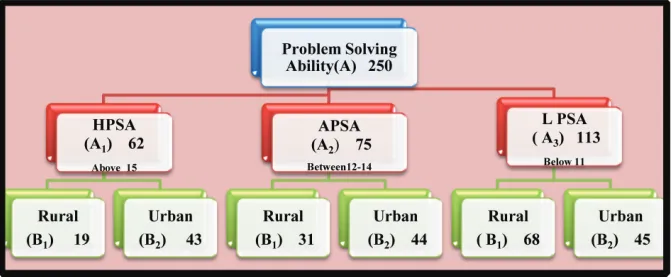
Sample: In the present study, stratified random sampling technique was used to select the sample of 250 students of 10th class (mean age-14.5 years) studied in private secondary schools affiliated to CBsE located at rural & urban area of rohtak city. The sample was further stratified based on location i.e. rural school students (118) & urban school students (132) and on the basis of problem-solving ability i.e. high problem solving ability students (62), average problem solving ability students(75) and low problem solving ability students(113). The schematic layout of factorial design used in the study along with the break up details of sample of this study has been presented in Fig. 1.
Figure 1: schematic Layout of 3×2 Factorial Designs with breakup Details of the sample selected for the study.
Tool used:
Problem solving Ability & Locality as The Influential Factors of Academic Achievement Among High school students Statistical Techniques Employed
Means and s.Ds. were used on the scores of achievement of school students under study. Analysis of Variance (ANOVA) with 3×2 factorial design was employed to study the main effects and interactional effects of independent variables (Problem solving ability & locality) on dependent variable (Academic Achievement) supplemented by t-test. To test the assumption of homogeneity of variance for ANOVA, Levene’s Test of homogeneity of variance was employed. The data was analyzed through sPss.
4. DATA ANALYSIS AND DISCUSSION
This section explores the effect of problem solving ability and locality on academic achievement of 10th class students. In the present study, the value of homogeneity of variance was calculated by Levene’s test and it was 1.705 which is not significant at 0.05 level. It means that variance of all the six groups were similar.
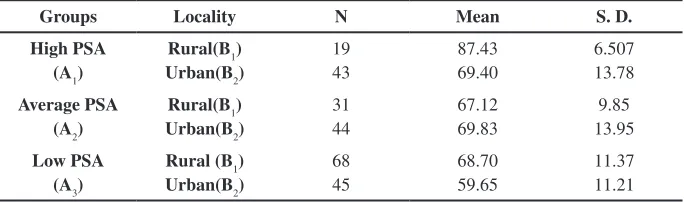
In order to study the main and interaction effects of problem solving ability and locality on academic achievement of the school students, data was subjected to analysis of variance of (3×2) factorial study with a randomized group design. In this section, the first independent variable i.e. problem solving ability coded as (A) was varied into three group high problem solving ability (A1), average problem solving ability (A2) and low problem solving ability (A3). The second independent variable i.e. locality coded as (B) was varied at two levels rural (B1) and urban (B2). A schematic layout of the factorial design used in the study for the variables problem solving ability and locality has been presented in Fig.1. The means and s.D.’s of different sub-samples have also been presented in the Table-1. Mean achievement scores of school students in relation to problem solving ability and locality has been presented graphically in Fig. 2.
Table 1: Means and s.D’s of sub samples for Mean Achievement scores of school students with respect to Problem solving Ability & Locality.
Groups Locality N Mean S. D.
High PSA (A1)
Rural(B1) Urban(B2)
19 43 87.43 69.40 6.507 13.78 Average PSA (A2)
Rural(B1) Urban(B2)
31 44 67.12 69.83 9.85 13.95 Low PSA (A3)
Rural (B1) Urban(B2)
Gupta, M. Kavita
Pasrija, P.
Figure 2: Mean Achievement scores of sub samples of school students with respect to Problem solving Ability (PsA) & Locality.
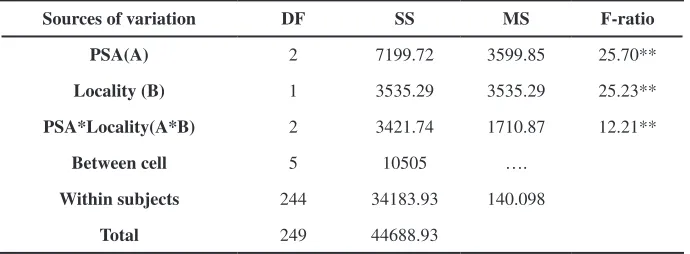
Table 2: summary of Two-way ANOVA for Mean Achievement scores of school students with respect to Problem solving Ability and locality.
Sources of variation DF SS MS F-ratio
PSA(A) 2 7199.72 3599.85 25.70**
Locality (B) 1 3535.29 3535.29 25.23**
PSA*Locality(A*B) 2 3421.74 1710.87 12.21**
Between cell 5 10505 ….
Within subjects 244 34183.93 140.098
Total 249 44688.93
**Significant at 0.01 level
Main Effect
Problem Solving Ability (A)
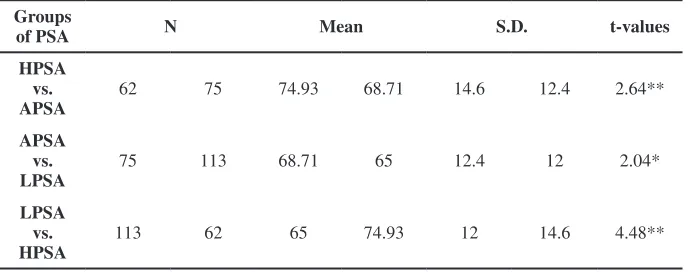
Problem solving Ability & Locality as The Influential Factors of Academic Achievement Among High school students ‘t’-test has been further employed to find out the significance of difference in
mean scores of academic achievement for different groups and has been given in Table 3
Table 3: ‘t’-values for the Mean Achievement scores of school students with respect to Problem solving Ability.
Groups
of PSA N Mean S.D. t-values
HPSA vs.
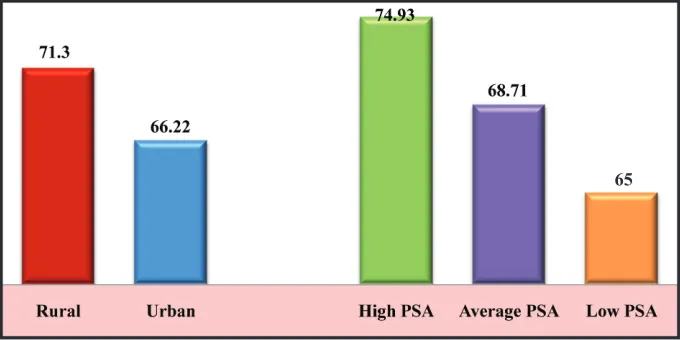
APSA 62 75 74.93 68.71 14.6 12.4 2.64**
APSA vs.
LPSA 75 113 68.71 65 12.4 12 2.04*
LPSA vs.
HPSA 113 62 65 74.93 12 14.6 4.48**
** Significant at 0.01 level * Significant at 0.05 level
HPSA=High Problem Solving Ability; APSA=Average Problem Solving Ability; LPSA=Low Problem solving Ability
Gupta, M. Kavita
Pasrija, P.
Locality (B)
It can further be inferred from the Table-2 that F-ratio for the effect of locality on academic achievement is 25.23 which is significant at.0.01 level. It indicates that locality has also play significant role in determining academic achievement of school students. This finding is in agreement with the findings of [7]; [11]; [15] who found that rural and urban differ significantly on academic achievement and problem solving ability. In order to investigate further, the ‘t’-value was computed and has been given in Table-4.
Table 4: ‘t’-values for the Mean Achievement scores of school students with respect to Locality.
Group N Mean S.D. ‘t’- value
Rural 118 71.30 12.5 3.06**
Urban 132 66.22 13.76
**Significant at 0.01 level
It can be inferred from Table-4, ‘t’-value 3.06 for the mean scores of academic achievement between the rural and urban school students is significant at 0.01 level. In the context of mean scores, it is found that the mean score of academic achievement of rural school students (71.30) is higher than urban school students (66.22).The present finding is in agreement with the findings of [7] and [10] who revealed that rural students had higher academic achievement in relation to problem solving ability than urban one. The mean scores for main effect of locality on academic achievement have been presented in Fig. 3.
65
Problem solving Ability & Locality as The Influential Factors of Academic Achievement Among High school students Interaction Effects of Problem Solving Ability (A) and Locality (B) on
Academic Achievement of School Students (A×B)
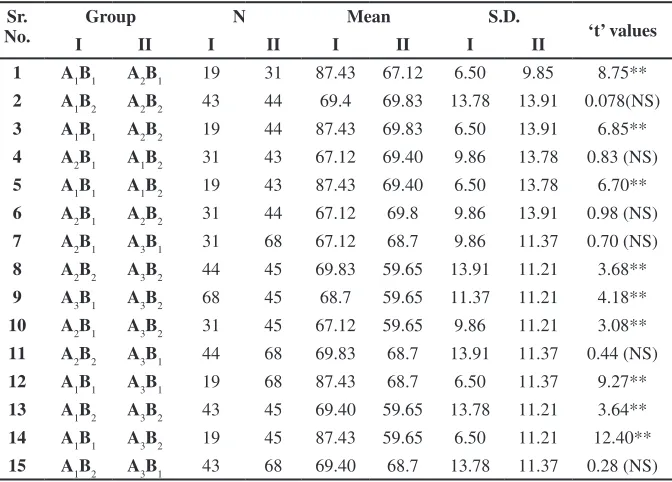
It can further be seen from Table-2, that F-ratio for the interaction effect of problem solving ability& locality on academic achievement of school students is 12.21 which is significant at 0.01 leading to inference that the interaction of problem solving ability and locality has played considerable role in determining academic achievement. The ‘t’ test was further employed to find out the significance of difference in mean scores of academic achievement for different group of problem solving ability and locality. The results for the same have been presented in the Table-5.
Table 5: ‘t’- values for Mean Achievement scores of school students for different Groups of Problem solving ability (A) × Locality (B)
Sr.
No. IGroupII I N II I MeanII I S.D. II ‘t’ values
1 A1B1 A2B1 19 31 87.43 67.12 6.50 9.85 8.75**
2 A1B2 A2B2 43 44 69.4 69.83 13.78 13.91 0.078(Ns)
3 A1B1 A2B2 19 44 87.43 69.83 6.50 13.91 6.85**
4 A2B1 A1B2 31 43 67.12 69.40 9.86 13.78 0.83 (Ns)
5 A1B1 A1B2 19 43 87.43 69.40 6.50 13.78 6.70**
6 A2B1 A2B2 31 44 67.12 69.8 9.86 13.91 0.98 (Ns)
7 A2B1 A3B1 31 68 67.12 68.7 9.86 11.37 0.70 (Ns)
8 A2B2 A3B2 44 45 69.83 59.65 13.91 11.21 3.68**
9 A3B1 A3B2 68 45 68.7 59.65 11.37 11.21 4.18**
10 A2B1 A3B2 31 45 67.12 59.65 9.86 11.21 3.08**
11 A2B2 A3B1 44 68 69.83 68.7 13.91 11.37 0.44 (Ns)
12 A1B1 A3B1 19 68 87.43 68.7 6.50 11.37 9.27**
13 A1B2 A3B2 43 45 69.40 59.65 13.78 11.21 3.64**
14 A1B1 A3B2 19 45 87.43 59.65 6.50 11.21 12.40**
15 A1B2 A3B1 43 68 69.40 68.7 13.78 11.37 0.28 (Ns)
** = Significant at 0.01 level NS = Not Significant
A1 = High PSA, A2 =Average PSA, A3 = Low PSA, B1 = Rural B2 = Urban
Gupta, M. Kavita
Pasrija, P.
for different groups of problem solving ability and locality have also been presented through histograms in the Fig. 4
Figure 4: Mean Achievement scores of school students for different groups of Problem solving Ability (A) × Locality (B).
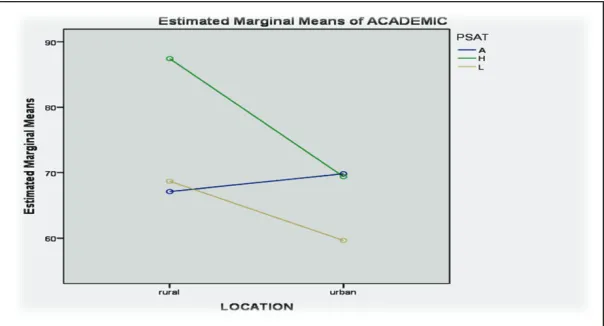
The interaction effect of problem solving ability and locality on academic achievement has been shown in Fig. 5. The graphical presentation for A×B interaction indicates that there is a significant interaction effect problem solving ability and locality factors on academic achievement as the three lines of different Problem solving abilities intersect each other.
Problem solving Ability & Locality as The Influential Factors of Academic Achievement Among High school students 5. FINDINGS OF THE STUDY
• Problem solving ability had a significant effect on the academic achievement of school students leading to the inference that students of high problem solving ability have highest academic achievement to the students with average problem solving ability and low problem solving ability.
• Locality was found to have a significant effect on academic achievement of school students. There was a significant difference in academic achievement between rural and urban school students. In the context of mean achievement scores, it was revealed that rural school students found high academic achievement as compare to urban school students.
• As significant interaction effect of problem solving ability and locality was found on academic achievement of school students. Further investigations with the help of t- test revealed that
The rural school students having high problem solving ability were reported to have significant highest academic achievement than average and low problem solving ability students. While rural school student with average problem solving ability possessed high academic achievement than students with low problem solving ability.
The urban school students having high problem solving ability & average problem solving ability were reported to have higher academic achievement than low problem solving ability. While no significant difference was found in academic achievement of urban school students with high problem solving ability and average problem solving ability.
It was found that the rural school students with high problem solving ability also possessed higher academic achievement than the urban school students with average problem solving ability. The rural school students having average problem solving ability were found to have higher academic achievement than urban school students with low problem solving ability. While no significant difference was found in academic achievement of rural students with average problem solving ability and urban school students with high problem solving ability.
Gupta, M. Kavita
Pasrija, P.
having low problem solving ability reported to have significant higher academic achievement from urban school students having low problem solving ability.
No significance differences was found in academic achievement of urban school students with average problem solving ability and rural area having low problem solving ability as well as urban school students with high problem solving ability and rural school students with low problem solving ability.
6. EDUCATIONAL IMPLICATIONS
Problem solving Ability & Locality as The Influential Factors of Academic Achievement Among High school students REFERENCES
[1] Adesoji, F. A. (2008). students’ ability levels and effectiveness of problem solving instructional strategy. Journal of Social Sciences, 17 (1), 5-8.
[2] Adeyemo, s. A. (2010). students’ ability level and their competence in problem-solving task in physics. International Journal of Education Research and Technology (IJERT), 1 (2), 35-47.
[3] Battle, j. & Lewis, M. (2002). To Increasing significance of class: the relative effect of race and socioeconomic status on academic achievement. Journal of Poverty,
6(2), pp.21.
http://dx.doi.org/10.1300/j134v06n02_02
[4] Darchingpui A. (1989). A study of science achievement, science attitude and problem solvingability among school students in Aizawl. North Eastern Hill University. In Fifth Survey of Educational Research. (1997). 2. N.C. E.r.T., New Delhi.
[5] Dhir, T. (2014). Problem solving ability and science process skills as the influential factors of scientific creativity.International Journal of Research Pedagogy& Technology in Education & Movement Science (IJEMS), 2 (4), 11-17.
[6] Dubey, L. N. (2006). Manuals and consumable booklet of problem solving ability test. Agra, National Psychological Corporation.
[7] Gakhar & Aseema (2004). Influence of self-concept stress, locality and gender on the academic achievement and reasoning ability of adolescents. Prachi Journal of Psycho-cultural Dimensions,20 (1), 25-28.
[8] Gupta, r. (2013).Problem solving ability and academic achievement among the students belonging to scheduled tribe and scheduled caste categories. International Journal of Research Pedagogy and Technology in Education and Movement Science, 1(3), 95-107.
[9] Gupta, M., Pasrija, P. & Kavita (2015). Effect of problem solving ability on academicachievement of high school students: A comparative study. Bhartiyam International Journal of Education & Research, 4 (II), 46-59.
[10] jeotee, K. (2012) reasoning skills, problem solving ability and academic ability: implications for study programme and career choice in the context of higher education in Thailand., Durham Theses, Durham University. Available at Durham
E-Theses Online: http://etheses.dur.ac.uk/3380/retrived on May14, 2014.
[11] Kalhotra K. s. (2014). A study of problem solving behavior of eighth class students in relation to their creativity. International Invention Journal of Arts and Social Sciences,1(1), 1-6.
[12] Kousar P. (2010). Effect of the problem-solving approach on academic achievement of students in mathematics at the secondary level. Contemporary Issues in Education Research,3(3), 9-14.
http://dx.doi.org/10.19030/cier.v3i3.181
Gupta, M. Kavita
Pasrija, P.
[14] Mayer, r. E. and Wittrock, M. C. (2006). Problem solving. In P. A. Alexander & P. H. Winne (Eds.) Handbook of Educational Psychology, 287–303. Mahwah, Nj: Lawrence Erlbaum
[15] Nataraj P. N. and Manjula M. (2012).A study of problem solving ability among the matriculation school students. International Journal of Teacher Educational Research (IJTER), 1(4), 44-51.
[16] Polya G. (1981) Mathematics and Plausible Reasoning. Princeton, Nj: Princeton University. Press.