Determinant of Mobile Devices
Acceptance for Learning among Students
in Developing Country
Shittu Ahmed Tajudeen [1], MadarshaKamal Basha [2], FakomogbonO. Michael [3], Alhaji Liman Mukthar [4]
[1] College Of Education Al-Hikmah University Ilorin, Nigeria
Email:
[2] Institute of Education International Islamic University Malaysia
[3] Department of Science Education
University Of Ilorin, Nigeria Email: [email protected]
[4] Institute of education, International Islamic University Malaysia
ABSTRACT
This study was conducted to understand the determinant of mobile devices for learning among students in developing world. A sample of 247 undergraduate students from Malaysia and Nigeria were involved in the study. An adapted but modified survey instrument was used to gather the data of the study. The variable of the study are perceived usefulness, perceived ease of use, perceived enjoyment, facilitating condition, behavioral intention and student attitude are the independent variable of the study. T-test and Multiple regression analysis was conducted. The findings of the study shows that there is no significant difference in acceptance to use mobile device for learning among science and non-science students but there is significant difference in acceptance to use mobile device for learning among male and female students. Perceived usefulness, perceived enjoyment, facilitating condition, and behavioral intention were found to significantly influence students’ acceptance of Mobile Device for learning, surprisingly perceived ease of use and student attitude was statistically insignificant in determining student acceptance to use MD for learning..
Keywords: Mobile devices, Technology Acceptance Model, Student acceptance
INTRODUCTION
The rapid advancement of emerging technology has increased the functionality of mobile communication devices
in the contemporary world. In the recent time, mobile phone such as smart phone, cell phone and personal digital
assistant (PDAs) are built with functions that allows different application, which enable connectivity and some other
internet applications (Sek, Lau,Teoh, Law & Parun, 2010). Some of the function of the cell phone can be equated with
that of personal computer (Cui & Wang, 2008). Due to additional features of the mobile phone and its capability to carry
out function just like that of personal computer, the rate of it use is growing rapidly among all ages everywhere in the
world.
The prevalence of mobile phone ownership and its popularity of its adoption and use among the present
generation of students have attracted the attention of educators and researchers in information and communication
technology field. Most especially, educators all over the world are exploiting the device beyond mere utilizing it for
communication alone to its use for teaching and implementing curriculum. This is because it is perceived as the most
acceptable medium to teach the present students (Tai & Ting, 2011).
The adoption of mobile device as a new learning tool is growing exponentially in the advance world. Its use for
mobile learning is becoming a new development in e‐learning and distance education. According to Sife, Lwoga and
Sanga (2007), mobile learning is an innovative way of utilizing handheld computer, internet‐enable cell phone for the
delivery of instruction and learning content to students. Keegan (2003) opined that there is increase in the use of
wireless technologies in education and that wireless technologies such as cell phone are transforming and changing
educational landscape so much so that teaching and learning can take place anywhere, everywhere and anytime thereby
creating a new innovation in learning process known as mobile learning. Barker, Krull and Mallinson, (2010) also point
Wireless technologies are revolutionizing education, transforming the tradition ways of learning and teaching into “anytime” and particularly “anyplace” education thereby creating advantage of promoting and supporting group work or project among students as well as engaging learning in learning related activities despite their diverse location. (pg 1)
Motiwalla’s (2007) explain that the utilization of mobile phone for learning cannot be underestimated because
the study on its use revealed that students found it to be a complementary tool in learning. Also, it uses enable
continuous learning outside the four wall of the classroom. Al‐Fahad (2009) study on student attitude and perception
toward mobile learning at King Saud University, Saudi Arabia reveal the advantage of mobile learning and that it would
enhance student communication and enrich learning experience of the learners. Keegan (2002) reported that the quality
and capability of handheld mobile device is increasing steadily, because of the advancement in technology, which enable
miniaturization as well as breakthrough in wireless technology. Roschelle’s (2003), and BenMoussa (2003) study on
mobile device for learning enumerated the following advantage of using wireless devices in learning environment. These
include the following:
It can augment physical space It leverage topological space
It aggregate coherent across all student individual contribution Can conduct and enhance classroom performance, and
Turning students’ act to become artifact
It enable users to filter and control information flow
It enable connectivity, either personalized or individualized connectivity
It improved collaboration via real‐time or instant interactivity which leverage better decision making
It enhance user orientation or direction which invariably useful in learning environment
Furthermore, Churchill and Churchill (2008) explained that handheld devices have the following usefulness in
education. These are: Portability, user can take it anywhere. Social interactivity, it can be use for collaboration.Text
sensitivity, it can be use to gather real or simulated data. Connectivity, it enables a connection to data collection devices
and network devices, lastly individuality, it can provide scaffolding which give clue to learner investigation and assist
them in construction of knowledge
Research study has revealed the growing use of mobile phone for teaching and learning process, yet, there
appear to be little empirical study as to what promote student acceptance of this new phenomenon in e‐learning, most
especially in the developing world like Malaysia and Nigeria. It is in realization of this gap that this study is conducted in
order to understand the reasons why students may or may not adopt mobile device for their learning using a theoretical
approach. It was reported by Corbeil and Valde‐Corbeil in (2007) that ownership of mobile phone with internet
application by students may not guarantee their acceptance to use it when it come to teaching and learning function. Therefore, the main objective of this study is to understand the determinant of mobile phone adoption in
educational setting in developing economic like Nigeria and Malaysia most especially when existing research finding
indicated that mobile device use for learning is still at its infancy. In doing this, the study employedTechnology
acceptance model(TAM) as a theoretical framework of the study and extend it with some factor from (UTAUT).
Theoretical Background
The determinant of new innovation and emerging technology adoption in education is increasingly attracting
information system and educational technology researchers’ attention in the contemporary world. Study of new
innovation has keep pace with rapid technology advancement and development in educational field. Understanding the
reason why users accept or reject to adopt and use different emerging technology in teaching and learning process has
been study through several theories. One of the prominent theory used in most of this study is Technology acceptance
theory (TAM) developed by Davis in 1985. Prior to the development of TAM, the theory of reason action (TRA) and
theory of planned behavior (TPB) were postulated (Fishbein & Ajzen, 1975).
The theory of reason action (TRA) was use to explain acceptance to use IS based on the users positive or
negative attitude toward a target behavior and the perception of the individual about what the people that are most
important to him/her would think if he/she exhibit a certain behavior (Fishbein & Ajzen, 1975). On the other hand,
control, which represent the ease or difficulty that a user may encounter when performing a target behavior (Ajzen,
1991).Similarly, Rogers (1985) postulated that adoption of new innovation is a function of the following five (5) factors,
compatibility, observability, triability, perceived complexity, and relative advantage.
According to King (2006), perceived usefulness and perceived ease of use in TAM has been extensively use in
predicting IT acceptance across several technology. Similarly, Ahmad, Basha, Marzuki, Hisham and Sahari (2010)
corroborated the predictive power of these two construct and the robustness of TAM in explaining the acceptance and
use of new innovation in education. As new innovation come into existence factor that are not consider before are now
becoming importance determinant for accepting IS among different level of users, hence, the extension of TAM (Shittu,
2011).Moreover, review of literature has shown that TAM is mostly used theory in model development of a specific user
acceptance of emerging technology. Nonetheless, attempt has also been made to extend the theory.
Prior to this study, several factor and theories have been used in previous research. For instance, Phuangthong
and Malisawan (2005) developed a model on Mobile learning adoption. In that study, student attitude to M‐learning
was influenced by perceived enjoyment. Also, Ju et al. (2007) study revealed that PU has a strong impact on users’
attitude and thereby affect intention of them to adopt M‐learning. This study tries to understand acceptance of mobile
device for learning from theoretical point of view of TAM and extend it with few factors inunified theory of acceptance
and use of technology (UTAUT). Below in figure (1) is the propose model for the study
Fig: 1 Proposed Model of the study
Perceived Usefulness, Perceived ease of use, and Behavioral Intention
Technology acceptance model developed by Davis (1989) is a theoretical model used in several study and it has
been found to be a robust and parsimonious framework for understanding user intention to accept to use IS. The model
consists of Perceived usefulness (PU), and perceived ease of use (PEOU). The model was later extended by Venkatesh
et al. (2003) and the extended model of TAM was unified theory of acceptance and use of technology (UTAUT). In many
literature reviewed for this study behavioral intention have been found to be a strong determinant to students perceive
usefulness and ease of use of emerging technology especially social media (Shittu et al. 2011).
Facilitating Condition
According to Venkatesh et al. (2003), facilitating condition is defined as the “degree in which an individual
believes that an organizational and technical infrastructure is provided to support the use of a system”. Venkatesh et
perceived
usefulness
perceived
ease of use
perceived
enjoyment
facilitating
condition
behavioral
intention
perceived
student attitude
al. (2003) concluded that facilitating condition is a strong predictor of actual use of technology and information system.
Wang and Shih (2008) also reported that facilitating condition has a significant effect on the use of IS. Morris (2008)
corroborated the finding and reported that age and experience are a moderating factor on FC. The study further
reported that effect on usage will increase steadily as age and experience of users’ increases.
Perceived Enjoyment
Perceived enjoyment is defined as the “extent to which the activity of using a system is perceived to be
enjoyable in its own right, apart from any performance consequences’ that may be anticipated”. Perceived enjoyment,
fun, and playfulness are example of intrinsic motivation which Davis, Bagozzi, and Warsaw (1992) explain as a strong
determinant indicated by user for accepting to use IS. The study on adoption of mobile learning in developing world by
Iqbal and Qureish (2012) revealed that perceived enjoyment does not influence student intention to adopt mobile
learning.
Attitude to adoption of mobile device for learning
Research study has shows that attitude of users’ is germane to adoption of technology. Positive or negative
attitude are developed by users’ toward the use of IS. According to Akerlind and Trevitt (1999) individual differences in
attitude, belief, skills and potential of user always have an impact on acceptance and final use of computer system. Even
some study revealed that demography variables such as age, students’ background, and their specialization contribute
in no small way to student attitude to emerging technology adoption in education (Bouhnik & Marcus, 2006; Liaw, 2008)
Research questions and hypotheses
This study aims at understanding factors determining mobile device acceptance for learning among the undergraduate students in developing world. The study sets to answer the following questions and carry out analysis on the hypotheses based on the underline theory used to understand the phenomenon under study.
Questions:
Q1: Is there any significant difference among male and female students ‘acceptance of mobile device
for learning?
Q2: Is there any significant difference in sciences and non‐science students’ acceptance of mobile device
for learning?
Hypotheses:
The hypotheses are generated for this study based on the underline theory employed.
H1: Perceived usefulness will has a positive influence on acceptance of mobile devices for learning
H2:Perceived ease of use will has a positive influence on acceptance of mobile devices for learning
H3:Facilitating condition will has a positive influence on acceptance of mobile devices for learning
H4: Perceived enjoyment will has a positive influence on acceptance of mobile devices for learning
H5:Student behavioral intention will has a positive influence on acceptance of mobile devices for learning
H6: Student attitude will has a positive influence on acceptance of mobile devices for learning
METHODS
Sample
The data for the study were collected through an adapted and modified survey questionnaire administered to
undergraduate students of International Islamic University Malaysia, Al‐Hikmah University, Ilorin, and University of
Maiduguri Nigeria. A hundred (100) survey instrument were distributed to each of the three university involve in the
study, totalling three hundred questionnaires (300) were administered out of which two hundred and seventy‐two were
found usable for the study. The participants in the study consist of one hundred and twenty three (123) male
undergraduate students representing 45% and one hundred and forty nine (149) female undergraduate students
representing 55%.
Research Instrument
The survey instrument used for collecting the data of the study consist of thirty four (34) items used for
measuring the seven (7) construct of the study. Perceived usefulness (PU) was measure with six (6) items, perceived
ease of use (PEOU) was measure with five (5) items, perceived enjoyment (PE) was measure with six (6) items, facilitating
condition (FC) was measure with four (4) items, behavioral intention (BI) was measure with four (4) items, attitude
towards use (ATT) was measure with four (4) items, and acceptance to use mobile device (ACCPT) was measure with
four (4) items. A five point likert measuring scale of 1 to 5 with one (1) being strongly disagree (SD) and five (5) being
strongly agree were the options presented to the responded.
Instrument Validity and Reliability
Prior to the administration of the instrument, construct validity and the reliability of the instrument was
ascertained. Factor analysis was conducted to validate the instrument of the study. Principal Component Analysis was
used for extraction and Varimax used as the rotation method. The Kaiser‐Meyer‐Olkin measure of sampling adequacy
(KMO) value of the data was 0.76 which is greater than 0.6 (Pallant, 2007). This shows that the sample is adequate. The
Barllet’s Test of Sphericity value was significant (p=0.000), the Eigen value was greater than one and the variance
explained was 78.5%. Seven factors were finally generated for the study. To ascertain the reliability of the instrument,
Cronbach’s Alpha was employed and the result show values above 0.7, which indicated good internal consistency
reliability. The table (1) below presents the 34 items used in the study, their correspondent loading and cronbach alpha.
Table 1: Valid items and their corresponding loadings and Alpha Values
Perceived Usefulness Loading
PU 1: Using mobile phone would make
it easier for me to learn 0.77
PU2: It would improve my
learning performance 0.76
PU3: Mobile phone would improve
my effectiveness in studying 0.74
PU4: It would improve my efficiency
in studying 0.72
PU5: Using mobile phone would give
me total control inmy learning process 0.74
PU6: I would find mobile devices
suitable for online learning 0.70
Total Reliability: 0.75
Perceived ease of use
PEO1: Using mobile phone for learning would be
easy for me 0.86
PEO2:I would find it easy to use mobile phone to upload and download materials
from the internet 0.81
PEO3: My interaction with mobile phone for
learningwould be clear and understanding 0.80
PEO4:It is easy to be skillful in using
mobile phone for learning 0.79
PEO5: It would be easy to access all learning
materialfrom mobile phone 0.74
Total Reliability: 0.76
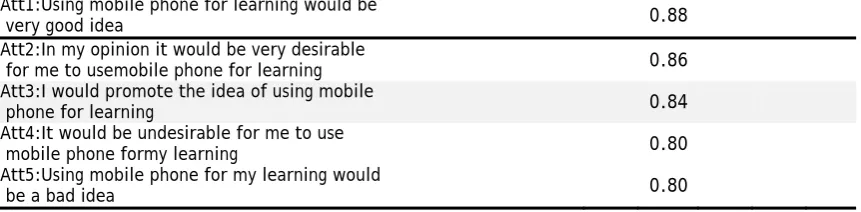
Attitude toward use of mobile devices ` Att1:Using mobile phone for learning would be
very good idea 0.88
Att2:In my opinion it would be very desirable
for me to usemobile phone for learning 0.86
Att3:I would promote the idea of using mobile
phone for learning 0.84
Att4:It would be undesirable for me to use
mobile phone formy learning 0.80
Att5:Using mobile phone for my learning would
be a bad idea 0.80
Behavioral intention
BI1: I intend to use mobile phone for learning 0.78 BI2:I intend to use mobile phone whenever
it is possible 0.74
Bi3: I intend to use mobile phone in
the future for learning 0.70
Bi4: I would adopt mobile phone for learning 0.70
Total Reliability: 0.73
Facilitating condition FC1: I have the resources necessary for
using mobile phonefor learning 0.77
FC2 : I have knowledge and skill that is necessary for using mobile phone
for learning 0.75
FC3: In my university my lecturer have been helpful in the use of mobile
phone for learning 0.73
FC4: I general my college has supported
the use of mobile phone for learning 0.70
Total Reliability: 0.70
Perceived Enjoyment PE1: I would find mobile phone enjoyable
to use for learning 0.88
PE2: I would find mobile phone exciting to
use for learning 0.84
PE3: I would find mobile phone pleasant to
use for learning 0.78
PE4: I would find mobile phone
very interesting to use 0.70
PE5: I would find mobile phone boring to
use for learning 0.66
PE6: I would find mobile phone disgusting
to use 0.60
Total Reliability: 0.77
Acceptance to use mobile phone ACPT1: I would accept to use mobile
devices for learning 0.87
ACPT2: I would engage in collaborative
learning with mobile devices 0.86
ACPT3: I would enjoy my other school social group to use mobile devices
for learning 0.84
ACPI4: I would enjoy my peers to use
mobile devices for learning 0.80
Analysis of Students’ Use of Mobile Device to Support Learning
The analysis shows that sixty percent (60%) of the students indicated to use MD every day for learning. Twenty
eight percent (28%) use it between 2‐3 times a week in their study. Ten percent (10%) use it between 2‐3 time in a
month, while less than five percent (5%) of them use it once in a month. Overall result indicated that greater percent of
the student use it almost every day for learning related activities.
Fig2: The frequency use of mobile device by student for learning related activities
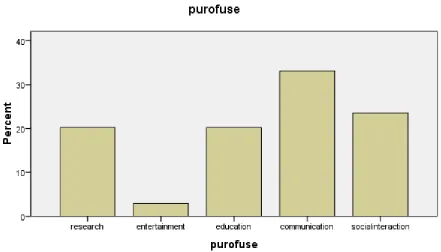
The Purpose of Using Mobile Device Indicated By Students
Fifty‐five students representing (20.2%) indicated to use mobile device for research related activities. Eight
students representing (2.9%) use it for entertainment purposes. Fifty‐five students representing (20.2%) use it for
educational activities. Ninety students representing (33.1%) use it for communication related activities and sixty‐four
Fig2: The purpose of use of mobile device by students
Table 2: Analysis of mean of Male and Female students’ acceptance to use mobile device in learning
sex N Mean Deviation Std. Std. Error Mean
Total acceptance to
use female 149 15.9732male 123 15.6504 2.822582.78739 .25450 .22835
F Sig t df Sig
(2tail)
Mean Difference
Std error
diff
95% confidence Lower upper Equal
variance assumed Equal variance
not assumed
2.37 .125 -.945 -.944
270 259.085
.345 .346
-.32275 -.32275
.34132 .34193
-.9951 -.9961
.3496 .3506
t-test of mean of male and female students’ acceptance of mobile device for learning
An independent sample t‐test was conducted to compare acceptance of mobile device for learning among male
and female students. Prior to analysis the data was screen for outlier and offending estimate, which the data was free
from. The finding shows that there was no significant difference in responses of male and female. The mean and
standard deviation for male is M (15.65), SD(2.82) and the mean and standard deviation for female group is M(15.97),
Table 3: Analysis of mean of science and non-science students’ acceptance to use mobile devices
Specializat
n N Mean Std. Deviation Std. Error Mean Total acceptance to
use non-science 173Science 99 16.525315.4277 2.413162.93569 .24253 .22320
F Sig t df Sig
(2tail)) Difference Mean error Std
95% confidence Lower upper Equal
variance assumed Equal variance
not assumed
7.367 .007 3.158 -3.3
270 237.306
.002 .001
-1.09751 -1.09751
.347 .329
-433 -448
1.78 1.74
t-test of mean of science and non-science students acceptance of mobile device for learning.
An independent sample t‐test was conducted to compare the acceptance of mobile device in teaching and
learning among science and non‐science students. Prior to analysis the data was screen for outlier and offending
estimate, which the data was free from. The finding shows that there was significant difference in acceptance of mobile
device for learning among the two groups of students. The mean and standard deviation for science student responses
is M (16.53), SD(2.41) and the mean for non‐science group is M(15.43), SD(2.94). The mean difference is ‐1.098, 95%
Confidence interval: ‐448 to 1.75.
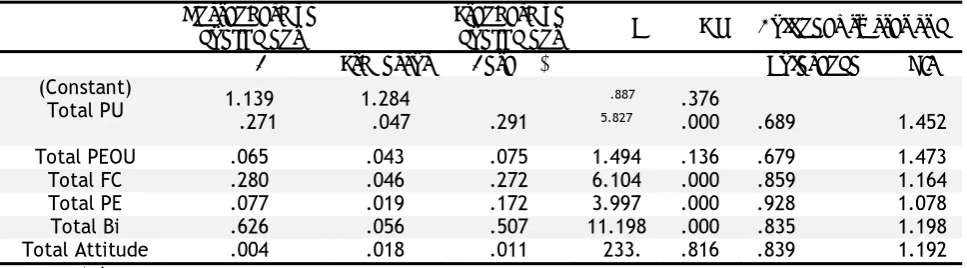
Table4: Multiple regression analysis of student acceptance to use MD
P ˂0.001
HYPOTHESES TESTING
Multiple regression analysis was used to analyze the hypotheses generated for the study. Prior to multiple
regression procedure, collinearity diagnostics were performed to ascertain that the data is free from multicollinearity.
The result shows that the assumption of multicollearity has not been violated. A look at the VIF value shows that all the
values were greater than 0.10 which is above the cut‐off point for multicollinearity (Pallant, 2007). The data of the study
has satisfied all the assumption for regression analysis. The results of the tested hypotheses here presented.
H1: Perceived usefulness will has a positive influence on acceptance of mobile devices for learning with beta
(β=0.291) and p ˂ 0.05; the hypothesis is supported.
Unstandardize coefficient
Standardize
coefficient T Sig Collinearity statistic
B Std error Beta (β) Tolerance VIF
(Constant)
Total PU .271 1.139 .047 1.284 .291 .887 5.827 .376 .000 .689 1.452 Total PEOU .065 .043 .075 1.494 .136 .679 1.473
H2: Perceived ease of use will has a positive influence on acceptance of mobile devices for learning with beta
(β=.075) and p ˂ 0.05; the hypothesis is not supported.
H3: Facilitating condition will has a positive influence on acceptance of mobile devices for learning with beta
(β=0.272) and p ˂ 0.05; the hypothesis is supported
H4: Perceived enjoyment will has a positive influence on acceptance of mobile devices for learning with beta
(β=.172) and p ˂ 0.05; the hypothesis is supported
H5: Student behavioral intention will has a positive influence on acceptance of mobile devices for learning with
beta (β=.507) and p ˂ 0.05; the hypothesis is supported
H6: Student attitude will has a positive influence on acceptance of mobile devices for learning with beta (β=.011)
and p ˂ 0.05; the hypothesis is not supported
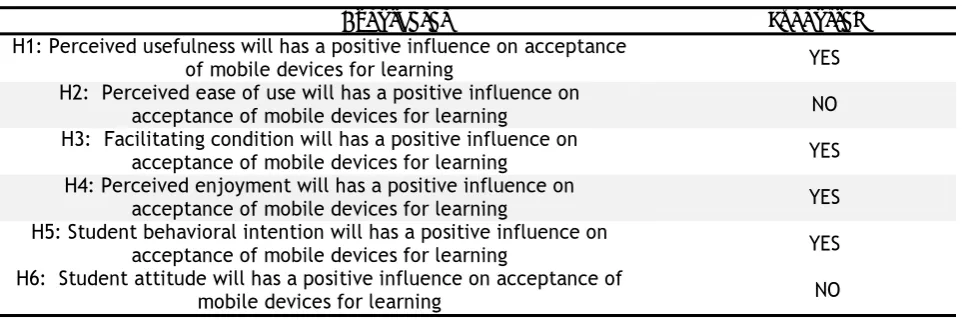
Table 5: Summary of the result of the Hypotheses Tested
Hypotheses Supported H1: Perceived usefulness will has a positive influence on acceptance
of mobile devices for learning YES H2: Perceived ease of use will has a positive influence on
acceptance of mobile devices for learning NO H3: Facilitating condition will has a positive influence on
acceptance of mobile devices for learning YES H4: Perceived enjoyment will has a positive influence on
acceptance of mobile devices for learning YES H5: Student behavioral intention will has a positive influence on
acceptance of mobile devices for learning YES H6: Student attitude will has a positive influence on acceptance of
mobile devices for learning NO
DISCUSSIONS
In‐line with the objective of the study, the findings of the study has revealed some fundamental issues in Mobile
Device (MD) acceptance for learning among students in developing world. The study shows that there is significant
difference in acceptance of mobile devices for learning among male and female, while there is no significant difference
in acceptance of mobile device for learning base on the area of specialization of the students. The implication of this
finding is that gender issue is crucial to adoption of mobile device in learning. The findings of the study have also
provided us with insight to some of the underline factors that can influence acceptance of mobile device. For instance,
the study shows that perceived usefulness is a good determinant of MD acceptance for learning. This finding is in
congruent with previous finding that reported the significant influence of PU on technology acceptance and mobile
learning (King, 2006; Ju et al. 2007; Ahmad et al. 2010; Iqbal & Qureish, 2012). On perceived ease of use, the finding of
this study shows that it does not have any significant influence on acceptance of MD, this finding contradict some
previous findings which reported the significant influence of PEOU on adoption of IS (Venkatesh et al. 2003, Young‐Wee
et al. 2010). On perceived enjoyment as a determinant to MD acceptance, the finding of this study supported previous
finding of Davis et al. (1993) which reported that perceived enjoyment as an intrinsic motivator is a strong determinant
for information system adoption. However, the study of Iqbal and Qureish (2012) contradict this finding despite the fact
that the two studies were conducted among student in developing country.
The finding of this study also revealed that facilitating condition is a strong determinant to adoption of mobile
device for learning. This finding is in congruent with Venkatesh et al. (2003) and Wang and Shih (2008) findings that
show that FC is a strong determinant indicated by users for accepting to use technology. In this study behavioral
learning, this submission show that adoption of MD by student is a function of their readiness through intention be it
positive or negative intention as the case may be. The finding corroborate the earlier finding of Davis (1985) and
Venkatesh et al. (1993) that reported that users intention is crucial to adoption of information system. Unlike student
intention which significantly influence acceptance to use MD in learning, student attitude does not have influence on
acceptance of MD for learning.
Theoretical and Practical Implication
Theoretically, the findings of this study have revealed the underline reason why students may adopt or reject
to use mobile device for their learning. The study show that perceived usefulness, perceived enjoyment, behavioral
intention, and facilitating condition are the factors that significantly contributes to acceptance of MD by students with
behavioral intention being the strongest factor, while perceived ease of use was statistically insignificant factor to MD
acceptance by student. The finding is an interesting one because it shows that the student did not see ease of use as an
important factor in MD acceptance for learning despite the fact that many study reported it to be an important factor
to adoption of IS (Ju et al. 2007). The revelation of this study shows that the familiarity of use could likely be the reason
why ease of use was statistically insignificant factor in this study. Therefore, the issue of ease of use in students learning
was insignificant and irrelevant as a factor for the acceptance of mobile devices for learning. Also, student attitude was
discover not to have any influence on acceptance of MD, this imply that student attitude be it negative or positive is
equally not relevant as a factor to influence the use of MD in learning. Practically, the finding of the study has revealed
that reasons for adoption of information system in the past may not be the same reasons why the students in the
contemporary world would adopt IS. This could be due to their exposure and use of different innovation in their day to
day activities.
CONCLUSIONS
The findings of this study will have important implication to all stakeholders most especially educators,
software developers, and instructional technology expert on how to improve MD with additional function for teaching
and learning process. E‐learning educator should as a matter of necessity consider its use to support and facilitate
student learning by adding it to their teaching kits. This study has contributed to existing literature on mobile device for
learning. The study has also validated the explanatory power of TAM on acceptance of new innovation in teaching and
learning process among the students. In conclusion, a qualitative study could be conducted for a deeper insight about
MD acceptance for learning among student. Better still; a longitudinal research study could also be carried out on it for
further understanding of this phenomenon.
REFERENCES
Ahmed, T.B.T., Madarsha, K.B., Zainuddin, A.M., Ismail, N. A., & Nordin, M.S (2010). Faculty’s Acceptance of computer based technology: Across-validation of an extended model. Australian Journal of Educational Technology, 26 (2), 268-279
Ajzen, I (1992). The theory of planned behavior, Organization behavior in human decision process, 50 (2), 179-211
Akerlind, G.S., & Trevitt, A.C (1999). Enhancing self-directed learning through educational technology: When students resist the change, Innovation in educational teaching International, 36 (2), 96-105
Al-Fahad, N,F (2008).Student attitudes and perceptions towards the effectiveness of mobile learning in King Saud University, Saudi Arabia. Turkish online Journal of Educational Technology. Vol 8, (2), 111-119
Churchill, D., & Churchill, N (2008).Educational affordances of PDAs: A study of a teacher exploration of this technology. Computer and Education, 50 (4), 1439-1450
Cui, G. & Wang, S (2008). Adopting cell phone in EFL teaching and learning. Journal of Educational Technology Development and Exchange, Vol 1, (1)
Davis, F.D (1986). A technology acceptance model for empirically testing new end-user information systems: Theory and result. PhD thesis, Sloan school of Management Massachusetts Institute of Technology
Davis, F.D (1989). Perceived usefulness, perceived ease of use and end user acceptance of information technology. MIS Quarterly, P3 (3), 319-340
Davis, F.D., Bagozzi, R.P., & Warshaw, P.R (1992). Extrinsic and intrinsic motivation to use computer in the work place. Journal Applied Social Psychology, 22, 1111-1132
Fishbein, M. & Ajzen, I (1975). Belief, attitude, intention and behavior: An introduction to theory and research. Addison-Wesley Reading, M.A
Iqbal, S., & Qureish, I. A (2012). M-learning adoption: A perspective from a developing country. Retrieved on July10, 2012 from http://www.irrodl.org/index.php/irrodl/article/view/1152/
Ju, T.L., Scriprapaipong, W., & Minh, D.N (2007). On the success factors of mobile learning. Paper presented at the 5th international conference on ICT and higher education. Bangkok, retrieved from http://www.mendeley.com/research/success-factor-mobile-learning/
Keegan, D. (2002). The future of learning: From e-learning to m-learning. ZIFF Papiere 119, Fernuversiat Hagen
Liaw, S.S. (2005). Investigating students’ perceived satisfaction, behavioral intention, and effectiveness of e-learning: A case study of the blackboard system. Computer & Education, 51, 664-873
Motiwalla, L.F. (2007). Mobile learning: A framework and evaluation. Computers & Education 49, (3), 581-596
Pallant, J. (2007). SPPSS survival manual. Third edition. Crows Nest: Allen and Unwin.
Roger’s, E. (1995). Diffusion of innovations. New-York, Freepress.
Roschelle, J. (2003). Keynote paper: Unlocking the learning value of wireless mobile devices. Journal of Computer Assisted Learning. 19 (3), 260-272
Shittu, A.T., Kamal, M. B., & Ahmad, T. B (2011). Investigating student’ attitude and intention to use social software in higher institution of learning in Malaysia. Presented at the e-learning and distance education conference held in Riyadh, Kingdom of Saudi Arabia. 21-24 February, 2011.
Tai, Y., & Ting, Y-L (2011). Adoption of mobile technology for language learning: Teacher attitudes and challenges. Jatcall journal, vol, 7 (1), p 3-18
Venkatesh, V., Morriss, M.G., Davis, G.B., & Davis, F.D (2003). User acceptance of information technology: Toward a unified view. MIS Quarterly, 27: 479-501
Wang, Y.S., & Shih, Y.-W.(2008). Why do people use information kiosks? A validation of the unified theory of acceptance and use of technology. Government Information Quarterly, 25 (1), 158-165