European Journal of Economic Studies, 2019, 8(1)
E
UROPEAN of Economic
J
ournal
Studies
Has been issued since 2012.
E-ISSN 2305-6282
2019, 8(1).Issued 2 times a year
EDITORIAL BOARD
Vidishcheva Evgeniya – Sochi State University, Sochi, Russian Federation (Editor-in-Chief)
Rajović Goran – International Network Center for Fundamental and Applied Research, Washington, USA (Deputy Editor-in-Chief)
Beciu Silviu – Economic Engineering in Agriculture and Rural Development UASVM Buchares, Romania
Bostan Ionel – Ştefan cel Mare University of Suceava, Romania
Dinh Tran Ngoc Huy – Banking University HCMC Viet Nam – GSIM, International University of Japan, Japan
Dudin Mikhail – Russian Presidential Academy of National Economy And Public Administration, Moscow, Russian Federation
Gvarliani Tatyana – International Network Center for Fundamental and Applied Research, Washington, USA
Kryshtanovskaya Olga – Institute of Sociology of the Russian Academy of Sciences, Moscow, Russian Federation
Minakir Pavel – Economic Research Institute FEB RAS, Khabarovsk, Russian Federation
Papava Vladimer – Ivane Javakhishvili Tbilisi State University, Tbilissi, Georgia
Prokopenko Olga – Sumy State University, Sumy, Ukraine
Radu Sorin – Universitatea din Petrosani, Petrosani, Romania
Štefko Róbert – University of Prešov in Prešov, Faculty of Management, Presov, Slovakia
Svagzdiene Biruta – Lithuanian University of Sports, Lithuania
Journal is indexed by: CrossRef (UK), EBSCOhost Electronic Journals Service
(USA), Electronic scientific library (Russia), Open Academic Journals Index (USA),
ResearchBib (Japan), ULRICH’s WEB (USA).
All manuscripts are peer reviewed by experts in the respective field. Authors of the manuscripts bear responsibility for their content, credibility and reliability.
Editorial board doesn’t expect the manuscripts’ authors to always agree with its opinion.
Postal Address: 1367/4, Stara Vajnorska str., Bratislava – Nove Mesto, Slovak Republic, 831 04
Website: http://ejournal2.com/ E-mail: [email protected]
Founder and Editor: Academic Publishing House Researcher s.r.o.
Release date 23.03.19. Format 21 29,7/4.
Headset Georgia.
Order № 115
© European Journal of Economic Studies, 2019
А
E
ur
ope
an
J
ou
rna
l of Econom
ic Studies
1
2019
C O N T E N T S
Articles and Statements
The Impact of Careful Application of Growth Management Policies and Sustainable Development on the Changing Marketing Environment
D. Al-Waely ... 3
The Possibility of Development of Sport-Recreational Tourism on Mountain Area Trešnjevik – Lisa and Environment
J. Bulatovic, A. Mladenović, G. Rajović ... 19
Impact of Blockchain Technology on the Payment Management Systems – What Future Holds?
S. Halilbegovic, Z. Kadic, N. Celebic, A. Arapovic, D. Kulovic ... 43
High Stock Trading Volumes before Holidays and Post-Holiday Price Drifts: Psychological Insights
A. Kudryavtsev ... 51
Concept of Multi-Level Simulation Model for Developing Regional Government’s Economic Strategy
M.M. Nizamutdinov, V.V. Oreshnikov ... 69
The Leverage Effect and Information Flow Interpretation for Speculative Bitcoin Prices: Bitcoin Volume vs ARCH Effect
C.W. Senarathne ... 77
Experience of Cultural Branding Development: Foreign and Russian Models
E.V. Vidishcheva, M. Gunare ... 85
The Financial Cycles and Their Importance to the Economy
C
opyright © 2019 by Academic Publishing House Researcher s.r.o.
Published in Slovak Republic
European Journal of Economic Studies
Has been issued since 2012.E-ISSN: 2305-6282
2019, 8(1): 3-18
DOI: 10.13187/es.2019.1.3
www.ejournal2.com
Articles and Statements
The Impact of Careful Application of Growth Management Policies and Sustainable Development on the Changing Marketing Environment
Dina Al-Waelyа , *
a World Islamic Sciences and Education University, Jordan
Abstract
This study aimed to identify the impact of the careful application of growth management policies and sustainable development on the changing marketing environment. The study has used the descriptive analytical approach, where a questionnaire was employed as the study instrument. The questionnaire consisted of (3) demographic variables and (26) items that were put together to measure the impact of the careful application of growth management policies and sustainable development on the changing marketing environment. The study population consisted of all Senior Managers who work at five-star hotels at the Dead Sea in Amman, Jordan, who amounted to (19) Senior Managers in (6) hotels, and the study sample included all (19) managers. The results showed that there is there is a statistically significant impact of the careful application of growth management policies on the changing marketing environment; it also showed that there is a statistically significant impact of the careful application of sustainable development on the changing marketing environment. The results of the means and standard deviations of the careful application of growth management policies fields from the point of view of the analysis showed that they were high, where the Attraction field came first, and the Expansion came last. There were other results have shown that the total mean and standard deviation of the Coordination field were high, where it had a mean of (3.91) and a standard deviation of (0.51). The results of the means and standard deviations of the sustainable development fields from the point of view of the analysis showed that they were high, where the Economic Dimension field came first, while the Environmental Dimension came last.
Keywords: careful application, growth management policies, sustainable development, changing marketing environment, Jordan.
1. Introduction
With respect to the hospitality industry, hotels speak to a key player in its esteem chain, as they produce an incredible effect as far as business and GDP, natural corruption, and social or social change. Given its financial and ecological effect, the hotel sector is a standout amongst the most evident potential recipients of applying social responsivity policies. Lodging managers are ending up more worried about these arrangements, as they comprehend it as an absolute necessity to accomplish reasonable development and long-haul gainfulness (Alles, Marqués, 2011).
* Corresponding author
Business exercises and the market environment are associated and depend on one another. Right when a change emerges in the market environment, it quickly influences organisation and especially the hotel sector, regardless of whether straightforwardly or by implication. Furthermore, the market environment depends on the factors of the market, which expects managers to think about market factors when settling on their choices, given that the achievement of an organisation depends on the market environment and the progressions it experiences. The changing marketing environment influences the selection of procedures, which expects managers to make arrangements, actualise them, and follow up on them as indicated by the different changes that may come to pass for the market, for example, financial, political, legitimate, and social changes, which may at last prompt an adjustment in the market environment (Tabassum, 2014).
As demands increased, so did the need to employ Growth Management Policies and Sustainable Development. Since Growth Management Policies and Sustainable Development became an important and valuable resource for any organisation regardless of type, and especially in the hotel sector, it became necessary for micro-and macro-marketing environments alike to be able to employ these policies and improve the changes in order to develop the business. Therefore, the current study was conducted to explore the impact of the careful application of growth management policies and sustainable development on the changing marketing environment.
2. Literature Review
Growth Management Policies
Below, the researcher will discuss the main dimensions that are of matter to this study.
Cooperation
Coordination is a very important case to use in our life especially in work that is why it deals with all about intra and inter-organizational level. Coordination mechanisms, which are necessary to use them such as programming, that organize by programs, plans, rules, routines, targets, and objective. In addition, they use feedback that consisted of communication and the concept of the mutual adaptation. As well as, hierarchy to examine the problems which goes beyond feedback and programming. Therefore, coordination plays a great role in the company when it suffers from the uncertainty that caused task interdependence. There were standardised procedures that achieve tasks with low interdependence like programs or rule that determine responsibilities and allocation resource. As well, to align the work, there were a group of tools and information technologies can help the team. Such as boundary objects lead to better communication. Coordination moved from being formal and consistent to be described as knowledge sharing, flexibility, and communication. While experts have depended on dynamic view, they dealt with the coordination as an emergent procedure that could be changing (Okhuysen, Bechky, 2009; Hsieh, 2018).
Attraction
There is a policy specialised in the development of urban centres, improving the kind of nature and make it more attractive. The surrounded cities support urban centres by establishing renewal projects and implement long running programmes. Which financed by public authorities, sometimes with homeowner or investors such as Europe Union. Therefore, the movements of development and reform help to decrease the phenomena of the shrinkage of population. however, the investments in urban renewal in Copenhagen is developed through last three decades, and now it’s more experienced than before. Besides all of that, the economic perspective sees that market forces lead to urban expansion thereby urban expansion will happened as long as the benefit from urban areas more than the agriculture areas (Fertner et al., 2016; Qian et al., 2015).
Expansion
South Korea use the transfer of urban function and movements that promoted new villages. In Japan, they use land readjustment in many developed countries depend on urban redevelopment as a criterion to improve the quality of cities. In addition, the most developed country depended to farmland protection policy to cope with the loss which resulted from urban expansion (Qian et al., 2015).
Sustainable Development
Sustainable development is an all-encompassing idea dependent on a basic guideline. The thought consolidates "progression that tends to the issues of the present without exchanging off the limit of future ages to address their very own issues." The objective of sustainable development is unmistakable to guarantee financial improvement, social equity and ecological security (Houdré, 2008).
Sustainable development is currently observed as a general idea appropriate to all zones of monetary life. It is characterised as an improvement that addresses the issues of current ages without trading off the necessities of who and what is to come. Without knowing past and current examples of creation and utilisation, and precisely evaluating current needs, the necessities of future ages can't be anticipated. Feasible development can likewise be alluded to as a harmony between alleged mainstays of sustainable development; economic (situated towards monetary development and improvement), social (personal satisfaction introduction), and environmental (condition arranged) approaches (Huttmanová, 2017).
Economic Dimension (Economic Viability)
The economic viability (sustainability) of accommodation includes the ideal and productive utilisation of property resources with the goal that they can keep on working in a beneficial way in the long haul. The capacity of individual tourism ventures relies upon the capacity to recognise markets that will keep on conveying business over the long haul; to comprehend what potential shoppers are searching for; adjust to patterns and changes in source economic situations, travel examples, and tastes. This requires a powerful and continuous market evaluation to manage advancement in cordiality hotels (Kapiki, 2013).
Economic viability is a part of the sustainable development technique of numerous hotels. The objective is to make high an incentive for their investors and visitors. The technique depends on the idea of a "primary concern" that consolidates economic viability, social responsibility, and environmental protection. The organisation must utilise the standards of sustainable development to create income and spare expenses and in this way stay beneficial to be practical (Kapiki et al., 2014).
Environmental Dimension (Environmental Protection)
Ensuring the earth's continuity – with climate change at the cutting edge – is a standout amongst the most imperative difficulties confronting humankind today. Purposeful activities – at the government, corporate and individual levels – must be taken to end the progressing decay of the earth (Bohdanowicz et al., 2011).
The hotel industry around the globe has been paying more attention to ecological issues as of late. It was noticed that 75 % of the environmental contamination caused by the hotel industry was the intemperate utilisation of vitality, water, and materials amid the activity of the business. Wastewater, vapour, and substances released amid the procedure will cause unfriendly effects on our condition. In this way, without the suitable structure and plan, nature will be antagonistically influenced. The idea of environmental protection and vitality preservation can invigorate green administration to assemble hotel offices. In the event that the hotel industry can try green administration, it won't just be advantageous to natural and biological assurance, yet will likewise diminish hotel working expenses. In addition, green showcasing can draw in purchasers who likewise bolster similar ideologies (Chen, Chen, 2012).
Social Dimension (Social Responsibility)
Social responsibility is a critical term for the hospitality business. An idea whereby organisations incorporate social and natural worries into their business forms and associate with partners on an intentional premise. Social responsibility is the duty of organisations to act morally and add to improvement while enhancing the personal satisfaction of the workforce, their families and in addition the network and society all in all (Sydnor et al., 2014).
sensibly diminishes its negative effect on the earth. The immediate sea likewise profits by advancing ecological thoughts among colleagues in a socially mindful hotel. The potential advantages of the network are expanded professional stability, social and instructive development, and animating the monetary advancement of nearby business visionaries (Abram, Jarzabek, 2016).
Marketing Environments
The changing in market environment proved the difficulties that market manager faced; it requires him to earn much information from business such as the demand and supply chain, the quality of the production process and so on, in order to examine and evaluate upcoming opportunities. Marketing environment divided into two categories, the indirect environment like customers and organisations, the external (indirect) environment, which is border than direct market, and include economic, technological, legal and cultural environment (Tabassum, 2014).
Microenvironment
The balance could be evident at micro-level environment through the scope and construction of the purchased utilities with accessible income and that’s for consumer product that the company deal with such as inputs buyer or consumer goods. The contribution of trading ensures stability at the microenvironment and that’s important to specify normality market (Pîndiche, Ionita, 2013).
Macro-Environment
The macro environment is an important factor, which leads to constant work and regular process. It could guide the organisation’s activities, ensure that can handle the needs of the society, and it has an impact on an organisation's behaviour such as customer's behaviour and so on. In addition to that, the macro environment affects microenvironment because of the macro environment's broader power (Pîndiche, Ionita, 2013).
3. Methodology Research Instrument
The instrument contains (26) items measuring the impact of the careful application of growth management policies and sustainable development on the changing marketing environment. The questionnaire has been distributed by hand.
The questionnaire contains (3) demographic variables and (26) questions that represent the study variables, which are:
Growth Management Policies, which has been formulated into benchmarks or objectives to be reached, and has been divided into (3) fields with (9) questions in total as shown below:
-Coordination, which contains (3) questions. -Attraction, which contains (3) questions. -Expansion, which contains (3) questions.
Sustainable Development, which has been formulated into benchmarks or objectives to be reached, and has been divided into (3) fields with (9) questions in total as shown below:
-Economic Dimension, which contains (3) questions. -Social Dimension, which contains (3) questions.
-Environmental Dimension, which contains of (3) questions.
Changing Marketing Environment, which has been formulated into benchmarks or objectives to be reached, and has been divided into (2) fields with (8) questions in total as shown below:
Study model
Hypotheses of the Study
1. Main Hypothesis (H01). There is no statistically significant impact of careful application of growth management policies (coordination, attraction, and expansion) and sustainable development (economic dimension, social dimension, and environmental dimension) on the changing marketing environment at the level (α ≤ 0.05).
2. Main Hypothesis (H02). There is no statistically significant impact of the careful application of growth management policies on the changing marketing environment at the level (α ≤ 0.05).
This hypothesis is divided into two sub-hypotheses:
Sub Hypothesis (H02-1). There is no statistically significant impact of the careful application of growth management policies on the microenvironment at (α ≤ 0.05).
Sub Hypothesis (H02-2). There is no statistically significant impact of the careful application of growth management policies on the macro-environment at (α ≤ 0.05).
H02-2: There is no statistically significant impact of attraction on the changing marketing environment at (α ≤ 0.05).
H02-3: There is no statistically significant impact of expansion on the changing marketing environment at (α ≤ 0.05).
This hypothesis is divided into two sub-hypotheses:
3. Main Hypothesis (H03). There is no statistically significant impact of sustainable development on the changing marketing environment at the level (α ≤ 0.05).
Sub Hypothesis (H03-1). There is no statistically significant impact of the sustainable development on the microenvironment at (α ≤ 0.05).
Sub Hypothesis (H03-2). There is no statistically significant impact of the sustainable development on the macro-environment at (α ≤ 0.05).
Data Analysis and Interpretation
To examine the hypotheses of the study, which were specifically formulated to examine the impact of careful application of growth management policies and sustainable development on the changing marketing environment, the Statistical Package for Social Sciences (SPSS) was used so as to process the following statistical techniques and tests and employ them in the data analysis:
-Descriptive Statistical Techniques; these techniques include means and standard deviations
-Reliability Test; this test employs instruments that were used to measure the reliability of
the study instrument and highlight its stability and consistency;
-Frequencies and Percentages; these techniques were used to describe the demographical
variables of the study;
-Normality tests;
-Multiple Regression Test; this test was used to explore the direct impacts of the study
variables.
Respondents were asked to read each question, and select one of the choices that are shown below:
-Score (5), for respondents who (Strongly Agree) -Score (4), for respondents who (Agree)
-Score (3), for respondents who (Neutral) -Score (2), for respondents who (Disagree)
-Score (1), for respondents who (Strongly Disagree) Participants
The population of the study consisted of all Senior Managers who work at five-star hotels at the Dead Sea in Amman, Jordan, who amounted to (19) Senior Managers in (6) hotels. The entire study population was selected due to their low number to represent the sample of the study as shown in Table 1. (19) Questionnaires were distributed, and all were retrieved, making the number of valid questionnaires (19), which was identified as (100%) of the total of distributed questionnaires, which are detailed below:
Table 1. Demographic Characteristics for the Study Sample(Gender)
Sample Gender
Percentage Frequency
84.2% 16
Male
15.7% 3
Female
100% 19
Total
From Table 1 it shows that the percentage of males from the Sample was (78.94 %) meanwhile it was for females (21.06 %).
Table 2. Demographic Characteristics of the Sample (Academic Level)
Sample Academic Level
Percentage (%) Frequency
0.0% 0
High School Degree or below
10.52% 2
Bachelor’s Degree
36.84% 7
Master’s Degree
52.63% 10
Doctorate Degree
100.0% 19
Total
Table 3. Demographic Characteristics of the Sample (Years of Experience)
Sample Years Of Experience
Percentage (%) Frequency
5.26 % 1
Less Than 1 Year
10.52 % 2
1-3 years
52.63 % 10
3-5 Years
36.84 % 7
More Than 5 Years
100.0 % 19
Total
For the variable (Years of Experience), it’s shown that the (Less than 1 year) rank has achieved (5.26 %), while the (1-3 years) rank achieved (10.52 %); on the other hand, the (3-5 years) rank achieved (52.63 %), while the (More than 5 years) rank achieved (36.84 %).
Tool Validity
Table 4. Cronbach’s Alpha for the Study Fields
Value of (α) Field
Field Number
Growth Management Policies
0.712 Coordination
1
0.733 Attraction
2
0.954 Expansion
3
Sustainable Development
0.606 Economic Dimension
1
0.753 Social Dimension
2
0.874 Environmental Dimension
3
Changing Marketing Environment
0.684 Micro Environment
1
0.801 Macro-Environment
2
As shown from the table above, it can be established that the total of Cronbach’s Alpha for the study fields was above (0.60), which means that the results of the study will be stable.
Analysis of the Results
To analyse the data and examine the hypotheses, as well as explore the impact of the careful application of growth management policies and sustainable development on the changing marketing environment, descriptive statistics for each field were calculated, in addition to using multiple and Linear Regression as follows:
Descriptive Statistics for the Instrument’s Fields
Table 5. Descriptive Statistics for Management Policies and Their Impact on the Changing Marketing Environment Level Std. Deviation Mean Field Field Number High 0.51 3.91 Coordination F1 High 0.61 4.11 Attraction F2 High 0.88 3.79 Expansion F3 High 0.47 4.09 Economic Dimension F4 High 0.54 3.95 Social Dimension F5 High 0.66 3.93 Environmental Dimension F6 High 0.40 4.24 Micro Environment F7 High 0.51 4.14 Macro-Environment F8
As seen from the table above, it’s apparent that the Coordination field has achieved a mean of (3.91) with a standard deviation of (0.51), while the Attraction field has reached a mean of (4.11) and a standard deviation of (0.61); in addition, the Expansion field has achieved a mean of (3.79) with a standard deviation of (0.88).
On the other hand, it’s been established that the Economic Dimension field has achieved a mean of (4.09) with a standard deviation of (0.47), while the Social Dimension field has reached a mean of (3.95) and a standard deviation of (0.54); in addition, the Environmental Dimension field has achieved a mean of (3.93) with a standard deviation of (0.66).
In addition, it has been established through the table above that the Micro Environment field achieved a mean of (4.24) with a standard deviation of (0.40), while the Macro-Environment field has reached a mean of (4.14) and a standard deviation of (0.51).
4. Results and Discussion
Main Hypothesis (H01). There is no statistically significant impact of careful application of growth management policies (coordination, attraction, and expansion) and sustainable development (economic dimension, social dimension, and environmental dimension) on the changing marketing environment at the level (α ≤ 0.05).
The Multiple Regression test has been used to check the direct impact of careful application of growth management policies and sustainable development on the changing marketing environment , where the results can be found in the table below:
Table 6. Multiple Regression Test to Check the Direct Impact of growth management policies and sustainable development on the changing marketing
Dependent
Variable R R2 F Sig DF CoefficientsPredictor B T Sig
Changing Marketing
Environment .900 .810 34.009 .000
2 Constant 2.099 5.261 .000
16 growth management
policies .739 3.594 .002
18 sustainable
development .205 0.787 .443
growth management policies and sustainable development. Furthermore, the Restriction Parameter (F) of the changing marketing environment was (34.009), which is caused by growth management policies and sustainable development; thus, we will accept the alternative hypothesis “There is a statistically significant impact of careful application of growth management policies (coordination, attraction, and expansion) and sustainable development (economic dimension, social dimension, and environmental dimension) on the changing marketing environment at the level (α ≤ 0.05)”
Main Hypothesis (H02). There is no statistically significant impact of the careful application of growth management policies on the changing marketing environment at the level (α ≤ 0.05).
To check the validity of the multiple regression for this model, both the VIF and tolerance were calculated for each field for the first independent variable as illustrated in the following table:
Table 7. VIF and Tolerance for Each Field for the First Independent Variable
Field Tolerance VIF
Coordination .119 8.389
Attraction .108 9.265
Expansion .163 6.144
As shown in the table above, it seems that all VIF values were less than 10, which leads to the compatibility of using the Multiple Regression test.
In addition, and regarding the tolerance values, it’s been revealed that these values are more than (0.05), which means that the regression modelling can be used to test the hypotheses.
The Multiple Regression test has been used to check the direct impact of growth management policies on the changing marketing environment, where the results can be found in the table below:
Table 8. Multiple Regression Test to Check the Direct Impact of Growth Management Policies on the Changing Marketing Environment
Dependent
Variable R R2 F Sig DF
Coefficients
Predictor B T Sig
Changing Marketing
Environment .899 .809 21.155 .000
3 Constant 1.690 3.604 .003
Coordination .196 .719 .483 15
Attraction .321 1.342 .200 18 Expansion .110 .817 .427
As shown from the table above regarding the impact of careful application of growth management policies on the changing marketing environment, there is a significant impact of growth management policies on the changing marketing environment, as the significant value was (0.000), which is less than (0.05), while the value of R was (0.899), and the coefficient of the determination R2 was (0.809). In addition, about (80.9 %) of the variation in the changing marketing environment isexplained by growth management policies. Furthermore, the Restriction Parameter (F) of the changing marketing environment was (21.155), which is caused by growth management policies; thus, we will accept the alternative hypothesis “There is a statistically significant impact of the careful application of growth management policies on the changing marketing environment at the level (α ≤ 0.05).”
Sub Hypothesis (H02-1). There is no statistically significant impact of the careful application of growth management policies on the microenvironment at (α ≤ 0.05).
Table 9. Multiple Regression Test to Check the Direct Impact of Growth Management Policies on the Microenvironment
Dependent
Variable R R2 F Sig DF
Coefficients
Predictor B T Sig
Microenvironment .873 .762 15.996 .000
3 Constant 1.477 3.604 .003
Coordination .404 1.421 .176
15
Attraction .400 1.607 .129
18 Expansion -.122 -.873 .397
As shown from the table above regarding the impact of careful application of growth management policies on the microenvironment, there is a significant impact of growth management policies on the microenvironment, as the significant value was (0.000), which is less than (0.05), while the value of R was (0.873), and the coefficient of the determination R2 was (0.762). In addition, about (76.2%) of the variation in the microenvironment is explained by growth management policies. Furthermore, the Restriction Parameter (F) of the microenvironment was (15.996), which is caused by growth management policies; thus, we will accept the alternative hypothesis “There is a statistically significant impact of the careful application of growth management policies on the microenvironment at (α ≤ 0.05).”
Sub Hypothesis (H02-2). There is no statistically significant impact of the careful application of growth management policies on the macro-environment at (α ≤ 0.05).
The Multiple Regression test has been used to check the direct impact of growth management policies on the macro-environment, where the results can be found in the table below:
Table 10. Multiple Regression Test to Check the Direct Impact of Growth Management Policies on the Macro-Environment
Dependent
Variable R R2 F Sig DF
Coefficients
Predictor B T Sig
Macro-Environment .852 .726 13.268 .000
3 Constant 1.903 2.822 .013
Coordination -.011 -.028 .978 15
Attraction .242 .703 .493 18 Expansion .341 1.768 .097
As shown from the table above regarding the impact of careful application of growth management policies on the macro-environment, there is a significant impact of growth management policies on the macro-environment, as the significant value was (0.000), which is less than (0.05), while the value of R was (0.852), and the coefficient of the determination R2 was (0.726). In addition, about (72.6 %) of the variation in the macro-environment is explained by growth management policies. Furthermore, the Restriction Parameter (F) of the macro-environment was (13.268), which is caused by growth management policies; thus, we will accept the alternative hypothesis “There is a statistically significant impact of the careful application of growth management policies on the macro-environment at (α ≤ 0.05).”
To check the validity of the multiple regression for this model, both the VIF and tolerance were calculated for each field for the second independent variable as illustrated in the following table:
Table 11. VIF and Tolerance for Each Field for the Second Independent Variable
Field Tolerance VIF
Economic Dimension .179 5.573
Social Dimension .271 3.695
Environmental Dimension .368 2.720
As shown in the table above, it seems that all VIF values were less than 10, which leads to the compatibility of using the Multiple Regression test.
In addition, and regarding the tolerance values, it’s been revealed that these values are more than (0.05), which means that the regression modelling can be used to test the hypotheses.
The Multiple Regression test has been used to check the direct impact of sustainable development on the changing marketing environment, where the results can be found in the table below:
Table 12. Multiple Regression Test to Check the Direct Impact of Sustainable Development on the Changing Marketing Environment
Dependent
Variable R R2 F Sig DF
Coefficients
Predictor B T Sig
Changing Marketing
Environment .829 .688 11.004 .000
3 Constant 1.805 3.310 .005
Economic
Dimension -.144 -.469 .646
15 Social
Dimension .398 1.817 .089
18 Environmental Dimension .357 2.347 .033
As shown from the table above regarding the impact of careful application of sustainable development on the changing marketing environment, there is a significant impact of sustainable development on the changing marketing environment, as the significant value was (0.000), which is less than (0.05), while the value of R was (0.829), and the coefficient of the determination R2 was (0.688). In addition, about (68.8%) of the variation in the changing marketing environment is explained by sustainable development. Furthermore, the Restriction Parameter (F) of the changing marketing environment was (11.004), which is caused by sustainable development; thus, we will accept the alternative hypothesis “There is a statistically significant impact of the careful application of sustainable development on the changing marketing environment at the level (α ≤ 0.05).”
Sub Hypothesis (H03-1). There is no statistically significant impact of the sustainable development on the microenvironment at (α ≤ 0.05).
Table 13. Multiple Regression Test to Check the Direct Impact of Sustainable Development on the Microenvironment
Dependent
Variable R R2 F Sig DF
Coefficients
Predictor B T Sig
Microenvironment .782 .612 7.879 .002
3 Constant 2.145 3.785 .002
Economic
Dimension .113 .354 .728
15 Social
Dimension .036 .158 .877
18 Environmental Dimension .378 2.393 .030
As shown from the table above regarding the impact of careful application of sustainable development on the microenvironment, there is a significant impact of sustainable development on the microenvironment, as the significant value was (0.002), which is less than (0.05), while the value of R was (0.782), and the coefficient of the determination R2 was (0.612). In addition, about (61.2%) of the variation in the microenvironment is explained by sustainable development. Furthermore, the Restriction Parameter (F) of the microenvironment was (7.879), which is caused by sustainable development; thus, we will accept the alternative hypothesis “There is a statistically significant impact of the sustainable development on the microenvironment at (α ≤ 0.05).”
Sub Hypothesis (H03-2). There is no statistically significant impact of the sustainable development on the macro-environment at (α ≤ 0.05).
The Multiple Regression test has been used to check the direct impact of sustainable development on the macro-environment, where the results can be found in the table below:
Table 14. Multiple Regression Test to Check the Direct Impact of Sustainable Development on the Macro-Environment
Dependent
Variable R R2 F Sig DF
Coefficients
Predictor B T Sig
Macro-Environment .820 .673 10.274 .001
3 Constant 1.464 2.184 .045
Economic
Dimension -.402 -1.062 .305
15 Social
Dimension .761 2.821 .013
18 Environmental Dimension .336 1.794 .093
As shown from the table above regarding the impact of careful application of sustainable development on the macro-environment, there is a significant impact of sustainable development on the macro-environment, as the significant value was (0.001), which is less than (0.05), while the value of R was (0.820), and the coefficient of the determination R2 was (0.673). In addition, about (67.3%) of the variation in the macro-environment is explained by sustainable development. Furthermore, the Restriction Parameter (F) of the macro-environment was (10.274), which is caused by sustainable development; thus, we will accept the alternative hypothesis “There is a statistically significant impact of the sustainable development on the macro-environment at (α ≤ 0.05).”
5. Conclusion, proposals, recommendations Discussion of the Results
The results of the means and standard deviations of the careful application of growth management policies fields from the point of view of the analysis showed that they were high, where the Attraction field came first, and the Expansion came last. This indicates that five-star hotels at the Dead Sea in Amman, Jordan care about attracting as many customers as possible in order for their business to thrive and grow. It can also imply that five-star hotels at the dead sea in Amman, Jordan care about expanding their business and making it grow regardless of the expenses that may come along with it, so long as it serves the objectives of the hotel and ensures better results in the long run.
Coordination
Results have shown that the total mean and standard deviation of the Coordination field were high, where it had a mean of (3.91) and a standard deviation of (0.51). This is because hotels at the Dead Sea in Amman, Jordan consider coordination an important element of its working environment and aims to instil it within its employees as much as possible.
Attraction
Results have shown that the total mean and standard deviation of the Attraction field were high, where it had a mean of (4.11), and a standard deviation of (0.61). This can be attributable to the keenness of five-star hotels at the Dead Sea in Amman, Jordan to employ the best ways possible to attract customers and broaden the scope of its customers, in addition to increasing their market share.
Expansion
Results have shown that the total mean and standard deviation of the Expansion field were high, where it had a mean of (3.79), and a standard deviation of (0.88). This is because five-star hotels at the Dead Sea in Amman, Jordan care about expanding their business and property in order to be able to provide more services, which, in turn, will make them more profits and allow them to grow.
Second: Sustainable Development
The results of the means and standard deviations of the sustainable development fields from the point of view of the analysis showed that they were high, where the Economic Dimension field came first, while the Environmental Dimension came last. This indicates that five-star hotels at the Dead Sea in Amman, Jordan care about boosting the economic stance and providing sustainable growth to the market as a part of its responsibility. It can also imply that five-star hotels at the Dead Sea in Amman, Jordan care about the environment as they live in it are keen to practise their role in preserving the environment as much as possible.
Economic Dimension
Results have shown that the total mean and standard deviation of the Economic Dimension field were high, where it had a mean of (4.09), and a standard deviation of (0.47). This is because five-star hotels at the Dead Sea in Amman, Jordan care about boosting the economic stance of the country it exists in and aims to provide a sustainable growth to the market as a part of its responsibility.
Social Dimension
Results have shown that the total mean and standard deviation of the Social Dimension field were high, where it had a mean of (3.95), and a standard deviation of (0.54). This can be attributable to the keenness of five-star hotels at the Dead Sea in Amman, Jordan to be a pivotal part in the society they live in; they also consider being active in the social dimension good for their overall image.
Environmental Dimension
Results have shown that the total mean and standard deviation of the Environmental Dimension field were high, where it had a mean of (3.93) and a standard deviation of (0.66). This is because five-star hotels at the Dead Sea in Amman, Jordan care about being an active actor when it comes to issues related to the environment, in addition to the fact that it lowers its costs, and paints a positive picture for customers who share the same views as them.
Third: Changing Marketing Environment
the most vital part of the business as it includes providers, market mediators, clients, partners, contenders, as well as the society in general. It can also imply that five-star hotels at the Dead Sea in Amman, Jordan care about their macro-environment as it prompts steady work and customary process.
Microenvironment
Results have shown that the total mean and standard deviation of the microenvironment field were high, where it had a mean of (4.24), and a standard deviation of (0.40). This is because five-star hotels at the Dead Sea in Amman, Jordan care about the external powers and factors that shape the microenvironment, which involves providers, market mediators, clients, partners, contenders, as well as the society in general, and guarantee they provide them with the best services and offers.
Macro-Environment
Results have shown that the total mean and standard deviation of the Macro-Environment field were high, where it had a mean of (4.14), and a standard deviation of (0.51). This can be attributable to the keenness of five-star hotels at the Dead Sea in Amman, Jordan to keep an eye out for external factors that might affect its business and aims to employ policies that would reinforce the beneficial factors and prevent the non-beneficial ones.
Discussion of the Hypotheses’ Results
The main hypothesis (H01) showed that there is a statistically significant impact of careful application of growth management policies (coordination, attraction, and expansion) and sustainable development (economic dimension, social dimension, and environmental dimension) on the changing marketing environment; this indicates that the five-star hotels in the Dead Sea are pursuing innovative policies to develop their service delivery practices so as to contribute to sustainable development and to make a radical and positive impact on the marketing environment.
The main hypothesis (H02) showed that there is there is a statistically significant impact of the careful application of growth management policies on the changing marketing environment. This can be because five-star hotels at the Dead Sea in Amman, Jordan make use of the growth policies to grow its business in order to respond fast to changes in the concerned environments effectively.
This hypothesis is divided into two sub-hypotheses:
The first sub-hypothesis (H01-1) showed that there is a statistically significant impact of the careful application of growth management policies on the microenvironment. This is because five-star hotels at the Dead Sea in Amman, Jordan aim to employ policies that are effective in terms of the microenvironment and the actors within that environment in order to gain benefits from it.
The second sub-hypothesis (H01-2) showed there is a statistically significant impact of the careful application of growth management policies on the macro-environment. This is because five-star hotels at the Dead Sea in Amman, Jordan care about the dynamic and competitive nature of their sector, which require them to develop in a strategical way in order to survive.
The main hypothesis (H02) showed that there is a statistically significant impact of the careful application of sustainable development on the changing marketing environment. This can be because five-star hotels at the Dead Sea in Amman, Jordan believe that sustainable development helps with managing their business in order to respond fast to changes in the concerned environments.
This hypothesis is divided into two sub-hypotheses:
The first sub-hypothesis (H02-1) showed that there is a statistically significant impact of the sustainable development on the microenvironment. This is because five-star hotels at the Dead Sea in Amman, Jordan correspond positively to their interest in sustainable development and its connection to accomplishing environmental and social benefits within the microenvironment; it can be also due to the fact that if managers perform high levels of social and environmental responsibility, they can improve their profits.
6. Conclusion
The significance of cautious utilization of development administration approaches the careful application of growth management policies and sustainable development is starting to be acknowledged by the entire world, particularly in five-star hotels at the Dead Sea in Amman, Jordan due to the far-reaching crises worldwide economy in general, and the Jordanian economy in particular. Hence, careful application of growth management policies and sustainable development have turned out to be vital requirements for any business to develop, given that they employ new and pioneering ways and methodologies to oversee various types of circumstances viably and offer exercises that are not the same as the traditional or ones that are unlike those that have been made before. It also allows hotels to be a memorable actor that people can relate to.
The present study was made as an attempt to explore the impact of the careful application of growth management policies and sustainable development on the changing marketing environment in five-star hotels at the Dead Sea in Amman, Jordan. In light of the results shown in this study, it has been concluded that organisations, especially hotels, should employ the different policies of growth management as well as practise the different responsibilities of sustainable development in order to help them achieve their short-and long-term goals and objectives, and how they would affect their micro- and macro-environments and, in turn, the thrive of their business, as these policies and responsibilities help senior managers to expand their knowledge and expertise in a way that suits the situation at hand, especially since the economic system is becoming more complex with each passing day.
Research Limitations and Direction for Further Research
The human limitation presented a major limitation within this study, as the study population was limited to include Senior Managers who work at five-star hotels at the Dead Sea in Amman, Jordan only.
While choosing Senior Managers who work at five-star hotels at the Dead Sea in Amman, Jordan was effective and appropriate for the current study, it would’ve been more effective to incorporate a bigger sample to acquire better outcomes. It would also be preferable to broaden the scope of the study to include hotels other than the ones in the Dead Sea and have it from across the entire Hashemite Kingdom of Jordan. In addition, further qualitative research would be required later on to measure the impact of the careful application of growth management policies and sustainable development on the changing marketing environment accurately.
Further research into the broader and more extensive impact of the careful application of growth management policies and sustainable development on the changing marketing environment with any new outcomes, regardless of whether they are positive or negative, would be highly valued and appreciated by the researcher.
References
Abram, Jarzabek, 2016 – Abram, M., Jarzabek, J. (2016). Corporate Social Responsibility in Hotel Industry: Environmental Implications. Ecocycles, 2(2), 9-16.
Alles, Marqués, 2011 – Alles, M., Marqués, R. (2011). Corporate Social Responsibility in the Hotel Sector: A Scientific Literature Review. Cuadernos de Turismo (Tourism Notebooks), (28), 235-236.
Bohdanowicz et al., 2011 – Bohdanowicz, P., Zientara, P., Novotna, E. (2011). International Hotel Chains and Environmental Protection: An Analysis of Hilton's We Care! Programme (Europe, 2006–2008). Journal of Sustainable Tourism, 19(7), 797-816.
Chen, Chen, 2012 – Chen, Y., Chen, Y. (2012). The Advantage of Green Management for Hotel Competitiveness in Taiwan: In the Viewpoint of Senior Hotel Managers. Journal of Management and Sustainability, 2(2), 211-218.
Fertner et al., 2016 – Fertner, C., Jørgensen, G., Nielsen, T., Nilsson, K. (2016). Urban Sprawl and Growth Management–Drivers, Impacts and Responses in Selected European and US Cities. Future Cities and Environment, 2(1), 9-21.
Houdré, 2008 – Houdré, H. (2008). Sustainable Development in the Hotel Industry. Cornell Hospitality Industry Perspectives, 1(2), 6-20.
Huttmanová, 2017 – Huttmanová, E. (2017). Evaluation of the Environmental Dimension of Sustainable Development in the EU Countries. Cleaner Production and Green Economy, (4), 5-10.
Kapiki, 2013 – Kapiki, S. (2013). Evaluating Economic Viability of the Lodging Industry: Independent vs. Chain Hotels. Paper Presented at the Contemporary Trends in Tourism and Hospitality-CTTH 2013 Titled, “Peace, Culture and Tourism,” Novi Sad, Serbia, September 2013, 287-297.
Kapiki et al., 2014 – Kapiki, S., Mu, L., Fu, J. (2014). Assessment of the Lodging Industry Profitability Performance: Invest in Independent or Chain Ownership? Turizam (Tourism), 18(2), 84-94.
Okhuysen, Bechky, 2009 – Okhuysen, G., Bechky, B. (2009). Coordination in Organizations: An Integrative Perspective. Academy of Management Annals, 3(1), 463-502.
Pîndiche, Ionita, 2013 – Pîndiche, E., Ionita, R. (2013). The Influence of Micro and Macro Environment Components on Trade Companies in Romania. Journal of Knowledge Management, Economics and Information Technology, 9: 327-337.
Qian et al., 2015 – Qian, J., Peng, Y., Luo, C., Wu, C., Du, Q. (2015). Urban Land Expansion and Sustainable Land Use Policy in Shenzhen: A Case Study of China’s Rapid Urbanization.
Sustainability, 8(1), 1-16.
Sydnor et al., 2014 – Sydnor, S., Day, J., Adler, H. (2014). Creating Competitive Advantage and Building Capital through Corporate Social Responsibility: An Exploratory Study of Hospitality Industry Practices. Management and Organizational Studies, 1(1), 52-62.
C
opyright © 2019 by Academic Publishing House Researcher s.r.o.
Published in Slovak Republic
European Journal of Economic Studies
Has been issued since 2012.E-ISSN: 2305-6282
2019, 8(1): 19-42
DOI: 10.13187/es.2019.1.19
www.ejournal2.com
The Possibility of Development of Sport-Recreational Tourism on Mountain Area Trešnjevik – Lisa and Environment
Jelisavka Bulatovic a, Aleksandra Mladenović a, Goran Rajović b , c , *
a College of Textile Design, Technology and Management, Belgrade, Serbia
b International Network Center for Fundamental and Applied Research, Washington, USA c Volgograd State University, Volgograd, Russian Federation
Abstract
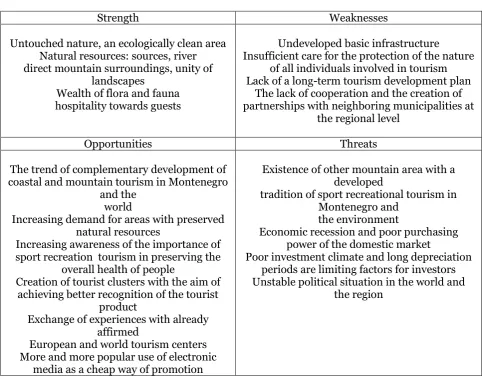
Sport and recreational tourism in the present time in Montenegro, it is actually one of the special forms of tourism that has a high tendency of growth. Mountainous area Trešnjevik – Lisa abounds in sports-recreational facilities that are only partially used. Many experts consider tourism today as a complex phenomenon, and it is also the subject of very frequent research. Almost everywhere in the world there is an area visited by tourists every day. Trends and society are changing, but the motives of traveling remain the same. There is a growing imperative to sports and recreation on vacation because of the hectic everyday life (Kalavarić, 2017). The mountainous area Trešnjevik – Lisa can be reached from two directions with a relatively good traffic connection: Kolašin – Mateševo – Bara Kralja (21 km) and from Andrijevica – via Most Bandović (15 km). The goal of developing of sports and recreational tourism in this mountainous area and its surroundings is to provide tourists with: establishing a balance between functional, motor and working abilities, satisfying social needs through entertainment, leisure and socializing, as well as rest, relaxation and recovery (Zegnal, Pletenac, 2010). The results of the research showed that sports and recreational facilities exist in only two tourist objects and that should strive for the construction of tourist accommodation facilities expanding the offer, introducing innovations, standardizing and improving sports-recreational content in the coming period, which would greatly contribute to the development of mountain areas Trešnjevik – Lisa as a destination of sports-recreational tourism.
Keywords: sport, recreation, development, tourism, Trešnjevik – Lisa, environment.
1. Introduction
Nepal and Chipeniuk (2005) according to Jodha (1991) has argued that mountain areas are quite distinct from other physiographic units and that ‘specificities’ such as diversity, marginality, inaccessibility, fragility and niche have influenced the level of development of the mountains. Nepal and Chipeniuk (2005) by Sharma (2000) has applied these concepts to tourism development issues in mountainous regions. To this one can add a further characteristic, namely the superior aesthetic quality of mountain landscapes. Discussed primarily in the context of mountainous area in the developing economies, this concept of mountain specificities is relevant to the developed economies as well, especially in terms of its potential application to mountain ecotourism (Nepal,
* Corresponding author
E-mail addresses: [email protected] (G. Rajović), [email protected] (J. Bulatović),
2002). Mountain diversity, marginality, inaccessibility, fragility, niche and aesthetics are interrelated and are dynamic concepts, as these characteristics are influenced by one another and change over time and space depending on the level of tourism development (Nepal, Chipeniuk, 2005).
Sports and recreational contents in animation programs in tourism offered to tourists during their stay in a certain tourist destination cause great interest of the tourists, since they are related to the maintenance and improvement of their psycho-physical health.
Practical realization of sports and recreational contents in tourist animation programs is relatively easy and simple, especially since numerous and simplest forms of movement are always available (for example walking, cycling) (Đorđević, 2017). Sports and recreational programs of tourist animation have a specific character compared to other, varied tourist animation programs, because their realization creates pleasant feelings and unforgettable experiences of tourists through physical activity and movement, and through various sports competitions, in the form of fun and "enjoyment". At the same time, this promotes interactive communication among tourists, which is one of the most important goals of sports and recreational animation, as well as the process of tourist animation in general (Đorđević, 2015).
Fig. 1. Mountain area Trešnjevik – Lisa on Google Map (www.medium.com)
According to Jovović et al (***), sports and recreational tourism in Montenegro, however, has enormous natural potentials for the development of very different and attractive sports and recreational activities on which can be based the programs development on different destinations, including Komovi – Bjelasica area, regardless of the problems with the development of sports and recreational infrastructure. A special advantage of this form of tourism is that it provides an opportunity for inclusion in the tours of all parts of Montenegro, which creates the preconditions for a more balanced development of a more passive, continental part of Montenegro, because this area of Komovi - Bjelasica (see Rajović, Bulatović, 2016), which belongs to the Trešnjevik – Lisa area, has many more preconditions for the development of this form of tourism. According to Jovović et al. (***), sports and recreational forms of tourism even may be the best way of function all the natural potentials of the mainland Montenegro, even more than agriculture, because tourism directly generates the development of agricultural production.
2. Methodology research
presence, promotion and development potential of sports and recreational contents in tourism in Montenegro, including the discussed area. According to Weed and Bull (2004) research in sport recreation tourism has focused on the problems and evaluations of the economic impacts of event sports recreation tourism; the trend towards leveraging research in event sports recreation tourism; the more holistic focus on social and cultural, as well as economic impacts of sports recreations participation tourism; the behavioral focus of research in sports recreation participation tourism, the examination of the role of sports recreations tourism in destination marketing and in generating media exposure; and the increasing concern with developing positive perceptions among local residents. It has been suggested that there is a need for theory as the field is transitioning from the “what” and the “who” to understanding the “why” and “how” (Gibson, 2008).
3. Analysis and Discussion
For millennia, mountains have been important for human livelihoods, in terms of agriculture and livestock raising as well as transport and trading of goods. Yet, in the current world economy, many mountains area have become marginal areas where few investments are made, people are economically disadvantaged, and resources are being degraded through many types of overuse. Tourism has become a primary source of revenue for many mountain areas, providing a rare opportunity for mountain people to participate directly in the global economy. There are many opportunities for the development of tourism in mountain regions (Mountain Agenda, 1999). According to Kassaye (2019) citing Clawson (1959) indicates that putting an accurate and acceptable value on outdoor sport-recreation would be valuable in resource management in different ways. First, it would provide a means for comparing the importance of sport-recreation with that of other uses of the same resources. Secondly, the value of the sport-recreation to be provided by a proposed recreation site would provide one measure of the desirability of making the necessary investment in the project. Thirdly, the value of the sport-recreation would provide a ceiling to any fees that might be charged for its use.
Table 1. Functions of tourism and sports recreation
Functions of tourism Functions of sports – recreation
I. Social (humanist) sports – recreational -culture – educational
health related socio-political
II. Economic functions currency for employment
for a development of underdeveloped areas - multiplicative
conversational
I. Social (humanist) health related
educational socio-political
II. Economic functions currency
for employment multiplicative
Source: Bartoluči, Andrijašević, 1999.
The best way to understand tourist motivation is to regard travel as a satisfier of needs and wants (Mill, Morrison, 1985). Silva (2019) according to Crompton (1979) and Crompton & McKay (1997) indicates that whole process begins with the needs of an individual. Wants occur when the person is either aware of the existence of the needs, or possibly even when in an unconscious condition. Then action will be taken when he/she is motivated. People travel because they believe that their needs and wants will be satisfied partially or even wholly by vacations or trips. The internal psychological factors (needs and wants) cause disequilibrium or tension within the individual, which lead to actions (for example taking vacation) to restore homeostasis by satisfying the required needs. However, people who take a pleasure trip are rarely compelled by a single need. Bartoluci et al (2016) according to Čavlek et al. (2011) and Keller (2001) indicates that when developing (sports-recreation) tourism in a certain area, one has to be familiar with its resources. “Overall tourism off err has to be based on autochthonous characteristics and capacities of resources (space) in order to achieve better economic and non-economic effects”. In other words, the spatial element and natural resources play an irreplaceable role in deciding which sports-recreation to develop, since “general sporting sports-recreation activities, which are integrated into leisure time tourism activities, depend greatly on the geographical and seasonal conditions at a destination”.
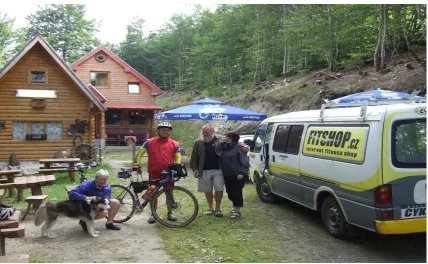
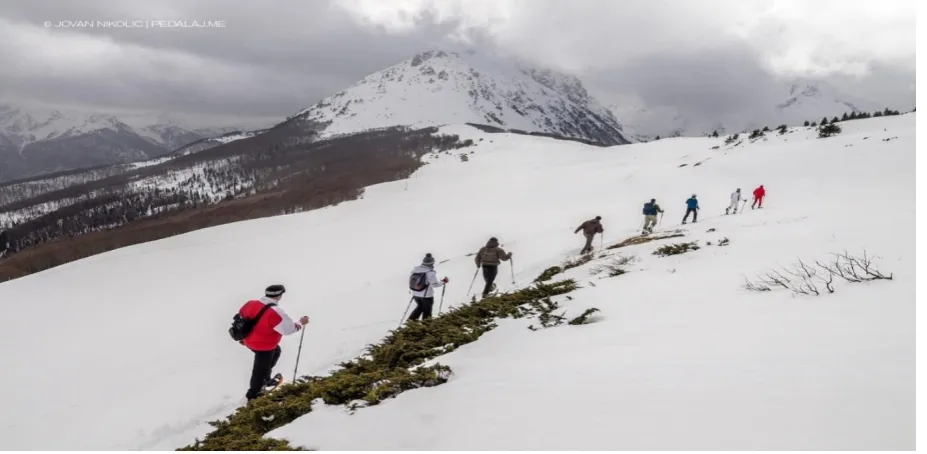
The natural resources necessary for tourist attractions are climate tourism resources, geomorphological, hydrographic, bio-geographical and landscape tourism resources (Čavlek et al., 2011). A favorable climate is one of the most important factors of the tourist attraction of the mountainous area Trešnjevik – Lisa. The climatic conditions of a particular tourist destination, such as the discussed area, have to be suit by people to spend their holidays comfortably as the human organism is very susceptible to the influence of different climatic elements. In the tourism of the Trešnjevik – Lisa mountainous area, relief forms (depressions and elevations) and geomorphological phenomena have an important function in designing tourist needs, but also in the construction of numerous tourist accommodation capacities, communal and other infrastructure (Rajović, Bulatović,2018). Unfortunately, in the discussed area are listed only two tourist facilities: “Krčmu Savo Lekić” and “Eco Dom Trešnjevik” located at the mountain pass of, surrounded by the mountains of Komovi and Bjelasica. Among the geomorphologic motives, the highest tourist value of Trešnjevik – Lisa has the mountainous character of the area, deriving its recreational importance or the possibility to practice with different sports, especially for skiing and hiking, but also for aesthetic and curiosity experiences (Rajović, Bulatović, 2016).
Fig. 3. “Eko dom Trešnjevik” – place for a vacation that leaves the tourists special and unforgettable memories (www.sr-rs.facebook.com)
Orientation and mass tourism trends towards the Komovi Mountains show that, with climate, hydrographic elements are the most attractive factors for the development of sports and recreational tourism. It should be mentioned Trešnjevički Stream, Rajova River and Čestogaz River (Rajović, Bulatović, 2018).
Fig. 4. Rest, recreation and research – one of the authors GR on Rajovoj (Rajović) River
Rajovoj (Rajović) River and Čestogaz River, offer outstanding opportunities for sports – recreational and entertainment events, as hunting, fishing, riding... The concept of landscapes in sports and recreational tourism is a unique set of different natural and social resources of the mountainous area of Trešnjevik – Lisa, which has a diverse and multi-faceted effect on man, and therefore they are classified into complex tourist motives of movement. Tesnjevik – Lisa mountain landscapes provide wide and long landscape experiences and exceptional scenes and are suitable for various recreational activities, especially if there is water (rivers) or snow in them (Čavlek et al., 2011). Mesophilic vegetation gives a distinctive look to the landscape. Basic structural elements of the landscape are spruce forests, meadows and pastures, and the whole mountainous area of – Lisa reflects freshness and green. Flower meadows are rich in endemic and relict species with decorative properties. The image of the area is completed by the katuns with traditional stockbreeder cottages (Bulatović, Rajović, 2018).
Fig. 5. Katun on the mountain Lisa – an enchanting view (www.toandrijevica.me)
Kassaye (2019) according to Manning (2011) and Neuvonen et al (2010) & Puustinen et al. (2009) indicates that visitor demand and associated mountain areas choices have been extensively examined, and correlations with internal area features and related quality have been identified. However, external characteristics such as access, accommodations, and available services outside the mountain areas have also been noted as factors that influence visitation. Page (2009) stated the reason behind the issue of defining visitor attractions is due to the diversity of users (tourists, residents, day-trippers) who provide a market broader than just tourists do. Page also states as the above reason has made many researchers to acknowledge the appropriate term to these attractions is a ‘visitor attractions’ (Kassaye, 2019).
Table 2. The diversification of winter sports activities
The diversification of winter sports activities Contemporary winter sports activities
Skiing
Cross – country skiing Telemarking
Cat – skiing Winter sports events
Ice – skating Horse – drawn sleigh
Curling Tobogganing
Snowboarding Snowmobiling Snowshoeing Heli – skiing Parapente/hangliding
Tubing Dog sledging Snow cycling
Thrill – sleds/extreme sledding Ice – climbing
Table 2 lists traditional winter sports along with those that are gaining popularity in the 21st century (Hudson, 2004). Denise and Florin (2018) according to (Markovic et al., 2013; Teodor, 2006; Higham et al., 2002; Agrawala, 2007) indicates that winter sports embrace activities, ranging from ice-skating to ice climbing, but it is skiing that is the mainstay of the winter tourism industry. The ski and snowboard industry has experienced remarkable growth in the last fifty years. It is estimated that today there are some 120 million skiers and snowboarders worldwide, with around 2.000 ski resorts in 80 countries catering to this important market. The physical exercise and tourism represent two activities which, together can contribute to life improvement. In recent years, it is seen that relationship between tourism and sport is increasing. Especially, the last part of 20 th century, defined as a term that witnessed increase of sport and tourism rapidly. Skiing activities represent very important attributes of winter tourism, being at the same sport activities, generating an entire industry within mountain areas.
This approach according to Radicchi (2013) based on research Wasche and Woll (2010) requires a variety of tools aimed at enhancing the potential attractiveness of a place by entering sports enterprises, local authorities, hotels, tour operators... In systems that allow effective management of relations with the market. A proper territorial promotion strategy through sports should not be only designed to induce a potential visitor to “buy” the services offered within a specific territory (events, sport...), but it should also establish a close relationship between customers (tourists, visitors) and local stakeholders (residents, institutions, local authorities, service providers, tour operators...) (Figure 6).
Fig. 6. The system of relationships among stakeholders for promoting a territory through sports tourism activities (Zagnoli, Radicchi, 2011)