COMPUTER SCIENCE & TECHNOLOGY
www.computerscijournal.org
June 2013, Vol. 6, No. (2): Pgs.67-74 An International Open Free Access, Peer Reviewed Research Journal
Published By: Oriental Scientific Publishing Co., India.
INTRODUCTION
User-based decision support system in route selection on a road network is great interest. It is necessary to provide the shortest path from origin to destination nodes1, 2. In a road network, the edge weight based on one of the distance, cost and travelling time. We propose a new type of path searching technique using fuzzy numbers. The main objective of this work is to deal with the imprecise data involved in different kinds of existing searching techniques in a more efficient
User-Based Intelligent Decision Support System in Route
Selection on Road Network
M.GEETHA
1and G.M.KADHAR NAWAZ
21Sona College of Technology (Autonomous),Department of MCA,Salem - 636 005,Tamilnadu,(India).
2Director, Sona College of Technology (Autonomous),Department of MCA ,
Salem - 636 005, Tamilnadu,(India).
Corresponding author E-mail :[email protected], [email protected]
(Received: May 25, 2013; Accepted: June 05, 2013)
ABSTRACT
Improving the efficiency of dynamic routing problem on road network is a difficult .There is numerous works proposed for this problem and they try to solve this in different aspects. Most of the existing routing problem based on static approach. In this paper, we propose a fuzzy Dijkstra’s shortest path algorithm based on dynamic approach. The linguistic variables that qualify user parameters are quantified using fuzzy set theory that provides fuzzy numbers outputs to predict the shortest route on network. By handling the fuzzy parameter, it gives issue to compare the distance between two different paths with their edge lengths represented by fuzzy numbers. The addition of fuzzy numbers using graded mean integration representation is used to improve Dijkstra’s algorithm. A numerical example of a road network is used to illustrate the efficiency of the proposed method.
Key words:User-based intelligent Decision Support System, Dijkstra’s Algorithm, User Parameter, Fuzzy Set Theory, Fuzzy Numbers.
Many efficient algorithms have been developed by Bellman, Dijkstra's, Dreyfus and these algorithms are referring to as the standard shortest path algorithms. One of the most used methods to solve the shortest path problem is Dijkstra's algorithm; it handles only the crisp number. But many optimization methods the linguistic variables quantity cannot be applied directly to fuzzy numbers, some modification are needed before using Dijkstra's algorithm. Many typical works3 transform the fuzzy number into crisp number4 by defuzzification method. When applying the fuzzy Dijkstra's, we need three key issues. Quantify the linguistic variables into fuzzy numbers, the graded mean integration representation method leads to the result that addition of two numbers can be represented in crisp number then the Dijkstra algorithm can be easily implemented.
In this paper , we are motivated to develop a Dijkstra's algorithm for fuzzy shortest path problem. The most classical shortest path algorithm is the Dijkstra's algorithm. Whose complexity is O(|E|+|V| log|V|, where |V| is the number of vertices and |E| is the number of edges, it is not applicable under fuzzy environments. Therefore, in this paper we modify the algorithm with the help of fuzzy set theory. At first, fuzzy numbers are used to represent the user parameter, then the fuzzy arithmetic between fuzzy numbers are adopted to find the shortest path, resulting in the fuzzy Dijkstra's algorithm(FDA) .So FDA handle the fuzzy shortest problem flexibility and effectively. In addition, one feature of FDA is that no order relation between fuzzy numbers is used.
The rest of the paper is organized as follows. In section 2, some basic concept of fuzzy set theory. Section 3 deals with User-based intelligent decision support system to find the set of user parameter for road network. Section 4 proposed FDA to solve fuzzy shortest path algorithm. Section 5 gives the assessment model and process. The results obtained are also given in this section. Section 6 concludes the paper.
Preliminaries
In this section some basic definition, fuzzy numbers and fuzzy arithmetic operations are
reviewed5.
Definition 2.1:
A fuzzy number . Let X be the Universe
of discourse, then a fuzzy set is defined as:
..(1)
This is characterized by a membership
function , where,
denotes the degree of membership of the element
x to the set .
Definition 2.2:
A triangular fuzzy number represented
with three points as follows =(a1,a2,a3 ) shown
in Fig 1. This representation is interpreted as membership functions and holds the following conditions
a1 to a2 is increasing function a2 to a3 is decreasing function a1 a2 a3
...(2)
Definition 2.3:
A trapezoidal fuzzy number represented
with three points as follows =(a1,a2,a3,a4 ) shown
in Fig 2. This representation is interpreted as membership functions and holds the following conditions
a1 to a2 is increasing function a2 to a3 is stable function a3 to a4 is decreasing function a1 a2 a3 a4
Definition 2.4:
Arithmetic Operation of Triangular Fuzzy Number Consider two triangular fuzzy numbers A =(a1, a2, a0) and B =(b1, b2, b3).
1. Addition of A and B :
A + B = (a1, a2, a3) + (b1, b2, b3) = (a1+b1, a2+b2, a3+ b3) where a1, a2, a3, b1, b2, and b3 are real numbers.
2. Product of A and B :
A x B=(c1, c2, c3) where T= {a1b1, a1b3, a3b1, a3b3} c1 = min T, c2 = a2b2, c3 = max T If a1, a2, a3, b1, b2, b3 are all non zero positive real numbers, then A x B = (a1b1, a2b2, a3b3)
3. Subtraction of A and B :
à - B =(a1, a2, a3) - (b1, b2, b3) = (a1-b3, a2-b2, a3-b1) where a1, a2, a3, b1, b2, and b3 are real numbers.
4. Division of A and B :
A / B =(a1, a2, a3) / (b1, b2, b3) = (a1/b3, a2/b2, a3/b1) Where à and are non-zero positive real numbers
Definition 2.5:
Defuzzification by Graded Mean Integration Method
The conversion of a fuzzy set (or) a fuzzy number to single crisp value is called defuzzification and is the reverse process of fuzzification.
Let B be a triangular fuzzy number and
be denoted as =(b1,b1,b3 ).Then we can set the
graded mean integration representation6 of B by above formula as
...(4)
Let C be a trapezoidal fuzzy number, and
be denoted as =(c1,c2,c3,c4 ). Then we can get
the graded mean integration representation of C by formula as
... (5)
The graded mean integration representation of the addition of triangular fuzzy
number and can be defined as:
...(6) The graded mean integration representation of the addition of triangular fuzzy
number and can be defined as:
...(7) The graded mean integration representation of the addition of trapezoidal fuzzy
number and can be defined as:
...(8) The graded mean integration representation of the addition of trapezoidal fuzzy
number and can be defined as:
...(9)
Dijkstra algorithm
the shortest path from the source to a vertex nearest to it, then to a second nearest, and so on.In general,before its ith iteration commences,the algorithm has already identified the shortest paths to i-1 other vertices nearest to the source.
Let the node at which we are starting be called the initial node. Let the distance of node Y be the distance from the initial node to Y. Dijkstra's algorithm will assign some initial distance values and will try to improve them step by step.
1. Assign to every node a tentative distance value: set it to zero for our initial node and to infinity for all other nodes.
2 Mark all nodes unvisited. Set the initial node as current. Create a set of the unvisited nodes called the unvisited set consisting of all the nodes except the initial node. 3. For the current node, consider all of its
unvisited neighbors and calculate their tentative distances. Even though a neighbor has been examined, it is not marked as "visited" at this time, and it remains in the unvisited set.
4. When we are done considering all of the neighbors of the current node, mark the current node as visited and remove it from the unvisited set. A visited node will never be checked again.
5. If the destination node has been marked visited (when planning a route between two specific nodes) or if the smallest tentative distance among the nodes in the unvisited set is infinity (when planning a complete traversal), then stop. The algorithm has finished.
6. Select the unvisited node that is marked with the smallest tentative distance, and set it as the new "current node" then go back to step 3.
Proposed method
Fuzzy logic is very effective in dealing with table that involve uncertain such as qualitative term, linguistic vagueness and human intervention8. There are assessment criteria in driver-preference route selection9 such as Travel time, Travel distance, Number of traffic signal, Entertainment of route, Difficulty of driving, etc. The membership function Travel time, Travel distance
used to find the shortest path. The best route based on Number of traffic signal, Entertainment of route, Difficulty of driving etc.
Fuzzy Dijkstra's algorithm Step 1
Construct a Network G = (V, E) where V is the set of vertices and E is the set of edges.
Step 2
Get the Trapezoidal fuzzy number of Traffic signal, Entertainment of route and Difficulty of driving member functions for each edge.
Step 3
Add Tollgate, Traffic and Quality of road fuzzy number using fuzzy arithmetic operation.
Step 4
Calculate risk factor of each edge using Definition 2.5.1
Step 5
Calculate all possible paths Pi, from source vertex s to all other vertices using Dijkstra's shortest path algorithm.
Fuzzy Dijikstra's algorithm Algorithm finds the shortest paths to a graph's vertices in order to their fuzzy values from a given source. First, it finds the shortest path from the source to a vertex nearest fuzzy values to it, then to a second nearest, and so on, In general , before its ith iteration commences, the algorithm has already identified the shortest paths to i-1 other vertices nearest to the source.These vertices, the source, and the edges of the shortest paths leading to them from the source form a subtree Ti can be referred to as "fringe vertices". They are the candidates from which Dijkstra's algorithm selects the next vertex nearest to the source.
fuzzydijkstra(G,S)
// Fuzzy Dijikstra's algorithm for single-source shortest paths
//Input:A weighted connected graph G=<V,E>with fuzzy parameter values is a (triangular or trapezoidal ) fuzzy numbers and its strating city node
//Output:the length dv of a shortest path from s to v and its penultimate vertex pv for every vertex v in V
for every route e in E do
GradeMeanIntMethod(R)// using for geeting crisp number
Initialize(Q) //initialize vertext priority in the priority queue to empty
for every vertex v in V do dυ ;pυ null Insert(Q,υ,dυ )ds
←
0; Decrease(Q,s,ds ) Vτ←
θ
forι 0 to|V|-1 do u* DeleteMin(Q)
Vτ Vτ {u*}
for every vertex u in V-Vτ that is adjacent to u* do
if du*+w(u*,u)<d_u; dυ du*+w(u*,u); pυ u* Decrease(Q,u,dυ)
Example
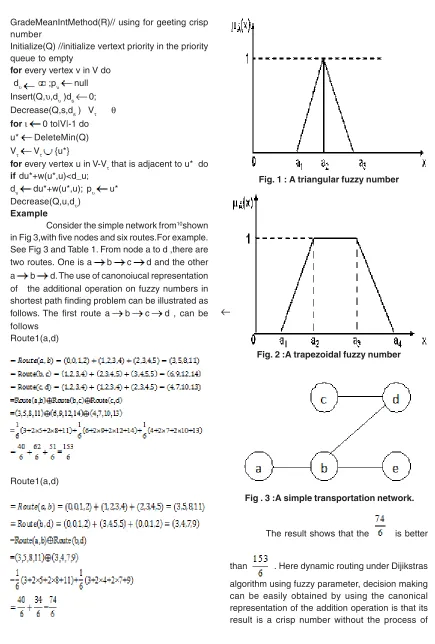
Consider the simple network from10shown in Fig 3,with five nodes and six routes.For example. See Fig 3 and Table 1. From node a to d ,there are two routes. One is a b c d and the other
a b d. The use of canonoiucal representation of the additional operation on fuzzy numbers in shortest path finding problem can be illustrated as follows. The first route a b c d , can be follows
Route1(a,d)
Route1(a,d)
The result shows that the is better
than . Here dynamic routing under Dijikstras
algorithm using fuzzy parameter, decision making can be easily obtained by using the canonical representation of the addition operation is that its result is a crisp number without the process of
Fig. 1 : A triangular fuzzy number
Fig. 2 :A trapezoidal fuzzy number
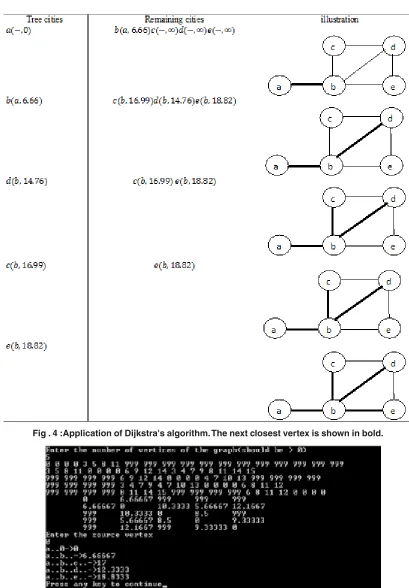
Fig . 4 :Application of Dijkstra's algorithm. The next closest vertex is shown in bold.
ranking fuzzy numbers.
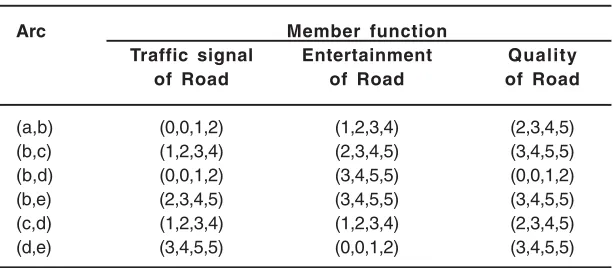
A numerical example of the fuzzy shortest path problem.It (Fig 4.) is used to show the efficiency of the proposed method.Tthe transportation network routes are trapezoidal fuzzy numbers with membership functions as shown in Table 1.
In step 1,city (a), which is source node,is moved to tree cities, while the distance from source city to all other remaining cities are calculated.Among them, the shortest one a?b ,whose route value 6.66 is moved to tree vertices.
In step 2, the next shortest path b?d, whose route value 14.76 is moved to tree vertices from the remaining cities.In step 3, city c ,value 16.99 from city b selected.In step 4, city e ,value 18.82 from city b selected. The remaining cities
become an empty set and the search is complete. The shortest path , in Fig 5. Shows the result
CONCLUSION
This paper using Dijkstras algorithm to solve the shortest path with fuzzy parameters.Three key issused are addressed. First how to add the fuzzy parameters.Second how to determine the addition of route fuzzy numbers.Third how to compare the distance between two different path when their routes are represented by fuzzy numbers. The proposed method using fuzzy arithmetic addition,graded mean integration method for fuzzy numbers.The example of simple network problem illustrate the efficieny of fuzzy Dijkstras algorithm. The proposed method can be applied to many network optimization problem.
1. M.xu, Y.Liu, Q.Huang, Y.Zhang, G.Luan; An improved Dijkstra shortest path algorithm for sparse network, Applied Mathematics and Computation 185, 247-254 (2007). 2. X.Lu, M. Camitz; Finding the shortest paths
by node combination, Applied Mathematics and Computation 217, 6401-6408 (2011). 3. S.T.Liu, C.Kao; Network flow problems with fuzzy arc lengths,IEEE Transaction on Systems, Man, and Cybernetics, Part B: Cybernetics 34, 765-769 (2004).
4. C.C.Chou; The canonical representation of multiplication operation on triangular fuzzy
REFERENCES
numbers , Computers and Mathematics with Applications 45 , 1601-1610 (2003). 5. R.E.Belman and L.A.Zadeh;,Decision
making in a fuzzy environment, Management science,17, B141-B164 (1970).
6. C.C.Chou.;The canonical representation of multiplication operation on triangular fuzzy numbers, Computers and Mathematics with Applications 45, 1601-1610 (2003). 7. E.W. Dijkstra; A note on two problems in
connexion with graphs, Numerische Mathmatik 1, 269-271 (1959).
Table 1. Parameters to compute membership functions.
Arc Member function
Traffic signal Entertainment Quality of Road of Road of Road
(a,b) (0,0,1,2) (1,2,3,4) (2,3,4,5)
(b,c) (1,2,3,4) (2,3,4,5) (3,4,5,5)
(b,d) (0,0,1,2) (3,4,5,5) (0,0,1,2)
(b,e) (2,3,4,5) (3,4,5,5) (3,4,5,5)
(c,d) (1,2,3,4) (1,2,3,4) (2,3,4,5)
8. T.Padma,P.Balasubramanie; Analytic hierarchy process to assess occupational risk for shoulder and neck pain,Applied Mathmatics and cmputation 193, 321-324 (2007).
9. Gyoo-Seok Choi(1), Jong-Jin Park(2) and Ki-Sung Seo(3);, Driver-preference Optimal
Route Search based on Genetic-Fuzzy Approaches