ISSN: 2306-9007 Omar & Anas (2014) 291
I
www.irmbrjournal.com March 2014I
nternationalR
eview ofM
anagement andB
usinessR
esearchV
ol. 3 Issue.1R
M
B
R
E-commerce in Malaysia: Development, Implementation and
Challenges
CHE MOHD ZULKIFLI CHE OMAR
Assoc. Prof Faculty of Management and EconomicsSultan Idris Education University 35900 TanjongMalim, Perak, Malaysia.
Email: [email protected]
ANAS, T.
Fakulty of Management, Darul Ridzuan Islamic College 33000, Kuala Kangsar, Perak, Malaysia.
Email: [email protected]
Abstract
The widespread in the use of the Internet as a commercial tool has led firms to seek in conducting business marketing innovatively via computer-mediated environment. The more businesses carried out online, customers will have a wider choice in the search for goods and services through online search. The E - commerce is currently growing rapidly around the world. This development has boosted the economy towards a more positive note and capable of generating a more favorable income. In Malaysia, the development of Information and Communication Technology (ICT), especially the Internet has enabled people in Malaysia to use the e- commerce in business and daily activities. The E-commerce applications cover a broad field and not limited to business alone. In fact, it also can provide many advantages to the e- commerce consumers in dealing with daily work that requires financial transactions. This article discusses the use of e- commerce application that is seen from the aspect of developments that take place, especially in Malaysia. In addition, it also discusses the implementation and the challenges that have to be undergone in order to ensure that the e- commerce can be used optimally in the course of daily work.
Key Words: E-commerce; ICT; Internet; Malaysia.
Introduction
The ICT technology has now substantially influenced the daily life activities. We often deal with the use of ICT such as the computers, Internet , telephones, and the like at work or at home. An individual always uses a computer and the Internet to obtain information, complete assignments, buy products and services, and to communicate with others (Morley and Parker, 2009).
The current ICT developments have made Malaysians more knowledgeable and informed. Source of information is now more readily available and disseminated. It is also able to generate thinking and brainstorming ideas to promote one beings and increase the source of income. Moreover, ICT is also a gateway for unlimited knowledge. ICT facilities and skills will be able to allow each individual to continue to gain knowledge in various fields for social use, employment, economy, education, politics and others (Musa, 2008)
ISSN: 2306-9007 Omar & Anas (2014) 292
I
www.irmbrjournal.com March 2014I
nternationalR
eview ofM
anagement andB
usinessR
esearchV
ol. 3 Issue.1R
M
B
R
In Malaysia, the e-commerce is still considered as a new medium. The community still prefer to conduct transactions directly and transact face to face without the use of ICT technologies such as the Internet. Only a handful of residents who adopt e-commerce system especially for business activities that involve financial transactions such as paying bills, book a plane ticket, and purchase goods and services through on-line [Malaysian Communications and Multimedia Commission (MCMC), 2008]. The government is now working very hard to ensure the development and investment on ICT is used whenever possible by all levels of the community.
Malaysia has changed its economics policy from agricultural based to industrial based to boost the economic growth to a more competitive and optimal, at par with other developed countries (Syed, Ali, Mohd Ismail, Hishamuddin, 2007) . As a result of these initiatives, Malaysia extends its focus on a more global economy by introducing the k-economy (knowledge economy). The impact of rapid technological development throughout the world, it is seen that the development of developing countries in the region, especially to adopt the new technology such as the e – commerce to be relatively slow , including Malaysia ( Syed et al . , 2007; Santos and Peffers , 1998 ) . In this regard, the Malaysian government is determined to implement the system and widespread its use through the introduction and use of e - commerce technology in the industrial and commercial sectors. In the 10th Plan period, the Government will continue to improve the delivery and efficiency of services to businesses by leveraging the use of ICT (Economic Planning Unit, 2011).
Accordingly, this article will discuss the development of the Internet business or e-commerce, especially in the context of Malaysia. In addition, other topics will also be discussed. Among these are the means of implementation in Malaysia as well as the challenges faced in particular to ensure the system is used and accepted by the people and thus be able to expand its use to the optimum level.
Definition and Concept of E-Commerce
The term of e-business was initially called or termed by a company of the International Business Machines (IBM), which became a precursor to the use of e-business in 1997 (Chaffey, 2007; Schneider, 2009). They said that the company has to define e-business as a business process transformation through the use of Internet technology.
Moreover, e-business is also defined as a specific type of business activity that is formed by one or more organizations through the use of Information Technology (IT) (Grefen, 2010). Grefen (2010) also stated that through the use of IT, it becomes a factor which can be distinguished between eBusiness with the traditional business. E-business is also defined as the e-commerce that has a very wide business scope and it is known as the e-business (Neto et al. Al., 2010).
E -commerce is a business space on the Internet . E -commerce is the process of distribution, buying, selling, marketing and servicing of a product or service using the Internet. Just by clicking the mouse, a transaction can be conducted anywhere and at anytime (Vince Brown 2006).
Besides that, Irfan Khairi defines Internet Business as "the use of the Internet as a tool to promote their products and services and take advantage of the interactive Internet to do the selling process. The Internet allows direct communication between the dealer and the buyer without meeting to face to face "( Irfan Khairi , 2005).
ISSN: 2306-9007 Omar & Anas (2014) 293
I
www.irmbrjournal.com March 2014I
nternationalR
eview ofM
anagement andB
usinessR
esearchV
ol. 3 Issue.1R
M
B
R
The concept of e-commerce includes business aspects of trade and financial activities not only for the transaction alone. It is also a role in expanding trade relations around the world through communication technology. The scope of e-commerce is comprised of various stakeholders such as traders, vendors, buyers, customers, governments, distributors, and so on. Internet is the fundamental factor for e-commerce system. The Internet has revolutionized the trading activities to be among the most important and major activities specifically for rapid economic development. The existence of e-commerce is certainly boost business activities and financial transactions without time limits and boundaries. All communication and dissemination of trade information become an important point in the effort to develop and expand the use of e-commerce worldwide.
Development of Internet usage.
As a result of the rapid development of planned and structured infrastructure, especially in the field of ICT has enabled Malaysia to develop on par with the other cluster countries. Malaysia has given a serious emphasis on the ICT development by introducing the Mutimedia Super Corridor (MSC) in 1996 (Junaidah, 2008).
Malaysia also wants to be the driving force in the development of ICT and it occurred to the leaders that ICT plays a significant role in the development of the country particularly to enhance the efficiency, productivity, and competitiveness (Mohd Yusof, Fuziah, Mohd Safar, and Mat Pauzi, 2009). To enhance the objectives of Vision 2020, a concerted effort has been undertaken through the seven innovative flagship applications. This application has been developed to boost the Malaysia MSC initiative and create multimedia utopia for innovative operators and consumers in various fields of multimedia technology. Multimedia Super Corridor (MSC) offers interesting initiative for Malaysians in this information era. The Seven MSC flagship applications is the Electronic Government Multipurpose Card, Smart School, Telehealth, Group R & D, e - Business and Technology Entrepreneur Development. One of these applications is the e - business or even better known as the internet business. Therefore, among the objectives of the existence of the flagship applications are aimed at boosting the economy, business opportunities , and foster the development of Small and Medium Enterprises (SME ) in the field of IT and Multimedia (Economic Planning Unit , 2006) .
All the planning and development outlined in the Malaysian Plan previously had caused the rapidly growing field of ICT parallel with other developing countries. In reation to that, a larger allocation is expected to be given by the government to boost the growth of ICT in the country particularly. This is in line with the government's aspiration in leading towards a high -income and developed country by 2020 in the future. To enhance the economy in higher value chain, several initiatives have been undertaken to develop human capital , improving ICT infrastructure and developing the infrastructure network (Economic Planning Unit , 2011 ) .
The year 1995 is considered as the starting era of the Internet in Malaysia. The growth of total Internet hosts in Malaysia began around 1996. According to the report of the first Malaysian Internet census performed from October to November 1995 by MIMOS and Beta Interactive Service, one out of every thousand Malaysians have the access to the Internet ( 20,000 Internet users out of 20 million inhabitants) ( Beta Interactive Services , 1996 ) . In 1998, this number increased to 2.6 % of the total population. Amount of computer units sold, which was 467 000 in 1998 and 701 000 in 2000 indicated an increasing growth (Lee, 2000).
ISSN: 2306-9007 Omar & Anas (2014) 294
I
www.irmbrjournal.com March 2014I
nternationalR
eview ofM
anagement andB
usinessR
esearchV
ol. 3 Issue.1R
M
B
R
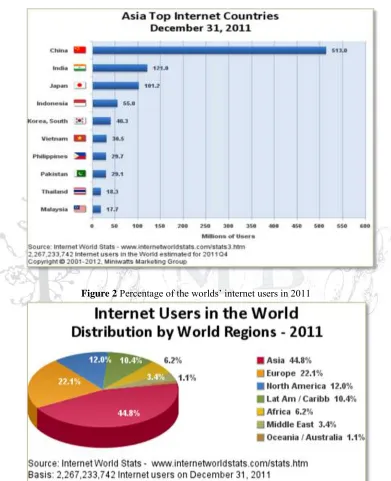
million Internet users in Malaysia. (Internet World Stats, 2011) Figure 2 shows the percentage of Internet users in the world, particularly in Asia for 2011.
Figure 1 Graph of internet users number for top 10 countries in Asia in 2011
Figure 2 Percentage of the worlds’ internet users in 2011
Figure 2
Percentage of the worlds’ internet users in 2011
ISSN: 2306-9007 Omar & Anas (2014) 295
I
www.irmbrjournal.com March 2014I
nternationalR
eview ofM
anagement andB
usinessR
esearchV
ol. 3 Issue.1R
M
B
R
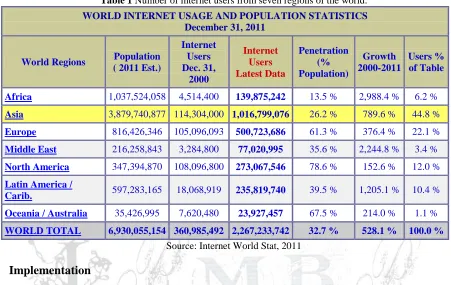
users in the world will increase by 1.5 times in every 5 years. Table 1 shows the number of internet users for seven regions of the world.
Table 1 Number of internet users from seven regions of the world.
WORLD INTERNET USAGE AND POPULATION STATISTICS December 31, 2011
World Regions Population ( 2011 Est.)
Internet Users Dec. 31,
2000
Internet Users Latest Data
Penetration (% Population)
Growth 2000-2011
Users % of Table
Africa 1,037,524,058 4,514,400 139,875,242 13.5 % 2,988.4 % 6.2 %
Asia 3,879,740,877 114,304,000 1,016,799,076 26.2 % 789.6 % 44.8 %
Europe 816,426,346 105,096,093 500,723,686 61.3 % 376.4 % 22.1 %
Middle East 216,258,843 3,284,800 77,020,995 35.6 % 2,244.8 % 3.4 %
North America 347,394,870 108,096,800 273,067,546 78.6 % 152.6 % 12.0 %
Latin America /
Carib. 597,283,165 18,068,919 235,819,740 39.5 % 1,205.1 % 10.4 % Oceania / Australia 35,426,995 7,620,480 23,927,457 67.5 % 214.0 % 1.1 %
WORLD TOTAL 6,930,055,154 360,985,492 2,267,233,742 32.7 % 528.1 % 100.0 % Source: Internet World Stat, 2011
Implementation
In terms of implementation of the e - commerce in Malaysia particularly, it began when the government has established a number of agencies to provide particular advantages in the use of the Internet. In January 2006, the government required that all public services to allow customers or consumers to pay their bills through on line ( Country Commerce , 2005) . This approach was made after looking at the growth of the application through on line that has grown rapidly in several countries and the government has taken this opportunity as an opportunity which should not to be missed. Results showed that Malaysia was ranked 33 th out of 64 countries involved with the scores obtained was 5.61 out of 10 ( Country Commerce , 2005) . The study was to measure the compliance as has been recommended by the government in the market with the opportunity to use Internet -based services . Recommendations that have been announced by the government is to ensure that services are based on the use of Internet is adopted and subsequently adapted to the services offered to consumers.
Government's efforts through the idea of the Prime Minister of Malaysia in promoting local industry participation in e-commerce are surely undisputable. This can be seen from the Master Plan of the National E-Commerce and the National E-Commerce Framework highlighted during the meeting of the International Advisory Panel (IAP) of MSC involving Microsoft, Lotus, Apple and others. The framework includes three guiding principles and four strategic approaches. Its principles cover the cooperation from the government, business and community, borderless recognition of e-commerce features and the creation of opportunities for the country to benefit from the initiative. Strategic approach encompasses trust and confidence in e-commerce, improving the legal framework and regulations, strengthen infrastructure and logistics support for e-commerce, as well as optimizing the economic and social benefits.
ISSN: 2306-9007 Omar & Anas (2014) 296
I
www.irmbrjournal.com March 2014I
nternationalR
eview ofM
anagement andB
usinessR
esearchV
ol. 3 Issue.1R
M
B
R
distribution or portal to strengthen brand identity and service interface. . These are the essence of the framework and main plan of the commerce that is expected to generate towards the development of e-commerce in Malaysia. This move can not be superficially trivial as economic programs carried out by the government previously have been proven successful.
In addition, various schemes / grants that have been completed for research and development, entrepreneur assistance (including training / technology transfer) by the agencies involved directly with the MSC.
The MSC project gives a strong impact in the development of e - commerce. Through one of its main applications, which is the borderless marketing, it is seen to be relevant to the e – commerce. Opening the smart city of Cyberjaya also influences the development of e - commerce. Community in the city will fully utilize the IT world and e - commerce applications as well as other main and fractional details.
Thus, through the development and improvement shown, it becomes the indication that many people have recognized the benefits of the internet service, especially in matters of trade. According to Leiner et.al., (2009 ) , the Internet represents one of the most successful examples of advantages in maintaining the investment and commitment to research and development in the information infrastructure . In fact, the Internet nowadays is a manifestation of much growth in terms of development and it is also an enabler of change and a transformation which is not only on infrastructure , but also to applications, users , services, and technological innovation ( Kleinrock , 2008) .
Challenges
The implementation of a technology certainly has its challenges and obstacles in achieving success or otherwise, especially when it involves the process to adopt a technology into the business work and daily activities of the local community (Siti Zobidah, Musa, Narimah, and Jusang, 2008). A new technology such as the e-commerce requires a planned and organized development so that it can be adopted by residents as a part of their daily activities. Implementation of a new technology depends on the responsible parties for implementing the operation of the technology so that it is beneficial to all parties and ultimately achieves the level of success of the use of a technology as desired (Siti Zobidah et. Al., 2008).
E -commerce is a system created to facilitate the users regardless who they are as producers, managers , buyers, customers , and others to conduct daily business without the hassle ( Kleinrock , 2008 ) . E – commerce is definitely very useful to someone who is concerned with the transparent and efficient business besides being cost effective and time ( Park , 2010) . The use of e - commerce is not just focused on purely business matters, but it also involves the day to day tasks such as the payment of utility bills , taxes , summonses, and so on. Users who use the e - commerce system will have the advantages offered to the e-commerce users. Among its advantages is that it can save time and cost ( Park , 2010) . By using only the e - commerce systems provided, users can avoid congestion such as at the service counter , especially when they want to make online bill payments , suits , taxes , and so on . Everything can be done only at the fingertips, it can be done at home through the online payment system.
ISSN: 2306-9007 Omar & Anas (2014) 297
I
www.irmbrjournal.com March 2014I
nternationalR
eview ofM
anagement andB
usinessR
esearchV
ol. 3 Issue.1R
M
B
R
Conclusion
The development of e- commerce in Malaysia now stands at a more encouraging note. With the initiative from the government to ensure that the e- commerce system is fully implemented by communities in Malaysia, various frameworks and infrastructure construction has been and will be developed in the future. It is in line with the rapid development of the e - commerce system that has been adopted by some developed countries and other emerging coutries in driving the economy of their countries respectively. Accordingly, the government has allocated a huge allocation in ensuring all equipment and requirements related to the ICT sector can be developed and can provide useful benefits to the communities in Malaysia especially to the e- commerce users.
Everything done surely has its own risks. Similarly, in the Internet business or e - commerce , as any other business still faces risks. However, something that is well planned and managed is able to reduce the risk that wil be faced by business owners .
E -commerce is seen as capable of generating handsome profits due to the strength of the Internet itself that covers a vast market. This business market is not only focused on the domestic market, but its main market is the international market. This also depends on the characteristics of the products or services offered to customers. But to capture the outside market, the owner should dominate the local market first in building the publicity and gaining experience. Owners should also be able to ensure users of their products or services offered to the consumers. Consumers need to be assured of the products sold.
With the use of ICT, Internet business never closes. It will operate 24 hours a day and seven days a week in accordance with the requirements of the owner. This is clearly an advantage in the customer service because customers can make transactions regardless of time and place barriers. Transactions can be done anytime, without any limit.
From the consumer point of view, the Internet is a facility for them to get the product or service they desire. Without having to be caught in the traffic, finding a parking space and wasting time. This is where the internet business plays its role. Where users can view and evaluate products on-line through the website, place the order and proceed with payment. Then, the goods will be delivered to their doorstep. All this will soon become a trend in today’s modern lifestyle. In accordance with the present life, especially for working people, time for shopping is very limited. Therefore, the e - commerce is a major option to purchase goods or services.
However, all of that can only be done through a wise management of the Internet business . By taking the examples of existing successful Internet business and consistent effort , e - commerce can be carried out successfully with the support of the government authorities and also winning the trust of consumers. With the innovation of the conventional method, it surely attracts consumers to deal virtually.
References
A. Kahar, Aidil Suraya (2008) Model Kepuasan Pelanggan Bagi Laman Web E-Runcit. Masters Thesis, Universiti Teknologi Malaysia, Faculty of Computer Science and Information System.
Chaffey, D. 2007. E business and E commerce Management. 3rd Ed. Harlow: Prentice Hall. Country Commerce. 2005. Malaysia. The Economist Intelligence Unit Limited. 103-109. Grefen, P. 2010. Mastering e business . 1st Ed. New York: Routledge.
Ibrahim, Shahizam (2006) Sistem perniagaan internet : Anggunasia.com. Masters thesis, Universiti Teknologi Malaysia, Faculty of Computer Science and Information System.
ISSN: 2306-9007 Omar & Anas (2014) 298
I
www.irmbrjournal.com March 2014I
nternationalR
eview ofM
anagement andB
usinessR
esearchV
ol. 3 Issue.1R
M
B
R
Junaidah Hashim. 2008. Factors Influencing the Acceptance of Web-Based Training in Malaysia: Applying the Technology Acceptance Model. International Journal of Training and Development. 12(4): 253-264.
Kleinrock, L. 2008. History of the Internet and Its Flexible Future. IEEE Wireless Communications. 8-18. Lee, W. (2000). Internet Took The Crown As Top IT Growth Area In Malaysia. Available at:
http://malaysia.cnet.com/news/2000/04/21/ 200000421j.html, 5 October 2009
Leiner, B. M., Kahn R. E, Postel J., Clark D. D, Lynch D. C, Wolff S., Cerf V. G., Kleinrock L., Roberts L. G. 2009. A Brief History of the Internet. ACM SIGCOMM Computer Communication Review 39(5): 22-31.
Mohd Akhir, Chairil Anwar (2009) Sistem Gerbang Pembayaran Atas Talian Melalui Internet. Masters thesis, Universiti Teknologi Malaysia, Fakulti Sains Komputer dan Sistem Maklumat.
Mohd Yusof Hj.Abdullah, and Mohd Safar Hasim, and Fuziah Kartini Hassan Basri, and Mohamed Azul Mohamad Salleh,and Ali Salman, (2007) Respons Generasi Muda Terhadap Aplikasi E-kerajaan dan
E-dagang. e-BANGI: Jurnal Sains Sosial dan Kemanusiaan, 2 (2). p. 14. ISSN 1823-884x
Mohd Yusof Hj. Abdullah, Fuziah Kartini Hassan Basri, Mohd Safar Hasim & Mat Pauzi Abd Rahman. 2009. The Portrayal of ICT in the Media: A Malaysian Scenario. Malaysia Journal of Communication.
25: 1-12.
Morley, D. & Parker C. S. 2009. Understanding Computers: Today and Tomorrow, Comprehensive. 12th ed. Boston: Cengage Learning.
Musa Abu Hassan. 2008. Memanfaatkan Teknologi Maklumat dan Komunikasi ICT untuk Semua. Serdang: Penerbitan Universiti Putra Malaysia.
Neto, P. L. D. O. C., Fusco J. P. A., & Reas J. G. M. D. 2010. Analysis of Quality in Brazilian ECommece (B2C). In Valepir B. & Alix T., Advances in Production Management Systems: New Challenges, New
Approaches. (pp. 506-513). Heidelberg, New York: Springer.
Siti Zobidah Omar, Musa abu Hassan, Narimah Ismail, & Jusang Bolong. 2008. Faktor Kejayaan dan Kegagalan Projek ICT di Luar Bandar. Pertanika Journal of Social Sciences and Humanities. 16(2): 173-186.
Suruhanjaya Komunikasi dan Multimedia Malaysia (SKMM). 2008. Household Use Internet Survey 2008.
Retrieved on 27 October 2011, atwww.apira.org/data/upload/HUIS08_02_oXJL4a.pdf.
Suruhanjaya Komunikasi dan Multimedia Malaysia (SKMM). 2010. Household Use Internet Survey 2010.
Retrieved on 27 October 2011, at http://www.apira2011.tw/s8.pdf.
Syed Shah Alam, Ali Khatibi, Mohd. Ismail Sayyed Ahmad dan Hishamuddin Bin Ismail. 2007. Factors Affecting E-Commerce Adoption in the Electronic Manufacturing Companies in Malaysia.
International Journal of Commerce and Management. 17(1/2): 125-139.
Unit Perancangan Ekonomi. 2006. Rancangan Malaysia Kesembilan 2006-2010. Bab 5:
Mengarusperdanakan Teknologi Maklumat dan Komunikasi. Putrajaya: Jabatan Perdana Menteri.
Retrieved on 20 September 2010 at
http://www.utusan.com.my/utusan/SpecialCoverage/RMK9/bahasa/Bab5.pdf.
Unit Perancangan Ekonomi. 2011. Rancangan Malaysia Kesepuluh 2011-2015. Kuala Lumpur: Percetakan Nasional Malaysia Berhad (PNMB). Retrieved on 26 November 2010 at http://www.epu.gov.my/html/themes/epu/html/RMKE10/rmke10_bm.html.
World Internet Usage (2011). World Internet Usage And Population Statistics December, 31 2011. Available at: http://www.internetworldstats.com/stats.htm
http://rahsiainternet.com/statistik/
http://warnasatu.blogspot.com/2011/11/data-statistik-pengguna-internet-di.html