Ames Laboratory Accepted Manuscripts
Ames Laboratory
10-2017
Tunable dimensional crossover and
magnetocrystalline anisotropy in Fe 2 P -based
alloys
I. A. Zhuravlev
University of Nebraska-Lincoln
Vladimir P. Antropov
Iowa State University, [email protected]
A. Vishina
Kings College LondonM. van Schilfgaarde
Kings College LondonK. D. Belashchenko
University of Nebraska-LincolnFollow this and additional works at:
http://lib.dr.iastate.edu/ameslab_manuscripts
Part of the
Condensed Matter Physics Commons
, and the
Metallurgy Commons
This Article is brought to you for free and open access by the Ames Laboratory at Iowa State University Digital Repository. It has been accepted for inclusion in Ames Laboratory Accepted Manuscripts by an authorized administrator of Iowa State University Digital Repository. For more information, please [email protected].
Recommended Citation
Zhuravlev, I. A.; Antropov, Vladimir P.; Vishina, A.; van Schilfgaarde, M.; and Belashchenko, K. D., "Tunable dimensional crossover and magnetocrystalline anisotropy in Fe 2 P -based alloys" (2017).Ames Laboratory Accepted Manuscripts. 86.
P -based alloys
Abstract
Electronic structure calculations are used to examine the magnetic properties of Fe2P-based alloys and the
mechanisms through which the Curie temperature and magnetocrystalline anisotropy can be optimized for
specific applications. It is found that at elevated temperatures the magnetic interaction in pure Fe2P develops
a pronounced two-dimensional character due to the suppression of the magnetization in one of the
sublattices, but the interlayer coupling is very sensitive to band filling and structural distortions. This feature
suggests a natural explanation for the observed sharp enhancement of the Curie temperature by alloying with
multiple elements, such as Co, Ni, Si, and B. The magnetocrystalline anisotropy is also tunable by electron
doping, reaching a maximum near the electron count of pure Fe2P. These findings enable the optimization of
the alloy content, suggesting coalloying of Fe2P with Co (or Ni) and Si as a strategy for maximizing the
magnetocrystalline anisotropy at and above room temperature.
Disciplines
Condensed Matter Physics | Materials Science and Engineering | Metallurgy
RAPID COMMUNICATIONS
PHYSICAL REVIEW MATERIALS1, 051401(R) (2017)
Tunable dimensional crossover and magnetocrystalline anisotropy in Fe
2P-based alloys
I. A. Zhuravlev,1V. P. Antropov,2A. Vishina,3M. van Schilfgaarde,3and K. D. Belashchenko1
1Department of Physics and Astronomy and Nebraska Center for Materials and Nanoscience,
University of Nebraska-Lincoln, Lincoln, Nebraska 68588, USA
2Ames Laboratory, Ames, Iowa 50011, USA
3Kings College London, London WC2R 2LS, United Kingdom
(Received 8 August 2017; published 11 October 2017)
Electronic structure calculations are used to examine the magnetic properties of Fe2P-based alloys and the
mechanisms through which the Curie temperature and magnetocrystalline anisotropy can be optimized for specific applications. It is found that at elevated temperatures the magnetic interaction in pure Fe2P develops a pronounced
two-dimensional character due to the suppression of the magnetization in one of the sublattices, but the interlayer coupling is very sensitive to band filling and structural distortions. This feature suggests a natural explanation for the observed sharp enhancement of the Curie temperature by alloying with multiple elements, such as Co, Ni, Si, and B. The magnetocrystalline anisotropy is also tunable by electron doping, reaching a maximum near the electron count of pure Fe2P. These findings enable the optimization of the alloy content, suggesting coalloying
of Fe2P with Co (or Ni) and Si as a strategy for maximizing the magnetocrystalline anisotropy at and above room
temperature.
DOI:10.1103/PhysRevMaterials.1.051401
Transition-metal pnictide alloys based on Fe2P have at-tracted considerable attention due to the unusual sensitivity of their magnetic properties to temperature, pressure, external magnetic field, and alloying [1–5], as well as their possible magnetocaloric applications [1], and they have been exten-sively studied theoretically [6–9]. Of particular interest is the magnetocrystalline anisotropy (MCA) of Fe2P, which, at 2.3 MJ/m3, is record high at zero temperature for systems without heavy elements [10,11]. Although ferromagnetism in Fe2P vanishes through a first-order phase transition at TC =216 K, this temperature can be greatly increased by alloying with Si, Ni, Co, and other easily available elements [1,2,12–14]. The origin of such unusual TC sensitivity to alloying is not understood. In combination with large MCA and appreciable coercivity observed [15] in Fe2P alloyed with Co, this feature makes Fe2P-based alloys interesting for permanent-magnet applications.
Here, we use first-principles calculations to study the magnetic properties of Fe2P-based alloys. We propose that TC is easily tunable owing to the two-dimensional (2D) character of the exchange interaction developing at elevated temperatures. We also find that MCA is controlled largely by band filling and is maximized close to the electron count corresponding to pure Fe2P. Based on these findings, we argue that coalloying with Co (or Ni) and Si is the optimal strategy to maximize the MCA at and above room temperature.
We use the Green’s function-based formulation of the tight-binding linear muffin-tin orbital method in the atomic sphere approximation [16]. Substitutional disorder was treated using our implementation of the coherent potential approximation (CPA) [17] with spin-orbit coupling (SOC) included and the MCA energyK calculated following Refs. [18–20]. The atomic sphere radii were carefully chosen to reproduce the full-potential band structure. Exchange and correlation were treated within the generalized gradient approximation [21]. A uniform mesh of 12×12×20 points provided sufficient accuracy for the Brillouin zone integration.
Atx <0.2 the (Fe1−xCox)2P alloy has a hexagonal struc-ture with lattice constants that are almost independent ofx [2]. Therefore, we used the experimental values for pure Fe2P (a=5.8675 ˚A,c=3.4581 ˚A) [2] at all concentrations in these alloys, and the internal coordinates from Ref. [22].
There are two inequivalent Fe sites in Fe2P: the tetrahedral, weakly magnetic FeI and the pyramidal, strongly magnetic FeII [4,8]. Co and Ni have a strong tendency to occupy the FeIsite [2,23]. The results we report here assume 100% site preference, but there is no qualitative difference with equal substitution on both types of sites.
Using the linear-response formalism [25], we find, in agreement with earlier results [7], that the exchange parameters in the ferromagnetic state do not change much with 10%–15% substitution of Co, Ni, or Si, while the experimental TC increases sharply. For example, TC nearly doubles at 10% Co substitution, while the paramagnetic Curie temperature θP increases only by 14% [26]. The dominant exchange parameters are strong ferromagnetic FeII-FeIIand a weaker but comparable FeI-FeII. Mean-field theory predictsTC of order 700 K that depends weakly on concentration, consistent with the behavior ofθP. Thus, the dramatic influence of various alloying elements onTC is quite puzzling. It was suggested [8] that the stabilization of the FeI local moments at elevated temperatures is responsible for theTC increase in Si-doped Fe2P, but it is unclear how this mechanism would apply to Co and Ni doping, which have an opposite effect on band filling.
We propose the following scenario, which is consistent with first-principles calculations and experimental evidence. We observe that the magnetic structure of Fe2P consists of alternating layers of FeI and FeII sites. The FeI sites are weakly magnetic, and their exchange coupling to FeIIsites is considerably weaker than the in-plane FeII-FeIIcoupling, while the FeI-FeIexchange is negligibly small. Therefore, we expect that the FeI sublattice magnetization declines much faster than FeIIas the temperature approachesTC. Indeed, a neutron diffraction measurement found a very small FeImagnetization
I. A. ZHURAVLEVet al. PHYSICAL REVIEW MATERIALS1, 051401(R) (2017)
[image:4.608.344.529.71.214.2](eV)
FIG. 1. Dependence of exchange interaction on the Fermi level in paramagnetic Fe2P. Black: Total exchange interaction (J0). Blue:
Interlayer exchange between two nearest layers of pyramidal FeII
sites (Jz). Inset: Enlargement ofJzat small doping. Top axis: Band
fillingN.
just below the first-orderTC in 7% Ni-substituted Fe2P [27]. As a result, the FeI-mediated coupling between the FeIIlayers is strongly suppressed near TC. On the other hand, as we will now show, direct interlayer FeII-FeII coupling is weak in pure Fe2P and strongly sensitive to band filling. Overall, this behavior indicates a crossover from three-dimensional to quasi-two-dimensional magnetism as a function of both temperature and composition of the alloy.
To calculate the direct coupling between the FeII layers, we model the paramagnetic state using the disordered local moment approach and calculate the FeII-FeII exchange pa-rameters Jij using the linear-response formalism [28]. The local moments on the FeI site vanish in this approach. We focus on the total effective exchange J0=
jJij and the interlayer exchange Jz=
jJij, where the prime restricts the summation to sitesj in the FeII layer that is adjacent to the one containing sitei. Figure1showsJ0andJzcalculated as a function of the Fermi energyEFin the rigid-band model [29]; the upper axis shows the band fillingN, which is the electron count per formula unit, referenced from pure Fe2P. It is seen thatJ0 increases smoothly by about 30% atN ∼1, which corresponds to a 50% substitution of all Fe atoms by Co. In a real alloy, J0 is not expected to increase as much, because alloying with Co reduces the magnetic moments. On the other hand, althoughJzshows a similar trend, it is small atN ≈0 and changes sign at a small hole doping (see the inset in Fig.1).
This result suggests that the magnetic structure effectively becomes quasi-2D at elevated temperatures. In this scenario, TC can be strongly suppressed from its mean-field value [30], while nothing special happens toθP. Moreover, Fig.1 shows that the degree of two-dimensionality is sensitive to electron doping, and we expect the effect of alloying or another perturbation onTCshould correlate with its effect onJz. While the electron (hole) doping makes the exchange interaction less (more) two-dimensional, specific alloying elements can also affectJzin ways that are unrelated to electron count, such as through the structural distortions induced by the size effect.
[image:4.608.77.269.71.212.2]Going beyond the rigid-band model, Fig.2 showsJ0 and the Jz/J0 ratio computed using CPA in paramagnetic Fe2P
FIG. 2. Dependence of the exchange coupling on band fillingN
in paramagnetic Fe2P-based alloys. (a)J0. (b)Jz/J0ratio. Symbols
connected by lines: At experimental lattice parameters for Fe2P. Blue
squares: At experimental lattice parameters [13] for Fe2P0.9Si0.1.
alloyed with Co, Ni, or Si, treating substitutional [25] and spin [28] disorder on the same footing. If the lattice constants are kept fixed (solid lines), the CPA results are similar to the predictions of the rigid-band model. However, it turns out the lattice distortion induced by Si overwhelms its effect on the electron count, and overall Si increasesJz(blue square). On the other hand, the structural distortion induced by alloying with Co or Ni is negligible. Thus, Co, Ni, and Siallincrease Jz, despite their opposite effects on the band filling. All these alloying elements also sharply increaseTC, which supports the idea that the degree of magnetic two-dimensionality correlates withTC and is otherwise hard to explain, given the opposite (and small) effects of Co and Si onJ0.
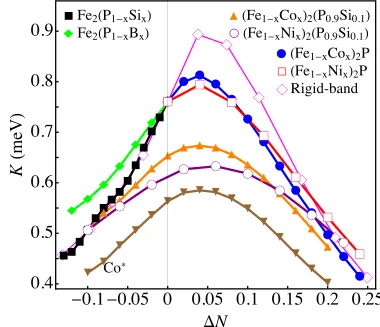
We now turn to magnetocrystalline anisotropy. Figure 3 shows the dependence ofKin Fe2P on the electron doping in the rigid-band model, as well as the CPA results for various alloys, all plotted as a function of the electron count N. First, we focus on three-component alloys with Co, Ni, Si, or B. As in the case of the exchange coupling, the rigid-band approximation agrees quite well with CPA calculations for
FIG. 3. Dependence ofKon band fillingNin different alloys (see legend) calculated in CPA. Inverted brown triangles (labeled Co∗): (Fe1−xCox)2P0.9Si0.1with experimental lattice parameters [13]
for Fe2P0.9Si0.1. Diamonds: Rigid-band approximation for Fe2P.
[image:4.608.338.528.538.702.2]RAPID COMMUNICATIONS
TUNABLE DIMENSIONAL CROSSOVER AND . . . PHYSICAL REVIEW MATERIALS1, 051401(R) (2017)
3z21
yz,zx xy,x2y2
[image:5.608.327.545.70.216.2]
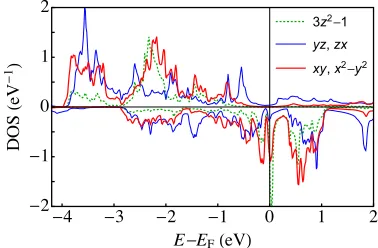
FIG. 4. Orbital-resolved partial density of 3d states for an FeII
atom.
these alloys. This agreement suggests that the MCA energy in Fe2P is not dominated by spin-orbit “hot spots,” which would be strongly suppressed by disorder [20]. Further, we see that the behavior ofKis primarily controlled by band filling. For example,Kbehaves very similarly in (Fe1−xCox)2P and (Fe1−xNix)2P alloys when plotted againstN, which means that the effect of Ni is equivalent to twice as much Co. The effect of Si or B also fits closely with the band filling trend.
The small offset of the maximum in Fig. 3 is likely an artifact of the atomic sphere approximation, which slightly overestimates the exchange splitting. While there is no intrinsic reason for the maximum to occur exactly atN =0, we found that a full-potential rigid-band calculation reproduces the trend seen in Fig. 3, but the maximum occurs almost exactly at N =0. The decline of the MCA energy with the increasing concentration of Ni or Co agrees with the experimental data [10,11,26].
To identify the mechanisms of MCA and its dependence on band filling, we first consider the site and spin decomposition of the anisotropy of the SOC energy [19,31]. We have verified that, as expected, this quantity closely follows the concentration dependence ofKin these alloys. The dominant term in the spin decomposition comes from the mixing of the minority-spin states of FeIIby the ˆSzLˆzterm in SOC, while the majority-spin and the spin-off-diagonal term are fairly small in the interesting range of concentrations. The contribution of FeIbehaves similarly but is a few times smaller. Given that the diagonal minority-spin contribution dominates, the MCA is approximately proportional to the orbital moment anisotropy [31,32], which may be easier to measure [32].
The orbital-resolved density of states for an FeII atom in pure Fe2P (Fig.4) shows two closely spaced peaks of thexy andx2-y2 character (or m= ±2 in theY
lm basis) separated by the Fermi level. Mixing of these states by the ˆLzoperator leads to the MCA maximum seen in Fig.3.
We now examine the contributions to K coming from different regions in the Brillouin zone [19]. Figure 5 shows the difference of the minority-spin single-particle energies for magnetization along thexandzaxes in pure Fe2P, resolved by k. We see that the MCA accumulates over a fairly large part of the Brillouin zone, with the most important contribution coming from the region withkz≈k1/3= |A|/3 (bright red area in Fig.5). Note that an earlier analysis [6] focused only on high-symmetry directions in the Brillouin zone, leading to
FIG. 5. Brillouin zone map of the k-resolved minority-spin contribution to K for pure Fe2P. Color intensity indicates the
magnitude of positive (red) or negative (blue) contributions. The
and M points are at kz= |A|/3 on theA and MLlines, respectively.
an erroneous conclusion that the dominant contributions toK come from band splittings along theKMandAlines. This observation underlines the need to examine the contributions coming from the entire Brillouin zone.
The origin of the dominant positive contribution from the vicinity of the kz≈k1/3 plane can be understood by examining the partial minority-spin spectral function for the transition-metal site. Figure 6 shows this spectral function for pure Fe2P, resolving 3d orbital contributions by color. We see two intersecting bands with the Fermi level cutting through them. The SOC strongly splits these bands forMz [Fig.6(b)], while the splitting is much weaker forMx(not shown). Although there is no exact spin-orbital selection rule, the states near the Fermi level are predominantly of thexy andx2-y2 character (see Fig.4). These orbitals are strongly mixed by the ˆLz(but not ˆLx) operator, which gives a positive contribution toK.
[image:5.608.78.267.71.195.2]The dependence ofK in (Fe0.85Co0.15)2P on thec/a ratio is similar to the results of Ref. [6] for pure Fe2P: A 5% increase inc/a results in a 30% increase in MCA, while the magnetization is slightly decreased. With increasing volume
FIG. 6. Partial minority-spin spectral function in thekz= |A|/3 plane for the transition-metal site in Fe2P. (a) Without SOC. (b) With
SOC forMz. The intensities of the red, blue, and green color channels are proportional to the sum ofm= ±2 (xyandx2-y2), sum
ofm= ±1 (xzandyz), andm=0 (z2) character, respectively.
[image:5.608.328.544.555.693.2]I. A. ZHURAVLEVet al. PHYSICAL REVIEW MATERIALS1, 051401(R) (2017)
the MCA increases slightly, at a rate of about 2% per 1% volume increase, while the magnetization is nearly constant.
At room temperature the anisotropy field and coercivity in (Fe1−xCox)2P are maximized at certain Co concentrations [15]. This is because there is a tradeoff between low TC at low concentrations and low MCA, even at T =0, at high concentrations. For permanent-magnet applications, it is of interest to maximize the MCA at the operating temperature. First, we considered the prospects of increasing the MCA of the (Fe0.85Co0.15)2P alloy by substituting a small amount of Fe by an additional alloying element, such as one with a stronger SOC. We found that Mn, Tc, and Re increaseKwhen equally substituted on both Fe sublattices, with Mn having the largest effect and Re the smallest. For example, a 5% substitution of Re increasesKby about 15%, and that of Mn by as much as 70%. However, if Mn fully segregates to the pyramidal site (which it strongly prefers [33]), the MCA is only enhanced by 20%. The effect of Mn is then essentially that of the reduced band filling, which could be achieved by simply reducing the amount of Co. Equal substitution of both Fe sites by Ru and Os has almost no effect onK, while Rh and Ir reduce it. Thus, double substitution of Fe by Co and another transition-metal element is not promising.
On the other hand, given that K is sensitive to band filling and is maximized close to the electron count of pure Fe2P, the following strategy suggests itself: coalloy Fe2P with Co or Ni and Si (on Fe and P sublattices, respectively) to maintain the optimal band filling while increasing TC well above the operating temperature. For example, as shown in Fig. 3, the MCA in (Fe1−xXx)2P0.9Si0.1 alloys, where X is either Co or Ni, has the same dependence on band filling as in three-component alloys. Although the lattice distortion corresponding to Fe2P0.9Si0.1reduces the maximal MCA, it is still achieved at the same band filling.
We have examined the Bloch spectral functions in these alloys and found that, in all cases, all the bands seen in Fig.6 are easily identifiable and their broadening is fairly small, while the band filling determines the location of the Fermi level. The band broadening does, however, reduce the MCA in (Fe1−xXx)2P0.9Si0.1compared to (Fe1−xXx)2P at the same band filling. Therefore, for alloys with the optimal band filling, coalloying with Co (or Ni) and Si still comes with a tradeoff between the increasing TC and decreasing MCA at
T =0.
As mentioned above, the shift of the maximum inKfrom N =0 is likely due to a slightly overestimated exchange splitting. Thus, we predict that MCA is maximized close to the 1:2 doping ratio for Co and Si, or 1:4 for Ni and Si.
CPA calculations show that the ground-state magnetization in Fe2P alloys with Co, Ni, and Si, in the relevant range of concentrations, is approximately a linear function of the band filling,M≈M0+AN, whereA≈ −0.85μB/f.u. In particular, atT =0 the “optimal” codoped alloys should have approximately the same magnetization as pure Fe2P.
Consider the series of (Fe1−xCox)2P1−y¯Siy¯ alloys where ¯
[image:6.608.336.534.71.200.2]y ≈2xmaximizesKatT =0 for the givenx. It is of practical interest to findx that maximizesK(T ,x) in this alloy at the givenT. To find this maximum, we calculateK(0,x) in CPA and approximate the temperature dependence as follows.
FIG. 7. Concentration dependence ofKat 273 K (black), 323 K (blue), and 400 K (red) in (Fe1−xCox)2P1−y¯Siy¯ alloys with optimal
band filling reached at ¯y≈2x. See text for details.
It is often possible to calculateK(T) using the disordered local moment method [20,34], but we do not have a quantitative model to represent the statistical distribution of the magnetic moments and their orientations in the present system with a weakly magnetic sublattice and a dimensional crossover. Therefore, we turn to the experimental data on K(T), which were measured at several concentrations in Ni-doped Fe2P [10,11]. TheK(T /TC) curves at 0%, 10%, and 20% Ni are monotonic and essentially identical when scaled by K(0). Therefore, we assume thatK(T ,x)/K(0,x)=f(T /TC) is the same function ofT /TC at any x, and we take it from experiment [10,11].
The missing piece is the dependence ofTConx. Consider
TC(x,y) in the alloy wherex andy are unrestricted concen-trations of Co and Si. Since we are considering the series of alloys at optimal band filling, we expect that the increase of TC(x,y¯) withx is primarily due to the increase inJz due to the structural distortion introduced by Si. In Fe2P1−ySiy, the hole doping reduces the effect of this structural distortion. Therefore, we can useTC(0,y¯) from the experimental data for Fe2P1−ySiyas the lower bound forTC(x,y¯) in the lower-bound estimate forK(T ,x)=f(T /TC)K(0,x).
The resulting lower-bound estimates forK(T ,x) are shown in Fig.7for three different temperatures. At room temperature, MCA reaches a maximum of about 0.26 meV/f.u. at x ≈ 0.09. At higher temperatures this maximum shifts to larger concentrations, while the maximum MCA declines. Thus, correcting for the 2% shift of theK(N) curve, we predict that the optimal alloy for permanent-magnet applications in the 300–400 K operating range has 7%–10% Co (or 3.5%–5% Ni) and a compensating amount of 14%–20% Si. This target composition should be the starting point for experimental verification. More generally, understanding the mechanisms by which alloying affects the Curie temperature and MCA provides a path for optimizing the composition of Fe2P-based alloys for specific applications.
The work at UNL was supported by the National Science Foundation through Grants No. 1308751 and No. DMR-1609776 and performed utilizing the Holland Computing Center of the University of Nebraska, which receives support
RAPID COMMUNICATIONS
TUNABLE DIMENSIONAL CROSSOVER AND . . . PHYSICAL REVIEW MATERIALS1, 051401(R) (2017)
from the Nebraska Research Initiative. Work at Ames Lab-oratory was supported by the Critical Materials Institute, an Energy Innovation Hub funded by the US DOE. Ames
Labora-tory is operated for the US DOE by Iowa State University under Contract No. DE-AC02-07CH11358. M.v.S. was supported by the EPSRC CCP9 Flagship Project No. EP/M011631/1.
[1] O. Beckman and L. Lundgren, in Handbook of Magnetic Materials, edited by K. H. J. Buschow (Elsevier, Amsterdam, 1991), Vol. 6.
[2] R. Fruchart, A. Roger, and J. P. Senateur,J. Appl. Phys.40,
1250(1969).
[3] S. K. Jain, S. Kumar, P. S. R. Krishna, A. B. Shinde, A. Krishnamurthy, and B. K. Srivastava,J. Alloys Compd.439,
13(2007).
[4] H. Fujii, S. Komura, T. Takeda, T. Okamoto, Y. Ito, and J. Akimitsu,J. Phys. Soc. Jpn.46,1616(1979).
[5] R. Wäppling, L. Häggstrom, T. Ericsson, S. Devanarayanan, E. Karlsson, B. Carlsson, and S. Rundqvist,J. Solid State Chem. 13,258(1975).
[6] M. Costa, O. Grånäs, A. Bergman, P. Venezuela, P. Nordblad, M. Klintenberg, and O. Eriksson,Phys. Rev. B86,085125(2012). [7] E. K. Delczeg-Czirjak, Z. Gercsi, L. Bergqvist, O. Eriksson, L. Szunyogh, P. Nordblad, B. Johansson, and L. Vitos,Phys. Rev. B85,224435(2012).
[8] E. K. Delczeg-Czirjak, L. Bergqvist, O. Eriksson, Z. Gercsi, P. Nordblad, L. Szunyogh, B. Johansson, and L. Vitos,Phys. Rev. B86,045126(2012).
[9] E. K. Delczeg-Czirjak, L. Delczeg, M. P. J. Punkkinen, B. Johansson, O. Eriksson, and L. Vitos,Phys. Rev. B82,085103
(2010).
[10] H. Tujii, T. Kamagaichi, T. Hokabe, and T. Okamoto,J. Phys. Soc. Jpn.37,1712(1974).
[11] H. Fujii, T. Hokabe, H. Fujiwara, and T. Okamoto,J. Phys. Soc. Jpn.44,96(1978).
[12] R. Chandra, S. Bjarman, T. Ericsson, L. Häggström, C. Wilkin-son, and R. Wäppling,J. Solid State Chem.34,389(1980). [13] P. Jernberg, A. A. Yousif, L. Häggström, and Y. Andersson,
J. Solid State Chem.53,313(1984).
[14] A. Catalano, R. J. Arnott, and A. Wold,J. Solid State Chem.7,
262(1973).
[15] K. J. de Vos, W. A. J. J. Velge, M. G. van der Steeg, and H. Zijlstra,J. Appl. Phys.33,1320(1962).
[16] I. Turek, V. Drchal, J. Kudrnovský, M. Šob, and P. Weinberger,
Electronic Structure of Disordered Alloys, Surfaces and Inter-faces(Kluwer, Boston, 1997).
[17] L. Ke, K. D. Belashchenko, M. van Schilfgaarde, T. Kotani, and V. P. Antropov,Phys. Rev. B88,024404(2013).
[18] I. Turek, V. Drchal, and J. Kudrnovský,Philos. Mag.88,2787
(2008).
[19] K. D. Belashchenko, L. Ke, M. Däne, L. X. Benedict, T. N. Lamichhane, V. Taufour, A. Jesche, S. L. Bud’ko, P. C. Canfield, and V. P. Antropov,Appl. Phys. Lett.106,062408(2015). [20] I. A. Zhuravlev, V. P. Antropov, and K. D. Belashchenko,
Phys. Rev. Lett.115,217201(2015).
[21] J. P. Perdew, K. Burke, and M. Ernzerhof,Phys. Rev. Lett.77,
3865(1996);78,1396(1997).
[22] B. Carlsson, M. Gölin, and S. Rundqvist,J. Solid State Chem. 8,57(1973).
[23] UsingVASP[24], we confirmed that Co and Ni prefer the tetra-hedral site, by 215 and 75 meV/atom, respectively, compared to the pyramidal site.
[24] G. Kresse and J. Furthmüller,Phys. Rev. B54,11169(1996). [25] A. I. Likhtensteyn, V. P. Antropov, and V. A. Gubanov,
Fiz. Metall. Metalloved.64, 667 (1987) [Phys. Met. Metallogr. 64, 35 (1987)].
[26] S. Kumar, A. Krishnamurthy, and B. K. Srivastava,J. Phys. D: Appl. Phys.41,055001(2008).
[27] S. Kumar, A. Krishnamurthy, B. K. Srivastava, and S. K. Paranjpe,J. Phys.: Condens. Matter19,196217(2007). [28] B. L. Gyorffy, A. J. Pindor, J. Staunton, G. M. Stocks, and H.
Winter,J. Phys. F15,1337(1985).
[29] V. P. Antropov, B. N. Harmon, and A. N. Smirnov,J. Magn. Magn. Mater.200,148(1999).
[30] I. Juhász Junger, D. Ihle, and J. Richter,Phys. Rev. B80,064425
(2009).
[31] V. P. Antropov, L. Ke, and D. ˚Aberg,Solid State Commun.194,
35(2014).
[32] J. Stöhr and H. C. Siegmann,Magnetism: From Fundamentals to Nanoscale Dynamics(Springer, Berlin, 2006).
[33] Y. Maeda and Y. Takashima,J. Inorg. Nucl. Chem.35,1963
(1973).
[34] J. B. Staunton, S. Ostanin, S. S. A. Razee, B. L. Gyorffy, L. Szunyogh, B. Ginatempo, and E. Bruno,Phys. Rev. Lett.93,
257204(2004).