WEED SCIENCE
Sequential and Co-Application of Glyphosate and Glufosinate in Cotton
Charles W. Cahoon*, Alan C. York, David L. Jordan, Richard W. Seagroves,
Wesley J. Everman, and Katie M. Jennings
C.W. Cahoon*, A.C. York, D.L. Jordan, R.W. Seagroves, W.J. Everman, and K.M. Jennings, Box 7620, North Carolina State University, Raleigh, NC 27695
*Corresponding author: [email protected] ABSTRACT
Glufosinate controls GR Palmer amaranth (Amaranthus palmeri S. Wats.), but might be less effective than glyphosate on certain weeds. Glyphosate and glufosinate applications in tol-erant cotton (Gossypium hirsutum L.) cultivars can broaden the spectrum of control and aid in resistance management. Research investigating sequential application and potential interac-tions with co-applicainterac-tions of glyphosate and glufosinate is limited. Field research at six loca-tions evaluated Palmer amaranth and annual grass control with glyphosate and glufosinate co-applied or sequentially applied. Herbicides were applied to two-leaf cotton and repeated 14 d later. A GR biotype comprised 10 to 90% of the Palmer amaranth populations. Greater Palmer amaranth control was achieved fol-lowing sequential applications of glufosinate compared with glyphosate. Co-application of glufosinate plus glyphosate was more effective than glyphosate alone at most locations but never more effective than glufosinate alone. Glypho-sate controlled goosegrass (Eleusine indica [L.] Gaertn.) more than glufosinate and a similar response was observed for large crabgrass (Digi-taria sanguinalis [L.] Scop.). Glufosinate and glyphosate co-applied were less effective than glyphosate alone on both grasses, but not more effective than glufosinate alone. Glufosinate followed by (fb) glyphosate was the preferred order for sequential application to control Palmer amaranth at most locations. With high percentages of the GR biotype, glufosinate ap-plied sequentially was more effective than any other sequential applications. Glyphosate fb glu-fosinate and gluglu-fosinate fb glyphosate controlled
large crabgrass similar to glyphosate applied sequentially and greater than glufosinate ap-plied sequentially. For goosegrass, glyphosate fb glufosinate was more effective than the reverse. Seven days after the second postemergence ap-plication, sequential application of glyphosate fb glufosinate controlled goosegrass as well as glyphosate applied sequentially and better than glufosinate applied sequentially.
P
almer amaranth (Amaranthus palmeri S. Wats.) is one of the most common and problematic weeds in cotton and other agronomic crops in the southern U.S. (Webster, 2013). The biology of this weed, its impact on cotton yield, and thedifficulty of control in cotton were reviewed by
Culpepper et al. (2010). Palmer amaranth has a high photosynthetic capacity, giving the weed the ability to grow rapidly (Ehleringer, 1983). Although crops suffer during dry conditions, Palmer amaranth has effective drought tolerance mechanisms allowing it to survive and grow (Ehleringer, 1983; Place et al., 2008; Wright et al., 1999). Palmer amaranth has been reported to reduce cotton yield up to 92% with eight weeds m-1 of row and interfere with
mechanical harvest (MacRae et al., 2008; Morgan et al., 2001; Rowland et al., 1999; Smith et al., 2000). Prior to commercialization of herbicide-resistant cotton, few postemergence (POST) herbicides were available to control Palmer amaranth; thus, effective control required multiple applications of preplant, preemergence (PRE), and POST-directed herbicides (Wilcut et al., 1995). Cultivation usually supplemented chemical control. These programs were effective if PRE herbicides received timely rainfall for activation and POST-directed herbicides were applied to small weeds (Culpepper and York, 1997). However, the height differential necessary for
POST-directed application was difficult to achieve
due to rapid growth of Palmer amaranth.
2002). However, with widespread planting of GR crops and extensive reliance on glyphosate, resistant biotypes evolved. Resistance to glyphosate has been
confirmed in 31 weed species (Heap, 2014). The first confirmation of resistance to glyphosate in an
Amaranthus species occurred with Palmer amaranth in Georgia in 2005 (Culpepper et al., 2006). By the
end of 2014, GR Palmer amaranth had been con
-firmed in 24 states (Heap, 2014). Palmer amaranth
resistant to acetolactate synthase (ALS)-inhibiting herbicides is also prevalent, and multiple resistance to both glyphosate and ALS-inhibiting herbicides
is common (Heap, 2014; Sosnoskie et al., 2011). In
North Carolina, 95% of the Palmer amaranth popu-lations contain at least some individuals resistant to both glyphosate and ALS-inhibiting herbicides
(Poirier et al., 2014).
Herbicides for POST application in cotton to control biotypes of Palmer amaranth with multiple resistance are limited (Culpepper et al., 2006). How-ever, glufosinate controls GR Palmer amaranth (Cul-pepper et al., 2006; Hoffner et al., 2012; Norsworthy et al., 2008; Whitaker et al., 2011), giving growers an option to control this weed in glufosinate-tolerant cotton (Barnett et al., 2013; Culpepper et al., 2009;
Gardner et al., 2006; Whitaker et al., 2011). In addi
-tion to Palmer amaranth, glufosinate also controls a
number of other weed species (Anonymous, 2014).
However, glufosinate is less effective than glypho-sate on grasses, sedges, and certain broadleaf
spe-cies (Corbett et al., 2004; Hoss et al., 2003; Koger
et al., 2007; Steckel et al., 1997; Whitaker et al., 2011; Wiesbrook et al., 2001). Application of both glyphosate and glufosinate to the same crop would broaden the spectrum of control due to glyphosate and glufosinate having different modes of action (Devine et al., 1993; Steirrucken and Amrhein, 1980). Use of both herbicides in the same crop also could
be beneficial for resistance management (Diggle et
al., 2003; Gressel and Segel, 1990; Norsworthy et
al., 2012; Wrubel and Gressel, 1994).
FiberMax and Stoneville cotton cultivars with both GlyTol® and LibertyLink® traits and Phytogen
cultivars with the WideStrike® trait are
commer-cially available and allow topical application of both glyphosate and glufosinate. These cultivars were planted on 70 to 75% of the hectares in Arkansas, Mississippi, North Carolina, South Carolina, and
Tennessee; 48 to 61% of the hectares in Alabama,
Louisiana, and Missouri; and 35% of the hectares in
Georgia in 2013 (USDA-AMS, 2014). The increas
-ing problem with GR Palmer amaranth has been a major reason for the transition to these cultivars.
Tolerance to glyphosate in GlyTol LibertyLink cultivars is due to insertion of the 2mepsps gene
(USDA-APHIS, 2008). The 2mepsps protein has
decreased binding affinity for glyphosate and con
-tinues to function in the presence of the herbicide. Tolerance to glufosinate is due to insertion of the bialaphos resistance (bar) gene (USDA-APHIS, 2003), which encodes for phosphinothricin acetyl-transferase, an enzyme that catalyzes the conver-sion of lethal L-phosphinothricin into nonlethal N-acetyl-L-phosphinothricin (Devine et al., 1993; Hinchee et al., 1993). Cotton with the WideStrike trait expresses two delta-endotoxins, which confer resistance to lepidopteran pests. This cotton was produced by cross breeding a transgenic line that produces the insecticidal protein Cry1Ac and a transgenic line that produces the insecticidal protein Cry1F (USEPA-OPP, 2005). Both of these events contain the phosphinothricin acetyltransferase (pat) gene, which was inserted for use as a selectable marker during plant transformation. The pat gene also confers resistance to glufosinate, although expression of the gene is incomplete and injury usu-ally occurs when glufosinate is applied topicusu-ally to WideStrikecotton (Culpepper et al., 2009; Steckel
et al., 2012; Whitaker et al., 2011). Injury appears as
necrosis on exposed cotton leaves shortly following application. The cotton typically recovers and yield is unaffected (Culpepper at al., 2009; Sweeney and Jones, 2015; Whitaker et al., 2011; Wright et al.,
2014) although exceptions have occurred, especially
with three applications per season, applications to larger cotton (Barnett et al., 2015), or applications to cotton stressed by early season insects (Stewart et al., 2013). The WideStrike trait is typically stacked with the Roundup Ready® Flex trait, which imparts
tolerance of glyphosate.
Cultivars with tolerance to both glyphosate and
glufosinate offer growers increased flexibility in
MATERIALS AND METHODS
The experiment was conducted at six sites in North Carolina during 2011 and 2012. Sites included the Upper Coastal Plain Research Station near Rocky Mount, private farms near Micro and Mount Olive,
and three separate fields at the Central Crops Re
-search Station near Clayton. Soils at each site are described in Table 1. All sites were naturally infested
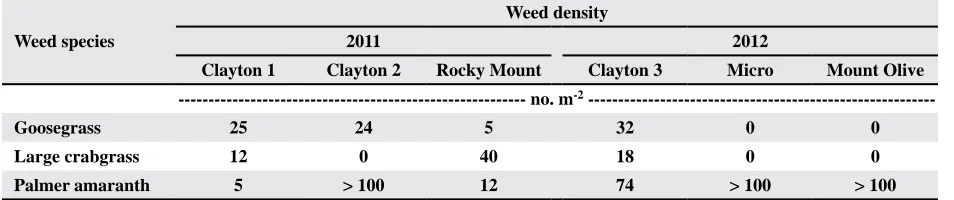
with Palmer amaranth (Table 2). In addition, four and
three sites were also infested with goosegrass and large crabgrass, respectively.
Cotton cultivar PHY 375 WRF (Dow
AgroSci-ences, Indianapolis, IN) was planted on 12 May 2011
at both Clayton sites and 6 May 2011 at Rocky Mount.
Cotton cultivar PHY 499 WRF (Dow AgroSciences, Indianapolis, IN) was planted 2 and 22 May 2012, at
Clayton and Micro, respectively. Cotton cultivar FM
1944GLB2 (Bayer CropScience, Research Triangle
Park, NC) was planted 7 May 2012 at Mount Olive. Cotton was planted in conventionally prepared seed-beds at all locations except Rocky Mount, which was in a strip-tillage system (Meijer and Edmisten,
2014). The potassium salt of glyphosate (Roundup
PowerMax® Herbicide, Monsanto, St. Louis,
Mis-souri) at 868 g ae ha-1 and paraquat (Parazone® 3SL
Herbicide, Makhteshim Agan of North America, Raleigh, NC) at 561 g ai ha-1 were applied 24 and
0 d before planting, respectively, at Rocky Mount to control winter vegetation and emerged summer annual weeds. Cotton was planted in 91-cm rows at Rocky Mount and 97-cm rows at other locations.
Plots were 4 rows by 9 m. The experimental design
was a randomized complete block with treatments replicated four times.
Treatments consisted of glyphosate and the ammonium salt of glufosinate (Liberty® 280 SL
Herbicide, Bayer CropScience, Research Triangle Park, NC) applied sequentially or co-applied. Glyphosate and glufosinate rates were based upon the manufacturers’ suggested use rates (1X rates)
of 868 and 543 g ae ha-1, respectively. Sequential
applications included glyphosate applied to two-leaf cotton 18 to 22 d after planting (POST-1)
followed by (fb) glufosinate applied 14 d later
to six-leaf cotton (POST-2) and glufosinate ap-plied POST-1 fb glyphosate apap-plied POST-2. Co-applications included mixtures of glyphosate plus glufosinate at 1X plus 1/2X, 1/2X plus 1X, and 1X plus 1X rates applied POST-1 and repeated
Table 1. Description of soils at experiment sites.
Site Year Soil seriesz Soil texture Soil pH Soil humic mattery
%
Clayton 1 2011 Norfolk Loamy sand 5.4 0.60
Clayton 2 2011 Lynchburg Sandy loam 5.4 1.08
Rocky Mount 2011 Aycock Sandy loam 5.5 0.41
Clayton 3 2012 Norfolk Loamy sand 5.2 0.46
Micro 2012 Faceville Sandy loam 5.4 0.56
Mount Olive 2012 Wagram Loamy sand 5.2 0.30
z Norfolk, fine-loamy, kaolinitic, thermic, Typic Knadiudults; Lynchburg, fine-loamy, siliceous, thermic Aeric Paleaquults;
Aycock, fine-silty, siliceous, subactive, thermic Typic Paleudults; Faceville, fine, kaolinitic, thermic Typic Knadiudults; Wagram, loamy, kaolinitic, thermic Arenic Kandiudults.
y Soils characterized by the Agronomic Services Division of the North Carolina Department of Agriculture and Consumer
Services. Soil humic matter determined according to Mehlich (1984).
Table 2. Weed species and density at experiment sitesz.
Weed species
Weed density
2011 2012
Clayton 1 Clayton 2 Rocky Mount Clayton 3 Micro Mount Olive
--- no. m-2
---Goosegrass 25 24 5 32 0 0
Large crabgrass 12 0 40 18 0 0
Palmer amaranth 5 > 100 12 74 > 100 > 100
injury, weed control, and seed cotton yield were subjected to analysis of variance using the PROC
MIXED procedure of Statistical Analysis Systems (SAS) (version 9.2; SAS Institute Inc., Cary, NC).
Visual estimates of weed control and cotton injury were arcsine square-root transformed before analysis (Grafen and Hails, 2002). Non-transformed data are presented, with means separation based upon analy-sis of transformed data. Data for nontreated controls were not included in analyses. Herbicide treatments
and location were fixed factors, whereas replications
were treated as random. Means were separated using Fisher’s Protected LSD at p = 0.05.
RESULTS AND DISCUSSION
Site/year combinations (environments) by
her-bicide treatment interactions were significant for
each response recorded, hence data were analysed by location.
Palmer amaranth control. Glyphosate applied
alone controlled Palmer amaranth 94 to 97% and
85 to 91% at 7 DAP1 and 7 DAP2, respectively, at Clayton 1, Clayton 2, Rocky Mount, and Mount
Olive (Tables 3 and 4). The few plants at these
locations that survived sequential glyphosate appli-cations were assumed to be a GR biotype. A larger percentage of the population was GR at Clayton 3, where glyphosate alone controlled Palmer
ama-ranth only 75 and 64% at 7 DAP1 and 7 DAP2,
respectively. Almost all plants at Micro were a GR biotype; glyphosate controlled Palmer amaranth < 10% at Micro.
at POST-2. For comparison, glyphosate and glu-fosinate were applied sequentially at 1X rates at the POST-1 and POST-2 application timings. A nontreated control was included for
compari-son. Excluding the nontreated control, all plots received a directed layby application of diuron (Direx®, Makhteshim Agan of North America,
Raleigh, NC) at 840 g ai ha-1 plus MSMA (MSMA
6 Plus, Drexel Chemical Co., Memphis, TN) at
2240 g ai ha-1 plus non-ionic surfactant (Induce®,
Helena Chemical Co., Collierville, TN) at 0.25% (v/v) 2 to 3 wk after POST-2 when cotton had 12
nodes and was 45 to 55 cm tall. Herbicides were
applied using a CO2-pressurized backpack sprayer
equipped with flat-fan nozzles (DG11002 TeeJet®
Drift Guard flat-spray nozzles, TeeJet Technolo
-gies, Wheaton, IL) set to deliver 140 L ha-1 at 165
kPa for the POST-1 and POST-2 applications. The
layby application was applied with a single flood
nozzle (TK-VS2 FloodJet® wide angle flat-spray
nozzle, TeeJet Technologies, Wheaton, IL) per
row middle set to deliver 140 L ha-1 at 210 kPa.
Percent weed control and cotton injury were estimated visually using a scale of 0 to 100, where 0 = no weed control or cotton injury and 100 = complete weed control or cotton death (Frans et al., 1986) 7 d after 1 (DAP1), 7 d after POST-2 (DAPPOST-2), 7 d after layby, and late in the season. Cotton in herbicide-treated plots was mechanically harvested in mid-October to mid-November using
a spindle picker modified for small-plot harvesting.
Cotton in nontreated controls could not be harvested due to the severe weed infestations. Data for cotton
Table 3. Palmer amaranth control 7 d after first postemergence application of glyphosate, glufosinate, and co-applications of glyphosate and glufosinatez.
Postemergence herbicidesy
Palmer amaranth control
2011 2012
Clayton 1 Clayton 2 Rocky
Mount Clayton 3 Micro
Mount Olive %
---Glyphosate (1X) 97 a 94 c 94 a 75 b 10 c 95 a
Glufosinate (1X) 97 a 97 b 94 a 96 a 93 a 99 a
Glyphosate (1X) + glufosinate (1/2X) 96 a 97 b 86 b 89 a 73 b 97 a
Glyphosate (1/2X) + glufosinate (1X) 97 a 97 b 95 a 93 a 94 a 98 a
Glyphosate (1X) + glufosinate (1X) 97 a 99 a 92 a 94 a 94 a 100 a
z Means within a column followed by the same letter are not different according to Fisher’s Protected LSD at p ≤ 0.05.
y Herbicides were applied to 2-leaf cotton 18 to 22 d after planting. The 1X rates of glyphosate and glufosinate were 868
No differences in Palmer amaranth control among treatments were noted 7 DAP1 at Clayton 1 and Mount Olive, with control ranging from 96 to 97% and 95 to 100%, respectively (Table 3). Co-applied glyphosate 1X plus glufosinate were 3 to 5%
and 14 to 19% more effective than glyphosate alone
at Clayton 2 and Clayton 3, respectively. Glufosinate 1/2X co-applied with glyphosate POST-1 reduced
control 8% at Rocky Mount, but all other treatments provided at least 92% Palmer amaranth control 7 DAP1 (Table 3). At Micro, glyphosate alone con-trolled Palmer amaranth only 10%, but glufosinate at the 1/2X and 1X rates co-applied with glyphosate
increased control to 73 and 94%, respectively, 7
DAP1. At all locations, Palmer amaranth control following co-applications of glyphosate at 1/2X or 1X with glufosinate 1X was similar to glufosinate
alone 7 DAP1 (Table 3).
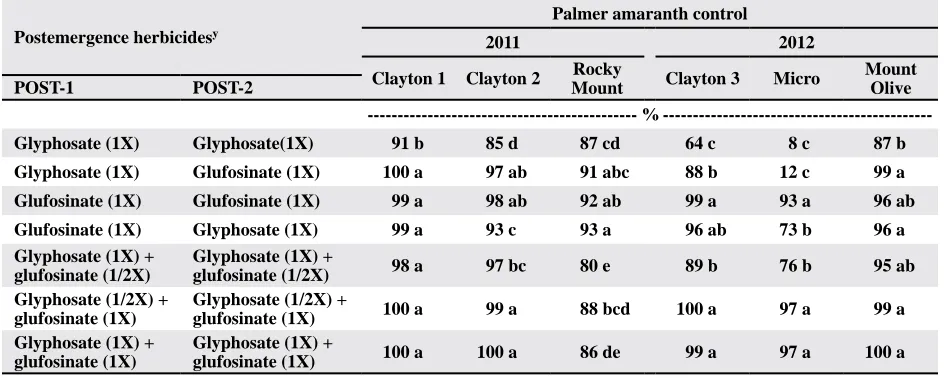
Palmer amaranth was controlled 92 to 99% 7 DAP2 by sequential glufosinate applications
POST-1 fb POST-2 (Table 4). Glufosinate applied
sequentially (92 to 99%) was more effective than glyphosate applied sequentially (8 to 91%) at all locations except Mount Olive, and a similar trend was noted at Mount Olive. Compared to glyphosate alone POST-1 fb POST-2, sequential applications of glufosinate 1/2X co-applied with glyphosate increased Palmer amaranth control 7, 12, 25, and 68% at Clayton 1, Clayton 2, Clayton 3, and Micro, respectively. However, sequential applications of glufosinate at the 1X rate co-applied with
glypho-sate was needed to increase control at Mount Olive
7 DAP2 (Table 4). The only negative response from
co-applying glufosinate and glyphosate occurred at Rocky Mount, where sequential applications of glufosinate 1/2X plus glyphosate controlled Palmer amaranth 7% less than sequential glyphosate ap-plications, and, in contrast to all other locations, glufosinate 1X co-applied with glyphosate applied sequentially did not improve control at Rocky Mount. At Rocky Mount, sequential applications of glyphosate 1X plus glufosinate 1X reduced control 6% compared with glufosinate applied alone sequentially. Whitaker et al. (2011) observed equivalent Palmer amaranth control with co-applied glufosinate and glyphosate relative to glufosinate
applied alone. However, Reed et al. (2014) noted
the addition of glyphosate to glufosinate reduced Palmer amaranth control 20 to 25% compared to glufosinate alone in 1 of 2 yr.
Results following sequential applications of glyphosate and glufosinate varied by location. Re-gardless of order of application, Palmer amaranth control 7 DAP2 following sequential applications of glyphosate and glufosinate (88 to 100%) was greater than glyphosate applied 1 fb
POST-2 (64 to 91%) at Clayton 1, Clayton POST-2, Clayton 3, and Mount Olive (Table 4). At Rocky Mount and
Micro, similar control was obtained with glyphosate POST-1 fb glufosinate POST-2 and glyphosate ap-plied sequentially. However, glufosinate POST-1 fb glyphosate POST-2 was 6 and 65% more effective
Table 4. Palmer amaranth control 7 d after the second postemergence application of glyphosate, glufosinate, and co-applications of glyphosate and glufosinatez.
Postemergence herbicidesy
Palmer amaranth control
2011 2012
Clayton 1 Clayton 2 Rocky
Mount Clayton 3 Micro
Mount Olive
POST-1 POST-2
--- %
---Glyphosate (1X) Glyphosate(1X) 91 b 85 d 87 cd 64 c 8 c 87 b
Glyphosate (1X) Glufosinate (1X) 100 a 97 ab 91 abc 88 b 12 c 99 a
Glufosinate (1X) Glufosinate (1X) 99 a 98 ab 92 ab 99 a 93 a 96 ab
Glufosinate (1X) Glyphosate (1X) 99 a 93 c 93 a 96 ab 73 b 96 a
Glyphosate (1X) + glufosinate (1/2X)
Glyphosate (1X) +
glufosinate (1/2X) 98 a 97 bc 80 e 89 b 76 b 95 ab
Glyphosate (1/2X) + glufosinate (1X)
Glyphosate (1/2X) +
glufosinate (1X) 100 a 99 a 88 bcd 100 a 97 a 99 a
Glyphosate (1X) + glufosinate (1X)
Glyphosate (1X) +
glufosinate (1X) 100 a 100 a 86 de 99 a 97 a 100 a
z Means within a column followed by the same letter are not different according to Fisher’s Protected LSD at p ≤ 0.05.
y POST-1 herbicides were applied to 2-leaf cotton 18 to 22 d after planting. POST-2 herbicides were applied 14 days later.
than glyphosate applied sequentially at Rocky Mount and Micro, respectively. At Clayton 1, Rocky Mount, and Mount Olive, glyphosate and glufosinate applied sequentially (91 to 100%) were as good as, but never better, than glufosinate applied sequentially (92 to 99%). Glyphosate POST-1 fb glufosinate POST-2 and glufosinate applied sequentially were similar at Clayton 1, Clayton 2, Rocky Mount, and Mount
Olive. In contrast, sequential applications of glypho
-sate fb glufosinate controlled Palmer amaranth 11 and 81% less than glufosinate applied sequentially at Clayton 3 and Micro, respectively. Clayton 3 and Micro were the locations with a larger percentage of the GR Palmer amaranth biotype.
Glufosinate controls Palmer amaranth only if applied when the plant is small (< 10 cm) (Barnett
et al., 2013; Corbett et al., 2004; Culpepper et al.,
2009; Gardner et al., 2006). Following poor control of Palmer amaranth by glyphosate POST-1, Palmer amaranth plant heights reached 20 to 30 cm, render-ing glufosinate applied POST-2 ineffective. Similar control was obtained by glufosinate POST-1 fb glyphosate POST-2 and glufosinate applied sequen-tially at Clayton 1, Rocky Mount, Clayton 3, and Mount Olive. Sequential application of glufosinate POST-1 fb glyphosate POST-2 was 5 and 20% less effective than glufosinate applied sequentially at Clayton 2 and Micro. Both of these locations
had more than 100 Palmer amaranth plants m-2
with a portion resistant to glyphosate and Palmer amaranth emerged several times during the season. Therefore, a second application of glufosinate was
more beneficial than glyphosate applied POST-2 at
these locations.
Trends in Palmer amaranth control 7 d after layby were generally similar to those observed 7 DAP2. No differences in control were noted among treatments at Rocky Mount (Table 5). Treatments containing glufosinate provided greater Palmer amaranth control than sequential applications of glyphosate at all locations except Mount Olive and Rocky Mount. At Mount Olive, no treatment was less effective than glyphosate applied sequentially (Table 5). Glyphosate and glufosinate co-applied or sequentially applied were more effective than glyphosate alone at Mount Olive. Glyphosate and glufosinate applied sequentially, regardless of order of application, were as effective as glufosinate ap-plied sequentially at all locations except Micro. At Micro, glufosinate POST-1 fb glyphosate POST-2 controlled Palmer amaranth 17% less than glufos-inate applied sequentially, but control was 57% greater than glyphosate POST-1 fb glufosinate POST-2. Co-application of glufosinate 1X plus glyphosate 1/2X or 1X was also as effective as glufosinate applied sequentially.
Table 5. Palmer amaranth control by glyphosate, glufosinate, and co-applications of glyphosate and glufosinate 7 d after layby applicationz.
Postemergence herbicidesy
Palmer amaranth control
2011 2012
Clayton 1 Clayton 2 Rocky
Mount Clayton 3 Micro
Mount Olive
POST-1 POST-2
--- %
---Glyphosate (1X) Glyphosate(1X) 93 b 86 d 82 a 62 b 5 d 84 c
Glyphosate (1X) Glufosinate (1X) 100 a 99 a 87 a 90 a 19 c 96 a
Glufosinate (1X) Glufosinate (1X) 100 a 97 bc 88 a 97 a 93 a 87 bc
Glufosinate (1X) Glyphosate (1X) 100 a 93 c 87 a 97 a 76 b 92 ab
Glyphosate (1X) + glufosinate (1/2X)
Glyphosate (1X) +
glufosinate (1/2X) 100 a 98 ab 78 a 88 a 80 b 95 ab
Glyphosate (1/2X) + glufosinate (1X)
Glyphosate (1/2X) +
glufosinate (1X) 100 a 100 a 88 a 98 a 97 a 92 ab
Glyphosate (1X) + glufosinate (1X)
Glyphosate (1X) +
glufosinate (1X) 100 a 100 a 83 a 94 a 95 a 94 a
z Means within a column followed by the same letter are not different according to Fisher’s Protected LSD at p ≤ 0.05.
y POST-1 herbicides were applied to 2-leaf cotton 18 to 22 d after planting. POST-2 herbicides were applied 14 days
later. The 1X rates of glyphosate and glufosinate were 868 and 543 g ha-1, respectively. All treatments received a
postemergence-directed layby application of diuron plus MSMA at 841 plus 2240 g ha-1, respectively, 2 to 3 wk after
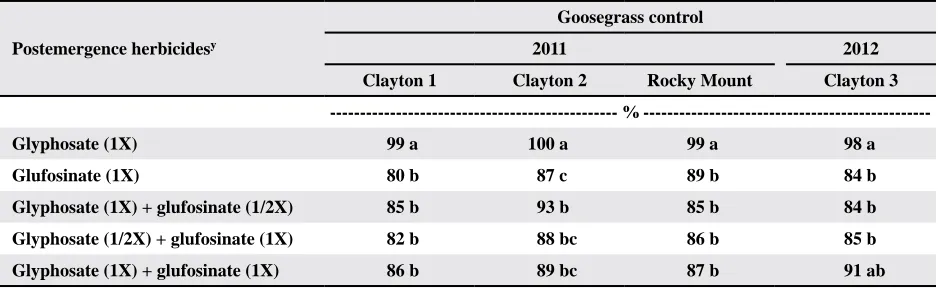
Annual grass control. Goosegrass was pres-ent at Rocky Mount and at each of the Clayton locations. Glyphosate controlled this weed 98 to 100% 7 DAP1 and was 10 to 19% more effective than glufosinate (Table 6). Others have reported that glyphosate is more effective than glufosinate
on goosegrass (Corbett et al., 2004; Culpepper et
al., 2000). Glyphosate co-applied with glufosinate and glufosinate applied alone were similarly ef-fective at all locations except Clayton 2. At this location, compared to glufosinate alone, glyphosate 1X plus glufosinate 1/2X controlled goosegrass
slightly greater. However, glyphosate 1X plus glu-fosinate 1X was no better than gluglu-fosinate applied sequentially. Additionally, co-applied glufosinate and glyphosate controlled goosegrass less than glyphosate applied alone except for glyphosate 1X plus glufosinate 1X at Clayton 3. Glufosinate antagonism of glyphosate has been reported on goosegrass, giant foxtail (Setaria faberi Herrm.),
Italian ryegrass (Lolium perenne L. ssp. multiflorum
[Lam.] Husnot.), rye (Secale cereal L.), and wheat (Triticum aestivum L.) (Bethke et al., 2013; Chahal et al., 2012; Chuah et al. 2008).
Glyphosate applied POST-1 and POST-2 con-trolled goosegrass 98 to 100% compared with 87 to 88% control by glufosinate applied sequentially 7 DAP2 (Table 7). Similar control at all locations was noted with glyphosate applied sequentially (98 to 100%) and glyphosate fb glufosinate (100%). Glufosinate fb glyphosate (93 to 99%) controlled goosegrass similar to glyphosate applied sequen-tially (98 to 100%) at Clayton 2, Clayton 3, and Rocky Mount, but 5% less than two applications
of glyphosate at Clayton 1. Glyphosate POST-1 fb glufosinate POST-2 controlled goosegrass 100% and was more effective than glufosinate applied sequentially (87 to 88%) at all locations. Glufosinate POST-1 fb glyphosate POST-2 (95 to 99%) was more effective than glufosinate applied sequentially (87 to 88%) at the Clayton locations. Compared to glyphosate alone, goosegrass control was reduced 5 to 11% and 12 to 20% by co-ap-plication of glyphosate and glufosinate at Clayton 1 and Rocky Mount, respectively. At Clayton 2,
glufosinate 1X plus glyphosate 1/2X or 1X was less effective than glyphosate alone. Compared to glyphosate alone, co-applied glyphosate and glufosinate reduced goosegrass control 13 to 22% at Rocky Mount, except for glyphosate 1X plus glufosinate 1X. Glyphosate at 1/2X co-applied with glufosinate did not improve control compared to glufosinate alone. However, glyphosate at 1X co-applied with glufosinate increased control at two of four locations.
Diuron plus MSMA applied layby masked some of the differences in goosegrass control noted 7 DAP2 (Table 8). At 7 d after layby, all treatments at Clayton 1 and Clayton 2 controlled goosegrass 97 to 100%. At Clayton 3, sequential applications of glyphosate fb diuron plus MSMA controlled goosegrass 95% compared with 80 to 87% control by all other treatments. At Rocky Mount, sequen-tial applications of glyphosate or glufosinate , and glufosinate fb glyphosate controlled goosegrass 93 to 98%. Other treatments controlled goosegrass 86 to 89%. Similar trends were noted for goosegrass control late in the season (data not shown).
Table 6. Goosegrass control 7 d after first postemergence application of glyphosate, glufosinate, and co-applications of glyphosate and glufosinatez.
Postemergence herbicidesy
Goosegrass control
2011 2012
Clayton 1 Clayton 2 Rocky Mount Clayton 3
--- %
---Glyphosate (1X) 99 a 100 a 99 a 98 a
Glufosinate (1X) 80 b 87 c 89 b 84 b
Glyphosate (1X) + glufosinate (1/2X) 85 b 93 b 85 b 84 b
Glyphosate (1/2X) + glufosinate (1X) 82 b 88 bc 86 b 85 b
Glyphosate (1X) + glufosinate (1X) 86 b 89 bc 87 b 91 ab
z Means within a column followed by the same letter are not different according to Fisher’s Protected LSD at p ≤ 0.05.
y Herbicides were applied to 2-leaf cotton 18 to 22 d after planting. The 1X rates of glyphosate and glufosinate were 868
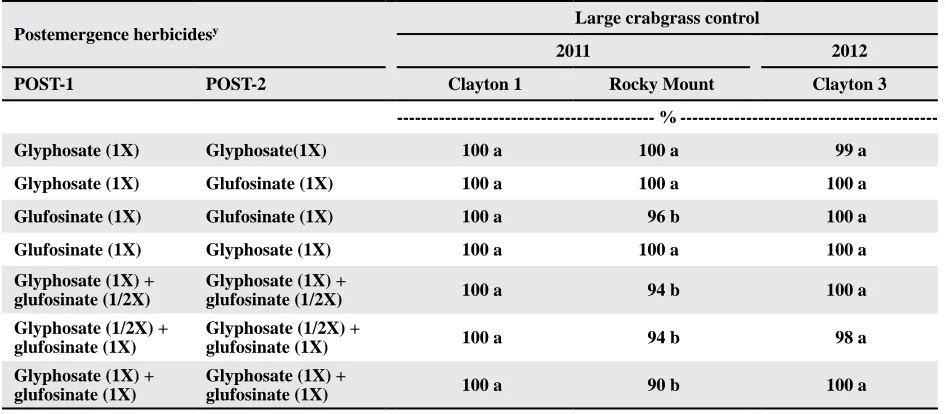
Large crabgrass was present at the Clayton 1, Clayton 3, and Rocky Mount locations. All herbi-cides and herbicide combinations applied POST-1 controlled this weed 98 to 100% (data not shown). Following POST-2 application, all treatments at Clayton 1 and Clayton 3 controlled large crabgrass 98 to 100% (Table 9). At Rocky Mount, glyphosate alone and glyphosate plus glufosinate applied
se-Table 7. Goosegrass control 7 d after the second postemergence application of glyphosate, glufosinate, and co-applications of glyphosate and glufosinatez.
Postemergence herbicidesy Goosegrass control
2011 2012
POST-1 POST-2 Clayton 1 Clayton 2 Rocky Mount Clayton 3
--- %
---Glyphosate (1X) Glyphosate(1X) 100 a 98 ab 100 a 100 a
Glyphosate (1X) Glufosinate (1X) 100 a 100 a 100 a 100 a
Glufosinate (1X) Glufosinate (1X) 88 c 88 c 88 bc 87 b
Glufosinate (1X) Glyphosate (1X) 95 b 99 a 93 ab 98 a
Glyphosate (1X) + glufosinate (1/2X)
Glyphosate (1X) +
glufosinate (1/2X) 91 c 93 bc 80 c 78 b
Glyphosate (1/2X) + glufosinate (1X)
Glyphosate (1/2X) +
glufosinate (1X) 89 c 89 c 88 bc 87 b
Glyphosate (1X) + glufosinate (1X)
Glyphosate (1X) +
glufosinate (1X) 95 b 88 c 80 c 98 a
z Means within a column followed by the same letter are not different according to Fisher’s Protected LSD at p ≤ 0.05.
y POST-1 herbicides were applied to 2-leaf cotton 18 to 22 d after planting. POST-2 herbicides were applied 14 days later.
The 1X rates of glyphosate and glufosinate were 868 and 543 g ha-1, respectively.
Table 8. Goosegrass control by glyphosate, glufosinate, and co-applications of glyphosate and glufosinate 7 d after layby applicationz.
Postemergence herbicidesy Goosegrass control
2011 2012
POST-1 POST-2 Clayton 1 Clayton 2 Rocky Mount Clayton 3
--- %
---Glyphosate (1X) Glyphosate(1X) 100 a 99 a 98 a 95 a
Glyphosate (1X) Glufosinate (1X) 100 a 100 a 87 c 87 b
Glufosinate (1X) Glufosinate (1X) 98 a 98 a 97 ab 82 b
Glufosinate (1X) Glyphosate (1X) 100 a 100 a 93 ab 87 b
Glyphosate (1X) + glufosinate (1/2X)
Glyphosate (1X) +
glufosinate (1/2X) 99 a 97 a 86 c 82 b
Glyphosate (1/2X) + glufosinate (1X)
Glyphosate (1/2X) +
glufosinate (1X) 98 a 100 a 87 bc 80 b
Glyphosate (1X) + glufosinate (1X)
Glyphosate (1X) +
glufosinate (1X) 99 a 98 a 89 bc 85 b
z Means within a column followed by the same letter are not different according to Fisher’s Protected LSD at p ≤ 0.05.
y POST-1 herbicides were applied to 2-leaf cotton 18 to 22 d after planting. POST-2 herbicides were applied 14 days
later. The 1X rates of glyphosate and glufosinate were 868 and 543 g ha-1, respectively. All treatments received a
postemergence-directed layby application of diuron plus MSMA at 841 plus 2240 g ha-1, respectively, 2 to 3 wk after
POST-2 application.
quentially, regardless of order of application, con-trolled large crabgrass 100%. Glufosinate applied POST-1 fb POST-2 and all sequential co-applications
of glufosinate and glyphosate were 4 to 10% less
Table 9. Large crabgrass control 7 d after the second postemergence application of glyphosate, glufosinate, and co-applications of glyphosate and glufosinatez.
Postemergence herbicidesy Large crabgrass control
2011 2012
POST-1 POST-2 Clayton 1 Rocky Mount Clayton 3
--- %
---Glyphosate (1X) Glyphosate(1X) 100 a 100 a 99 a
Glyphosate (1X) Glufosinate (1X) 100 a 100 a 100 a
Glufosinate (1X) Glufosinate (1X) 100 a 96 b 100 a
Glufosinate (1X) Glyphosate (1X) 100 a 100 a 100 a
Glyphosate (1X) + glufosinate (1/2X)
Glyphosate (1X) +
glufosinate (1/2X) 100 a 94 b 100 a
Glyphosate (1/2X) + glufosinate (1X)
Glyphosate (1/2X) +
glufosinate (1X) 100 a 94 b 98 a
Glyphosate (1X) + glufosinate (1X)
Glyphosate (1X) +
glufosinate (1X) 100 a 90 b 100 a
z Means within a column followed by the same letter are not different according to Fisher’s Protected LSD at p ≤ 0.05.
y POST-1 herbicides were applied to 2-leaf cotton 18 to 22 d after planting. POST-2 herbicides were applied 14 days later.
The 1X rates of glyphosate and glufosinate were 868 and 543 g ha-1, respectively.
Cotton injury and yield. The ‘FM 1944GLB2’
cotton at Mount Olive sustained no injury from either glyphosate or glufosinate. This cultivar contains both the GlyTol and LibertyLink traits and is resistant to both glyphosate and glufosinate
(Wallace et al., 2011). Injury at the other locations,
which included WideStike cotton, was expressed as foliar necrosis. Glufosinate alone caused 5 to
10% and 4 to 10% necrosis 7 DAP1 and 7 DAP2,
respectively (data not shown). At both locations in 2011, but not in 2012, co-application of glypho-sate with glufosinate increased necrosis 2 to 7% 7 DAP1 (data not shown). Steckel et al. (2012) also observed greater injury with co-applied glufosinate and glyphosate applied to WideStrikecotton. Cot-ton injury in the current study was transient with little to no injury observed at layby. The amount of necrosis in this study was similar to that reported previously with glufosinate applied to WideStrike varieties (Culpepper et al., 2009; Whitaker et al., 2011). Utilization of the rates and number of ap-plications investigated in this study, glufosinate would be expected to have no adverse effect on yield of WideStrikecotton (Culpepper et al., 2009; Steckel et al., 2012; Whitaker et al., 2011).
No cotton yield differences were observed among herbicide treatments at Clayton 2, Rocky
Mount, or Mount Olive (Table 10). Although differences in Palmer amaranth control were observed at these locations, all treatments con-trolled Palmer amaranth at least 80% 7 DAP2
and 7 d after layby (Tables 4 and 5). At Clayton
1, cotton yield was similar following glyphosate only and sequential application of glyphosate and glufosinate alone or as a co-application (Table
10). In addition, cotton yield following glufos
-inate only was greater than glyphosate only and glyphosate plus glufosinate co-applications treat-ments. These yield responses did not correlate
with Palmer amaranth control (Tables 4 and 5).
Cotton yield at Clayton 3 following glyphosate POST-1 and POST-2 was less than yield with all other treatments (Table 10). Palmer amaranth was
controlled only 64% at 7 DAP2 by this treatment
compared with at least 88% control by all other
treatments (Table 4). Glyphosate only or glypho
One component of a resistance management strategy is use of multiple, effective modes of action against species most prone to herbicide resistance (Norsworthy et al., 2012). Rotation of a GR crop with a glufosinate-tolerant crop would allow use of both glyphosate and glufosinate within the rotation. For resistance management, this would be prefer-able to continuous use of either herbicide alone. However, use of both herbicides within the same crop year would more effectively delay resistance evolution than annual herbicide rotation (Norsworthy et al., 2012). Thus, cotton cultivars with tolerance to both glyphosate and glufosinate, such as those with the GlyTol LibertyLink traits or those with the WideStrike trait, could be useful in a management program to avoid selection for resistance. The ques-tion that arises is whether the two herbicides should
be applied sequentially or as a mixture. In fields
currently without resistant biotypes, co-applications of the two herbicides theoretically would be more effective in preventing resistance selection than sequential applications (Diggle et al., 1993; Powles et al., 1997). Co-applications of glyphosate and glufosinate would have characteristics deemed es-sential for prevention of resistance (Norsworthy et al., 2012). Glyphosate and glufosinate are both effective on Palmer amaranth (assuming susceptible biotypes
Table 10. Cotton yield following postemergence application of glyphosate, glufosinate, and co-applications of glyphosate and glufosinatez.
Postemergence herbicidesy
Seed cotton yield
2011 2012
Clayton 1 Clayton 2 Rocky
Mount Clayton 3 Micro
Mount Olive
POST-1 POST-2
--- kg ha-1
---Glyphosate (1X) Glyphosate(1X) 3910 bc 2190 a 1340 a 2620 b 0 c 3360 a
Glyphosate (1X) Glufosinate (1X) 3960 abc 2890 a 1580 a 3380 a 0 c 4180 a
Glufosinate (1X) Glufosinate (1X) 4200 a 2540 a 1710 a 3350 a 2630 a 3690 a
Glufosinate (1X) Glyphosate (1X) 4090 ab 2810 a 1220 a 3750 a 2090 b 4030 a
Glyphosate (1X) + glufosinate (1/2X)
Glyphosate (1X) +
glufosinate (1/2X) 3910 bc 2780 a 1540 a 3330 a 1900 b 4180 a
Glyphosate (1/2X) + glufosinate (1X)
Glyphosate (1/2X) +
glufosinate (1X) 3880 bc 2900 a 1730 a 3680 a 2760 a 4060 a
Glyphosate (1X) + glufosinate (1X)
Glyphosate (1X) +
glufosinate (1X) 3750 c 2620 a 1800 a 3640 a 2700 a 3860 a
z Means within a column followed by the same letter are not different according to Fisher’s Protected LSD at p ≤ 0.05.
y POST-1 herbicides were applied to 2-leaf cotton 18 to 22 d after planting. POST-2 herbicides were applied 14 days
later. The 1X rates of glyphosate and glufosinate were 868 and 543 g ha-1, respectively. All treatments received a
postemergence-directed layby application of diuron plus MSMA at 841 plus 2240 g ha-1, respectively, 2 to 3 wk after
POST-2 application.
and timely application of glufosinate), and they have different modes of action (Devine et al., 1993; Steir-rucken and Amrhein, 1980). However, glufosinate mixed with glyphosate might antagonize glyphosate on glyphosate-susceptible Palmer amaranth (Reed et
al., 2014) and grasses (Bethke et al., 2013; Chahal et
al., 2012; Chuah et al. 2008). Because of antagonism, Norsworthy et al. (2012) suggested that sequential applications would be superior to co-applications for reducing risks of resistance.
Most Palmer amaranth populations in North Carolina, and probably across the Southeast and Mid-South, already have GR biotypes comprising at least
part of the population (Poirier et al., 2014). In the
current study, control by glyphosate alone indicated 10 to 15% of the population at Clayton 1, Clayton 2, Rocky Mount, and Mount Olive; about 35% at Clayton 3; and more than 90% at Micro was
resis-tant to glyphosate (Table 4). Large populations of
Palmer amaranth can build up quickly (Norsworthy
et al., 2014). That, along with the devastation caused by the weed in cotton and the difficulty of control,
especially when it is resistant to commonly used herbicides (Culpepper et al. 2010), means Palmer amaranth must be the primary focus in formulating
weed management programs. In fields with Palmer
primary objective of a management program should be reducing the seedbank (Norsworthy et al., 2012). Considering the fecundity of Palmer amaranth, es-sentially complete control is necessary to reduce the seedbank (Culpepper et al., 2010; Norsworthy et al.,
2014). At every location in this study, regardless of
the percentage of the population thought to be GR, sequential applications of glufosinate was more ef-fective than glyphosate applied sequentially (Table
4). In fields where a GR biotype comprises a large
percentage of the population, such as the Micro location, glyphosate and glufosinate applied sequen-tially would be much less effective than glufosinate applied sequentially. And, similar to observations by Wiggins et al. (2013), there was no improve-ment in control when glyphosate is co-applied with glufosinate, because most individuals were resistant to glyphosate. Glyphosate would do little in this situation to reduce selection pressure on glufosinate.
At locations other than Micro, where most of the Palmer amaranth was still susceptible to glypho-sate, glyphosate could substitute for one of the
glufosinate applications without sacrificing Palmer
amaranth control. Residual soil-applied herbicides are recommended in cotton management programs for Palmer amaranth (Culpepper et al., 2013; Scott
and Smith, 2011; Wilson et al., 2011; York, 2014).
Good Palmer amaranth control by soil-applied her-bicides would increase the success with sequential POST applications of glufosinate and glyphosate. Because glufosinate added to glyphosate reduced large crabgrass and goosegrass control compared to glyphosate alone, sequential applications would be more effective on grasses.
ACKNOWLEDGMENTS
Partial funding for this research was provided by the cotton producers of North Carolina through the
Cotton Incorporated State Support Program.
REFERENCES
Anonymous. 2014. Liberty® 280 SL Herbicide label [Online].
Available at http://www.cdms.net/LDat/ldUA5004.pdf (verified 18 March 2015).
Barnett, K.A., A.S. Culpepper, A.C. York, and L.E. Steckel. 2013. Palmer amaranth (Amaranthus palmeri) control by
glufosinate plus fluometuron applied postemergence to
WideStrike® cotton. Weed Technol. 27:291–297.
Barnett, K.A., A.S. Culpepper, A.C. York, and L.E. Steckel. 2015. Evaluation of WideStrike® cotton response to re-peated applications of glufosinate at various application
timings. Weed Technol. 29: 154–160.
Bethke, R.K., W.T. Molin, C. Sprague, and D. Penner. 2013. Evaluation of the interaction between glyphosate and
glufosinate. Weed Sci. 61:41–47.
Chahal, G.S., D.L. Jordan, J.D. Burton, D. Danehower, A.C.
York, P.M. Eure, and B. Clewis. 2012. Influence of water quality and co-applied agrochemicals on efficacy of
glyphosate. Weed Technol. 25:167–176.
Chuah, T.S., H.H. Teh, T.S. Cha, and B.S. Ismail. 2008.
Antagonism of glufosinate ammonium activity caused by glyphosate in the tank mixtures used for control goose-grass (Eleusine indica Gaertn.). Plant Protect. Quart. 23:116–119.
Corbett, J.L., S.D. Askew, W.E. Thomas, and J.W. Wilcut.
2004. Weed efficacy evaluations for bromoxynil, glu -fosinate, glyphosate, pyrithiobac, and sulfosate. Weed
Technol. 18:443–453.
Culpepper, A.S., and A.C. York. 1997. Weed management in no-tillage bromoxynil-tolerant cotton (Gossypium hirsu-tum). Weed Technol. 11:335–345.
Culpepper, A.S., and A.C. York. 1998. Weed management in
glyphosate-tolerant cotton. J. Cotton Sci. 2:174–185.
Culpepper, A.S., and A.C. York. 1999. Weed management in glufosinate-resistant corn (Zea mays). Weed Technol.
13:324–333.
Culpepper, A.S., T.L. Grey, W.K. Vencill, J.M. Kichler, T.M. Webster, S.M. Brown, A.C. York, J.W. Davis, and W.W. Hanna. 2006. Glyphosate-resistant palmer amaranth (Amaranthus palmeri) confirmed in Georgia. Weed Sci.
54:620–626.
Culpepper, A.S., J. Kichler, and A.C. York. 2013. UGA pro-grams for controlling Palmer amaranth in 2013 cotton. Publ. C952. Univ. Georgia Coop. Ext. Serv., Athens, GA [Online]. Available at
http://extension.uga.edu/publica-tions/detail.cfm?number=C952 (verified 18 March 2015).
Culpepper, A.S., T.M. Webster, L.M. Sosnoskie, and A.C. York. 2010. Glyphosate-resistant Palmer amaranth in the United States. p. 195–212 In V.K. Nandula (ed.). Glyphosate Resistance in Crops and Weeds: History, Development, and Management. John Wiley & Sons, Hoboken, NJ.
Culpepper, A.S., A.C. York, R.B. Batts, and K.M. Jennings. 2000. Weed management in glufosinate- and glypho-sate-resistant soybean (Glycine max). Weed Technol.
Culpepper, A.S., A.C. York, P. Roberts, and J.R. Whitaker. 2009. Weed control and crop response to glufosinate
applied to ‘PHY 485 WRF’ cotton. Weed Technol.
23:356–362.
Devine, M.D., S.O. Duke, and C. Fedtke. 1993. Inhibition of
amino acid biosynthesis. p. 251–291 In Physiology of Herbicide Action. Prentice-Hall, Englewood Cliffs, NJ. Diggle, A.J., P.B. Neve, and F.P. Smith. 2003. Herbicides
used in combination can reduce the probability of
her-bicide resistance in finite weed populations. Weed Res. 43:371–382.
Ehleringer, J. 1983. Ecophysiology of Amaranthus palmeri, a Sonoran Desert summer annual. Oecologia 57:107–112. Frans, R.E., R. Talbert, D. Marx, and H. Crowley. 1986.
Experimental design and techniques for measuring and analyzing plant responses to weed control practices.
p. 29–46 In N. D. Camper (ed.). Research Methods in Weed Science. Southern Weed. Science Society, Las Cruces, NM.
Gardner, A.P., A.C. York, D.L. Jordan, and D.W. Monks. 2006. Management of annual grasses and Amaranthus spp. in glufosinate-resistant cotton. J. Cotton Sci. 10: 328–338. Grafen, A. and R. Hails. 2002. Selecting a transformation.
p. 179–179 In Modern Statistics for the Life Sciences.
Oxford University Press Inc., New York, NY.
Gressel, J., and L. A. Segel. 1990. Modelling the effectiveness of herbicide rotations and mixtures as strategies to delay
or preclude resistance. Weed Technol. 4: 186–198. Heap, I. 2014. International survey of herbicide resistant
weeds [Online database]. Available at
http://www.weed-science.org (verified 18 March 2015).
Hinchee, M.A.W., S.R. Padgette , G.M. Kishore , X. Delan-nay , and R.T. Fraley . 1993. Herbicide-tolerant crops. p.
243–263 In S. Kung and R. Wu (eds.). Transgenic Plants.
Academic Press, Inc., San Diego, CA.
Hoffner, A.E., D.L. Jordan, A. Chandi, A.C. York, E.J. Dun-phy, and W.J. Everman. 2012. Management of Palmer amaranth (Amaranthus palmeri) in glufosinate-resistant soybean (Glycine max) with sequential applications of
herbicides [Online]. ISRN Agron., vol. 2012. Article ID 131650 (doi:10.5402/2012/131650) (verified 18 March
2015).
Hoss, N.E., K. Al-Khatib, D.E. Peterson, and T.M. Loughin.
2003. Efficacy of glyphosate, glufosinate, and imazetha -pyr on selected weed species. Weed Sci. 51:110–117.
Koger, C.H., I.C. Burke, D.K. Miller, J.A. Kendig, K.N.
Reddy, and J.W. Wilcut. 2007. MSMA antagonizes
glyphosate and glufosinate efficacy on broadleaf and
grass weeds. Weed Technol. 21:159–165.
MacRae, A.W., A.S. Culpepper, T.M. Webster, L.M. Sos-noskie, and J.M. Kichler. 2008. p. 1696 In Proc. Belt-wide Cotton Conf., Nashville, TN. 8-11 Jan. 2008. Natl. Cotton Counc. Am., Memphis, TN.
Mehlich,A. 1984. Photometric determination of humic matter
in soils, a proposed method. Commun. Soil Sci. Plant
Anal. 15:1417–1422.
Meijer, A.D., and K.L. Edmisten. 2014. Cotton production
with conservation tillage. p. 156–163 In 2014 Cotton
Information. Publ. AG-417. North Carolina Coop. Ext.
Serv., Raleigh, NC [Online]. Available at http://cotton.
ces.ncsu.edu/wp-content/uploads/2014/02/2014-Cotton-Information.pdf (verified 18 March 2015).
Morgan, G.D., P.A. Baumann, and J.M. Chandler. 2001. Competitive impact of Palmer amaranth (Amaranthus palmeri) on cotton (Gossypium hirsutum) development
and yield. Weed Technol. 15:408–412.
Norsworthy, J.K., G. Griffith, T. Griffin, M. Bagavathiannan, and E.E. Gbur. 2014. In-field movement of
glyphosate-resistant Palmer amaranth (Amaranthus palmeri) and its impact on cotton lint yield: evidence supporting a
zero-threshold strategy. Weed Sci. 62:237–249.
Norsworthy, J.K., G.M. Griffith, R.C. Scott, K.L. Smith, and L.R. Oliver. 2008. Confirmation and control of glypho -sate-resistant palmer amaranth (Amaranthus palmeri) in Arkansas. Weed Technol. 22:108–113.
Norsworthy, J.K., S.M. Ward, D.R. Shaw, R.S. Llewellyn, R.L. Nichols, T.M. Webster, K.W. Bradley, G. Frisvold, S.B. Powles, N.R. Burgos, W.W. Witt, and M. Barrett. 2012. Reducing the risks of herbicide resistance: best management practices and recommendations. Weed Sci. 60:31–62.
Place, G., D. Bowman, M. Burton, and T. Rufty. 2008. Root penetration through a high bulk density soil layer: dif-ferential response of crop and weed species. Plant Soil 307:179–190.
Poirier, A.H., A.C. York, D.L. Jordan, A. Chandi, W.J.
Ever-man, and J.R. Whitaker. 2014. Distribution of glypho -sate- and thifensulfuron-resistant Palmer amaranth (Amaranthus palmeri) in North Carolina [Online].
J. Int. Agron., Vol. 2014. Article ID 747810 (doi: 10.1155/2014/747810) (verified 18 March 2015). Powles, S.B., C. Preston, I.B. Bryan, and A.R. Jutsum. 1997.
Herbicide resistance: impact and management. Adv. Agron. 58:57–93.
Reed, J.D., J.W. Keeling, and P.A. Dotray. 2014. Palmer
Rowland, M.W., D.S. Murray, and L.M. Verhalen. 1999. Full-season Palmer amaranth (Amaranthus palmeri) interference with cotton (Gossypium hirsutum). Weed
Sci. 45:305–309.
Scott, G.H., S.D. Askew, and J.W. Wilcut. 2002. Glyphosate systems for weed control in glyphosate-tolerant cotton (Gossypium hirsutum). Weed Technol. 16:191–198. Scott, B., and K. Smith. 2011. Prevention and control of glyphosate-resistant pigweed in soybean and cotton. Publ. FSA2152. Univ. Arkansas Coop. Ext. Serv., Little Rock, AR.
Smith, D.T., R.V. Baker, and G.L. Steele. 2000. Palmer ama-ranth (Amaama-ranthus palmeri) impacts on yield, harvesting, and ginning in dryland cotton (Gossypium hirsutum).
Weed Technol. 14:122–126.
Sosnoskie, L.M., J.M. Kichler, R.D. Wallace, and A.S. Cul-pepper. 2011. Multiple resistance in Palmer amaranth to
glyphosate and pyrithiobac confirmed in Georgia. Weed
Technol. 59:321–325.
Steckel, L.E., D. Stephenson, J. Bond, S.D. Stewart, and K.A. Barnett. 2012. Evaluation of WideStrike® Flex cotton response to over-the-top glufosinate tank mixtures. J. Cotton Sci. 16:88–95.
Steckel, G.J., L.M. Wax, F.W. Simmons, and W.H. Phillips, II. 1997. Glufosinate efficacy on annual weeds is influenced
by rate and growth stage. Weed Technol. 11:484–488.
Steirrucken, H.C., and N. Amrhein. 1980. The herbicide glyphosate is a potent inhibitor of 5-enolpyruvyl-shikim-ic acid-3-phosphate synthase. Biochem. Bioph. Res. Co.
94:1207–1212.
Stewart, S.D., L.E. Steckel, and S. Steckel. 2013. Evaluation of WideStrike® cotton (Gossypium hirsutum) injury from early season herbicide and insecticide tank mixes. J. Cot-ton Sci. 17:219–226.
Sweeney, J.A., and M.A. Jones. 2015. Glufosinate tolerance of multiple WideStrike and Liberty-Link cotton (Gos-sypium hirsutum) cultivars. Crop Sci. 55:1–8.
US Department of Agriculture – Agricultural Marketing
Ser-vice [USDA-AMS] 2014. Cotton Varieties Planted 2014
Crop. Publ. mp_cn 833. U.S. Dept. Agric., Washington, DC [Online]. Available at http://www.ams.usda.gov/
mnreports/cnavar.pdf (verified 18 March 2015).
US Department of Agriculture – Animal and Plant Health
Inspection Service. [USDA-APHIS]. 2003. Approval of Aventis CropScience USA LP Petition (02-042-01p)
Seeking a Determination of Non-regulated Status for Glufosinate-ammonium Herbicide-tolerant Cotton Transformation Event LLCotton25 [Online]. Available at
http://www.aphis.usda.gov/brs/aphisdocs2/02_04201p_ com.pdf (verified 18 March 2015).
US Department of Agriculture – Animal and Plant Health
Inspection Service. [USDA-APHIS]. 2008. Determina -tion of Non-regulated Status for Glyphosate-Tolerant (GlyTolTM) Cotton, Gossypium hirsutum, event GHB614 [Online]. Available at http://www.aphis.usda.gov/brs/
aphisdocs/06_33201p_pea.pdf (verified 18 March 2015). US Environmental Protection Agency – Office of Pesticide
Programs. [USEPA-OPP]. 2005. Bt Cry1F/Cry1Ac WideStrike Cotton Registration Action Document [Online]. Available at http://www.epa.gov/oppbppd1/ biopesticides/ingredients_keep/tech_docs/brad_006512.
pdf (verified 18 March 2015).
Wallace, R.D., L.M. Sosnoskie, A.S. Culpepper, A.C. York, K.L. Edmisten, M.G. Patterson, M.A. Jones, H.L. Crooks, G.L. Cloud, and J. Pierson. 2011. Tolerance of GlyTol® and GlyTol® + LibertyLink® cotton to glypho-sate and glufosinate in the southeastern U.S. J. Cotton Sci. 15:80–88.
Webster, T.M. 2013. Weed survey – southern states: broadleaf crops subsection. p. 275–287 In Proc. South. Weed Sci. Soc., Houston, TX. 28-30 Jan. 2013. South. Weed Sci. Soc., Las Cruces, NM.
Whitaker, J.R., A.C. York, D.L. Jordan, and A.S. Culpepper. 2011. Weed management with glyphosate- and
glufos-inate-based systems in PHY 485 WRF cotton. Weed
Technol. 25:183–191.
Wiesbrook, M.L., W.G. Johnson, S.E. Hart, P.R. Bradley, and L.M. Wax. 2001. Comparison of weed management sys-tems in narrow-row, glyphosate- and glufosinate-resis-tant soybean (Glycine max). Weed Technol. 15:122–128. Wiggins, M.S., L.E. Steckel, and K.A. Barnett. 2013.
Glypho-sate and glufosinate application timing for Glytol® + Liberty Link® systems. p. 666 In Proc. Beltwide Cotton Conf., San Antonio, TX. 7-10 Jan. 2013. Natl. Cotton Counc. Am., Memphis, TN.
Wilcut, J.W., A.C. York, and D.L. Jordan. 1995. Weed
man-agement systems for oil seed crops. p. 343–400 In A. E. Smith (ed.) Handbook of Weed Management Systems. Marcel Dekker, New York.
Wilson, R.G., B.G. Young, J.L. Matthews, S.C. Weller, W.G. Johnson, D.L. Jordan. M.K. D. Owen, P.M. Dixon, and D.R. Shaw. 2011. Benchmark study on
glyphosate-resis-tant cropping systems in the United States. Part 4: Weed
management practices and effects on weed populations and soil seed banks. Pest. Manag. Sci. 67:771–780. Wright, S.R., M.W. Jennette, H.D. Coble, and T.W. Rufty.
1999. Root morphology of young Glycine max, Senna obtusifolia, and Amaranthus palmeri. Weed Sci.
Wright, S.D., A. Shrestha, R.B. Hutmacher, G. Banuelos, K.A.
Hutmacher, S.I. Rios, M. Dennis, K.A. Wilson, and S.J. Avila. 2014. Glufosinate safety in WideStrike® Acala
cotton. Weed Technol. 28:104–110.
Wrubel, R.P., and J. Gressel. 1994. Are herbicide mixtures
useful for delaying the rapid evolution of resistance? A
case study. Weed Technol. 8:635–648.
York, A.C. 2014. Weed Management in Cotton. p. 66–117.
In 2014 Cotton Information. Publ. AG-417. North Carolina Coop. Ext. Serv., Raleigh, NC [Online]. Available at http://cotton.ces.ncsu.edu/wp-content/
uploads/2014/02/2014-Cotton-Information.pdf (verified