University of New Orleans University of New Orleans
ScholarWorks@UNO
ScholarWorks@UNO
University of New Orleans Theses and
Dissertations Dissertations and Theses
12-15-2007
Exploring an Monolingual English - Speaking Teacher's
Exploring an Monolingual English - Speaking Teacher's
Perceptions of Classroom Interventions to Foster Hispanic
Perceptions of Classroom Interventions to Foster Hispanic
English Language Learners' Primary Language
English Language Learners' Primary Language
Alexandra Joan Herques University of New Orleans
Follow this and additional works at: https://scholarworks.uno.edu/td
Recommended Citation Recommended Citation
Herques, Alexandra Joan, "Exploring an Monolingual English - Speaking Teacher's Perceptions of Classroom Interventions to Foster Hispanic English Language Learners' Primary Language" (2007). University of New Orleans Theses and Dissertations. 609.
https://scholarworks.uno.edu/td/609
This Dissertation is protected by copyright and/or related rights. It has been brought to you by ScholarWorks@UNO with permission from the rights-holder(s). You are free to use this Dissertation in any way that is permitted by the copyright and related rights legislation that applies to your use. For other uses you need to obtain permission from the rights-holder(s) directly, unless additional rights are indicated by a Creative Commons license in the record and/ or on the work itself.
Exploring an MonolingualEnglish - Speaking Teacher’s
Perceptions of Classroom Interventions to Foster Hispanic English Language Learners’ Primary Language
A Dissertation
Submitted to the Graduate Faculty of the University of New Orleans In partial fulfillment of the Requirements for the degree of
Doctor in Philosophy in
The Department of Curriculum and Instruction
by
Alexandra Joan Herques
B.S., University of Louisiana at Lafayette, 1998 M.ED., Nicholls State University, 2003
Acknowledgements
Since this journey began in the year 2004 I have many people to thank for their support
and motivation. I would like to first recognize my mother and father for their belief in me that I
could conquer this large goal and for their advice on many issues that arose throughout this
process. I would also like to acknowledge my brother and sisters, especially my two sisters who
became my biggest cheerleaders as I completed this paper.
I wish to also acknowledge my friends who supported me through this process in their
own unique ways: I would like to thank my friend Scott for helping me with any technological
issues that arose throughout the course of my general exam, proposal and the completion of this
paper. I especially would like to thank my friend Bridget, who shared this journey with me as she
wrote her own dissertation. Specifically I would like to thank Bridget for all of her support,
insight and help in the completion of this paper. Lastly I would like to thank all of my friends
who did not invite me places so I would not be tempted to put my work to the side and have
some fun.
Finally, I would like to acknowledge the members of my committee for their patience,
advice, support and their knowledge in the area of English Language Learners and qualitative
research. I would especially like to thank Dr. April Bedford for the encouragement that she gave
me and for her unique way of knowing when I needed reassurance and support throughout this
process.
Overall, there are many people who have touched my life during the completion of this
degree and I would like to thank all of them for their support and confidence in me throughout
Table of Contents
List of Tables v
Abstract vi
Chapter I.
Introduction 1
Focus of the Study 5
Method of Investigation 7
Definitions 9
Significance of the Research 11
Conclusion 12
Chapter II.
Introduction 13
Hispanic English Language Learners 13
Conflicting Views on the Incorporating English Language Learners’
Primary Language into the Classroom Setting 19
The School’s Environment and the use of the English Language
Learners’ Primary Language in the Classroom Setting 28 Teachers and the use of English Language Learners’ Primary
Language in the Classroom Setting 34
Literature Review Conclusion 41
Theoretical Framework 41
Conclusion 51
Chapter III.
Introduction 52
Pilot Study 54
Research Design 58
Research Questions 61
Delimitations 62
Setting and Participants 63
Data Collection Methods 68
Data Analysis 81
Validity 84
Transferability 85
Ethical Issues 87
Conclusion 88
Chapter IV.
Introduction 90
Teacher Profile 91
School Environment Profile 93
Classroom Environment Profile 96
Themes 119
Hightened Awareness 119
Challenges 126
Changes to Interventions 130
Teacher Enjoyment 131
Conclusion 133
Chapter V.
Introduction 135
Mrs. Livingston 136
The School and the Classroom Environments 138
Hispanic English Language Learners in Mrs. Livingston’s Class 139 Mrs. Livingston and her Experiences with the Interventions that
may foster the use of Hispanic English Language Learners’ Primary
Language in the Classroom Setting 140
The Findings and Their Relation to the Needs of the Study 143
Limitations 144
Implications 145
Recommendations for Future Research 146
Summary 148
References 150
Appendixes
Appendix A 158
Appendix B 160
Appendix C 162
Appendix D 164
Appendix E 165
Appendix F 166
Tables and Figures
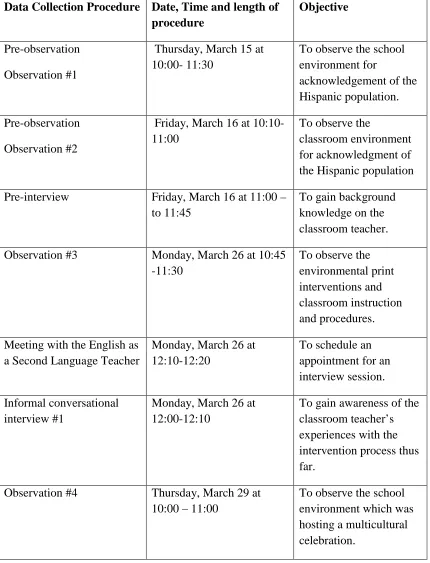
Table 1 Time line of data collection procedures 69
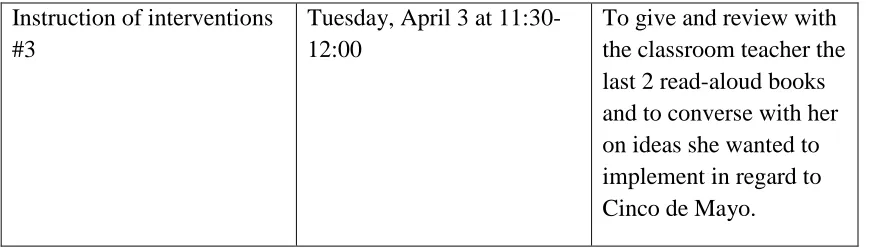
Table 2 Time line for instruction of interventions 75 Table 3 Spanish literature used in interventions 76
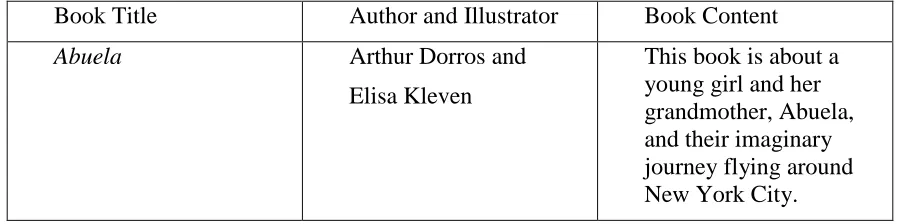
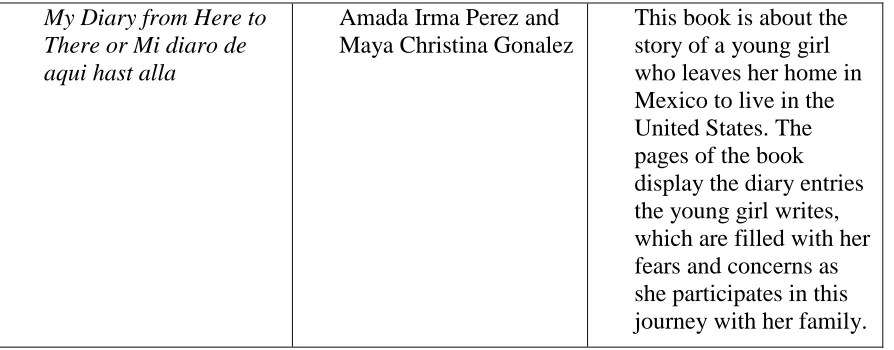
Table 4 Books used for real-alouds 77
Abstract
Although awareness of cultural diversity is slowly occurring, the need for multicultural
curricula is increasing more each day as even more ethnically and linguistically diverse students
enter into United States classrooms. The education of English Language Learners is a
controversial topic due to people’s mixed beliefs on the amount of English and primary language
instruction needed to aid students’ English language development. Due to the shortage of
bilingual teachers many English Language Learners in the Unites States are learning English
through the regular education classroom instructed by monolingual English-speaking teachers.
This case study implemented qualitative research methods in order to extend
understanding of how a monolingual English speaking teacher can strategically incorporate
Hispanic English Language Learner’s primary language into the classroom setting and the
teacher’s experiences throughout this process. This case study will introduce a monolingual
English speaking teacher to interventions that can foster the use of Hispanic English Language
Learners’ primary language in the classroom setting. The findings of this study include the
experiences the participating teacher encounters throughout the intervention process. These
findings include: heightened awareness, challenges, changes to interventions and enjoyment.
Key Words
Hispanic English Language Learners’ primary language
Monolingual English-speaking Teacher
Qualitative Case study
Chapter I
Introduction
The purpose of this case study is to extend understanding of how a monolingual English
speaking teacher can strategically incorporate Hispanic English Language Learners’ primary
language into the classroom setting and the teacher’s experiences throughout this process. This
case study will introduce a monolingual English speaking teacher to interventions that can foster
the use of Hispanic English Language Learners’ primary language in the classroom setting. The
findings of this study will include the experiences the participating teacher encounters
throughout the intervention process.
Although awareness of cultural diversity is slowly occurring, the need for multicultural
curricula is increasing more each day as even more ethnically diverse students enter into United
States classrooms. According to researchers at the University of Houston’s center for research on
education, “Hispanic students currently make up fifteen percent of the elementary school-age
population and will comprise nearly twenty-five percent of the total school age population by the
year 2025” (Padron, Waxman, & Rivera, 2002, p.2). United States’ classrooms have always
encompassed a large amount of diversity among their students. Historically, school-aged
students possessed differences in ethnic, cultural, religious and racial backgrounds. Today
students still enter school with the preceding differences, but presently these differences appear
broader and more complex than they have in the past (Ladson- Billings, 2001).
One of the major differences in today’s classrooms is differences in students’ linguistic
backgrounds. English Language Learners are students “who come from language backgrounds
other than English and whose English language proficiency is not yet developed to the point
of Medicine, 1997, p. 15). The United States has created various educational programs to
educate English Language Learners in American schools. These programs differ according to the
amount of English and primary language “that is used for instructional purposes” (Ochoa &
Rhodes, 2005, p. 77). These six programs are:
1. Structured Immersion or English-only programs— All the students in these programs are
English Language Learners from various language backgrounds. “They receive
instruction in English, with an attempt made to adjust the level of English so subject
matter is comprehensible. Typically there is no native-language support.” (National
Research Council Institute of Medicine, 1997, p. 19)
2. English as a second language (ESL) programs—“Students receive specified periods of
instruction aimed at the development of English-language skills, with a focus on
grammar, vocabulary, and communication rather than academic content areas” (p. 19).
This type of ESL program typically pulls the English Language Learners out of the
general education classroom to have a “more individualized focus on English language
development” (Ochoa & Rhodes, 2005, p. 78).
3. Content-based (ESL) programs—“Students receive specified periods of ESL instruction
that is structured around academic content rather than generic English language skills”
(National Research Council Institute of Medicine, 1997, p. 19).
4. Transitional bilingual education programs—“Most students in the program are English
Language Learners. They receive some degree of instruction through the primary
language; however, the goal of the program is to transition to English as rapidly as
possible, so that even within the program, there is a rapid shift toward using primarily
5. Maintenance bilingual education—“Most students in the program are English Language
Learners and from the same language background. They receive significant amounts of
their instruction in their primary language. Unlike transitional programs, these programs
aim to develop English proficiency, but also to develop academic proficiency in the
primary language” (National Research Council Institute of Medicine, 1997, p. 20).
6. Two-waybilingual programs or dual bilingual programs—Typically about half of the
students in this program have a primary language of English and “the other half are
English Language Learners from the same language group. The goal of the program is to
develop proficiency in both languages for both groups of students” (National Research
Council Institute of Medicine, 1997, p. 20).
Many researchers support two-way bilingual programs or dual bilingual programs for English
Language Learners and native English speakers (Cummins, 2001; Schwarzer, Haywood, &
Lorenzen, 2003).
Although programs have been developed to assist English Language Learners acquire
English language proficiency, the implementation of these programs depends on the availability
of resources to school districts (Ochoa & Rhodes, 2005). Some English Language Learners
receive as little as thirty minutes of English as a Second Language instruction weekly due to the
availability of certified English as a Second Language teachers in their particular school district.
It is important to realize that for English Language Learners who are enrolled in English as a
Second Language programs, this is typically the sole program they receive to meet their
linguistic needs (p. 78). Many school districts are unable to find an adequate number of certified,
English as a Second Language teachers to serve their English Language Learner population (p.
School districts have also experienced difficulties hiring bilingual teachers to teach the
bilingual education programs developed for English Language Learners. Although the number of
English Language Learners in the United States continues to grow steadily each year, only a
small percentage of these students are instructed by bilingual teachers (Freeman & Freeman,
1994). The shortage of bilingual teachers causes many English Language Learners in the United
States to acquire English as a second language through the regular general education curriculum
(Schwarzer, Haywood, & Lorenzen, 2003).
According to Hudelson (1987), teachers do not have to be bilingual to work effectively
with English Language Learners; however they do need to possess a thorough understanding of
their students’ language and learning and transform this knowledge into classroom practice.
Teachers who are assigned English Language Learner students very rarely receive instructional
support in working with these students in their classrooms. Fillmore and Snow (2000) contend
that it is very likely that most teachers have gone through the public school system without ever
having the opportunity to “study the structure of English or to learn another language, and as a
result, they do not feel very confident talking about language” (p. 10).
United States demographic changes have occurred so quickly that school districts cannot
keep up with the challenges these changes present (Boyd & Brock, 2004). “Between 1990 and
2000, the Hispanic population increased by approximately 10 million people, accounting for 38
percent of the nation’s overall population growth during the decade” (National Center for
Education Statistics, 2003, p. 6).
The lack of support school districts offer teachers leads some monolingual English
speaking teachers to base their classroom routines and curriculum on perceptions and myths they
among teachers according to Samway and McKeon (1999) is that teachers who instruct students
in English speaking classrooms “should not allow students to use their primary language, as this
will retard their English language development” (p. 12). Teachers who support this myth are
aware of the importance in helping their English Language Learners develop English language
proficiency, and they believe that the avenue to complete this task involves immersion
exclusively in the English language (Freeman & Freeman, 1993). The belief in this myth causes
some monolingual teachers to forbid the use of English Language Learners’ primary language in
the classroom setting. This myth is not reality. Krashen (1999) contends that first language
literacy is important in the teaching of English Language Learners. Students should be allowed
and encouraged to use their primary language in the classroom when English language
development is not the focus of instruction (Perez, 1994). English Language Learners should
also be allowed to speak their primary language with friends and school personnel who share
their linguistic culture because this action supports their native language maintenance and it
sends the message to the student that “diversity is not a problem, but rather an opportunity for
every American to experience other people’s culture” (Perez, 1994, p. 151).
Monolingual teachers who are educating English Language Learners in the context of the
regular education classroom can use the English Language Learners’ primary language as a
valuable tool for all students. This study investigates how a monolingual English-speaking
teacher can strategically incorporate Hispanic English Language Learners’ primary language into
the classroom setting and the teacher’s experiences throughout this process.
Focus of the Study
Building on the research that promotes the use of English Language Learners’ primary
understanding of how a monolingual English-speaking teacher can strategically incorporate
Hispanic English Language Learners’ primary language into the classroom setting and of the
teacher’s experiences throughout this process. A review of the literature explored various areas
related to this topic: first, an overview of Hispanic English Language Learners was explored in
order to understand these students’ backgrounds and challenges; second, the contradicting views
of including English Language Learners’ primary language in the classroom setting was
presented with the intention that the reader will become aware of the views related to this topic;
third, school environments and the use of English Language Learners’ primary language in the
classroom setting was explored in order for the reader to become familiar with the present state
of the use of English Language Learners’ primary language within the context of the classroom;
and last, teachers and the use of English Language Learners’ primary language in the classroom
setting was investigated so that the reader would understand that many variables are involved in
the relationship between the teacher and the use of English Language Learners’ primary
language in the context of the classroom.
The classroom teacher will be the primary participant in this case study and the majority
of the data gained will be based on her actions, thoughts and perceptions; therefore the research
questions that guide this study focus on the classroom teacher. The research questions are:
(1) What are the classroom teacher’s attitudes and perspectives before, during, and after the
implementation of interventions that foster the use of Spanish English Language
Learners’ primary language in the classroom setting?
(2) What are the experiences a monolingual English speaking teacher encounters throughout
the process of interventions that foster the use of Spanish-speaking English Language
(3) Based on the teacher’s perceptions of the students’ actions, how do all students respond
to the implementation of interventions that foster the use of Spanish-speaking English
Language Learners’ primary language in the classroom environment?
(4) How do the teacher’s perceptions of her students’ responses to the interventions that
foster the use of Spanish-speaking English Language Learners’ primary language in the
context of the classroom affect her actions and beliefs about the implementation of the
particular interventions utilized in her classroom?
A need exists to understand answers to the preceding questions in hopes of developing models
and theories on the implementation of English Language Learners’ primary language in the
context of the classroom in order to extend the knowledge base for pre-service teachers,
in-service teachers, education professors, and school administrators.
Method of Investigation
A qualitative case study was chosen in order to extend understanding of how a
monolingual English-speaking teacher can strategically incorporate Hispanic English Language
Learners’ primary language into the context of the classroom and of her experiences throughout
this process. This case study included instructing a monolingual English speaking teacher on the
interventions that may foster the use of English Language Learners’ primary language in the
classroom setting and observing the classroom teacher as she implemented these particular
interventions.
A case study was chosen due to the complexity of the relationship between the classroom
teacher, the school and classroom environment, and the students. The case study method also
may foster the use of English Language Learners’ primary language in the context of the
classroom.
Yin (2003) contends that “case study methods allow investigators to retain the holistic
and meaningful characteristics of real-life events” (p. 2). I observed a classroom teacher and her
students throughout the course of the school day. To record in the natural setting of the school
day, qualitative research was required. The qualitative research methods that will be used for this
particular case study in order to create an in-depth analysis of the case are: observations,
interviews and journal entries.
The first data collection methods conducted in this specific case study were a
pre-observation and a pre-interview. Pre-pre-observations and pre-interviews were conducted in order to
gather information to describe the participating teacher, the school, the classroom and the class
of students. Observations and interviews were conducted throughout the intervention process
with the intention of gaining understanding of the experiences the classroom teacher was
encountering during the implementation of interventions that may foster the use of English
Language Learners’ primary language in the context of the classroom. A final interview along
with journal entries written by the classroom teacher were collected so that I could gain a richer
understanding of the experiences of the classroom teacher throughout the intervention process.
My research goals are first to explore and describe the monolingual teacher, the school,
and the incorporation of interventions that foster the use of English Language Learners’ primary
language in the context of the classroom. Secondly, I hope to investigate the successes and
challenges the classroom teacher experiences throughout the process of implementing
interventions that fosters the use of English Language Learners’ primary language in the
Definitions
Hispanic Americans– “Americans who share a culture, heritage, and language that originated
in Spain. Most of the Hispanics living in the United States have cultural origins in Latin
America. The largest group of Hispanics in the United States are Mexican Americans, Puerto
Ricans, and Cubans” (Banks, 2001, p. 429). Hispanics are one of the fastest growing groups of
color, and the United States census projects that by the year 2050 Hispanics will make up 24
percent of the nation’s population (Banks, 2001).
The majority of the research conducted in educational settings uses the terms “Latino” or
“Hispanic” to describe participants, but the research is primarily based on the lives of Mexican
Americans (Torres, 2004). Several Hispanics in the United States prefer to be referred to as
Latinorather thanHispaniceven though almost all United States documents and reports use the
termHispanic.For the purpose of this report, I will use the terms Hispanic English Language
Learners or Spanish-speaking English Language Learners due to the fact that all the English
Language Learners in the participating teacher’s class speak Spanish. The exact group of
Hispanic origins of these Spanish-speaking English Language Learners in the participating
teacher’s class is unknown.
Early childhood students– The early childhood years span from birth through age eight, which
includes a child’s earliest school years through the third grade.
English speaking and academically proficient in English- Speaking a language, in this case
English, is different from being academically proficient in a language. When an English
Language Learner begins to speak English that does not necessarily mean they are capable of
Variations in content can result in different levels of cognitive demand on learners.
Language used to communicate about objects and concrete concepts tends to place less of
a cognitive load on learners than does language about complex notions or abstract ideas.
Language that expresses what one already knows and understands is less cognitively
demanding than that which teaches a new concept or principle. (Samway & McKeon,
1999)
Limited- English- Proficient (LEP)– “The most commonly used term to refer to students who
come from language backgrounds other than English and whose English proficiency is not yet
developed to the point where they can profit fully from English-only instruction” (National
Research Council Institute of Medicine, 1997, p. 15).
English Language Learners (ELLs) –This term has been assigned to nonnative English
speakers who are learning English (Samway & McKeon, 1999).
Bilingualism –“An individual with a language background other than English who has
developed proficiency in his or her primary language and enough proficiency in English not to
be disadvantaged in an English-only school environment” (National Research Council Institute
of Medicine, 1997, p. 16). For the purpose of this study, bilingualism for native English
speakers will mean the ability to use two languages (Agnes, 2003).
Monolingual-The ability to use or know only one language. In the case of the teacher in this
particular study, the one language will be English .
Balanced bilinguals -Individuals who have attained a similar level of skills in two languages
(Cummins, 2001).
General education classroom or mainstreaming-The process that involves placing English
Language shift -“When a community does not maintain its language, but gradually adopts
another one” (Hoffman, 1991, p. 186).
Culture –“The ideations, symbols, behaviors, values and beliefs that are shared by a human
group” (Banks, 2001, p. 428).
Significance of the Research
Previous research has thoroughly explored the areas of English Language Learners and
the programs developed for these particular students; however, there is not an abundance of
information available on how a monolingual general education teacher can foster the
development of these linguistically diverse students.
A teacher who instructs Hispanic English Language Learners was chosen for this case
study due to the overall expanding population in the United States of Hispanic groups and the
constant and immediate growth of Hispanics in the particular area in which this case study is set.
Hispanics were also the minority group of exploration due to the difficulties and hardships
Hispanic suffer in society and the United States school systems. “Hispanic students as a group
have the lowest level of education and the highest dropout rate of any group of students.
Conditions of poverty and health, as well as other social problems have made it difficult for
Hispanics living in the United States to improve their educational status” (Padron, Waxman,
Rivera, 2002, p. 1).
This study adds to the knowledge base that monolingual-English speaking teachers can
be effective agents in assisting English Language Learners with their language transition and
maintenance. The primary goal of this research is to find out information that can help build
throughout the process of implementing English Language Learners’ primary language into the
context of the classroom.
The information investigated will give pre-service and in-service teachers insight into
some of the difficulties a monolingual English-speaking teacher might experience throughout
this process. The information recorded can be processed and changed to better meet the needs of
monolingual English-speaking teachers and all students.
Researchers and educators will be interested in this information because it gives teachers
another avenue to take within the realm of educating English Language Learners. Also, the
implementation of this research is simple and inexpensive for most teachers. This is important
since expense is one of the major reasons for the shortage of programs for English Language
Learners. Lastly, the results of this study will aid in the instruction of all students and will assist
school systems in creating citizens prepared for the linguistically and culturally diverse future of
the United States of America.
Conclusion
This chapter introduced the exploratory topic of this particular case study. Ultimately,
this study will extend understanding of how a monolingual English-speaking teacher can
strategically incorporate Hispanic English Language Learners’ primary language into the context
of the classroom and of this teacher’s experiences throughout this process. The following
chapters will include a review of the literature that solidifies the need for this case study and an
Chapter II
Review of the Literature
The purpose of this case study is to extend understanding on how a monolingual
English-speaking teacher can strategically incorporate Hispanic English Language Learners’ primary
language into the classroom setting and to describe the teacher’s experiences throughout this
process. The data collected throughout this study will support monolingual English-speaking
teachers in the creation of multicultural learning environments that are beneficial for all students.
Therefore, a review of the literature includes: 1. an overview of Hispanic English Language
Learners; 2. stances and contradicting views of including English Language Learners’ primary
languages in the classroom setting; 3. school environments and the use of English Language
Learners’ primary language in the context of the classroom and 4. teachers and the use of
English Language Learners’ primary language in the classroom setting. This section will also
include the theoretical framework for this study due to its correlation with the literature,
questions and interventions used in this specific case study.
Hispanic English Language Learners
“Students of diverse backgrounds” are becoming more predominant in regular education
classrooms (Au, 2006). Au (1993) restates in her 2006 publication,Multicultural Issues and
Literacy Achievement, the three areas of cultural differences students of diverse backgrounds
show: “ethnicity, socioeconomic status, and primary language” (p. 4). This case study focuses on
the area of primary languages, specifically on those students whose primary language is Spanish
and are presently being educated in English speaking schools. I chose to study students whose
primary language is Spanish due to the United States’ large Hispanic population and the
change in Hispanic demographics in which this case study takes place, a need has evolved for
more research in the area of monolingual English speaking teachers and their relations to
Hispanic English Language Learners.
According to researchers at the University of Houston’s Center for Research on
Education, “Hispanic students currently make up fifteen percent of the elementary school-age
population and will comprise nearly twenty-five percent of the total school age population by the
year 2025” (Padron, Waxman, & Rivera, 2002, p.2). Seventy five percent of students enrolled in
programs for English Language Learners, including English as a second language (ESL)
programs and bilingual education programs are Hispanic students or students whose primary
language is Spanish (Padron, Waxman, & Rivera, 2002).
The high percentages of the Hispanic school-aged population are due to the overall
Hispanic population increase in the United States.
Between 1990 and 2000, the Hispanic population increased by approximately 10 million
people, accounting for 38 percent of the nation’s overall population growth during the
decade. Hispanics are expected to account for 51 percent of the population growth
between 2000 and 2050 so that, by mid-century, Hispanics are projected to reach 98
million in number, thus representing about one-fourth of the total U.S. population….
(National Center for Education Statistics, 2003, p. 6)
This large increase of Hispanic students in Unites States school systems calls for citizens,
especially teachers to be informed about and to understand the characteristics and diverse needs
of Hispanic students. Gonzalez, Moll, and Amanti (2005), through longitudinal research in
households of diverse students, call the approaches specific groups of people take toward
“People are competent, they have knowledge, and their life experiences have given them that
knowledge” (p. x). The pedagogical link with this information that researchers or teachers can
gather about their students is that instruction must be connected to students’ lives, and the
curriculum must be connected to history and community environments for maximum learning to
occur (Gonzalez, Moll, & Amanti, 2005).
Obstacles of Spanish English Language Learners
Members of the Hispanic population encounter several obstacles that directly and
indirectly affect their academic successes in schools. One of the largest challenges that Hispanic
households and communities encounter is high and persistent poverty. “About 35% of Hispanic
children (18 years of age or younger) live in poverty” (Padron, Waxman, & Rivera, 2002, p.2).
\The United States Department of Education (1996) compared urban schools and their high
concentration of students of poverty with suburban schools, which are known for less of a
concentration of students of poverty, and found that poverty affects students’ access to a quality
education and their ability to succeed in school. Along with the hardships created by poverty,
some Hispanic students also experience school-related obstacles directly influencing their
academic success.
The National Association for the Education of Young Children (1997), through their
position statements, continuously reminds the public of the importance of students’ early
childhood experiences: “Children’s experiences during early childhood not only influence their
later functioning in school but also can have effects throughout life” (p. 6). Hispanic children at
the age of three are less likely to be enrolled in preprimary education than African Americans or
White children (National Center for Education Statistics, 2003). However, there is no
enrolled in pre-kindergarten or kindergarten programs at the age or 4 or 5 (National Center for
Education Statistics, 2003). Statistics show that “only 63% of Hispanic kindergartners go on to
graduate high school. Only 32% of Hispanics enroll in college, and of that 32%, only 10%
graduate. These percentages are significantly lower than those for White and African American
kindergartners” (Padron, Waxman, & Rivera, 2002, p. 2). Overall, Hispanic students are faced
with obstacles such as poverty and lack of early childhood schooling activities before they reach
the elementary grades.
The way schools systems function may also create challenges for Hispanic students. It
has been reported that some of the current teaching practices prevalent in schools that serve
Hispanic English Language Learners are connected to the underachievement of Hispanic
students (Padron, Waxman, & Rivera, 2002). Haberman (1991), a professor of curriculum and
instruction, coined the term, “pedagogy of poverty” (p. 291). This pedagogy is consistent with
the direct instruction model of teaching, a model that focuses on teacher acts only (Haberman,
1991). These teacher acts are systematic and exclude real life acts of pedagogy: “giving
information, asking questions, giving directions, making assignments, monitoring seatwork,
reviewing assignments, giving tests, reviewing tests, assigning homework, reviewing homework,
settling disputes…” (Haberman, 1991, p. 291). This form of instruction is generic for all students
and it does not encourage students to perform to their academic potential. A teacher directed
environment accompanied by student compliance breeds unreceptive resentment that may create
school resistance among students (Haberman, 1991).
Paulo Freire (2004) in his book,Pedagogy of the Oppressed, referred to this method of
instruction as the “banking concept of education” (p. 72). Freire states that the attitudes and
(p.73). He refers to the oppressed society as those who are poor and subjected to policies and
procedures created by the dominant group, “the oppressors” (p. 48). The attitudes and practices
of the banking concept of education include:
(1.)the teacher teaches and the students are taught;
(2.)the teacher knows everything and the students know nothing;
(3.)the teacher thinks and the students are thought about;
(4.)the teacher talks and the students listen—meekly;
(5.)the teacher disciplines and the students are disciplined;
(6.)the teacher chooses and enforces his choice, and the students comply;
(7.)the teacher acts and the students have the illusion of acting through the action of the
teacher;
(8.)the teacher chooses the program content, and the students (who were not consulted)
adapt to it;
(9.)the teacher confuses the authority of knowledge with his or her own professional
authority, which he or she sets in opposition to the freedom of the students;
(10.) the teacher is the Subject of the learning process, while the pupils are mere
objects. (Freire, 2004, p. 73)
Characteristics of high performing schools serving Hispanic English Language Learners
In order to aid Hispanic English Language Learners in overcoming their educational
obstacles, high performing schools serving Mexican American students have been
researched. Scribner and Scribner (2001) conducted a study on schools along the
Texas-Mexico border whose student population consists mainly of Mexican American English
on their research that school failure for Mexican American students can be avoided and that
the characteristics of performing Mexican American schools are similar to
high-performing non-Mexican American schools (Scribner & Scribner, 2001). These
characteristics involve community, teacher accountability, communication, and
student-centered classrooms. Some of these characteristics are:
(1.)the way schools addressed community and family involvement,
(2.)how they built a collaborative school governance system
(3.)their commitment to connecting curricula and instructional techniques to students’
funds of knowledge and cultural backgrounds,
(4.)how they used advocacy-oriented assessment practices that held educators
accountable for their instructional strategies and for the impact they had on Mexican
American learners.
(5.)a clear, coherent vision and mission shared by the school community
(6.)collaborative administrators who modeled their dedication and vision
(7.)humanistic leadership philosophies
(8.)empowerment of professional staff
(9.)current and appropriate professional development
(10.) an ethic of caring
(11.) the belief that all students can succeed
(12.) an emphasis on accountability
(13.) a culture of innovation
(14.) teachers who accept full responsibility for helping students
(16.) consistent, productive, and intensive collaboration among teachers
(17.) the encouragement of collaborative learning
(18.) student access to a wide variety of learning materials and
(19.) utilization of both Spanish and English, as needed, to enhance learning.
(Scribner & Scribner, 2001, p. 1-2)
All these characteristics can be put into practice by monolingual English speaking
teachers. Many of the above characteristics are not controversial, but utilizing some of these
procedures is against the beliefs of many educators and public citizens. Consequently, the
area that this case study focuses on, extending understanding of how a monolingual English
speaking teacher can strategically incorporate Hispanic English Language Learners’ primary
language into the classroom setting and the teacher’s experiences throughout this process, is
controversial.
Conflicting Views on Incorporating English Language Learners’ Primary Language into the
Classroom Setting
Pluralist and Assimilationist Stances
Au (2006), in,Multicultural Issues and Literacy Achievement,discreetly describes the
pluralist and assimilationist stances. Those who take the assimilationist view tend to express
special interest in the dominant group and argue that it is important for all members of society to
have a common foundation of knowledge (Au, 2006). Assimilationists like to use the metaphor
of the “melting pot” to describe their views, which include that “all ethnic groups within society
should accept and adopt the same values as the dominant group” (p. 2).
The pluralist group differs from the assimilationist group in that they tend to take a
community without “the less powerful groups having to be assimilated into the more powerful
ones” (Au, 2006, p. 3). Pluralists like to use the metaphor of the “salad or stew” versus the
“melting pot,” hence they believe that the “individual ingredients still retain their own distinct
identities” (Au, 2006, p. 3). Assimilationists usually favor American literary classics where
pluralists find great value in multicultural literacy that includes the works of various types of
ethnicities (Au, 2006). The pluralist stance supports including English Language Learners’
primary language into the classroom setting:
Pluralists point out that the imposition of an English-only language policy in the United
States runs counter to that of all other developed countries, in which educated people are
expected to be fluent in two, if not three or four different languages. The pluralist
perspective is that individuals need not leave behind or deny the cultural heritage of their
families to be good citizens who contribute to the larger society. (Au, 2006, p. 4)
Au (2006) contends that her support of the pluralist point-of-view “stems from repeated
observations, as well as considerable research, showing that maintaining the status quo and an
assimilationist perspective in schools has led to patterns of continuing inequality in educational
outcomes for students of diverse backgrounds” (p. 4).
Non supporters of English Language Learners’ Primary Languages in the classroom setting
Those who do not support using or valuing English Language Learners’ primary
language in the classroom setting are advocates of English only instruction. These followers
believe that in order for English Language Learners to acquire the English language they must
hear it and use it in an academic setting (Ochoa & Rhodes, 2005). When parents of English
Language Learners are given the choice of the type of instruction for their children and they
school: that this is the best way for their child to learn English (Ochoa & Rhodes, 2005). They
may also choose this type of instruction due to their own experiences with speaking a language
other than English when they entered school and the hardships and challenges it presented to
them (Ochoa & Rhodes, 2005).
The purpose of this case study is to extend understanding of how a monolingual English
speaking teacher can strategically incorporate Hispanic English Language Learners’ primary
language into the classroom setting and to describe the teacher’s experiences throughout this
process. Therefore an in-depth view of the decision to support the inclusion of English
Language Learners’ primary language in the classroom setting will be presented.
Supporters of English Language Learners’ Primary Languages in the Classroom Setting English
Language Learners’ Reading Proficiency may be Enhanced by the use of their Primary
Languages in the Classroom Setting.
Although it appears logical to believe that the best way to help English Language
Learners develop English language proficiency is through strictly immersing these students in
English, research contradicts this view. Research demonstrates and many leaders in the field of
reading education believe that the most effective way for English Language Learners to develop
English language proficiency and academic concepts is through these students’ native languages
(Krashen, 1999; Hudleson, 1987; Hakuta, 1986; Au, 2006). Krashen (1999), inCondemned
Without a Trial,states that schools which provide English Language Learners with quality
education in their primary languages give these students two valuable gifts: knowledge and
literacy. “The knowledge that children get through their first language helps make the English
they hear and read more comprehensible. Literacy developed in the primary language transfers to
This case study focuses on a monolingual teacher of early childhood English Language
Learners; consequently, these students are preliterate. “We define preliterate students as those
who have not yet learned to read and write in any language” (Williams & Snipper, 1990, p.78). It
is important for preliterate students to fully develop their primary language because their first
language instruction builds the coherent methods needed to foster academic concepts (Freeman
& Freeman, 1994). Therefore the concepts learned in their primary language transfer to concepts
in English, and these skills build general linguistic proficiency. If English Language Learners
enter school and stop using primary language and begin to use English, “it may be more difficult
for them to develop their general linguistic proficiency” (p. 168). It is beneficial for early
childhood English Language Learners to be in a classroom that supports the use of the primary
language as well as English. Then the student will be able to develop proficiency in both
languages.
Pride May be Established by English Language Learners due to the Use of Their Primary
Languages in the Classroom.
When English Language Learners are instructed in an English speaking classroom, they
often begin to feel that their primary languages and cultures are sources of conflict due to the
difficulties they experience in school (Perez, 1994). Freeman and Freeman (1994), leaders in
reading education, support the belief that allowing students to use their primary languages in the
classroom setting builds English Language Learners’ self-esteem.
Instruction as a whole can capitalize on students’ strengths. Allowing English Language
Learners to use their primary language in the classroom gives them opportunities to demonstrate
their knowledge and competence and to exhibit what they know rather than what they do not
language, they build confidence to pursue other academic obstacles. Teachers can explore
different options to find out about their students’ backgrounds and languages and share this
knowledge with their class. “Respecting and appreciating diverse language is a necessary first
step in successful literacy instruction” (Barnitz, 1997, p. 25).
Banks (2002), a leader in the field of multicultural education, supports the notion that
because the “Anglocentric” curriculum still exists in varying forms in our nation’s schools and
universities, educators are harming both the Anglo-American students and students of diverse
ethnicities and backgrounds. When students are taught mainly from the perspective of one
dominant culture, they are denied the flavor and richness of literature, music, values and
lifestyles of other ethnicities. Students of Western European descent can be enriched by being
exposed to the various views of other cultures such as African Americans, Puerto Rican
Americans, Polish Americans, Italian Americans and Mexican Americans. According to Lake
and Pappamihiel (2003), “all young children, whether native or non-native English speakers,
bring a wealth of information, cultures and resources with them” to school (p. 203). However, in
order for the sharing of culture to take place, teachers must be knowledgeable and accepting of
all students’ backgrounds (p. 203). Sharing of cultures builds community, and all students gain
the comfort of being part of this unity. When students feel comfortable and can identify
themselves as part of the community they begin to feel good about themselves and their family
backgrounds.
English Language Learners’ Family Relations May be Strengthened as a Result of Including
their Primary Languages in the Classroom Setting.
Fully immersing English Language Learners in English leads them to believe that in
English Language Learners, in hopes of avoiding school obstacles, develop English quickly and
lose their primary language (Wong-Fillmore, 1991). “When a community does not maintain its
language, but gradually adopts another one,” this is referred to as a language shift (Hoffman,
1991, p. 186).
In order to protect their children from the negative stigma associated with diverse
language usage, many parents promote their child’s development of the English language.
Wong-Fillmore (1991) explains that in homes where parents communicate with children in the
family’s primary language and the child is persistent in learning English and only responds in
English, family communication may dissolve. This leads parents to be cut off from their children
and unable to provide the support children need in and out of school.
In other circumstances English Language Learners blame their parents for not teaching
them English (Wong-Fillmore, 1990). Therefore these students may reject their family’s native
language and the cultural values their parents have taught them. Once again this creates a
language barrier among family members. English Language Learners and especially early
childhood English Language Learners need to communicate with their parents in order to receive
support and guidance in life.
According to Brice and Roseberry-McKibbin (2001), the main rationale for maintaining
English Language Learners’ primary language is that “parents should be able to communicate
with their children” (p. 12). In Brice and Roseberry-McKibbin’s (2001) research experiences
with the parents of English Language Learners, they found that the parents of these students are
generally supportive of the use of English and their child’s primary language in classroom
English language learning, then their fears of their child’s lack of school success are alleviated”
(p. 13).
Wong-Fillmore (1991) states that:
Society should not adopt educational policies that diminish the role families
must play in the socialization and education of their children, nor should it
contribute to the breakdown of family unity. Not everything children need to
learn can or should be learned in school. (p. 43)
English Language Learners’ Primary Language can be used in the Classroom Setting as a
Resource for all Students.
Exposing native English speakers, especially monolingual students, to the language
varieties of their English Language Learner classmates allows them to experience different
languages and cultures. These experiences are aligned with the goals of multicultural education.
According to Banks (2002), multicultural education is comprised of four major goals: (1) to
assist individuals in experiencing greater self-understanding by viewing themselves from the
perspectives of other cultures; (2) to avoid focusing primarily on mainstream Anglo-American
culture, and to provide students with cultural and ethnic alternatives; (3) to equip all students
with the skills, attitudes, and knowledge necessary to function within and across other cultures,
within the mainstream culture and within their own ethnic cultures; (4) to limit or lessen the pain
and discrimination that members of some ethnic and racial groups experience due to their diverse
racial, cultural and physical characteristics.
When monolingual English speakers experience the primary language of their English
Language Learner classmates, they become aware that cultural diversity is the norm in the 21st
speakers to become respectful citizens in the United State’s rapidly changing society. This
exposure to various languages will enable native English speakers in the future to compete in the
global marketplace due to their knowledge and experiences with a variety of languages and
cultures (p. 301)
Including English Language Learners’ Primary Language in the Context of the Classroom may
Foster Bilingualism
The term bilingual encompasses several definitions. These definitions vary depending on
who is acquiring the second language, and under what circumstances this person has chosen or
not chosen to learn a second language. For the purpose of this study, bilingual will refer to “an
individual with a language background other than English who has developed proficiency in his
or her primary language and enough proficiency in English not to be disadvantaged in an
English-only school environment” (National Research Council Institute of Medicine, 1997, p.
16).
Vygotsky (1986) explained that being able to express the same thought in more than one
language enables children to compare and contrast two language systems, which allows them to
develop a greater metalinguistic awareness. Metalinguistic awareness “is the ability to analyze
the form as well as the content of language, knowledge of how to talk about language, and
control over non-literal uses of language like puns, irony, and figures of speech” (Snow, 1990, p.
65). Metalinguistic skills are strongly related to the emergence of reading in young children (p.
65).
According to Cummins (2001), the studies which have reported positive effects
associated with bilingualism usually involve balanced bilinguals. Balanced bilinguals are
concluded that these studies exhibit evidence that under the conditions of balanced bilingualism,
a second language can be acquired at no cost to an individual’s primary language skills (p. 51).
Peal and Lambert (1962), through a research study on bilingualism, found that bilinguals
performed better than monolinguals on verbal and nonverbal intelligence tests. Also through the
St. Lambert Experiment, a famous study on bilingual children, Lambert and Tucker (1972) found
that bilingual children possess either equal abilities with their monolingual classmates or
cognitive advantages over their monolingual classmates.
Recent research has shown that bilingualism enhances classification skills, concept formation,
analogical reasoning, visual-spatial skills, creativity and additional cognitive gains (Chipongian,
2000). However Baker (1993) argues that a level of competence must be reached in both
languages in order for the cognitive benefits of bilingualism to take place. When students exhibit
a level of competence in both languages—for example, being able to produce “two or more
words for an object or idea,” they “may possess an added cognitive flexibility” (Baker, 1996, p.
130). Cognitive flexibility in relationship to bilingualism and creativity means that the bilingual
person who has competence in two or more languages may increase his or her “fluency,
flexibility, originality, and elaboration in thinking” (Baker, 1996, p. 130).
According to Baker (1996) the relationship between bilingualism and cognitive benefits
does not have to be a cause and effect relationship. “It is not impossible that the causal link may
run from cognitive abilities to enhanced language learning. Or it may be that language learning
and cognitive development work hand in hand. One both promotes and stimulates the other” (p.
141). This research implies that when all students, English Language Learners and non-English
When English Language Learners are allowed to use their primary language in the
classroom setting, bilingualism is fostered in all students. English Language Learners are able to
maintain their primary language while at the same time learning English. These students are able
to speak English and their primary language at school and then enter their homes where they are
able to communicate with their families in their primary languages. Allowing English Language
Learners to use their primary language in the classroom establishes choices for them, and it
enables them to maintain both languages.
When English Language Learners use their primary language in the context of the
classroom, it becomes a learning resource for native English speakers. Native English speakers
who are proficient in English are exposed to diverse languages. This exposure allows students to
become familiar with a second language in addition to their primary language. Native English
speakers may become interested in other languages and cultures, and this interest may lead
students to the motivation necessary to acquire a second language. Cummins (2001) stresses,
“Even minimal investment in bilingual programs for both majority and minority students and a
focus on infusing multicultural awareness across the curriculum can contribute significantly both
to the nation’s economic competitiveness and to its ability to collaborate internationally in
resolving global problems” (p. 301).
The School’s Environment and the use of English Language Learners’ Primary Language in the
Classroom Setting
The Curriculum
The school environment can determine how successfully English Language Learners
make the crucial transition from home to school (Fillmore & Snow, 2000). Nieto (1999), a leader
takes place because minds do not exist in a vacuum, somehow disconnected from and above the
messiness of everyday life” (p.11). There are very few American schools that promote
bilingualism (Cummins, 2001). In fact, most schools are structured to minimize the use of
English Language Learners’ primary language even among students who enter school as
bilinguals (Cummins, 2001).
Commins (1989), through studying and analyzing four Spanish-speaking bilingual
students’ language patterns found that students were reluctant to use their native language of
Spanish in English-Spanish bilingual programs, although the use of Spanish was accepted and
encouraged in this context. This finding led her to examine students’ language pattern usage and
their attitudes towards speaking Spanish or English. She found that students preferred to use
English in several contexts including the home and school even though they were more
proficient in Spanish due to the stigmatisms the Spanish language presented. Commins (1989)
recorded that students concluded a negative connotation with speaking Spanish through the
school environment or the way Spanish-speaking students were perceived at their particular
schools. The Spanish-speaking bilingual students were aware of being different, and they were
able to make the connection between speaking Spanish with the “low” or “dumb” group or those
students who are always placed in low reading or low math classes (Commins, 1989, p.35).
Schools and faculty may unconsciously send the message to Spanish-speaking English Language
Learners that because their language is not used for instruction, it is not valued. This perception
may be presented through the school’s curriculum.
Eisner (2002), a professor of curriculum and instruction at Stanford University, presents
“the three curricula that all schools teach”: the explicit, the implicit and the null curriculum (p.
87). Eisner (2002) states:
When we ask, therefore, about the means through which schools teach, we can recognize
that one of the major means is through the explicit curriculum that is offered to students.
But that is not all. Schools also teach, through the implicit curriculum, that pervasive and
ubiquitous set of expectations and rules that defines schooling as a cultural system that
itself teaches important lessons. And we can identify the null curriculum—the options
students are not afforded, the perspectives they may never know about, much less be able
to use, the concepts and skills that are not a part of their intellectual repertoire. Surely, in
the deliberations that constitute the course of living, their absence will have important
consequences on the kind of life that students can choose to lead. (p. 106-107)
The explicit curriculum is goals and objectives that are publicly stated, such as school
district curriculum guides (Eisner, 2002). The implicit curriculum, sometimes referred to as the
“hidden curriculum,” is not officially stated (Joseph, Bravmann, Windschitl, Mikel, & Green,
2000, p. 3). This type of curriculum can be intentionally or unintentionally taught (Eisner,
2002). For example, when a teacher is trying to teach her students to treat each other with
respect she will intentionally model this behavior, but she will not state it in her lesson plans or
report this information to parents. The curriculum can be unintentionally taught as in the
situation stated above: students can comprehend their value to the school and teachers, due to the
way they are treated or their culture is presented in the school setting. The implicit curriculum or
the hidden curriculum plays a large role in how English Language Learners perceive their
“place” in the school setting. When the school environment does not acknowledge the diverse
not valued. This leads into the “null” curriculum, which includes everything that teachers do not
teach (Eisner, 2002). This curriculum includes not presenting students with different
perspectives, biases, or considerations, which in turn will make students incapable of analyzing
material, such as history, on their own (Eisner, 2002). The harm of this curriculum is that in the
future students will not be able to make their own decisions and learn to depend on their
judgment to make life choices.
The Dominant Language and Culture, English, and the School Environment
Heath (1983), a researcher in language development, concluded from her studies of white
and black working-class families, that the lack of school success experienced by English
Language Learners may be due to a mismatch of home and school cultures. Au (2006) also
contends through her research of Hawaiian children that the school is a mainstream institution;
therefore it promotes the mainstream language and culture of English. This choice of functioning
by the school may present learning obstacles to English language learners due to their
unfamiliarity with values and standards of behavior implemented in the school (Au, 2006).
Some contemporary theorists in the field of education believe that schools are structured
to operate on the promotion and reliance of the dominant language, English (Delpit, 1995;
McLaren, 2003). Lisa Delpit (1995), a researcher in the field of education, presents the theory of
“the culture of power” and its existence in American schools and classrooms. There are five
aspects of the culture of power:
(1) Issues of power are enacted in classrooms.
(2) There are codes or rules for participating in power; that is, there is a “culture of
(3) The rules of the culture of power are a reflection of the rules or the culture of those
who have the power.
(4) If you are not already a participant in the culture of power, being told explicitly the
rules of that culture makes acquiring power easier.
(5) Those with the power are frequently least aware of—or least willing to
acknowledge—its existence. Those with less power are often most aware of its
existence. (p. 12)
Delpit’s “culture of power” theory is closely related to the use of English Language
Learners’ primary languages in the context of the classroom. The “power” in this situation is the
dominant or majority group, which involves the language permitted by the Anglo Saxon culture,
Standard English. When English Language Learners are taught, instructed and assessed in
English, the “power” group decides their “normalcy” or intelligence (p. 25). The rules or codes
for participating in power, refer to language. English Language Learners do not speak the
language of the “power” group; therefore, they are not following the rules or participating in the
school environment correctly.
Robisheaux (1993), through a qualitative study of why Hispanic English language
learners were having difficulties in the regular education classroom, found that teachers reflected
characteristics of power and authority. “There is a close relationship between teachers’
interactions and the manner in which those interactions reproduce the dominant culture”
(Robisheaux, 1993, p.109). She also concluded from classroom observations that the classroom
atmosphere is a haven for the reproduction of the dominant culture. This representation of power
by teachers was accommodated with the use of English for instruction, which announced to
(Robisheaux, 1993, p. 112 ). Robisheaux (1993), through observations of English Language
Learners, concluded that Spanish was perceived by students as the language of the home and that
it is not as powerful as English because it is not used in the school setting. Power, which usually
is controlled by the dominant group, can be presented in many different areas of the school
environment.
Robisheaux (1993), through analyzing the practices of Hispanic and non-Hispanic
teachers, also found that Hispanic teachers not only reproduce the dominant culture as much as
non-Hispanic teachers, but they do so in the same ways. She then concluded that Hispanic
teachers use their connection with Hispanic English Language Learners, which was enhanced by
their ability to communicate with these particular students, as a “tool for acculturation to the
dominant culture” (p. 108).
Delpit (1995) explains that when students are not part of the power group, it is much
easier for them to acquire membership when they receive explicit directions or rules on how to
become part of the group. Hoffman (1991) contends that “one of the most powerful causes of
language shift can be seen in those areas where the school language is that of the high-status
group and no provision is made for the children of the low-status group to learn to read and write
the language of their ancestors” (p. 191). This case study, which fosters the use of Hispanic
English Language Learners’ primary language in the context of the classroom, aims to expose all
students to various languages in order to prevent English Language Learners from feeling
isolated or inferior.
Peter McLaren (2003) in his publication,Life in Schools,examines schools by using a
“critical theory of education” (p. 185). This view examines “schools both in their historical
dominant society” (p. 185). The main objective for critical theorists is “to empower the
powerless and transform existing social inequalities and injustices” (McLaren, 2003, p. 186).
When English Language Learners are not allowed to use their primary language in the context of
the classroom or do not have the choice to become bilingual, these students are disempowered. If
students would be able to use their primary language in the classroom and maintain their
language, it may give them the ability to continue communicating with their family and prepare
them for society and the marketplace. When teachers and schools promote English Language
Learners’ primary language in the classroom, according to McLaren, they are trying to transform
“social inequalities and injustices” (p. 158).
Teachers and the use of English Language Learners’ Primary Language in the Classroom
Setting
One of the major challenges for present day United States teachers is the number of
English Language Learners placed in their mainstream classrooms. Although the number of
English Language Learners continues to grow steadily each year, only a small percentage of
these students are instructed by bilingual teachers (Freeman & Freeman, 1994). The United
States teaching force is not well prepared to help English Language Learners adjust to school and
learn happily: “Too few teachers share and know about their students’ cultural and linguistic
backgrounds or understand the challenges inherent in learning to speak and read Standard
English” (Fillmore & Snow, 2000, p.3).
Teacher judgments and expectations
The judgments teachers make daily can have a large impact on students’ lives. These
judgments range from everyday judgments and responses that affect students’ sense of self as