1
The Relationship between Gait Kinetics and Normalized Gait Kinematics
Robrena Wade1, Ryan Buchanan2
1Department of Kinesiology and Dance, New Mexico State University, Las Cruces, USA
2Department of Mechanical and Aerospace Engineering/New Mexico State University, Las Cruces, USA
Abstract
Purpose: Falls in the elderly are a significant problem threatening the emotional, financial and physical
well-being of older adults. As intrinsic risk factors have gained traction as significant contributors to increased falls risk, one problem with parameters such as biomechanical variables is that they are difficult to compare across individuals in raw form. To combat this issue, it may benefit researchers to focus on how scaled biomechanical variables in an effort to increase comparison capabilities. The purpose of this study was to correlate selected gait kinetics with the normalized gait kinematic measure of stride length to leg length ratio. Methods: Data collection sessions were conducted separately across 36 areas in the United States, producing an initial pool of 850 subjects. Subjects first completed a non-extensive medical history form that included a history of past falls then lengths of the right and left legs of each subject were measured to the nearest 0.01cm and recorded. Lastly, gait data were collected by The Electronic Caregiver Co. (ECG), Mobile Fall-Risk Assessment Unit from a pressure sensitive walkway (Tekscan, Boston, MA.) where each subject walked across at their own pace. After trials, all data was converted to digital format in a deidentification process by the Electronic Caregiver® Mobile Falls Risk Assessment Laboratory team then sent to New Mexico State University Laboratorio de Biomechanica (NMSU-LdB) for subsequent analysis. Results: Impulse, maximum force, and peak pressure with regards to standard deviation showed to be only slightly varied (≤1 difference) while the other variables had a greater difference in standard deviation when comparing the right and left leg. There was greater overall deviation in the right leg than left excluding max peak pressure which shows a minimal of 3.2% greater in the left leg than the right leg. All variables were correlated to stride length to leg length ratio, but the normalized variables had a stronger correlation (p < 0.01) than the non-normalized variables on both the right and left sides. Conclusion: These data indicate there are significant correlations between right and left leg maximum resultant ground force reaction, maximum peak pressure and impulse and stride length to leg length ratio. These relationships may provide a possible normalization factor allowing gait characteristics to be compared across individuals of different builds.
2
Introduction
Falls in the elderly are a significant problem that threatens the emotional, financial and physical well-being of older adults. The emotional impact of falling has been shown to include feelings of fragility, loss of control and helplessness and approximately 25% of older adults have been shown to express a fear of falling related primarily to their
emotional status1-2. With regard to financial
implications the CDC reports that the average hospitalization costs per fall in
2002 was $34,2943. Although Medicare
covers approximately 78% of the cost of falls this potentially leaves individuals who have been hospitalized due to falls with a
related cost in excess of $75003. It should
also be noted that as age increases, the cost associated with the treatment falls
increases potentially leaving aged
individuals at an increased financial risk as they become less financially stable in the latter portion of their lives3. In regards to physical impact, over 700,000 patients a year are hospitalized because of a fall
injury4. Additionally, reports indicate 68.1%
of fallers experience physical injuries with
5.9% being major injuries5 such as traumatic
brain injuries, hip fractures and broken bones3,6.
The prevalence and consequences of falls has led to research identifying numerous
risk factors associated with falling7-19. These
risk factors are typically classified as extrinsic or intrinsic. Extrinsic factors often
include environmental and
polypharmaceutical variables. These
variables contribute to increased fall risk due to factors such as walking on uneven
surfaces or tripping20 and actions occurring
within the household during activities of
daily living21. Additionally, falls risk
increases significantly with the number of
drugs used per day23. Although extrinsic
factors play a significant role in increased falls risk, they are many times difficult to address. However, intrinsic factors, which include biomechanical and/or physiological variables, are sometimes alterable through the use of training and intervention strategies. The study of these intrinsic variables has also shown their impact on fall risk. A recent meta-analytic study of 16 studies investigating risk factors associated
with falling identified biomechanical
variables as three of the top four risk factors having the greatest influence on falls risk ratio23 with the majority of falls
occurred during whole body movements8,
24-25. Although there has been significant
research on those factors associated with falling in the elderly, there appears to be little to no decline in the rate of falls. Thus it is imperative that research into this problem continue.
3 ubderstand the relationship between what
has been measured and overall
functionality, without scaled gait kinematics comparison across individuals remains difficult. Because of these factors, we feel it may benefit to focus on how biomechanical variables correlate to normalized gait kinematics. Thus, the purpose of this study was to correlate selected gait kinetics with the normalized gait kinematic measure of stride length to leg length ratio. It was hypothesized that peak pressure, impulse and ground reaction will be positively correlated to stride length to leg length ratio.
Methods
Participants
Data collection sessions were conducted separately across 36 areas in the United States, producing an initial pool of 850 subjects. Subjects that had blindness, displayed inability to walk for 30 seconds, or could not complete the participation waiver were excluded from participation. Prior to the test trials for data collection, all subjects were informed of the potential risks and benefits of their participation in the study and were allowed to ask any questions. Following the question and answer period, all subjects consenting to participate in the study provided written consent. These processes resulted in a loss of 12.5% of the initial subject pool with a total of 742 subjects (age: 71.4±8.2yrs, height: 158.9±21.6cm, mass: 59.1±8.7kg) ultimately participating in the study.
Procedures
The Electronic Caregiver® Mobile Falls Risk
Assessment Laboratory team collected all consent forms voluntarily signed by all subjects to participate in test trials. Subject testing consisted of three stages. First, subjects completed a non-extensive medical history form that included a history of past falls. Second, the lengths of the right and left legs of each subject were measured to the nearest 0.01cm and recorded. Lastly, gait data were collected by The Electronic Caregiver Co. (ECG), Mobile Fall-Risk Assessment Unit from a pressure sensitive walkway (Tekscan, Boston, MA.). For this last stage, the data collection procedures were demonstrated for each participant before they walked down the walkway. For the data collection pass, all walking pace characteristics were self-selected by the participant and data describing gait biomechanics were collected at 100Hz. Following the completion of testing trials, all data converted to digital format in a process where subject identification was extracted and replaced with a unique
identifier in order to maintain
confidentiality on all subject data (i.e. medical history, gait trial data, and leg lengths).
Following the de-identification of the data
by the Electronic Caregiver® Mobile Falls
Risk Assessment Laboratory team and the provision of a unique identifier, the de-identified data were digitally transmitted to
the New Mexico State University
4 for subsequent analysis. Prior to any
analysis by the NMSU-LdB, a request for secondary data analysis was submitted to and approved by the NMSU Institutional Review Board.
Statistical analyses
All gait kinetics and kinematics were initially analyzed to assess measures of stability
(central tendency) and instability
(variability) within the distribution. Once it was observed that the distributional characteristics were such that the model assumptions associated with subsequent
analyses would be met, bivariate
correlation analyses were carried out to determine the strength of the relationship between the scaled stride length to leg length variable and standard kinetic variables (i.e. impulse, ground reaction force and peak pressure). For all correlation analyses, the scaled stride length variable was the dependent variable and the gait kinetic parameters were the dependent variables. Due to the fact that multiple correlation analyses were run with sets of three independent kinetic parameters, the initial alpha level was set at α = 0.05 and then corrected using the Bonferroni correction technique. This resulted in the final alpha level associated with the correlation analyses being set at α = 0.016 for the determination of significance. With regard to statistical power, a prior estimation of sample size indicted that with alpha set at α = 0.016 due to the Bonferroni correction, 1-β set at 0.80 as is deemed the standard in inferential analyses and r =
0.113 for the observation of a weak
relationship between variables, the
necessary sample size for returning a significant result was estimated to be n = 695.
Results
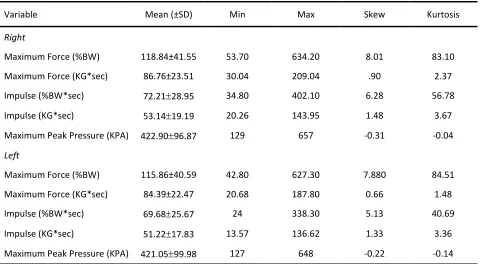
The results of distributional assessments indicated that the scaled gait kinematic of stride length to leg length ratio was fairly stable, exhibited symmetry and were approximately normally distributed across both the right and left sides of the body. With regard to kinetic variables assessed, the non-normalized version of the variables returned similar results to those observed for stride length to leg length ratio. However, the normalized versions of these kinetic variables demonstrated a distinct lack of symmetry and were observed to be significantly leptokurtic (peaked). These results are displayed in Table 1. Additionally due to the symmetrical nature of gait, it was necessary to examine the symmetry of the data collected for the right and left sides. Examination of the central tendency measures for each side of the body indicated each variable was similar for the right and left bodily sides with differences in mean values ranging between less than 1% and 4%, indicating fairly symmetrical gait across the sample.
5 right and left sides. The direction of the
relationship between the variables was the same for both sides of the body with
impulse (both raw and scaled form) being inversely related to stride length to leg
length ratio and both maximum force and maximum peak pressure (in raw and scaled form) being directly related to stride length to leg length ratio.
Table 1. Normalized version of kinetic variables.
Variable Mean (±SD) Min Max Skew Kurtosis
Right
Maximum Force (%BW) 118.84±41.55 53.70 634.20 8.01 83.10
Maximum Force (KG*sec) 86.76±23.51 30.04 209.04 .90 2.37
Impulse (%BW*sec) 72.2128.95 34.80 402.10 6.28 56.78
Impulse (KG*sec) 53.1419.19 20.26 143.95 1.48 3.67
Maximum Peak Pressure (KPA) 422.9096.87 129 657 -0.31 -0.04
Left
Maximum Force (%BW) 115.86±40.59 42.80 627.30 7.880 84.51
Maximum Force (KG*sec) 84.39±22.47 20.68 187.80 0.66 1.48
Impulse (%BW*sec) 69.6825.67 24 338.30 5.13 40.69
Impulse (KG*sec) 51.2217.83 13.57 136.62 1.33 3.36
Maximum Peak Pressure (KPA) 421.0599.98 127 648 -0.22 -0.14
Table 2. Correlation data of the subjects.
Conditions Maximum Force (BW*sec)
Maximum Force (KG)
Impulse (%BW*sec)
Impulse (KG*sec)
Maximum Peak Pressure (KPA)
SLLL Ratio R .133
.000 699
.126 .001 700
-.163 .000
699
-.176 .000
700
.337 .000 700
SLLL Ratio L .153
.000 673
.184 .000 675
-.129 .001
673
-.130 .001
675
.353 .000 675
Discussion
Descriptive and distributional assessments throughout this study demonstrated that both the gait kinematics and gait kinetics of
6 representative of the typical sample
presented in gait analysis research. However, it should be discussed that the distributional characteristics of the kinetic variables analyzed in this study were observed to be dramatically different based on the application of normalization techniques. Although the normalized kinetic data demonstrated high magnitudes of skewness and kurtosis with regard to the distribution of data, the Pearson Product Moment Correlation coefficient has been shown to be remarkably robust and retain power even when model assumption violations with regard to distributional
assessments are violated26. Thus the
potential violations associated with the
distributional characteristics of the
normalized gait kinetic variables should not be interpreted as having a significant impact on the findings. This is further supported by the fact that the direction of the relationship was not altered with normalization and the magnitude of the relationship was not altered significantly (normalization explained only 0.18% more variability in the normalized gait kinematic for maximum force and only 0.44% less variability in the normalized gait kinematic for impulse).
With regard to maximum force all descriptive data were slightly greater in the right leg than the left leg and a greater correlation was observed for the right side of the body. The positive correlation between maximum force and stride length to leg length ratio on both sides of the body
is an indicator that increased maximum force may correspond to an increase in stride length to leg length ratio. This finding is not surprising because anterior/posterior ground reaction forces regulate linear gait
velocities27. Because gait velocity is a
function of stride and/or step length and cadence, increases in force in the anterior direction should result in increased stride length to leg length ratio if cadence remains consistent. Additionally, because linear gait velocity is so strongly related to fall risk in the elderly, this finding may provide clinical applications for decreasing fall risk in those individuals over the age of 65 years. Many times those patients presenting with decreased gait velocity, cadence and step or stride length also present with an increased
fear of falling28. This fear of falling may
result in clinicians working with aged individuals experiencing difficulty in their
attempts to alter gait parameters
associated with risk of falls. However, the finding this work may provide clinicians the ability to focus on working with patients to increase maximum force in the anterior direction in an effort to increase stride length to leg length ratio. This may remove the focus from those gait variables shown to be associated with fear in aged individuals (cadence and stride or step length) while still eliciting positive changes in gait that reduce the risk associated with falling.
7 the right leg. The negative correlation
between impulse and stride length to leg length ratio indicates that decreased impulse corresponds to an increase in stride length to leg length ratio. This finding is not surprising if impulse is examined from a momentum perspective; it seems that decreases in the change in momentum of the system (change in impulse) correspond to increases in stride length to leg length ratio. As with maximum force, it is understood that linear gait speed is
regulated by anterior/posterior impulses27.
Additionally from walking speeds between 1.0m/s and 2.0m/s increased impulse is observed while walking speeds between 2.0m/s and 3.0m/s decreased impulse is observed. Again, as cadence remains constant, increased linear gait velocity may be a function of increased stride/step length. For those individuals over the age of 65 years, decelerating and accelerating when walking is seen frequently from constantly trying to maintain their stability throughout gait. An individual who has a constant mass and cadence (velocity) could potentially alter their momentum to a point where constant speed throughout the gait cycle is exhibited, resulting in a greater stride length to leg length ratio. As a clinician, working on achieving a constant speed in gait, assuming cadence is constant, could result in the individual feeling a greater stability throughout rather than their previously feeling of constant instability. Once an elderly individual no longer focuses on the accelerating or
decelerating of their gait, but rather focus on constant momentum then their risk for falling decreases.
With regard to maximum peak pressure all descriptive data was slightly greater in the right leg than the left leg and a larger correlation coefficient was also observed for the right leg. The positive correlation between maximum peak pressure and stride length to leg length ratio is an indicator that increased maximum peak pressure could potentially correspond to an increased stride length to leg length ratio. Again, this finding is not surprising, particularly given the relationship between maximum force and pressure (force per unit area). As force increases as it did in the current study, the overall area of the foot remains constant. Although it must be assumed that the contact area associated with foot strike in gait remain constant, if this occurs any increase in maximum force would result in an increase in peak pressure. Thus, it may be that the increased peak pressure observed in this study is more a function of the observed increase in maximum force that was also observed. Therefore, it may benefit clinicians to focus more on maximum force generation than peak pressure when working with aged individuals in an effort to alter stride length to leg length ratio.
Conclusion
8 information describing gait characteristics
of aged individuals is massive. The results of this study indicated that kinetic variables (in both scaled and raw form) were correlated to the scaled gait kinematic parameter of stride length to leg length ratio. This finding is important in that the scaling of stride length to leg length may potentially allow for intra-subject comparisons of gait kinematics in a manner that has yet to be accomplished.
Although the findings of this study may be applicable to many individuals, the next step would be to determine whether causal
relationships exist. These future
investigations would provide a starting point for impacting an extremely negative, yet common occurrence in aged individuals. These investigations should use an approach that allows for inter-subject comparison rather than an approach making attempts to only generalize to an aged population.
Acknowledgements
The authors would like to acknowledge the
work of the Electronic Caregiver® Mobile
Falls Risk Assessment Laboratory in the collection of the data analyzed in this study.
Address for Correspondence
David W. Keeley, PhD, Department of Kinesiology and Dance, New Mexico State University, Las Cruces, NM, USA, 88003. PHONE: (575)616-5186; EMAIL: [email protected].
References
1. Silverton R, Tideiskaar R. (1989). Psychosocial
Aspects of Falls. 2nd edition Springer, New York.
2. Liddle J, Gilleard C. (1995). The emotional
consequence of falls for older people and their families. Clin Rehabil, 9, 110-114.
3. Stevens JA, Corso PS, Finkelstein EA, Miller TR.
(2006). The costs of fatal and non-fatal falls among older adults. Inj Prev, 12, 290-295.
4. Centers for Disease Control and Prevention,
National Center for Injury Prevention and
Control. Web–based Injury Statistics Query and
Reporting System (WISQARS) [online]. Accessed February 15, 2016.
5. Stel VS, Smit JH, Pluijm SM, Lips P. (2004).
Consequences of falling in older men and women and risk factors for health service use and functional decline. Age Ageing, 33, 58-65.
6. Jager TE, Weiss HB, Coben JH, Pepe PE. (2000).
Traumatic brain injuries evaluated in U.S. emergency departments, 1992–1994. Acad Emerg Med, 7, 134–40.
7. Berg WP, Alessio HM, Mills EM, Tong C. (1997).
Circumstances and consequences of falls in independent community-dwelling older adults. Age and Ageing, 26, 261-268.
8. Campbell AJ, Borrie MJ, Spears GF. (1989). Risk
factors for falls in a community based prospective study of people 70 years or older. J Gerontol, 44, M112-M117.
9. Davis JW, Ross PD, Nevitt MC, Wasnich RD.
(1999). Risk factors for falls and for serious injuries on falling among older Japanese women in Hawaii. J Am Geriatr Soc, 47, 792–798.
10. Kiely DK, Kiel DP, Burrows AB, Lipsitz LA. (1998).
Identifying nursing home residents at risk for falling. J Am Geriatr Soc. 46, 551–555.
11. Lipsitz LA, Jonsson PV, Kelley MM, Koestner JS.
(1991). Causes and correlates of recurrent falls in ambulatory frail elderly. J Gerontol, 46, M114–M122.
12. Luukinen H, Koski K, Laippala P, Kivela SL.
(1995). Risk factors for recurrent falls in the elderly in long-term institutional care. Public Health, 109, 57–65.
13. Mahoney J, Sager M, Dunham NC, Johnson J.
9
14. Myers AH, Baker SP, Van Natta ML, Abbey H,
Robinson EG. (1991). Risk factors associated
with falls and injuries among elderly
institutionalized persons. Am J Epidemiol, 133, 1179–1190.
15. Nevitt MC, Cummings SR, Kidd S, Black D.
(1989). Risk factors for recurrent nonsyncopal falls: A prospective study. JAMA, 261, 2663– 2668.
16. Thapa PB, Gideon P, Fought RL, Ray WA. (1995).
Psychotropic drugs and risk of recurrent falls in ambulatory nursing home residents. Am J Epidemiol, 142, 202–211.
17. Tinetti ME, Speechley M, Ginter SF. (1988). Risk
factors for falls among elderly persons living in the community. N Engl J Med, 319, 1701–1707.
18. Vellas BJ, Wayne SJ, Garry PJ, Baumgartner RN.
(1998). A two year longitudinal study of falls in 482 community-dwelling elderly adults. J Gerontol A Biol Sci Med Sci Sciences, 53A, M264–M274.
19. Tinetti ME, Doucette JT, Claus EB. (1995). The
contribution of predisposing and situational risk factors to serious fall injuries. J Am Geriatr Soc, 43, 1207–1213.
20. Li W, Keegan TH, Sternfeld B, Sidney S,
Quesenberry CP Jr, Kelsey JL. (2006). Outdoor falls among middle-aged and older adults: a neglected public health problem. Am J Public Health, 96, 1192–1200.
21. Tinetti ME, Speechley M. (1989). Prevention of
falls in the elderly. N Engl J Med, 320, 1055-1059.
22. Ziere G, Dieleman JP, Hofman A, Pols HA, van
der Cammen TJ, Stricker BH. (2006).
Polypharmacy and falls in the middle age and elderly population. Br J Clin Pharmacol, 61, 218-223.
23. Rubenstein LZ, Powers C. (1999). Falls and
mobility problems: Potential quality indicators and literature review (the ACOVE Project). Santa Monica, CA: RAND Corporation. 1–40.
24. Niino N, Tsuzuku S, Ando F, Shimokata H. (2000).
Frequencies and circumstances of falls in the National Institute for Longevity Sciences, Longitudinal Study of Aging (NILS-LSA). J Epidemiol, 10, S90-S94.
25. Winter DA, Patla AE, Frank JS, Walt SE. (1990).
Biomechanical walking pattern changes in the fit and healthy elderly. Phys Ther, 70, 340-347.
26. Fowler RL. (1987). Power and robustness in
product-moment correlation. Appl Psychol Meas, 11, 419-428.
27. Peterson CL, Kautz SA, Neptune RR. (2011).
Braking and propulsive impulses increase with speed during accelerated and decelerated walking. Gait and Posture, 33, 562-567.
28. Reelick MF, van Iersel MB, Kessels RP, Rikkert