in the population sciences published by the Max Planck Institute for Demographic Research Konrad-Zuse Str. 1, D-18057 Rostock · GERMANY www.demographic-research.org
DEMOGRAPHIC RESEARCH
VOLUME 22, ARTICLE 13, PAGES 321-346
PUBLISHED 09 MARCH 2010
http://www.demographic-research.org/Volumes/Vol22/13/ DOI: 10.4054/DemRes.2010.22.13
Research Article
Can public policies sustain fertility
in the Nordic countries?
Lessons from the past and
questions for the future
Marit Rønsen
Kari Skrede
© 2010 Marit Rønsen & Kari Skrede.
This open-access work is published under the terms of the Creative Commons Attribution NonCommercial License 2.0 Germany, which permits use, reproduction & distribution in any medium for non-commercial purposes, provided the original author(s) and source are given credit.
1 Background 322
2 Lessons from the past 323
3 Questions for the future 326
4 Present analysis 329
4.1 Research questions 329
4.2 Data and methods 330
4.3 Results 331
5 Concluding remarks 338
6 Acknowledgments 340
Can public policies sustain fertility in the Nordic countries?
Lessons from the past and questions for the future
Marit Rønsen1
Kari Skrede2
Abstract
The collective evidence of past research indicates that Nordic social welfare policies have had positive impacts on fertility. Yet, some patterns cause concern. One concern is that the good recuperation at cohort level partly is explained by relatively high fertility levels among women educated for female-dominated jobs with extensive part-time work. One may therefore question whether the present development is compatible with gender equality. Another concern is a more socially selective entry into fatherhood. Based on updated analyses of female as well as male fertility trends in Norway we address these issues, focussing especially on associations with educational level and field.
1. Background
The Nordic countries share many similarities in political, economic and social development, but as documented in several studies, there are considerable differences with regard to the historical development and the extent to which present family policies also integrate gender equality as an explicit political goal (Borchorst 1994, Kjeldstad 2001, Leira 1992, Sainsbury 2001, Skrede 1999). Such variations in an otherwise similar socio-cultural setting provide a good framework for investigations of policy effects on fertility, and together with ample availability of high quality register data, this has served as a point of departure for much recent comparative fertility research (e.g. Andersson 2004, Andersson et al. 2009, Duvander, Lappegård, and Andersson 2008, Neyer et al. 2006). Even if it is difficult to disentangle policy effects from more indirect influences of the broader economic, social, and cultural context, the collective evidence seems to corroborate that welfare policies enabling parents to combine childbearing and employment have had a positive impact on childbearing behaviour. Cohort fertility remains stable or is even increasing somewhat in younger generations, women in their thirties recuperate postponed births remarkably well, even the well educated, and educational level differentials have diminished across cohorts and across countries (Andersson et al. 2009). Moreover, there is evidence of pronatalistic effects of specific policy programmes. The Swedish "speed premium" is a well known example that has been documented by several authors (Andersson 1999, Berinde 1999, Hoem 1993, Oláh 2003), and positive effects of parental leave extensions and increasing day-care supply have been reported from both Finland and Norway (Kravdal 1996, Rindfuss et al. 2007, Rønsen 2004a). Finally, the usage of policies like parental leave and cash benefits for childcare has been found to stimulate childbearing (Duvander and Andersson 2006, Duvander, Lappegård, and Andersson 2010, Vikat 2004, Aassve and Lappegård 2009). The latter may be due to selection, but it is an interesting finding that warrants closer examination.
male-dominated sectors (Hoem, Neyer, and Andersson 2006a, 2006b, Lappegård 2001, 2006). The relatively high and stable cohort fertility of the Nordic countries may thus, to a large extent, depend on a family-friendly, gender-segregated labour market with extensive part-time work, and an underlying selection of family-oriented women with strong preferences for children into occupations in these sectors.
Recent analyses of Norwegian men complement this picture, indicating a stronger socio-economic selection into fatherhood in younger cohorts (Skrede 2002, 2003, Lappegård, Rønsen, and Skrede 2008). Moreover, childlessness is rising even among highly educated men, which is a new phenomenon. A somewhat speculative, but in our opinion quite plausible, reason for part of the postponement of childbearing by highly educated women may thus be difficulties in finding a man who is willing to share parental duties at a more equal level than what we have previously described as gender
equality light (Skrede 2005, Rønsen and Skrede 2006).
In this article we summarise the lessons from the past concerning the associations between public policies and fertility development in the Nordic countries, and elaborate more on the concerns for the future. Next, we complement previous research with updated analyses of the present development of both female and male fertility in Norway. We focus on socioeconomic dissimilarities manifested not only through level of education, but also through field of education. Besides reflecting personal preferences, field of education is closely connected to a person’s future occupation and employment sector, and in previous research this has proved to be a better indicator of fertility behaviour than the mere level attained (Hoem, Neyer, and Andersson 2006a, 2006b, Lappegård 2001, 2006).
2. Lessons from the past
the Swedish parental-leave system introduced in 1980 which allowed mothers the same benefit as for their previous child if they had a next child within a given period, even without returning to work between the births3. As could be expected, this has
encouraged mothers to have their next child sooner (Andersson 1999, 2004, Berinde 1999, Hoem 1990, 1993, Oláh 2003). The new pattern of birth spacing has encompassed women at all educational levels, and is not a temporary phenomenon. It did not disappear during the economic downturn and fertility decline during the 1990s, nor did it vanish thereafter (Andersson, Hoem, and Duvander 2006).
Another finding from Sweden, which has recently also been documented for Norway, is that women are more likely to have a next child if the father took parental leave with the first child, suggesting that features encouraging an active participation from the father in child care may stimulate fertility (Duvander and Andersson 2006, Oláh 2003, Duvander, Lappegård, and Andersson 2010). A positive effect is also evident for mothers who took extended leave, but only for the propensity to have a third child. Interestingly, higher third-birth rates among women who made use of extended leave in connection with special cash benefits for child-care have also been found for Finland (Vikat 2004) and Norway (Aassve and Lappegård 2009). Such positive effects of the use of family policies may, however, also be due to selection, as more family oriented fathers and mothers may be more inclined to have another child and also to take more leave.
Evidence from Norway further indicates that there is a positive effect of increasing day-care supply on fertility. This has recently been documented for first births by Rindfuss et al. (2007), and previously also by Kravdal (1996) for third births, although in the latter case mainly at low levels of day-care coverage and among highly educated women. For Sweden, researchers have found no significant positive effects on fertility of either the availability or price of day care (Andersson, Duvander, and Hank 2004). However, this study only covers two years (1996-1997) and does not control for unobserved local factors that may affect both fertility decisions and the local availability of day-care centres. When using fixed-effects models to control for such endogeneity, Rindfuss et al. (2007) find clear positive effects of day-care availability in Norway, as mentioned above. Analyses of the importance of the length and economic compensation of the parental leave programmes in the Nordic countries are harder to find, but one comparative study of Finland and Norway renders some support for the hypothesis that parental leave extensions may stimulate fertility (Rønsen 2004a). The effect is most significant for Finland, which had more extensions during the analysis period (about 1960-1990), and is mainly limited to the probability of giving birth to a second or third child.
The accumulated evidence from past research thus supports the notion that there are positive effects of welfare policies on fertility, but as demonstrated by the Swedish trend in the 1990s, a generous family policy program is no guarantee for a high fertility level. In the early 1990s, Sweden experienced a period of slack in the economy that soon led to a sharp rise in unemployment, and young people and people with low education were hit particularly hard. For the first time ever, there were also cutbacks in financial support to families. Subsequently, fertility declined from 2.1 children per woman in 1992 to about 1.5 in 1997. Thus, economic cycles and economic prospects also clearly have an impact on fertility, and rising unemployment probably has a negative influence both because of poorer income prospects for the present, and possibly even more important, because of a greater feeling of insecurity about the future.
However, as demonstrated by comparisons of Sweden and Finland, deteriorating macroeconomic conditions may not necessarily have the same adverse effects on fertility in all countries. In Finland, unemployment also rose very quickly and to higher levels than in Sweden in the early 1990s, but fertility remained at a relatively high level. Evidently, the recession did not have a noticeable influence on the childbearing behaviour of Finnish women. As suggested by Vikat (2004), one explanation for the divergent fertility response in Finland and Sweden may be that the Finnish welfare state was able to retain most of its important functions during the recession. Besides, the home-care allowance (HCA) scheme had been fully implemented just before the downturn of the economy. This may have encouraged some women to have a child and take extended childcare leave with the support of the HCA while the labour market conditions were unfavourable. A couple of Swedish studies suggest that fertility in Sweden may exhibit stronger pro-cyclic patterns because its family policy is more closely linked to prior employment activity (Björklund 2006, Jonsson and Dlab 2003). Compared to Finland, the income-replacement in the parental leave scheme is higher in Sweden, while the minimum amount received by those with little or no previous income is much lower.
fertility in all countries. The fertility patterns among highly educated women are further seen to be converging across countries, as is evidenced by both age at first birth, childlessness and final number of children. The general impression is therefore, that similar policies have contributed to a fairly common fertility pattern in the Nordic countries (Andersson et al. 2009).
However, there are also indications that dissimilarities in policy programmes at the country level have contributed to different fertility behaviours. The divergent fertility trends in Finland and Sweden during the recession in the early 1990s is one indication in this direction. Another example is linked to the more generous transitional allowance to lone parents in Norway, which may have contributed to the distinctly higher first-birth rates among young Norwegian women. Like the Finnish home-care allowance, it may also have served as a counter-cyclical measure during the spell of relatively high youth unemployment in Norway in the early 1990s, which did not seem to affect first-birth rates very much (Rønsen and Skrede 2006). Among the Nordic countries, Norway also has the highest cash benefit at childbirth for mothers with no or little labour market experience prior to birth and the most generous support arrangements for students with childbirths (Bjørnberg, Ólafsson, and Eydal 2006). Hence, fairly generous cash benefits or minimum allowances may serve as a counter-cyclical measure and have a stabilising effect on fertility during times of recession.
3. Questions for the future
Norwegian mothers spend for example almost 2.5 more hours more per day on household work than fathers (Vaage 2002). Mothers also take most of the parental leave in connection with childbirth, even if the leave programmes, in principle, are gender neutral and can be used by either parent. The present situation may thus rightly be described as gender equality light (Skrede 2004).
Another Nordic labour market characteristic is high and persistent gender segregation. Women and men are concentrated in different occupations, industries and sectors (horizontal segregation), and are further divided in terms of their position in the job hierarchy, even within the same occupation or profession (vertical segregation). In Norway, the female share of employees in the health and social sector is e.g. approximately 80%, while industries like construction and oil and gas industry have female shares of only 10-20%. The gender differences largely follow the division between the public and private sector. Women account for most of the employees in the public sector (about 70%), while men constitute the majority in the private sector (about 65%, Ministry of Children and Equality 2008). Job hierarchy disparities are, among other things, reflected in the lower proportion of women in management positions. Even if Nordic women today constitute about half of the workforce and are as well educated as men, they are far outnumbered in jobs which involve leadership responsibilities. In Norway, for example, only about one in three managers is a woman (Statistics Norway 2009b).
Mainly as a result of gender unequal practices and labour market segregation, women still earn significantly less than men. The gender pay gap in the Nordic countries varies between 16-20% (Eurostat 2009b), and has been surprisingly stable since the mid 1980s in spite of the progress in female education and labour force participation. In countries where equal pay for women and men has long been on the political agenda, this is a matter of great concern, so much so, that Norway in 2006 appointed a government commission to consider measures to reduce the gender pay gap. It is beyond the scope of this article to pursue this issue, but it serves to emphasize that gender equality is still very much an unfinished project, and that issues related to equal opportunities and equal outcomes for women and men remain high on the political agenda of Nordic societies.
arrangements and ample opportunities for part-time work, but it may also reflect a self-selection of family-oriented women into such occupations. Large and increasing variations related to field of education have further been found in an analysis of the timing of first birth in Norway (Lappegård and Rønsen 2005). Besides reflecting preference heterogeneity, this probably indicates varying career-adjustments due to differences in women's opportunity costs of a career break by occupational sector. Increasing educational differences in entry into motherhood across cohorts further suggest that long parental leaves and generous family benefits may fit better with a career track in the public sector and within female-dominated professions than among highly educated young women in the private sector and within jobs and professions with more male competition.
Women’s increasing age at first birth indicates that family formation and motherhood represent more of a challenge for today's female generations than for cohorts born in the mid and late 1950s. Recent analyses of the family formation of Norwegian men complement this picture, displaying both a stronger socio-economic selection into fatherhood, and a strong increase in childlessness even among highly educated men, which is a new phenomenon. In addition, multi-partner fertility (having children with more than one woman) has become more widespread (Skrede 2003, Lappegård, Rønsen, and Skrede 2008). On these grounds, we have recently suggested that part of the postponement of childbearing for highly educated women may be related to difficulties in finding a man who is willing to share parental duties at a more equal level than gender equality light (Rønsen and Skrede 2006).
Another explanation of delayed fatherhood among younger highly educated men is the possible existence of negative attitudes from employers towards their active involvement in the fatherhood role. Earlier research for Norway indicates e.g. that men in career jobs in the private sector often experience negative attitudes from employers if they take longer parental leaves than the stipulated daddy quota (Brandth and Kvande 2005)4. From this perspective, the postponement can be seen as a strategy for
establishing a solid foothold in the labour market prior to becoming a father.
Consequently, if gender equality in society is to be attained, one may question the sustainability of the current fertility development. Considering on the one side the increasing intra-cohort differences in younger female cohorts with regard to completed fertility (childlessness and number of children born), and on the other side the present variation in parenthood practices, it seems plausible to suggest that the present level of fertility presupposes a gender equality light division of work between the parents. We have therefore argued that the current birth trends reflect a gender equality deficit
4 The daddy quota is a part of the parental leave that is reserved exclusively for fathers, and the family will
(Skrede 2005, Rønsen and Skrede 2006). In the following we pursue these issues based on updated analyses of female as well as male fertility in Norway.
4. Present analysis
4.1 Research questions
So far no studies of the relationship between fertility behaviour in the Nordic countries and field of education have addressed the development over time, as the analyses have either been based on just a few selected cohorts (Hoem 1994, Hoem, Neyer, and Andersson 2006a, 2006b), or the time trend has not been reported (Lappegård 2001, 2006). Our main focus in this paper is the development of fertility differentials over time, and we address the following questions: First, has the fertility behaviour of women with different educational background become more similar in younger cohorts, or are there persisting or even increasing divergences? Second, what is the role of family policies? Here alternative hypotheses are conceivable. If, as suggested before, a family-friendly policy fits better with a career track in some parts of the labour market such as in the public sector, we would expect to find increasing differentials across time. If, on the other hand, work in more competitive-oriented sectors requires more generous policies to be compatible with the upbringing of children, we may expect smaller differentials over time in tandem with the general expansion of policy programmes. Finally, the policies may have benefited all groups more or less equally, and then we may expect to find quite persistent patterns and stable differentials. Which of these hypotheses gain the stronger support will be further illuminated by the investigation of the development across cohorts.
4.2 Data and methods
The data are from the Norwegian Central Population Register and the Norwegian Educational Database. The data cover cohorts born from 1935 onwards. We have longitudinal information on births as well as on education, but the earliest records of education are from 1970. Our study is based on original birth cohorts, i.e. we observe the birth histories of individuals born in the country and calculate cohort fertility measures from age-specific parity-progression rates cumulated over their life course (ages 15-49 for women and 15-59 for men). Age is defined as age by the end of a calendar year (calendar year minus birth year). People who die or emigrate before age 49 (women) or 59 (men) are censored at the time of death or emigration. To alleviate the common problem of seeking to explain fertility behaviour at a certain age by the educational level reported and possibly attained at a later stage, we condition on educational level attained at age 30, when most people have finished their educational activity. We therefore exclude cohorts born before 1940, when education is included in the analysis.
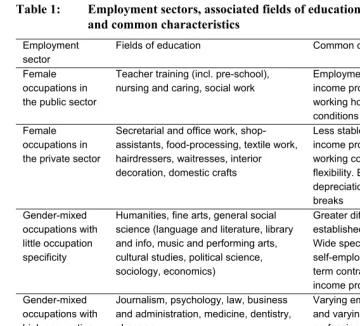
Table 1: Employment sectors, associated fields of education, and common characteristics
Employment sector
Fields of education Common characteristics
Female occupations in the public sector
Teacher training (incl. pre-school), nursing and caring, social work
Employment security, stable income prospects, flexible working hours, top parental-leave conditions
Female occupations in the private sector
Secretarial and office work, shop-assistants, food-processing, textile work, hairdressers, waitresses, interior decoration, domestic crafts
Less stable job contracts and income prospects, poorer working conditions, less flexibility. But: lower skill depreciation during employment breaks
Gender-mixed occupations with little occupation specificity
Humanities, fine arts, general social science (language and literature, library and info, music and performing arts, cultural studies, political science, sociology, economics)
Greater difficulties in getting established in the labour market. Wide spectrum of jobs and more self-employment. More short-term contracts, less stable income prospects. Gender-mixed
occupations with high occupation specificity
Journalism, psychology, law, business and administration, medicine, dentistry, pharmacy
Varying employment prospects and varying returns. High professionalism, long hours. Higher skill depreciation during employment breaks.
Male-dominated occupations
Engineering and construction, science, mathematics and computing, agriculture, forestry and fishery, transport, protection and security
Mostly private-sector employment. More difficult to enter, highly competitive, less flexibility, but certain advantages in constituting ”the gender alibi”?
4.3 Results
level). This is usually not possible with smaller data sets, and is therefore seldom done in analyses of fertility by educational level.
As shown in Figure 1, the trend for women at the highest tertiary level is quite different from the trend for women at the lowest tertiary level. The former group is the only one with declining childlessness across cohorts, from just above 20% in the 1940-44 cohort to 15% in the 1965-67 cohort. In the other educational groups, childlessness has been increasing, continuously for women with primary education and up to the very youngest cohort for women with secondary and higher education. The trends are quite parallel with increases of about 1-3 percentage points, least for those with a short tertiary education and most for those with primary education. In the youngest cohort the levels of childlessness were almost 14% in the lowest tertiary group and about 11% in the primary and secondary group.
Figure 1: Proportion childless at age 40 by level of education. Female cohorts
0 5 10 15 20 25
1940-44 1945-49 1950-54 1955-59 1960-64 1965-67
Birth cohort
P
er cen
t
Primary Secondary Tertiary I Tertiary II
stable, except for a slight further decline in completed fertility at age 40 for women at the lowest tertiary level.
Figure 2: Cohort total fertility at age 40 by level of education. Female cohorts
1,6 1,8 2 2,2 2,4 2,6
1940-44 1945-49 1950-54 1955-59 1960-64 1965-67
Birth cohort
CTF
R
Primary Secondary Tertiary I Tertiary II
The converging trends in Figures 1 and 2 thus indicate that there are few obstacles to childbearing for highly educated women in Norway. Even if this group has become less select over time, it seems reasonable to assume that more generous, family-friendly welfare policies have played a part in the observed downward trend of childlessness and an upward trend in completed fertility for highly educated women. Another lesson from Figures 1 and 2, is that different levels of education no longer seem to create large fertility differentials between women. We shall now see if the same holds true for women with different types (fields) of education.
sectors have proportions that vary between 9-12%. Another feature worth noticing is the very stable development within female-dominated fields in the public sector where the proportion childless has fluctuated around 11% in all cohorts. The other sectors have had a fairly parallel development with increases in childlessness of 3-4 percentage points across cohorts born from the 2nd World War and until the early 1960s. A third
noticeable feature is the slight downward trend in childlessness within most fields in the youngest cohort. These are women who were in their prime childbearing years in the late 1980s and 1990s, which was a period of rapid expansions of family policies in Norway. One may speculate, therefore, that this dip has something to do with the more generous policies encountered by the youngest cohort.
Figure 3: Proportion childless at age 40, by type of education. Female cohorts
0 5 10 15 20 25
1940-44 1945-49 1950-54 1955-59 1960-64 1965-67
Birth cohort
P
er cen
t
Feminised, public sector Feminised, private sector Mixed, little occ. spec. Mixed, high occ. spec. Male-dominated
trend continued until the early 1960s cohorts. Also worth noticing is the downward trend for the gender-mixed group with little occupation specificity in the youngest cohort. Except for the male-dominated sector, the gap between female-dominated occupations in the public sector and the other sectors thus appears to have widened somewhat for cohorts born in the 1950s and 1960s.
Figure 4: Cohort total fertility at age 40, by type of education. Female cohorts
1,6 1,8 2 2,2 2,4 2,6
1940-44 1945-49 1950-54 1955-59 1960-64 1965-67
Birth cohort
CTFR
Feminised, public sector Feminised, private sector Mixed, little occ. spec. Mixed, high occ. spec. Male-dominated
occupation specificity, may further indicate that women in this sector have profited less than other groups from the large expansion in family policies in the late 1980s and early 1990s. This may partly be explained by their less secure work environment, which is characterised by more self-employment, poorer parental leave arrangements, and more short-term contracts.
Our third question is related to the trend in men’s fertility patterns, and the extent to which fatherhood has become more selective in younger cohorts. As has recently also been reported by others (Kravdal and Rindfuss 2008), the association between level of education and fertility is quite opposite for men and women (Figure 5 vs. Figure 1). For men, the highest level of childlessness is found among those with the lowest education, and the lowest level among those with the highest education. Compared to women, there has also been a much steeper rise in childlessness, encompassing men at all levels of education, also those at the highest tertiary stage. At age 40, the proportion in this group with no children was close to 20%, while it was 26% among men with primary education.
Figure 5: Proportion childlessness at age 40 by level of education. Male cohorts
Childlessness at age 40
0 5 10 15 20 25 30
1940-44 1945-49 1950-54 1955-59 1960-64 1965-67 Cohort
Per ecnt
The trends across cohorts in the various educational level groups have been fairly similar, but one group that stands out is men with short, tertiary education, which has had a sharper rise in childlessness than the other groups. This is likely to reflect the composition of the fields of education that usually complete at this level, and closer analyses reveal that, in particular, men within humanities and art, social science and journalism have very high childlessness levels (close to or above 30%, see Lappegård, Rønsen, and Skrede 2008). These are also groups that have had large increases across cohorts.
The higher and faster growing childlessness among men than among women suggests that multi-partner fertility must be on the rise, and this is confirmed by our analyses. (Figure 6). The trends across cohorts for different educational groups vary more than for childlessness, however. In spite of the fact that men with low education are the most likely to remain childlessness, multi-partner fertility is higher and has increased most in this group, whereas men with a long tertiary education are much less likely to have children with more than one woman. Furthermore, the proportions have remained fairly stable across cohorts. In the youngest cohort, multi-partner fertility was less than 5% among fathers with high tertiary education against almost 20% among fathers with primary school only. This gap may shrink as the men grow older, as low-educated men are younger when they become fathers. However, further analyses of cohorts born until 1955-57 show that the multi-partner fertility pattern at age 50 is not very different (Lappegård, Rønsen, and Skrede 2008). The proportion who had children with more than one woman at that age was 7% in the highest educated group and 19% in the lowest educated group. Moreover, the increase from age 40 to age 50 for the 1955-57 cohort was almost the same, about 3 percentage points in each group.
Figure 6: Multi-partnered fertility at age 40 by level of education. Male cohorts
Multi-partnered fertility at age 40
0 5 10 15 20 25
1940-44 1945-49 1950-54 1955-59 1960-64 1965-67
Cohort
Per cent
Primary Secondary University I University II
5. Concluding remarks
the well educated, and converging fertility patterns among highly educated women across countries. The updated analyses for Norway presented in this paper add to and confirm this picture.
In addition to policies that facilitate the combination of children and employment, gender equality has been identified as a factor that may influence fertility (McDonald 2000, 2006). Previous studies from both Norway and Sweden also corroborate that gender-equal childcare practices play a role for the propensity to have another child (Oláh 2003, Duvander and Andersson 2006, Duvander, Lappegård, and Andersson 2010). In this paper we draw the attention to the other side of the coin, asking whether the current fertility trends really are compatible with gender equality, which is an explicit goal for all Nordic societies. Given the persisting gender unequal practices and outcomes in both the labour market and in the family, we argue that the relatively high fertility levels of the Nordic countries, in part, depend on a division of labour between women and men that we have described as gender equality light. We further argue that it may thus be appropriate to speak of a gender equality deficit in current birth patterns. This is amongst others reflected in the higher birth rates of women that we (from their choice of education and occupation) would expect to have relatively strong preferences for family and children, including willingness to reduce their engagement in paid work during childrearing phases. If the fertility- and work preferences of these more family-oriented women should change and/or the family policies are not developed to cater more for the needs of all groups of women, including the more career-oriented and self-employed, it may not be possible to sustain fertility at the present level in the future. A continued emphasis on family- and labour market policies that enable and stimulate the involvement of fathers needs to be an integral part of this development.
Important tasks for future research will be to shed more light on the imbalances of the current division of human and social reproduction, between women and men, as well as between the public and the private sector. Male fertility and variations in young men’s attitudes to fatherhood and shared parental duties is one subject in need of more attention. The present paper is a small contribution in this direction. Another subject to be examined is the fertility decisions of couples and their associations with the labour market attachment, occupation, and employment sector of both partners. These are questions that have to be left for the future.
6. Acknowledgments
We are grateful for valuable comments from anonymous reviewers of Demographic
Research and participants at the IUSSP International Seminar on Public Policies and
References
Aassve, A. and Lappegård, T. (2009). Childcare cash benefits and fertility timing in Norway. European Journal of Population 25(1): 67-88.
doi:10.1007/s10680-008-9158-6.
Andersson, G. (1999). Childbearing trends in Sweden 1961-1997. European Journal of
Population 15(1): 1-24. doi:10.1023/A:1006145610780.
Andersson, G. (2004). Childbearing developments in Denmark, Norway, and Sweden from the 1970s to the 1990s: A Comparison. Demographic Research S3(7): 153-176. doi:10.4054/DemRes.2004.S3.7.
Andersson, G., Duvander, A-Z., and Hank, K. (2004). Do child-care characteristics influence continued child bearing in Sweden? An investigation of the quantity, quality, and price dimension. Journal of European Social Policy 14(4): 407-418.
doi:10.1177/0958928704046881.
Andersson, G., Hoem, J.M., and Duvander, A-Z. (2006). Social differentials in speed-premium effects in childbearing in Sweden. Demographic Research 14(4):
51-70. doi:10.4054/DemRes.2006.14.4.
Andersson, G., Rønsen, M., Knudsen, L.B., Lappegård, T., Neyer, G., Skrede, K., Teschner, K., and Vikat, A. (2009). Cohort fertility patterns in the Nordic countries. Demographic Research 20(14): 313-352. doi:10.4054/DemRes.
2009.20.14.
Attias-Donfut, C., Ogg, J., and Wolff, F-C. (2005). Family support. In: Börsch-Supan, A., Brugiavini, H., Jürges, J., Mackenbach, J., Siegrist, J., and Weber, G. (eds.).
Health, ageing and retirement in Europe: First results from the Survey of
Health, Ageing and Retirement in Europe. Mannheim: Mannheim Research
Institute for the Economics of Aging: 171-178.
Berinde, D. (1999). Pathways to a third child in Sweden. European Journal of
Population 15(4): 349-378. doi:10.1023/A:1006287630064.
Björklund, A. (2006). Does family policy affect fertility? Lessons from Sweden.
Journal of Population Economics 19 (1): 3-24. doi:10.1007/s00148-005-0024-0.
Bjørnberg, U., Ólafsson, S., and Eydal, G. B. (2006). Education, employment and family formation: Differing patterns. In: Bradshaw, J. and Hatland, A. (eds.).
Social policy, employment and family change in comparative perspective.
Borchorst, A. (1994). Welfare state regimes, women's interests and the EC. In Sainsbury, D. (ed.). Gendering welfare states. London: Sage Publications: 26-44.
Brandth, B. and Kvande, E. (2005). Fedres valgfrihet og arbeidslivets tidskulturer.
Tidsskrift for samfunnsforskning 46(1): 35-54.
Duvander, A-Z. and Andersson, G. (2006). Gender equality and fertility in Sweden: A study on the impact of the father's uptake of parental leave on continued childbearing. Marriage and Family Review 39(1-2): 121-142.
doi:10.1300/J002v39n01_07.
Duvander, A-Z., Lappegård, T., and Andersson, G. (2010): Family policy and fertility: fathers' and mothers' use of parental leave and continued childbearing in Norway and Sweden. Journal of European Social Policy 20(1): 45-57.
doi:10.1177/0958928709352541.
Dykstra, P.A. and Hagestad, G.O. (2007). Childlessness and parenthood in two centuries. Journal of Family Issues 28(11): 1518-1532. doi:10.1177/
0192513X07303881.
Eurostat. (2009a). Employment and unemployment (LFS) [electronic resource]. Luxembourg: Eurostat http://epp.eurostat.ec.europa.eu/portal/page/portal/
employment_unemployment_lfs/data/database.
Eurostat. (2009b). Labour market (including Labour Force Survey). Earnings [electronic resource]. Luxembourg: Eurostat. http://epp.eurostat.ec.europa.eu/
portal/page/portal/labour_market/earnings.
Gauthier, A.H. (1996). The measured and unmeasured effects of welfare benefits on families: Consequences for Europe's demographic trends. In: Coleman, D. (ed.).
Europe's population in the 1990s. Oxford: Oxford University Press: 297-331.
Gauthier, A.H. (2007). The impact of family policies on fertility in industrialized countries: a review of the literature. Population Research and Policy Review
26(3): 323-346. doi:10.1007/s11113-007-9033-x.
Hausmann, R., Tyson, L.D., and Zahidi, S. (2007). The Global Gender Gap Report
2007. Geneva: World Economic Forum.
Hoem, B. (1994). Lärare föder flere barn. Välferdsbulletinen No. 3: 17-19.
Hoem, J.M. (1990). Social policy and recent fertility change in Sweden. Population and
Hoem, J.M. (1993). Public policy as the fuel of fertility. Acta Sociologica 36(1): 19-31.
doi:10.1177/000169939303600102.
Hoem, J.M., Neyer, G., and Andersson, G. (2006a). Education and childlessness: The relationship between educational field, educational level, and childlessness among Swedish women born in 1955-59. Demographic Research 14(15): 331-380. doi:10.4054/DemRes.2006.14.15.
Hoem, J.M., Neyer, G., and Andersson, G. (2006b). Educational attainment and ultimate fertility among Swedish women born in 1955-59. Demographic
Research 14 (16): 381-404. doi:10.4054/DemRes.2006.14.16.
Jonsson, A. and Dlab, B. (2003). Sysselsätting och fruktsamhet i Sverige och Finland. [Thesis]. Stockholm University: Nationalekonomiska institutionen.
Kjeldstad, R. (2001). Gender policies and gender equality. In: Kautto, M., Fritzell, J., Hvinden, B., Kvist, J., and Uusitalo, H. (eds.). Nordic welfare states in the
European context. London: Routledge: 66-97.
Kravdal, Ø. (1996). How the local supply of day-care centers influences fertility in Norway: A parity-specific approach. Population Research and Policy Review
15(3): 201-218. doi:10.1007/BF00127049.
Kravdal, Ø. and Rindfuss, R.R. (2008). Changing relationships between education and fertility - a study of women and men born 1960-64. American Sociological
Review 73(5): 854-873. doi:10.1177/000312240807300508.
Lappegård, T. (2001). Valg av utdanning - valg av livsløp. Tidsskrift for
samfunnsforskning No. 3: 409-435.
Lappegård, T. (2006). Studies on Fertility and Childcare in Contemporary Norway. Register analyses. [PhD thesis]. Oslo: University of Oslo, Department of Sociology and Human Geography.
Lappegård, T. and Rønsen, M. (2005). The multifaceted impact of education on entry into motherhood. European Journal of Population 21(1): 31-49.
doi:10.1007/s10680-004-6756-9.
Lappegård, T., Rønsen, M., and Skrede, K. (2008). Educational differences in
childlessness and multi-partnered fertility among men. Paper presented at The
European Population Conference, Barcelona, Spain, July 9-12 2008.
Leira, A. (1992). Welfare states and working mothers. The Scandinavian experience.
McDonald, P. (2000). Gender equity in theories of fertility transition. Population and
Development Review 26(3): 427-439. doi:10.1111/j.1728-4457.2000.00427.x.
McDonald, P. (2006). Low fertility and the state: The efficacy of policy. Population
and Development Review 32(3): 485-510.
doi:10.1111/j.1728-4457.2006.00134.x.
Ministry of Children and Equality (2008). Gender and pay. Facts, analyses and measures to promote equal pay. Oslo: Ministry of Children and Equality (Official Norwegian Report 2008:6).
Ministry of Children and Equality (2009). Men, male roles and gender equality. Ministry of Children and Equality (Report No. 8 (2008-2009) to the Storting). Neyer, G. and Andersson, G. (2008). Consequences of family policies on childbearing
behavior: Effects or artefacts? Population and Development Review 34(4): 699-724. doi:10.1111/j.1728-4457.2008.00246.x.
Neyer, G., Andersson, G., Hoem, J.M., Rønsen, M., and Vikat, A. (2006). Fertilität, Familiengründung und Familienerweiterung in den nordischen Ländern. In: Bertram, H., Krüger, H., and Spiess, C.K. (eds.). Wem gehört die Familie der
Zukunft? Expertisen zum 7. Familienbericht der Bundesregierung. Opladen:
Barbara Budrich Verlag: 207-233.
Oláh, L.Sz. (2003). Gendering fertility: Second births in Sweden and Hungary.
Population Research and Policy Review 22(2): 171-200.
doi:10.1023/A:1025089031871.
Plantega, J., Remery, C., Figueiredo, H., and Smith, M. (2009). Towards a European Union Gender Equality Index. Journal of European Social Policy 19(1): 19-33.
doi:10.1177/0958928708098521.
Rindfuss, R.R., Guilkey, D., Morgan, S.P., Kravdal, Ø., and Guzzo, K.B. (2007). Child care availability and first-birth timing in Norway. Demography 44(2): 345-372. doi:10.1353/dem.2007.0017.
Rønsen, M. (2004a). Fertility and public policies - evidence from Norway and Finland.
Demographic Research 10(6): 143-170. doi:10.4054/DemRes.2004.10.6.
Rønsen, M. (2004b). Fertility and family policy in Norway - A reflection on trends and possible connections. Demographic Research 10(10): 265-286. doi:10.4054/DemRes.2004.10.10.
Scandinavia. Gender relations in welfare states. Bristol: The Policy Press: 53-76.
Rønsen, M. and Skrede, K. (2008). Fertility trends and differentials in the Nordic countries – Footprints of welfare policies and challenges on the road ahead.
Vienna Yearbook of Population Research 2008: 103-123.
doi:10.1553/populationyearbook2008s103.
Sainsbury, D. (2001). Gender and the making of the Norwegian and Swedish welfare states. Social Politics 8(1): 113-143.
Skrede, K. (1999). Shaping gender equality - the role of the state: Norwegian experiences, present policies and future challenges. In: Palier, B. and Bouget, D. (eds.). Comparing social welfare systems in Nordic countries and France.
Nantes: Maison des Sciences de l'Homme, Ange-Guépin, MIRE Vol. 4: 169-199.
Skrede, K. (2002). Towards gender equality in Norway's young generations? In Carling, J. (ed.). Nordic demography: Trends and differentials. Oslo: Unipub/Nordic Demographic Society, Scandinavian Population Studies Vol. 13: 191-218. Skrede, K. (2003). Gender, generations and life courses in the melting pot. In: Eriksen,
J. and Gulbrandsen, L.(eds.). Natalie Rogoff Ramsøy (1924 - 2002): En pionér i
norsk og internasjonal sosiologi – et minneskrift. Oslo: Norwegian Social
Research, NOVA-rapport 10/03: 59-87.
Skrede, K. (2004). Familiepolitikkens grense – ved ”likestilling light”? In: Ellingsæter A.L. and Leira, A. (eds.). Velferdsstaten og familien. Utfordringer og
dilemmaer. Oslo: Gyldendal Akademisk: 160-200.
Skrede, K. (2005). Foreldreskap i forandring - færre menn blir fedre. Tidsskrift for
kjønnsforskning 29(2): 4-22.
Statistics Norway (2001). Norwegian Standard Classification of Education. Revised 2000, Oslo: Statistics Norway.
Statistics Norway (2009a) Labour Force Survey 2008 [electronic resource]. Oslo: Statistics Norway. http://www.ssb.no/aku_en/
Statistics Norway (2009b). Grunntabeller fra AKU. Årsgjennomsnitt 2008. Oslo: Statistics Norway.
Vaage, O. (2002). Til alle døgnets tider. Tidsbruk 1970-2000. Oslo: Statistics Norway (SA 52).
Vikat, A. (2004). Women's labor force attachment and childbearing in Finland.