when the concentration of hemoglobin is high at the beginning of a dialysis session [1–3]. Iron (Fe) deficiency is the main cause of anemia in dialyzed patients. Reduction of the Fe concentration in the whole body is a result of increased demand for iron and loss or depletion of the iron reserve [4]. Atten-tion should also be paid to the fact that disrupAtten-tion of the cycle of iron may also be related to the iron transporter protein called transferrin [5].
Chronic kidney disease constitutes a serious worldwide clinical problem. An important issue arising early during the treatment of renal failure is anemia. It has an important influence on the circulatory system, leading to heart hypertrophy, and as a consequence to the Cardio-Renal Anemia Syndrome (CRAS) described by Silverberg [1, 2]. It was proven that in patients with End-Stage Re-nal Disease (ESRD), prognosis is much better
Teresa Kurzawa
1, A, B, D, F, Aleksander Owczarek
2, C, D, F,
Joanna K. Strzelczyk
3, D–F, Karolina Gołąbek
3, D, F, Andrzej Wiczkowski
3, A, E, FThe Content of Reticulocyte Hemoglobin and Serum
Concentration of the Soluble Transferrin Receptor
for Diagnostics of Anemia
in Chronically Hemodialyzed Patients
1 Analytical Laboratory SP ZOZ Team Municipal Hospital, Chorzów, Poland2 Statistical Division, Department of Instrumental Analysis, Medical University of Silesia, Sosnowiec, Poland 3 Department of Medical and Molecular Biology, School of Medicine with the Division of Dentistry,
Medical University of Silesia, Zabrze, Poland
A – research concept and design; B – collection and/or assembly of data; C – data analysis and interpretation; D – writing the article; E – critical revision of the article; F – final approval of article
Abstract
Background. Chronic renal disease constitutes a serious worldwide clinical problem. An important issue arising
early during the treatment of renal failure is anemia. Patients in the end-stage of renal disease chronically treated with hemodialysis frequently suffer from anemia with iron deficiency.
Objectives. The aim of the study was to evaluate the usefulness of determining the reticulocyte hemoglobin content
and serum concentration of soluble transferrin receptor in the detection of anemia caused by iron deficiency in comparison with the classic markers of iron circulation in serum in chronic dialysis patients with ESRD.
Material and Methods. Sixty-six sets of hematologic results and iron turnover rates were analyzed, sampled from
hemodialyzed patients (test group), as well as 34 sets of the same results taken from healthy people (control group). Statistically significant variables were found and a stepwise backward discriminant analysis was performed for them.
Results. The results showed that dialyzed patients have a significantly lower serum concentration of hemoglobin,
CHr, HCT, TSAT, Fe and TIBC and significantly higher serum concentration of sTfR, ferritin and C-reactive protein compared to the control group. Based on the results of discriminant analysis, we proposed a scheme for assessing the risk of anemia.
Conclusions. The concentrations of hemoglobin, soluble transferrin receptor, iron in the serum and C-reactive
protein turned out to be the most useful for diagnostic purposes. Moreover, the concentration of soluble transferrin receptor confirmed its high diagnostic value in the detection of iron deficiency-based anemia in patients undergo-ing dialysis for chronic renal failure at the end-stage compared to conventional iron turnover ratios in the serum (Adv Clin Exp Med 2016, 25, 3, 425–431).
Key words: anemia, hemodialysis patients, reticulocyte hemoglobin content, soluble transferrin receptor.
ORIGINAL PAPERS
Adv Clin Exp Med 2016, 25, 3, 425–431
Reticulocyte hemoglobin content (CHr) is a di-rect measure of the iron reserves. The reliabili-ty of this indicator for assessing iron deficiency in ESRD patients has been confirmed by many au-thors. The importance of CHr emerges not only from the fact that it is a specific and sensitive indi-cator of iron deficiency, but also because it is easy to measure by hematology devices [6]. On the ba-sis of published reports, it seems to be purposeful to include in the study the concentration of soluble transferrin receptor (sTfR) as an indicator which allows differentiation of iron deficiency. The num-ber of transferrin receptors present in erythroblasts depends on iron reserves in the body and increas-es with iron deficiency. It has been confirmed that hemodialysis (HD) patients treated with erythro-poiesis stimulating agents have higher sTfR serum concentration as a result of the release of receptors from the erythroblasts surface. The concentration of sTfR makes possible an assessment of the de-gree of erythropoiesis excitation, because increased sTfR expression correlates with the increase in the number of erythroblasts. Some authors suggest that the increase in sTfR concentration may be the first signal of iron deficiency in patients suffering from ERSD, even more significant than ferritin [7, 8]. The basic markers of anemia in dialysis patients are concentration of hemoglobin (Hb) and hemato-crit (HCT) values. According to recommendations from the European Renal Association – European Dialysis and Transplant Association (ERA-EDTA), hemodialysis patients suffering from chronic kid-ney diseases should maintain target indicators of anemia at the following levels: Hb > 11 g/dL and HCT > 33%, or to reach the recommended concen-trations during the 4 months from the beginning of renal substitution treatment. It is recommended that Hb concentration should not exceed 14 g/dL in these patients due to the risks associated with post-dialysis blood compressing [9]. Inadequate produc-tion of erythropoietin (EPO) is the main reason of anemia in patients with chronic kidney disease [10]. EPO is involved in the regulation of erythropoie-sis. In the bone marrow, EPO affects the prolifera-tion of erythroid progenitor cells and enhances the production of red blood cells. Recombinant human EPO is analyzed as a treatment for anemia in oncol-ogy, kidney disease and heart failure [10, 11].
The aim of the study was to evaluate the use-fulness of determining the reticulocyte hemoglo-bin content (CHr) and serum concentration of soluble transferrin receptor in the detection of ane-mia caused by iron deficiency in comparison with the classic markers of iron circulation in serum in chronic dialysis patients with ESRD.
Material and Methods
Material
The analysis involved 66 sets of hematolog-ic iron turnover rates (three consecutive sets per-formed every two months), in 24 male patients aged from 31 to 87 years (median 55 years). All pa-tients underwent renal replacement therapy (mean time: 34 months). The control group consisted of 34 healthy males, first-time blood donors aged from 18 to 64 years (median 35 years).
All volunteers, in the regional Blood Donor Center in Katowice, had hematologic iron turnover rates assessed, due to the anticipated permanent blood donation. Only men were involved in this study because the objective of the research was to se-lect as homogeneous an analyzed group as possible. Hemodialysis sessions were performed for each patient three times a week with a HD Braun type Dialog device. Each treatment lasted 4 h on average. During dialysis, each patient received standard epoetinum alpha (Eprex) at a dose of 1500 IU (range 1000–2000 IU). Whole blood was collected into tubes containing an anticoagulant (EDTA K3). Serum was extracted from blood tak-en at the “clot” in a test tube with polypropyltak-ene pellets and a clotting accelerator (PPMA). After collection, within no more than 90 min, the blood was centrifuged for 10 min at 3000 rpm. Immedi-ately after separation, the serum concentrations of Fe, UIBC, sTfR and CRP were measured. The same procedure was used for the determination of the morphological parameters of the blood, including the CHr. Hematology tests were conducted using an ADVIA 120 hematology analyzer (Bayer). An Integra 400 Plus biochemical analyzer (Roche Di-agnostics) was used to assess the indexes of iron turnover (metabolism) rates in serum.
Statistical Analysis
anal-ysis, a classification (decision) tree for the assess-ment of the risk of anemia in patients undergoing dialysis was created.
Results
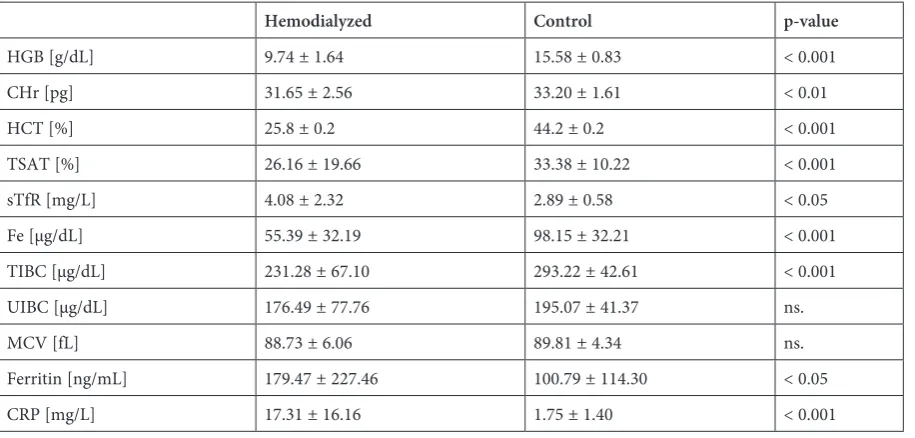
The dialyzed patients have significantly lower serum concentrations of hemoglobin, CHr, HCT, TSAT, Fe and TIBC and significantly higher serum concentrations of sTfR, ferritin and C-reactive protein compared to the control group ( Table 1).
The discriminant analysis, taking into account the seven variables presented in Table 2, showed that the hemoglobin concentration and iron, the concentration of CRP > 5 mg/L, as well as the concentrations of the soluble transferrin recep-tor, make it possible, with 98% sensitivity and 66% specificity, to classify the patients to the group with a high risk of the occurrence of anemia (variables that left in the step-wise backward analysis).
Based on its results, the classification functions are presented below, for the control group K and for the patient group D.
D = –44.15 + 2.23⋅HGB + 21.82⋅log10(sTfR) +
+ 31.74⋅log10(Fe) – 3.69⋅CRP*
K= –75.60 + 6.51⋅HGB + 10.12⋅log10(sTfR) +
+ 21.73⋅log10(Fe) + 0.45⋅CRP*
where CRP* is equal to 1, if CRP serum level ex-ceeds the level 5 mg/L; otherwise it is equal to 0.
In order to assess whether a patient qualifies, one should calculate the functions below:
D (HGB, sTfR, Fe, CRP) ≥ K (HGB, sTfR, Fe, CRP) – the person is at risk of the occurrence of anemia D (HGB, sTfR, Fe, CRP) < K (HGB, sTfR, Fe, CRP) – the person is not at risk of the occurrence of anemia. A patient belongs to a class for which the clas-sification function achieved a greater value.
Finally, the classification function is as follows (F > 0):
F = 31.45 – 4.31⋅HGB + 11.7log10(sTfR) +
+ 10⋅log(Fe) – 3.24⋅CRP*
Table 3 presents the confusion matrix, taking into account the classification function obtained. In order to fulfill the requirements of the discrimi-nant analysis, Fe and sTfR were logarithmized.
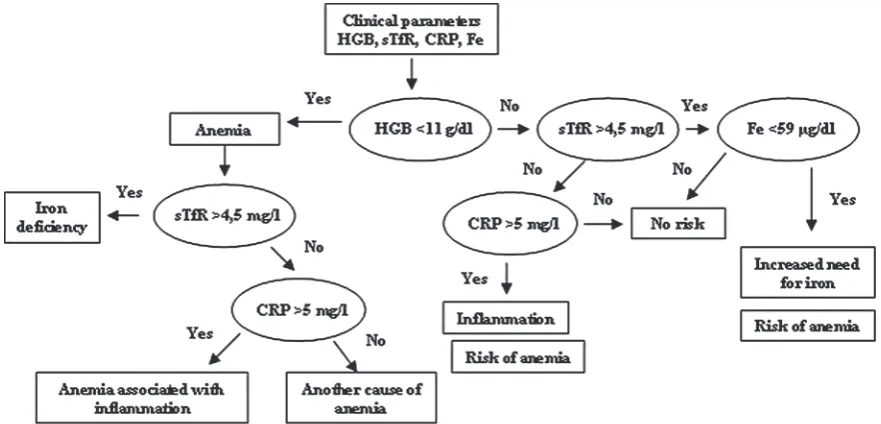
Based on the results of the discriminant anal-ysis and assuming the cut-off points recommend-ed by the ERA-EDTA, we have proposrecommend-ed a scheme for assessing the risk of anemia, shown in Fig. 2. The risk of anemia assessment based only on
con-Table 1. Statistical description of parameters in hemodialyzed and control groups
Hemodialyzed Control p-value
HGB [g/dL] 9.74 ± 1.64 15.58 ± 0.83 < 0.001
CHr [pg] 31.65 ± 2.56 33.20 ± 1.61 < 0.01
HCT [%] 25.8 ± 0.2 44.2 ± 0.2 < 0.001
TSAT [%] 26.16 ± 19.66 33.38 ± 10.22 < 0.001
sTfR [mg/L] 4.08 ± 2.32 2.89 ± 0.58 < 0.05
Fe [µg/dL] 55.39 ± 32.19 98.15 ± 32.21 < 0.001 TIBC [µg/dL] 231.28 ± 67.10 293.22 ± 42.61 < 0.001 UIBC [µg/dL] 176.49 ± 77.76 195.07 ± 41.37 ns.
MCV [fL] 88.73 ± 6.06 89.81 ± 4.34 ns.
Ferritin [ng/mL] 179.47 ± 227.46 100.79 ± 114.30 < 0.05 CRP [mg/L] 17.31 ± 16.16 1.75 ± 1.40 < 0.001 ns. – not statistically significant.
Table 2. Results of discriminant analysis
Parameter F test p-value Effect
HGB 202.1108 < 0.001 in model log10(Fe) 9.3975 < 0.01 in model CRP > 5 mg/L 25.3451 < 0.001 in model log10(sTfR) 12.3092 < 0.001 in model CHr 0.0985 ns. out of model Ferritin 0.4716 ns. out of model HCT 0.0594 ns. out of model
centration of hemoglobin and hematocrit yields 83% sensitivity and 100% specificity. After adding serum concentration of Fe to the model, sensitivi-ty improved to 89% however specificisensitivi-ty decreased
to 94%. With the decision tree, we obtained 95% sensitivity and 100% specificity and a positive/nega-tive predica positive/nega-tive value of 100% and 92%, respeca positive/nega-tively.
Discussion
The major reasons for anemia in patients with chronic kidney disease are the reduction EPO pro-duction, chronic inflammation, shortened half-life of erythrocytes and iron deficiency [12, 13]. Intra-venous iron is a valid element in the treatment of ESRD. Unfortunately, such therapy may increase the risk of infection through impairment of neu-trophil and T-cell function and promotion of mi-crobial growth [14]. A diagnosis of anemia is based on laboratory parameters such as: plasma iron, fer-ritin, sTfR, transferrin saturation, hepcidin and erythrocyte zinc protoporphyrin/heme ratio [15].
Fig. 1. Classification of data using
discrimi-nant analysis on a plane (using the first two principal components)
Table 3. Results of classification obtained with the use of
the discriminant analysis method based on the variables: HGB, log10(Fe), CRP > 5 mg/L and log10(sTfR)
Anticipated classification % correct anemia
n no anemian
Classifi-cation observed
tested 98.48 65 1 control 100.00 0 34 total 99.00 65 35
n – number.
Modern recommendations related to the meth-ods of monitoring iron metabolism and treatment of anemia in patients chronically hemodialyzed due to renal failure who are treated with erythro-poiesis stimulating agents should provide high-er hemoglobin concentration, within the range of 11–12 g/dL and hematocrit values between 33% and 36%. All of these anemia indexes were ana-lyzed according to their diagnostic usefulness, as recommended by the ERA-EDTA [9].
As a result of that analysis, the concurrent va-lidity parameters were assessed for reticulocyte he-moglobin content (CHr). In all results of the tests analyzed, only 1% of CHr assays had values below the standard, whereas in 89% of cases, reticulocyte hemoglobin content was not decreased. The calcu-lations show that the accuracy of anemia diagnosis was 45% with an 83% chance to get a false nega-tive result. These results undermine the usefulness of assessment of reticulocyte hemoglobin content in the detection of anemia in the case of hemodi-alyzed patents and are significantly different from the results obtained by Fishbane et al. [16]. Their research included patients who were intravenous-ly treated with an iron preparation and were divid-ed into two groups, in which the iron turnover was assessed according to the results of laboratory tests on the concentration of ferritin and transferrin saturation (first group) and reticulocyte hemoglo-bin content (second group). According to the au-thors of the research, the results obtained proved the greater usefulness of CHr assays as an index to measure iron metabolism during treatment with iron preparations and erythropoietin, when com-pared to the assessments of ferritin and TSAT. When comparing the concentration of ferritin, the percentile saturation of transferrin and the con-tent of hemoglobin in reticulocytes, the authors found that the reticulocyte hemoglobin content al-lows for better estimation of a dose of medicine ad-ministered to the patients in order to stabilize their iron content management. Based on the results of their own studies, Fishbane et al. suggest assessing the reticulocyte hemoglobin content as a precise and reliable index which can help monitor intra-venous therapy to supplement iron deficiency in chronically hemodialyzed patients [10].
However, that conclusion seems to be not doc-umented enough. While assessing the reticulocyte hemoglobin content, which is a cellular index, the authors assumed it to be sufficient to assess distur-bances in the management of iron in the system. The test groups were not statistically significant-ly different at the time the tests were commenced, nor at the time they were finished. Standard devi-ation in both groups amounted to 1.8 and 1.7 pg, respectively, while the difference between
medi-an reticulocyte hemoglobin content was also not statistically significant and amounted to 1.0 pg. The study by Karagülle et al. demonstrates that CHr is a helpful parameter that can be safely used in the diagnosis of anemia [17].
The results of research conducted by other au-thors confirm the usefulness of an assessment of soluble transferrin receptor in diagnosing iron de-ficiencies [18–21]. Those authors recommend sT-fR as a reliable index which makes it possible to as-sess the assimilability of iron during the treatment of its systemic deficiencies [19]. The usefulness of sTfR assessment in the identification of anemia type was confirmed by, among others, Tarng and Huang. Tarng and Huang studied changes in the concentration of the transferrin receptor in the plasma in the case of hemodialyzed patients treat-ed with erythropoietin (EPO) [22]. The results of the assessment of that soluble receptor statistical-ly significantstatistical-ly differentiated the group of people with anemia from the group treated with kidney replacements. Those authors confirmed that the sTfR index can prove useful in the assessment of the degree of excitation of erythropoiesis as a re-sponse to the treatment of anemia with erythropoi-etin. Moreover, the results suggest a close relation between the concentration of the soluble transfer-rin receptor and iron deficiency in the system [22]. A study by Rubab et al. has shown that serum hepcidin provides useful information on the lev-el and availability of iron during inflammation, compared to conventional markers of iron. Serum hepcidin level changes in patients with ESRD on HD. We should note that hepcidin regulates plas-ma iron. Hepcidin production is reduced in the presence of iron deficiency, hypoxia and ineffec-tive erythropoiesis, while increased production is stimulated increased plasma and stored iron [12].
In our own research, the concentration of iron in the serum proved to be the best individual diag-nostic parameter if classic anemia indexes (HGB + HCT) are to be considered. The analysis of results by the discriminant method confirmed the high diagnostic value of hemoglobin concentration in the detection of anemia in chronically hemodia-lyzed patients. The HGB index proved to be statis-tically significant, whereas assessment of hemato-crit values, mentioned in recommendations for the code of conduct in cases of patients with anemia and chronic kidney failure set by the EBPG, turned out to be statistically insignificant.
5% and a chance to obtain a falsely positive re-sult amounting to 0%. The accuracy of diagno-sis was 97%. The diagram confirms the disease with a positive predictive value (PPV) of approx. 100% and denies it with a negative predictive val-ue (NPV) of 92%.
The suggested classification diagram has high-er paramethigh-er values for diagnostic accuracy than the traditional method of anemia detection based only on the concentration of hemoglobin in blood (HGB) and hematocrit (HCT), as well as the test set based on the combination of HGB + HCT + Fe. No similar studies which assess the diagnostic usefulness of iron turnover indexes based on the method of stepwise backward discriminant analy-sis were found in the literature available to us.
Results by Sedlackowa et al. were similar to ours. Their study showed that iron, transferrin, albumin and hemoglobin were significantly low-er in patients, and slow-erum flow-erritin, sTfR, hepcidin, CRP and IL-6 were significantly higher in dialyzed patients compared to control healthy volunteers. There was a poor correlation between hepcidin, ferritin and CRP in hemodialyzed patients. It can be concluded that the influence of inflammation on hepcidin levels in hemodialyzed patients is not important and other factors including its retention and high iron stores in end-stage renal disease also participate [23].
As is commonly known, anemia is a serious clinical and diagnostic problem, therefore the in-tense search for a universal, non-invasive
algo-rithm of laboratory tests to discover its causes con-tinues. It seems that limiting the number and types of necessary descriptive variables will make it pos-sible to make concise assumptions for the inter-pretation of those results (the statistical model) in both detection of anemia and monitoring the ad-vances in its treatment. The standard of morpho-logical and biochemical indexes currently used may not reflect the actual state of iron resourc-es due to the influence of inflammatory procresourc-essresourc-es and other factors.
The set of tests suggested in this paper includes concentrations of the following: hemoglobin, iron, C-reactive protein and soluble transferrin recep-tor. A set of data obtained with the use of classi-fying differential equations and based on the re-sults of an assessment of each element of the test set makes it possible to obtain high sensitivity and diagnostic specificity, as well as accuracy of the di-agnosis superior to that obtained with the use of traditional diagnostic methods, in order to classify the examined patients.
To sum up, the highest diagnostic value has been demonstrated for the concentrations of he-moglobin (HGB), soluble transferrin receptor (sT-fR), iron in the serum (Fe) and C-reactive protein (CRP). Moreover, determining the concentration of soluble transferrin receptor confirmed its high diagnostic value in the detection of iron deficiency anemia in patients undergoing dialysis for chronic end-stage renal failure in comparison to the con-ventional rates of rotation of iron in serum.
References
[1] Silverberg D: Outcomes of anaemia management in renal insufficiency and cardiac disease. Nephrol Dial
Transplant 2003, Suppl 2, ii7–12.
[2] Silverberg D, Wexler D, Blum M, Wollman Y, Iaina A: The cardio-renal anaemia syndrome: Does it exist?
Nephrol Dial Transplant 2003, Suppl 8, viii7–12.
[3] González-Costello J, Comín-Colet J: Iron deficiency and anaemia in heart failure: Understanding the FAIR-HF
trial. Eur J Heart Fail 2010, 12, 1159–1162.
[4] Beutler E, Waalen J: The definition of anemia: What is the lower limit of normal of the blood hemoglobin
con-centration? Blood 2006, 107, 1747–1750.
[5] Formanowicz D, Formanowicz P: Transferrin changes in haemodialysed patients. Int Urol Nephrol 2012, 44,
907–919.
[6] Brugnara C, Schiller B, Moran J: Reticulocyte hemoglobin equivalent (Ret He) and assessment of iron-deficient
states. Clin Lab Haematol 2006, 28, 303–308.
[7] Mitsuiki K, Harada A, Miyata Y: Assessment of iron deficiency in chronic hemodialysis patients: Investigation of
cutoff values for reticulocyte hemoglobin content. Clin Exp Nephrol 2003, 7, 52–57.
[8] Mitsuiki K, Harada A, Miyata Y: Reticulocyte hemoglobin content in hemodialysis patients with acute infection.
Clin Exp Nephrol 2004, 8, 257–262.
[9] SECTION II. Targets for anaemia treatment. Nephrol Dial Transplant 2004, 19 Suppl 2, ii6–ii15.
[10] Satirapoj B, Supasyndh O, Choovichian P: A comparative study of efficacy and safety of the lyophilized
pow-der alpha-erythropoietin and the liquid form alpha-erythropoietin for hemoglobin maintenance in patients with hemodialysis treatment. J Med Assoc Thai 2014, 97, 899–906.
[11] Grote Beverborg N, Verweij N, Klip IT, van der Wal HH, Voors AA, van Veldhuisen DJ, Gansevoort RT, Bakker SJ, van der Harst P, van der Meer P: Erythropoietin in the General Population: Reference Ranges and
Clinical, Biochemical and Genetic Correlates. PLoS One 2015, 10, e0125215. DOI: 10.1371/journal.pone.0125215.
[12] Rubab Z, Amin H, Abbas K, Hussain S, Ullah MI, Mohsin S: Serum hepcidin levels in patients with end-stage
[13] Formanowicz D, Formanowicz P: Transferrin changes in haemodialysed patients. Int Urol Nephrol 2012, 44,
907–919. DOI: 10.1007/s11255-011-9947-4.
[14] Ishida JH, Johansen KL: Iron and infection in hemodialysis patients. Semin Dial 2014, 27, 26–36. DOI: 10.1111/
sdi.12168.
[15] Al-Ghananim RT, Nalbant D, Schmidt RL, Cress GA, Zimmerman MB, Widness JA: Reticulocyte hemoglobin
content during the first month of life in critically ill very low birth weight neonates differs from term infants, chil-dren, and adults. J Clin Lab Anal 2015. DOI: 10.1002/jcla.21859.
[16] Fishbane S, Shapiro W, Dutka P, Valenzuela OF, Faubert J: A randomized trial of iron deficiency testing
strate-gies in hemodialysis patients. Kidney Int 2001, 60, 2406–2411.
[17] Karagülle M, Gündüz E, Sahin Mutlu F, Olga Akay M: Clinical significance of reticulocyte hemoglobin content
in the diagnosis of iron deficiency anemia. Turk J Haematol 2013, 30, 153–156. DOI: 10.4274/Tjh.2012.0107.
[18] Baillie FJ, Morrison AE, Fergus I: Soluble transferrin receptor: A discriminating assay for iron deficiency. Clin.
Lab Haematol 2003, 25, 353–357.
[19] Means RT, Allen J, Sears DA, Schuster SJ: Serum soluble transferrin receptor and the prediction of marrow
aspi-rate iron results in a heterogeneous group of patients. Clin Lab Haematol 1999, 21, 161–167.
[20] Nagral A, Mehta AB, Gomes AT, Ellis G, Jackson BF, Sabin CA, McIntyre N: Serum soluble transferrin receptor
in the diagnosis of iron deficiency in chronic liver disease. Clin Lab Haematol 1999, 21, 93–97.
[21] Vendt N, Talvik T, Leedo S, Tomberg K, Kool P, Tillmann V, Grünberg H: The reference limits and cut-off value
for serum soluble transferrin receptors for diagnosing iron deficiency in infants. Int J Lab Hematol 2009, 31, 440–446.
[22] Tarng DC, Huang TP: Determinants of circulating soluble transferrin receptor level in chronic haemodialysis
patients. Nephrol Dial Transplant 2002, 17, 1063–1069.
[23] Sedlackova T, Racek J, Rajdl D, Kielberger L, Eiselt J, Malanova L, Babuska V: Relationship between hepcidin and
ferritin in haemodialysed patients. Wien Klin Wochenschr 2013, 125, 448–452. DOI: 10.1007/s00508-013-0388-1.
Address for correspondence:
Joanna K. Strzelczyk
Department of Medical and Molecular Biology Medical University of Silesia in Katowice ul. Jordana 19
41-808 Zabrze Poland
Tel. +32 272 21 71
E-mail: [email protected] Conflict of interest: None declared Received: 27.02.2015