Volume 7, Issue 3, 2020, pp. 121-141 Available online at www.jallr.com ISSN: 2376-760X
* Correspondence: Layal Tariq Bedairi, Email: layalbedairi gmail.com © 2020 Journal of Applied Linguistics and Language Research
Usage of Arabic Pidgin Language Among Saudi Arabic
Speakers and Foreign Workers in Yanbu
Layal Tariq Bedairi * Yanbu University College, Saudi Arabia
Suzan Al -Doubi
Yanbu University College, Saudi Arabia
Abstract
The purpose of this study was to investigate Arabic Pidgin language used among Saudi Arabic speakers and foreign workers in Yanbu, Saudi Arabia. In Yanbu society, Saudi Arabic speakers and foreign workers use Arabic Pidgin language in their everyday conversations to communicate successfully. The research investigated the features and varieties of Arabic Pidgin language. Moreover, the study also identified Saudi Arabic speakers’ attitudes toward the use of Arabic Pidgin in Yanbu. The participants of the study were four foreign workers from different nationalities, Kenyan, Indian, and Indonesian and fifty-six Saudi Arabic speakers. Mixed-methods research was used. Therefore, the tools of collecting the data were observations, interviews, and a questionnaire. The observation of simultaneous conversations among Saudi Arabic speakers and foreign workers was the first tool. Foreign workers were interviewed and asked about their usage of Arabic Pidgin. The questionnaire was given to Saudi Arabic speakers to collect their attitudes about the use of Arabic Pidgin. The results of the study showed that the variety of using Arabic Pidgin by foreign workers and Saudis was very similar. Saudis and foreign workers used the same structures while speaking Arabic Pidgin. However, there was only one difference which was using of gender pronouns by foreign workers. The findings of the interviews showed the features of Arabic Pidgin which included insertion, adding, combining, and code-switching. The results of the questionnaire showed positive and negative attitudes toward Arabic Pidgin. Saudis had positive attitudes toward Arabic Pidgin for communication purposes. However, they had negative attitudes in the development of Arabic language.
Keywords: pidgin, Arabic speakers, foreign workers, attitude
INTRODUCTION
opportunities. Working in another country requires learning at least basic aspects of the native language of that country. As a result, the Pidgin language exists. Foreign workers and native speakers tend to use Pidgin language to communicate easily and successfully. Pidgin language speakers are people belonging to different communities and who use the simplified form of language to build a successful communication (Foy, 2007). This language is different from the original one because it has separate form and features. In Yanbu, Arabic Pidgin plays a strong role as it is commonly used by Saudis and foreign workers in communicative situations. As suggested by Albakrawi (2012), the interaction between Saudis and expats has a strong influence on developing Saudi Pidgin. Moreover, the different situations build Saudi Pidgin, such as every day conversation among Saudis and house keepers, drivers, cleaners and office keepers. As mentioned by Gomaa (2007), in Saudi Arabia the Pidgin language occurs in everyday conversation among Saudis and expat workers.
In Saudi Arabia’s setting, foreign workers and Saudis face difficulty to use the native
language in their communication. They neither use Saudi Arabic language nor the foreign
workers’ first language. As a result, the Pidgin language is created. Saudis and expats use
the Pidgin language to communicate successfully, but this language carries many new structures which are not related to the original language (Saudi Arabic language variation).
THIS STUDY
The purpose of the study was to investigate the features of Arabic Pidgin used in Saudi Arabia in Yanbu. The study also investigated the variation of Arabic Pidgin used among Saudi Arabic speakers and foreign workers in Yanbu. Saudi Arabic speakers’ attitudes
toward the usage of Arabic Pidgin in Yanbu were explored. This study sought to answer the following questions.
▪ What are the features of Arabic Pidgin spoken in Yanbu?
▪ What are the variations of Arabic Pidgin used among Saudi Arabic speakers and expat workers?
▪ What are Saudi Arabic speakers’ attitudes toward Arabic Pidgin language used in
Yanbu?
LITERATURE REVIEW
This section presents theoretical backgrounds about Pidgin language. In this part, the concepts of Pidgin and foreign worker are defined. Moreover, previous studies that are related to Pidgin language are presented.
Smith, 1994). As stated by Gomaa (2007), Arabic Pidgin is a simplified form of Arabic that is created by the interaction between Saudis and guest workers.
As suggested by Mohamed, Ramendran, and Yacob (2012), a foreign worker is a non-national person who does a specific job abroad. Oversea companies or recruitment agencies offer different career opportunities for those workers to complete the manpower of the country for an interim time.
Previous Studies
The first study was done by Gomaa (2007) on Arabic pidginization. The research took place at Assiut University, Egypt. The purpose of the study was to explain, and examine the Arabic Pidgin spoken in Saudi Arabia, to examine the circumstances under which Arabic Pidgin emerged as a linguistics phenomenon, and to put Arabic Pidgin spoken in Saudi Arabia in appropriate framework according to the history events and hypothesis of Pidgin language. The participants of the study were adult Saudi speakers and Indian workers. The type of the research was qualitative. The researcher collected the data by using observations and video recordings. He collected the data freely by setting in different places, listening to what is going on, and writing down his observations. He started with observation then the video recordings. The results showed that the Pidgin
language varied phonologically and impacted by Saudis’ spoken language. In addition,
there were differences in the production of Arabic consonants and vowels by the Indian workers. The findings of the study also showed that foreign workers and native speakers used the simple form of Arabic language to communicate and be understood easily. The second study was done by Albakrawi (2012) on the linguistic effect of foreign Asian workers on the Arabic Pidgin in Saudi Arabia. It was done at the University of Tabuk, Tabuk, Saudi Arabia. The purpose of the study was to investigate the linguistics impact of the Asian workers on Saudi Arabic language. The participants of the study were Asian workers in Saudi Arabia. The type of the research was qualitative. The researcher collected the data by conducting interviews with the participants. The results of the
research showed that the Asian workers’ Pidgin had an impact on Saudi Arabic language.
Arabic Pidgin produced by Asian workers was weak in different aspects. For example, it had lack of inflections, tenses that were expressed by time adverbials, definite article, numerals, separate negation system, copula that is mismatched with its subject, and verb
inflections and tense. These differences affected Saudi language’s variety.
were collected by making interviews with the participants in two cities in Saudi Arabia: Riyadh and Alkharj. The analysis of the interviews was based on ten morpho-syntactic phenomena. The results of the study showed that Gulf Arabic Pidgin is affected by the
participants’ first language and the duration of staying in Gulf. The study also presented
that the Gulf Arabic system is respected by the participants on only one aspect which is conjunction markers.
Another study was done by Onjewu and Okpe (2015) in Antalya, Turkey. The study was about examining the tendencies of using Pidgin instead of Standard English by the students who speak English as a foreign language. The purpose of the study was to specify the responsible elements of using Pidgin English among students. Another purpose was to find out the strategies that helped to reduce and remove the elements which led to use Pidgin in order to achieve better proficiency of Standard English. The participants of the study were a thousand students randomly selected from three tertiary institutions in Kaduna and Nigeria. The participants were seminary and university students. The research was a qualitative research. The researchers used a questionnaire which contained direct and open ended questions that focus on the students’ usage of Pidgin
English with their family, friends, colleagues, and everywhere. The data were analysed by frequency counts and context analysis. The results of the study showed that most of the students use Pidgin English in their backgrounds. The findings of the study also showed that the time of teaching standard English in schools was not enough for the students as non-resident students. Therefore, it was difficult to solve the problem because it is beyond the control of the learning institution. It is impossible to impose the rules of using the language communicatively especially outside the classroom.
Additionally, a study was done by Abongdia (2014) on ideologies and attitudes towards Pidgin English in Cameroon. The study was done in Rome, Italy, University of Yaoundé 1. The aims of the study were to highlight some of the ideas and attitudes responsible of
using Cameroon Pidgin English (CPE), and to discover the language variety’s function in
the social life of Cameroon and the University of Yaoundé 1. The participants were 60 students and 15 lecturers from the University of Yaoundé 1. The students were Applied Linguistics students in their third year, and the lecturers were from Applied Linguistics and English departments. The research was a qualitative research. The data were collected by using an open-ended questionnaire, interviews, and observations. The findings of the questionnaire showed that most of the students had positive attitudes toward CPE and they prefer to use both CPE and Camfran-anglais (CFA). The last CFA is a hip hop language variety born from CPE. The results of the interviews showed that most of the students liked to use CPE. They saw it as a social language which benefits different people from different educational levels since CPE had two verities which were Anglophone and Francophone. Moreover, the observations displayed that there was a
great use of Anglophone variety in the participants’ interaction. Another note was
data which are interviews with foreign workers, observations of conversations among Saudis and foreign workers, and a questionnaire that is given to Saudis.
METHOD
Research Design
This research is a mixed methods research. The researcher uses observations, interviews, and a questionnaire to collect data.
Participants
The participants were three groups: the first group consisted of Saudis and foreign workers who used Arabic Pidgin. The second group were four foreign workers with different backgrounds. In particular, they were one Indian, one Kenyan, and two Indonesians. The third group was fifty-six Saudi Arabic native speakers and their age ranged between 20 and 35 years old.
Instruments
Observation
The researcher listened to spontaneous conversations among Saudi Arabic speakers and foreign workers at home and public places. The conversations were analyzed carefully. Therefore, the researcher investigated the variation of Arabic Pidgin based on a rubric. The rubric included grammatical, and vocabulary features (see Appendix A).
Interview
Interviews with foreign workers were conducted to determine the features of Arabic Pidgin. Using interviews helped to determine their point of views of using this language variety. Moreover, the reasons of using Arabic Pidgin were presented. The interviews had four questions about their usage of Arabic Pidgin. The researcher used a structured
interview. The participants’ responses were recorded, and analyzed (see Appendix B).
Questionnaire
A close ended online questionnaire was designed based on Likert scale. The questionnaire consisted of five statements. There were five points on the questionnaire (strongly agree, agree, neutral, disagree, strongly disagree). The purpose of the
questionnaire was to investigate Saudi Arabic speakers’ attitudes toward using Arabic
Pidgin language (see Appendix C). Data Collection Procedure
RESULTS AND DISCUSSION Observations
The first tool of this research was observations. The purpose of observations was to investigate the variations in the use of Arabic Pidgin among Saudi Arabic speakers and expat workers. The observations were made by listening to spontaneous conversations
among Saudis and foreign workers. Unlike Gomma (2007)’s study that was observing
naturally conversations between Saudis and Indian workers in Riyadh, Saudi Arabia. The present study observed spontaneous conversations among Saudis and expat workers from different nationalities in Yanbu industrial city, Saudi Arabia. The observations were based on a rubric to compare the variety of using Arabic Pidgin. The following part discusses the variety of using Arabic Pidgin by Saudis and expat workers:
This part is related to Arabic Pidgin variety spoken by Saudis. According to the
observations’ rubric the following aspects were noticed in their usage of Arabic Pidgin.
Verbs. Verbs in Saudis’ Arabic Pidgin variety has specific usage. Saudis combining verb
with noun to form a verb. An example of a conversation between Saudi and Indian driver: Saudi: ارب راظتنإ يوس تنإ
/ ɪntə sɑwɪ ɪntizɑr bərɑ/
Instead of: ارب رظتنإ / ɪntəzɪr bərɑ/
which means “wait outside.”, but it is used in this form “you do waiting outside.”
Another example of a conversation between Saudi and Kenyan housekeeper: Saudi: ؟ ةلاص ي تيوس ي تنإ
/ ɪnti sɑwɪti sɑlɑh/
Instead of: ؟ ي تيلص /sɑleɪti/
Which means “did you pray?”, but it is used in this form “you do prayer?” Saudis use the verb “do” with noun to form verbs.
Saudis’ Arabic Pidgin variety also presents using verbs by making incorrect tenses. An
example from a conversation between Saudi and Kenyan housekeeper: Saudi: ؟سبلام يوكي ي تنإ
/ ɪnti jɪkwi mælæbɪs/ Instead of: ؟سبلاملا ي تيوك /kwiti ælmælæbɪs/
Which means “did you iron the clothes?” here the speaker is talking about a past event.
However, she uses present verb "يوكي" / jɪkwi / to talk about a past event in this form
Another example of a conversation between Saudi and Pakistani driver: Saudi: راضخ قح لحم فرعي تنإ
/ɪntə jʕərf məhæl hæg χudær/
Instead of: راضخلا لحم فرعت / tʕərf məhæl alχudær/
Which means “you know vegetable store?” here the speaker is talking about a past event you know it already, but he uses present verb فرعي/ jʕərf/ instead of a past verb.
Pronouns. The correct structure of Arabic language is verb + subject. However, in Saudis’
Arabic Pidgin variety, the researcher noticed that Saudis use subject + verb to form a sentence. They add the pronouns ‘تنا’ or ‘ ي تنإ’ which means ‘you’ before verbs. An example of a conversation between Saudi and Indian driver:
Saudi: اشع دعب تيب لاعت تنإ / ɪntə tʕæl bet bæʕæd ɪʃæ / Instead of: اشعلا دعب لاعت / tʕæl bæʕæd ælɪʃæ /
Which means “come home after Ishaa prayer.” but here it was used in this form “you come after Ishaa prayer.” Another example of a conversation between Saudi and Kenyan
housekeeper.
Saudi: اركب قح لكا يوس ي تنإ / ɪnti sɑwɪ ækəl hæg bʊkræ/
Instead of: اركب لكا يوس /sɑwɪ ækəl bʊkræ/
Which means “do tomorrow’s food.” but here it was used in this form “you do tomorrow’s food.” According to these examples, there was utilization of the pronoun تنإ and ي تنإ before verbs.
Possessive. Saudis’ Arabic Pidgin variety presented lots of using the possessive تنا قح
/hæg ɪntə/. An example of a conversation between Saudi and Kenyan housekeeper: Saudi: ؟ ي تنإ قح ةزاجإ فيك
/keɪf ɪdʒæʒæzæ hæg ɪnti/ Instead of: ؟ كتزاجإ فيك /keɪf ɪdʒæʒæztɪk/
Which means “how was your holiday?” but here it was used as “how was you’s vacation?”
Mixing. Mixing between Arabic Pidgin and English was practiced by Saudis in their Arabic Pidgin variety. An example of a conversation between Saudi and Kenyan housekeeper:
/ ɪnti sɑwɪ ækɪl mæʕ apətīzər/ Instead of: لكلأا عم تلابقم يوس / sɑwɪ mæʕ mʊʡbɪlæt ælækɪl /
Plural. In Arabic language, there are three grammatical numbers which are singular,
plural, and dual. These grammatical numbers are connected with the noun. If the number is plural, the noun should be plural. However, Saudis use the plural number with a singular noun. An example of a conversation between Saudi and Indian driver:
Saudi: ةقيقد ة رشع ىتتسا تنإ / ɪntəɪstnəʕʃrə dʡɪʡæ / Instead of: قئاقد ة رشع ىتتسا /ɪstnəʕʃrə dʡɪʡæiʡ /
Which means “wait for ten minutes”, but here it was used in this form “you wait ten minute”. Saudi used a singular noun instead of a plural noun.
Repetition words. Saudis Arabic Pidgin includes repeating of words. They say specific
word two times to express another meaning of word. An example of a conversation between Saudi and driver:
Saudi: ارب قاوس اوس اوس سلجا تنا
/ ɪntə ædʒlɪs səwæ səwæ səwæg bəræ/ Instead of:ارب قاوسلا عم سلجا
/ædʒlɪs mæʕ ælsəwæg bəræ/
Saudi repeated the word اوس / səwæ / which means “together” instead of using preposition “with.”
These aspects were noticed while observing spontaneous conversations in different places, such as home and streets. It was about Saudis’ variety of using Arabic Pidgin.
The following part is related to Arabic Pidgin spoken by foreign worker. The following aspect were noticed while observing spontaneous conversations between Saudis and foreign workers.
Verbs. Foreign workers’ variety presented some structures while using verbs.
They combining verb and noun to form a verb. An example of a conversation between Saudi and Kenyan housekeeper:
Housekeeper: ءاعد يوس انا / ænɑ sɑwɪ duʕɑ /
Instead of: تيعد
Foreign workers use the verb “do” with noun “prayer” to form a verb. The sentence was used to express a past event and it meant “I prayed.” but here it was used in this form “I do prayer.”
Using of verbs by foreign workers also showed using of incorrect verb tenses. An example of a conversation between Saudi and Indonesian housekeeper:
Housekeeper: سبلام لسغي يف انا سما ى /æms ænɑ fi yəgəsɪl mælæbɪs/
Instead of: سبلاملا تلسغ /gəsəlt ælmælæbɪs/
Foreign workers used a present verb tense to form a past event. The sentence was used to express a past event, but the verb لسغي/yəgəsɪl/ was present. The meaning of the
sentence was ‘I washed my clothes’, but it was used in this form ‘Yesterday I in wash clothes’
Gender pronoun. In Arabic language, there are gender pronouns which are related to the gender of the listener. Unlike English language when you speak to someone, you have
to use the word “you” regardless of his or her gender. In Arabic Pidgin variety spoken by foreign workers, using of these gender pronouns was wrong. Foreign workers used the
males’ pronoun تنا/ɪntə/ with females and female’s pronoun ي تنا/ɪnti/ with males. An example of part of a conversation between Saudi an Indonesian housekeeper:
Housekeeper was talking with a male: ؟ ارب حور ي تنا
/ɪnti ruh bæræ/
Instead of: ؟ ارب تحر تنا /ɪntə ruhət bæræ /
In the above example, the housekeeper used female pronoun referring to male.
Negated sentences. In Arabic language, the most common negation letter is ام/mæ/, but
in foreign workers’ Arabic Pidgin variety the letter ام/mæ/ was used with another preposition يف /fi/. An example of a conversation between Kenyan housekeeper and ى Saudi:
Kenyan: يلص يفام انا ى / ænɑ mɑ fi sɑli /
Instead of: تيلص ام انا / ænɑ mɑ sɑlaɪt /
Possessive. Using of possessive in foreign workers’ Arabic Pidgin variety was significant. They used the possessive تنا قح /hæg ɪntə/ in most conversations. An example of a conversation between Saudi and Indonesian housekeeper:
Indonesian: تنا قح لكا اداه / hædæ ækɪl hæg ɪntə / Instead of:كلكا اداه / hædæ ækəlk/
Dual. In Arabic language, the using of dual based on adding two letters at the end of the word, but in Arabic Pidgin spoken by foreign workers, they used dual by combining number two and singular noun. An example of a part of conversation between Saudi and Indian driver:
Driver: شيع لاير ى ينتا بيج انا / ænæ dʒi:b ɪtnɪn rɪjɑl ʕeʃ /
Instead of: ى يلايرب شيع ثتبج / dʒi:bt ʕeʃ bi: rɪjɑlɪn /
The speaker used number two and singular noun to form a dual.
Repetition. Foreign workers repeated some words to express a specific word. They use the same word two times. An example of a part of conversation between Indonesian housekeeper and Saudi:
Housekeeper: يوش يوش نوميل طح يف اناى / ænæ fi: hut laɪmu:n ʃuwaɪʃuwaɪ/ Instead of: ليلق نوميل تيطح
/ hæteɪt gəli:l laɪmu:n/
The speaker used the word /ʃuwaɪ/ which means “little” for two times to emphasis the meaning of “little.”
Based on previous examples, observations showed that the variety of Saudis and foreign workers was very similar. The researcher found that they used the same structures of using Arabic Pidgin. At the beginning, this variety was created by Saudis. As a result, foreign workers copied their variety and used it. However, there was only one difference
according to the observation’s rubric which was the usage of gender pronoun, Saudis used gender pronouns correctly. In other words, they used female pronouns for females and male pronouns for males. However, foreign workers did the opposite that they used female pronouns for males and male pronouns for females.
The results of the observations were unlike Gomaa (2007)’s study. In the present study the results showed that Saudis and foreign workers had mostly the same Arabic Pidgin’s variety. In contrast, Gomaa’s (2007)’s study claimed that Indian workers’ Arabic Pidgin
Interviews
Interviews with foreign workers were the second tool in this research. The purpose of
the interviews was to answer the second research question which was “what are the
features of Arabic Pidgin spoken in Yanbu?”. The following participants were four foreign
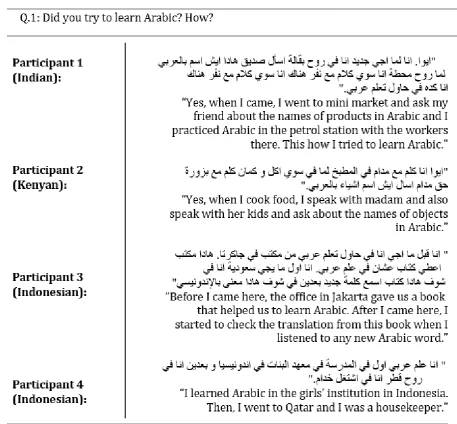
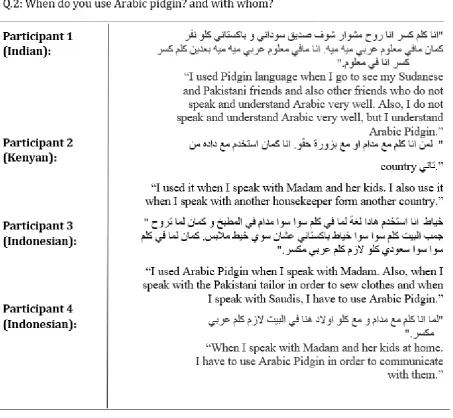
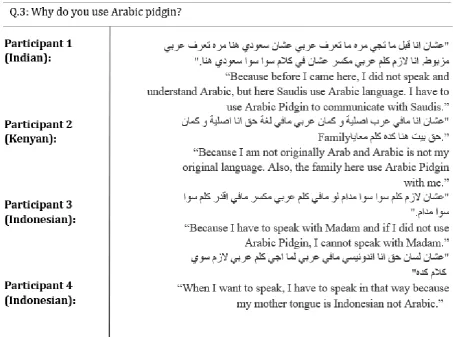
workers who worked in Yanbu. The interviews contained four questions and the responses were analyzed to find out the features of Arabic Pidgin. The focus of the interviews was on the structure of the participants’ responses and it was not on the
responses of the questions themselves. The responses were analyzed after presenting all tables.
Table 1. Foreign workers’ responses of the first interview question
According to the previous interviews, the following part discusses the features of Arabic Pidgin.
Insertion of the preposition /fi:/. There was a strong use of the preposition يف/fi:/ ى
which means “in” in English. The participants used the preposition between noun and
verb. For example,
"ةلاقب حور يف انا " ى / ænɑ fi: ruh bɪkəlɑ/
Which means “I went to mini market”, but here it was used in this form “I in went to Mini market”. Another example,
" ي برع ملعت لواح يف انا" ى
/ ænɑ fi: hɑwɪl təʕləm ʕæræbi:/
Which means “I tried to learn Arabic’, but here it was used in this form “I in tried to learn Arabic”.
Incorrect usage of verbs. Using of verb had special usage in Arabic Pidgin. Such as, using the imperative verbs to form past and present tenses. For example, when the foreign workers want to talk about an action that he/she did in the past or present, they used an imperative verb.
An example of using an imperative verb to form a past event: "ةسردملا يف ي برع ملع انا"ى
/ ænɑ ʕlɪm ʕæræbi: fi: mædrəsɑ/
Here the verb /ʕlɪm/ means “teach”, but the speaker here expressed an action that
happened in the past. In particular, she meant “I learned Arabic at school”, but she used
the verb /ʕlɪm/ instead of using the verb /təʕləmt/ which means “learned”. Moreover, in
Arabic when the speaker talks an action that is done by her/his self and it is a past tense, they have to add the letter /t/ at the beginning and the end of the word to make it past tense. However, in Arabic Pidgin speakers used the imperative /ʕlɪm/ without adding /t/ sound.
Other examples of using an imperative verb to form a present tense. "شك ملك انا"
/ænɑ kəlɪm kəsɪr/ "مادم عم ملك انا"
/ænɑ kəlɪm mæʕ mædæm/
Here the verb /kəlɪm/ means “speak”, but the speakers used the imperative verb / kəlɪm/ Instead of using the preset verb to talk about habits /ætkələm/. In Arabic language when the speaker wants to talk about a habit that he/she does, they have to use the letter /a/ at the beginning of the verb.
Using the verbs in Arabic Pidgin also has another feature. In Arabic language there are feminine and masculine letters used when the speaker wants to talk about someone. Moreover, when the speaker wants to talk about him/herself, they have to use the letter /a/ at the begging of the verbs. However, in Arabic Pidgin, when speakers want to talk about an action that is done by themselves, they used the feminine and masculine letters. For example,
" ي جت ام لبق انا"
/ ænɑ ʡəbl mæ tɪdʒi:/
Here the speaker used the feminine verb /tɪdʒi:/ which means “she comes” instead of
using the verb /ædʒi:/ which means “I come”. Another example,
Here the speaker used the masculine verb / jəʕrɪf / which means “he knows” instead of
using the verb / æʕrɪf / which means “I know”. In addition, the speaker was talking about
himself not about another person.
Repetition. In Arabic Pidgin and according to the previous interviews, the participants were repeating specific words for two times to express a specific meaning. For example,
"مادم اوس اوس ملك انا "
/ænɑ kəlɪm sæwæ sæwæ mædæm/
The speaker repeated the word / sæwæ / which means “with” for two times. The purpose of repeating the word is to form the meaning “with”. The speaker repeated the word
/sæwæ/ instead of using the preposition /mæʕ/. Another example,
م ميس ميس ملك يف انا"ى
"ماد
/ ænɑ fi: kəlɪm seɪm seɪm mædæm/
In this example, the speaker repeated the English word "same” /seɪm/ for two times and she meant that she speaks like her sponsor. Here the speaker mixed two languages that she repeated an English word to from a specific meaning.
Another example,
"هيم هيم ي برع مولعم يفام انا" ى
/ænɑ mæfi: məʕlu:m ʕæræbi: mɪjɑ mɪjɑ/
In the last example, the speaker repeated the word /mɪjɑ/ which means “one hundred”
for two times. This example is very common in Arabic Pidgin and they use it to form the
meaning of “very well”. The speaker meant that he did not speak Arabic very well.
Combing a negated letter and preposition in negated sentences.
In Arabic language the using of negated sentences is based on adding negated letters such as, /mɑ/ and /lɑ/ which mean “not” in English. However, in Arabic Pidgin the usage of negated letters is different. Moreover, they combine the letter /mɑ/ with the proposition
/fi:/. For example, " ي برع ملك فرعي يفام انا" ى
/ænɑ mæfi: jəʕrɪf kəlɪm ʕæræbi: /
Here the participant used negated sentence by combing the negated letter /mɑ/ with the
preposition /fi:/. It is very common situation for making negated sentences. However,
that in Arabic Pidgin some people use the negated letter /mɑ/ without the preposition /fi:/, but they use the following verb incorrectly. For example,
" ي برع فرعت ام هرم ي جت ام لبق انا"
Here the participant used the negated letter /mɑ/ correctly without adding preposition,
but he did not use a correct verb. The speaker used the verb /təʕrɪf/ instead of using the verb /æʕrɪf/.
Possessive. In Arabic language, using of possessive is based on adding specific letters to the main word. Using of possessive in Arabic Pidgin is based on combining the word /hæg/ with a subject. For example,
"انا قح ةغل يفام ي برع"ى
/ ʕæræbi: mæfi: lʊgɑ hæg ænɑ /
" يسينودنا انا قح ناسل ناشع" /lɪsɑn hæg ænɑ ɪnduni:si:/
These examples showed the using of possessive in Arabic Pidgin. The participants used
the possessive word /hæg/ which is expressed in English by using the ‘s’ possessive (‘s)
plus the subject of the possessive. The previous examples were talking about a possessive of the speakers themselves so, they used the word /ænɑ/ which mean “I”.
Code-switching. Code-switching of words from different languages was lack, but only
one participant, who was Kenyan, switched a word from English. An example, "اياعم ملك هدك انه تيب قح family”
/ fəmɪli: hæg bet kɪdə kəlɪm məʕjɑ/
Here the Kenyan house keeper mixed two languages that she used the English word
“family” while using Arabic pidgin. It was not very common in Arabic pidgin and it was based on the workers’ language background.
These features of Arabic Pidgin were noticed while analyzing the responses of the interviews. The usage of Arabic Pidgin had different structures. These structures were created by Saudis, and copied by foreign workers. The features of Arabic Pidgin also had incorrect usage of grammars, vocabulary, and prepositions that the speakers used these aspects in wrong positions or situations. The features also included addition and repetition of words to form specific meanings. Arabic Pidgin has long list of features. However, these were some of the features which were analyzed according to the responses of interviews.
The results of the interviews were similar to Albakrawi (2012)’s study. The present study
showed the features of Arabic Pidgin. Moreover, Albakrawi (2012)’s study also presented
similar features such as, the insertion of the preposition /fi:/, negation sentences, and tenses.
Questionnaire
The last tool of this research was a questionnaire. The researcher designed it to answer
the last research question which was: “what are Saudis” attitudes toward using Arabic
Pidgin?” This questionnaire was given to 56 Saudis. It included five statements and the
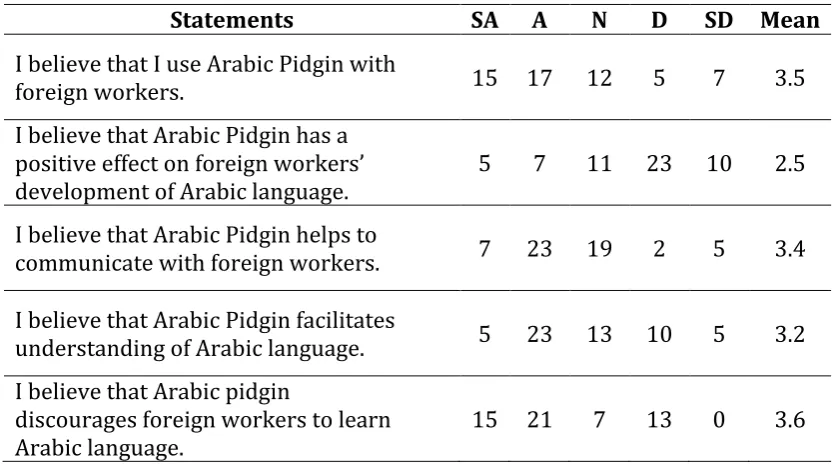
Table 5. Responses for questionnaire items
Statements SA A N D SD Mean
I believe that I use Arabic Pidgin with
foreign workers. 15 17 12 5 7 3.5
I believe that Arabic Pidgin has a
positive effect on foreign workers’
development of Arabic language. 5 7 11 23 10 2.5 I believe that Arabic Pidgin helps to
communicate with foreign workers. 7 23 19 2 5 3.4 I believe that Arabic Pidgin facilitates
understanding of Arabic language. 5 23 13 10 5 3.2 I believe that Arabic pidgin
discourages foreign workers to learn
Arabic language. 15 21 7 13 0 3.6
Table (5) shows Saudis’ attitudes toward using Arabic Pidgin. First, statement one shows
that more than half of the participants strongly agreed and agreed that they use Arabic Pidgin with foreign workers. Statement one also presents that Arabic Pidgin is a common language for Saudis that they knew and used it with foreign workers. In contrary, the second statement shows that 41% of the participants disagreed that Arabic Pidgin has a
positive effect in improving expats’ Arabic language. Saudis believed that Arabic Pidgin may result a negative backwash for the developing of Arabic language this type of language carries lots of incorrect structures. The third statement shows that most of the
participants’ responses ranged between agree and neutral that Arabic Pidgin helps to communicate with expats. The participants saw Arabic Pidgin as a communicative language. Regardless its wrong structures, it helps to communicate easily. The fourth statement presents that nearly half of the participants agreed that Arabic Pidgin facilitates the understanding of Arabic language. Arabic pidgin includes easy and simple structures. As a result, it is also easy to be understood. In addition, the structures of Arabic Pidgin are not used in native Arabic. The last statement presents that the responses of the participants were ranged between strongly agree and agree that Arabic Pidgin discourages foreign workers to learn Arabic language. Pidgin is a simplified form of language which is easier to be used. As a result, expats prefer to use it rather than learning Arabic language.
CONCLUSION
Arabic Pidgin is a new form of language that has its own structures. The purposes of the study were to investigate the features of Arabic Pidgin, the varieties of Arabic Pidgin, and
to select Saudis’ attitudes toward using Arabic Pidgin. The results of the study showed the features of Arabic Pidgin that included insertion, adding and combining, and
code-switching. The finding also showed that the varieties of foreign workers and Saudis’ Arabic Pidgin were similar, and Saudis’ attitudes toward using Arabic Pidgin were negative in development of Arabic language and positive in facilitating the communication.
In the process of making this research, the researcher faced some obstacles. Because of Corona virus, the researcher faced difficulties on collecting the data. First, in the process of making observations. Instead of making the observations in public places, the researcher had limited places. Second, the researcher had limited number of foreign workers for the interviews. The researcher planned to make the interviews with more than four participants, but because of sudden circumstances, the researcher reduced the number of participants.
The researcher recommends future researchers to have more participants from different nationalities and jobs environments. In addition, this will help to analyze Arabic Pidgin specifically. Moreover, the researcher also recommends to observe spontaneous conversations in public places.
REFERENCES
Abongdia, J. (2014). Ideologies and attitudes towards Pidgin English in Cameroon. Mediterranean Journal of Social Sciences, 5 (7), 601-608. Retrieved from
https://pdfs.semanticscholar.org/4896/20d0024d8a53c6ae77f91a8249af8cd9a 593.pdf
Albakrawi, H. (2012). The linguistic effect of foreign Asian workers on the Arabic Pidgin in Saudi Arabia. Research on Humanities and Social Sciences, (2), 127-133.
Retrieved from
file:///C:/Users/DELL/AppData/Local/Packages/Microsoft.MicrosoftEdge_8we kyb3d8bbwe/TempState/Downloads/3134-5167-1-PB%20(1).pdf
Almoaily, M. (2013). Language variation in Gulf Pidgin Arabic. (Unpublished doctoral dissertation). Newcastle University, Tyne, England. Retrieved from
https://theses.ncl.ac.uk/jspui/bitstream/10443/1859/1/Almoaily%2013.pdf Foy, C. (2007). Pidgin and creole language genesis deconstructing the status quo.
(Unpublished bachelor’s thesis). Retrieved from
https://www.scss.tcd.ie/undergraduate/computer-science-language/bacsll_web/cfoy0607.pdf
Gomaa, Y. (2007). Arabic pidginization: The case of Pidgin in Saudi Arabia. Journal of the Faculty of Arts, (19), 85-120. Retrieved from
https://www.researchgate.net/publication/316421161_Arabic_Pidginization_Th e_Case_of_Pidgin_in_Saudi_Arabia
Journal of Academic Research in Business and Social Sciences, 2(10), 531-532. Retrieved from
https://pdfs.semanticscholar.org/47ee/5004c63257a67c14640ae44435bf69e2 e71c.pdf
Muysken, P., & Smith, N. (1994). The study of pidgin and creole languages. In P. Muysken (Ed.), & N. Smith (Ed.), Pidgin and Creole (pp.3). Amsterdam: John Benjamins Publishing Company. Retrieved from
https://core.ac.uk/download/pdf/16105776.pdf
Onjewu, M., & Okpe, A. (2015). Investigation the preference for pidgin instead of Standard English by students of English as a foreign language. Procedia-Social and Behavioral Sciences, 199, 738-742. Retrieved from
https://www.sciencedirect.com/science/article/pii/S1877042815046248/pdf? md5=c1a3ee59e85685e2d6b91608902bfac5&pid=1-s2.0-S1877042815046248-main.pdf
Woodward Jr, J. C. (1973). Some characteristics of pidgin sign English. Sign Language Studies, 3(1), 39-46. Retrieved from
http://intrpr.info/library/woodward-characteristics-of-pidgin-english.pdf
Appendix A – Observation rubric
The purpose of this rubric was to take notes while observing spontaneous conversations between Saudis and foreign workers.
Grammatical features used
Verb tenses
Gender pronouns
Negated sentences
Subject-verb sentences
Prepositions
Vocabulary Plural Singular Dual Repetition
words
Mixing
Appendix B - Interview
The purpose of interviews was to investigate the features of Arabic pidgin. The interviews were recorded to select these features.
Question Response
1- Did you try to learn Arabic language? how? ؟فيك ؟ ي برع ةغل ملعت لواح يىف تنا
2- When do you use Arabic Pidgin? and with whom? ؟ ى يم عم ؟شكم ي برع مدختسا تنا تم
3- Why do you use Arabic Pidgin? ؟ شكم ي برع مدختسا يىف تنا شيل
Appendix C - Questionnaire
The purpose of questionnaire was to select Saudis’ attitudes toward using Arabic Pidgin. Please read the statement, and choose the option that suits you the most.
Statements Strongly
agree ةدشب قفاوا
Agree
قفاوأ
Neutral
دياحم
Disagree
قفاوأ لا
Strongly disagree قفاوأ لا
ةدشب
1- I believe that I use Arabic Pidgin with foreign workers.
عم ةسركملا ةيبرعلا ةغللا مدختسأ يننأب دقتعأ .ةيبنجلأا ةلامعلا
2- I believe that Arabic Pidgin has a positive effect on foreign workers’ development of Arabic language.
يف ي باجيا ريثأت اهل ةسركملا ةيبرعلا ةغللا نأب دقتعأ ةغللا ريوطت .ةيبنجلأا ةلامعلا ىدل ةيبرعلا
3- I believe that Arabic Pidgin helps to communicate with foreign workers.
لىع دعاست ةسركملا ةيبرعلا ةغللا نأب دقتعأ .ةيبنجلأا ةلامعلا عم لصاوتلا
4- I believe that Arabic Pidgin
facilitates understanding of Arabic
language.
ةغللا مهف لهست ةسركملا ةيبرعلا ةغللا نأب دقتعأ .ةيبرعلا
5- I believe that Arabic Pidgin discourages foreign workers to learn Arabic language.