M E T H O D O L O G Y
Open Access
Toward a comprehensive evidence map of
overview of systematic review methods:
paper 1
—
purpose, eligibility, search and
data extraction
Carole Lunny
1, Sue E. Brennan
1, Steve McDonald
1and Joanne E. McKenzie
2*Abstract
Background:Overviews of systematic reviews attempt to systematically retrieve and summarise the results of multiple systematic reviews. Methods for conducting, interpreting and reporting overviews are in their infancy. To date, there has been no evidence map of the methods used in overviews, thus making it difficult to determine the gaps and priorities for methods research. Our objectives were to develop and populate a comprehensive framework of methods for conducting, interpreting and reporting overviews (stage I) and to create an evidence map by mapping studies that have evaluated overview methods to the framework (stage II).
Methods:We searched methods collections (e.g. Cochrane Methodology Register, Meth4ReSyn library, AHRQ Effective Health Care Program) to identify eligible studies for both stages of this research. In stage I, cross-sectional studies, guidance documents and commentaries that described methods proposed for, or used in, overviews were used to develop and populate the framework of methods. Drafts and multiple iterations of the framework were discussed and refined by all authors. In stage II, we identified and described studies evaluating overview methods and mapped these evaluations to the framework.
Results:In this paper, we present results for the four initial steps of conducting an overview: (a) specification of the purpose, objectives and scope, (b) specification of the eligibility criteria, (c) search methods and (d) data extraction. Twenty-nine studies mentioned or described methods relevant to one or more of these steps. In the developed framework, identified methods and approaches were grouped according to the steps an overview author would need to undertake. Fifteen studies evaluated identified methods, all of which mapped to the search methods step. These studies either reported the development and evaluation of a new search filter to retrieve systematic reviews or compared the performance of multiple filters.
Conclusion:Gaps in the evaluation of methods were found for the majority of steps in the framework. More empirical studies are needed to evaluate the methods outlined and provide a comprehensive evidence map. The framework is useful for planning these evaluations and for planning methods required to deal with challenges that arise when conducting an overview.
Keywords: Overviews of systematic reviews, Overview, Meta-review, Umbrella review, Review of reviews, Overview methods, Systematic review methods, Evidence mapping, Evaluation of methods, Evidence synthesis
* Correspondence:[email protected]
2School of Public Health and Preventive Medicine, Monash University,
553 St Kilda Road, Melbourne, VIC 3004, Australia
Full list of author information is available at the end of the article
© The Author(s). 2017Open AccessThis article is distributed under the terms of the Creative Commons Attribution 4.0
Background
Overviews of systematic reviews synthesise the results of multiple systematic reviews. Overviews are typically broader in scope than systematic reviews (SRs) and may examine different interventions for the same condition, the same intervention for different conditions, or the same intervention for the same condition but focusing on different outcomes [1–4].
The number of published overviews has increased steadily in recent years largely in response to the in-creasing number of SRs [5, 6]. The main steps and many of the methods used in the conduct of SRs are directly transferrable to overviews, such as independent study se-lection and data extraction [7]. However, many features are unique to overviews and require the application of different or additional methods. For example, methods for assessing the quality or the risk of bias of SRs, deal-ing with the inclusion of the same trial in multiple SRs, dealing with out-of-date SRs, and dealing with discord-ant results across SRs [6].
Despite the growth in overviews, there has been no evidence map identifying the range of methods for over-views and examining the evidence for using these methods. Evidence mapping is a systematic method used to characterise and catalogue a body of literature per-taining to evidence on a topic and is useful for identi-fying gaps in the literature [8, 9]. Evidence mapping has been commonly used to map the effects of healthcare interventions; however, the approach may also be applied for mapping the evidence on other topics, such as collating and synthesising evidence on the range and performance of research methods.
It is critical to determine whether there is evidence to support the use of methods for overviews because the validity and reliability of the findings from overviews de-pend on the performance of the underlying methods. This research aims to provide a comprehensive frame-work of overview methods and the evidence
underpin-ning these methods—an evidence map of overview
methods. In doing so, we aim to help overview authors plan for common scenarios encountered when con-ducting an overview and enable prioritisation of methods development and evaluation.
Objectives
The objectives of this study were to (a) develop and populate a comprehensive framework of methods that have been used, or may be used, in conducting, inter-preting and reporting overviews of systematic reviews of interventions (stage I); (b) map studies that have evalu-ated these methods to the framework (creating an evi-dence map of overview methods) (stage II); and (c) identify unique methodological challenges of overviews and methods proposed to address these.
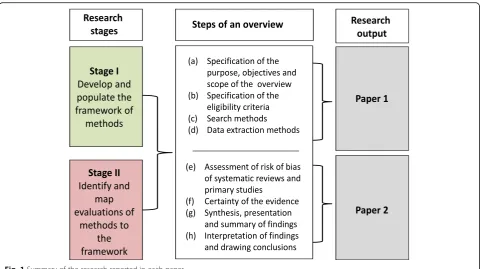
This paper is the first of two companion papers. In this first paper, we present the methods framework for the four initial steps of conducting an overview: (a) spe-cification of the purpose, objectives and scope of the overview; (b) specification of the eligibility criteria; (c) search methods and (d) data extraction methods (stage I). We then map studies evaluating methods to this framework (stage II). In a second paper, we will present the methods framework, and a map of evaluation stud-ies, for the subsequent steps in conducting an overview: assessing risk of bias of primary studies and SRs; cer-tainty of evidence arising from the overview; synthesis, presentation and summary of findings; and interpret-ation of findings and drawing conclusions (Fig. 1).
We use the term‘methods framework’(or equivalently, ‘framework of methods’) to describe the organising struc-ture we have developed to group related methods and against which methods evaluations can be mapped. The highest level of this structure is the broad steps of con-ducting an overview (e.g. search methods). The methods framework, together with the studies that have evalu-ated these methods, form the evidence map of over-view methods.
Methods
A protocol for this study has been published [10]. The methods for the two stages (Fig. 2) are now briefly described, along with deviations from the planned methods.
Stage I: development and population of the framework of methods
Search methods
Fig. 2Stages in the development of an evidence map of overview methods
Eligibility criteria
For the development and population of the framework, we identified articles describing methods used, or rec-ommended for use, in overviews of systematic reviews of interventions.
Inclusion criteria:
i. Articles describing methods for overviews of systematic reviews of interventions
ii. Studies examining methods used in a cross-section or cohort of overviews
iii. Guidance (e.g. handbooks and guidelines) for undertaking overviews
iv. Commentaries or editorials that discuss methods for overviews
Exclusion criteria:
i. Articles published in languages other than English ii. Studies describing methods for network
meta-analysis
iii. Articles exclusively about methods for overviews of other review types (i.e. not of interventions)
We populated the framework with methods that were different or additional to those required to undertake a SR of primary research. Methods evaluated in the con-text of other ‘overview’ products, such as guidelines, which were of relevance to overviews, were included.
The eligibility criteria were piloted by three reviewers independently on a sample of articles retrieved from the search to ensure consistent application.
Study selection
Two reviewers independently reviewed titles and ab-stracts for their potential inclusion against the eligibility criteria. Full-text articles were retrieved when both re-viewers agreed that inclusion criteria were met or when there was uncertainty. Any disagreement was resolved by discussion or by arbitration of a third reviewer. In in-stances where there was limited or incomplete informa-tion regarding a study’s eligibility (e.g. when only an abstract was available), the study authors were contacted to request the full text or further details.
Data extraction, coding and analysis
One author collected data from all included articles using a pre-tested form; a second author collected data from a 50% sample of the articles.
Data collected on the characteristics of included
studies We collected data about: (i) the type of article
(coded as per our inclusion criteria), (ii) the main contri-bution(s) of the article (e.g. critique of methods), (iii) the
extent to which each article described methods or ap-proaches pertaining to each step of an overview (e.g. men-tion without descripmen-tion, described—insufficient detail to implement, described—implementable), (iv) a precis of the methods or approaches covered and (v) the data on which the article was based (e.g. audit of methods used in a sample of overviews, author’s experience).
Coding and analysis to develop and populate the
framework of methods We planned to code articles in
NVivo software, applying a coding frame to extract de-scriptions of methods pertaining to each step of an over-view [10]. However, during the initial phases of analysis, we found the extracts difficult to interpret when read out of context because many methods were either sparsely described or were inferred rather than explicit. As a consequence of the difficulty coding these data, we revised our analytic approach. We separated studies that described a method pertaining to a step in the overview process, from those that made cursory mention of a method. The subset of articles coded as providing de-scription were read by two authors (CL and SB, JM or SM) who independently drafted the framework for that step to capture and categorise all identified or inferred methods. To ensure comprehensiveness of the frame-work, methods were inferred when a clear alternative existed to a reported method (e.g. using decision rules or an algorithm to combine eligibility criteria was rarely mentioned, but was clearly an option for mul-tiple sub-steps).
The drafts and multiple iterations of the framework were discussed and refined by all authors, during which we delineated unique decision points faced when plan-ning each step of an overview (e.g. determiplan-ning eligibility criteria to deal with SRs with overlap, determining how discrepant data across SRs will be handled) and the methods/options available for each. We grouped con-ceptually similar approaches together and extracted examples to illustrate the options. For example, we categorised all approaches that involved specifying cri-teria to select one SR from multiple overlapping SRs together, and then listed examples of criteria sug-gested in included studies (e.g. select most recent SR, highest quality, most comprehensive).
Stage II: Identification and mapping of evaluations of methods
Search methods
the retrieval of SRs (Additional file 2) since articles de-scribing the development and evaluation of search strategies for SRs may reasonably not have mentioned ‘overviews’ (or its synonyms) and thus would not be identified in the main searches. For the other steps, the identified methods were specific to overviews, so evaluations were judged likely to be retrieved by our main search.
Eligibility criteria
To create the evidence map, we identified articles de-scribing evaluations of methods for overviews of system-atic reviews of interventions.
Inclusion criteria:
i. SRs of methods studies that have evaluated methods for overviews
ii. Methods studies that have evaluated methods for overviews
Exclusion criteria:
i. Articles published in languages other than English ii. Methods studies that have evaluated methods for
network meta-analysis
We added the additional criterion that methods studies had to have a stated aim to evaluate methods, since our focus was on evaluation and not just applica-tion of a method.
Study selection
We used the same process for determining which studies met the inclusion criteria for stage II as for stage I (‘Study selection’section Stage I).
Data extraction
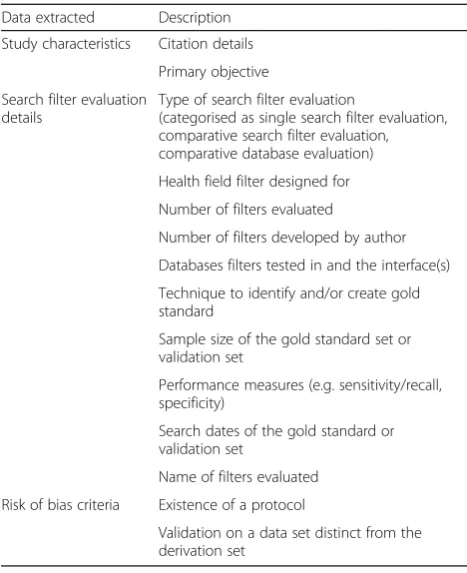
The only methods evaluations identified were evalua-tions of search filters for SRs, from which we extracted the data listed in Table 1. We had originally planned to extract quantitative results from the methods evaluations relating to the primary objectives; however, on reflection, we opted not to do this since we felt this lay outside the purpose of the evidence map. Data were extracted inde-pendently by two authors (CL, JEM) from four (of 15) studies. The remaining data were extracted by one author (CL).
Assessment of the risk of bias
We planned to report the characteristics of the stage II evaluation studies that may plausibly be associated with bias. For methods evaluations of search filters for identifying SRs, we used assessment criteria informed by Harbour [11]. The assessment criteria
included existence of a protocol and validation of the filter on a data set distinct from the derivation set (external validation).
Analysis
The yield and characteristics of the methods evaluation studies were described and mapped to the framework of methods.
Results
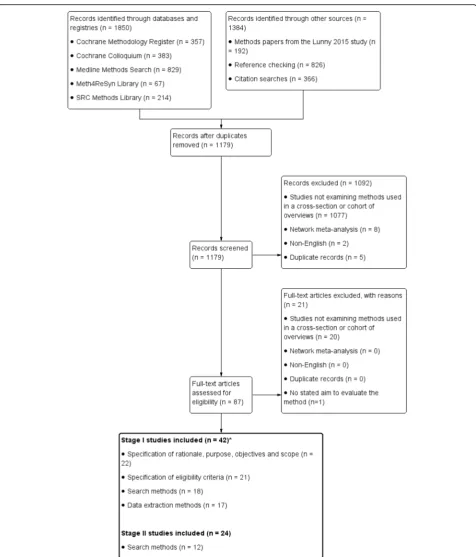
Results of the search
We retrieved 1850 records through searching
data-bases and methods collections. A further 1384
records were identified through other sources
(methods articles identified as part of a related research project [5], reference checking, and forward citation searching). After removal of duplicate re-cords, 1179 records remained (Fig. 3). From screening titles and abstracts, we excluded 1092 records that were ineligible. We assessed 87 full-text reports for eligibility and excluded 21, with reasons noted in Additional file 3. Of the remaining 66, 42 were included in stage I and 24 in stage II.
Our purposive search strategy (dated May 2016) to identify studies evaluating search filters for the retrieval
Table 1Data extracted from methods studies evaluating search
filters for SRs
Data extracted Description
Study characteristics Citation details
Primary objective
Search filter evaluation details
Type of search filter evaluation
(categorised as single search filter evaluation, comparative search filter evaluation, comparative database evaluation)
Health field filter designed for
Number of filters evaluated
Number of filters developed by author
Databases filters tested in and the interface(s)
Technique to identify and/or create gold standard
Sample size of the gold standard set or validation set
Performance measures (e.g. sensitivity/recall, specificity)
Search dates of the gold standard or validation set
Name of filters evaluated
Risk of bias criteria Existence of a protocol
of SRs resulted in the inclusion of three more stage II studies (see Fig. 4 for details), bringing the total number of methods evaluations to 27.
Of the 42 stage I and 27 stage II studies, 29 and 15, respectively, pertained to one or more of the four
initial steps in conducting an overview and so are cluded in this first paper; the remainder will be in-cluded in our second companion paper. All 15 stage II studies were evaluations of search filter studies for retrieval of SRs.
Stage I: development and population of the framework of methods
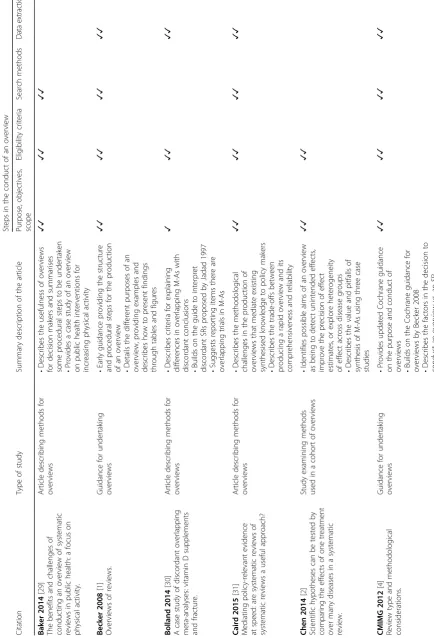
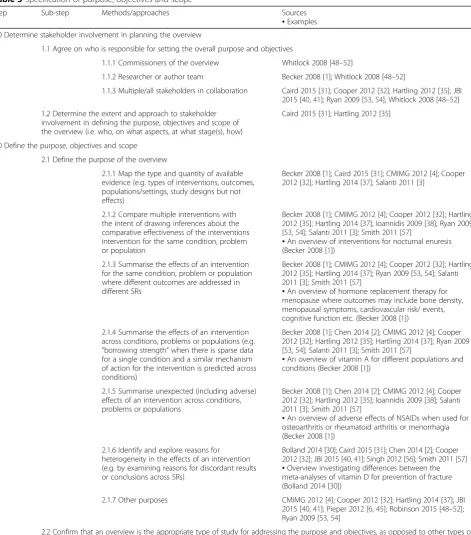
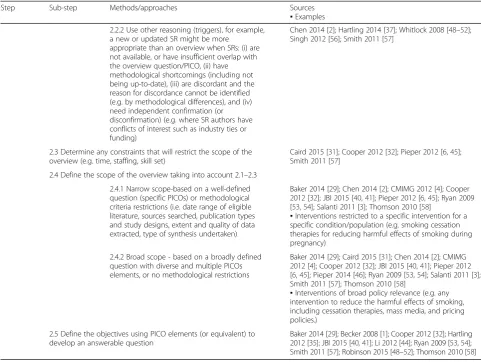
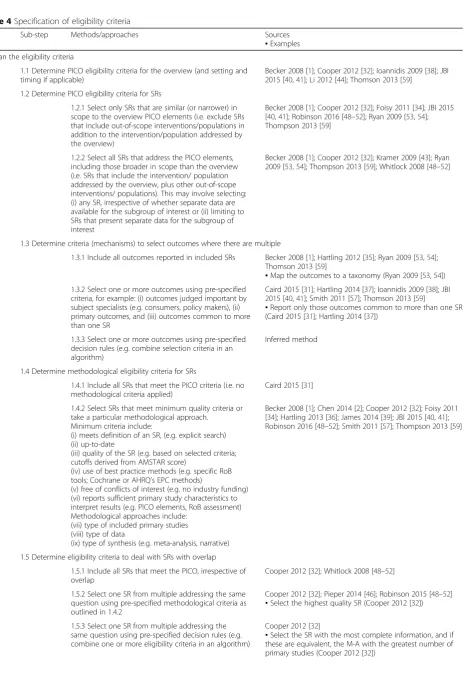
We first describe the characteristics of the included arti-cles (see ‘Characteristics of included articles’; Table 2), followed by presentation of the developed methods frame-work. This presentation is organised into sections repre-senting the broad steps of conducting an overview (sections ‘Specification of purpose, objectives and scope’, ‘Specification of eligibility criteria’,‘Search methods’ and ‘Data extraction’; Tables 3, 4, 5 and 6). In each section, we orient readers to the structure of the methods framework, which includes a set of steps and sub-steps (e.g. under ‘Search methods’, the steps are‘plan the sources to search’, ‘plan the search strategy for retrieval of SRs’, and ‘plan how primary studies will be retrieved’). Components within the tables are referred to using labels and numbers (e.g. 2.1.3). We highlight methods/approaches to deal with commonly encountered scenarios for which overview au-thors need to plan (see ‘Addressing common scenarios unique to overviews’; Table 7). Our description is focused on methods/options that are distinct, have added com-plexity, compared with SRs of primary studies, or have
been proposed to deal with major challenges in undertak-ing an overview. Importantly, the methods/approaches and options reflect the ideas presented in the literature and should not be interpreted as endorsement for the use of the methods. Reporting considerations for all steps are reported in Additional file 4.
Characteristics of included articles
Table 3Specification of purpose, objectives and scope
Step Sub-step Methods/approaches Sources
▪Examples 1.0 Determine stakeholder involvement in planning the overview
1.1 Agree on who is responsible for setting the overall purpose and objectives
1.1.1 Commissioners of the overview Whitlock 2008 [48–52]
1.1.2 Researcher or author team Becker 2008 [1]; Whitlock 2008 [48–52]
1.1.3 Multiple/all stakeholders in collaboration Caird 2015 [31]; Cooper 2012 [32]; Hartling 2012 [35]; JBI 2015 [40,41]; Ryan 2009 [53,54]; Whitlock 2008 [48–52]
1.2 Determine the extent and approach to stakeholder involvement in defining the purpose, objectives and scope of the overview (i.e. who, on what aspects, at what stage(s), how)
Caird 2015 [31]; Hartling 2012 [35]
2.0 Define the purpose, objectives and scope
2.1 Define the purpose of the overview
2.1.1 Map the type and quantity of available evidence (e.g. types of interventions, outcomes, populations/settings, study designs but not effects)
Becker 2008 [1]; Caird 2015 [31]; CMIMG 2012 [4]; Cooper 2012 [32]; Hartling 2014 [37]; Salanti 2011 [3]
2.1.2 Compare multiple interventions with the intent of drawing inferences about the comparative effectiveness of the interventions intervention for the same condition, problem or population
Becker 2008 [1]; CMIMG 2012 [4]; Cooper 2012 [32]; Hartling 2012 [35]; Hartling 2014 [37]; Ioannidis 2009 [38]; Ryan 2009 [53,54]; Salanti 2011 [3]; Smith 2011 [57]
▪An overview of interventions for nocturnal enuresis (Becker 2008 [1])
2.1.3 Summarise the effects of an intervention for the same condition, problem or population where different outcomes are addressed in different SRs
Becker 2008 [1]; CMIMG 2012 [4]; Cooper 2012 [32]; Hartling 2012 [35]; Hartling 2014 [37]; Ryan 2009 [53,54]; Salanti 2011 [3]; Smith 2011 [57]
▪An overview of hormone replacement therapy for menopause where outcomes may include bone density, menopausal symptoms, cardiovascular risk/ events, cognitive function etc. (Becker 2008 [1])
2.1.4 Summarise the effects of an intervention across conditions, problems or populations (e.g. “borrowing strength”when there is sparse data for a single condition and a similar mechanism of action for the intervention is predicted across conditions)
Becker 2008 [1]; Chen 2014 [2]; CMIMG 2012 [4]; Cooper 2012 [32]; Hartling 2012 [35]; Hartling 2014 [37]; Ryan 2009 [53,54]; Salanti 2011 [3]; Smith 2011 [57]
▪An overview of vitamin A for different populations and conditions (Becker 2008 [1])
2.1.5 Summarise unexpected (including adverse) effects of an intervention across conditions, problems or populations
Becker 2008 [1]; Chen 2014 [2]; CMIMG 2012 [4]; Cooper 2012 [32]; Hartling 2012 [35]; Ioannidis 2009 [38]; Salanti 2011 [3]; Smith 2011 [57]
▪An overview of adverse effects of NSAIDs when used for osteoarthritis or rheumatoid arthritis or menorrhagia (Becker 2008 [1])
2.1.6 Identify and explore reasons for heterogeneity in the effects of an intervention (e.g. by examining reasons for discordant results or conclusions across SRs)
Bolland 2014 [30]; Caird 2015 [31]; Chen 2014 [2]; Cooper 2012 [32]; JBI 2015 [40,41]; Singh 2012 [56]; Smith 2011 [57] ▪Overview investigating differences between the meta-analyses of vitamin D for prevention of fracture (Bolland 2014 [30])
2.1.7 Other purposes CMIMG 2012 [4]; Cooper 2012 [32]; Hartling 2014 [37]; JBI 2015 [40,41]; Pieper 2012 [6,45]; Robinson 2015 [48–52]; Ryan 2009 [53,54]
2.2 Confirm that an overview is the appropriate type of study for addressing the purpose and objectives, as opposed to other types of reviews (i.e. intervention review, network meta-analysis)
described. Relatively, few articles described methods across all of the initial steps in conducting an over-view (n= 6).
Specification of purpose, objectives and scope
The two steps in the framework under ‘specification of purpose, objectives and scope’ were ‘determine stakeholder involvement in planning the overview (1.0)’ and ‘define the purpose, objectives and scope (2.0)’ (Table 3). In the following, we focus on the methods/approaches and options for the step ‘define the purpose, objectives and scope (2.0)’. Other methods/approaches are similar to those in planning a SR, but have been included in the framework for completeness.
We identified different purposes for undertaking an overview (2.1), with some of these purposes being ‘map the type and quantity of available evidence (2.1.1)’,‘compare multiple interventions with the intent
of drawing inferences about the comparative
effectiveness of the interventions for the same condi-tion (2.1.2)’and ‘summarise the effects of an interven-tion across different conditions, populations, or problems (2.1.4)’. The latter borrows strength when there is sparse data for a single condition and a simi-lar mechanism of action for the intervention is pre-dicted across conditions. Options for confirming that an overview is the appropriate type of study for ad-dressing the purpose and objectives (as compared with an intervention review or network meta-analysis) (2.2), included the ‘use of a decision tool (2.2.1)’ or ‘use other reasoning (2.2.2)’. A further identified sub-step was to ‘determine any constraints that will restrict the scope of the overview (2.3)’. Considerations arising from sub-steps 2.1–2.3 will influence whether an overview is conducted to address a narrow or broad question (2.4). This decision is then operationalised in the final identified sub-step‘define the objectives using Population, Interven-tion, Comparison, Outcome (PICO) elements (or equiva-lent) to develop an answerable question (2.5)’.
Table 3Specification of purpose, objectives and scope(Continued)
Step Sub-step Methods/approaches Sources
▪Examples 2.2.2 Use other reasoning (triggers), for example,
a new or updated SR might be more appropriate than an overview when SRs: (i) are not available, or have insufficient overlap with the overview question/PICO, (ii) have methodological shortcomings (including not being up-to-date), (iii) are discordant and the reason for discordance cannot be identified (e.g. by methodological differences), and (iv) need independent confirmation (or disconfirmation) (e.g. where SR authors have conflicts of interest such as industry ties or funding)
Chen 2014 [2]; Hartling 2014 [37]; Whitlock 2008 [48–52]; Singh 2012 [56]; Smith 2011 [57]
2.3 Determine any constraints that will restrict the scope of the overview (e.g. time, staffing, skill set)
Caird 2015 [31]; Cooper 2012 [32]; Pieper 2012 [6,45]; Smith 2011 [57]
2.4 Define the scope of the overview taking into account 2.1–2.3
2.4.1 Narrow scope-based on a well-defined question (specific PICOs) or methodological criteria restrictions (i.e. date range of eligible literature, sources searched, publication types and study designs, extent and quality of data extracted, type of synthesis undertaken)
Baker 2014 [29]; Chen 2014 [2]; CMIMG 2012 [4]; Cooper 2012 [32]; JBI 2015 [40,41]; Pieper 2012 [6,45]; Ryan 2009 [53,54]; Salanti 2011 [3]; Thomson 2010 [58]
▪Interventions restricted to a specific intervention for a specific condition/population (e.g. smoking cessation therapies for reducing harmful effects of smoking during pregnancy)
2.4.2 Broad scope - based on a broadly defined question with diverse and multiple PICOs elements, or no methodological restrictions
Baker 2014 [29]; Caird 2015 [31]; Chen 2014 [2]; CMIMG 2012 [4]; Cooper 2012 [32]; JBI 2015 [40,41]; Pieper 2012 [6,45]; Pieper 2014 [46]; Ryan 2009 [53,54]; Salanti 2011 [3]; Smith 2011 [57]; Thomson 2010 [58]
▪Interventions of broad policy relevance (e.g. any intervention to reduce the harmful effects of smoking, including cessation therapies, mass media, and pricing policies.)
2.5 Define the objectives using PICO elements (or equivalent) to develop an answerable question
Baker 2014 [29]; Becker 2008 [1]; Cooper 2012 [32]; Hartling 2012 [35]; JBI 2015 [40,41]; Li 2012 [44]; Ryan 2009 [53,54]; Smith 2011 [57]; Robinson 2015 [48–52]; Thomson 2010 [58]
CMIMGComparing Multiple Interventions Methods Group,JBIJoanna Briggs Institute,NSAIDsnonsteroidal anti-inflammatory drugs,PICOsPopulation, Intervention,
Table 4Specification of eligibility criteria
Step Sub-step Methods/approaches Sources
▪Examples 1.0 Plan the eligibility criteria
1.1 Determine PICO eligibility criteria for the overview (and setting and timing if applicable)
Becker 2008 [1]; Cooper 2012 [32]; Ioannidis 2009 [38]; JBI 2015 [40,41]; Li 2012 [44]; Thomson 2013 [59]
1.2 Determine PICO eligibility criteria for SRs
1.2.1 Select only SRs that are similar (or narrower) in scope to the overview PICO elements (i.e. exclude SRs that include out-of-scope interventions/populations in addition to the intervention/population addressed by the overview)
Becker 2008 [1]; Cooper 2012 [32]; Foisy 2011 [34]; JBI 2015 [40,41]; Robinson 2016 [48–52]; Ryan 2009 [53,54]; Thompson 2013 [59]
1.2.2 Select all SRs that address the PICO elements, including those broader in scope than the overview (i.e. SRs that include the intervention/ population addressed by the overview, plus other out-of-scope interventions/ populations). This may involve selecting: (i) any SR, irrespective of whether separate data are available for the subgroup of interest or (ii) limiting to SRs that present separate data for the subgroup of interest
Becker 2008 [1]; Cooper 2012 [32]; Kramer 2009 [43]; Ryan 2009 [53,54]; Thompson 2013 [59]; Whitlock 2008 [48–52]
1.3 Determine criteria (mechanisms) to select outcomes where there are multiple
1.3.1 Include all outcomes reported in included SRs Becker 2008 [1]; Hartling 2012 [35]; Ryan 2009 [53,54]; Thomson 2013 [59]
▪Map the outcomes to a taxonomy (Ryan 2009 [53,54]) 1.3.2 Select one or more outcomes using pre-specified
criteria, for example: (i) outcomes judged important by subject specialists (e.g. consumers, policy makers), (ii) primary outcomes, and (iii) outcomes common to more than one SR
Caird 2015 [31]; Hartling 2014 [37]; Ioannidis 2009 [38]; JBI 2015 [40,41]; Smith 2011 [57]; Thomson 2013 [59]
▪Report only those outcomes common to more than one SR (Caird 2015 [31]; Hartling 2014 [37])
1.3.3 Select one or more outcomes using pre-specified decision rules (e.g. combine selection criteria in an algorithm)
Inferred method
1.4 Determine methodological eligibility criteria for SRs
1.4.1 Include all SRs that meet the PICO criteria (i.e. no methodological criteria applied)
Caird 2015 [31]
1.4.2 Select SRs that meet minimum quality criteria or take a particular methodological approach.
Minimum criteria include:
(i) meets definition of an SR, (e.g. explicit search) (ii) up-to-date
(iii) quality of the SR (e.g. based on selected criteria; cutoffs derived from AMSTAR score)
(iv) use of best practice methods (e.g. specific RoB tools; Cochrane or AHRQ’s EPC methods)
(v) free of conflicts of interest (e.g. no industry funding) (vi) reports sufficient primary study characteristics to interpret results (e.g. PICO elements, RoB assessment) Methodological approaches include:
(vii) type of included primary studies (viii) type of data
(ix) type of synthesis (e.g. meta-analysis, narrative)
Becker 2008 [1]; Chen 2014 [2]; Cooper 2012 [32]; Foisy 2011 [34]; Hartling 2013 [36]; James 2014 [39]; JBI 2015 [40,41]; Robinson 2016 [48–52]; Smith 2011 [57]; Thompson 2013 [59]
1.5 Determine eligibility criteria to deal with SRs with overlap
1.5.1 Include all SRs that meet the PICO, irrespective of overlap
Cooper 2012 [32]; Whitlock 2008 [48–52]
1.5.2 Select one SR from multiple addressing the same question using pre-specified methodological criteria as outlined in 1.4.2
Cooper 2012 [32]; Pieper 2014 [46]; Robinson 2015 [48–52] ▪Select the highest quality SR (Cooper 2012 [32])
1.5.3 Select one SR from multiple addressing the same question using pre-specified decision rules (e.g. combine one or more eligibility criteria in an algorithm)
Cooper 2012 [32]
Specification of eligibility criteria
The two steps in the framework under ‘specification of eligibility criteria’ were ‘plan the eligibility criteria (1.0)’ and ‘plan the study selection process (2.0)’(Table 4). In the following, we focus on the step ‘plan the eligibility criteria (1.0)’, which covers methods that are key to deal-ing with common scenarios and challenges that arise in overviews (Table 7).
A unique decision in planning overviews is to ‘ deter-mine methodological eligibility criteria for SRs (1.4)’. Multiple criteria were identified, including approaches for selecting reviews that meet minimum quality criteria, or reviews that take a particular methodological ap-proach (1.4.2). These criteria underpin many of the iden-tified approaches for dealing with SRs with overlap in information and data (1.5). Overlap can arise when SRs with similar topics include one or more identical pri-mary studies. One identified option was to include all SRs that meet the PICO criteria irrespective of overlap, that is, ignore overlap, note overlap, or deal with overlap
using other methods (e.g. data extraction, synthesis) (1.5.1). However, other approaches aim to minimise overlap by specifying criteria to select one SR from mul-tiple (1.5.2). These approaches include selecting one SR based on methodological criteria for SRs (see options in 1.4.2), selecting the most comprehensive SR, or exclud-ing SRs that do not contain any unique primary studies (1.5.4). The latter approach may still result in inclusion of multiple overlapping SRs. An inherent complexity in using eligibility criteria to deal with overlap is that using single criteria can result in unintended loss of informa-tion through exclusion of important SRs (for example, the most recent SR could be excluded if only the highest quality SR is selected). An approach that overcomes this is to combine multiple criteria in an algorithm (1.5.3).
Another identified decision was whether to include additional primary studies (1.6). One option was to in-clude primary studies only if pre-specified eligibility cri-teria are met (1.6.2). Circumstances that may prompt inclusion of primary studies are outlined in 1.6.2. Table 4Specification of eligibility criteria(Continued)
Step Sub-step Methods/approaches Sources
▪Examples 1.5.4 Exclude SRs that do not contain any unique
primary studies, when there are multiple SRs
Pieper 2014 [46]
1.6 Determine whether to consider additional primary studies for inclusion
1.6.1 Do not include primary studies Becker 2008 [1]; Caird 2015 [31]; Thompson 2013 [59]; Whitlock 2008 [48–52]
1.6.2 Include primary studies if pre-specified eligibility criteria are met, for example: (i) when a SR is not up-to-date, (ii) when a SR is inconclusive (i.e. new studies may overturn the findings of a SR), (iii) when the included SRs provide incomplete coverage of evidence in relation to the overview PICO (e.g. missing one or more interventions, population subgroup, study design), and (iv) when there are concerns about the methods SRs used to identify and select studies
Baker 2014 [29]; Caird 2015 [31]; Cooper 2012 [32]; Pieper 2014 [46]; 2014 [47]; Thompson 2013 [59];
White 2009 [48–52]
▪Include primary studies if the evidence in the SRs is inconclusive (e.g. when addition of a new primary study may overturn the findings) (Pieper 2014 [47])
▪Include primary studies if the SRs are assessed as low quality (Pieper 2014 [47])
1.6.3 Include primary studies using pre-specified decision rules to determine eligibility (e.g. combine one or more eligibility criteria in an algorithm for selection)
Pieper 2014 [47]
2.0 Plan the study selection process
2.1 Determine the number of overview authors required to select studiesa
2.1.1 Independent screening all stages by 2 or more authors
Becker 2008 [1]; Chen 2014 [2]; Hartling 2012 [35]; Li 2012 [44]; Pieper 2012 [6,45]; 2014 [47]; Smith 2011 [57]
2.1.2 One author screening at all stages Hartling 2012 [35]; Li 2012 [44]; Pieper 2014 [47]
2.1.3 One author screening titles/abstracts, 2 or more screening full text
Hartling 2012 [35]
2.1.4 One screened at all stages, 2nd confirmed Hartling 2012 [35]
2.1.5 One screened at all stages, 2nd confirms if uncertainty
Hartling 2012 [35]
AHRQ’s EPCAgency for Healthcare Research and Quality‘s Evidence-based Practice Center,AMSTARA MeaSurement Tool to Assess systematic Reviews,
CMIMGComparing Multiple Interventions Methods Group,JBIJoanna Briggs Institute,PICOsPopulation, Intervention, Comparison, Outcome, and Study design,
RCTrandomised controlled trial,SRssystematic reviews
a
Search methods
The three steps in the framework under ‘search
methods’were‘plan the types of sources to search (1.0)’, ‘plan the search strategy for retrieval of SRs (2.0)’, and ‘plan how primary studies will be retrieved, if eligibility criteria determines that primary studies should be in-cluded (3.0)’ (Table 5). Search methods for overviews largely parallel those used in a SR of primary studies. Unique considerations relate to the option to restrict searches to SR databases (1.1.1), the use of filters devel-oped to retrieve SRs (2.1), and approaches to searching for additional primary studies.
If additional primary studies are eligible for the over-view, authors will need to determine the sequence of searching for SRs and primary studies. The search for
primary studies may be done in parallel with the search for SRs (3.1.1), or in sequence, searching first for SRs then for primary studies (3.1.2). The latter strategy focuses on retrieving primary studies where evidence is missing (i.e. where SRs are not up-to-date or where the SRs provide incomplete coverage of the overview question).
Data extraction
The two steps in the framework under ‘data extraction’ were ‘plan the data elements to extract (1.0)’ and ‘plan the data extraction process (2.0)’ (Table 6). We now highlight methods/approaches for dealing with these two steps, with a focus on methods for dealing with scenar-ios described in Table 7.
Table 5Search methods
Step Sub-step Methods/approaches Sources
▪Examples 1.0 Plan the sources to search
1.1 Determine the type of sources to search
1.1.1 Select the types of databases to search (e.g. SR databases (e.g. Cochrane, Epistemonikos), prospective SR registers (e.g. PROSPERO), or general bibliographic databases (e.g. EMBASE, PubMed), or grey literature databases (e.g. conference databases, government websites))
Becker 2008 [1]; Baker 2014 [29]; Caird 2015 [31]; Cooper 2012 [32]; Hartling 2012 [35]; 2014 [37]; James 2014 [39]; JBI 2015 [40,41]; Li 2012 [44]; Pieper 2012 [6,45]; Pieper 2014 [47]; Silva 2015 [55]; Smith 2011 [57]; Thomson 2013 [59]; Whitlock 2008 [49–51]
1.1.2 Select other types of sources (e.g. reference checking, forward citation searching, handsearching key journals)a
Cooper 2012 [32]; Hartling 2012 [35]; JBI 2015 [40,41]; Li 2012 [44]; Smith 2011 [57]
1.1.3 Select a combination of 1.1.1–1.1.2 Cooper 2012 [32]; Hartling 2012 [35]; JBI 2015 [40,41]; Silva 2015 [55]; Smith 2011 [57]; Whitlock 2008 [48–52]
2.0 Plan the search strategy for retrieval of SRs
2.1 Determine the search filter to use in general databases
2.1.1 Select a published SR filter (e.g. EMBASE, MEDLINE, PubMed)
Cooper 2012 [32]; CMIMG 2012 [4]; JBI 2015 [40,41]; Robinson 2016 [48–52]; Smith 2011 [57]
▪Montori 2006 SR filter (Cooper 2012 [32]) 2.1.2 Develop a new search filter based on a
conceptual approach or a textual analysis approach
Baker 2014 [29]; Caird 2015 [31]; Cooper 2012 [32]; Hartling 2012 [35]; JBI 2015 [40,41]
3.0 Plan how primary studies will be retrieved, if eligibility criteria determines that primary studies should be included
3.1 Determine the sequence for searching
3.1.1 Run a parallel search strategy for both SRs and primary studies simultaneously
Baker 2014 [29]; JBI 2015 [40,41]; Pieper 2014 [46]; Pieper 2014 [47]; Salanti 2011 [3]; Thomson 2013 [59]; Whitlock 2008 [49–51]
3.1.2 Run a sequential search strategy first for SRs and second for primary studies (i.e. either develop a strategy to search for primary studies, or use the search strategies of the included SRs to search for primary studies)
Pieper 2014 [47]
3.2 Use pragmatic/expedient approaches to retrieve primary studies Caird 2015 [31]
▪Consult experts (Caird 2015 [31]) 3.3 Select a combination of 3.1–3.2
CMIMGComparing Multiple Interventions Methods Group,JBIJoanna Briggs Institute,PROSPEROInternational Prospective Register of Systematic Reviews,
SRssystematic reviews
a
Table 6Data extraction
Step Sub-step Methods/approaches Sources
▪Examples 1.0 Plan the data elements to extract
1.1 Determine the data to extract on the characteristics of SRsa Becker 2008 [1]; Caird 2015 [31]; JBI 2015 [40,41]; Li 2012 [44]; Ryan 2009 [53,54]
1.2 Determine the data required to assess which SRs address the
overview question and allow assessment of the overlap across SRsa Smith 2011 [57]
1.3 Determine data to extract about the results from the SRs for each relevant primary outcome
1.3.1 Extract M-A results Becker 2008 [1]; Caird 2015 [31]; Hartling 2012 [35]; Smith 2011 [57]
1.3.2 Extract numeric trial results Thomson 2013 [59]
1.3.3 Extract narrative results Bolland 2014 [30]; JBI 2015 [40,41]; Li 2012 [44]; Ryan 2009 [53,54]
1.3.4 Extract a combination of 1.3.1–1.3.3
1.3.5 Extract risk of bias assessment (overall assessment, or domain/item level data, or both) and certainty of the evidence
Becker 2008 [1]; Hartling 2012 [35]; JBI 2015 [40,41]; Li 2012 [44]; Ryan 2009 [53,54]
1.4 Determine the data to extract from primary studiesa
1.4.1 Extract numerical trial results Caird 2015 [31]
1.4.2 Extract data required to assess risk of bias for each domain or item
Hartling 2012 [35]
1.5 Develop a data extraction forma Becker 2008 [1]; Cooper 2012 [32]; Hartling 2012 [35]; JBI 2015 [40,41]; Singh 2012 [56]
2.0 Plan the data extraction process
2.1 Determine the sources where data will be obtained from
2.1.1 SRs Becker 2008 [1]; Bolland 2014 [30]; Caird 2015 [31]; CMIMG
2012 [4]; Hartling 2014 [37]; JBI 2015 [40,41]; Pieper 2012 [6,45]
2.1.2 Primary studies Caird 2015 [31]; Salanti 2011 [3]; Thomson 2013 [59]; Whitlock 2008 [48–52]
2.1.3 Registry entries (for SRs and/or trials) Inferred method
2.1.4 A combination of the above Caird 2015 [31]; Salanti 2011 [3]; Thomson 2013 [59]; Whitlock 2008 [48–52]
2.2 Determine how overlapping information across SRs will be handled
2.2.1 Extract information from all SRs Bolland 2014 [30]; Caird 2015 [31]; CMIMG 2012 [4]; Cooper 2012 [32]; Hartling 2014 [37]; JBI 2015 [40,41]; Pieper 2014 [46]; White 2009 [48–52]
2.2.2 Extract information from only one SR based on a priori eligibility criteria
Cooper 2012 [32]; CMIMG 2012 [4]; Foisy 2011 [34]; Hartling 2014 [37]; Pieper 2012 [6,45]; Pieper 2014 [47]; Thomson 2013 [59]
▪SR with the greatest number of trials (Cooper 2012 [32]) ▪Most recent SR (Pieper 2014 [47]; Cooper 2012 [32]) 2.3 Determine how discrepant data across SRs will be handled in data extraction
2.3.1 Extract all data, recording discrepancies Becker 2008 [1]; Bolland 2014 [30]; Caird 2015 [31]; Kovacs 2014 [42]; Pieper 2012 [6,45]; Pieper 2014 [46]; Smith 2011 [57]; Thomson 2010 [58]
2.3.2 Extract data from only one SR based on a priori eligibility criteria
Cooper 2012 [32]; Pieper 2014 [47]
▪Most recent SR and SR of the highest quality (Pieper 2014 [47])
▪Highest quality SR (Cooper 2012 [32]) 2.3.3 Extract data element (e.g. effect estimates, quality
assessments) from the SR which meets decision rule criteria
Bolland 2014 [30]; Cooper 2012 [32]
Table 6Data extraction(Continued)
Step Sub-step Methods/approaches Sources
▪Examples 2.3.4 Reconcile discrepancies through approaches
outlined in 2.4
Bolland 2014 [30]; Caird 2015 [31]; Flodgren 2011 [33]; JBI 2015 [40,41]; Salanti 2011 [3]; Thomson 2010 [58]; Whitlock 2008 [48–52]
2.4 Determine additional steps to deal with missing data from SRs, or when there is variation in information reported across SRs
2.4.1 Retrieve reports of the primary studies Bolland 2014 [30]; Caird 2015 [31]; CMIMG 2012 [4]; Flodgren 2011 [33]; Pieper 2012 [6,45]; Pieper 2014 [47]; Salanti 2011 [3]; Thomson 2010 [58]; White 2009 [49–51]
2.4.2 Contact SR or trial authors, or both, for missing info and/or clarification
Bolland 2014 [30]; Flodgren 2011 [33]; JBI 2015 [40,41]; Whitlock 2008 [49–51]
2.4.3 Search SR or trial registry entries for information Inferred method
2.4.4 A combination of the above approaches Bolland 2014 [30]; Caird 2015 [31]; Salanti 2011 [3]; Thomson 2010 [58]; Whitlock 2008 [48–52]
2.4.5 Do not take additional steps to deal with missing data or discrepancies
Becker 2008 [1]; Caird 2015 [31]; Foisy 2011 [34]; JBI 2015 [40,41]
2.5 Pilot the data extraction forma Cooper 2012 [32]; JBI 2015 [40,41]
2.6 Determine the number of overview authors required to extract dataa
2.6.1 Single, double, or more Becker 2008 [1]; Bolland 2014 [30]; Hartling 2012 [35]; JBI 2015 [40,41]; Li 2012 [44]; White 2009 [48–52]
2.6.2 Data extraction versus data checking Becker 2008 [1]; CMIMG 2012 [4]; Singh 2012 [56]; Whitlock 2008 [48–52]
▪Evaluate a random sample of primary studies to ensure that data abstraction is accurate and reproducible (Whitlock 2008 [48–52])
2.7 Determine if authors (co-)authored one or several of the reviews included in the overview, and if yes, plan safeguards to avoid bias in data extraction
Buchter 2015 [60]
▪Overview authors do not extract data from their co-authored SRs
CMIMGComparing Multiple Interventions Methods Group,JBIJoanna Briggs Institute,M-Ameta-analysis,SRssystematic reviews
a
Adaption of the step from SRs to overviews. No methods evaluation required, but special consideration needs to be given to unique issues that arise in conducting overviews
Table 7Methods and approaches for addressing common scenarios unique to overviews
Methods/approaches proposed in the literaturea
Scenario for which authors need to plan Eligibility criteria (Table4) Data extraction (Table6)
1 Reviews includeoverlappinginformation and data (e.g. arising from inclusion of the same primary studies)
1.4.2 1.5 (1.5.1–1.5.4)
1.2
2.2 (2.2.1, 2.2.2)
2 Reviews reportdiscrepantinformation and dataa 1.4.2
1.6.2, 1.6.3
2.3 (2.3.1–2.3.4) 2.2.1, 2.2.2 2.4 (2.4.1–2.4.5)
3 Data aremissingor reviews reportvaryinginformation (e.g. information on risk of bias is missing or varies across primary studies because reviews use different tools)
1.6.2, 1.6.3 2.4 (2.4.1–2.4.5)
4 Reviews provide incomplete coverage of the overview question (e.g. missing comparisons, populations)
1.6.2, 1.6.3 1.2
2.1.2, 2.1.4 2.4
5 Reviews are not up-to-date 1.4.2
1.6.2, 1.6.3
2.1.2, 2.1.4
6 Review methods raise concerns about bias or quality 1.4.2 1.6.2, 1.6.3
1.2
a
Table 8 Characteristics of stage II evaluation of me thods studies (Continued) First Aut hor Year Title Primary objec tive Existence of a proto col Stud y design Health field the filter designed for # of filte rs evaluat ed (# filters de veloped by the author) Database (interfaces) Techniqu e to identify and/or create a gold standa rd Sample size of the gold standard set or validation set (n) Validation on a data set distinct from the derivation data Perform ance me asures used Search dates for the gold standard or validation set Name of filters evaluate d (number of filters) Rathbone 2016 [ 12 ] A comparison of the performan ce of seve n key bibliographic databases in identifying all relevant systematic reviews of interventions for hyperten sion. Evaluate seven databases to determine their coverage of SRs of hypertension NR Compa rative database evaluati on Hypertension N/A Cochrane, DARE,
EMBASE, Epistemonikos, MEDLINE,
PubMed, and TRIP Develo ped base d on database searches 440 N/A Sens itivity/recall, precisi on 2003 – 2015 SR fil te rs inc o rp o ra te d in to th e d atab ase s; M ED LIN E u se d M on to ri 2 00 5 Shojania 2001 [ 21 ] Taking adva ntage of the exp losion of systematic reviews: an efficient MEDLIN E search strategy . Evaluate a sea rch strategy for identifying SRs NR Search filter evaluati on
Treatment diagnosis, prognosis, causation, quality improvement, or
economic s N/A MEDLINE (PubMed) Hand searching, Develo ped base d on database searches 104 No Sens itivity/recall, precisi on 1999 – 2000 PubMed n.d. White 2001 [ 18 ] A statistical approach to designing search filters to find systematic reviews: objectivity enhances accuracy. Improve methods to derive a mo re objective search strategy to identify SRs in MEDLINE NR Search filter evaluati on, Compa rative search filter evaluati on
Treatment diagnosis, prognosis, causation
7 (5) MEDLINE (Ovid) Hand searching journal s 110 No Sens itivity/recall, precisi on 1995 and 1997 White 2001 (five] Boynton 1998 CRD -Wo lf 1996 Wilczynsk i 2007 [ 22 ] EMBASE search strategies achieved high sensitivity and specificity for retrieving methodologi cally sound systematic reviews. Develop search strategies that optimize the retrieval of SRs from EMBA SE. NR Search filter evaluati on
Internal medicinegeneral practice,
mental health, nursing practice N/A MEDLINE Hand searching journal s 220 No Sens itivity/recall, spec ificity, precisio n, accura cy 2000 Wilczyns ki 2007 Wilczynsk i 2009 [ 23 ] Consistency and accuracy of indexing systematic review articles and me ta-analyses in medline. Determine the consistency and accuracy of indexing SRs and meta-analyses in MEDLINE NR Search filter evaluati on Medicine N/A MEDLINE Develo ped base d on database searches NA No Sens itivity/recall, spec ificity, precisio n, accura cy 2000 Wilczyns ki 2009 Wilczynsk i 2011 [ 24 ] Sensitive Clinical Queries retrieved relevant systematic reviews as well as primary studies: an analytic survey. Determine how well the previously validated broad and narro w Clinical Que ries retrieve SRs NR Search filter evaluati on
Therapy, diagnosis prognosis, etiology
Table
8
Characteristics
of
stage
II
evaluation
of
me
thods
studies
(Continued)
First
Aut
hor
Year
Title
Primary
objec
tive
Existence of
a
proto
col
Stud
y
design
Health
field
the
filter
designed
for
#
of
filte
rs
evaluat
ed
(#
filters
de
veloped
by
the
author)
Database (interfaces)
Techniqu
e
to
identify
and/or
create
a
gold
standa
rd
Sample
size
of
the
gold
standard
set
or
validation
set
(n)
Validation
on
a
data
set
distinct
from
the
derivation
data
Perform
ance
me
asures
used
Search
dates
for
the
gold
standard
or
validation
set
Name
of
filters
evaluate
d
(number
of
filters)
Wong
2006
[
26
]
Optimal
CINAHL
search
strategies
for
identifying
therapy
studies
and
review
articles.
Design
optima
l
search
strategies
for
locating
review
articles
in
CINAHL
NR
Search
filter
evaluati
on
Nursing
and
allied
health
N/A
CINAHL
Hand
searching
journal
s
127
No
Sens
itivity/recall,
spec
ificity
precisio
n,
accura
cy
2000
Wong
2006
Zacks
1998
[
25
]
Developing
search
strategies
for
detecting
high
quality
reviews
in
a
hypertext
test
collection.
Determine whether sensitive
and
specific
search
strategies
exist
to
select
SRs
NR
Search
filter
evaluati
on
Etiology, prognosis, therapy
diagno
sis
N/A
SWISH
v.1.1.1
Develo
ped
base
d
on
database
searches
209
No
Sens
itivity/recall,
spec
ificity
Not
reported
Zacks
1998
Sensitivity/re
call
is
defined
as
the
proportion
of
relevant
reports
correc
tly
retrie
ved
by
the
filter;
Precision
is
the
number
of
relevant
reports
retrieved
divided
by
the
total
number
of
records
retrieved
by
the
filter;
NNR
is
the
inverse
of
the
precision;
Specif
icity
is
the
proportion
of
irrelevant
reports
correc
tly
not
retrieved
by
the
filter,
Accur
acy
is
the
proportion
of
all
reports
that
are
correctly
classified
CDSR
Cochrane
Database
of
Systematic
Reviews,
CR
D
Centre
for
Review
and
Dissemination,
n.d.
no
date,
NNR
number
needed
to
read,
N/A
not
appl
icable,
NR
not
reported,
PH
public
health,
SRs
systematic
reviews,
SWISH
Simple
Web
Indexing
System
for
An identified sub-step in planning the data elements to extract (1.0) was determining the data to extract about the results from the SRs (1.3). For overviews, this will be driven by the purpose of the overview (e.g. whether the aim of the overview is to summarise results narratively from included SRs, or synthesise the results from component trials, or meta-analyses, from the in-cluded SRs). In addition to determining the data to extract about results from SRs, if the eligibility criteria of the over-view include primary studies, then the data to extract from primary studies will also need to be determined (1.4).
A complexity that arises when undertaking an over-view is the challenge of how to deal with overlapping (2.2) and discrepant (2.3) information and data across SRs. Identified options include extraction of informa-tion from all SRs, noting any discrepancies (2.2.1, 2.3.1), or extraction of data and information from only one SR (2.2.2, 2.3.2) based on pre-specified criteria, such as using the most recent SR, or the SR of the highest quality. Or, when there are discrepancies, differ-ent data elemdiffer-ents (e.g. effect estimates, quality assess-ments) might be extracted from different SRs that meet certain decision rules (2.3.3), such as the SR that re-ports the most complete information on effect esti-mates. Methods for dealing with variation in the information reported and missing data are outlined in sub-step 2.4. In overviews, compared with SRs, there is additional complexity in resolving variation in informa-tion reported and missing data since there is an additional source of information (SRs in addition to primary studies).
Addressing common scenarios unique to overviews
Many of the identified methods were proposed to over-come common methodological challenges unique to overviews. Table 7 summarises these scenarios, showing methods that could be used to address each. While the literature reviewed often suggested a single method or step at which a scenario should be dealt with, Table 7 shows that there are multiple options, some of which can be combined.
Stage II: identification and mapping of evaluations of methods
We found no studies that had evaluated methods in the steps of the framework for ‘specification of purpose, ob-jectives and scope’,‘specification of eligibility criteria’and ‘data extraction’. Fifteen studies, published between 1998 and 2016, evaluated search filters for the retrieval of SRs (Table 8). One study [12], evaluated the performance of seven bibliographic databases to determine their cover-age of SRs. This evaluation mapped to the option‘select the types of databases to search’ (1.1.1) of the ‘search methods’ step of the framework (Table 5). Of the
remaining 14 studies, two compared the performance of multiple published filters [13, 14], four developed new search filters and compared their performance against other published filters [15–18], and eight developed and evaluated new search filters (but without compari-son with other published filters) [19–26]. These evalua-tions mapped to the option‘select a published SR filter’ (2.1.1) of the ‘search methods’ step of the framework (Table 5).
The filters were designed to retrieve SRs across a range of databases (CINAHL, DARE, EMBASE, PsycINFO, Epistemonikos, MEDLINE, Simple Web Indexing System for Humans (SWISH) and TRIP). Seven studies developed the gold standard by handsearching journals, three used a combination of handsearching journals and database searches and five used only database searches. The per-formance measures used included sensitivity/recall, speci-ficity, precision, accuracy and the number needed to read. In terms of risk of bias, none of the evaluation studies re-ferred to a study protocol or noted the existence of one, and only three validated their search filter on a data set distinct from the derivation set [13, 16, 17].
Discussion
Despite the emergence of overviews as a common form of evidence synthesis, to date, there has been no com-prehensive map of overview methods or the evidence underpinning these methods. We aimed to address this gap. A framework was developed for the initial steps in the conduct, interpretation and reporting of an overview (specification of the purpose, objectives and scope; specification of the eligibility criteria; search methods; and data extraction methods) with associated methods/ approaches and options. The framework makes explicit large number of steps and methods that need to be con-sidered when planning an overview and demonstrates some of the added complexity in an overview compared with a SR of primary studies. The framework also dem-onstrates that challenges in undertaking an overview, such as dealing with overlapping information across SRs, may be dealt with at different steps of the over-view process (e.g. specification of eligibility criteria or data extraction). Fifteen evaluation studies were found
in stage II, all of which mapped to the ‘search
methods’ step of the framework. These studies either developed and evaluated a new search filter or com-pared the performance of existing search filters to re-trieve SRs.
What this study adds to guidance and knowledge about overview methods?
coverage of methods, wherein guidance covers selected options but not alternatives and insufficient description to operationalise many methods (Table 2). While others have concluded there is a lack of consensus over many methods [28], overviews serve many purposes, and dif-ferent approaches are needed for difdif-ferent purposes. Recognising this, the framework attempts to capture the spectrum of options available to overview authors, pro-viding a tool for systematic consideration of alternative approaches. We highlight the scenarios for which over-view authors need to plan and identify methods pro-posed to tackle each scenario (Table 7). While these contributions help to address the patchy coverage of methods, the framework cannot address the lack of op-erational detail in current guidance. A forthcoming up-date of the Cochrane Handbook should help [28], but other guidance will be needed to cover the many methods not applicable to Cochrane overviews. For au-thors writing guidance, the framework could serve as a checklist to ensure comprehensive coverage of the methods proposed in the literature.
The lack of evaluation studies identified in stage II in-dicates that there is limited evidence to inform methods decision-making in overviews. For each of the steps in the framework, there is often a range of different methods to use, which could conceivably impact on the results and conclusions of the overview, their utility for decision-makers, and the time/resources required to complete the overview. This lack of evaluation of methods means [28] there may be inappropriate variabil-ity in the methods employed across overviews (as has been observed [6]). Further, overviews that seek to ad-dress the same research question, but which are under-taken using different methods, may reach discordant conclusions.
How might the framework be used by overview authors and methodologists?
The framework may be useful to researchers conducting overviews and methodologists. As highlighted above, the framework is useful for making explicit the decisions overview authors need to make when planning an over-view. Using the framework as a checklist to plan methods for dealing with common scenarios should lessen the challenges that arise when conducting an overview. Using the framework during protocol develop-ment may also lead to less post-hoc decision-making that can arise from not being aware of the decisions that need to be made before commencing the overview. Less post hoc decision-making may limit potential bias in the process of undertaking the overview. For overview meth-odologists, the provision of comparative options for each of the steps of the framework facilitates identification (and prioritisation) of methods evaluations that might be
undertaken. For example, examining those steps where selection of a different option is hypothesised to import-antly impact on the results and conclusions of the over-view (discussed below under ‘Future research to refine and populate the framework and evidence map’).
Strengths and limitations
To our knowledge, this is the first attempt to create a comprehensive framework of the many methods pro-posed for use in overviews. It is also the first study, of which we are aware, that has used evidence mapping in the context of methods research. A protocol of this in-vestigation has been published [10] and any post hoc de-cisions have been documented. During our analysis, we developed an organising structure to group-related methods and used consistent language to synthesise the varied descriptions encountered in the literature. We also made inferences to ensure that where a clear alternative to a described method existed, it was captured in the frame-work. Both steps helped generate a more uniform and complete inventory of methods than would have been possible through simply collating methods as described.
Methods studies related to overviews are challenging to find other than in specialist methodology registers, such as the Cochrane Methodology Register and the Meth4ReSyn library, meaning that some methods arti-cles may have been missed. We conducted reference checking and forward citation searching in three data-bases to minimise the number of missed articles. Further, we focused our search on locating articles that used the term ‘overview’(or related terminology). How-ever, methods that may be applicable to overviews, such as those used in clinical practice guidelines, may not have been located. We did not broaden our search, or specifically examine guidance documents for produ-cing guidelines, to keep the project containable. Our analysis involved piecing together information spread across multiple sources, and ‘translating’ varied de-scriptions of methods into a common language. This process, and the many decisions involved in structuring our framework required considerable judgement. While the process led to a more complete and uniform descrip-tion of methods than we identified in any other source, the subjective nature of this analysis means that other re-searchers may have made different decisions.
Future research to refine and populate the framework and evidence map
as methods for overviews are evaluated, the evidence map can be further populated. While there is currently too little methods evaluation for a visual representation (or map) of the evidence to be useful, the framework provides the structure for creating this map. Some prior-ity areas requiring evaluation, which we encourage methodologists to consider, relate to the decisions around eligibility and data extraction. For example, what is the effect of selecting one SR from multiple SRs ad-dressing the same topic versus including all SRs? Out-comes of interest may include proximal measures, such as whether eligible primary studies or important data are missed. More distal measures include time taken to complete the overview, utility for decision-makers, and whether the findings and conclusions of the review change. Additionally, researchers could examine whether observed effects vary when different eligibility criteria are used to select one SR from a multiple. Similar ques-tions can be posed about the effects of extracting data from one versus multiple SRs, from primary studies to SRs only, and so on. Evidence arising from these evalua-tions should lead to further refinement of the framework and, more importantly, empirical data about the trade-offs associated with alternative methodological approaches.
Conclusions
A framework of methods for conducting, interpreting and reporting overviews of systematic reviews for the initial four steps of undertaking an overview was developed and populated. Studies evaluating methods for overviews were identified and mapped to the framework. Evaluation of methods allows us to make informed choices about the most appropriate methods to use. However, gaps in the evaluation of methods were found in the majority of steps. More evaluation of the methods used in overviews is needed. The results of this research are useful for identify-ing and prioritisidentify-ing methods research on overviews and provide a basis for the development of planning and reporting checklists.
Additional files
Additional file 1:Search strategies. (DOCX 3.49 kb)
Additional file 2:Purposive search strategies. (DOCX 3.53 kb)
Additional file 3:Characteristics of excluded studies. (DOCX 5.65 kb)
Additional file 4:Table of reporting considerations. (DOCX 6.65 kb)
Abbreviations
AHRQ’s EPC:Agency for Healthcare Research and Quality’s Evidence-based Practice Center; AMSTAR: A Measurement Tool to Assess Systematic Reviews; CDSR: Cochrane Database of Systematic Reviews; CMIMG: Comparing Multiple Interventions Methods Group; CRD: Centre for Reviews and Dissemination; JBI: Joanna Briggs Institute; M-A: Meta-analysis; N/A: Not applicable; NNR: Number needed to read; NR: Not reported; PH: Public Health; PICO: Population (P), intervention (I), comparison (C) and outcome (O); PROSPERO: International Prospective Register of Systematic Reviews;
RCT: randomised controlled trial; SRs: Systematic reviews; SWISH: Simple Web Indexing System for Humans
Acknowledgements Not applicable.
Funding
This work was conducted as part of a Ph.D. undertaken by CL, who is funded by an Australian Postgraduate Award and an International Postgraduate Research Scholarship administered through Monash University, Australia. JEM holds a National Health and Medical Research Council (NHMRC) Australian Public Health Fellowship (1072366). The funding bodies had no involvement in the design of the study, data collection, analysis, interpretation, preparation of the manuscript or the decision to submit the manuscript.
Availability of data and materials
All data generated or analysed during this study are included in this published article.
Authors’contributions
CL, JEM, SEB and SM are responsible for the conception and design of the study. CL, JEM and SM did the search strategy development. CL, JEM and SEB contributed in the study selection and data extraction. CL, JEM, SEB and SM took part in the independent development of the framework and group refinement and consensus and in the drafting and editing of the manuscript. All authors read and approved the final manuscript.
Ethics approval and consent to participate Not applicable.
Consent for publication Not applicable.
Competing interests
JEM is an Associate Editor of Systematic Reviews and is a Guest Editor for the thematic series‘Overviews of systematic reviews: development and evaluation of methods’, to which this paper was submitted. SEB is an Associate Editor of Systematic Reviews. Neither JEM nor SEB were involved in the peer-review or editorial decisions for this manuscript. CL and SM declare that they have no competing interests.
Publisher’s Note
Springer Nature remains neutral with regard to jurisdictional claims in published maps and institutional affiliations.
Author details
1Cochrane Australia, School of Public Health and Preventive Medicine,
Monash University, Melbourne, Australia.2School of Public Health and Preventive Medicine, Monash University, 553 St Kilda Road, Melbourne, VIC 3004, Australia.
Received: 13 December 2016 Accepted: 20 October 2017
References
1. Becker LA, Oxman AD. Overviews of reviews. Cochrane Handbook for Systematic Reviews of Interventions. In: Higgins JPT, Green S, editors. . Hoboken: John Wiley & Sons; 2008. p. 607–31.
2. Chen YF, Hemming K, Chilton PJ, Gupta KK, Altman DG, Lilford RJ. Scientific hypotheses can be tested by comparing the effects of one treatment over many diseases in a systematic review. J Clin Epidemiol. 2014;67(12):1309–19. 3. Salanti G, Becker L, Caldwell D, Churchill R, Higgins J, Li T, Schmid C.
Evolution of Cochrane intervention reviews and overviews of reviews to better accommodate comparisons among multiple interventions. In: Report from a meeting of the Cochrane comparing multiple interventions methods groups. Madrid: Cochrane Comparing Multiple Interventions Methods Groups; 2011.