Shifting Towards Inquiry-Orientated
Learning in a High School Outreach
Program
Tom Gordona, Manjula D. Sharmaa, Helen Georgioua, and Matthew Hilla Corresponding author: [email protected]
aSchool of Physics, University of Sydney, Sydney NSW 2006, Australia
Keywords: inquiry-orientated learning (IOL), Kickstart Physics, Higher School Certificate (HSC), physics education research (PER), mental effort, Sydney University Physics Education Research group (SUPER), school of physics, physics
International Journal of Innovation in Science and Mathematics Education, 23(6), 63-74, 2015.
Abstract
This paper presents results of an examination the effect of the introduction of inquiry-orientated learning, IOL, activities into the formal education outreach program for senior high school Physics students run by School of Physics at the University of Sydney, ‘Kickstart Physics.’ This is the flagship outreach program from the Faculty of Science and accommodates approximately a quarter of the total number of students that sit the state Physics exam. The project considered how students arrive at different inquiry-orientated outcomes such as making hypotheses, displaying and interpreting data, validity, reliability, as well as the mental effort reported by the students during the Kickstart workshop. Results from a survey developed for this study show that a significant increase in mental effort was applied by the students in the inquiry-orientated logbook. In addition, the results presented here suggest that the existing, non-modified logbook, based on the current state (NSW) syllabus, has a strong inquiry focus. The methodology was to survey Senior high school students taking part in the Kickstart workshops. Some were given a logbook to accompany the session designed from the NSW Physics syllabus, and some were given a logbook designed around inquiry-orientated learning. The content related to the syllabus for each workshop remained constant.
Context
Universities often offer a range of programs for high school students as outreach activities. These programs have various objectives, including student recruitment. One such outreach program is the Kickstart Physics program run by the School of Physics at the University of Sydney. Previously, program evaluations were focused on the performance of the staff involved and content of the program (Dooley 2010) rather than student engagement, learning outcomes or the inquiry-orientated nature of the workshop.
the delivery of the workshops. The student tutors are trained in the delivery of the content, the HSC syllabus, and the use of the demonstrations and experiments.
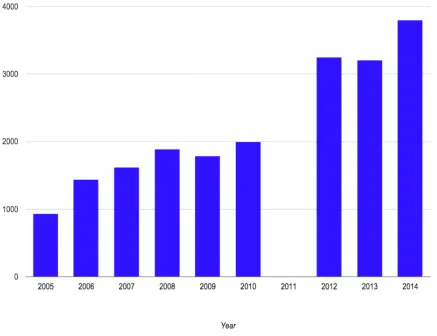
In 2014, 9,739 students sat the HSC exam for Physics (NSW Board of Studies Website 2014) and 2,253, attended the Kickstart workshops (23%) from across the state of New South Wales. Since the workshops have been running, the number of attendees has slowly risen to be more than double of what it was at the program’s inception. Figure 1 shows total number of enrolments. Note that this does not represent the number of unique students since students may attend more than one workshop. The data for 2011 is omitted due to unreliable data.
Figure 1. Increase of student numbers attending Kickstart over time
Inquiry in Kickstart
Inquiry as an educational pedagogy underpins all science and with such a large number of students available for survey, this presents an excellent opportunity to gather meaningful data on inquiry-orientated learning and has been briefly investigated with some preliminary results analysed (Gordon, Sharma and Georigou 2014). However, there is a scarcity of papers on inquiry oriented learning in high school science outreach programs.
‘a clear positive trend favoring inquiry-based instructional practices, particularly instruction that emphasizes student active thinking and drawing conclusions from data. Teaching strategies that actively engage students in the learning process through scientific investigations are more likely to increase conceptual understanding than are strategies that rely on more passive techniques.’ (p.474)
From our perspective, the claims made by Minner et al. (2010) would make investing in inquiry-oriented learning in Kickstart worthwhile. But what would the inquiry activities look like given the short time frame within which the Kickstart activities occur?
The critical issue is, how to incorporate inquiry. Inquiry features strongly in tertiary education (Kirkup 2013) and in the NSW syllabus, so is therefore a strong focus in schools (Tamir, Stavy and Ratner 1998). However, there is little incentive for outreach providers to implement inquiry-orientated learning into their programs. This paper examines how a unique environment such as Kickstart Physics might incorporate inquiry-orientated learning
Depending on which type of enquiry, different facets of inquiry need to be considered. Campbell, Abd-Hamid and Chapman (2010) consider framing research questions, designing investigations, conducting investigations, collecting data and drawing conclusions; while work published by the NRC considers questions, data and evidence, analysis, explanations, connections with scientific knowledge, and justification as important. This is in line with the 5E’s model of engage, explore, explain, elaborate and evaluate (Bybee 2008) utilised in science teacher education programs in many countries including Australia and the United States of America.
For our experiments, we drew on the above and focused on a concrete set of outcomes relevant to the syllabus and consistent with findings from literature, (Richardson, Sharma and Khachan 2008). This is particularly important for outreach programs of this nature, as these must match the perceived needs of the participating teachers and students. They need to see the immediate value in engaging with outreach activities in senior high school while preparing for a high stakes exam. These were:
● Make a hypothesis
● Design an experimental procedure
● Collect and present data
● Analyse data
● Identify risks
● Relate results to applications
● Comment on validity, reliability and accuracy
● Relate conclusion to experimental aim
These outcomes formed the basis of part of the survey instrument.
A mental effort scale effort was also used as a measure for cognitive load (Paas, Tuovinen,
Tabbers and Van Gerven 2003). An increase in mental effort can be seen to help students learn through thinking through processes (Hake 1998) as opposed to following instructions. Vosniadou et al. (2001) explain:
‘Learning is an effortful and mindful process and students should be encouraged to construct their own knowledge and skills through active processing, rather than being passive listeners’ (p.382)
Aims
In exploring how best to include IOL activities in the Kickstart Workshop, we considered how effective the materials were in engaging students by:
● Measuring the reported confidence of students’ ability in implementing the outcomes listed in the earlier section
● Measuring the mental effort students were exerting during the activity
● Analysing the use of the redesigned logbooks.
● Assessing student understanding of inquiry
The expected outcomes from the experiment were that the students show an increase in confidence across most, if not all of the identified areas of inquiry, an increase in mental effort over the course of the 2.5 hour workshop and an increase in the use of the redesigned logbooks, and finally, to have the students understand what is meant by the term scientific inquiry.
While the overarching aim is to improve a student’s learning outcomes using IOL methods in the workshop, we did not directly measure this in our this study. It would be informative and powerful to measure student learning outcomes related to inquiry however, the tools to do this have not been satisfactorily developed in the literature. This is a worthy aim for future work.
Methods
The existing workshop was originally designed to assist teachers to navigate through the new syllabus (Whymark, Stewart, Sharma and Prosser 2002) at a time where they had very little support or resources. Those resources have since matured and thus the content and structure of the original workshops and logbooks were no longer appropriate. With the experience of a qualified high school teacher, together with the research expertise of the Sydney University Physics Education Research (SUPER) group and the Faculty of Science, the workshops underwent a research based iterative redesign in order to better deliver the content, align the session with best practice and provide useful resources for students and teachers.
The study focused on the workshops of the two modules above due to larger sample size, the students had also already completed those topics in class with their teacher. This decision was made for reliability and also to control as many variables as possible and eliminate any bias, while offering students opportunities to demonstrate their understanding of experimentation rather than introduce new content.
The study was carried out during the Kickstart sessions in 2014, which ran either in the morning or afternoon, Monday to Friday. The survey and the study had ethics approval.
Experiment design
The experiment design was to complete a comparative study of student responses from an existing logbook against a modified inquiry-orientated logbook. A sample of nt=318 students
were surveyed from the 2014 Kickstart outreach program with ni=92 asked to complete the
inquiry-orientated workshop and ne=226 students completed the existing workshop. The
students participated with informed consent and were aware that the study would not affect their school assessment.
The changes made to the logbooks made were specifically designed to increase the input of inquiry-orientated pedagogy into the program. A stronger focus on skills and processes replaced textbook-like content. For example, where the existing logbook asked the students to graph some tabulated data, the inquiry-orientated logbook asked students: how would best represent tabulated data? The idea being that the process of interpreting and presenting data is a fundamental scientific skill, but it is also an element that students studying in the HSC are tested on (NSW Board of Studies Physics Syllabus 2002).
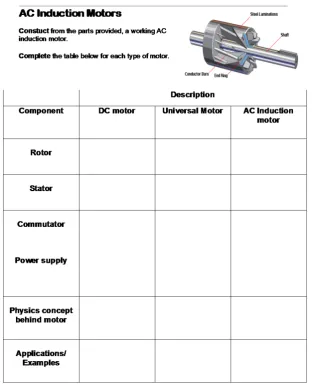
Presented here in Figure 2 is an example of the difference between the existing worksheet and inquiry-orientated logbook. Evident is that the existing worksheet is asking students to fill out a table with assistance and guidance from a student tutor. This is an activity that could very easily be completed by a class in their own time and has no real inquiry-orientated learning element present. In the inquiry-orientated logbook, students are asked to construct a disassembled model of an AC induction motor, and then essentially create an experiment method for their process.
Existing worksheet
Inquiry Logbook
Procedure and instruments
The worksheets were designed to reduce the information presented where possible by cutting out unnecessary words and instructions and redundant sources of information in place of hands on techniques (Sweller 1998). The casual academic tutors were given a brief introduction and training to the modified logbook and understood the rationale for the project.
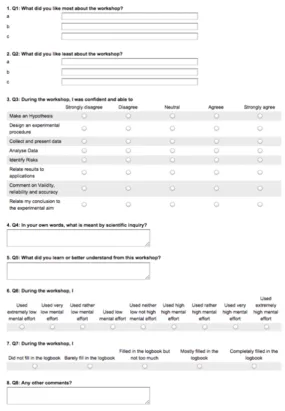
Figure 3. Survey responseform
To investigate inquiry we considered a number of inquiry-orientated outcomes, (Richardson et al. 2008) as listed in dot-points in the Inquiry in Kickstart section of this paper (Making a hypothesis, analysing data, etc.). These outcomes informed the design of the survey instrument.
Results and discussion
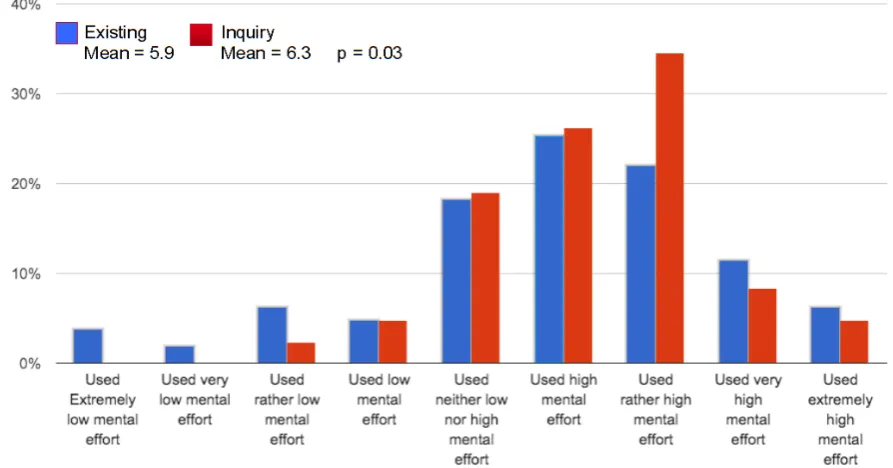
Figure 4 is the strongest result from the experiment, shows the responses to a validated Likert scale (Muller 2008). An analysis of the t-test of the mean of these two responses shows a statistical significant difference from the existing to the inquiry-orientated logbooks with p=0.03.
Figure 4. How much mental effort was used in the workshop?
This result indicates that the more inquiry-orientated design is present in the logbook, the more the students’ work at the experiments. This extra mental effort is thought to translate into deeper learning for students (Hake 1998). An encouraging result was that no student completing the inquiry-orientated logbook reported using anything less than rather low mental effort.
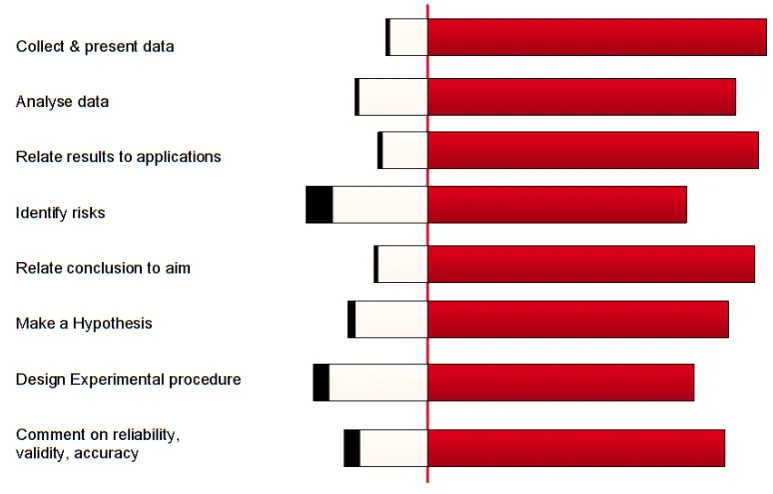
In Figure 6, the results from the ranking of question 3 are presented in order of descending frequency of responses from the responses completed by students completing the existing worksheet. We can see a general shift in positive responses from the inquiry-orientated workshop, but overall we can generalise that both the existing logbooks and the inquiry-orientated logbooks promote inquiry-inquiry-orientated thinking with very positive responses. This aligns with the fact that the logbooks have previously undergone an iterative process towards IOL.
Figure 6. Frequency (%) of Likert responses to identified elements of scientific inquiry ordered by the frequency of responses from the existing worksheet
When asked in the survey about the term scientific inquiry, it became clear that the students completing the inquiry-orientated logbook had a clearer understanding of the term than those who completed the existing logbook. The column labelled scientific inquiry in Figure 7 represents those students who simply restated the question of “In your own words, what is scientific inquiry?” From the graph, we see that the students that completed the inquiry-orientated worksheet were far more likely to define scientific inquiry with a thought-out response for example, “asking a question, design a method to observe data to address this question,” rather than simply restating the question From the responses, “to enquire about science.” This was an unexpected result from the modification of the logbooks.
Conclusions and implications
The principal conclusion from this project is that it is indeed possible to have meaningful IOL in a 2.5 hour workshop with minimal tutor training for thousands of students by research backed inquiry-orientated logbooks as seen by student participant responses to modified logbooks. Further indications from this project will form the aims and hypotheses for subsequent research projects.
Implications for scientific skills
Students attending the Kickstart workshops generally report to be confident in the identified scientific skills. However, more focus on skills such as commenting on reliability, validity and accuracy will be considered in future studies in order to better measure the observations. Future studies will consider this question further in order to collect more data and insights into the details of the level of confidence in specific scientific inquiry skills in high school students.
Implications for mental effort
From these results, further modification of the logbooks will take mental effort into account and will endeavour to ensure that a challenge is presented to the students during the workshop in order to maximise the benefits they gain from the workshop through the increase of mental effort. Care will need to be taken to not make the mental effort too great so that the tasks become too difficult.
This will be a delicate balance between offering a challenge while keeping to the syllabus and time constraints. The successful approach seems to be to remove verbal and textual instruction and replace it with hands-on activities aligning with previous research. Further investigation into mental effort in an outreach program will seek to further gather more data on this.
Acknowledgments
The authors would like to thank students who participated in the investigation, and the casual academic tutors for the Kickstart program and the School of Physics and the SUPER group. A special thank you is extended to Associate Professor Manjula D. Sharma for insights and inspiration to complete my first research project and for continuing support during the process.
References
Bell, R. L., Smetana, L., & Binns, I. (2005). Simplifying inquiry instruction. The Science Teacher, 72(7), 30-33. Bybee, R. (2008). Teaching Science as Inquiry. In L.W. Trowbridge, R. W. Bybee, & J. C. Powell (Eds.),
Teaching secondary school science: Strategies for developing scientific literacy (pp. 50-57). Upper Saddle River, NJ: Merrill.
Dooley, P. (2010). Building a Successful Outreach Program. Proceedings of the 16th UniServe Science Annual Conference (pg.122). Sydney, Australia: University of Sydney
Campbell, T., Abd-Hamid, N. H., & Chapman, H. (2010). Development of instruments to assess teacher and student perceptions of inquiry experiences in science classrooms. Journal of Science Teacher
Education, 21(1), 13-30.
Familari, M., Da Silva, K. B., Rayner, G., Young, J., Cross, A., & Blanksby, T. (2013). Scientific inquiry skills in first year biology: building on pre-tertiary skills or back to basics?. International Journal of Innovation in Science and Mathematics Education, 21(1), 15.
Proceedings of the Australian Conference on Science and Mathematics Education (pg. 28). Sydney, NSW: University of Sydney
Hake, R. R. (1998). Interactive-engagement vs. traditional methods: A six thousand-student survey of mechanics test data for introductory physics courses, American Journal of Physics,66(1), 64-74.
Kickstart Physics (2014). Retrieved April 29, 2015, from http://sydney.edu.au/science/outreach/high-school/kickstart/physics.shtml
Kirkup, L. (2013). Inquiry-oriented learning in science: Transforming practice through forging new partnerships and perspectives. ALTC National Teaching Fellow Final Report for the Australian Government Office for Learning and Teaching. Retrieved April 29, 2015, from
http://www.olt.gov.au/system/files/resources/Kirkup_NTF_report_2013_2.pdf
Minner, D. D., Levy, A. J., & Century, J. (2010). Inquiry-based science instruction—what is it and does it matter? Results from a research synthesis years 1984 to 2002. Journal of Research in Science Teaching,
47(4), 474-496.
Muller, D. (2008) Designing effective multimedia for physics education. (Doctoral dissertation). University of Sydney: Sydney, Australia.
NSW Board of Studies (2014). Retrieved February 6, 2015, from http://www.boardofstudies.nsw.edu.au/news-media/media-guide-2014/numbers.html
NSW HSC Physics syllabus (2002). Retrieved February 6, 2015, from
http://www.boardofstudies.nsw.edu.au/syllabus_hsc/pdf_doc/physics-st6-syl.pdf
Paas, F., Tuovinen, J. E., Tabbers, H. & Van Gerven, P. W. M. (2003). Cognitive load measurement as a means to advance cognitive load theory. Educational Psychologist,38(1), 63-71.
Richardson, A., Sharma, M. D., & Khachan, J. (2008). What students learning in practicals? A cross sectional study in a university physics laboratories. CAL-Laborate International,16, 20-27.
Sharma, M. D., Mendez, A., Sefton, I. M., & Khachan, J. (2014). Student evaluation of research projects in a first year physics laboratory, European Journal of Physics, 35, 2.
Tamir, P., Stavy, R., & Ratner, N. (1998). Teaching science by inquiry: assessment and learning. Journal of Biological Education, 33(1), 27-32.
Vosniadou, S., Ioannides, C., Dimitrakopoulou, A., & Papademetriou, E. (2001). Designing learning environments to promote conceptual change in science. Learning and Instruction, 11(4), 381-419. Whymark, A., Stewart, C., Sharma, M. D., & Prosser, M. (2002). Does the new HSC physics syllabus let
students think differently about their physics knowledge differently? Proceedings of the 15th Australian Institute of Physics Congress (pp. 265-267). Sydney, NSW: University of Sydney