The Indians didn’t know what in earth it was when his ship came into the harbour.… So the Chief, Chief Maquinna, he sent out his warriors… in a couple of canoes to see what it was. So they went out to the ship and they thought it was a fish come alive into people.
They were taking a good look at those white people on deck there. One white man had a real hooked nose, you know. And one of the men was saying to this other guy, “See, see … he must have been a dog salmon, that guy, there, he’s got a hooked nose.”
The other guy was looking at him and a man came out of the galley and he was a hunchback, and the other one said, “Yes! We’re right, we’re right. Those people, they must have been fish. They’ve come back alive into people. Look at that one, he’s a humpback [salmon]. He’s a humpback!”
—A First Nation oral account of the first meeting of the Nuu-chah-nulth [noo-CHAH-noolth] and Captain Cook’s ship in Nootka Sound
(see text credits page for source)
Cultures in Contact
Vikings were the first Europeans to visit North America, in the year 1000. The next Europeans to arrive did so 500 years later. The first contacts took place with peoples who lived on or near the coast. They included the Mi’kmaq [MIG-mah], the Haudenosaunee [hah-duh-nuh-SAH-nee], and the Montagnais [MON-tun-yay]. Both First Nations peoples and Europeans were surprised to meet people who seemed so different from themselves.
We all find it hard to understand people who are different from us. We are used to our own way of doing things. Sometimes we think our way is the best way. This was probably how the Europeans and First Nations peoples felt when they first met. This is called being ethnocentric. Each thought that their own ethnic group was superior. After contact, both groups began a long process of learning to understand one another. They gradually found ways to get along.
for Trade
Key
CONCEPT
▲
There came to us a canoe with nine men in it. This canoe drew near to the vessel, the people in it singing. But they would not come near enough for us to communicate by means of signs. Having followed us for some time, they returned to the land. About five o’clock this canoe, and another in which there were six people, caught up with us, both drawing up to our stern. The captain made them a present of some strings of beads and they gave us some dried fish. But they would not come on board the ship. These people were well-built, with long hair, and they were clothed in pelts and skins; some of them were bearded.
—A Spaniard’s account of his first meeting with a First Nation along the west coast of North America
(see text credits page for source)
How did the various peoples in North America both work
together in the fur trade and compete to control it?
Chapter
INQUIRY
Perspectives on First Contacts
1. Discuss with your classmates what challenges First Nations peoples and Europeans must have overcome to build a good relationship. Which do you think was the greatest challenge? Why?
2. The First Nations and Europeans began working together in the fur trade. Do your
views of people change when you start working with them, for example, on a sports team? If so, in what ways do they change? Predict how a European fur trader’s and a First Nations trapper’s view of each other may have changed as they began to work together.
Think
AHEAD
▲
Changing First Impressions
First Nations peoples and Europeans learned to get along because they wanted to trade. They began a long process of learning to respect one another’s differences. This chapter invites you to learn how this process began. You will see how the fur trade laid the foundations of the Canadian economy. You’ll look at the different partnerships among the various First Nations, the Métis [may-TEE], the Canadiens, and the British. You’ll also learn how the fur trade affected First Nations and Métis societies.
Do you sometimes wonder why events happen, and why they have particular results? The Skill Check feature in this chapter shows you how to
Analyze Causes and Effects. This skill is important to your studies because it will help you analyze historical events. The project at the end of the chapter will ask you to analyze effects from a variety of perspectives.
T
he North American fur trade brought many peoples together. Some peoples worked together. Others competed. Many effects resulted from these forms of contact, as you’ll see in this chapter.A causeis something that makes an event happen. An effectis the result of this event. Effects are sometimes called consequences. An event may have several effects.
Cause and Effect in History
Together, a series of causes and effects may lead to a major change or event. When studying the past, study the causes and effects of an event together. This helps you see why major events happen.
Identifying Causes and Effects ]
1. Think about your favourite hobby or sport. a) What caused you to take up this form of
recreation? Think about your early impressions of it. Think about whether someone influenced you. b) What are your hobby’s effects? Think about how
it changed you. Think about how it affects your day-to-day life.
Unexpected Effects []
Many effects can come out of one event. Sometimes the effects, in turn, cause even more effects. When this happens, there is a chain of causes and effects over time.
Sometimes the effects that come out of an event are unexpected. For example, if you join the volleyball team, you might miss a half-day of school to go to the finals.
2. Expand your cause-and-effect chart. Add effects of effects. Add effects you didn’t expect.
Analyze the causes and effects of your favourite hobby or sport. Use a cause-and-effect chart
like the one here to help you. To identify causes and effects, use
connecting words and phrases like these to connect ideas.
• As a result of … • If … then … • Because …
• Nevertheless … • This led to … • Therefore …
S
KILL
C
HECK
:
Analyze Causes
G
enerations of First Nations, Inuit [IN-yoo-it], and Métis as well as Frenchand English adventurers took part in the fur trade. In this section, you will learn how these groups of people found ways to work together.
Partners in Trade
Initially, the fur trade was a partnership between European traders and First Nations hunters and trappers. As in all partnerships, each had something the other wanted.
The First Nations peoples valued the metal goods that came from Europe. These included pots, knives, axes, copper wire, and guns. These goods were stronger and lasted longer than the tools and utensils they made for themselves out of stone or wood. The First Nations traded for other goods as well, such as blankets, cloth, and thread.
What did the First Nations peoples have that the Europeans wanted? Just one thing: fur, and lots of it! Fox, marten, otter, bear, lynx, muskrat, wolf, beaver—the traders snapped up the furs of all these animals. In Europe, they used them for fashionable trims on coats and jackets. The most popular European fashion trend, however, was the beaver felt hat.
The Barter System
When you go to the store to buy something, you pay for it with money. In the time of the fur trade, Europeans used metal coins for money, but they also traded goods. The exchange of goods is called barter.
The First Nations had been trading among themselves for hundreds of years. They used the barter system. Trading parties carried corn, tobacco, furs, copper, pottery, and many other goods long distances to trade with their neighbours. People traded to get what they needed.
Before trade began, those who had travelled a long way would rest for a bit. They would establish feelings of respect and trust with their hosts by exchanging gifts and sharing the peace pipe. Throughout Eastern North America, wampum (strings of shells) would be offered to honour new friends and create harmony.
When the French arrived, they adopted this way of doing business.
How did the First Nations peoples work with
the French and the British in the fur trade?
Focus
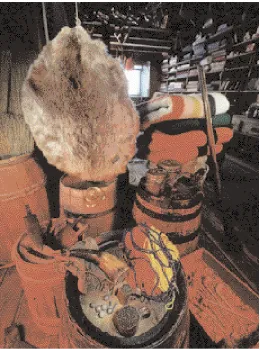
Figure 4.1 Some of the items the First Nations trappers took in trade. How do you think each of these items changed day-to-day life for First Nations peoples?
The Trading Ceremony
There were many ceremonies involved in the fur trade, such as gift giving. For what reasons do you exchange gifts with people?
Charles Lalemant was a French Jesuit missionary. In this excerpt, he describes a trading session in 1626. (Europeans commonly used the term Indianat that time. Today, First Nations prefer to be known by the name of their nation.)
The day of their arrival, the French merchants erect their huts and the Indians arrive in their canoes. The second day the Indians hold a
council and present their gifts. Gifts are always given when people visit each other. The French give presents then to the Indians.
The third and fourth day the Indians trade and barter their furs for blankets, hatchets, kettles, capes, little glass beads, and many similar things. It is a pleasure to watch them during this trading.
When it is over they take one more day for the feast which is made for them, and the dance. Early the next morning the Indians disappear like a flock of birds.
Source: Sharon Sterling, Outlooks 4: Our Beginnings
(Toronto: Oxford University Press, 2000), p. 166.
“
”
V
OICES
V
OICES
CASE
STUDY
Dedicated Followers of Fashion
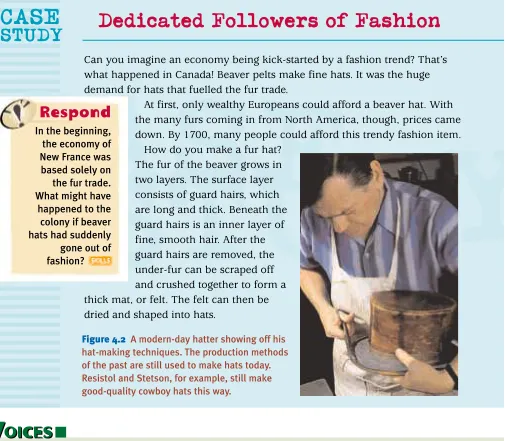
Can you imagine an economy being kick-started by a fashion trend? That’s what happened in Canada! Beaver pelts make fine hats. It was the huge demand for hats that fuelled the fur trade.
At first, only wealthy Europeans could afford a beaver hat. With the many furs coming in from North America, though, prices came down. By 1700, many people could afford this trendy fashion item.
How do you make a fur hat? The fur of the beaver grows in two layers. The surface layer consists of guard hairs, which are long and thick. Beneath the guard hairs is an inner layer of fine, smooth hair. After the guard hairs are removed, the under-fur can be scraped off and crushed together to form a thick mat, or felt. The felt can then be dried and shaped into hats.
In the beginning, the economy of New France was based solely on
the fur trade. What might have
happened to the colony if beaver hats had suddenly gone out of fashion?
Respond
The fur trade was a partnership in the sense that European traders and First Nations trappers engaged in it together. The
question is, did they benefit equally from trade? It cost a lot of money to run trading posts and ship furs across the ocean. Even so, the European fur traders were paid about 10 times more for the pelts than they paid for goods to trade. This mark-up ensured healthy profits.
Three Key Players
Three major groups took part in the fur trade: the First Nations, the merchants, and the coureurs de bois.
• First Nations. During the winter, First Nations men hunted and trapped animals. The women skinned the animals and prepared the pelts. In the spring, when the ice on the rivers and lakes melted, the men and women loaded their bark canoes with furs. They travelled to the trading posts to trade these furs for goods.
Sometimes they transported furs for other hunting groups, too.
• Merchants.In both the French and
English fur trade, merchants financed and organized the trade. They purchased trading goods in Europe and shipped them to Canada. Then they shipped the furs back to Europe to sell to the hat makers.
• Coureurs de bois and voyageurs.The phrase coureur de bois means “runner of the woods.” You will recall reading about these adventurers in Chapter 2. They were the French traders who paddled on long journeys into the wilderness to trade for furs with the First Nations. Later, these hardy men paddled the trade canoes from Montréal to the trading forts. They
became known by another French word,
voyageurs.
Relying on First
Nations []
Europeans could not have been involved in the fur trade without a great deal of help. As you have seen in earlier chapters, Europeans did not know how to cope in the North American wilderness. The First Nations helped them by
Look on the
Voices and Visions
CD-ROM to watch a re-enactment of a bargaining session at a fur-trading post.
Tech Link
Hudson’s Bay blankets still have several narrow black lines running along one edge. These indicate the number of beaver pelts a blanket of that size was worth.
• showing them how to find food
• teaching them how to make medicine to cure diseases such as scurvy
• providing advice on how to dress for the cold weather • providing transportation in
the form of canoes,
snowshoes, and toboggans • sharing their knowledge of
the region
• translating trade deals with various groups
• helping them negotiate
• providing a workforce to cook food, sew moccasins, prepare pemmican, snare animals, lace snowshoes, and so on
First Nations Women:
Another Perspective []
When you think of the people who took part in the fur trade, do you think of the First Nations women? They did not hunt for furs. However, First Nations and Métis women played a different but equally important role for their communities.
• Preparing furs.Women prepared most pelts that crossed the ocean. First, they scraped off the flesh. They rubbed the pelt with the brains of the animal, smoked it over an open fire, and soaked it in warm water. Then they worked the pelt until it was soft.
• Working in the forts.Women also helped in the forts. They performed many
essential tasks, such as making moccasins and clothing. They collected birchbark and spruce gum for making canoes. They wove fishing nets and snowshoes and gathered firewood. They contributed to the food supply by snaring small animals and collecting nuts, roots, berries, and bulbs as well as leaves to make tea. • Working “on the road.”Women paddled
the canoes and worked in camps, too. Matonabbee was the Dene [DEN-ay] explorer who led Samuel Hearne on his trips. (The Dene lived in the boreal forest and on the tundra of the Northwest Territories.) Matonabbee refused to travel without women to help. In Dene society, then as now, all clan members shared the duties and responsibilities of survival. These members included women and children.
• Sharing language and geography skills. Many First Nations and Métis women knew more than one language. This made them valuable as interpreters and
negotiators. They also worked as guides.
1. Has your impression of First Nations women in the fur trade changed? If so, explain.
2. The fur trade was a partnership between First Nations peoples and Europeans. a) With a partner, discuss what each group
contributed to the partnership. How did each group benefit? Show your information in a visual organizer. You might use a chart like this one.
b) In your opinion, did one group benefit more than the other did? Explain.
Think It
Through
▲
First Nations Europeans Contributions to
the fur trade
Benefits from the fur trade
Look in Chapter 1 on the Voices and Visions
CD-ROM to see the process of tanning hides first-hand.
Tech Link
Many First Nations women made pemmican.
I
n this section, you will read about how the French government influenced the fur trade and the economy of New France. You’ll also see how transportation was key tomaking that economy work.
The Foundation of
an Economy
The coureurs de bois spent their wages in the shops. The shop owners used their profits to buy food from the farmers. The farmers used that money to buy services from the cooper (a barrel maker) or other businesses. And so the trading, buying, and selling spread from one person or business to the next. In the early days of New France, the fur trade was the foundation of the
economy. That situation changed as new industries developed. Eventually, the economy grew to become the economy of the country in which you live today. We owe a great deal to the First Nations trappers and European traders who paved the way for the future.
The King and the
Economy
The French king controlled the fur trade and used the profits to benefit the colony. He appointed officials to carry out his plans. As you read the following section, think about how these plans changed as new officials were placed in charge.
Jean-Baptiste Colbert
In 1663, the king put Jean-Baptiste Colbert in charge of planning. Colbert wanted the colony to be part of the mercantile system. The colonists in New France would receive goods made in France. In return, New France would send the home country fish, timber, and, of course, furs. Colbert would not allow the traders to build trading posts in the interior of North America. He
believed this would lead to conflict with the First Nations. Instead, the French relied on the extensive economic network of the Wendat [WAH-n-dot], who brought furs from many First Nations to Montréal.
Jean Talon
As you learned in Chapter 2, Jean Talon was in charge of the economy after 1665. He used government money to attract more colonists. He supported local industries. Under Talon, the number of French colonists doubled.
The French Fur Trade
How did the government of France affect the fur trade and the
economy of New France over time?
Focus
Governor Frontenac
A French noble, the Marquis de Frontenac, became governor in 1672. He faced a problem. Many Wendat had been killed by smallpox. The Haudenosaunee had killed many more. The whole Wendat society fell apart. They could no longer bring furs to Montréal. The less powerful Odawa [oh-DAH-wuh] tried to do this. Their enemies, the Haudenosaunee, made this dangerous.
Frontenac went ahead with a plan to send coureurs de bois into the interior. He wanted to expand the system of trading posts deep into the interior. If he didn’t, he knew the English would.
The Great Peace of
Montréal ]
Three nations banded together to fight the Haudenosaunee. The Council of Three Fires consisted of the Potawatomi [pot-uh-WAH-tuh-mee] south of Lake Erie, the Odawa on Manitoulin Island, and the Ojibwa [oh-JIB-way] on the north shores of Lakes Huron and Superior. They had many successes. Their efforts made the Haudenosaunee more and more weary of war.
After six decades, the First Nations and New France were ready to discuss peace. In the summer of 1701, 1300 delegates from 40 First Nations communities arrived in Montréal. They came in hundreds of canoes from Acadia in the east, the Great Lakes region in the west, James Bay in the north, and all points between.
All parties showed the quality of good citizenship by working hard to find a way to end the fighting. At the end of the peace talks, the French, their First Nations allies, and the Haudenosaunee signed a treaty. The First Nations would no longer battle each other or the French. New France would not attack any more Haudenosaunee villages. The trappers and traders would be able to travel safely.
“The hatchet is stopped,” said Michipichy, a Wendat leader. “We have buried it during these days here in the deepest place in the earth, so that it will not be taken up again by one side or the other.” (Source: Quoted in Gilles Havard, The Great Peace of Montréal of 1701[Montréal,
Kingston: McGill–Queen’s University Press, 2001], p. 145.)
Economic Development ]
Coureurs de bois could now travel in peace. They got furs from the Montagnais and the Odawa, who traded with distant First Nations for furs. Local beaver populations had begun to dwindle. As a result, the French expanded farther north and west
in search of more beaver. This quest led Europeans to explore the entire continent.
The growing profits in the fur trade helped other parts of the economy grow. Mills, shipbuilding yards, and iron foundries sprang up. New textile industries were encouraged. The shipyards built ships for the fishing industry, trade, and the French navy. The peace lasted until the 1750s.
Transportation: Crucial
to Any Economy []
For trade to succeed, the traders needed transportation. During the fur trade, there were no trucks, trains, or airplanes. Traders relied on boats to transport their goods. As the First Nations knew, water routes were fast and convenient.
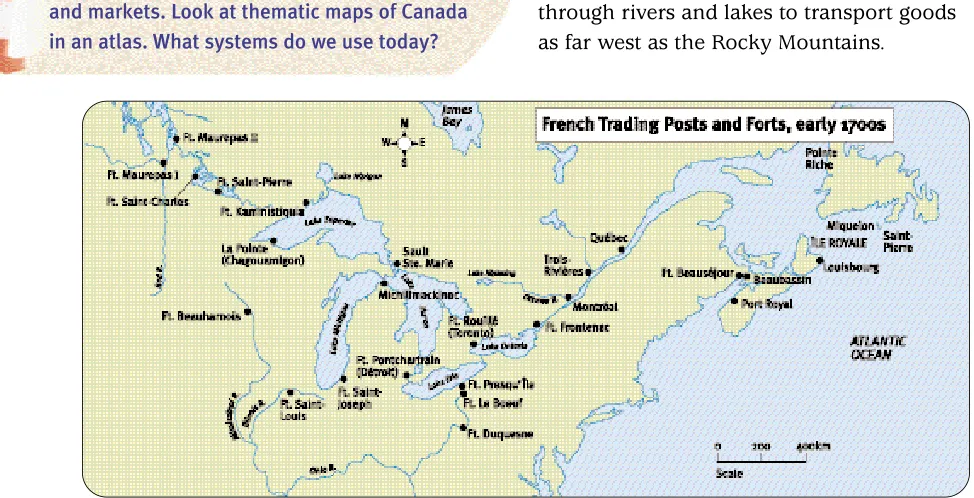
France controlled trade along the St. Lawrence River and on the Great Lakes. This gave the French fur traders a great advantage. In the Eastern United States, the Adirondack Mountains blocked English fur traders from expanding into the West. The French, on the other hand, could paddle through rivers and lakes to transport goods as far west as the Rocky Mountains.
Global Connections
Three hundred years ago, business people shipped furs across the ocean from North America to France. This global trade was a sign of things to come. Check the tags on your clothes. Where were your clothes made? Many things Canadians buy are imported from other countries. Many things we make in Canada are exported to other countries. Now, as in the days of the fur trade, our economy depends on global trade.
Global Connections
Figure 4.6 French forts in the early 1700s. Compare the pattern of forts on this map with the pattern on
The Canoe—A Canadian Institution
How can a little boat be part of a country’s identity? For many Canadians, a summer vacation wouldn’t be the same without a canoe. On the more serious side, did you know that the canoe played an important role in the fur trade?
In their canoes the Indians can go without restraint, and quickly, everywhere, in the small as well as the large rivers. So that by using canoes as the Indians do, it will be possible to see all there is.
—Samuel de Champlain
Source: Library and Archives Canada, “The Exploration of Canada: Transportation,”
http://www.collectionscanada.ca/ explorers/h24-1403-e.html.
Travelling into the interior of North America would have been impos-sible without the canoe. The birchbark canoes built by the Eastern First Nations were well suited for travelling on lakes and rivers. They were lightweight. This meant they moved through the water quickly. They were easy to carry over a portage(overland route between two water-ways). Yet they were sturdy, so they could last on long journeys.
Making a canoe was a highly skilled craft. John Kawapit, a member of the Cree (Nehiyawak [nay-HI-uh-wuk]) Nation, makes canoes. He shows his strong sense of citizenship as he describes the importance of being a canoe maker:
Even long ago there were some men who could not make all the things that were needed. In each camp there were only a few who could make everything. The hardest thing to build was the canoe. The man who could make a canoe was very happy because the people depended on it so much.
—John Kawapit, Great Whale River, Québec
Source: Canadian Museum of Civilization, “Wave Eaters: Native Watercraft in Canada,” http://www.civilization.ca/aborig/ watercraft/wainteng.html.
Identity
Identity
In a group, talk about the ways in which the canoe is part of the Canadian identity. What other things can you think of that symbolize our country?
Respond
The word canoecame from Arawak, an indigenous language spoken in the Caribbean. It is just one of many Aboriginal words that have become part of the English language. What others can you think of?
In 1715, Pierre La Vérendrye took charge of a French trading post near Lake Superior. During his years there, he made several trips through the forests of what is now Northern Ontario. He claimed these lands for France.
In 1732, La Vérendrye, three of his sons, and a nephew travelled west to the lands the French called le pays d’en haut—the upper country. A group of First Nations peoples led the way. Eventually, they reached Lake Winnipeg.
As they explored the West, La Vérendrye and his group came upon the Saskatchewan River. First Nations used the Saskatchewan River as their
main east-west route. It soon became the most important river for the French fur traders, too. La Vérendrye made many alliances with the First Nations. He also started several trading posts in the West. In 1743, two of his sons travelled as far as the Rockies. La Vérendrye died in 1749. He thought he was a failure because he had not found the “Western Sea.” Today, most historians feel differently about his contributions. Ask yourself: Would Canada be the same today without the efforts of this citizen of New France?
Biography
Biography
Figure 4.8 The routes followed by Pierre La Vérendrye and his sons as they moved west.
1. Make a cause-and-effect chart. Use it to show how the French king and his officials changed New France over time.
2. Think about the Great Peace of Montréal in 1701. What caused this event to happen? What were its effects on various groups?
3. Get an outline map of North America’s river systems from your teacher. Trace possible water routes through lakes and rivers between Montréal and the Rocky Mountains. If possible, use GIS software for this task.
Think It
Through
▲
Expanding Trade
The French made good use of the First Nations’ knowledge of transportation routes. They also heard stories from many First
Nations peoples about a great “Western Sea” that lay beyond Lake Superior. If they could reach it, the French thought, it would take them all the way to China. Can you guess what we call this great sea today?
U
nlike the French, the English were not interested in creating a colony in what is now Canada. In 1670, the Englishking granted a charter for control of the fur trade to the privately owned Hudson’s Bay Company (HBC). It had one goal: to make money. This affected the
relationship between the English fur traders and the First Nations trappers. In this section, you’ll learn how the English fur trade worked. You’ll see how the French and English ways of trading were different.
Why Hudson Bay?
The English built their forts along the icy shores of Hudson Bay. There were some advantages to this location.
• It was close to the abundant fur supply of the northern forests. Northern furs are better because animals grow the thickest fur in the coldest climates.
• Many rivers flow into Hudson Bay. They provided good transportation routes for the First Nations trappers.
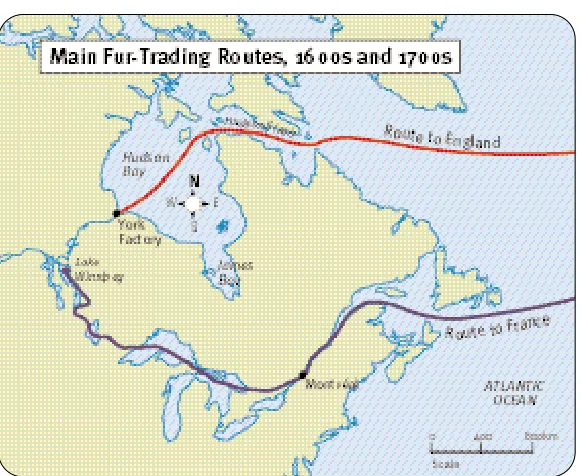
• Large supply ships could deliver heavy supplies directly to the English forts. The French route involved both a sea voyage by ship to Montréal, and a lengthy journey by canoe to reach the furs. The HBC could get furs to England in one year, while the French took two.
The English Fur Trade
In what ways was the English fur trade different from the French fur trade?
Focus
Isabel Gunn (1781–1861)
Isabel Gunn’s boyfriend, John Scarth, travelled from Scotland to Canada to work for the Hudson’s Bay Company. Gunn followed him in 1806. Women were not allowed, though, so she disguised herself as a man!
For two years, “John Fubbister” worked for the Hudson’s Bay Company. She performed all the duties expected of the men at the fort. No one guessed that “John” was really a woman, until she gave birth to a baby. Her baby was the first non-Aboriginal child born in the Northwest. After the birth, Gunn was reunited with Scarth in Grandes Fourches.
Later, Gunn took her baby to a post on Hudson Bay. She worked there for another year, taking in laundry. Then she returned home to Scotland.
Biography
Biography
Figure 4.9 The two main fur-trading routes into the interior. Compare the two routes. In what ways was the rivalry for control of the fur trade a rivalry between these two transportation routes?
CASE
STUDY
The English liked to trade for furs at their posts. Most posts were forts. The buildings were surrounded by a stockade—a wooden barrier of upright posts. Entry was controlled. The First Nations didn’t like the change. They liked it better when the traders travelled to them. Would this be a problem?
The Hudson’s Bay Company built many trading posts. The posts served as warehouses for trade goods, supplies, and ammunition. Employees came from Britain to live and work in the posts for years at a time.
The traders soon learned how helpful the nearby First Nations people could be in running the posts. The First Nations people learned that they could
earn a good living working at the posts. The First Nations men cut wood, hunted big game, and loaded and unloaded goods. The women also played key roles, especially in making snowshoes, moccasins, canoes, and pemmican. With everyone working together, the posts became bustling hives of activity.
Nonetheless, the English still found that life at fur-trading posts was harsh. One trader at York Factory described it as “nine months of winter varied by three of rain and mosquitoes.”
Sometimes it is hard to get used to new ways of doing things. How did the English and First Nations people find ways to get along?
Respond
Whitefish 17 346 Ptarmigan 4 663 Ducks 4 298 Geese 4 274 Deer 3 530 Plovers 3 359 Other fish 2 715 Rabbits 816 Trout 420 Freshwater cod 38 Caribou tongue 35 Caribou heads 15
Figure 4.11 The wild animals eaten at York Factory during one winter there. About 40 people lived at the fort. Which of these foods have you eaten?
Make a Venn diagram or comparison organizer. Use it to compare the similarities and differences in the English and French fur trades. Which trading style did the First Nations
Think It
Through
▲
Life at a Hudson’s Bay Company
Trading Post
Source: M. Payne, The Most Respectable Place in the Territory(Ottawa: Canadian Parks Service, 1989), p. 146.
T
he competition between French and English fur traders came to an abrupt halt in 1760, when New France came under British control. (You’ll learn more about thisin Chapter 5.) The French trade ended. Some of the French traders settled in the Great Lakes
Lowlands with their First Nations wives. These couples created a new people—the Métis. In this section, you will learn other ways that the fur trade in the West brought various peoples together.
The Nor’Westers []
Within a few years, fur traders from Montréal were returning to the woods. These new traders blended the English and French ways of doing things. The traders were Scottish or English business people, mainly from Montréal. Many married Francophone women.
In 1779, a group of the new traders from Montréal formed the North West Company. Known as the Nor’Westers, they extended the fur trade farther than it had been in the days of New France. Now the goal of the company was to make money rather than to build a colony. These traders
ran an efficient business while embracing the traditional methods of the French fur traders. They worked hard to improve ties made by the French with the First Nations peoples.
The hard-working men who paddled the canoes and hauled supplies across the portages were the fabled voyageurs. These were the men who used to be known as the coureurs de bois. Most were Canadiens— Francophone citizens of North America. They were joined by Mohawk and Anishinabe paddlers. The rest of the voyageurs were Métis.
The Métis were the children of
European fathers and First Nations mothers. They played a substantial role in the fur trade. Many of them knew two languages, so they acted as interpreters. They were comfortable in more than one culture. Métis became the chief suppliers of buffalo meat to the Western trading posts.
For years, the Métis worked both as voyageurs and as employees in the forts. The 1804 list of North West Company employees, for example, includes mostly French and Métis names. Strong young men such as Jean-Baptiste Lemay, François Boucher, and Pierre Laliberté made the fur trade possible.
How did the fur trade in the West
bring various peoples together?
Focus
Figure 4.12 Fur-trading posts in Western Canada. This map shows the most important posts. Describe the location of the forts in relation to bodies of water.
The Annual Cycle
The trading posts of the Western interior were very far from Montréal. The voyageurs could not make the trip there and back in one summer. Instead, canoes came from both directions and met in the middle at Fort William, on Lake Superior. Those who lived year-round at the
posts were known as inlanders, or winterers. They brought the furs they had traded with the First Nations. The large canoes from Montréal brought supplies and trade items. After the goods were exchanged, the partners held a banquet and a dance to celebrate. Then each group headed back.
Life of the Voyageur
The voyageurs combined a spirit of adventure with a willingness to work hard for the good of the group. Most of them spoke both French and a First Nations language. They enjoyed good relations with First Nations communities. They worked for the Nor’Westers until 1821, when the HBC bought the North West Company.
Because of the voyageurs, French was the language of the Western fur trade. Many First Nations learned to speak French. Later, many voyageurs settled permanently in the West. They were the first Europeans to set down roots on the Prairies. They helped spread the French language and way of life across the country.
Figure 4.13 A voyageurs’ camp outside the rebuilt Fort William. Parks Canada workers play the roles of people at the fort. What would Canadians get out of historical “performances” like this?
In 1822, a former trader, Alexander Ross, gave a ride to a 70-year-old man on his way to Red River. As Ross talked with him, he discovered that the man had been a voyageur. This is part of what the man told Ross. As you read, think about this man’s strong sense of pride and citizenship.
I have now been 42 years in this country. For 24 I was a light canoeman. I required but little sleep, but sometimes got less than I required. No portage was too long for me; all portages were alike. My end of the canoe never touched
the ground till I saw the end of it. Fifty songs a day were nothing to me. I could carry, paddle, walk, and sing with any man I ever saw. During that period I saved the lives of ten bourgeois [merchants], and was always the favourite because when others stopped to carry at a bad step and lost time, I pushed on—over rapids, over cascades, over chutes; all were the same to me. No water, no weather ever stopped the paddle or the song. … Yet, were I young I should glory in commencing the same career.
Source: CanText, “1700: The Coureurs de Bois,” http://207.61.100.164/cantext/newfranc/1700ross.html.
“
”
V
OICES
V
OICES
To hear two voyageur songs, open Chapter 2 on your Voices and VisionsCD-ROM.
The Nor’Westers in
Alberta []
Some Americans travelled into the Northwest to take part in the fur trade. Peter Pond was an American from Connecticut. In 1778, First Nations people persuaded him to build a small trading post on the Athabasca River.
They wanted the post so they wouldn’t have to go all the way to York Factory. It was the first fur-trading post in what is now Alberta.
This post was soon replaced by Fort Chipewyan [chip-uh-WY-un], a North West Company site on Lake Athabasca. It was named for the Dene people who lived east of the lake. They also supplied furs to the fort. Fort Chipewyan quickly became a major trading centre and the first European community in Alberta. It was so big that the voyageurs jokingly called it the “Emporium of the North.” Today, it sits just east of Wood Buffalo National Park.
Figure 4.14 A painting of voyageurs paddling their canoe in rapids. Frances Hopkins painted it in 1879. She was the wife of a fur-trade official. How do you think this influenced the way she portrayed what she experienced? Do you see her in the painting?
First Nations who took part in the fur trade in Alberta were the Siksika [sik-SIK-uh], the Piikani [bee-GUN-ee], the Kainai [KY-ny], the Tsuu T’ina [tsoo-TIN-uh], the Cree, and the Nakoda [na-KOH-dah]. Farther north, the
Chipewyan, the Dene, the Dunne-Za [duh-nuh-ZAH], and the Dene Tha’ [DEN-ay-dah] also traded with the Nor’Westers.
The voyageurs sang many songs to keep the time as they paddled through the day. This favourite came from France, but the Canadien tune is different. Although it began as a ballad about a young man recalling a lost love, it became a way for the Canadiens to vow to remember New France before the rule of the British. Here are the last three verses.
À la claire fontaine
You have no cares to grieve you, While I could weep today, For I have lost my loved one In such a senseless way.
Refrain:
Many long years have I loved you, Ever in my heart you’ll stay.
She wanted some red roses But I did rudely say
She could not have the roses That I had picked that day.
Now I wish those red roses Were on their bush today, While I and my beloved Still went our old sweet way.
Source: Edith Fulton Fowke, Chansons de Québec (Folk Songs of Québec)(Waterloo, ON: Waterloo Music Company Limited, 1957), p. 63.
V
OICES
Fierce Competition
From Fort Chipewyan, the Nor’Westers carried the fur trade westward up the Peace and Mackenzie Rivers, building trading posts as they went. Not to be outdone, the HBC did the same. Each company wanted to be closer to the trappers. They both offered higher prices for furs.
On the down side, some rival traders also got into fist fights as they competed to get the most furs. Some traders bullied the trappers to get their furs. Some began to trade alcohol for furs, too. The relationship between the First Nations trappers and the rival traders became increasingly difficult.
Alexander Henry the Younger was the factor at Rocky Mountain House from 1810 to 1811. He kept a journal of the daily activities at the trading post. Desjarlais and Pichette, the two workers Henry mentions in his journal, were Métis.
Nov. 20th, 1810. B. Desjarlais hunting; seven men out to raise dog trains [cutting wood to make dog sleds]; four laying up canoes and cleaning the fort; one making a wood sled; one off for meat, one cutting wood, one carting, one making kegs. Our canoes are much split by the frost and four of our large axes broke today, being nearly as brittle as glass. Desjarlais killed nothing, as the animals about the fort have all
been roused by men going for wood for sleds; searching for horses, etc.
Nov. 23rd. Two Sarcees [Tsuu T ’ina] arrived from near Wolf River, where buffalo are numerous; they brought a few beavers.
Dec. 1st. Pichette finished the fort gates, and the bastions were put in order, but they are wretched buildings for defence.
Dec. 4th. Nine young Indians arrived, each with a dog travois and a few bad wolfskins, for which they wanted tobacco.
Source: Elliot Coues, ed., New Light on the Early History of the Greater Northwest: The Manuscript Journals of Alexander Henry and of David Thompson, 1799–1814
(Minneapolis: Ross & Haines, 1965).
“
”
V
OICES
V
OICES
To see a historical painting of two competing forts side by side, open Chapter 4 on your Voices and VisionsCD-ROM.
Tech Link
Crossing the Rockies
For years, the Rocky Mountains created a barrier that kept the voyageurs from pushing westward. Explorers could not find a way through the mountains. An explorer named Alexander Mackenzie wanted to solve the riddle. He was a veteran Nor’Wester who had come to Canada from Scotland to work in the fur trade when he was just 15 years old.
In 1789, Mackenzie tried a long river heading out of Great Slave Lake. It took him to the Arctic Ocean, so he called it the “River of Disappointment.” What is it called now? (Hint: Look at the map at left.) A few years later he tried again. This time he travelled up the Peace River and down the Bella Coola River. A Métis named François Beaulieu accompanied him. With Beaulieu’s help, Mackenzie’s expedition became the first group of Europeans to cross the continent by land from east to west.
Figure 4.16 Alexander Mackenzie’s two trips in search of the Pacific Ocean. It has been said that the fur trade was the most important factor in exploring the West. Do Mackenzie’s expeditions support this theory?
Marie-Anne Gaboury (1780–1875)
Marie-Anne Gaboury was the first non-Aboriginal woman to live in
Western Canada. She was born near Trois-Rivières in Québec. She married Jean-Baptiste Lagimodière. He was a voyageur with the HBC. Soon, he yearned to go west again. Gaboury would not allow it—unless she could go, too!
The two went to live in the fur country in Manitoba, and then to Fort Edmonton in the Northwest. In the summer, Gaboury went on buffalo hunts. She was an important leader in the community. She became godmother for many people there. Today, when people stroll down rue Marie-Anne-Gaboury in Edmonton (named in 1988), they think of this important person in Alberta’s history.
One of Gaboury’s daughters, Julie, became the mother of the Métis leader Louis Riel. Gaboury was a noteworthy pioneer who helped establish the French presence in Western Canada.
1. What caused the fierce competition in the Alberta fur trade? What resulted from it? Use a cause-and-effect chart to organize your thoughts.
2. Scan this section to make a list of individuals involved in the fur trade.
a) What did they each accomplish? With whom did each of them work? b) Choose one person. Draw a picture or
write a poem to show a scene from his or her life in the fur trade.
Think It
Through
▲
Historic sites are all over Canada. How can historic sites tighten our bonds with the early citizens of our country? How can they strengthen our sense of identity? When Alexander Mackenzie reached the Pacific Ocean, he wrote a message on a rock, as you can see at left. He used a mixture of animal grease and dye. Today, you can only reach this spot by water. Would you like to see this?
The Métis guide François Beaulieu was only 22 when he went with Alexander Mackenzie to search for the Pacific Ocean. He later became a leader of the Yellowknife Montagnais. He traded for the Hudson’s Bay
Company. What skills does a person need to be a wilderness guide?
I
n this chapter, you have seen how the fur trade was a process of contact and economic development. As with any activitythat brings cultures together, the fur trade resulted in changes. In this section, you will learn about a few of those long-term changes.
The Best Form of
Flattery []
The First Nations and Europeans got to know each other. They found things to admire in each other’s culture. They began to copy the other’s way of doing things. They also borrowed each other’s technologies. The identities of Canada’s peoples have evolved over time, as we have adapted to one another’s ways of doing things.
The Impact of Contact
What was the impact of the fur
trade on First Nations’ societies, economies, and sense of identity?
Focus
In 1749, Pehr Kalm visited Canada from Sweden. He saw how the French newcomers copied the First Nations peoples.
The French in Canada in many respects follow the customs of the Indians, with whom they have constant relations. They use the tobacco pipes, shoes, garters, and belts of the Indians.
They follow the Indian way of waging war exactly; they mix the same things with tobacco; they make use of the Indian bark boats and row them in the Indian way; they wrap a square piece of cloth round their feet, instead of stockings, and have adopted many other Indian fashions.
Source: Adolph Benson, ed., Peter Kalm’s Travels in North America(New York: Dover Publications, 1966).
“
”
V
OICES
V
OICES
Negative Impacts []
Contact between cultures was not always positive. Think about who did well over time. European companies made a lot of money from the fur trade. In time, European governments claimed First Nations territories as their own.
In contrast, the First Nations suffered greatly over time. Contact with Europeans turned their traditional ways of life upside down. It eroded their societies. It led to the loss of their lands. Societies that had thrived before contact were altered forever. The ethnocentrism of the newcomers often led to misunderstandings.
Shifting Ways of Life
The fur trade changed the way of life of many First Nations individuals. It affected their sense of identity as well.
• Working for the fur trade.Many First Nations people adapted their old way of life to work in the fur trade. They focused their efforts on trapping furs. Others worked at the trading posts. First Nations people hunted for food for the newcomers and paddled the canoes filled with furs. • Following the fur.As time went by, beaver
supplies shrank. Some First Nations moved out of their traditional territories to find more. Sometimes this displaced other First Nations and led to disputes.
• Depending on European goods.Before the fur trade, the First Nations met their needs using the environment around them. Some traded with other nations. Those who became involved in the fur trade began to use goods that only the traders could supply.
• Hunting the buffalo.In the West, First Nations such as the Cree and Nakoda hunted buffalo as a way of life. They expanded their hunt to make pemmican for the voyageurs. Later, newcomers hunted and traded for buffalo hides. The buffalo herds quickly disappeared. The way of life of First Nations of the Plains changed forever.
• Loss of language. French and English became the dominant languages. The slow process of Aboriginal language loss began.
The Invisible Enemy
Perhaps the greatest disaster to result from the fur trade was disease. The traders and missionaries who came from Europe brought many germs. Diseases such as smallpox, measles, influenza, and whooping cough did not exist in North America before the Europeans came. The First Nations and Inuit had no immunity to them. Their bodies were unable to fight these diseases.
CASE
STUDY
Trading alcohol for fur was not common before the nineteenth century. That changed in the 1860s. The worst misuse of alcohol occurred in what is now southern Alberta. The American government had banned alcohol in Montana Territory. Many American “free traders” came north to Canada. There was no police force here. They could do what they liked. They went after the quick profits to be had by trading alcohol for buffalo hides.
Many of these traders were hardened Civil War veterans. They cared little for the First Nations people. In fact, they were
extremely callous in their dealings with First Nations.
In 1869, J.J. Healy and Alfred Hamilton built Fort Whoop-Up near present-day Lethbridge. It was the largest of about 40 whiskey-trading posts along the Oldman and Belly Rivers. Fort Whoop-Up was a frightening place. It had a four-metre-high stockade, brass cannons, and iron bars over the doors and
windows. Trade at Fort Whoop-Up grew from 5000 hides in 1869 to about 60 000 in 1875.
The “whiskey” the traders offered was a vile brew. It contained pure alcohol, tea leaves, rotten chewing tobacco, painkillers, red peppers, lye, ginger, soap, red ink, and molasses. The hunters who drank this stuff got so sick that they could not take care of their families. Many died from its poisons. Violence became common. In the winter of 1872–1873 alone, about 70 members of the Kainai First Nation died in violent
encounters. (The Kainai are some of the oldest residents of the western prairie region.)
In Chapter 9, you’ll see how the Canadian government responded to the lawlessness in the West.
What led to the “whiskey” trade? Think of at least three impacts it had on First Nations.
Respond
Fort Whoop-Up and the Whiskey Trade
Figure 4.18 The American traders were not the only ones to trade liquor. This is a list of trade goods carried by a canoe that travelled west from Fort William to Fort Lac la Pluie (later called Fort Frances) in 1806. There were kegs
Walker, reported from the Saskatchewan River, “the Smallpox is raging with such great Violence over the Country, not hardly sparing any that takes it.” (Source: Walker’s Journal at Hudson House, 1781–1782, in E.E. Rich, ed., Cumberland House Journals
How are First Nations dealing with the results of the smallpox
epidemics? Among other things, they’re trying to get back the remains of their ancestors. The Haida [HY-duh] live on Haida Gwaii [HY-duh-gwy] in the Queen Charlotte Islands in British Columbia. There were once as many as 30 000. That figure dropped to 800 by 1885. The Chicago Field Museum took 160 bodies from Haida gravesites. They thought the Haida would be extinct soon. In 2003, the museum returned these remains to the Haida Nation. The Haida were then able to rebury their ancestors with respect and honour.
Figure 4.19 Andy Wilson at the Skidegate Haida Repatriation Signing Ceremony at the Chicago Field Museum in October 2003. Wilson helped make the traditional bentwood boxes that were used to bring home his 160 Haida ancestors.
Creating a New Culture ]
One very positive result of contact between First Nations peoples and Europeans was the creation of a new culture: the Métis. Métis are people of dual heritage. The first Métis were the children of First Nations women
and European fur traders. Some of these children embraced the heritage of their French, English, or Scottish fathers. Others embraced the heritage of their First Nations mothers. Many others embraced both. Thus was born the unique Métis culture. You will learn more about the Métis in Chapter 8.
1. Recollect the eyewitness accounts of first contact at the beginning of this chapter. a) Since then, many changes took place in
the lives of the First Nations. Discuss these in a small group.
b) Create a graphic organizer to show the positive and negative impact of European contact on First Nations. You can write or draw each of the impacts in the chart. c) Compare your findings with those of
another group. What impacts would you add if you were starting over?
d) Are you in a good position to judge what is or is not a negative impact? Explain.
2. a) Create a three-column chart like the one below to record information about the impact of the fur trade on Canada. In
the first column, list these factors: • There was an abundant supply of
quality fur in northern North America. • Traders and First Nations trappers
needed one another.
• The French king used the fur trade to develop New France.
• There was an east-west river system. • Pemmican was made from buffalo. Add other factors.
b) Choose what you think was the most influential factor. Explain your choice in writing or to a partner.
3. How did the various peoples in North America both work together in the fur trade and compete to control it?
Think It
Through
▲
Point of View
Our point of viewis the way we see things as individuals. People have different points of view about things they observe.
What makes your point of view different from someone else’s? Your family, your education, your culture, your personal experiences, and your personality can all affect your point of view. Think about a recent event that you and a friend saw differently. Perhaps you both saw an argument. Perhaps you disagreed on who started it.
Individuals can see historical events differently, too. Look at the engraving on this page. How would Gaboury view this event? How would a First Nations person view it? When we study history, it is important to find different people’s points of view. Otherwise, we cannot truly understand the past.
Perspective
People’s perspectives are different from their individual points of view. A perspectiveis the generally shared point of view of a group. It can reflect the outlook of people from a cultural
group, faith, age category, economic group, and so on. For example, the Haudenosaunee perspective on the French fur trade was quite different from the Wendat perspective on it.
Focus
Recall activity 3 on page 92. You thought about how various aspects of the fur trade affected the development of Canada. Now think about the perspectives various groups had about these impacts.
1. Think about perspectives in a small group. The east-west water system allowed the French fur trade to develop westward. It brought Europeans into the interior of the continent. What would be the perspectives of the following groups about that impact? Keep in mind that perspectives can include a variety of concerns and can change over time. • the First Peoples who participated in the
French trade, for example, the Wendat • the First Peoples who did not, for example,
the Haudenosaunee • the Canadiens
• the English, who went west via Hudson Bay 2. With your group, choose another impact of
the fur trade. Consult the final section of this chapter for ideas. Develop a cause-and-effect chart for it. Analyze the impact from a variety of perspectives. Consider it in the short term and long term. Make a graphic organizer on chart paper and present your results.
Think about It
3. Discuss with your class why students of history should try to understand a variety of perspectives.
4. Did your views of the fur trade change as a result of doing this exercise? Explain.
Chapter 4
PROJECT
Understanding Point of View
and Perspective