Copyright © 2007 (Christopher S. Yoo). Licensed under the Creative Commons Attribution Non-commercial No Derivatives (by-nc-nd). Available at http://ijoc.org.
What Can Antitrust Contribute to the Network Neutrality Debate?
CHRISTOPHER S. YOO
*University of Pennsylvania
Over the course of the last year, policymakers have begun to ask whether antitrust can play a constructive role in the network neutrality debate. A review of both the theory and the practice of antitrust suggests that it does have something to contribute. As an initial matter, antitrust underscores that standardization and interoperability are not always beneficial and provides a framework for determining the optimal level of standardization. In addition, the economic literature and legal doctrine on vertical exclusion reveal how mandating network neutrality could reduce static efficiency and could impair dynamic efficiency by deterring investment in alternative last-mile technologies. Antitrust thus suggests that network neutrality is better suited to the ex post, case-by-case approach associated with the rule of reason than the ex ante, categorical approach associated with per se illegality and regulation. To say that the substantive principles of antitrust offer insights that can inform the debate is not to say that antitrust courts represent the optimal institutional locus for enforcing a network neutrality mandate. Lingering questions about courts’ institutional competence to supervise access regimes suggest that to the extent that antitrust enforcement authorities wish to take a more active role with respect to network neutrality, they would be better served by focusing their efforts on disclosure and consumer education than attempting to use antitrust to impose access requirements on network owners.
Christopher S. Yoo: [email protected] Date submitted: 2007-06-05
Table of Contents
Introduction I. The Costs and Benefits of Standardization and Interoperability II. The Economics of Vertical Exclusion
A. Vertical Exclusion and Static Efficiency 1. The Theoretical Literature on Vertical Exclusion 2. The Empirical Literature on Vertical Exclusion 3. Supreme Court Doctrine and the Merger Guidelines with Respect to Vertical Exclusion 4. Antitrust’s Relevance to Network Neutrality 5. Separating the Horizontal from the Vertical B. Vertical Exclusion and Dynamic Efficiency III. Institutional Considerations Conclusion
Introduction
Over the past two years, an issue known as “network neutrality” has emerged as one of the most hotly contested issues in communications policy. Proposed amendments that would have mandated network neutrality played a pivotal role in the debates over telecommunications reform legislation pending before Congress.1 Network neutrality has also been a recurrent concern in recent regulatory proceedings before the Federal Communications Commission (FCC). For example, in issuing its Wireline Broadband
Internet Access Services Order in August 2005, the FCC found insufficient evidence to justify mandating
1 On April 5, 2006, the Subcommittee on Telecommunications and the Internet of the House Energy and Commerce Committee rejected a network neutrality amendment by a vote of 8-23 before approving the bill by a vote of 27-4. Three weeks later, the full Committee also rejected a network neutrality amendment by a vote of 22-34 before approving the bill by a vote of 42-12. During the debates on the bill on the House floor, the full House rejected a network neutrality amendment by a vote of 152-269 and approved the underlying bill by a vote of 321-101. The issue was more closely contested in the Senate, in which the Senate Commerce Committee rejected a network neutrality amendment by a vote of 11-11. Disagreements over the issue played a key role in preventing the underlying legislation from reaching the Senate floor. See Christopher S. Yoo, Network Neutrality and the Economics of Congestion, 94 GEO.L.J.
network neutrality as a regulatory matter.2 At the same time, the FCC reserved the right to change its mind should circumstances warrant doing so3 and issued a Policy Statement recognizing its intention to preserve consumers’ rights to access content, run applications, and attach devices as they see fit.4 The FCC’s orders clearing a number of recent mergers reaffirmed its decision not to mandate network neutrality, concluding that competition was sufficiently robust to prevent network providers from discriminating against any particular content or applications and pointing to the lack of evidence in the record that any network provider had engaged in such practices.5 In March 2007, the FCC issued a notice of inquiry seeking specific examples of network providers disfavoring particular content and seeking comment on the impact of any such behavior on consumers.6
As the debate has matured, policymakers have begun to consider whether antitrust might play a constructive role in the network neutrality debate. On May 26, 2006, the House Judiciary Committee reported a bill that would have incorporated a network neutrality mandate into the antitrust laws.7 The
2 Appropriate Framework for Broadband Access to the Internet over Wireline Facilities, Report and Order and Notice of Proposed Rulemaking, 20 F.C.C.R. 14853, 14904 ¶ 96 (2005) [hereinafter Wireline Broadband Internet Access Services Order], petition for review filed sub nom. Time Warner Telecom v. FCC, No. 05-4769 (3d Cir. Oct. 26, 2005).
3 Id.
4 Appropriate Framework for Broadband Access to the Internet over Wireline Facilities, Policy Statement, 20 F.C.C.R. 14986 (2005). The FCC’s commitment to promoting access was subject to caveats for the needs of law enforcement, protection against harm to the network, and reasonable network management.
Id.
5 AT&T Inc. and BellSouth Corporation Application for Transfer of Control, Memorandum Opinion and Order, 22 F.C.C.R. 5662, 5727-31 ¶¶ 116-120, 5742-46 ¶¶ 151-153 (2007) [hereinafter AT&T-BellSouth Order]; Applications for Consent to the Assignment and/or Transfer of Control of Licenses: Adelphia Communications Corporation (and subsidiaries, debtors-in-possession), Assignors, to Time Warner Cable Inc. (subsidiaries), Assignees; Adelphia Communications Corporation (and subsidiaries, debtors-in-possession), Assignors and Transferors, to Comcast Corporation (subsidiaries), Assignees and Transferees; Comcast Corporation, Transferor, to Time Warner, Inc.; Transferee; Time Warner, Inc., Transferor, to Comcast Corporation, Transferee, Memorandum Opinion and Order, 21 F.C.C.R. 8203, 8296-99 ¶¶ 217-223 (2006) [hereinafter Adelphia Order]; Verizon Communications, Inc. and MCI, Inc. Applications for Approval of Transfer of Control, Memorandum Opinion and Order, 20 F.C.C.R. 18433, 18507-09 ¶¶ 139-142 (2005) [hereinafter Verizon-MCI Order]; SBC Communications, Inc. and AT&T Corp. Applications for Approval of Transfer of Control, Memorandum Opinion and Order, 20 F.C.C.R. 18290, 18365-68 ¶¶ 140-143 (2005) [hereinafter SBC-AT&T Order].
6 Broadband Industry Practices, Notice of Inquiry, 22 F.C.C.R. 7894 (2007).
Senate Judiciary Committee has engaged in active discussions as to whether network neutrality could be addressed through antitrust.8 In a major policy speech, Federal Trade Commission (FTC) Chairman Deborah Platt Majoras “urge[d] caution” and warned of the dangers of mandating network neutrality “absent clear evidence of market failure or consumer harm.”9 At the same time, the FTC formed an Internet Access Task Force to study issue, which conducted two days of hearings in February 200710 and issued a report recommending that policymakers should hesitate before mandating network neutrality in the absence of a clear demonstration of market failure or consumer harm.11
In this Article, I would like to explore what antitrust can contribute to the debate about network neutrality. Part I explores the implications of the economics of standardization. Part II examines the insights provided by the theory and doctrine on vertical exclusion. Part III evaluates institutional considerations addressing whether antitrust courts or administrative agencies represent the proper institutional locus for network neutrality. I conclude that although the substantive principles embodied in federal antitrust law offer insights that can enlighten the current policy discussion, the institutional limitations of antitrust enforcement suggest that consumer protection would be better promoted through ensuring that consumers have more complete information than through enforcing a network neutrality mandate.
I. The Costs and Benefits of Standardization and Interoperability
Network neutrality proponents argue that regulation must protect applications and content providers’ ability to reach every possible consumer if the environment for innovation on the Internet is to be preserved.12 There is no question that standardization and interoperability provide real consumer benefits. As is the case with any economic attribute, however, these benefits are counterbalanced by other considerations. Thus, the economic literature does not provide unequivocal support for
8 David Hatch, Stevens “Very Close” to Votes Needed for Telecom Cloture, CONGRESS DAILY PM, July 27, 2006, http://nationaljournal.com/pubs/congressdaily/.
9 Deborah Platt Majoras, Chairman, Fed. Trade Comm’n, Luncheon Address at the Progress & Freedom Foundation’s Aspen Summit: The Federal Trade Commission in the Online World – Promoting Competition and Protecting Consumers 14, 15 (Aug. 21, 2006), available at
http://www.ftc.gov/speeches/majoras/060821pffaspenfinal.pdf.
10 Broadband Connectivity Competition Policy: Public Workshop Before the Fed. Trade Comm’n (Feb. 13-14, 2007), available at http://www.ftc.gov/opp/workshops/broadband/index.html.
11 Fed. Trade Comm’n Internet Access Task Force, Broadband Connectivity Competition Policy: A Federal
Trade Commission Staff Report (June 2007) available at
http://www.ftc.gov/reports/broadband/v070000report.pdf.
standardization. Instead, the literature suggests a framework for determining the optimal level of standardization and helps identify those factors that will determine when nonstandardization would better promote competition and economic welfare.
The economic analysis of standardization draws in large part on the burgeoning literature on network economic effects13 that has begun to play an increasingly important role in antitrust law.14 Network economic effects exist when the value of a network is determined by the number of other customers connected to it. The more people you can reach through the network, the more valuable it becomes. According to network neutrality proponents, mandating nondiscriminatory access to a standardized network would promote innovation by guaranteeing that all innovators will be able to reach the widest possible market.15 At the same time, network economic effects are often described as creating demand-side scale economies that give larger networks decisive competitive advantages. Over time, the greater value of the larger network inevitably induces customers of smaller networks to shift to larger networks, which in turn causes the difference in value created by network economic effects to widen still further until only the largest provider survives. One policy concern is that the resulting feedback effect will tend to drive markets toward monopoly. In addition, once the market adopts a particular standard, network economic effects create a form of inertia that can make that standard unusually difficult to dislodge. In other words, once a market has become “tipped,” network economic effects can cause an existing network technology to become “locked in” and persist even after a superior technology has emerged.16 After a market has become tipped, network neutrality proponents warn, the network owner will be in a strategic position to control the direction of innovation by determining which, if any, innovations will be permitted to go forward.17
13 See, e.g., Stanley M. Besen & Joseph Farrell, Choosing How to Compete: Strategies and Tactics in
Standardization, J.ECON.PERSP., Spring 1994, at 117; Joseph Farrell & Garth Saloner, Standardization,
Compatibility, and Innovation, 16 RAND J. ECON. 70 (1985); Michael L. Katz & Carl Shapiro, Network
Externalities, Competition, and Compatibility, 75 AM.ECON.REV. 424 (1985).
14 See United States v. Microsoft, 253 F.3d 34, 49-50, 60 (D.C. Cir. 2001) (en banc); United States v. Microsoft, 147 F.3d 935, 939, 953 (D.C. Cir. 1998); United States v. Microsoft, 56 F.3d 1448, 1452 (D.C. Cir. 1995).
15 See, e.g., Mark A. Lemley & Lawrence Lessig, The End of End-to-End: Preserving the Architecture of
the Internet in the Broadband Era, 48 UCLA L. REV. 925, 945-46 (2001).
16 See, e.g., Brian W. Arthur, Competing Technologies, Increasing Returns, and Lock-In by Historical
Events, 99 ECON. J. 116 (1989); Joseph Farrell & Garth Saloner, Installed Base and Compatibility:
Innovation, Product Preannouncements, and Predation, 76 AM.ECON.REV. 940, 941-43 (1986); Michael L.
Katz & Carl Shapiro, Systems Competition and Network Effects, J. ECON.PERSP., Spring 1994, at 93, 108.
Focusing solely on network economic effects arguably suggests that standardization and interoperability would be the optimal business practice in all network industries. A closer reading of the literature reveals that the analysis is considerably more complex than some network neutrality proponents would lead one to believe.18 For example, the leading commentators on network economic effects have long recognized that one of the primary costs of standardization is the loss of product variety.19 As a simple, formal model offered by Joseph Farrell and Garth Saloner illustrates, the optimality of standardization depends on whether the benefits from product diversity dominate the benefits from being part of a larger network or vice versa. Indeed, this model identifies circumstances under which the equilibrium level of standardization is excessive and where social welfare would increase if the networks were permitted to become incompatible.20
This in turn suggests that the move away from universal standardization may represent nothing more than the natural outgrowth of the elimination of the restrictions on commercialization in the mid-1990s.21 The increasing heterogeneity of the demands being placed on the network has created considerable pressure on the network to evolve in response. Should consumer preferences become sufficiently heterogeneous, nonstandardization may represent the optimal outcome.22 Thus, as I have argued at length elsewhere, these considerations counsel in favor of adopting an approach of “network
18 The discussion that follows draws on the more extensive analysis presented in Christopher S. Yoo,
Beyond Network Neutrality, 17 HARV. J.L. & TECH. 1, 34-37 (2005) [hereinafter Yoo, Beyond Network
Neutrality]. One insight often overlooked in the more simplistic expositions is that network adoption
decisions involve not one, but two offsetting network economic effects. As a result, markets may be too willing as well as too reluctant to change standards, depending on which of the two effects dominates. Whether technology adoption will exhibit excess momentum or excess friction is thus an empirical question that cannot be answered a priori. See Christopher S. Yoo, Vertical Integration and Media
Regulation in the New Economy, 19 YALE J. ON REG. 171, 278-79 (2002) [hereinafter Yoo, Vertical
Integration].
19 Katz & Shapiro, supra note 16, at 110 (noting that “the primary cost of standardization is the loss of variety: consumers have fewer differentiated products to pick from, especially if standardization prevents the development of promising but unique and incompatible new systems”); Joseph Farrell & Garth Saloner, Standardization, Compatibility, and Innovation, 16 RAND J. ECON. 70, 71 (1985) (counting “reduction in variety” as one of the “important social costs” of standardization).
20 Joseph Farrell & Garth Saloner, Standardization and Variety, 20 ECON.LETTERS 71 (1986).
21 Christopher S. Yoo, Would Mandating Broadband Network Neutrality Help or Hurt Competition?: A
Comment on the End-to-End Debate, 3 J. ON TELECOMM.&HIGH TECH.L. 23, 34-37 (2004).
22 Katz & Shapiro, supra note 16, at 106 (noting that “market equilibrium with multiple incompatible products reflects the social value of variety”); S.J. Liebowitz & Stephen E. Margolis, Should Technology
Choice Be a Concern of Antitrust Policy?, 9 HARV. J.L. & TECH. 283, 292 (1996) (“Where there are
diversity” that allows network owners to experiment with different architectures.23 Permitting networks to dif ferentiate the services in this manner can help alleviate the tendency toward market concentration associated with any demand-side scale economies created by network economic effects.24 In the words of Michael Katz and Carl Shapiro, “Customer heterogeneity and product differentiation tend to . . . sustain multiple networks. If the rival systems have distinct features sought by certain customers, two or more systems may be able to survive by catering to consumers who care more about product attributes than network size.”25
The analysis is complicated still further when the underlying technological environment is dynamic. As Michael Katz and Carl Shapiro noted in their seminal work on network economic effects, when the underlying technology is static, private ordering will tend to lead to suboptimal levels of standardization.26 They note in a companion piece that the incentives in favor of standardization and compatibility can become excessive when the underlying technology is undergoing rapid technological change.27
The costs of standardization and compatibility become particularly concrete once one focuses on the particular form of standardization implicit in the leading network neutrality proposals. In attempting to preserve the existing architecture of the Internet, these proposals in essence endorse preventing network owners from deviating from the transfer control protocol/internet protocol (TCP/IP), which represents the de facto standard governing the current Internet. TCP/IP has two salient characteristics. First, it routes packets on a “best efforts” basis that does not provide any guarantee that any particular packet will ever arrive. Second, it prioritizes packets on a “first come, first served” basis without regard to the source of the content or the particular application with which the packets are associated.
While well suited for the applications that dominated the early years of the Internet, such as e-mail and web browsing, for which delays of a fraction of a second are essentially unnoticeable, TCP/IP has posed problems for newer applications that either require guaranteed delivery within a certain amount of time, such as remote heart monitoring, Internet telephony, streaming media, and graphics-intensive online gaming. As a theoretical matter, network owners have the option of reducing latency by deploying
23 Yoo, supra note 21, at 54-63; Yoo, Beyond Network Neutrality, supra note 18, Beyond Network
Neutrality, at 18-65; Christopher S. Yoo, Network Neutrality and Competition Policy: A Complex Relationship, in NET NEUTRALITY OR NET NEUTERING: SHOULD BROADBAND INTERNET SERVICES BE REGULATED? 25 (Thomas M. Lenard & Randolph J. May eds., 2006).
24 Yoo, Beyond Network Neutrality, supra note 18, at 27-37.
25 Katz & Shapiro, supra note 16, at 110.
26 Katz & Shapiro, supra note 13.
additional bandwidth rater than engaging in network management. Such a solution would require network owners to anticipate correctly the amount of bandwidth necessary and where it should be located. As a practical matter, network owners are never able to anticipate the precise magnitude and shape of consumer preferences, the manner in which end users will distribute themselves geographically, and the manner in which the complementary technologies that affect network demand will develop. When combined with the fact that network capacity takes time to deploy, this inherent uncertainty in the pattern and magnitude of network demand necessarily means that adding bandwidth will not always be available as an option.28
Indeed, as noted earlier, one of the primary concerns most often expressed is that the universal adoption of a particular standard can cause that standard to become “locked in” and that feedback effects can stifle deviations from the existing standard even when such deviations would be efficient.29 This would suggest that the central policy goal should be to encourage rather than discourage network owners to experiment with architectures that deviate from the status quo. It also suggests that mandating standardization might somewhat perversely serve to reinforce rather than alleviate a source of market failure.
The Protean quality of network economic effects only serves to underscore their ambiguity. Rather than serving as a one-way ratchet in favor of universal interoperability, as some network neutrality proponents suggest, network economic effects are more properly regarded as providing a framework for determining the optimal level of standardization. Furthermore, features of the current Internet, such as increasing heterogeneity and technological dynamism, suggest that deviations from universal interoperability might in fact be optimal. At a minimum, the literature suggests that policymakers should not adopt a posture of a priori skepticism toward experiments with alternative network architectures that deviate from TCP/IP.
The problem is well illustrated by a problem that arose on the NSFNET during the mid-1980s. The NSFNET was originally designed on the assumption that end users would connect to the network through dumb terminals. In so doing, the network managers failed to anticipate the emergence of the personal computer, which made it easy for end users to transfer files as well as enter keystrokes. The increase in file transfer sessions eventually congested the network until terminal sessions began to run acceptably slow. Although the best long-run solution was to expand capacity to reflect the increase in network demand, such a solution was unavailable in the short run. NSFNET’s interim solution was to impose nonneutrality by reprogramming its routers to give terminal sessions a higher priority than file transfer sessions.30
28 Yoo, Beyond Network Neutrality, supra note 18, at 20-26, 70-71.
29 See, e.g., Mark A. Lemley, Antitrust and the Internet Standardization Problem, 28 CONN.L.REV. 1041, 1045-54 (1996) (arguing that Internet standards are subject to lock-in).
This example underscores the extent to which capacity expansion and network management represent alternative approaches to the problems of congestion. Although NSFNET turned to network management only as an interim measure, such a solution need not be temporary. On the contrary, one would expect the relative costs of capacity expansion and network management to vary over time and for the preferred solution in any particular case to vary with the precise nature of the costs involved. At some point and in some instances, network management would presumably emerge as the more efficient solution.31
This possibility counsels against tying network managers’ hands by limiting their flexibility in addressing the needs of network management a priori. Promoting what I have called “network diversity” would allow network owners to pursue a broader range of technological, institutional, and pricing arrangements. Many network neutrality proponents are animated by a particular vision of the ideal structure of the Internet built around the so-called “end-to-end argument,” in which innovation is concentrated on the edge of the network and can proceed without having to obtain permission from network owners. As I have discussed at some length in my prior work, the original theoretical writings on the end-to-end argument upon which network neutrality proponents based their early arguments explicitly recognize that deviations from end-to-end are sometimes appropriate and reject arguments that it should be universally mandated.32 Simply put, certain types of innovation require close coordination with the core of the network. As technology develops and the demands that end users are placing on the network change, it is only natural for the network to evolve to meet these new demands, and some of these changes may well take place within the network itself rather than at the edge. Mandating standardization on the current architecture of the Internet threatens to foreclose these types of innovations.
These considerations suggest that the term, network neutrality, is something of a misnomer. On the contrary, every routing protocol inevitably favors certain applications and disfavors others.33 Thus, by favoring content and applications suited to the Internet’s current architecture, network neutrality only promotes innovation of a particular type. The benefits of the greater market reach provided by standardization must be offset by the loss of innovations that depend on a fundamentally different network architecture to succeed.
It is for this reason that a growing number of senior network engineers, including TCP/IP co-author Robert Kahn and the so-called “grandfather of the Internet” David Farber, have recently come out in opposition to network neutrality.34 A large group of distinguished economists recently issued a
31 Id. at 22, 71.
32 Yoo, supra note 21, at 41-46.
33 Yoo, Beyond Network Neutrality, supra note 18, at 20-22, 25.
34 David Farber & Michael Katz, Hold Off on Network Neutrality, WASH. POST, Jan. 19, 2007, at A19; Andrew Orlowski, Father of the Internet Warns Against Network Neutrality, THE REGISTER, Jan. 18, 2007,
statement making largely the same point.35 Other distinguished scholars, such as end-to-end co-author David Clark, while sympathetic to the goals of network neutrality, have urged caution to make sure that it is not implemented in a way that prevents network owners from providing the quality of service guarantees upon which many innovative new services depend.36 Indeed, history suggests that our very conception of what constitutes “the network” may be subject to change. To state just one example, it is easy to forget that what we now know as the Internet began as an application riding on top of a voice network. In today’s world, voice is now an application riding on top of a data network. This fundamental inversion of what constitutes “the network” may be destined to repeat itself. Many people regard content distribution networks like Akamai as an application overlaid on top of the Internet. It is conceivable that distributed caching, with intelligence embedded in the network to reroute queries to different caches in a manner that minimizes delay and the use of network resources, may again revolutionize our notions of what constitutes “the network.”37
II. The Economics of Vertical Exclusion
Network neutrality proponents also raise the concern that network owners will engage in vertical exclusion.38 Vertical exclusion occurs when a firm uses its control over a critical input to harm competition in upstream and downstream markets that depend upon that input. A firm can attempt to exercise vertical exclusion in two different ways. First, a firm that controls a bottleneck input can vertically integrate into an adjacent level of production and either by deny competitors access to the input altogether or set the price for access to that input so high that competitors cannot compete effectively. Second, the firm can accomplish the same result without vertically integrating simply by giving preferential treatment to a limited group of strategic partners and offering less attractive terms to everyone else.
In the context of network neutrality, the concern is that digital subscriber line (DSL) and cable modem providers will use their control over the last mile either to favor their own proprietary content and
35 William J. Baumol et al., Economists’ Statement on Network Neutrality Policy (AEI-Brookings Joint Center Working Paper No. RP07-08, Mar. 2007), available at http://ssrn.com/abstract=976889.
36 Marjory S. Blumenthal & David D. Clark, Rethinking the Design of the Internet: The End-to-End
Arguments vs. the Brave New World, 1 ACM TRANSACTIONS ON INTERNET TECH. 70 (2001); David D. Clark,
Network Neutrality: Words of Power and 800 Pound Gorillas, 1 INT’L J.COMM. (2007) (forthcoming this issue).
37 Dave Clark et al., The Growth of Internet Overlay Networks: Implications for Architecture, Industry Structure and Policy 15-28 (Sept. 8, 2005) (unpublished manuscript, presented at the 33rd Research Conference on Communication, Information and Internet Policy), available at
http://web.si.umich.edu/tprc/papers/2005/466/TPRC_Overlays_9_8_05.pdf.
38 See, e.g., LESSIG, supra note 17, at 165-66; Barbara van Schewick, Toward an Economic Framework for
applications or to enter into agreements that give selected content and applications providers preferential treatment over their competitors. This is not the first time that policymakers have been concerned that last-mile providers might vertically exclude unaffiliated providers of content and applications. The same concern underlay the proceedings initiated by the FCC during the 1970s and 1980s known as the
Computer Inquiries, which attempted to prevent the Bell System from using its control over its local
telephone networks to harm competition in the “enhanced services” that were the precursor to modern content and applications associated with the Internet.39 The federal government’s antitrust suit that led to the breakup of AT&T, while primarily designed to foster competition in long distance, also included provisions prohibiting the Bell System from offering proprietary “information services,”40 a category which it defined to be coterminous with “enhanced services,”41 and requiring it to provide equal access to all information service providers.42 Finally, the FTC and the FCC responded to concerns that Time Warner’s cable modem systems would favor America Online’s proprietary content by conditioning their approval of the merger between those two companies on their willingness to negotiate access agreements with at least three unaffiliated Internet service providers.43
In each case, the conceptual foundation was the essential facilities doctrine.44 Leading commentators have recognized that concerns about discrimination in favor of affiliated services that lie at the heart of the essential facilities doctrine is about vertical exclusion.45 The analogy between network neutrality and the essential facilities doctrine thus suggests that the debate should be informed by the dramatic changes in the stance taken with respect to vertical exclusion in the economic literature and in Supreme Court doctrine over the past half century, which has largely abandoned per se illegality in favor
39 Daniel F. Spulber & Christopher S. Yoo, Access to Networks: Economic and Constitutional Connections, 88 CORNELL L.REV. 885, 1005-09 (2003).
40 United States v. AT&T Co., 552 F. Supp. 131, 189-90 (D.D.C. 1982) (“MFJ”), aff’d mem. sub nom. Maryland v. United States, 460 U.S. 1001 (1983).
41 Id. at 178 n.198.
42 Id. at 195-97.
43 America Online, Inc., Decision and Order, Docket No. C-3989, 2001 WL 410712 (F.T.C. Apr. 17, 2001); Applications for Consent to the Transfer of Control of Licenses and Section 214 Authorizations by Time Warner, Inc. and America Online, Inc., Transferors, to AOL Time Warner Inc., Transferee, Memorandum Opinion and Order, 16 F.C.C.R. 6547, 6590 ¶ 96 (2001).
44 United States v. AT&T Co., 524 F. Supp. 1336, 1352-53 (D.D.C. 1981); Gerald R. Faulhaber,
Bottlenecks and Bandwagons: Access Policy in the New Telecommunications, in 2 HANDBOOK OF
TELECOMMUNICATIONS ECONOMICS 487, 493-94 (Samit K. Majumdar et al. eds., 2005).
of the rule of reason, which permits practices to go forward unless and until actual harm to competition can be shown.46 Abandoning ex ante prohibition in favor of an ex post, case-by-case approach would provide the breathing room for experimentation upon which technological and economic progress depend. It would also reflect appropriate humility to anticipate which business models will ultimately prove successful.
A. Vertical Exclusion and Static Efficiency
This law and economics of vertical exclusion has undergone a sea change over the past half century. As I trace below, the theoretical literature has become much more skeptical of firms’ ability and incentive to engage in vertical exclusion. In addition, a growing body of empirical scholarship has revealed that vertical practices tend to be welfare enhancing. These analytical developments have transformed both Supreme Court doctrine and the enforcement policies of the federal antitrust enforcement agencies and provide insights into the network neutrality debate. This Part closes by examining more recent arguments that have attempted to reframe network neutrality in horizontal rather than vertical terms.
1. The Theoretical Literature on Vertical Exclusion
Antitrust law has largely tracked the ebb and flow of the theoretical analyses of vertical exclusion appearing in the industrial organization literature. Prior to the 1970s, the scholarly literature was quite hostile toward vertical practices, arguing that vertical integration and vertical contractual restraints rarely yielded efficiencies and that firms with relatively small market shares could fairly easily foreclose entry in their primary markets and could harm competition in vertically related markets.47
Over time, commentators associated with the Chicago School of antitrust law and economics began to chip away at antitrust’s traditional hostility toward vertical practices. They showed that as a threshold matter, certain structural preconditions must be met before vertical integration and vertical contractual restraints can plausibly harm competition. First, the firm must have a dominant position in its primary market. Otherwise, buyers could avoid any attempts to exercise vertical exclusion simply by transferring their purchases to another provider. Second, the secondary market into which the firm is attempting to exercise vertical exclusion must also be concentrated and protected by entry barriers. If not, any attempt to raise price in the secondary market would simply cause competitors to expand their production and/or stimulate new entry.48
46 For a more extensive review of this history, see Yoo, Vertical Integration, supra note 18, at 186-206; Yoo, supra note 1, at 1885-87.
47 See, e.g., JOE S.BAIN,BARRIERS TO NEW COMPETITION 144-47, 155-56 (1956); CARL KAYSEN &DONALD F. TUNER,ANTITRUST POLICY: AN ECONOMIC AND LEGAL ANALYSIS 120-21, 132 (1959).
Even when the market is structured in a way that allows firms to exercise leverage over vertically related markets, those firms generally lack the incentive to do so. Since the 1950s, scholars have recognized that there is typically only one monopoly rent in any vertical chain of production and that a firm that monopolizes any one level can generally capture all of the available profit without vertically integrating simply by charging the monopoly price for its input.49 Firms thus have far less incentive to engage in vertical exclusion than previously imagined. The literature did identify some circumstances under which vertical practices can be profitable. The fact that in most of these cases the vertical exclusion was either welfare enhancing (such as when the vertical practice eliminates double marginalization50) or ambiguous (such as when the vertical practice facilitates price discrimination51 or rationalizes input substitution when inputs can be used in variable proportions52) gainsaid any suggestion that these exceptions could justify blanket hostility toward vertical integration and vertical contractual restraints. The clearest case when vertical exclusion is both profitable and economically detrimental is when firms use vertical integration or vertical contractual restraints to evade rate regulation, which even scholars advocating a more accommodating stance toward vertical practices conceded posed a threat to competition.53 The emergence of competition among different network providers has led to the widespread curtailment of rate regulation, which in turn has rendered this exception increasingly less important.
At the same time, commentators recognized that vertical integration and vertical restraints can be the source of substantial efficiencies. In particular, these scholars have drawn on Coase’s early work on the theory of the firm54 to explore how vertical integration can reduce transaction costs.55 Chicago
49 See, e.g., Ward S. Bowman, Tying Arrangements and the Leverage Problem, 67 YALE L.J.19,20-21 (1957).
50 See, e.g., Joseph J. Spengler, Vertical Integration and Antitrust Policy, 58 J.POL.ECON. 347 (1950).
51 See, e.g., Martin K. Perry, Price Discrimination and Forward Integration, 9 BELL J. ECON. 209, 215 (1978).
52 See, e.g., John M. Vernon & Daniel A., Graham, Profitability of Monopolization by Vertical Integration, 79 J.POL.ECON. 924 (1971).
53 Compare, e.g., William F. Baxter, The Viability of Vertical Restraints Doctrine, 75 CAL.L.REV. 933, 947 (1987) (arguing that “all vertical arrangements should generally be presumed benign”); with William F. Baxter, Conditions Creating Antitrust Concern with Vertical Integration by Regulated Industries—“For
Whom the Bell Doctrine Tolls”, 52 ANTITRUST L.J. 243 (1983) (recognizing that vertical integration by a regulated monopolist can lead to anticompetitive harms).
School scholars drew upon this theoretical literature to argue in favor a less restrictive stance toward vertical integration and vertical contractual restraints.56 Indeed, some commentators went so far as to suggest that vertical practices so rarely harm competition that they should be exempt from antitrust scrutiny altogether.57
More recent scholarship associated with the post-Chicago School of antitrust law and economics has employed game theoretic models to rebut the Chicago School’s more extreme claims by identifying still more circumstances under which vertical practices can harm competition. It would be a mistake to regard these studies as justifying returning to a posture of hostility toward vertical integration and vertical contractual restraints. These analyses generally model the relevant market either as dominant firm industries58 or as oligopolistic markets engaged in Cournot or Bertrand competition.59 In so doing, these models presuppose that the relevant markets are both concentrated and protected by entry barriers. Thus, these studies only serve to confirm that vertical integration and vertical contractual restraints cannot plausibly harm competition unless the same structural preconditions identified by the Chicago School are satisfied. Furthermore, these models also acknowledge that vertical integration may create efficiencies sufficient to offset any anticompetitive effects, which in turn forecloses adopting an position of hostility toward vertical integration a priori.60 Although these studies were effective at rebutting calls for exempting vertical practices from antitrust scrutiny altogether, these studies’ acknowledgement that vertical exclusion is only possible under limited circumstances and is often welfare enhancing belies any
55 See, e.g., OLIVER E.WILLIAMSON,MARKETS AND HIERARCHIES 20-40, 82-131 (1975); Benjamin Klein, Robert G. Crawford, & Armen A. Alchian, Vertical Integration, Appropriable Rents, and the Competitive
Contracting Process, 21 J.L.&ECON. 297 (1978); Lester G. Telser, Why Should Manufacturers Want Fair
Trade?, 3 J.L. & ECON. 86 (1960).
56 Robert Bork, The Rule of Reason and the Per Se Concept: Price Fixing and Market Division, 75 YALE L.J. 373, 453-54 (1966); Richard A. Posner, The Rule of Reason and The Economic Approach: Reflections on
the Sylvania Decision, 45 U.CHI.L.REV. 1 (1977).
57ROBERT H.BORK,THE ANTITRUST PARADOX 226, 231, 288 (1978); Richard A. Posner, The Next Step in the
Antitrust Treatment of Restricted Distribution: Per Se Legality, 48 U. CHI.L.REV. 6, 22-25 (1981).
58 See, e.g., Steven C. Salop & David T. Scheffman, Raising Rivals’ Costs, 73 AM. ECON. REV.(PAPERS & PROC.) 267, 268 (1983).
59 See, e.g., Oliver Hart & Jean Tirole, Vertical Integration and Market Foreclosure, 1990 BROOKINGS PAPERS
ON ECONOMIC ACTIVITY: MICROECONOMICS 205; Janusz A. Ordover et al., Equilibrium Vertical Foreclosure, 80 AM.ECON.REV. 127 (1990); Michael H. Riordan, & Steven C. Salop, Evaluating Vertical Mergers: A
Post-Chicago Approach, 63 ANTITRUST L.J. 513 (1995); Michael A. Salinger, Vertical Mergers and Market
Foreclosure, 103 Q.J.ECON. 345 (1988).
suggestion that they would support returning to the hostility toward vertical integration and vertical contractual restraints that prevailed prior to the 1970s.
Another line of authority, inspired by Michael Whinston’s seminal analysis of tying,61 analyzes the possibility that vertical integration could lead to dynamic anticompetitive effects.62 Most of the scenarios analyzed by Whinston presuppose the satisfaction of the structural preconditions identified above by assuming that the primary market is a monopoly and the secondary market is subject to scale economies. Whinston does, however, consider at least one scenario in which the firm engaged in tying faces a degree of competition. Interestingly, although under these circumstances tying can lead to foreclosure, its impact on welfare is ultimately ambiguous. As a result, Whinston explicitly recognized that his model’s ambiguous welfare implications, as well as the fact that his model “ignore[s] a number of other possible motivations” for tying, undermined its ability to serve as a basis for a practical legal standard.63 Dennis Carlton and Michael Waldman’s extension of Whinston’s work similarly emphasizes the ambiguity of the welfare implications and cautions against proscribing practices based on the theoretical possibility of harm without any evaluation of the potential efficiencies.64 Thus, by their own terms, these models provide no support for treating vertical practices as illegal per se. Instead of embracing per se illegality, these models endorse the more case-specific analysis associated with the rule of reason.
2. The Empirical Literature on Vertical Exclusion
The shift in the theoretical literature toward a more accommodating stance toward vertical integration and vertical contractual restraints draws further support from the growing empirical literature studying those practices. For example, a recent survey of twenty-three empirical studies of vertical integration and vertical contractual restraints conducted by four members of the FTC staff found “a paucity of support for the proposition that vertical restraints/vertical integration are likely to harm consumers.” Indeed, only one of the studies under review found that vertical integration was harmful to consumers, and even in that study the welfare losses were found to be “miniscule.” In contrast, “a far greater number
61 Michael D. Whinston, Tying, Foreclosure, and Exclusion, 80 AM.ECON.REV. 837 (1990).
62 See Dennis Carlton & Michael Waldman, The Strategic Use of Tying to Preserve and Create Market
Power in Evolving Industries, 33 RAND J. ECON. 194 (2002). For an argument in favor of network neutrality based on these models, see van Schewick, supra note 38, at 353-56. For a useful analyses of the limitations of these models, see James C. Cooper et al., Vertical Antitrust Policy as a Problem of
Inference, 23 INT’L J.INDUS.ORG. 639, 646-48 (2005); Alexander C. Larson, Antitrust Tie-In Analysis After Kodak: A Comment, 63 ANTITRUST L.J. 239, 255-57 (1994).
63 Whinston, supra note 61, at 832-34, 855-56.
of studies found that the use of vertical restraints in the particular context studied improved welfare unambiguously.”65
Another recent survey divided the empirical studies of vertical restraints into two categories: those that were voluntarily adopted and those that were mandated or prohibited by the government. This survey found that of the twelve published studies of vertical restraints that were voluntarily adopted, nine found that the vertical restraint under study enhanced consumer welfare, while only three found that the practices reduced consumer welfare. In contrast, among the eleven studies of vertical restraints that were either mandated or prohibited by the government, nine found a reduction in consumer welfare, with the welfare impact of the remaining two studies being ambiguous. Although these authors recognize that the small number of studies made it difficult to make definitive claims, they describe the evidentiary record “quite striking,” “surprisingly consistent,” and “compelling” in its support for the proposition that privately imposed vertical restraints benefit consumers or at least do not harm them. At the same time, “[w]hen the government intervenes and forces firms to adopt (or discontinue the use of) vertical restraints, in contrast, it tends to make consumers worse off.” The survey concluded that the empirical record thus provides “consistent and convincing” evidence against government intervention to protect against vertical exclusion.66
3. Supreme Court Doctrine and the Merger Guidelines with Respect to Vertical Exclusion
Antitrust doctrine with respect to vertical integration and vertical contractual restraints has evolved in parallel with the shift in the scholarly consensus. Prior to the mid-1970s, the Supreme Court took a rather dim view of vertical integration, in one case striking down a vertical merger between a manufacturer and a retailer controlling a mere five percent and one percent of the market respectively.67 The initial Merger Guidelines issued by the Justice Department in 1968 adopted a similar stance, disfavoring mergers between vertically related firms controlling as little as ten and six percent of their markets.68 The Court followed a similar pattern with respect to vertical contractual restraints, either
65 Cooper et al., supra note 62, at 648, 660-61.
66 Francine LaFontaine & Margaret Slade, Exclusive Contracts and Vertical Restraints: Empirical Evidence
and Public Policy, in HANDBOOK OF ANTITRUST ECONOMICS 21 (Paolo Buccirossi ed., forthcoming 2007),
available at http://www2.warwick.ac.uk/fac/soc/economics/staff/faculty/slade/wp/ecsept2005.pdf.
67 Brown Shoe Co. v. United States, 370 U.S. 294, 328-34 (1961); see also Ford Motor Co. v. United States, 405 U.S. 562, 578 (1971) (invalidating vertical merger resulting in 10% foreclosure); United States v. E.I. du Pont de Nemours & Co., 353 U.S. 586 (1956) (invalidating vertical merger resulting in foreclosure of 6% to 7%).
holding them illegal per se69 or striking them down at such low levels of concentration as to be tantamount to the same thing.70
Over the last thirty years, antitrust law with respect to vertical integration and vertical contractual restraints has evolved to incorporate the insights of the theoretical and empirical literature discussed above. The Supreme Court has determined that per se illegality should be reserved for conduct “that would always or almost always tend to restrict competition and decrease output” and that manifests “such a pernicious effect on competition and to be so lack[ing] [in] . . . redeeming value” that nothing would be lost declaring it illegal without requiring any demonstration of harm to competition or inquiring whether any efficiencies exist that might justify the practice. Because vertical practices often do not impair competition and can in fact enhance economic welfare, the Court concluded that they should presumptively be governed by the rule of reason and that any “departure from that standard must be justified by demonstrable economic effect.”71
Applying this standard, the Supreme Court has overruled all of its precedents declaring vertical practices illegal per se. For example, in its landmark Sylvania decision, the Supreme Court overruled a decision holding territorial restrictions illegal per se and instead established that all nonprice vertical restraints are subject to the rule of reason.72 Regarding vertical restraints with respect to price, in 1997 the Supreme Court overruled a prior decision holding that vertical agreements setting the maximum price that retailers can charge for products were per se illegal and instead held that they were subject to the rule of reason.73 Finally, in June 2007, the Supreme Court eliminated the last remaining per se prohibition applicable to vertical contractual restraints and held that vertical agreements setting the minimum price that retailers could charge for products are governed by the rule of reason.74
69 See, e.g., N. Pac. Ry. Co. v. United States, 356 U.S. 1, 5 (1957) (tying); United States v. Arnold, Schwinn & Co., 388 U.S. 365 (1966) (territorial restrictions).
70 See, e.g., Standard Oil Co. v. United States, 337 U.S. 293, 314 (1948) (striking down exclusive dealing contract that foreclosed 16% of the market).
71 Bus. Elecs. Corp. v. Sharp Elecs. Corp., 485 U.S. 717, 724, 726 (1988) (internal quotation marks omitted).
72 Continental T.V., Inc. v. GTE Sylvania Inc., 433 U.S. 36, 58-59 (1997); see also Bus. Elecs., 485 U.S. at 724-26.
73 State Oil Co. v. Khan, 522 U.S. 3 (1997).
Mainstream acceptance of the economic principles discussed above is also reflected in subsequent changes to the Justice Department Guidelines applicable to vertical mergers.75 First, the Guidelines require that the primary market be concentrated, declaring that antitrust authorities are unlikely to challenge a vertical merger unless the post-merger Herfindahl-Hirschman Index (HHI) exceeds 1800, which is the level of concentration in a market comprised of between five and six equally sized competitors. It should be noted that these guidelines represent safe harbors within mergers firms are immune from challenge. The mere fact that the post-merger HHI may exceed the defined threshold does not necessarily mean that the antitrust enforcement authorities will challenge the merger. Indeed, a joint FTC-Justice Department study of enforcement activity revealed that antitrust authorities almost never challenge mergers in the telecommunications industry unless the post-merger HHI exceeds 2400.76 Second, the Guidelines require that the secondary market be concentrated and protected by entry barriers.77 Third, the Guidelines recognize that even if those structural preconditions are met, the presence of significant efficiencies might nonetheless justify permitting the merger to go forward even though the market structure raises the real possibility of anticompetitive effects.78 In short, the current Merger Guidelines requires proof of the same structural prerequisites identified above as a precondition for any antitrust enforcement activity. As such, they concur with the economic consensus and with Supreme Court doctrine with respect to vertical restraints by rejecting any categorical prohibitions and instead allowing vertical integration to proceed unless harm to competition can be demonstrated on a case-by-case basis.
75 The current Guidelines covering non-horizontal mergers were originally promulgated as section 4 of the overall Merger Guidelines issued by the Justice Department in 1984. See 1984 Merger Guidelines, 49 Fed. Reg. 26,823, 26,834-36 (June 29, 1984). When issuing the revised Merger Guidelines in 1992, the Justice Department and the FTC indicated that section 4 of the 1984 Guidelines continued to provide the framework for analyzing vertical mergers. See 1992 Horizontal Merger Guidelines, 57 Fed. Reg. 41,552, 41,552 (Sept. 10, 1992), available at http://www.usdoj.gov/atr/public/guidelines/hmg.pdf. Although the 1985 Vertical Restraint Guidelines were rescinded by the Clinton Administration, the Non-Horizontal Merger Guidelines remain in force, as evidenced by their continuing availability on the Antitrust Division’s website. See U.S. Dept. of Justice, Non-Horizontal Merger Guidelines,
http://www.usdoj.gov/atr/public/guidelines/2614.pdf.
76 Fed. Trade Comm’n & U.S. Dept. of Justice, Merger Challenges Data, Fiscal Years 1999-2003, at tbl. 6 (2003) (reporting that of 214 merger challenges brought in the telecommunications industry during this period, only one involved a market in which the post-merger HHI was below 2400), available at http://www.ftc.gov/os/2003/12/mdp.pdf.
77 Non-Horizontal Merger Guidelines, supra note 75, § 4.212.
4. Antitrust’s Relevance to Network Neutrality
As noted earlier, the FCC and antitrust courts have previously raised the concern that network owners might use their control over the last mile to harm competition in complementary goods and services.79 Policymakers should exercise considerable caution before extending these antitrust and regulatory precedents to apply to the modern Internet. Each of those measures were adopted at a time when the local telephone monopoly represented the only means through which providers of complementary services could reach end users. The choice was thus between unregulated monopoly and regulation, and the poor economic performance of unregulated monopoly tipped the balance in favor of regulation notwithstanding the significant costs.
The situation is quite different today. Consistent with the early predictions of the FCC80 and contrary to the predictions of early network neutrality advocates,81 DSL has emerged as a viable competitor to cable modems, capturing forty-five percent of the market by the end of 2006.82 Verizon is the process of investing $23 billion to deploy a new fiber-based broadband service known as FiOS. In addition, a number of alternative last-mile technologies are waiting in the wings, including WiFi, WiMax, broadband over powerline, and third-generation mobile communications systems.
Reframing the policy decision as a choice between regulated and unregulated oligopoly rather than a choice between regulated and unregulated monopoly fundamentally alters the relevant policy calculus. Theoretical and empirical studies have shown that the oligopolies perform significantly better than monopolies. Given the significant costs of regulation, this improvement in performance may be enough to tip the policy balance away from regulation even if the market only consists of three or even two competitors.83
79 See supra notes 39-43 and accompanying text.
80 Inquiry Concerning the Deployment of Advanced Telecommunications Capability to All Americans in a Reasonable and Timely Fashion, and Possible Steps to Accelerate Such Deployment Pursuant to Section 706 of the Telecommunications Act of 1996, 15 F.C.C.R. 20,913, 20,983 ¶ 186 (2000).
81 See, e.g., LESSIG, supra note 17, at 161; Lemley & Lessig, supra note 15, at 951-54.
82 Broadband Booms in 2006, THE BRIDGE, Mar. 27, 2007, at 4, available at
http://www.thebridgemediagroup.com/media/archives/2006Annual_BR032707.pdf.
83Howard A. Shelanski, Adjusting Regulation to Competition: Toward a New Model of U.S.
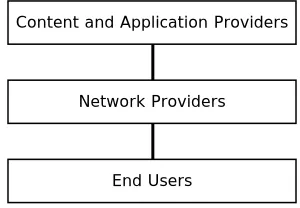
Figure 1
Network Providers as Intermediaries in a Two-Sided Market
Furthermore, in assessing the competitiveness of the relevant markets, network neutrality proponents have often been too facile in defining the relevant geographic markets.84 The fact that most consumers confront at best a last-mile duopoly has led many analysts to jump to the conclusion that the relevant markets are overly concentrated.85 In so doing, they ignore the fundamental insight that last-mile providers operate in what amounts to a two-sided market. In one side of the market, last-last-mile providers bargain with end users. On the other side of the market, last-mile providers bargain with content and applications providers.86
There is no reason to presume that the geographic scope of both of these markets should be the same. Consider first the downstream market in which last-mile providers contract with end users. This market is clearly local. As of today, most customers have only two options in last-mile providers: cable modem and DSL service provided by the local cable or telephone company operating in their area. Given the wireline nature of both cable modem and DSL service, last-mile providers located in other cities cannot serve as viable substitutes.
The relevant geographic scope of the other side of the two-sided market, in which last-mile providers meet content and applications providers, is quite different. The content and applications offered by different providers can serve as substitutes for one another even if they are located in another part of
84 Yoo, supra note 46, at 254; Yoo, Beyond Network Neutrality, supra note 18, at 72; Yoo, supra note 1, at 1892-93.
85 See, e.g., Lemley & Lessig, supra note 15, at 952.
86 This is, of course, something of an oversimplification. In reality, the industry also encompasses backbone providers as well as last-mile providers serving business customers, as well as providers of hardware, software, and numerous other complements. Consistent with the terms of the current debate, all upstream providers will be lumped into the category of applications and content providers.
Content and Application Providers
Network Providers
the country. As a result, the proper scope of the geographic market on this side of the two-sided market is national, if not international.
Absent concentration in the national market, the fact that particular last-mile providers may be able to deny content and applications providers to a particular locality is of little consequence. Although the producer of any good or service would like as widespread distribution as possible, firms rarely achieve universal distribution. Yet that fact does not necessarily prevent them from competing effectively. A firm’s inability to obtain distribution in any particular part of the country does not matter so long as it is able to obtain sufficient distribution in other parts of the country to assure viability. In other words, as a general matter, content and applications providers care more about the size of the total market they can reach than about their ability to reach consumers in any particular metropolitan area. In fact, the D.C. Circuit reached a similar conclusion in the analogous context of cable television. The court recognized that the viability of a cable television network did not depend on its ability to reach audiences in any particular locality, but rather on the size of the total audience they are able to reach. So long as a cable television network is able to reach enough viewers to achieve minimum viable scale, its inability to reach any particular viewers is beside the point.87 The FCC followed similar reasoning when rejecting arguments that the local market power enjoyed by early cellular telephone providers threatened competition in the cellular telephone equipment market. The fact that each cellular provider represented a fraction of the national equipment market effectively prevented them from harming competition in the equipment market.88 In these markets, it is national reach, not local reach, that matters.
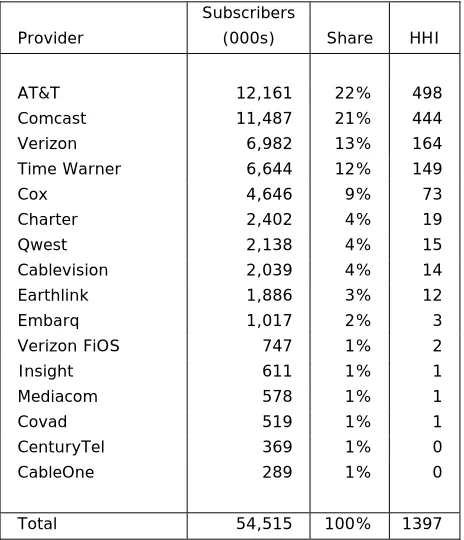
The geographic scope of the side of the market in which last-mile providers meet content and applications providers is thus national. The relevant question is thus whether the largest players control a sufficiently large percentage of the national subscriber base to threaten competition. A review of the subscribership numbers of the leading last-mile broadband providers suggests that, even taking into account the recent Adelphia and BellSouth acquisitions, the national market for content and applications remains sufficiently unconcentrated to protect against anticompetitive harms. The overall HHI is 1397, below the level of 1800 identified by the Merger Guidelines as the threshold for raising anticompetitive concerns and well below the level of 2400 that represents the de facto threshold for enforcement activity actually employed by antitrust authorities in the telecommunications industry. In addition, the market for content and applications providers remains vibrantly competitive, and the absence of entry barriers makes it likely to remain so.
87 Time Warner Entm’t Co. v. FCC, 240 F.3d 1126, 1131-32 (D.C. Cir. 2001) (citing Implementation of Section 11(c) of the Cable Television Consumer Protection and Competition Act of 1992, Third Report and Order, 14 F.C.C.R. 19098, 19114-18 ¶¶ 40-50 (1999)).
Figure 2
Last-Mile Broadband Subscribers as of Year End 2006
Provider
Subscribers
(000s) Share HHI
AT&T 12,161 22% 498
Comcast 11,487 21% 444
Verizon 6,982 13% 164
Time Warner 6,644 12% 149
Cox 4,646 9% 73
Charter 2,402 4% 19
Qwest 2,138 4% 15
Cablevision 2,039 4% 14
Earthlink 1,886 3% 12
Embarq 1,017 2% 3
Verizon FiOS 747 1% 2
Insight 611 1% 1
Mediacom 578 1% 1
Covad 519 1% 1
CenturyTel 369 1% 0
CableOne 289 1% 0
Total 54,515 100% 1397
Source: Rider Research: Communications Countdown—Q4 2006, ONLINE REP., Mar. 17, 2007, at 29.
Put a different way, standard oligopoly theory dictates that any market participant’s ability to capture rents is dictated by the number of competitive alternatives that are available. As noted earlier, most residential customers have only two options in last-mile broadband providers: the incumbent cable operator and the incumbent local telephone company. The imposition of network neutrality would not increase the number of last-mile options one iota and thus would not change the bargaining power between last-mile providers and end users. Given that network neutrality would, however, leave last-mile providers bargaining power vis-à-vis end users unaffected, one would not expect network neutrality to lead to any reduction in the prices charged to end users. Network neutrality would have a dramatic effect on the other side of the two-sided market by affecting how last-mile providers and content/applications providers divide up those rents. From this perspective, network neutrality has less to do with benefiting consumers and more to do with adjusting the bargaining power between the Verizons and the Googles of the world.
Not only are the structural preconditions necessary for vertical integration to harm competition not satisfied; as I have argued at some length in my prior work, deviations from network neutrality can also yield substantial efficiencies. For example, giving priority to packets associated with time-sensitive applications can broaden the number of ways in which network owners can manage the growing problem of network congestion.89 In addition, experimenting with different protocols and establishing exclusivity arrangements with certain content providers can sharpen competition among last-mile providers by allowing them to diversify their offerings.90 Allowing combinations of content and conduit can also eliminate double marginalization and yield substantial transaction cost efficiencies,91 as the FCC recognized when approving SBC-AT&T, Verizon-MCI, and AT&T-BellSouth mergers.92 Indeed, all of the academic commentators at the FTC’s Public Workshop on Broadband Connectivity Competition Policy, regardless of whether they were generally favorably or unfavorably disposed toward network neutrality, uniformly recognized that deviations from network neutrality can be beneficial as well as harmful.
Antitrust law has long settled how to address practices that have an ambiguous impact on welfare. If a practice is always harmful (or so nearly always harmful that little would be lost declaring it unlawful without any close examination of its precise effect on competition), the practice is declared illegal per se.93 If a practice is never harmful, a case can be made in favor of treating it as legal per se.94 When
89 Yoo, supra note 1, at 1863-85.
90 Yoo, Beyond Network Neutrality, supra note 18, at 27-37.
91 Yoo, supra note 46, at 192-200, 260-65.
92 AT&T-BellSouth Order, supra note 5, at 5768-69 ¶¶ 211-213; Verizon-MCI Order, supra note 5, at 18533-34 ¶¶ 202-203; SBC-AT&T Order, supra note 5, at 18387-88 ¶¶ 190-191.
93 See, e.g., N. Pac. Ry. Co. v. United States, 356 U.S. 1, 5 (1957).
a practice can plausibly be either harmful or beneficial, as seems to be the case with most vertical practices (including deviations from network neutrality), antitrust law applies the rule of reason, which permits the practice to go forward unless and until those challenging the practice can demonstrate actual anticompetitive harm.95
From this perspective, mandating network neutrality would be the functional equivalent of declaring certain vertical practices illegal per se. Such an outcome has no support in economic theory (which finds the welfare implications of vertical integration and vertical contractual restraints to be ambiguous) or in empirical studies of vertical exclusion (which suggest that vertical integration and vertical contractual restraints tend to be welfare enhancing more often than not). Mandating network neutrality would also be contradicted by the regulatory precedents of the FCC, which have consistently found insufficient evidence indicating that discrimination against content and applications providers poses any threat to competition.96
Taking such a position is in no way inconsistent with acknowledging that standardization can yield substantial benefits. Indeed, as the literature on network economic effects demonstrates, powerful incentives in favor of standardization already exist. Indeed, if these incentives are sufficiently strong, there would be no need to mandate standardization as a regulatory matter. If anything, network economic effects raise the possibility that the incentives toward standardization may be too strong and that deviations from the existing standard should be encouraged rather than discouraged.97 The proper question in determining whether to ban deviations from network neutrality is not whether network neutrality is in general beneficial, as it doubtlessly is in many, if not most, cases. Instead, the proper question is whether deviations from network neutrality pose such a great threat to competition that firms should not be permitted to experiment with them. The existence of plausible justifications for deviating from network neutrality undercuts the case for prohibiting such deviations a priori. On the contrary, the empirical studies indicating that vertical integration tends to promote economic welfare suggests that it would be more appropriate to adopt a permissive stance toward vertical integration and to place the burden of proof should rest on those who would oppose it.98
Permitting experimentation with practices until concrete harm can be demonstrated also appears to be an appropriate way to show humility about anyone’s ability to predict which approaches will ultimately prove to be best for consumers. This lesson is demonstrated quite vividly by the furor surrounding America Online’s acquisition of Time Warner. Many observers warned that the resulting
95 Bus. Elecs. Corp. v. Sharp Elecs. Corp., 485 U.S. 717, 726 (1988).
96 See supra note 5 and accompanying text; see also Yoo, supra note 1, at 1908 & n.33 (collecting statements from Michael Powell, Kevin Martin, and Jonathan Adelstein acknowledging the absence of any evidence that network owners were discriminating against particular content or applications).
97 See supra notes 16, 29 and accompanying text.