DOI:
10.22075/JRCE.2018.14362.1260
journal homepage: http://civiljournal.semnan.ac.ir/
Compressive Strength Prediction Using the ANN
Method for FRP Confined Rectangular Concrete
Columns
Y. Sharifi
1*, F. Lotfi
2and A. Moghbeli
31. Associate Professor, Department of Civil Engineering, Vali-e-Asr University of Rafsanjan, Iran
2. Master of structures, Faculty of Engineering, Institute of Higher Education Allameh Jafari Rafsanjan, Iran 3. Master of structures, Department of Civil Engineering, Vali-e-Asr University of Rafsanjan, Iran
*
Corresponding author: [email protected] ([email protected])
ARTICLE INFO
ABSTRACT
Article history:
Received: 27 March 2018 Accepted: 07 November 2018
Fiber Reinforced Polymer (FRP) was extensively employed as external confinement to strengthen the RC structures. Extensive studies were carried out to assess a more exact formula for measuring the strength enhancement of such strengthens concrete columns. A database from several experimental tests on was gathered. A comparison between the experimental values and existing formulae showed an urgent need for a more exact formula. This study investigated to develop an exact formula based artificial neural networks (ANNs), to present the strength enhancement. The ANN-based method was simulated based on the collected database and an exact formula generated. The proposed formula was compared to current formulae employing the gathered database. The results demonstrated that the new formula based ANN gives the best accuracy than others. A sensitivity analysis based on Garson’s algorithm was generated for indicating the value of each used variable.
Keywords: ANN,
Compressive Strength, FRP Confined Rectangular Concrete Columns, Garson’s Algorithm.
1. Introduction
Retrofitting of the RC columns utilizing FRP
as confined reinforcement, showed the
enhancement
of
the
capacity
and
performance of structures columns. A series
of different strength models to present the
performance of RC columns retrofitted using
FRP were introduced recently [1-9]. The
most majority of the proposed formulae that
135
it is difficult to formulate the distribution of
stress exactly. The proposed formulae were
the same for circular and rectangular
sections, previously. Currently to modify the
non-uniform stress distribution a ratio as
shape factor has been introduced. Therefore,
presenting an exact formula to assess the
performance of a rectangular section is an
interesting concern for the present paper.
Equation 1 present the enhanced compressive
strength of FRP-confined RC columns.
1 l
cc co
co
f
f f a
f
(1)
cc
f
: Strength enhancement of FRP-confined
RC column;
fco: the compressive capacity of
the RC column;
fl: The confinement lateral
strength,
fl 2tfFRP/d;
a: the factor for
confinement effectiveness;
fFRP: The FRP
strength;
t:
The FRP thickness;
d
: The
column diameter.
Nowadays, ANN has been utilized in the
simulating of several civil engineering
problems by researchers. The application of
conventional methods to derive a formula to
measure the capacity of FRP-confined RC
columns, in reason of unknown multivariable
and noisy database is not suitable. In this
study, the ANN is applied for the estimation
of the capacity of the FRP confined concrete
columns. ANN was employed for
input-output
models.
In
this
model,
the
experimental dataset is used for training the
system. If using the dataset obtains
appropriate information on the problem,
therefore the trained ANN model will contain
sufficient information on the output and the
model can be present as a reliable model. In
several published currently papers, ANN has
been used for different applications in
engineering
[14-32].
As
mentioned,
collecting an exact experimental database is
an essential activity in first. Therefore, a
large numbers specimens on the FRP
confined concrete columns were gathered.
Besides, all of the important existing
formulae for strength enhancement of
FRP-confined RC columns were collected. The
existing formulae to measure the strength of
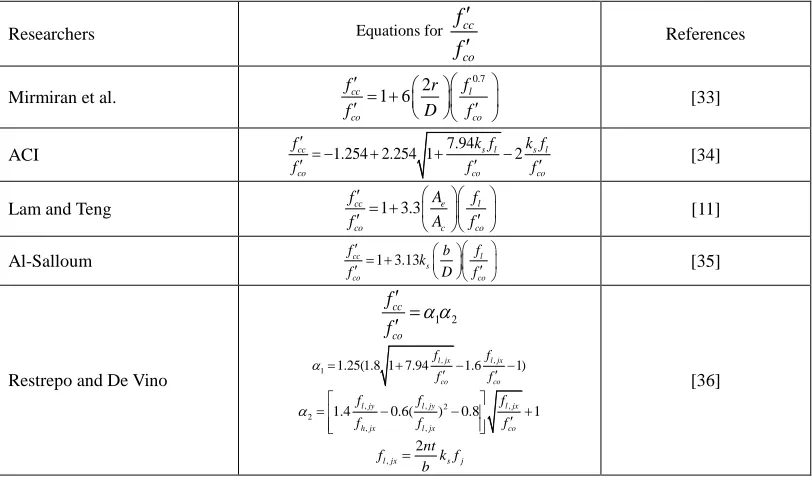
FRP-confined RC columns were tabulated in
Table 1. A new formula based ANN approach
was managed here.
Table 1. The Models used for FRP-Confined Concrete Compressive Strength.
Researchers Equations for cc
co
f f
References
Mirmiran et al.
0.7
2 1 6
cc l
co co
f r f
f D f
[33]
ACI cc 1.254 2.254 1 7.94 s l 2 s l
co co co
f k f k f
f f f
[34]
Lam and Teng cc 1 3.3 e l
co c co
f A f
f A f
[11]
Al-Salloum cc 1 3.13 l
s
co co
f b f
k
f D f
[35]
Restrepo and De Vino
1 2
cc
co
f f
, , 1 1.25(1.8 1 7.94 1.6 1)
l jx l jx co co
f f
f f
, , 2 ,
2
, ,
1.4 l jy 0.6( l jy) 0.8 l jx 1
h jx l jx co
f f f
f f f
,
2
l jx s j
nt
f k f
b
,
2
l jy s j
nt
f k f
h
2 2
2 2
1 3 1
s
s
b r h r
k
bh A
Shehata et al. cc 1 0.85 l
co co
f f
f f
[37]
Kumutha et al. cc 1 0.93 l
co co
f f
f f
[38]
2. Experimental Database
In this article, the experimental dataset for
using in the ANN model was obtained from
reliable technical literatures [11, 35, 37,
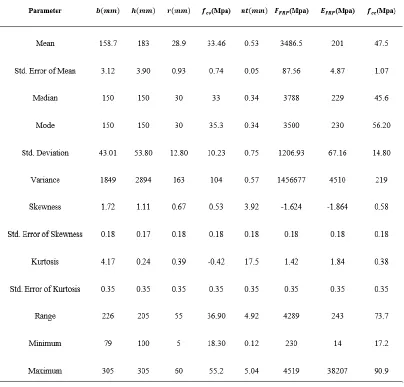
39-47]. The statistics of these variables that
applied for the development of the ANN
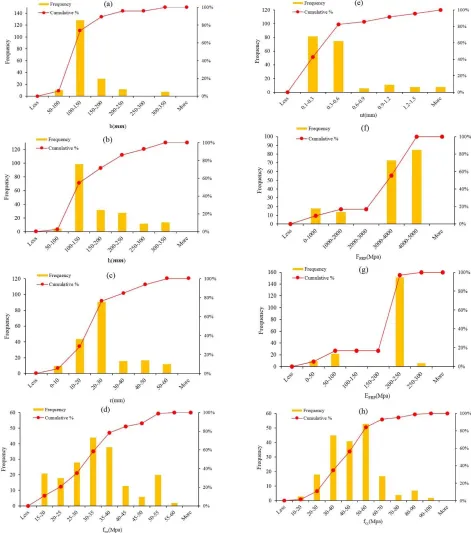
structure, are shown in Table 2. Moreover, to
illustrate
the
distribution
of
these
parameters, the frequency histograms are
shown in Fig. 1. Fig. 1 presents the suitable
used database that can be employed
trustworthy.
137
Fig. 1. Variables histograms used in the model generation.
3. Artificial Neural Networks
In the present research ANN is used to
investigate
the
practical
formula
for
measuring the capacity of the
The MLP applies feed-forward procedure
for generation. The MLP has been
introduced as one of the powerful network
for examination each continuous function in
each desired accuracy [48, 49]. The
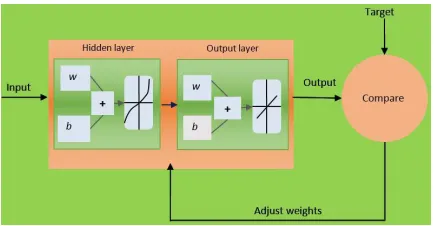
feed-forward process examines one or several
variable/s as output/s using foreteller inputs
variables (see Fig. 2). The network process
of feed-forward is based on the layers
formation and connected synapses. A value
that named weight is labeled to each
synapse, demonstrates the effect of its
neuron and consequently input. Besides, a
supervised algorithm that is used for
multilayers networks was employed.
Back-propagation (BP) process compares the
obtained output from algorithm to real value
and adapt the results until the specified error
obtained. The ANN generates using a trial
and error process that each input variables
specified by a weight. Then the input nodes
is introduced as:
1 n
j ij i j
i
net w x b
(2)
where
net
jidentified as the set data for
neuron; and
x
i,
b
jand
w
ijare the input, the
bias and the weight for each parameters,
respectively.
Finally,
the
output
was
evaluated using the function that generated
for present ANN. There are several transfer
functions including Sigmoid, Hyperbolic
tangent and Gaussian functions. The outputs
function was identified as below:
j j
out f net
(3)
where
out
jand
f
identify as the output and
transfer function, respectively.
Fig. 2. An ANN structure schematically.
In the current study the
Levenberg-Marquardt (LM) algorithm is performed.
The LM is an optimized algorithm that in
the least apaches than other algorithms
convergence [50].
3.1. Performance Measures
Four criteria were employed to investigate
the efficiency of the established ANN based
model. The following parameters introduced
as absolute percentage error (
Err
), mean
absolute error (
MAE
), mean squared error
(
MSE
) and correlation coefficient (
R
) as
below:
100
i i i iy
t
Err
t
(4)
11
N i i iMAE
y
t
N
(5)
2 11
(
)
N i i iMSE
t
y
N
(6)
1 2 2 1 1(
)(
)
(
)
(
)
N ii i i
i
N N
i
i i i
i i
y
y
t
t
R
y
y
t
t
(7)
where
N
show the number of samples,
t
iand
i
t
show the exact and average of the exact
outputs, respectively, and
y
iand
y
ishow the
139
3.2. ANN Structure for Predicting
f
ccThe experimental dataset was applied for
developing a new formula to measure the
compressive strength of the FRP-confined
RC columns. The recognition of the
variables influence the
f
ccof FRP-confined
RC columns is difficult and moreover the
effective parameters are not independent
from each other and some of them may be
strongly related together. After an initial
survey the input and output parameters for
model generating consist seven and one
variables:
, , , co, , FRP, FRP
cc
input b h r f nt F E
output f
where
fcc: The compressive capacity of
FRP-confined RC columns.
b,
h,
r, fco,
nt,
FRP
F
, and
EFRPwere identified that affect the
compressive strength. As noted, nodes
numbers influence the model network, the
ideal hidden nodes number is specified by
trial-and-error process. By enhancement of
neurons number in the hidden layer,
accuracy of network increases. On the other
hand, it is clear that each network by more
neurons in the hidden layer yields a tedious
and
lengthy
equation.
Therefore,
by
considering the accuracy of the model, in the
current paper a model by two hidden layer
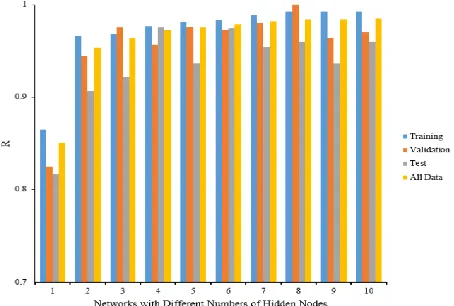
nodes was generated. The R and MSE of the
generated network consisting of the different
nodes are tabulated in Figs. 3 and 4.
Fig. 3. Correlation coefficient (R) for different networks.
Fig. 4. The MSE of network using several nodes.
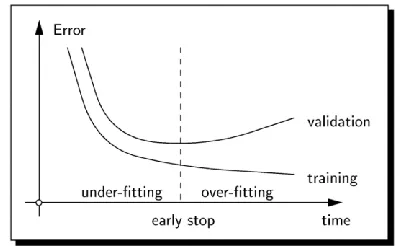
estimates suitable estimations of the other
samples than those applied in the training set
(See Fig. 5).
Fig. 5. The error of validation set increases from the specified point. [5].
Data distributed to three groups entitled
training, validation, and testing. The
distribution percent values in each set are
arranged as 70, 15, and 15 for training,
validation and testing sets model. Thus,
from 190 data for the estimation of
f
cc, 132
specimens were applied in training set, 29
specimens are applied for validating, and
testing of model. It is an important issue to
introduce the amount of the used specimens
in training set of the proposed model, and it
is mainly related to the reliability of the
model [52]. Frank and Todeschini [53]
investigated that the optimized model
achieves as the number of database
specimens to used variables exceed from 3.
Moreover, they recommend the ratio 5 for a
reliable model. Here, the noted ratio
adjusted as 190/7 =27.14. Standardization of
input and output values for model simulation
made the developed model more optimized
as below:
i si
X Mean
X
SD
(7)
where
X
iis variable values,
Mean
and
SD
identified as the mean and standard
deviation
of
variables,
respectively.
Therefore, the input and output layers
comprised
seven
and
one
neuron,
respectively. Consequently, an ANN model
concluding one layers with two neurons in
hidden layer modified as LM/BP learning
algorithm was established. The
Log-Sigmoid transfer function was applied to
derive the formulae in explicit form. The
predicted results of
f
ccvalues by ANN
model are illustrate in Fig. 6. It is shown in
Fig. 6 that training, validation and testing
data sets yield a good correlations between
actual and predicted values.
141
3.3. Formula Assessment
Closed form equation can be established
based on the constructed ANN model for
predicting the
f
ccof concrete columns. The
output of each network can be stated as
follow:
2 1 1 2
output f W f W X b b
(8)
where
W
1and
W
2show the first and second
layer weight matrix, respectively, moreover
b
1and
b
2show the first and second bias of
layer. Consequently, The formula based
ANN method for assessing the
f
ccis
generated as:
2
1
1
output
f W
f W
X
where
1 1 2 3 4 5 6 7
T
X x x x x x x x
1 1, 1 2, 1 3, 1 4, 1 5, 1 6, 1 7, 1 1
2 1, 2 2, 2 3, 2 4, 2 5, 2 6, 2 7, 2
A A A A A A A A
A A A A A A A A
b W W W W W W W
W
b W W W W W W W
1
0.099 0.6723 0.4581 0.5096 0.1027 1.0696 0.2357 0.0143 0.6869 0.4630 0.4916 0.1879 1.0688 0.2508
W
1, 2,
2 out A out A out
W = b W W
3.1816 211.8431 214.9806
2
W =
Finally, a formula based on the ANN
method to assess the compressive strength is
shown as follows:
1 2 94.6115 1 1 3135.8 3182.2 cc e e
f
(9)
1 0.0002 0.0125 0.0358
0.0498 0.1363 0.0009
0.0035 2.544
co FRP
FRP
b h r
f nt F
E
(10)
1 0.0003 0.0128 0.0362
0.0481 0.2495 0.0009
0.0037 2.6576
co FRP
FRP
b h r
f nt F
E
(11)
4. Model Accuracy
The accuracy of the proposed formula based
ANN-model is tabulated in Table 2. The
parameters of
R
,
MSE
and
MAE
are chosen
to assess the performance of the presented
formulation. For model validity, an accepted
phenomena introduced by Gandomi
et al
.
[54]. This criteria expressed as follows:
1- For |R| > 0.8, a strong correlation between
the obtained and evaluated values happens.
2- For 0.2 < |R| < 0.8, a correlation between
the obtained and evaluated values happens.
3- For |R| < 0.2, a week correlation between
the obtained and evaluated values happens.
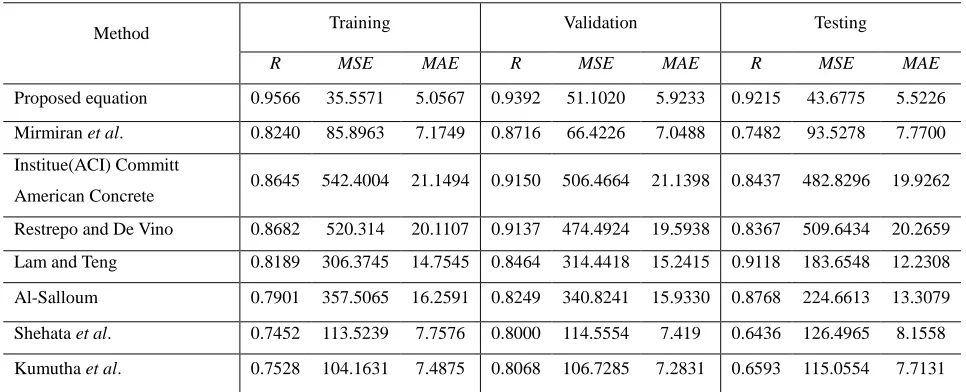
Table 3. Accuracy of the existing models for evaluations.
Method Training Validation Testing
R MSE MAE R MSE MAE R MSE MAE
Proposed equation 0.9566 35.5571 5.0567 0.9392 51.1020 5.9233 0.9215 43.6775 5.5226
Mirmiran et al. 0.8240 85.8963 7.1749 0.8716 66.4226 7.0488 0.7482 93.5278 7.7700
Institue(ACI) Committ
American Concrete 0.8645 542.4004 21.1494 0.9150 506.4664 21.1398 0.8437 482.8296 19.9262
Restrepo and De Vino 0.8682 520.314 20.1107 0.9137 474.4924 19.5938 0.8367 509.6434 20.2659
Lam and Teng 0.8189 306.3745 14.7545 0.8464 314.4418 15.2415 0.9118 183.6548 12.2308
Al-Salloum 0.7901 357.5065 16.2591 0.8249 340.8241 15.9330 0.8768 224.6613 13.3079
Shehata et al. 0.7452 113.5239 7.7576 0.8000 114.5554 7.419 0.6436 126.4965 8.1558
Moreover, it is clear that for a strong model,
the error values have to be at minimum. The
evaluation measures presented in Table. 3
confirm that the proposed formulation (Eq.
9) are capable for prediction of
f
ccin the
concretes columns as confined using FRP.
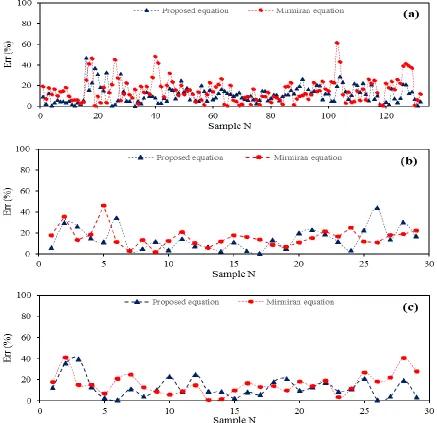
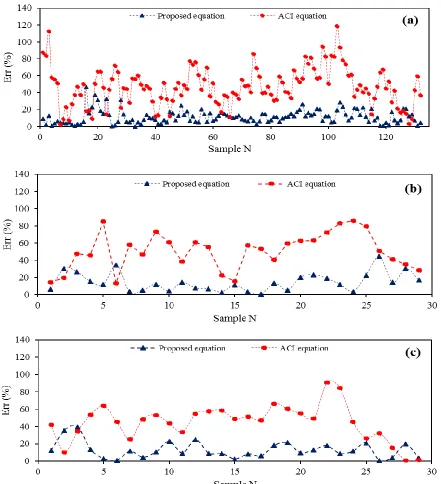
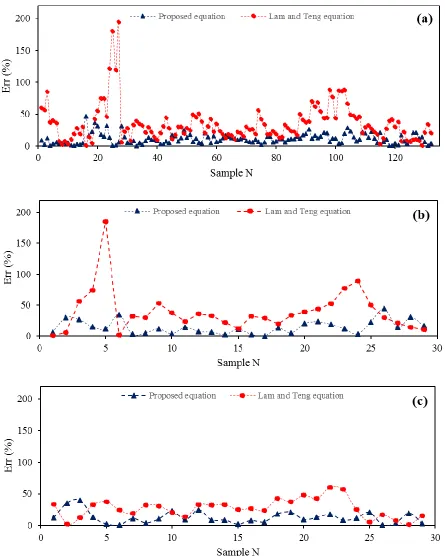
Furthermore, for more comparison the
obtained results of proposed formula and
existing formulations have been plotted as
shown in Figs. 7-13. In this study the least
dimension of column sections ( ), long side
of column sections ( ), corner radius of a
section ( ), unconfined concrete strength
(
), total thickness of FRP (
nt
), tensile
strength of FRP (
) and elastic modulus
of FRP
are presented as important
effective variables for assessing the
.
Accuracy of the ANN formula, and those
evaluated from Mirmiran
et al.
, Institute
(ACI) Committee American Concrete, Lam
and Teng, Al-Salloum, Restrepo and De
Vino, Shehata
et al.
and Kumutha
et al.
is
examined and given in Table 3.
143
145
147
Fig. 13. The Kumutha et al and proposed formula comparison: (a) training data, (b) validation data, (c) testing data.
5. Sensitivity Analysis
149
variable. Garson’s algorithm [56] was
performed to compute the significance of the
input variables. Fig. 14 illustrates the
procedure of this algorithm. An example to
show the Garson’s algorithm is clarified as
below:
1- The contribution of inputs through
input-hidden-output
linkage
evaluates
(e.g.,
C
Aa=W
Aa×W
oA).
2-
The
inputs
relative
contributions
evaluates (e.g., r
Aa=|C
Aa|/|C
Aa+C
Ab+ C
Ac|).
3- The input relative contributions are
summed (e.g., S
a=r
Aa+r
Ba).
4- The relative importance of each input (r
I)
evaluates (e.g., r
Ia=S
a/(S
a+S
b+ S
c)).
Fig. 14. Garson’s algorithm used in ANN.
Fig. 15. Variables significance used in the ANN.
Fig. 15 shows the significance of each
parameters. It can be found that the (
)
and (
h
) shown the most influence on the
compressive capacity of FRP-confined RC
columns.
5. Conclusions
In the current research, the
ANNwas applied
to assess the compressive capacity of the
FRP-confined
RC
columns.
The
experimental
dataset
including
190
specimens was obtained using 12 reliable
technical literatures for ANN model
development.
Consequently, the ANN
model containing two hidden layer neurons
is constructed and seven input parameters
were considered including:
the
least
dimension of column sections ( ), long side
of column sections ( ), corner radius of a
section ( ), unconfined concrete strength
(
), FRP thickness (
nt
), FRP strength
(
) and elastic modulus of FRP
.
At the next, the new formula based on ANN
was presented and performance
analysis
was
undertaken
for
confirmation
of
this
formulae. It can be concluded that the ANN
formulation
based
model
give
more
exactness than other existing formulae. At
the end, the importance of the used
parameters was determined using Garson’s
algorithm and it was found that the (
)
and (
h
) exert dominant influences on the
compressive capacity of FRP-confined RC
columns, respectively. As a final point, the
essential aim of the present research was
developing precise equation to evaluate the
compressive capacity of FRP-confined RC
columns. The new proposed formulae can be
used by practical engineering applications.
[1] Spoelstra, M.R., Monti, G. (1999). “FRP-confined concrete model.” Journal of Compos. Constr., Vol. 3, Issue 143, pp. 143–150. doi: 10.1061/(ASCE)1090-0268.
[2] Chaallal, O., Hassan, M., Shahawy, M. (2003) “Confinement model for axially loaded short rectangular columns strengthened with fiber reinforced polymer wrapping.” Journal of ACI Struct., Vol. 100, Issue 2, pp. 215–221. [3] Lam, L., Teng, J.G. (2003) “Design-oriented
stress-strain model for FRP-confined concrete.” Constr. Build. Mater, Vol. 17, Issue 6–7, pp. 471–489.
[4] Harajli, M.H., Hantouche, E., Soudki, K. (2006) “Stress-strain model for fiber-reinforced polymer jacketed concrete columns.” Journal of ACI Struct., Vol. 103, Issue 5, pp. 672–682.
[5] Wu, Y.F., Wang, L.M. (2009) “Unified strength model for square and circular concrete columns confined by external jacket”. Journal of Struct. Eng., Vol. 135, Issue 3, pp. 253–261. doi: 10.1061/(ASCE)0733-9445.
[6] Cui, C., Sheikh, S.A. (2010) “Analytical model for circular normal and high-strength concrete columns confined with FRP.” Journal of Compos Constr., Vol.
115, pp. 562–572. doi:
10.1061/(ASCE)CC.1943-5614.0000115:562–572.
[7] Lee, C.S., Hegemier, G.A., Phillippi, D.J. (2010) “Analytical model for fiber-reinforced polymer-jacketed square concrete columns in axial compression.” Journal of ACI. Struct, Vol. 107, Issue 2. [8] Wu, Y.F., Zhou, Y.W., (2010) “Unified
strength model based on Hoek-Brown failure criterion for circular and square concrete columns confined by FRP”. Journal of Compos Constr., pp. 175–184. doi: 10.1061/(ASCE)CC.1943-5614 .0000062.
[9] Yazici, V., Hadi, M.N.S. (2012) “Normalized confinement stiffness
approach for modeling FRP-confined concrete.” Journal of Compos Constr., pp. 520–528. doi:10.1061/(ASCE)CC.1943-5614.0000283.
[10] Richart, F.E., Brandtzaeg, A., Brown, R.L. (1928) “A study of the failure of concrete under combined compressive stress.” Bulletin 1985, Univ. of Illinois Engineering Experimental Station, Champaign, IL.
[11] Lam, L., Teng, J.G. (2003) “Design-oriented stress-strain model for FRP-confined concrete in rectangular columns”. Journal of Reinf. Plast. Compos, Vol. 22, Issue 13, pp. 1149– 1186.
[12] Toutanji, H., Han, M., Gilbert, J., Matthys, S. (2010) “Behavior of large-scale rectangular columns confined with FRP composites.” Journal of Compos Constr., pp. 62–71. doi: 10.1061/(ASCE)CC.1943-5614.0000051.
[13] Wu, Y.F, Wei, Y.Y. (2010) “Effect of cross-sectional aspect ratio on the strength of CFRP-confined rectangular concrete columns.” Eng. Struct., Vol. 32, Issue 1, pp. 32–45.
[14] Naderpour, H., & Alavi, S. A. (2017). A proposed model to estimate shear contribution of FRP in strengthened RC beams in terms of Adaptive Neuro-Fuzzy Inference System. Composite Structures, 170, 215-227.
[15] Ilkhani, M., Moradi, E., Lavasani, M. Calculation of Torsion Capacity of the Reinforced Concrete Beams Using Artificial Neural Network. Soft Computing in Civil Engineering, 2017;
1(2): 8-18. doi:
10.22115/scce.2017.48685
151
[17] Behfarnia, K., & Khademi, F. (2017). Acomprehensive study on the concrete compressive strength estimation using artificial neural network and adaptive neuro-fuzzy inference system. Iran University of Science & Technology, 7(1), 71-80.
[18] Khademi, F., & Jamal, S. M. (2016). Predicting the 28 days compressive strength of concrete using artificial neural network. i-Manager's Journal on Civil Engineering, 6(2), 1.
[19] Heidari, H., Tavakoli, D. and Fakharian, P. (2014). “Approximate eigenvalue of plate by artificial neural networks.” Journal of Modeling in Engineering, Vol. 11, Issue 35, pp. 49-62.
[20] Naderpour, H., Fakharian, P., Rafiean, A. H. and Yourtchi, E. (2017). “Estimation of the Shear Strength Capacity of Masonry Walls Improved with Fiber Reinforced Mortars (FRM) Using ANN-GMDH Approach.” Journal of Concrete Structure and Materials, Vol. 1, Issue 2, pp. 47-59.
[21] Naderpour, H., Noormohammadi, E., Fakharian, P. (2017). “Prediction of Punching Shear Capacity of RC Slabs using Support Vector Machine.” Concrete Research, Vol. 10, Issue 2, pp. 95-107. [22] Naderpour, H., Fakharian, P. (2017).
“Predicting the Torsional Strength of Reinforced Concrete Beams Strengthened with FRP Sheets in terms of Artificial Neural Networks.” Journal of Structural and Construction Engineering, Vol. 2017, -. doi: 10.22065/jsce.2017.70668.1023 [23] Hosseini Vaez, S. R., Naderpour, H. and
Barati, M. (1396). “The prediction of the flexural strength of NSM-FRP reinforced beams using artificial neural networks.” Structural Engineering and Construction, Vol. 4, Issue 4, pp. 16-28.
[24] Tohidi, S. and Sharifi Y. (2015). “Empirical modeling of distortional buckling strength of half-through bridge girders via stepwise regression method.” Advances in
Structural Engineering, Vol. 18, Issue 9, pp. 1383-1397.
[25] Tohidi, S. and Sharifi, Y. (2016). “Neural networks for inelastic distortional buckling capacity assessment of steel I-beams.” Thin-Walled Structures, Vol. 94, Issue 9, pp. 359-371.
[26] Tohidi, S. and Sharifi, Y. (2014). “Inelastic lateral-torsional buckling capacity of corroded web opening steel beams using artificial neural networks.” The IES Journal Part A: Civil & Structural Engineering, Vol. 8, issue 1, pp. 24-40. [27] Sharifi, Y. and Tohidi, S. (2014).
“Lateral-torsional buckling capacity assessment of web opening steel girders by artificial neural networks–elastic investigation.” Frontiers of Structural and Civil Engineering, Vol. 8, issue 2, pp. 167–177. [28] Sharifi Y, Tohidi S. (2014). “Ultimate
capacity assessment of web plate beams with pitting corrosion subjected to patch loading by artificial neural networks.” Advanced Steel Construction, Vol. 10, Issue 3, pp. 325-350.
[29] Tohidi, S. and Sharifi, Y. (2014). “A new predictive model for restrained distortional buckling strength of half-through bridge girders using artificial neural network.” KSCE Journal of Civil Engineering, Vol. 10, Issue 3, pp. 325– 350.
[30] Tohidi, S. and Sharifi, Y. (2014). “Load-carrying capacity of locally corroded steel plate girder ends using artificial neural network.” Thin-Walled Structures, Vol. 100, issue 1, pp. 48–61.
[31] Hosseinpour, M. Sharifi, H. and Sharifi Y. (2018). “Stepwise regression modeling for compressive strength assessment of mortar containing metakaolin.” International Journal of Modelling and Simulation,
https://doi.org/10.1080/02286203.2017.14 22096.
Buckling Strength of Half-Through Bridge Girders via Stepwise Regression Method.” Advances in Structural Engineering, Vol. 18, Issue 9, pp. 1383-1397.
[33] Mirmiran, A., Samaan, M., Shahawy, M. (1998) “Model of concrete confined by fibre composite.” Journal of Struct. Eng., Vol. 124, Issue 9, pp. 1025–1031.
[34] ACI 440. (2002) “Guide for the design and construction of externally bonded FRP systems for strengthening concrete structures.” Detroit, Mich., American Concrete Institute.
[35] Al-Salloum, Y.A. (2007) “Influence of edge sharpness on the strength of square concrete columns confined with FRP composite laminates.” Compos. Part B Eng., Vol. 38, Issue 5, pp. 640–650. [36] Restrepo, J., deVino, B. (1996)
“Enhancement of axial load-capacity of reinforced concrete columns by means of fiberglass–epoxy jackets.” In: Proceedings of the 2nd International Conference on Advanced Composite Materials in Bridges and Structures (ACMBS-II), CSCE, Montreal, Canada, pp. 547–690.
[37] Shehata, I.A.E.M., Carneiro, L.A.V., Shehata, L.C.D. (2002) “Strength of short concrete columns confined with CFRP sheets.” Mater. Struct, Vol. 35, Issue 1, pp. 50–58.
[38] Kumutha, R.,Vaidyanathan, R., Palanichamy, M.S. (2007) “Behaviour of reinforced concrete rectangular columns strengthened using GFRP.” Journal of cement and concrete composites, Vol. 29, Issue 8, pp. 609–615.
[39] Rochette, P., Labossiére, P. (2000) “Axial testing of rectangular column models confined with composites.” Journal of Compos. Constr, Vol. 3, Issue 129, pp. 129–136. doi:10.1061/(ASCE)1090-0268(2000)4.
[40] Harajli, M.H., Hantouche, E., Soudki, K. (2006) “Stress-strain model for fiber-reinforced polymer jacketed concrete
columns.” Journal of ACI Struct. Vol. 103, Issue 5, pp. 672–682.
[41] Rousakis, T.C., Karabinis, A.I., Kiousis, P.D. (2007) “FRP-confined concrete members: Axial compression experiments and plasticity modelling.” Eng. Struct, Vol. 29, Issue 7, pp. 1343–1353.
[42] Masia, M.J., Gale, T.N., Shrive, N.G. (2004) “Size effects in axially loaded square-section concrete prisms strengthened using carbon fibre reinforced polymer wrapping. Can. J. Civ. Eng., Vol. 31, Issue 1, pp. 1–13.
[43] Wang, L.M., Wu, Y.F. (2008) “Effect of corner radius on the performance of CFRP-confined square concrete columns: Test.” Journal of Eng. Struct., Vol. 30, Issue 2, pp. 493–505.
[44] Wu, Y.F., Wei, Y.Y. (2010) “Effect of cross-sectional aspect ratio on the strength of CFRP-confined rectangular concrete columns.” Journal of Eng. Struct., Vol. 32, Issue 1, pp. 32–45.
[45] Wang, Z.Y., Wang, D.Y., Smith, S.T., Lu, D.G. (2012) “CFRP confined square RC columns. I: Experimental investigation.” Journal of Compos. Constr., pp. 150–160.
doi:10.1061/(ASCE)CC.1943-5614.0000245:150–160.
[46] Ilki, A., Kumbasar, N. (2003) “Compressive behaviour of carbon fibre composite jacketed concrete with circular and non-circular cross-sections.” Journal of Earthq. Eng., Vol. 7, Issue 3, pp. 381– 406.
[47] Tao, Z., Yu, Q., Zhong, Y.Z. (2008) “Compressive behaviour of CFRP-confined rectangular concrete columns Mag.” Concrete Res., Vol. 60, Issue 10, pp. 735–745.
[48] Cybenko, J. (1989) “Approximations by super positions of a sigmoidal function.” Math Control Signal Syst, pp. 303–314. [49] Marquardt, D. (1963) “An algorithm for
153
parameters.” Journal of Soc. Ind. Appl. Math, Vol. 11, pp. 431–441.[50] Hagan, M.T., Menhaj, M.B. (1994) “Training feed forward networks with the Marquardt algorithm.” IEEE Transactions on Neural Networks, Vol. 5, Issue 6, pp. 861-867.
[51] Hristev, R.M. (1998) “The ANN book.” GNU public license.
[52] Gandomi, A.H, Tabatabaei, S.M., Moradian, M.H, Radfar, A., Alavi, A.H. (2011) “A New Prediction Model for the Load Capacity of Castellated Steel Beams.” Journal of Constructional Steel Research, Vol. 67, pp. 1096–1105.
[53] Frank, I.E., Todeschini, R. (1994) “the data analysis handbook.” Amsterdam: Elsevier.
[54] Gandomi, A.H., Mohammadzadeh S., Juan Luis Pérez-Ordó˜nezc, Alavi, A.H. (2014) “Linear genetic programming for shear strength prediction of reinforced concrete beams without stirrups.” Applied Soft Computing, Vol. 19, pp. 112–120.
[55] Alavi, A.H., Ameri M., Gandomi, A.H., Mirzahosseini, M.R. (2011) “Formulation of flow number of asphalt mixes using a hybrid computational method.” Constr. Build. Mater. Vol. 25, pp. 1338–1355. [56] Garson, G.D. (1991) “Interpreting