S
ST
TA
AT
TI
IS
ST
TI
IC
CA
AL
L
A
AN
NA
AL
LY
YS
SI
IS
S
O
O
F
F
TH
T
HE
E
E
EF
FF
FE
EC
CT
TS
S
O
OF
F
P
PO
OU
UL
LT
TR
RY
Y
M
MA
AN
NU
U
RE
R
E
A
AN
ND
D
N
NP
PK
K
F
FE
ER
RT
TI
IL
LI
IZ
ZE
ER
R
O
O
N
N
T
TH
HE
E
Y
YI
IE
EL
LD
D
OF
O
F
M
MA
AI
IZ
ZE
E
Kazeem A. Osuolale
1, Olakunle Kayode
2, Olawoore S. Adebayo
21
Department of Statistics, University of Ibadan, Ibadan, Nigeria
2
Department of Statistics, Oyo State College of Agriculture and Technology, Igboora, Nigeria
Corresponding Author: Kazeem A. Osuolale, [email protected]
ABSTRACT: This study is aimed at analysing the effects of Poultry manure and NPK fertilizer on fresh weight, dry weight and yield of Maize at the Institute of Agricultural Research and Training, Moore Plantation, Apata, Ibadan in 2015 and 2016 Cropping Sessions. The study adopted the statistical model for analysing the effects of Poultry manure and NPK fertilizer applications on the growth and yield of Maize (Zea Mays). This model was based on factorial experiment and the results obtained showed that poultry manure and NPK fertilizers equally contributed significantly to the fresh plant weights of maize for a bumper harvest while the interaction of the two factors did not indicate any significant difference. In the analysis of dry weight of maize the contribution of the two factors considered was the same to the quality of dry weight of maize.The results also showed that the two factors contributed greatly to the quality and bumper harvest of maize. However, the interaction of the factors gave the impression that poultry manure and NPK fertilizer have equal contributions to the quality and bumper harvest of seed yield of maize.
KEYWORDS: Analysis, Factorial experiment, Maize, Model, Yield.
1. INTRODUCTION
Maize (Zea mays) is the third most important cereal that is next to wheat and rice. This crop is commonly cultivated in the tropics and warm sub-tropics for food, livestock and other industrial uses. In Nigeria, maize is considered as an important food, fodder and industrial crop grown both commercially and as subsistence crop. Maize is used for the production of indigenous and commercial food products that are enjoyed for their unique and distinctive flavours. It can be eaten fresh or milled into flour and serves as a valuable ingredient for baby food, cookies, biscuits, ice cream, pancake mixes, livestock feed and a variety of traditional beverages. Efforts made to obtain a high yield of maize would necessitate the augmentation of the nutrient status of the soil in order to meet the crop’s requirements for optimum productivity and maintenance of soil fertility. The nutrient status of the soil can be increased by boosting the soil nutrient content either by the use of
The role of organic manure in maintaining organic matter and raising the growth and yield of cereal crops had long been recognized in most agro-ecological zones. Poultry manure is the richest animal manure in NPK relative to other organic manures such as cow, horse, steer, sheep, swine and rabbit manure. The nutrient value in these manures varies greatly depending on the diet and age of the animals ([ATB01]). In view of the significance of maize as a grain crop and the role of Poultry Manure and NPK fertilizers in its high productivity, this study is, therefore, aimed at examining the effects of varying Poultry Manure and NPK fertilizer on the growth and yield of maize. Many experiments have been carried out in different countries of West Africa on the application of fertilizers to crops and soil fertility trials have also been conducted not only on tree and economic crop but also on animal and food crops such as okro, cassava, maize and tomatoes among others in Nigeria, Ghana and Senegal. The results of such efforts were reviewed by ([AO82]). Early work at the International Institute of Tropical Agriculture ([IIT74]) also involved the applications of fertilizers. This paved way for a number of Nitrogen, Phosphorus or NPK fertilizers and Poultry manure trials to be carried out on okro, oranges and tomatoes on peasant and experimental farms in various parts of Western Nigeria ([IIT84]). [Oje00] affirmed that the idea of using all combinations of various sets of treatments in fertilizer experiments is archaic. [PA17] also conducted a study on the factorial analysis of the effect of NPK fertilizer on the yield of white yam. The treatments involved this study were measured on four rates of Poultry Manure (0, 500, 1000 and 1500 kgha-1) and NPK fertilizer levels (0, 100, 200, 300). Poultry manure was applied into the soil exactly one week before planting while the NPK fertilizers were applied at two weeks after sowing. Maize seeds were planted at a spacing of 30 cm by 50 cm and at rate of 5-10kg of seeds/ha. The data collected for this study includes fresh weight, dry weight and yield of maize. A study was carried out a study on the effects of application timing on maize production using poultry manure [OKC09]. In their study, low soil fertility was identified as a major factor militating against crop production in many tropical cropping systems where the amount of fertilizers used was low and agricultural residues were not returned to the soil for its rejuvenation. As a result of this, the performance of maize (Zea mays) in response to application of a uniform rate of 30 t/ha of fresh poultry manure was studied on a loamy soil at Ilorin in the southern Guinea savannahof Nigeria to determine the effects of poultry manure application timing on maize production.
2. MATERIALS AND METHODS
This study adopted the statistical model for analysing the effects of Poultry manure and NPK fertilizer applications on the growth and yield of Maize (Zea Mays). The statistical model employed was based on factorial experiment and is given by:
(1)
where i= 1,2,3,4;j=1,2,3,4;k=1,2; a=4; b=4; n=2 Yijk is the kthobservation taken under the ith level of NPK and jth level of poultry manure, µ is the overall mean effect, is the level of NPK effect, is the effect of the jth rate of manure, is the effect of
interaction between NPK fertilizers and poultry manure and is the random error component. The
Latin notations given in equation 1 are as defined below:
a= number of levels of NPK effect. b = number of rates of poultry manure. n = number of observation at each level
The factorial experimental methodology is preferred to a sequence of experiments investigating the factors separately ([Oeh10]). The principles of this factorial methodology are the main and interaction effects in its model. The secondary data collected from the Institute of Agricultural Research and Training, Moore Plantation, Apata, Ibadan were used in this study. The model assumes that the population is normally and independently distributed with mean and variance , that is, (µ, σ2) , the error terms are normally and independently distributed with mean, = 0 and variance σ2 ,that is, eijk (0,σ
2 ), the NPK effects and poultry manure rates are additive and sum of their effects are equal to zero, that is,
, the interaction effects of NPK and Poultry manure are additive and their sums are also equal to zero and there are abn total observations in the experiment conducted. The Analysis of Variance (ANOVA) was given in Table 1which gave the partitioning of the total sum of squares into recognizable sources of variation.The total corrected sum of squares (SST) is:
+ ( )2]
=bn
Then SST is given as:
SST = SSN + SSP + SSNP + SSE (3)
The number of degree of freedom with each sum of square is also given in Table 1.
where MSE = SSE /ab(n-1)
In computations, the sums of squares are defined as:
(4)
-
(5)
(6)
The sum of squares between the ab cell totals would be first obtained, and referred to as the sum of
squares due to subtotals
(7)
SSI = SSsubtotals – SSN – SSP (8) SSE = SST – SSI – SSP – SSN
= SST – SSsubtotals (9)
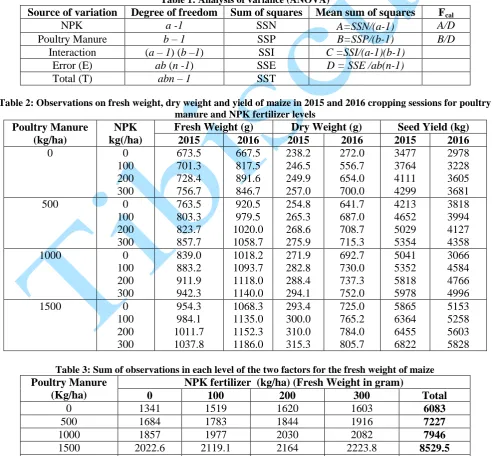
The data collected is given in Table 2 showing the poultry manure and the NPK fertilizers measured in kg/ha at varying levels applied on the fresh and dry weight as well as the seed yield of maize. The sums of observations in each level of poultry manure and NPK fertilizer for the fresh weight and dry weight of maize are given Table 3 and Table 4, respectively.
Table 1: Analysis of variance (ANOVA)
Source of variation Degree of freedom Sum of squares Mean sum of squares Fcal
NPK a -1 SSN A=SSN/(a-1) A/D
Poultry Manure b – 1 SSP B=SSP/(b-1) B/D
Interaction (a – 1) (b –1) SSI C =SSI/(a-1)(b-1)
Error (E) ab (n -1) SSE D = SSE /ab(n-1)
Total (T) abn – 1 SST
Table 2: Observations on fresh weight, dry weight and yield of maize in 2015 and 2016 cropping sessions for poultry manure and NPK fertilizer levels
Poultry Manure (kg/ha)
NPK kg(/ha)
Fresh Weight (g) Dry Weight (g) Seed Yield (kg)
2015 2016 2015 2016 2015 2016
0 0
100 200 300 673.5 701.3 728.4 756.7 667.5 817.5 891.6 846.7 238.2 246.5 249.9 257.0 272.0 556.7 654.0 700.0 3477 3764 4111 4299 2978 3228 3605 3681
500 0
100 200 300 763.5 803.3 823.7 857.7 920.5 979.5 1020.0 1058.7 254.8 265.3 268.6 275.9 641.7 687.0 708.7 715.3 4213 4652 5029 5354 3818 3994 4127 4358
1000 0
100 200 300 839.0 883.2 911.9 942.3 1018.2 1093.7 1118.0 1140.0 271.9 282.8 288.4 294.1 692.7 730.0 737.3 752.0 5041 5352 5818 5978 3066 4584 4766 4996
1500 0
100 200 300 954.3 984.1 1011.7 1037.8 1068.3 1135.0 1152.3 1186.0 293.4 300.0 310.0 315.3 725.0 765.2 784.0 805.7 5865 6364 6455 6822 5153 5258 5603 5828
Table 3: Sum of observations in each level of the two factors for the fresh weight of maize
Poultry Manure (Kg/ha)
NPK fertilizer (kg/ha) (Fresh Weight in gram)
0 100 200 300 Total
0 1341 1519 1620 1603 6083
500 1684 1783 1844 1916 7227
1000 1857 1977 2030 2082 7946
1500 2022.6 2119.1 2164 2223.8 8529.5
Table 4: Sum of observations in each level of the two factors for the dry weight of maize
Poultry Manure (Kg/ha)
NPK fertilizer (kg/ha) (Dry Weight in gram)
0 100 200 300 Total
0 510.2 803.2 903.9 957 3174.3
500 896.5 952.3 977.3 991.2 3817.3
1000 964.6 1012.8 1025.7 1046.1 4049.2
1500 1018.4 1065.2 1094 1121 4298.6
Total 3389.7 3833.5 4000.9 4115.3 15339.4
3. STATISTICAL ANALYSIS OF THE DATA AND RESULTS OF THE ANALYSIS
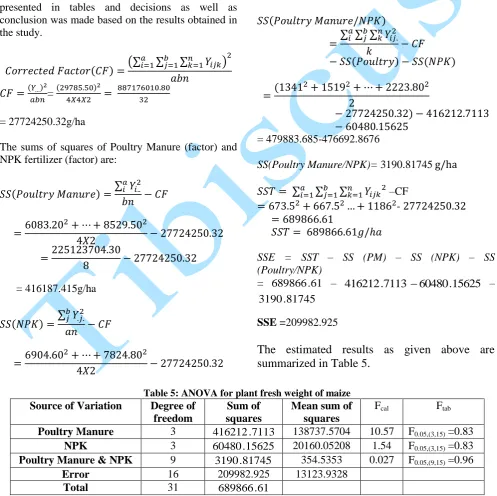
The fixed effect model given in equation 1 was used in the analysis. The sums of squares of the respective factors were estimated and the ANOVA results were presented in tables and decisions as well as conclusion was made based on the results obtained in the study.
=
= 27724250.32g/ha
The sums of squares of Poultry Manure (factor) and NPK fertilizer (factor) are:
= 416187.415g/ha
The sums of squares of the interaction between Poultry Manure and NPK fertilizer effects, total and error are estimated as:
= 479883.685-476692.8676
SS(Poultry Manure/NPK)= 3190.81745
–CF
-
SSE = SST – SS (PM) – SS (NPK) – SS (Poultry/NPK)
= 689866.61 – 416212.7113 60480.15625 – 81745
. 3190
SSE =209982.925
The estimated results as given above are
summarized in Table 5.
Table 5: ANOVA for plant fresh weight of maize
Source of Variation Degree of freedom
Sum of squares
Mean sum of squares
Fcal Ftab
Poultry Manure 3 416212.7113 138737.5704 10.57 F0.05,(3,15) =0.83
NPK 3 60480.15625 20160.05208 1.54 F0.05,(3,15) =0.83
Poultry Manure & NPK 9 3190.81745 354.5353 0.027 F0.05,(9,15) =0.96
Error 16 209982.925 13123.9328
The results presented in Table 6 showed that Fcal (10.57) > Ftab (0.83), this implies that there is significant difference among the poultry manure levels, and as a result of this, poultry manure has significant contribution to fresh plant weight of maize. The Fcal (1.54) > Ftab (0.83), implies that there is significant difference among the NPK fertilizer levels and thus, NPK fertilizer levels do affect the fresh plant weights of maize positively for bountiful harvest. The result also showed that Fcal (0.027) < Ftab (0.96) and therefore the quality of interaction between the levels of Poultry manure and NPK fertilizer has no significant difference.
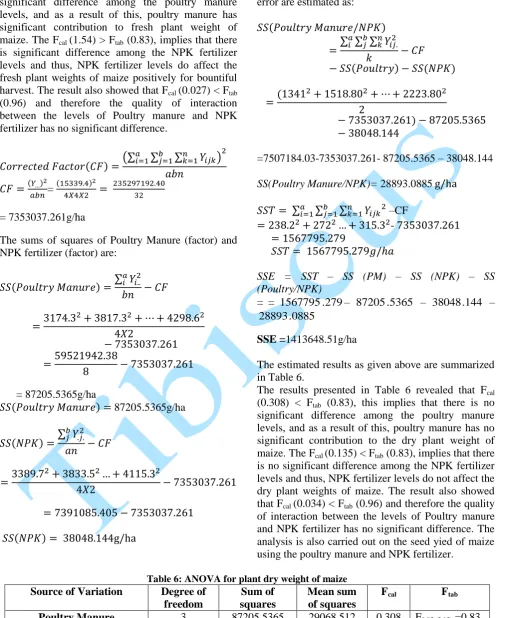
=
= 7353037.261g/ha
The sums of squares of Poultry Manure (factor) and NPK fertilizer (factor) are:
= 87205.5365g/ha
87205.5365g/ha
The sums of squares of the interaction between Poultry Manure and NPK fertilizer effects, total and error are estimated as:
=7507184.03-7353037.261- 87205.5365 – 38048.144
SS(Poultry Manure/NPK)= 28893.0885
–CF
-
SSE = SST – SS (PM) – SS (NPK) – SS (Poultry/NPK)
= = 1567795.279– 87205.5365 – 38048.144 – 0885
. 28893
SSE =1413648.51g/ha
The estimated results as given above are summarized in Table 6.
The results presented in Table 6 revealed that Fcal (0.308) < Ftab (0.83), this implies that there is no significant difference among the poultry manure levels, and as a result of this, poultry manure has no significant contribution to the dry plant weight of maize. The Fcal (0.135) < Ftab (0.83), implies that there is no significant difference among the NPK fertilizer levels and thus, NPK fertilizer levels do not affect the dry plant weights of maize. The result also showed that Fcal (0.034) < Ftab (0.96) and therefore the quality of interaction between the levels of Poultry manure and NPK fertilizer has no significant difference. The analysis is also carried out on the seed yied of maize using the poultry manure and NPK fertilizer.
Table 6: ANOVA for plant dry weight of maize
Source of Variation Degree of freedom
Sum of squares
Mean sum of squares
Fcal Ftab
Poultry Manure 3 87205.5365 29068.512 0.308 F0.05,(3,15) =0.83
NPK 3 38048.144 12682.715 0.135 F0.05,(3,15) =0.83
Poultry Manure & NPK 9 28893.0885 3210.343 0.034 F0.05,(9,15) =0.96
Error 15 1413648.51 94243.234
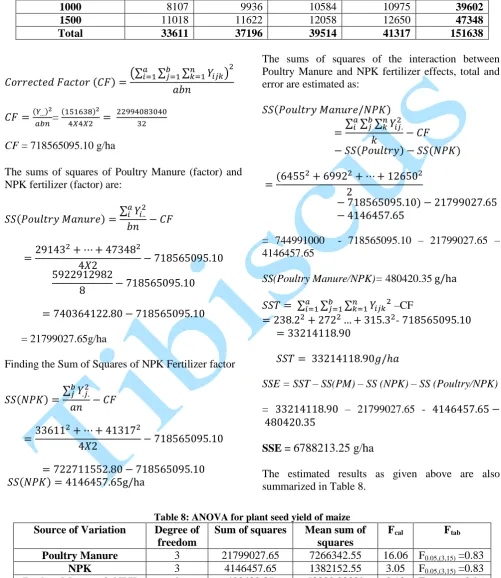
Table 7: Sum of observations in each level of the factor for the seed yield of maize
Poultry Manure (Kg/ha)
NPK fertilizer (kg/ha) (Seed Yield in kg)
0 100 200 300 Total
0 6455 6992 7716 7980 29143
500 8031 8646 9156 9712 35545
1000 8107 9936 10584 10975 39602
1500 11018 11622 12058 12650 47348
Total 33611 37196 39514 41317 151638
=
CF = 718565095.10 g/ha
The sums of squares of Poultry Manure (factor) and NPK fertilizer (factor) are:
= 21799027.65g/ha
Finding the Sum of Squares of NPK Fertilizer factor
The sums of squares of the interaction between Poultry Manure and NPK fertilizer effects, total and error are estimated as:
= 744991000 - 718565095.10 – 21799027.65 – 4146457.65
SS(Poultry Manure/NPK)= 480420.35
–CF
-
SSE = SST – SS(PM) – SS (NPK) – SS (Poultry/NPK)
= – 21799027.65 -
SSE = 6788213.25 g/ha
The estimated results as given above are also summarized in Table 8.
Table 8: ANOVA for plant seed yield of maize
Source of Variation Degree of freedom
Sum of squares Mean sum of squares
Fcal Ftab
Poultry Manure 3 21799027.65 7266342.55 16.06 F0.05,(3,15) =0.83
NPK 3 4146457.65 1382152.55 3.05 F0.05,(3,15) =0.83
Poultry Manure & NPK 9 480420.35 53380.03889 0.12 F0.05,(9,15) =0.96
Error 15 6788213.25 452547.55
The results presented in Table 8 revealed that Fcal (16.06) > Ftab (0.83), this implies that there is significant difference among the poultry manure levels, and as a result of this, poultry manure has significant contribution to the plant seed of maize. The Fcal (3.05) > Ftab (0.83), implies that there is significant difference among the NPK fertilizer levels and thus, NPK fertilizer levels do affect the plant seed of maize. The result also showed that Fcal (0.12) < Ftab (0.96) and therefore the quality of interaction between the levels of Poultry manure and NPK fertilizer has no significant difference.
4. DISCUSSION OF RESULTS
This study investigated the effects of Poultry manure and NPK fertilizer levels on fresh weight, dry weight and yield of Maize in 2015 and 2016 Cropping Sessions. The results obtained in this study showed that poultry manure and NPK fertilizers equally contributed significantly to the fresh plant weights of maize for a bumper harvest while the interaction of the two factors did not indicate any significant difference. In the analysis of dry weight of maize, the contribution of the two factors considered was the same to the quality of dry weight of maize. The results also showed that the two factors contributed greatly to the quality and bumper harvest of maize. However the interaction of the factors gave the expression that poultry manure and NPK fertilizer have equal contributions to the quality and bumper harvest of seed yield of maize.
5. CONCLUSIONS
This study concluded that poultry manure and NPK fertilizers equally contributed significantly to the fresh plant weights of maize for a bumper harvest while the interaction of the two factors did not indicate any significant difference. The contribution of the two factors considered was the same to the quality of dry weight of maize. The two factors, poultry manure and NPK fertilizers, contributed greatly to the quality and bumper harvest of maize but the interaction of the factors gave the expression that poultry manure and NPK fertilizer have equal contributions to the quality and bumper harvest of seed yield of maize. Based on the results of the analysis of this study it is recommended that the Institute should use either poultry manure or NPK fertilizer applications for the quality harvest of seed yield of maize as one of these will be sufficient to have quality harvest of the yield of maize for subsequent cropping sessions. Government could also organise a scheme that would educate the farmers and research institutes on the use of fertilizers on crops and
REFERENCES
[AO82] A. A. Agboola, J. A. Omueti - Soil fertility problem and its management in tropical Africa. Paper presented at the International Institute of Tropical Agriculture Ibadan, Nigeria, 1982. [ATB01] W. B. Akanbi, A. O.Togun, R. A.
Baiyewu - Suitability of plant residue compost as nursery growing medium for some tropical fruit tree seedlings, Moor Journal of Agricultural Research, vol. 2, 41-45, 2001.
[Ike84] J. E. G. Ikeorgu - Some micro-environmental changes under cassava (manihot esculenta crantz)-maize (zea mays) intercrops grow with okra (abelmoschus esculentus l) and ‘egusi’ melon (colocynthis vulgaris l) , PhD thesis, University of Ibadan, Nigeria, 1984. [IIT74] International Institute of Tropical
Agriculture- Maize programme report, Annual Report, 56-87, 1974.
[IIT87] International Institute of Tropical Agriculture - Management programme, Annual Report, Ibadan, 1987.
[IIT90] International Institute of Tropical Agriculture - Cassava in tropical Africa, A Reference Manual, 1990. [Oeh10] G. W. Oehlert - A first course in design
and analysis of experiments, ISBN 0-7167-3510-51, QA279.O34 2000 519.5—dc21 Library of Congress Cataloging-in-Publication Data, 2010. [Oje00] S. O. Ojeniyi - Effect of goat manure
on soil nutrients and okra yield in a rainy forest area of Nigeria, Applied Tropical Agriculture, vol. 5, 20-23, 2000.
[OKC09] J. K. Omisore, M. Y. Kasili, U. C. Chukwu - Determination of Optimum Poultry Manure Rate for Maize Production, in Proceedings of the 43rd Annual Conference of the Agricultural Society of Nigeria (ASN),260-263, 2009. [PA17] O. P. Popoola, M. A. Afolabi -