Editorial
Rather belatedly, we have come to the final issue of Library and Information Research for 2009: and, regretfully, this will be my final issue as joint editor. Editing the journal is a very rewarding, but time-consuming, role, and there comes a point when the demands of the day job have to come first! Indeed, this issue would have been even more delayed had it not been for the sterling work (as ever) of my co-editor, Miggie Pickton, ably aided by Jonathan Jones, who has joined the team as Editorial Assistant. Between them, they have undertaken the lion’s share of the copy editing of the papers in this issue, and ensured that it has come to virtual press without greater delay.
However, with my resignation it is a case of out with the old and in with the new! The Editorial Board of Library and Information Research is delighted to welcome warmly a new joint editor, Dr. Alison Pickard, from the School of Computing, Engineering and Information Sciences at Northumbria University. We are sure that Alison will be a real asset to the journal, and that she will make an invaluable contribution to the work of the Library & Information Research Group. We wish her all the best in her work for the journal. We would also like to extend a similarly warm welcome to Jonathan Jones who, as mentioned above, has also joined the team and has already volunteered a significant amount of time to the journal, both in terms of assisting with editorial work and with scanning and uploading earlier hard copy issues into the journal site, thus creating an online open access archive for the journal.
And, as ever, we are sure that you will find the papers and reviews in this issue of both intrinsic interest and of practical use, whatever your role and working
context may be. The editorial team at Library and Information Research are constantly seeking to extend the sectoral coverage of the journal, so it is particularly pleasing to include in this issue a number of papers that focus primarily on the work of schools libraries – in this case, in Scotland.
Staying with the theme of innovation in research techniques, Andrew Shenton discusses the development and potential benefits of the use of modelling-through-reaction in user studies, to investigate the specification of preferred features of the ‘ideal information entity’. In particular, he focuses on the potential of the method to help bridge the gap between empirical research and the information
professional to whom he suggests such research all too often may seem, on the surface, ‘irrelevant to their real areas of interest’.
The paper by David Bawden et al. pursues the theme that is surely dear to the heart of most of those working in library and information services: how do we measure and demonstrate the value and impact of what we do on the users of our services? Whilst it is relatively easy to measure performance, as the authors comment, measuring impact is another matter altogether. However, in a time of threatened budgets such as the present, it is ever more important that we are able to do just that. In the paper, the authors report their experiences evaluating the impact of public library services in a couple of case study settings, using an approach based on Christine Urquhart’s Value project for health care information services.
In an educational environment where widening participation is high on the policy agenda, Muir et al.’s paper discussing research into the accessibility of the content of e-books for students with diverse needs is of considerable value in itself.
However, it is especially pleasing to be able to publish the paper on a further two counts: firstly, it is good to note that the paper was jointly authored by a team that involved collaboration between an academic, a practitioner and an MSc student – this very much embodies the collaborative and collegial spirit of Library and Information Research. Secondly, the research was partly made possible by funds given to Dr. Muir as successful recipient of the 2008 CILIP LIRG Research Award. It is good to see the Award being put to such beneficial use: we hope that the research findings will be used by all those involved in the future design, development, publication and provision of e-books.
We are also delighted to include the paper by Ian McCracken, outlining a holistic approach to engage secondary school pupils in Govan in Glasgow in developing their own skills and becoming independent learners. Collaboration between teachers and the school library – and the pupils themselves – has led to pupils not only developing their own transferable and employability skills levels, but being able to identify and demonstrate these skills, with a concomitant impact on subsequent employment levels. The paper also reports significant impact of the project in terms of pupils’ enhanced self-esteem, behaviour and life chances.
Cromar discusses the work of the Libraries R 4 Learning project, which was funded by the Scottish Library and Information Council (SLIC) to develop and deliver a programme of advocacy - designed to inspire and encourage effective, equal working partnerships between librarians and teachers in local secondary schools – again, echoing the theme of collaboration and collegiality in the achievement of shared objectives.
This issue of Library and Information Research also introduces a new feature that we hope to be able to bring you on a fairly regular basis: a round-up of links and references to recent research on a topical subject. In this issue, Janet Clapton, Project Information Manager at the Social Care Institute for Excellence, has identified recent work on open access publishing. Although she is quick to point out that this is intended to be a ‘taster’ rather than a comprehensive review, it will provide an excellent starting point for anyone wanting to evaluate the recent evidence on the chosen subject, and we are grateful to Janet for all the time that has gone into the preparation of the review.
Finally, we offer a number of reviews of recently published books. These include Philip Thornborow and Phil Oakman’s review of Graham Matthews et al. latest work on disaster management in archives, libraries and museums; Rachel Fitzgerald’s review of Michael Sauers’ book on the latest search techniques and tools facilitated by Web 2.0; Rob Howe’s review of Jane Devine and Francine Effer-Sider’s book entitled Going Beyond Google; and last but not least, Kate Littlemore’s review of Sarah McNicol’s work on joint-use libraries, a concept which is surely set to be a growing feature of the 21st Century library landscape. The reviewers are all practitioners at The University of Northampton. We thank them for the time spent on preparing these book reviews and would like to remind readers that writing a review for Library and Information Research offers an excellent means of dipping your toes in the publication water: if you or your organisation would like to contribute to the book reviews section of the journal then we would be pleased to hear from you.
We hope you enjoy this issue, and that these papers stimulate ideas for research that you can carry out in your own work context, and hopefully write about for the journal. And please remember that we are always happy to receive your feedback on the content of the journal.
_______________________________________________________________________ Sue Cromar
Libraries R 4 Learning: Supporting the Curriculum for
Excellence in Aberdeenshire
Sue Cromar
Abstract
In April 2009, Aberdeenshire Library and Information Service (ALIS) was awarded £10,000 by the Scottish Library and Information Council (SLIC) to develop and deliver a programme of advocacy - designed to inspire and encourage effective, equal working partnerships between librarians and teachers in local secondary schools. All materials created over the lifetime of this project will be published under a Creative Commons licence, and made available to be used and adapted by library professionals across Scotland. This article outlines some of the ideas and observations that fed into our successful proposal, and sets out our plans for achieving key outcomes of the Libraries R 4 Learning project.
1 Context
ALIS is an integrated service, supporting both school and public libraries across Aberdeenshire from its headquarters in Oldmeldrum. Operations are managed by a team of Network Librarians based in Aberdeenshire‟s seventeen secondary schools, or Academies. These professionals have responsibility for school library services, and for all public library branches in their catchment area. The Network Librarians are supported by a central team of professional staff, including a
Young People‟s Services Librarian, a Primary Schools‟ Librarian and an Information Literacy Librarian.
Our planned approach to information literacy development across Aberdeenshire is defined in our current strategy document:
“to support the integration of core, transferable information and critical literacy skills within formal and informal learning experiences, supporting
Aberdeenshire’s citizens of all ages to become effective lifelong learners”
Over the last ten years, our librarians have used centrally produced workbooks and other support materials with first year pupils, covering a variety of basic information skills. By making these materials available for use in every
Academy, our intention had been to ensure that Aberdeenshire‟s pupils received the same breadth of instruction, whichever school they attended. However, while some Network Librarians were allocated several hours (generally from timetabled English lessons) to work through the materials with pupils, others were given very little time and were restricted to covering the essentials of Dewey, alphabetical order and library orientation.
With few exceptions, information literacy sessions had been delivered as one-off events, usually confined to the first few weeks of S1, and were rarely reinforced or developed as pupils progressed through the school. This was very much a bolt-on approach, often bearing little relatibolt-on to the rest of the curriculum. Not surprisingly, librarians reported that pupils often seemed unable to relate what they had learned – way back at the start of their first term – to the topic
investigations or research tasks set by their class teachers.
Some Academies had already begun to work towards a more effective model, where information and critical literacy skills are situated within meaningful classroom activities or real-life situations across all subjects and year groups, and Network Librarians are full partners in the development and delivery of learning materials. Our strategy is to develop this approach across all schools in
Aberdeenshire.
2 Perceptions
Since coming into post as Information Literacy Librarian in October 2008 I‟ve visited all our Academies, have seen some innovative and imaginative practice around information literacy support, and witnessed some inspirational teacher - librarian partnerships in action. However, the impact of information literacy interventions has varied greatly across Aberdeenshire. To take our new strategy forward, Network Librarians must overcome barriers grounded in outdated and inaccurate – but deeply rooted – perceptions around the role of school librarians in learning and teaching. These professionals are often cast firmly in the role of support staff, considered to be serving a purely functional role in the school, and unlikely to be taken seriously as potential collaborators.
3 The Curriculum for Excellence – an ideal opportunity for partnership Scottish schools are in the process of implementing the Curriculum for
For the first time in their professional lives, many secondary school teachers are being asked to take account of pupils‟ literacy experiences in their own subject area. Scientists and mathematicians, for example, are faced with the problem of how to develop pupils‟ reading, writing, listening and talking experiences in their laboratory or classroom. They are not expected to manage these changes in isolation, however, but in partnership with “a range of practitioners, including those who work in school library resource centres, who make an enormous contribution to the development of the literacy skills of children and young people” (Learning & Teaching Scotland, 2009c). Teachers are actively
encouraged to team up with professionals beyond the classroom to create real and relevant experiences for their pupils which will help them develop and apply literacy skills in a wide range of contexts.
School librarians across Scotland recognise that this period of change presents a golden opportunity to forge meaningful, effective working partnerships with teaching staff - to “get out there and start knocking on doors”, become “part of the solution”. (Blane, 2009). The Libraries R 4 Learning project was conceived to support our local Network Librarian team to do just that. We are also keen to share good practice with schools and Local Authorities elsewhere.
4 Project aims
Our core aim is to raise the profile of Network Librarians as partners in developing and delivering experiences and outcomes within and beyond the classroom, especially those which relate to literacy across the curriculum.
„Literacy across learning‟ outcomes are organised within the headings of reading, writing, listening and talking, then by further subdivisions which include finding and using information, and understanding, analysing and evaluating. A number of these outcomes and experiences include statements which relate directly to information literacy, for example:
“To help me develop an informed view, I am exploring the techniques used to influence my opinion. I can recognise persuasion and assess the reliability of information and credibility and value of my sources”. (LIT 3-18a)
“ …. I recognise when it is appropriate to quote from sources and when I should put points into my own words. I can acknowledge my sources appropriately”. (LIT 3-25a)
(Learning and Teaching Scotland, 2009d) We will bring academics and school library staff together for planning and
development events designed to get teaching staff reflecting on the ways in which librarians can support their work with pupils, and on how they could collaborate to develop learning experiences. It is essential that we develop the skills and confidence of our Network Librarians as advocates of their service – and
5 Why advocacy?
With the support of Gilian Dawson from the University of Aberdeen, our Network Librarians have already begun to look at the concepts of advocacy and
relationship marketing, and how they can be applied in schools. It is not our intention to run a traditional „here we are, we‟re great, come and get us‟ marketing campaign. Instead, we‟re looking at how we can nurture and sustain relationships at the „chalk-face‟. We must get across that librarians are well equipped to
support their teaching colleagues through the process of integrating literacy across learning – sharing the load, saving them time, ensuring that key curriculum
outcomes and experiences are met. We also aim to convey the message that information and critical literacy skills are relevant for life, not just for libraries!
6 Project outcomes and outputs
Training in advocacy and relationship marketing skills for our Network Librarians and Young People‟s Services staff has already begun. Within the next few weeks, some staff will receive multimedia production and editing training, after which we will begin to produce a bank of materials to support CPD activities in schools. Our project outputs will include a series of presentations and short multimedia clips for use with teachers, school management teams and curriculum planners. The materials will focus on the integration of information literacy skills across formal and informal learning, and everyday life situations. There will be a strong emphasis on partnership, and the added value which professional librarians can bring to planning for learning and teaching.
7 Why multimedia?
The production of a series of individual film clips will be one of the core outputs of this project. As librarians, we can talk passionately and at length to our teaching colleagues about the value of information skills and their place in the curriculum, but much of what we have to say is „second hand news‟. We believe it‟s time that our audience heard about the value of information literacy skills „from the horse‟s mouth‟ - from learners and practitioners in the „real world‟ who exploit these skills on a daily basis.
Writing on the crucial importance of advocacy in promoting the development of information literacy across learning, Peter Godwin asserts that “[we] must get the message across simply and forcefully …. using well illustrated material with punchy examples of where IL counts” (Godwin, 2009, 3). This is precisely what we hope to achieve by using multimedia to present our case. In this instance, our „message‟ is the importance of information literacy skills in a range of situations, and the role that librarians can play in supporting literacy across learning. Our aim is to create something inspirational, memorable, thought-provoking and engaging – and flexible, so that materials can be used as a whole or as individual sound-bites.
(www.slainte.org.uk) – an online community for library and information professionals in Scotland – to be used as a complete package, or adapted as required by other library and information practitioners.
8 Next steps
From November 2009, we will plan and produce our DVD and compile other support materials for both school librarians and teaching staff. A training and development day will be held in the Spring of 2010 to bring Network Librarians together with curriculum managers and Literacy Co-ordinators from each of the Academies. The aim of the event will be to investigate practical ways in which information and critical literacy skills can be integrated within classroom practice, and how teacher-librarian partnerships could be encouraged and supported in schools. When all project training and development events have taken place, we will translate our outcomes into some guidelines for school librarians and
academics relating to advocacy, partnership working and integrating literacy across learning.
The first project outputs – a set of CPD materials for use with teaching staff and curriculum managers - will be published online by the end of April 2010, followed shortly afterwards by a variety of multimedia materials. Finally, our Network Librarian team will pilot these in schools across Aberdeenshire and an evaluation will be included in our final project report. We are grateful to SLIC for giving us this opportunity to transform our service in the schools sector and hope our experiences will be of relevance and value to the rest of the Scottish library and information community and beyond.
References
Aberdeenshire Library and Information Service (2009) Draft information literacy strategy.
Blane, D. (2009) „Librarians should get out there … and start knocking on doors‟, Times Educational Supplement [online], 6 February. URL:
http://www.tes.co.uk/article.aspx?storycode=6008405 [accessed 22.7.09]. Godwin, P. (2009) Information literacy “sans frontieres”. URL:
http://librariesofthefuture.jiscinvolve.org/files/2009/03/information-literacy-_sans-frontieres_.doc [accessed 23.10.09].
Learning and Teaching Scotland (2009a) Building the curriculum 4: skills for learning, skills for life and skills for work. URL:
http://www.ltscotland.org.uk/Images/literacy_across_learning_principles_practice _tcm4-540108.pdf [accessed: 23.10.09].
_______________________________________________________________________ Christine Irving
Christine Irving is the Researcher / Project Officer of the Scottish Information Literacy Project where she developed the National Information Literacy
Framework (Scotland) with cross sector partners. Previous projects she has been
Collecting case studies / exemplars of good practice to enrich
The National Information Literacy Framework (Scotland)
Christine Irving
Abstract
This paper discusses the challenges, process and reasons for collecting case studies / exemplars of good practice from practitioners to enrich The National Information Literacy Framework (Scotland). The lessons learned show that there is a tendency for people to think they are not doing anything special and therefore do not respond to emails for exemplars of good practice. They are however once contacted happy to share their practice. It is therefore essential to use networks of contacts, leave plenty of time to talk, visit and work with people on submitting their work as a case study / exemplar. Sharing practice also contributes to
professional development both for the individual and their community and to the field of research.
Background information is provided on the national framework, the project funding, the project partners and the range of examples collected for different sectors. Plus use of templates and Web 2 tools.
1 Introduction
1.1 A national overarching framework
for the 21st century is seen as a key tool for the embedding of information literacy in schools, FE, HE, and lifelong learning and for life.
With funds from Eduserv a draft framework was developed and piloted in conjunction with cross sector partners with the aim of:
defining information literacy learning in terms of statements of skills, knowledge and understanding; enabling the notional levelling process and
outcomes to become transparent and clearly understood by other learning providers, receiving organisations and or employers to meet the needs of the lifelong learner more effectively;
supporting a continuing learning process through identifying a learning pathway within the context of SCQF (Scottish Credit Qualification Framework) (SCQF, 2005) as part of an educational guidance or personal development planning process;
mapping the existing learning that is taking place allocating a notional level to learning outcomes utilising relevant reference points such as the SCQF generic level descriptors with the intention of providing a general shared understanding of each level which can then be linked to academic, vocational or professional practice;
incorporating and highlight CILIP's information literacy skills and competences definition (CILIP, 2004) and SQA's Information Handling Skills Intermediate 2 qualification.
The target audience for the framework is:
library and information professionals working in learning and teaching environments / organisations;
learning and teaching organisations e.g. Learning and Teaching Scotland, Skills Development Scotland;
organisations involved in qualifications and accreditation e.g. CILIP, SQA.
The draft framework levels cover:
Schools
Secondary Schools / Further Education Colleges Further / Higher Education
Higher Education
Lifelong learning including all information-using communities
e.g. workplaces, adult literacies, community learning, public libraries
and have common skills running through them. Although there are differences in
tasks appropriate for that level then further developed to the level other sectors require, thus creating a learning pathway for education or personal development planning process.
1.2 Project Partners
The development of the draft framework has been possible due to collaboration and the general aims of the project which is to:
attract and work with partners in secondary and tertiary education, the world of work and the wider community;
work primarily within the Scottish educational system but also to work with interested parties UK wide and abroad;
work with relevant non governmental agencies such as Learning and Teaching Scotland, the Scottish Credit and Qualifications Framework, Scottish Qualifications Authority, Skills Development Scotland, and professional bodies such as CILIP, SCURL, SCONUL;
research the role and importance of information literacy in the workplace both in the public and corporate sectors and work with partners in these areas;
research the role and importance of information literacy in continuing professional development (CPD);
engage in information literacy advocacy through all available channels and opportunities such as the Scottish Parliament and Executive, relevant NGO‟s and the educational and information media;
develop links with agencies in other countries undertaking information literacy advocacy.
„Working with partners to create an information literate Scotland‟ has enabled the framework to develop from an initial idea discussed with a member of the
advisory group to the revised online interactive framework it is today with case studies and exemplars of good practice plus news of information literacy activities, developments and strategies.
2 Methodology
In 2007-8 the draft framework underwent a piloting exercise with the project‟s advisory group, project partners from schools, further education colleges, universities and different workplaces plus adult literacy initiatives.
The above would see a departure from other national frameworks in Australia, New Zealand and America that just have the skills levels. It would aim to show through the exemplars how the skills had been mapped into course design, recognising different modes of teaching and learning. For example evidence based, problem based plus target disciplines that value information and feed forward / link with further developments including educational development strategies such as:
the Curriculum for Excellence within schools and FE sector specifically the Literacy Across Learning Outcomes and Experiences (Learning and Teaching Scotland, 2009) which illustrates the progressional nature of literacy skills (including what they refer to as information / critical literacy) and how these play an important role in all learning
initiatives within further and higher education.
Discussions were also held with senior personnel at LTS (Learning and Teaching Scotland). All emphasised the importance of including exemplars of good practice drawn from real life experience.
Some exemplars had been identified through the draft framework piloting exercise but more were needed and an initial approach of asking for exemplars of good practice was met by silence. A new more proactive strategy had to be adopted as it seemed that people did not see their activities as „exemplars of good practice‟ so there was a need to explore, identify, discuss, visit and see information literacy activities being carried out by project partners and interested parties and then ask if the activity could be used as an exemplar / case study.
On the lifelong learning side CILIP‟s Information Literacy definition has no levels or depths of skills required attached to it; however research carried out by the project into „The role of information literacy in the workplace: an exploratory qualitative study' (Crawford and Irving, 2009) funded by The British Academy determined that:
those in the workplace would need to look at how individuals define information literacy in terms of their own qualifications, training and work experience. For example Lloyd and Somerville‟s (2006) work with fire-fighters highlights smell and touch as information sources;
those involved in adult or community learning may wish to use levels within the other sectors that they feel are appropriate.
This study helped us to increase the number of workplace partners and introduced us to Adult Literacy networks and encouraged us to look at the role of public libraries in developing information literacy training programmes.
Information Services) and following a lengthy protracted period fruitful
discussions were held resulting in an agreement that the project would submit a number of information literacy case studies from different sectors.
In addition the discussions with LTS also led to work funded by them to identify exemplars of good practice within the cross curricular area of information literacy for dissemination through their Online Service Curriculum for Excellence - Sharing Practice (Learning and Teaching Scotland, 2009a) which offers an important mechanism to keep education authority and school staff informed and supported.
The addition of these exemplars to add value to the LTS Online Service by: facilitating access to practitioners‟ good practices and classroom resources within this important cross curricular area;
demonstrating how specific information literacy competencies can be applied in practice;
identifying exemplars linked to different levels within the curriculum, subjects and resources;
o the exemplars matched against the National Information Literacy Framework (Scotland) standards / levels;
the exemplars and the framework will provide school teachers with an identified standard of information literacy skills at the identified levels and contribute to the development of information literacy and media literacy skills among school pupils;
o it should help to alleviate the concerns of teachers about their capacity to take on this work identified by Professor Dorothy Williams of Robert Gordon University (Williams and Wavell, 2006);
providing resources that will contribute to the development of Glow which is the “world‟s first national intranet for education” within schools
(Learning and Teaching Scotland, 2009b);
providing information for education managers within this important cross curricular area;
sharing expertise from library and information science research to education in a key area for the 21st Century.
The work to be informed by, advised and supported by Project partners:
The above support made a big difference and thirteen case studies were identified. However the process was a much longer one than anticipated, over running the original project timescale of February 2008 - December 2008.
3 Exemplars / case studies
Although the exemplars / case studies were slow to come / identify we have managed to collect a range of examples for each section which are now listed within the restructured framework which is a weblog (National Information Literacy Framework Scotland, 2009).
3.1 School case studies / exemplars of good practice
Information Literacy Model – ExPLORE (City of Edinburgh)
North Ayrshire Information Literacy Toolkit – Primary Schools
Schools toolkit for Information Literacy – Nursery – primary 7 (12 year olds) (Aberdeenshire)
Transition from primary to secondary school (Craigholme School, Glasgow)
Sharing practice – IL case studies (Curriculum for Excellence)
School Information Literacy Policy (Benton Park High School, Leeds)
Real and Relevant – Information Literacy Skills for the 21st Century Learner (Literacy Development Officer, Curriculum for Excellence)
3.2 Secondary school case studies / exemplars of good practice
Govan High staff induction programme that challenges ICT assumptions
1st Year English Library Research project Biography (Ardrossan Academy)
Supporting pupils in developing their information skills in an academic context (Caldervale High School, Airdrie)
Helping senior pupils with research for Higher History extended essays (Dunbar Grammar School)
East Lothian School Librarians IL activities
Largs Academy – information literacy activities
James Gillespie High School - developing S1 information literacy
Information literacy using the ExPLORE model (Gracemount High School, Edinburgh)
Information literacy and the draft CfE Science Outcomes (Holy Rood High School)
3.3 FE college case studies / exemplars of good practice
IL diagnostic assessment @ Carnegie College
3.4 HE college case studies / exemplars of good practice
University of Abertay – Appendix D
Loughborough University – Appendix E
Although the Loughborough example is not a Scottish example it does
demonstrate how two different universities have used the same set of skills – the SCONUL 7 Pillars Model as their starting point but have embedded / introduced them differently.
Other HE /university case studies / exemplars of good practice added include:
Dundee University and three Dundee High Schools
Glasgow Caledonian University – iLearn Framework
3.5 Workplace case studies / exemplars of good practice
NHS Scotland information literacy competency framework
Skills for Scotland: A Lifelong Skills Strategy
Scottish Government Information Services IL activities
3.6 Public library case studies / exemplars of good practice
Inverclyde Libraries – Greenock; Dumfries and Galloway Libraries – Ewart Library; Glasgow Libraries – Mitchell Library and Glasgow REAL Learning Centres
The idea of using a weblog to facilitate the transformation of the 68 page pdf draft information literacy framework into a more flexible tool that enabled case studies / exemplars of good practice to be added emerged as experience with the project blog grew and the potential of what could be done with blogs apart from blogging. The static pages would contain the framework details whilst the blog postings would facilitate the communication of any news, activities and developments and enable interested parties to comment on any of the postings or on the framework pages.
project (2009) confirmed similar difficulties. Whether this is a nationality or professional trait or a combination of both it leaves the collector with the task of seeking out activities, investigating them and then making a decision on whether it fits the qualities they think makes a good exemplar of good / best practice or case study. It is necessary to use a variety of means but using networks of contacts, getting out and about talking to and seeing first hand what people are doing is an amazing experience which despite being time consuming is definitely worthwhile and has proved successful.
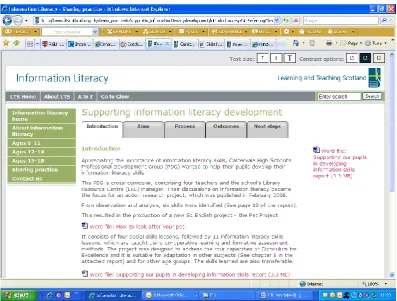
Whilst the LTS (2009) sharing practice funded case studies used a template (Figure 1) which resulted in a professional looking tabbed mini website providing some consistency to layout and preventing scrolling as the text is broken up, it did take some effort to convince those providing the case studies that the template was there to help them not make more work for them.
Figure 1: Screenshot of online LTS case study
However the project did not have the IT resources that LTS have so the decision was taken to summarise the activity with contact details listed for anyone who wanted more information given. Hopefully the facility of being able to comment on the exemplar or the individual whose exemplar it is being able to provide an update for all to see may prove more useful.
5 Conclusion
So was it worth all the effort of collecting case studies / exemplars? Definitely, as it provides ideas and benchmarking possibilities not only for those new to the profession or sector but to the existing LIS practitioner and hopefully will encourage sharing practice and collaborative working. It also gives the research community insights into what information literacy activities LIS practitioner are involved in.
Whilst the information literacy activities need to be reviewed and updated to incorporate new resources, tools, technology it does provide a useful snapshot of what is happening in Scotland at the moment and possible areas for research and development.
In addition “Sharing good practice within and beyond their own establishments and cluster” along with “personal reading and research, including engaging with online resources and discussing and sharing good practice through these
resources” are recognised as part of best professional development (The Scottish Government, 2009, 4-5). Not just for the individual concerned but also their community and interested parties and contributes to the field of research.
References
CILIP (2004) CILIP information literacy definition. URL:
http://www.cilip.org.uk/get-involved/advocacy/learning/information-literacy/pages/definition.aspx
[accessed 25.01.2010].
Learning and Teaching Scotland (2009) Curriculum for Excellence - Sharing Practice. URL:
http://www.ltscotland.org.uk/curriculumforexcellence/sharingpractice/index.asp
[accessed 07.10.09].
Learning and Teaching Scotland (2009a) Glow Scotland. URL:
http://www.ltscotland.org.uk/glowscotland/about/index.asp [accessed 07.10.09]. Learning and Teaching Scotland (2009b) Information literacy: Sharing practice. URL: http://www.ltscotland.org.uk/informationliteracy/sharingpractice/index.asp [accessed 07.10.09].
Learning Literacies for a Digital Age (LLiDA) (2009) URL:
The Scottish Government (2007) Skills for Scotland: A Lifelong Skills Strategy URL: http://www.scotland.gov.uk/Topics/Education/skills-strategy [accessed 07.10.09].
The Scottish Government (2009) towards a professional development strategy for curriculum for excellence: management board discussion paper. URL:
http://www.ltscotland.org.uk/publications/t/publication_tcm4565600.asp?strRefer ringChannel=curriculumforexcellence [accessed 07.10.09].
SCQF (2005) Scottish Credit Qualification Framework. URL:
http://www.scqf.org.uk/ [accessed 25.01.2010].
Williams, D.A. and Wavell, C. (2006) Teachers' Conceptions of Information Literacy in Relation to their Classroom Practice. URL:
http://www.rgu.ac.uk/abs/research/page.cfm?pge=13088# [accessed 07.10.09].
_______________________________
Acknowledgement
The project would like to acknowledge the following funding bodies: Esmee Fairbairn Foundation; Eduserv; Learning and Teaching Scotland (LTS) for their belief in the project and the project team.
_______________________________________________________________________
The future is skills
Ian McCracken
Abstract
In this article, the author describes the formation, development and current status of a skills system in use in a Glasgow Secondary School. The school’s
circumstances are outlined, and then the article explains how issues and
observations with the school library led to a number of hypotheses and a rationale. The progress of the skills system as it evolved and became part of a Whole School concept is explored, and the characteristics of the system, which the school
believes is unique, are discussed. The ways in which this Future Skills System relates to the new curriculum in Scotland are indicated, together with the means by which the system brings together careers, employers, expectations and skills. The article concludes by highlighting the current stage in the process.
Introduction
In its follow-through report published earlier this year, H M Inspectorate of Education (HMIE) identified Govan High School’s development of “Future Skills” as an example of good practice: “…that allows the school to identify, develop record and report the achievements of individual young people” (HMIE, 2009). While many documents, reports and organisations have highlighted the importance of skills, Govan High School has gone a significant step further by specifically identifying these skills, and integrating them throughout the school in every way possible. The fact that HMIE has now publically recognised this achievement – and the further steps that the school has undertaken (as described in the quotation above) – demonstrates clearly the unique nature of the skills system and underlying philosophy that the school has undertaken.
colleges, universities, employers and educationalists. Senior Library and
Information Managers have recognised in the Future Skills System a serious and dedicated effort to, at long last, tackle properly the chimera of transferable skills that have so long eluded definition.
Govan High School
Govan High School is a secondary school (ages 11-18) in the South-West of Glasgow. The school is in a district that often features near the top of any list of deprived areas in Scotland, according to a number of reports. Over the years, the number of pupils in the catchment area has shrunk, and is now less than 400. Employment in the area has for generations been very high. Few pupils
traditionally go on to university straight from school. The school is very much at the centre of the community and makes every effort to try and overcome some of the real and perceived barriers that have prevented pupils from – in the words of the school mantra – “achieving their full potential”. Staff who work here are very committed to assisting pupils as much as possible and willingly work above and beyond formal job description – e g by running lunchtime clubs, out of school events, etc. Those most involved with the System described in this article are the Headteacher, who has now worked in the school for 14 years, the librarian who has worked here for 29 years, and the Deputy Headteacher, who although he has worked in the school for less time, has seen the issues affecting pupils at first hand, starting when he was appointed with a role in Behaviour Support.
Current curricular structure in Scotland
“A Curriculum for Excellence” is the name given to the current system in place in Scotland. To quote from the website (Learning and Teaching Scotland, 2009a): “The purpose of Curriculum for Excellence is encapsulated in the four capacities to enable each child or young person to be a successful learner, a confident individual, a responsible citizen and an effective contributor.
The experiences and outcomes in the range of curriculum areas build in the attributes and capabilities which support the development of the four capacities. This means that, taken together across curriculum areas, the experiences and outcomes contribute to the attributes and capabilities leading to the four capacities.”
Future Skills – starting points
they must be in every kind of work that was being done, whether in the classroom, the library/resource centre or on an educational visit out of school. I knew from working with different departments and establishments that there was much idiosyncrasy or randomness in the description of skills. It therefore became a key principle that everyone (staff and pupils) should use the same skills set, and that we should establish the notion of a “Common Vocabulary”. By ensuring that people throughout the school were referring to the same skills by the same names, it eliminated confusion and – for the first time – enabled connections to be made throughout the school.
When we describe these principles to the many visitors who come to hear and see future skills in action, their simplicity often surprises people. However, we have never yet come across any individual or organisation that has actually established its own principles or indeed appears to have considered the importance of
underlying principles themselves. Librarians and information managers often encounter “assumptions” by others and as a consequence have to help users find information that others have “assumed” the users can find for themselves. In the education field, my view is that the most common assumption is that
pupils/students have excellent analytical skills. I cannot see how it can be possible for there to be skills transferability without analytical ability: the pupil/student has to be able to analyse the task in one subject and be able to recognise the same basic element in another subject – but who teaches analytical skills?
As part of its consideration of the principles involved, we looked at the notion of the independent learner. It became clear that to be independent learners,
pupils/students must be involved in their learning. This not only reinforced the Common Vocabulary – for how could pupils become involved in their learning without having a way of sharing information about it – but it also led us to put the learner at the centre of everything we were doing: in theory and in practice.
Skills origins - library
Like many librarians, I had often been surprised at how often tasks that teachers set pupils in the library often took many skills for granted, or where skills were mentioned at all, that they were described in entirely different ways by different teachers. Frequently, this resulted in teachers getting angry with pupils – they often thought that the problem was because pupils were deliberately wasting time, whereas from what I could see the issue was more fundamental.
An opportunity to put this theory into practice came in the form of a Homework Club that I started with support from local Community Workers and the school’s Behaviour Support teachers. The group of pupils attending the Homework Club did not fit any conventional stereotype of those most likely to attend such clubs so were therefore an ideal group for our purposes. As well as homework emanating from teachers, we also used a wide range of fun learning activities and through both highlighted skills. As can be imagined this took a lot of time and effort, but we persevered as the pupils were clearly enjoying being given more opportunity to become involved and were often competing with one another to be first to recognise their skills.
When it was decided that the library would be converted into a Learning Resource Centre, it became essential to seek pupil helpers to assist in the complicated process. A number of senior pupils volunteered, and provided invaluable assistance. Starting from the list of skills compiled for the Homework Club, the helpers and I identified a whole range of skills that would be useful. The purpose of the list was three-fold: first of all so that we could look at a wide range of skills that pupils were themselves identifying, secondly so that they could judge their own progress “before” and “after”, and thirdly so that pupils completing university or job applications could more confidently describe their own skills, and could explain very clearly how they had gained these skills.
The screenshot in Appendix 1 highlights the skills that between us we developed in the left-hand column. The scores listed show some of those that one pupil estimated she had improved.
When we reviewed the skills, it was obvious that there was some duplication or overlap; also that if skills were to be utilised in a wider context some of them would be far too specific or would apply only to libraries. The next stage is set out below.
Skills background - whole school
A staff visit to a school in Ireland, an innovative Primary-Secondary Pupil
Induction programme and a Visual-Audio-Kinaesthetic Staff Training Programme were the very diverse starting points for the development of Future Skills at a whole school level from its inception in the library/resource centre.
In Ireland, we were looking at various initiatives taking place in a partner school. One of these was a mentoring programme, in which younger pupils received much help and support from older pupils. The school had an extensive training programme for the older pupils, who were able to speak with confidence,
articulacy, intelligence and understanding about the role they played in supporting those in lower year groups. What caused complete silence and indeed
consternation were questions to the mentors from us regarding what skills the older pupils themselves got out of it – this was not covered in the training, and none of the pupils appeared to have thought of it for themselves – an
An external consultancy was employed to run an in-service activity on Visual, Auditory and Kinaesthetic Skills (Child Central, 2009) Staff were then divided into groups to ensure a mix of different subjects. As a participant in one group, it was soon evident to me that there was much more in common than teachers themselves realised in how various subjects were tackled. I offered to pull all the ideas together and look for underlying techniques and ideas. This later became very valuable evidence to demonstrate to any subject-bound staff that there was much more in common across the subjects than had been previously recognised. It had also brought to the fore yet again the issue of transferability of skills, as Teacher A would state the name of a process that encouraged Visual Skills in their subject, and everyone else would look blank until Teacher A described what actually took place, and Teacher B would say “oh yes, we call that….”. The fact that teachers themselves were experiencing the effects of a lack of any collective way of describing things made the later introduction of the Common Vocabulary resonate much more clearly than it would have done otherwise.
As a change from the standard routine of showing next year’s new intake of pupils round the school in June, we had devised a title “Skills, Thrills and Fun” and invited staff to run activities on a theme – crime and investigation. In order to maintain the curriculum for other year-groups, middle school pupils had been drafted in to assist staff on a random allocation basis to make sure the younger pupils did not get lost, or to take them to dining hall, and other facilities. It soon became evident in many of the activities that these middle school helpers had many more skills. They took part most enthusiastically and were equally able in helping the younger pupils with a whole variety of tasks. What was remarkable was that some of the pupils who were best at doing this had hitherto either demonstrated no interest in anything, or were “challenging” pupils. Again, the skills implications were considerable and made us think about how these could be replicated. We chose what we thought at the time would be a good idea – trying to “convert” other lessons to the Skills, Thrills, Fun formula. We also made a list of skills that had been used in one of the activities, but it soon became evident that trying to convert lessons was an endless and tedious job, and that the skills list was far too narrow in conception.
We therefore had an Open Meeting for staff to suggest skills and arrived at a provisional list. The experiences that many staff had undergone through Skills, Thrills and Fun and the Visual, Auditory and Kinaesthetic Training had helped to engender an understanding of the importance of this meeting, so there was a large turnout from a wide variety of departments.
Connector, The Communicator, The Originator, The Sorter and The Decider. The concept was and is that everyone is a mixture of skills from all of these categories, and that many if not most people will have significant “grey areas” or hidden skills which various experience and better analytical skills can help them
recognise. We pictured these skills in a circle with “The Learner” in the middle, to signify that the model applied to pupils and adults, and that each learner needed to have a variety of types of skill. We also wanted to emphasise the fact that every learning area (not just traditional classrooms) contributed to the potential
development of a wide range of the skills: we did not want a situation for example where the English Department in school might “assume” that it could or should just focus on the skills of the Communicator, or the Technical Department assume that it equated with the Doer. Such narrow thinking would have been totally contrary to our way of thinking – fortunately any fears we might have had in that respect were completely groundless, or were eliminated through the extensive staff training process, which included all categories of staff, not just teachers. From our abortive experiment with Skills, Thrills and Fun (described above), we had also come up with a radical way of approaching change – no longer would teachers (or other staff) have to discard all the work they currently did and have to start again, but instead, all they would have to do would be to highlight skills that were already present in their lessons, and involve pupils in this process.
Figure 2: Model illustrating the Future Skills ‘families’.
When several years later the Curriculum for Excellence used some similar
terminology in its four capacities - “Effective Contributor”, “Responsible Citizen”
The Sorter The Originator
The Communicator
The Decider The Contributor
The Doer The Connector
The
Learner
Once we had refined our skills list through the medium of the Standard Grade matching process described above, we also realised that, now that we had our definitive skills list, they could be matched to anything else – so we have
progressively matched them to individual lessons and learning experiences, course plans, national and local employers’ expectations, to the Skills for Scotland
strategy (Scottish Government, 2007) to 100 wide-ranging careers, as well as to Curriculum for Excellence (in principle and in detail). Given that there is a great deal of talk about employers’ expectations but often little substance, it is perhaps useful to note that Govan High School liaises with the Glasgow South Business Club and matched the Future Skills directly to responses from employers. When the President of the Glasgow South Business Club saw the Future Skills System for himself, he stated to the school “This is exactly what Businesses are looking for”.
Recording pupils’ skills
With the financial assistance of the local council, and the technical expertise of an educational ICT Company, the school has now set up a database where all the skills gained by individual pupils can be recorded, analysed and evaluated. Pupils can ask to have skills certificates printed for them. These not only show what skills the pupils have gained, which skills areas are their strong point, which developmental events and activities they have been involved in, but also indicates how successful they have been in each of the four capacities of a Curriculum for Excellence.
Parallels
From 2004, the Future Skills System has gradually been developed. Being
centrally involved throughout this time, I have been able to see very clearly what I term macrocosm-microcosm parallels between the system and library services. Many of the Future Skills have a clear place within libraries – e. g. most of the skills in the Communicator, Connector, Decider, Doer families in particular fall into this category. If pupils/students are involved in helping in the library, then self-evidently, the Contributor comes into play.
Effects in the library/resource centre
Highlighting skills pupils can learn in the library by using more generic skill names has helped me – and I think can assist other librarians – in drawing
teachers’ attention to connections between different subject requirements and the place that libraries can play in their development. By emphasising the
operation with teaching staff, then the benefits of this continuity should immediately be recognised.
Wider effects
Since the Future Skills system has come into operation and despite a significant downturn in the local and national economy, there has been a marked increase in number of the school’s leavers going into jobs, education and training. Pupils giving us feedback after successful interviews have on a number of occasions indicated how impressed prospective employers have been with the certificates. In terms of the effect on pupils – they are now often much more self-confident, since not only members of staff but their fellow class-members are highlighting skills they previously did not know they possessed. While impossible to measure in any formal way, the many visitors who come to the school from throughout the country invariably comment on pupils’ engagement with skills. While it may sound a simple thing, pupils being confidently able to identify specific skills that they have acquired or developed across the whole curriculum is much harder than might be supposed. I have read many articles about skills, but never seen one yet in which the skills are named, are in use under the same names across the
curriculum, link classroom work with wider achievement, and above all actively involve pupils in the process.
Squaring the circle
Lest readers think that the information literacy element has been lost, recently this author utilised the Future Skills system to analyse all the Outcomes and
Experiences from Curriculum for Excellence that explicitly or implicitly included an information literacy element (Learning and Teaching Scotland, 2009b).
This process was valuable for a number of reasons: first of all, it enabled overarching skills connections to be made throughout all the subject-specific outcomes/experiences, which makes it much easier to identify the skills required and employ a common vocabulary to assist pupils in their acquisition. Secondly, it also helped to identify which skills would be most required by pupils in reaching these outcomes. In ascending order, these were: Image modelling; Reaching conclusions; Setting information out; Big picture connections, adapting
communication, discovering, processing information, gathering facts, ICT E-lit; and – top of the list – Analytical skills.
Conclusion
The development of the Future Skills System has enabled the school to identify and track skills throughout the curriculum, and into wider achievements. It is also of considerable value in identifying the need to focus on underlying skills, what these skills are and how important they are in a number of different settings. Libraries are often already in the forefront of supporting the acquisition of many of these skills; therefore the use of such a system of this may even prove useful in demonstrating in a clear and comprehensive way how much libraries can
References
Child Central (2009) URL: http://www.child-central.com/learning-styles-children.html [accessed 20.9.09]
HM Inspectorate of Education (2009) Follow-through report on Govan High School, URL:
http://www.hmie.gov.uk/documents/followup/GovanHSFT8433836.html
[accessed 20.9.09]
Learning and Teaching Scotland (2009a) A Curriculum for Excellence, URL:
http://www.ltscotland.org.uk/curriculumforexcellence/curriculumoverview/aims/f ourcapacities.asp [accessed 20.9.09]
Learning and Teaching Scotland (2009b) Experiences and outcomes, URL:
http://www.ltscotland.org.uk/curriculumforexcellence/experiencesandoutcomes/in dex.asp [accessed 20.9.09]
Scottish Government (2007) Skills for Scotland, URL:
Appendix 2: List of Future Skills in the seven categories
THE COMMUNICATOR
Adapting communication
Being able to put across information, ideas, etc in a way that’s clear and takes account of their possible effects
Creating word pictures
If you see a picture, video, football game etc, being good at putting what you’ve seen into words
Creative writing Being good at imagining situations or events, and describing them in writing
Empathetic skills Acting with a lot of understanding for others’ feelings, or for the feel of a situation
Focus on feeling Being able to tune into the way emotions (yours or someone else’s) ought to play a part in something you’re involved in
ICT-E-lit (electronic literacy)
Being able to search for the answer to something easily on the Internet, and knowing when you’ve found the information that meets your needs
Note taking Being able to write down the important points from a source of information, such as a book, internet site or speech
Objective reporting Being able to describe something that happened, without including how you felt about it, or any of its personal effects on you
Presentational skills Being able to show others work you (or others) have done or produced in an attractive way
Self projection Being aware of how your actions or behaviour are seen by others, and making changes in the way you act, so that you come over the way you really want to
Setting information out
Being able to take information that you’ve heard or read and make it clear to others
Sharing ideas Being able to and willing to explain your ideas to others, and not just keep them to yourself
Summarising skills Being able to put the main points of a long piece of information (written or spoken) clearly across to others
THE CONNECTOR
Analytical skills Being able to take a situation and study it fully, and understand what are the most important things about it
Auditory learning skills Listening to a skill or task being described, and being able to learn how to do it yourself, from what you’ve heard
Big picture connections If someone sees the “big picture connections”, he or she understands that there’s more involved in a situation than it appears, and can take a mental step back from things
Current affairs awareness Being interested in important issues affecting you, going on around you or in the world
Diagrammatic interpretation Being able to easily understand information in the form of a line drawing, pattern, blueprint, plan DIY drawing, musical score and so on
Future orientation Thinking about and planning for the future, instead of only getting caught up with what’s happening right now
Gathering facts Being able to find the right information that you need for a task
Image modelling Being able to have a clear picture in your head of something without actually seeing it
Networking connections Being able to see how different things tie together Objective rational thinking Looking at a situation on its own, without letting
your personal beliefs get in the way
Perceptive interpretation Having the ability to watch or hear something and understand the meaning behind it
Processing information Not just listening to what people say to you, or something you’ve read, but being able to think about what it means
Synthesizing skills Being able to bring together ideas or information from different sources and put them into an overall picture that you can understand, and that makes sense
Very observant Being good at seeing exactly what’s going on around you
THE CONTRIBUTOR
Consideration Being able to take into account the feelings or ideas of others
Co-operation Being willing to work together with others without wanting your own way all the time
Environmentally friendly Wanting to do your part in helping the planet by recycling, cutting down global warming by saving energy, and so on
Helping others Being willing to give your time, understanding skills or patience in supporting others
Participation Being willing to take part in jobs, activities or tasks Team skills Being able to work well with others in a group –
THE DECIDER
Decision-making Being able to know clearly how and when it’s important to make choices
Efficiency Knowing what you’re intending to do, and having everything you need to hand without waiting until the last minute
Focus on task Being able to keep everything else out of your mind, except the one thing you’re working on
Judgement Being able to make the best decisions. This might include ones where there is no easy answer, or where you can only use previous experiences to come to an answer
Leadership Being the kind of person that others like to follow. Someone that sets an example, or is good at
encouraging others
Objective peer evaluation Looking at others just on their situations or
abilities, without letting friendship or dislike get in the way
Organising Being good at getting things into an order that’s easy to understand and use. Not getting into a mess with your work or your life
Reaching conclusions Having studied a situation, being able to understand clearly what caused it, and what the results are
Self-evaluation and correction Being able to look at how you’re behaving, or the work you’re doing, understand that you could do better, and what you need to do to achieve this Strategic planning Starting with a clear general plan of what you
THE DOER
3-D spatial judgement Being good at hitting what you’re aiming at, or being able to judge distances, spaces and objects well
Action learning skills Copying a skill or task being shown, and being able to learn how to act it out yourself
Deriving activity from instruction Being able to carry out a task that you have only read or heard what you’re supposed to do
Experiencing Being willing to involve yourself in some real-life experience, and the completely different feelings you get from doing so
Following instructions Being able to carry out everything you’ve been given to do in the way you’re supposed to be doing it
Hand-eye co-ordination Having the skills to match what movements you’re making with what you’re actually seeing during a task or a sport
ICT - practical Being able to use a lot of different word processing and graphics programs
Mechanical skills Being confident with machinery, types of apparatus, engines and so on
Perseverance Being willing to keep on with something, even when you feel you’re not getting anywhere, or might even fail
Practical application Being handy with a wide range of skills and tools that are used to make or repair things, or in other real-life situations
Practical measuring Being able to use a range of measuring tools such as rulers, scales, graphs, measuring jugs, and so on Pushing boundaries Being willing to try harder than you or others might
expect, or push yourself into new areas Using equipment Being good with a lot of different tools and
THE ORIGINATOR
Creativity Having the kind of brain that often comes up with new ideas, works of art, pieces of music etc. Designing Being able to put together all the parts that make
up a plan, menu or new idea
Discovering Being able to find out about new things or new situations
Imagination Having the ability to dream up ideas for stories, paintings, or thinking how things could be very different from what they are
Independent expression Being able to come up with your own ways of doing things, without copying other people’s opinions, fashions or artistic ideas
Independent working Being able to come up with your own answers, without copying other people’s work
THE SORTER
Assimilation Being able to take in all the facts and make some sense of them
Counting skills Being good with numbers and figures Flexibility Being good at trying different ways of
finding answers to a problem, or being willing to change plans to go along with other people
Neurological connections Being able to take in one kind of information to your brain, and change it into another form
Open to discussion Able to listen to someone else’s ideas, and willing to understand that you may not always be right
Problem-solving Being good at coming up with ways of solving tricky situations
_______________________________________________________________________ Janet Clapton
Recent research and resources on: Open access publishing
(compiled November 09)Janet Clapton
What is this column?
This is an occasional column, intended to provide a selection of recently published articles and other resources on a specific topic.
The selection is a „taster‟ rather than being exhaustive, and is not a comprehensive review of evidence on the topic.
The aim is to encourage LIS practitioners‟ current awareness: delve into the resources and links and see where it takes you!
How was material gathered?
Material was gathered by using approaches such as:
1. Searching Tic Tocs Table of Contents service to find RSS feeds on relevant journals: see www.tictocs.ac.uk/
2. Using a feed reader such as Google Reader to process and search within the RSS feeds www.google.com/reader
3. Searching across CILIP resources for members: see www.cilip.org.uk
Member resources (requires member login). 4. Drawing on LIRG website links: see
What is “Open Access?”
“Open Access” is a model of research publication where material is freely
available on the internet. There is debate around the impact and utility of this type of approach.
Wikipedia gives a detailed definition and discussion:
http://en.wikipedia.org/wiki/Open_access
See also CILIP Information Team‟s webpage on open access journals:
www.cilip.org.uk/informationadvice/practicalguides/openaccess/
Suggested resources
Directory of Open Access Journals www.doaj.org/ including 97 journals listed under Library and Information Science
OpenJ-Gate www.openj-gate.org including 79 journals listed under Library and Information Sciences
Registry of Open Access Repositories http://roar.eprints.org/
The Open Access Directory http://oad.simmons.edu/oadwiki/Main_Page Budapest Open Access Initiative http://www.soros.org/openaccess
This loose collaboration is committed to promoting the open access publication of research, within a diversity of approaches.
Biomed Central www.biomedcentral.com/ Biomed Central is a major open access publisher.
Selected items from recent journals
Wong, Yi-Ling (San Jose State University) (2009). Open access in libraries. Library Student Journal, 4, January 2009.
The journal is written for and by Masters degree LIS students. This paper, from the latest issue, is a critical discussion of the general background and basic concepts of open access, as well as its current developments. (Full text access available via journal home page www.librarystudentjournal.org/index.php/lsj). Waaijers, Leo. (2009) Publish and cherish with non-proprietary peer review Systems. Ariadne, 59.
The author defines non-proprietary peer review as “peer review systems that do not require the assignment of copyright to the organiser of the peer review i.e. the publisher”. (Full text accessible via journal home page at www.ariadne.ac.uk/ ).
Joint, N. (2009). The Antaeus column: does the 'open access' advantage exist? A librarian's perspective. Library Review, 58(7), 477-481.
Discussion paper on running and evaluating open access repositories. (Full text accessible via CILIP member resources).