To Propose an Improvement in Zhang-Suen
Algorithm using Genetic Algorithm for Image
Thinning
Simrat Kaur Malik
1, Amrit Kaur
2¹Student, Department of Electronics and Communication, Punjabi University, Patiala, India ²Assistant Professor, Department of Electronics and Communication, Punjabi University, Patiala, India
Abstract- Thinning is the preprocessing stage to make simple more elevated amount analysis and recognition for such applications like OCR. In this paper thinning and its different algorithm is depicted. It is inferred that there are a few loopholes in thinning algorithm. So there is a need to enhance thinning rate. The thinning algorithm’s performance has been analyzed in terms of PSNR value, MSE value and thinning rate. Genetic Algorithm has been used to solve a wide range of optimization problems. In this paper the genetic algorithm is used to enhance execution of the algorithm. Genetic algorithm begins parallel searching from autonomous purposes of pursuit space in which the arrangement learning is poor or not accessible. The arrangement relies on the communication of the surroundings and genetic operators. The simulation results demonstrate that the proposed algorithm performs better as far as PSNR, MSE and thinning rate.
Keywords- Thinning, Zhang Suen, Skeletonization, Genetic algorithm
I. INTRODUCTION
Image processing is a technique to change over an image into digital frame and play out a few operations on it, keeping in mind the end goal to get an enhanced image or to concentrate some valuable data from it. It is a sort of signal regulation in which info is an image, similar to video edge or photograph and output might be an image or characteristics connected with that image. Typically Image Processing framework incorporates regarding images as two dimensional signals while applying officially set signal processing strategies for them. Image Processing frames core research area inside engineering and computer science discipline. In computer graphics, images are physically produced using physical models of objects, environments, and lighting, rather than being procured from natural scenes, as in most vivified motion pictures.
Computer vision, then again, is regularly viewed as high level state image processing out of which a machine/computer/software means to decipher the
physical contents of an image or a succession of images.
A. Thinning
Thinning is an image processing process in which binary valued image regions are condensed to lines that surmise the inside skeletons of the regions. For every single image region, it is generally required that the lines of the thinned result are related, so that these can be utilized to surmise shape and topology in the original image. A fundamental thought behind thinning is in the preprocessing stage to make simple more elevated amount analysis and recognition for applications such as unique finger impression analysis, optical Character Recognition, outline comprehension, and highlight identification for computer vision [5]. The skeleton of a binary image is an essential exhibit for the shape analysis and is valuable for some pattern recognition application. The skeleton of an item is a line connecting focuses midway between the limits [3]. Thinning methods have been used in numerous fields, for example, automated mechanical inspection, pattern recognition, biological shape portrayal and image coding and so on. The principle target of thinning is to enhance efficiency, to diminish transmission time. The skeleton alludes deep down of an image [5]. Skeletonization is generally applied on binary images which comprise of black (foreground) and white (background) pixels. It takes a binary image as an input, and delivers another binary image as an output. Skeletonization has been utilized as a part of a wide variety of different applications like: Optical character recognition (OCR) [2,5], Pattern recognition [3], Fingerprint classification [4], Medical imaging [4], Biometric authentication [5], Signature verification [5].
B. Thinning Algorithms
All thinning algorithms are characterized into two broad categories:
1) Iterative thinning algorithm [3] 2) Non iterative thinning algorithm [3]
sequential or parallel way [3]. Sequential thinning algorithms which analyse contour pixels of an item in a foreordained request, and this can be proficient by either raster scanning or following the image by neighbouringpixels. In parallel thinning algorithms, the pixels are erased on the premise of results acquired from the past iteration. Subsequently parallel thinning algorithms are appropriate for implementation in parallel processes [3].
a) Sequential thinning: This algorithm is that which inspect contour points in a foreordained request of an article and this can be proficient by either raster scanning or taking after the images by contour pixels.
b) Parallel Algorithm: In this type of algorithms pixels are inspected for deletions on the premise of some past accessible cycle results.
2) Non-iterative (non-pixel based): Thinning is not in view of inspecting individual pixels. Without inspecting all the individual pixels, these algorithms create a specific median or focus line of the pattern to be thinned straight forwardly in one pass. Some prominent non pixel based strategies incorporate average axis transforms, distance transforms, and determination of centrelines by line taking over. Average axis transforms regularly utilize gray-level images where pixel intensity speaks to distance to the boundary of the item [3]. Distance transform based strategies figure the distance to the image background for every item pixel and utilize this data to figure out which pixels are a piece of the skeleton.
II. REVIEW OF LITERATURE
In [2] the author proposes another skeletonization algorithm which consolidates sequential and parallel methodologies which goes under iterative methodology. The algorithm is directed in three phases. Initial two phases are used to separate the skeleton and the third is utilized for optimizing the skeleton into one-pixel width. An exploratory result demonstrates that the proposed algorithm creates preferred results over the past Skeletonization algorithms.
In [3] the author proposes two new iterative algorithms for thinning binary images. In the main algorithm, thinning of binary images is finished by utilizing two operations: edge detection and subtraction. Second algorithm depends on more than once deletion of the pixels until a one pixel thick pattern in a binary image is acquired. Erosion conditions are devised to guarantee safeguarding connectivity. Exploratory results demonstrate that edge based iterative thinning algorithm is tedious when contrasted with the advanced Skeletonization algorithm.
In [4] the author discusses an extensive variety of skeletonization algorithms on binary images, including pixel based deletion and non-pixel based deletion strategies. In this paper Algorithms are talked about in detail and connections between the distinctive skeletonization algorithms have additionally been investigated. Different correlations have been made between skeletons obtained from different skeletonization algorithms on the premise of subjective and objective criteria.
In [5] the author presented a framework for making thinning algorithms vigorous against noise in sketch images. The framework assesses the optimal filtering scale naturally and adaptively to the input image. Test results demonstrated that this framework is robust against the run of the mill sorts of noise which exists in sketch images, for the most part contour noise and scratch.
In [10] the author performs thinning of binary images by rehashing two sub-cycles: one erases the south-east boundary points and the north-west corner points while the other one erases the north-west boundary points and south-east corner points. Point deletion is done by a particular set of rules. The two sub-iterations are rehashed until no more points validate the deleting rules.
In [6] the author proposes another sequential algorithm which utilizes flag map and bitmap all the while to choose whether a boundary pixel ought to be erased or not. Three execution criteria are proposed in this paper for the comparison of the proposed algorithm with different algorithms. Trial results demonstrate that the skeleton created by the proposed sequential algorithm is not just one pixel thick, perfectly associated, all around characterized but at the same time are immune to noise.
In [7] the author presents a novel rule-based system for skeletonizing. The author has introduced a formal scientific determination which demonstrates how the focal lines are gotten and shape of the image stays associated. Test results are introduced on symbols, characters, and letters written in various languages, and on rotated, flipped, and noisy symbols. The outcomes demonstrate that the created technique is viable, and quick, and can thin any image in any dialect, regardless of the direction of rotation.
III. ZHANG-SUEN THINNING ALGORITHM
is depended. In the first, a pixel I (i,j) is erased if the accompanying conditions are fulfilled:
1. Its connectivity number is one.
2. It has at least two black neighbours and not more than six.
3. At least one of I(i,j+1), I(i-1, j) and I(i, j-1) are white.
4. At least one of I(i-1,j), I(i+1,j) and I(i,j-1) are white.
In the second iteration step 3 and 4 are changed. Step 1 and 2 remains same.
3. At least one of I(i-1, j), I(i,j+1), and I(i+1,j) are white.
4. At least one of I(i, j+1), I(i+1,j) and I(i,j-1) are white.
A 3*3 window is moved down throughout the image and calculations are carried out at each pixel to decide whether it will stay on pixel or not.
Towards the end, pixels which fulfilled these conditions are erased. At the end of the sub-iteration if there is no pixel to analyse then algorithm stops.
IV. PROPOSED METHODOLOGY
The greater part of the skeletonization algorithms experience the ill effects of conventional issues, for example, decreasing to one pixel width of the skeleton, saving geometrical and topological properties. A number of the algorithms have the issue of discontinuity in the images. A few procedures have failed to protect the shape topology and are not reconstructable. Spurious tails and rotating the content shape is different major issue and because of this a large portion of the thinning techniques have fizzled.
Thinning issue requires two errands to be executed: (a) peeling the thick pixels off (b) ceasing the peeling procedure when the pixel size diminishes to precisely one. The first can be accomplished without any difficulty. The principle trouble emerges in the second part, because of the fact that the halting choice must be done consequently. This can be accomplished utilizing a constant cellular neural network via preparing the neural network. A large portion of the conventional thinning approaches experience the ill effects of noise sensitivity and pivot dependency. With the utilization of neural networks, we can perform thinning invariant under arbitrary rotations.
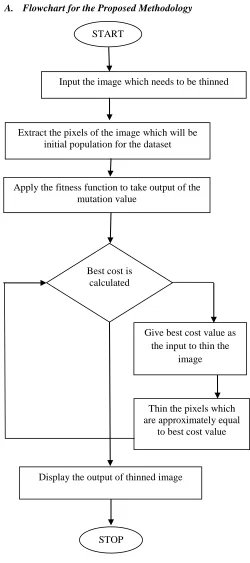
A. Flowchart for the Proposed Methodology
Fig. 1 Flowchart of proposed methodology
The main steps are described below:
1. Create a dataset.
2. Implementing existing algorithms: To implement the existing Zhang-Suen’sthinning algorithm.
START
Input the image which needs to be thinned
Extract the pixels of the image which will be initial population for the dataset
Apply the fitness function to take output of the mutation value
Best cost is calculated
Give best cost value as the input to thin the
image
Thin the pixels which are approximately equal
to best cost value
Display the output of thinned image
3. Propose a new method for skeletonization using neural networks.
4. Evaluating Performance: To evaluate the performance of existing algorithms and new proposed method for skeletonization using neural networks on the basis of some performance measures:
a) Thinning Rate: The degree to which an object is said to be thinned can be measured in terms of thinning rate. b) MSE: Mean square error.
c) PSNR: Peak signal to noise ratio.
V. EXPERIMENTAL RESULTS
The proposed scheme is implemented in MATLAB.
Fig. 2 Image Loaded
The image is stacked for the thinning as shown in figure Fig. 2. The thinning is strategy of expelling the unwanted data from image. To expel the unwanted data from the image thinning component is utilized which will evacuate unwanted data. The Zhang-Suen algorithm is utilized for thinning which gave an output regarding MSE, PSNR and thinning rate as shown in figure Fig. 3.
Fig. 3Application of Zhang-Suen algorithm
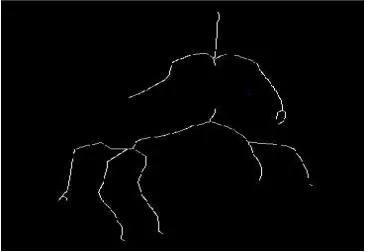
As shown in figure Fig. 4, to improve the output of Zhang-Suen algorithm in terms of PNSR, MSE and TR, enhancement is proposed which will be based on genetic algorithm. In this figure genetic algorithm is executed with Zhang-Suen algorithm. After applying
thegenetic algorithm the output of the thinning is image is shown which has better results than an existing one.
Fig. 4 Application of ProposedAlgorithm
Table 1: Table of Comparison
Parameter Zhang-Suen
Algorithm
Proposed Algorithm
PSNR 28.25 33.02
MSE 98.14 32.69
Thinning Rate 0.51 0.61
VI. CONCLUSION
The thinning isa technique to remove unwanted pixels from the image without reducing its quality. In the previous work, various algorithms have been proposed to implement thinning. In this work, improvement has been proposed in Zhang-Suen algorithm to apply thinning on the gray scale images. In the existing Zhang-Suen algorithm conditions for thinning are static which reduce the efficiency of thinning. The proposed work is based on Genetic Algorithm. Genetic algorithm begins parallel searching from autonomous purposes of pursuit space in which the arrangement learning is poor or not accessible. The arrangement relies on communication of the surroundings and genetic operators. The simulation is performed in MATLAB and the results shows that proposed algorithm is better in terms of thinning rate, MSE and PSNR.
REFERENCES
[1] Gonzalez R.C. and Woods R.E. (2002) Digital Image
Processing 2nd Ed. Tom Robbins.
[2] Abu-Ain W, et al. “Skeletonization Algorithm for Binary
Images” The 4th International Conference on Electrical
[3] Padole G.V, Pokle S. B. “New Iterative Algorithms For
Thinning Binary Images” Third International Conference on
Emerging Trends in Engineering and Technology IEEE 2010 pp. 166-171
[4] Lam L, et al. “Thinning methodologies-A comprehensive
survey” IEEE transactions on pattern analysis and machine
intelligence Vol. 14 No. 9 September 1992 pp. 869-885 [5] Chatbri et al. “Using scale space filtering to make thinning
algorithms robust against noise in sketch images” Pattern
Recognition letters 42(2014) pp. 1-10
[6] Zhou R.W., et al. “A novel single-pass thinning algorithm and
an effective set of performance criteria” 1995 Elsevier Science
pp. 1267-1275.
[7] Ahmed et al. “A Rotation Invariant Rule-Based Thinning
Algorithm for Character Recognition” IEEE transactions on
pattern analysis and machine intelligence, vol. 24, no. 12, December 2002 pp. 1672-1678
[8] Rockett “An Improved Rotation-Invariant Thinning
Algorithm” IEEE transactions on pattern analysis and machine
intelligence, vol. 27, no. 10, October 2005 pp.1671-1674 [9] Saeed K, et al. “K3M: A universal algorithm for image
skeletonization and a review of thinning techniques”
International Journal of Applied Mathematics & Computer Science, 2010, Vol. 20, No. 2, pp. 317–335
[10] Jagna A. and Kamakshiprasad V. “New parallel binary image
thinning algorithm” ARPN Journal of Engineering and
Applied sciences vol. 5, no. 4, April 2010 pp. 64-67
[11] Guo Z. and Hall R.W “Parallel thinning with Two- Sub
iteration algorithms” Communications of the ACM March