EFFECT OF SCALING AND ROOT PLANING ON SERUM RENAL FUNCTION MARKERS IN
SYSTEMATICALLY HEALTHY CHRONIC PERIODONTITIS SUBJECTS
A CONTROLLED CLINICAL TRIAL
*Sagar Prakash Kadam, Abhijit Ningappa Gurav, Rahul Ashok Patil, Abhijeet Rajendra Shete,
Sumit Sharad Shetagar, Pradnya Rajendra Khatavkar and Swapneel Charandas Bodele
Department of Periodontology
ARTICLE INFO ABSTRACT
Purpose:
loss of attachment and bone loss. It is closely related to several systemic diseases, such as cardiovascular disease. The link between periodonta
be due to infection and inflammation. The periodontal inflammatory state may increases the chronic inflammation present in CKD, thus decreasing renal function. Periodontal therapy may reduce inflammation and im
Materials and Methods:
group I and groups II. Group I was test group (TG) included twenty five patients and group II was control group (CG) included twenty
group only. Serum renal function and clinical parameters were checked at baseline and one month after SRP.
Results:
statistical difference among TG (p= 0.102). Before and after Comparison (baseline and 1 month) in TG, the clinical and renal function markers were statistically significant (p < 0.001).
Conclusion:
periodontal improvement, also serum creatinine, urea and bilurubin levels showed improvement after SRP.
Copyright©2017, Sagar Prakash Kadam et al.This
unrestricted use, distribution, and reproduction in any medium, provided the original work is properly cited.
INTRODUCTION
Chronic periodontitis (CP) the most common type infectious disease resulting in inflammation of the supporting structure of the teeth, ultimately loss of attachment and bone loss. This process leads to formation of pocket around the tooth and/or attachment loss.(AAP. 1999) It is a highly prevalent chronic inflammatory disease and closely related to several systemic diseases, such as cardiovascular disease and diabetes mellitus (Pihlstrom, 2005; Persson, 2008). Besides, CP
a risk factor and a prediction model for CKD. (Taylor GW. 2008)The association between periodontal disease and CKD may be due to either infection or inflammation
The periodontal inflammatory state increase the state of chronic inflammation present in CKD, thus decreasing renal
*Corresponding autour: Sagar Prakash Kadam,
Department of Periodontology, Tatyasaheb Kore Dental College and Research Centre, Kolhapur, Maharashtra, India.
ISSN: 0975-833X
Article History:
Received 23rd March, 2017
Received in revised form 10th April, 2017
Accepted 18th May, 2017
Published online 20th June,2017
Citation: Sagar Prakash Kadam, Abhijit Ningappa Gurav, Rahul Ashok Patil, Abhijeet Rajendra Shete, Khatavkar and Swapneel Charandas Bodele, 2017.
periodontitis subjects – A controlled clinical trial”, Internationa
Key words:
Chronic periodontitis, Serum creatinine, Serum urea, Serum bilirubin.
RESEARCH ARTICLE
EFFECT OF SCALING AND ROOT PLANING ON SERUM RENAL FUNCTION MARKERS IN
SYSTEMATICALLY HEALTHY CHRONIC PERIODONTITIS SUBJECTS
A CONTROLLED CLINICAL TRIAL
Sagar Prakash Kadam, Abhijit Ningappa Gurav, Rahul Ashok Patil, Abhijeet Rajendra Shete,
Sharad Shetagar, Pradnya Rajendra Khatavkar and Swapneel Charandas Bodele
Department of Periodontology, Tatyasaheb Kore Dental College and Research Centre,
Kolhapur, Maharashtra, India
ABSTRACT
Purpose: Chronic periodontitis (CP), the commonest type of periodontal disease caused progressive loss of attachment and bone loss. It is closely related to several systemic diseases, such as
cardiovascular disease. The link between periodontal disease and chronic kidney disease(CKD) may be due to infection and inflammation. The periodontal inflammatory state may increases the chronic inflammation present in CKD, thus decreasing renal function. Periodontal therapy may reduce inflammation and improves endothelial function.
Materials and Methods: Fifty one CP patients (Age 35- 60 years) was selected. Categorized group I and groups II. Group I was test group (TG) included twenty five patients and group II was control group (CG) included twenty six patients. Scaling and root planing (SRP) was done in test group only. Serum renal function and clinical parameters were checked at baseline and one month after SRP.
Results: After comparison of the clinical parameter and renal function markers at bas
statistical difference among TG (p= 0.102). Before and after Comparison (baseline and 1 month) in TG, the clinical and renal function markers were statistically significant (p < 0.001).
Conclusion: In the study there is significant improvement in periodontal parameter, which shows periodontal improvement, also serum creatinine, urea and bilurubin levels showed improvement after
This is an open access article distributed under the Creative Commons Att use, distribution, and reproduction in any medium, provided the original work is properly cited.
(CP) the most common type infectious disease resulting in inflammation of the supporting structure of the teeth, ultimately loss of attachment and bone loss. This process leads to formation of pocket around the tooth and/or is a highly prevalent chronic inflammatory disease and closely related to several systemic cardiovascular disease and diabetes mellitus CP has emerged as CKD. (Taylor GW. 2008)The association between periodontal disease and CKD may be due to either infection or inflammation (Levey, 1999). The periodontal inflammatory state increase the state of chronic inflammation present in CKD, thus decreasing renal
Sagar Prakash Kadam,
Department of Periodontology, Tatyasaheb Kore Dental College and
function (Kshirsagar, 2007). Traditional periodontal therapy reduces inflammation and improves endothelial function (D’Aiuto, 2010). Periodontal diseases as an increased risk for various chronic diseases. It contributes to increased generalized inflammatory burden which leads to wors
CKD. (Seinost, 2005) Pathogens cause destruction of tooth supporting tissues resulting in loss of attachment around the teeth and ultimately entry of pathogens and their products in
systemic circulation which caused
inflammation (Menon, 2003). The deleterious effects of
systemic inflammation on renal function could occur during the period of active periodontal infection and accumulate during the life time of the individual. Inflammation is an important predictor of low serum albu
dialysis patients. (Grubbs, 2011)Subjects with CKD have higher prevalence of periodontal disease while non
periodontal therapy (NSPT) has been indicated to decrease the inflammatory burden in patients with CKD and thus inferred
International Journal of Current Research Vol. 9, Issue, 06, pp.51975-51979, June, 2017
Sagar Prakash Kadam, Abhijit Ningappa Gurav, Rahul Ashok Patil, Abhijeet Rajendra Shete, Sumit Sharad Shetagar, Pradnya Rajendra
2017. “Effect of scaling and root planing on serum renal function markers in systematically healthy chronic
International Journal of Current Research, 9, (06), 51975-51979.
EFFECT OF SCALING AND ROOT PLANING ON SERUM RENAL FUNCTION MARKERS IN
SYSTEMATICALLY HEALTHY CHRONIC PERIODONTITIS SUBJECTS –
Sagar Prakash Kadam, Abhijit Ningappa Gurav, Rahul Ashok Patil, Abhijeet Rajendra Shete,
Sharad Shetagar, Pradnya Rajendra Khatavkar and Swapneel Charandas Bodele
Research Centre,
Chronic periodontitis (CP), the commonest type of periodontal disease caused progressive loss of attachment and bone loss. It is closely related to several systemic diseases, such as diabetes and l disease and chronic kidney disease(CKD) may be due to infection and inflammation. The periodontal inflammatory state may increases the chronic inflammation present in CKD, thus decreasing renal function. Periodontal therapy may reduce
60 years) was selected. Categorized into group I and groups II. Group I was test group (TG) included twenty five patients and group II was six patients. Scaling and root planing (SRP) was done in test group only. Serum renal function and clinical parameters were checked at baseline and one month
After comparison of the clinical parameter and renal function markers at baseline there is no statistical difference among TG (p= 0.102). Before and after Comparison (baseline and 1 month) in TG, the clinical and renal function markers were statistically significant (p < 0.001).
vement in periodontal parameter, which shows periodontal improvement, also serum creatinine, urea and bilurubin levels showed improvement after
Commons Attribution License, which permits
Traditional periodontal therapy reduces inflammation and improves endothelial function Periodontal diseases as an increased risk for various chronic diseases. It contributes to increased generalized inflammatory burden which leads to worsening of 2005) Pathogens cause destruction of tooth supporting tissues resulting in loss of attachment around the teeth and ultimately entry of pathogens and their products in
systemic circulation which causedincreased systemic
The deleterious effects of
systemic inflammation on renal function could occur during the period of active periodontal infection and accumulate during the life time of the individual. Inflammation is an important predictor of low serum albumin levels among 2011)Subjects with CKD have higher prevalence of periodontal disease while non-surgical periodontal therapy (NSPT) has been indicated to decrease the inflammatory burden in patients with CKD and thus inferred
INTERNATIONAL JOURNAL OF CURRENT RESEARCH
Sumit Sharad Shetagar, Pradnya Rajendra
that CKD and CP may have bidirectional relationship (Wahid, 2013). The present study designed to evaluate the effect of SRP on serum renal function markers and asses the relative risk of CKD in systematically sound CP patient.
MATERIAL AND METHODS
A non-surgical interventional clinical study was carried out from January 2015 to March 2015 in fifty one patients at the department of Periodontology, Tatyasaheb Kore Dental College and Research Centre, New Pargaon, Kolhapur, INDIA. Prior approval for the study was obtained from the local ethical committee. Clinical trial is registered at
www.clinicaltrials.gov. (NCT02636114). Patients with
generalized CP [(moderate and severe) according to CDC working group, 2007 criteria].Age ranging from 35-60 ( mean 45) years, should have at least 20 natural teeth, who have not received periodontal therapy within preceding six months were included in this study. Tobacco in any form and alcoholics, any other systemic disease which can alter the course of periodontal disease, subjects should have pregnant, women on hormone replacement therapy or hormonal contraceptives, patients taking steroidal or non-steroidal anti-inflammatory drugs (previous 3 months) or antibiotics, anti-inflammatory drugs in the previous six month and patients with aggressive periodontitis were excluded from this study. Study was explained, including the benefits, risks and alternative treatments, the patients signed an informed consent form indicating their agreement to participate in the study and each patient was assigned a patient number in ascending order to maintain the masking of evaluators. Eg. First patient is given a number D1, Second D2, and so on.
Groups
This was a Phase 2 clinical trial with an interventional model of parallel assignment with two arms. Hence, after screening through inclusion and exclusion criteria patients were divided into two groups, 25 (13 males and 12 females) patients were included in TG and 26 (13 males and 13 females) subjects included in CG.
Intervention
The study was non-surgical controlled clinical trial. A single study co-ordinator patient into two groups by using Quick Cals, Graphpad software and it has stratified with a 1:1 allocation. SRP had performed for all subjects in TG only at baseline by one trained Periodontist under local anaesthesia (if required) using Piezoelectricscaler [Satelec ACTEON P5TM], hand scalers and curette. Clinical parameter which includes plaque index (PI), gingival index (GI), probing depth (PD), clinical attachment loss (CAL) had recorded by trained examiner using UNC-15 probe in both groups.
Blood collection
5 ml of blood was collected from the antecubital fossa by venipuncture using 20-guage needle with 5 ml syringes. Blood samples were left to clot for (1-2) hours, then centrifuged at 4000 rpm for 15 minutes to obtain the serum. Serum was collected in disposable plastic serum containing tube, which
was stored at (2-40C) until time of assay. Estimation of levels
of urea (GLDH- urease method), bilirubin total (Diazo Method), creatinine (modified JAFFE’S method) was done at
the baseline and one month in both the groups, at ANANT laboratory, kodoli, Kolhapur (INDIA).
Statistical analysis
Descriptive and inferential statistical analysis has been carried out in the present study. A result on continuous measurements has presented on Mean ± SD (Min-Max) and results on categorical measurements has presented in number (%). Significance was assessed at 5% level of significance. The following assumptions on data was made, Assumptions: 1.Dependent variables should be normally distributed, 2.Samples drawn from the population should be random, cases of the samples should be independent Student t test (two tailed, independent) has been used to find the significance of study parameters on continuous scale between two groups (Inter group analysis) on metric parameters. Chi-square/ Fisher Exact test has been used to find the significance of study parameters on categorical scale between two or more groups. The Statistical software namely SAS 9.2, SPSS 15.0, Stata 10.1, MedCalc 9.0.1, Systat 12.0 and R environment ver.2.11.1 were used for the analysis of the data and Microsoft word and excel have been used to generate graphs, tables etc.
RESULTS
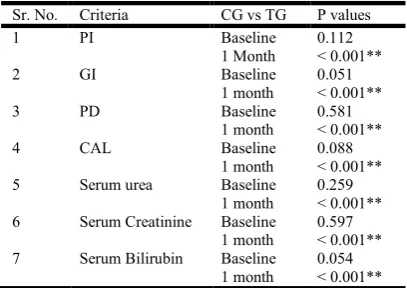
[image:2.595.309.560.500.607.2]The demographic distribution in the CG and TG were similar. There was no significant difference in age, as the mean and standard deviations were 45.68±2.94 yrs and 45.84±4.19 yrs for the respective groups. [Table 1] It can be seen that CG and TG not differed with respect to PI, GI, PD, CAL, serum urea, creatinine and bilirubin at the baseline. [Table 2] Baseline measurements showed no statistical difference in the PI (p=0.112) but one month after intervention it was showed statistically significant difference between CG and TG (p< 0.001).
Table 1. Descriptive analysis among Test and Control Group
Age in
years
Test Group Control Group P value
No % No %
40-50 21 84.0 24 96.0
0.876
51-60 4 16.0 1 4.0
Total 25 100.0 25 100.0
Mean ± SD 45.84±4.19 45.68±2.94
Gender Test Group Control Group
0.777
No % No %
Female 13 52.0 12 48.0
Male 12 48.0 13 52.0
Total 25 100.0 25 100.0
Table 2. Intergroup Comparison of Parameters in Control Group (CG) and Test group
Sr. No. Criteria CG vs TG P values
1 PI Baseline 0.112
1 Month < 0.001**
2 GI Baseline 0.051
1 month < 0.001**
3 PD Baseline 0.581
1 month < 0.001**
4 CAL Baseline 0.088
1 month < 0.001**
5 Serum urea Baseline 0.259
1 month < 0.001**
6 Serum Creatinine Baseline 0.597
1 month < 0.001**
7 Serum Bilirubin Baseline 0.054
[image:2.595.331.535.648.792.2]On comparing the GI at baseline there was no significant difference between TG and CG (p=0.051) but assessing the value after 1 month showed statistically significant difference between CG and TG (p< 0.001). Likewise, on evaluation of the PD at baseline there was no significant difference in CG and TG (p<0.581), after 1 month, there was significant difference between CG and TG (p= 0.001).
Table No. 3 Intragroup Comparison of Parameters in Control Group (CG)
Sr. No. Criteria Control Group P values
1 PI Baseline vs 1 Month 0.103
2 GI Baseline vs 1 Month 0.754
3 PD Baseline vs 1 Month 0.327
4 CAL Baseline vs 1 Month 0.215
5 Serum urea Baseline vs 1 Month 0.047*
6 Serum creatinine Baseline vs 1 Month 0.083
7 Serum bilirubin Baseline vs 1 Month 0.103
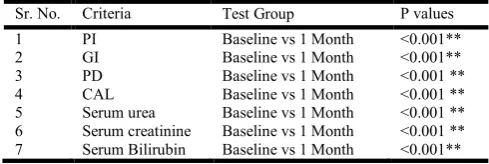
Table No. 4 Intragroup Comparison of Parameters in Test Group (TG)
Sr. No. Criteria Test Group P values
1 PI Baseline vs 1 Month <0.001**
2 GI Baseline vs 1 Month <0.001**
3 PD Baseline vs 1 Month <0.001 **
4 CAL Baseline vs 1 Month <0.001 **
5 Serum urea Baseline vs 1 Month <0.001 **
6 Serum creatinine Baseline vs 1 Month <0.001 **
7 Serum Bilirubin Baseline vs 1 Month <0.001**
Non-significant difference was seen in case of CAL, which was measured at baseline (p<0.088) but statistical significant difference seen 1 month after SRP (p=0.001). Comparison of serum analysis it was showed no significant difference in serum urea level at the baseline (p=0.259) and 1 month evaluation it was showed statistical significant difference between CG and TG after SRP (p=0.001), likewise, on assessment of serum creatinine level showed no significant difference between CG and TG at baseline (p=0.597) Serum bilirubin showed statistical significant difference at 1 month in TG after intragroup and intergroup comparison with CG (p=0.001). After intragroup evaluation of all periodontal parameters and serum parameters of CG at baseline and at 1 month showed that there was no statistical significant difference [Table 3] but TG showed statistical significant difference between at baseline and 1 month in periodontal and serum parameters after SRP [Table 4].
DISCUSSION
American dental association highlighted 200 possible connections between oral health and systemic diseases (Loos, 2006)Studies have been established a relationship of systemic conditions like cardiovascular diseases, diabetes mellitus, anemia, pulmonary diseases, osteoporosis and CKD with oral diseases but the relationship yet established is an association and not causation (Bokhari, 2006). In some situations a bidirectional model has also been observed. Presence of one condition increases the chances of others. On the other hand controlling one condition might be benefiting the patient regarding the other condition. CKD is a systemic condition which significantly affects oral hard and soft tissues. One of the main effects is enamel hypoplasia due to disturbance in enamel formation and mineralization. The other manifestations of CKD and hemodialysis (HD) therapy are xerostomia,
enamel hypoplasia, calcification of root canals, abnormal pH of saliva and abnormal delay in eruption of teeth. (Proctor R. 2005) Community based study showed a high percentage of CKD in the general population (Anees, 2011).
In this study, we investigated the possible association between CP and renal insufficiency by assessing clinical parameter and kidney disease markers in two groups of subjects which were diagnosed with CP with absence of any systemic condition. The patients with CP had slight alteration in the level of the blood parameter of renal dysfunction, relative to normal value and furthermore these markers stayed within their normal ranges in both groups, suggesting that severe CP does not affect renal function.(Johnson CA 2004a,2004b)These findings were obtained from 1 direct and 2 indirect markers of renal function i.e direct bilirubin and serum creatinine and urea respectively. Several studies have been published showing correlation between CP and renal dysfunction, some of which involve specific bacterial species. According to Socransky (1998) the micro-organisms responsible for CP belong to the red complex (Porphyromonasgin givalis, Tanerellaforsythia and Treponemadenticola), while Sendy J et al. (2009)reported that there is considerable evidence that CP related micro-organisms impaired blood rheological parameters and thereby contribute significantly to accelerated systemic or local diseases that cause premature death in dialyzed patients. In addition, for a number of years, reference values have been used for various diseases that do not yet signify the actual disease but are close to the upper limit of the normal range. An example is impaired fasting plasma glucose. (Burtis, 2006) The same reasoning could be applied to laboratory assays used as markers for kidney damage, to allow preclinical signs to be detected before the onset of the disease. Thus, by analogy with diabetes, in this study the TG and CG was compared not only with each other but also with kidney dysfunction marker reference values. Hence, we were tried to discover whether CP could promote any detectable change in kidney function, even when the marker in question remained within its reference interval, although it shifted nearer to the upper limit of this range and whether the SRP have beneficial roleon serum renal function markers such as urea, creatinine and bilirubin in systematically healthy CP patient. In present study, it can be seen that CG and TG not differed with respect to PI, GI, PD, CAL serum Urea, creatinine and bilirubin at the baseline. At baseline there was no statistical difference in the clinical parameters but after intervention in the TG and CG evaluation after one month it showed statistically significant difference was observed in TG only. Comparison of serum parameters it was showed that, there was no significant difference in serum urea level at the baseline but after 1 month evaluation showed statistical significant difference between CG and TG. After intragroup evaluation of all periodontal clinical parameters and serum parameters of CG at baseline and at 1 month showed no statistical significant difference but TG showed statistical significant difference between from baseline to 1 month in periodontal and serum parameters after SRP. Various cross sectional studies conducted in Brazil, Canada, Turkey, USA and Taiwan reported that CP was significantly more frequent among HD patients as compared to normal persons and periodontal disease was comparatively more severe and prevalent in CKD patients (Klassen, 2002; Duran, 2004; Souza, 2005; Chen, 2006; Craig, 2008). These studies enrolled above 1000 study subjects for a better comparison among patients and healthy controls. Based on community periodontal
[image:3.595.39.284.300.382.2]high severity of CP as compared to healthy population. Using
CAL as an indicator of periodontitis, Thorman et al. (2009)
reported that HD patients had significantly more attachment loss as compared to healthy individuals. Studies focusing on the periodontal health of End Stage Renal disease (ESRD) patients on HD maintenance therapy have reported the presence of poor oral hygiene and gingival inflammation in study subjects (Duran, 2004).
In a clinical trial performed on 352 patients, researcher found an increased severity of CP in HD patients as compared to normal healthy persons. On the other hand, Bots CP et al. (2006) in a study from Netherlands of ESRD patients, some of whom were receiving HD, did not find an increased loss of attachment when compared with some healthy case-matched controls. Periodontal status of ESRD patients receiving HD showed no increase in periodontal indices when compared with case-matched controls (Thorman, 2009). The authors noticed that the HD group had greater numbers of periodontopathic bacterial species than the CG (Bots, 2006). After adjusting other risk factors, CP was highlighted as an independent risk factor for CKD in most of the trials. In a case control study,
Kshirsagar et al. (2007) observed an association of severe
periodontal disease and hypoalbuminemia in a group of patients who were receiving long-term outpatient HD. In study subjects, patients with periodontal disease were three times more likely to have low serum albumin than patients without periodontal disease. Some clinical trials showed that periodontal treatment bring changes in serum inflammatory markers of CKD patients and successful periodontal therapy decreases serum C-reactive protein levels, Interleukin-6 and Low Density Lipoprotein-cholesterol (Nibali L. 2012). Vilela et al. (2011) reported the findingsof a randomized controlled trial that periodontal therapy decreases level of serum prohepcidin in CKD patients. The issue of poor oral health status in CKD patients apparently deserves a higher awareness of the problem and increased attention and indicates the need for a closer collaboration between primary care physicians, nephrologists and dentists. (Chen, 2006)A few studies analyzed the levels of creatinine in serum before and after 3 months in periodontitis patients. Improvements in clinical status were noted following periodontal maintenance and there was a corresponding decrease in creatinine levels. This finding co related to our findings. The results of this study demonstrated that patients with CP suffered slight alteration in the level of any of the blood indicators of renal dysfunction, relative to the healthy group and furthermore these markers stayed within their normal ranges in both groups, suggesting that severe CP does not affect renal function.
Conclusion
Within limits of this study there is association between renal function markers and periodontal disease within normal levels. In the study there is significant improvement in periodontal parameter, which shows periodontal improvement, also serum creatinine, serum urea and serum bilirubinlevel shows improvement 1 month evaluation after SRP.
REFERENCES
American Academy of Periodontology.International workshop for a classification of periodontal disease and conditions. Ann Periodontol., 1999; 4:1-112.
Anees, M., Hameed, F., Mumtaz, A., Ibrahim, M., Saeed Khan, M.N. 2011. Dialysis-related factors affecting quality
of life in patients on hemodialysis. Iran J Kidney Dis.,
5(1):9-14.
Bokhari, S.A., Khan, A.A. 2009. Growing burden of non-communicable diseases: the contributory role of oral
diseases.Eastern Mediterranean Region perspective. East
Mediterr Health J., 15(4):1011-1020.
Borawski, J., Wilczynska-Borawska, M., Stokowska, W., Mysliwiec, M. 2007. The periodontal status of pre-dialysis chronic kidney disease and maintenance dialysis patients. NephrolDial Transplant, 22(2):457-464.
Bots, C.P., Poorterman, J.H., Brand, H.S., Kalsbeek, H., van
Amerongen, B.M., Veerman, E.C. et al. 2006. The oral
health status of dentate patients with chronic renal failure undergoing dialysis therapy. Oral Dis., 12(2):176-180. Burtis, C.A., Ashwood, E.R., Bruns, D.E. 2006. eds. Tietz
textbook of clinical chemistry and molecular diagnostics. 4th ed. St Louis: Elsevier Saunders, p.837-901.
Chen, L.P., Chiang, C.K., Chan, C.P., Hung, K.Y., Huang, C.S. 2006. Does periodontitis reflect inflammation and
malnutrition status in hemodialysis patients? Am J Kidney
Dis., 47(5):815-822.
Craig, R.G. 2008. Interactions between chronic renal disease and periodontal disease. Oral Dis., 14(1):1-7.
D’Aiuto, F., Nibali, L., Parkar, M., Patel, K., Suvan, J., Donos,
N. et al. 2010. Oxidative stress, systemic inflammation,
and severe periodontitis. J Dent Res., 89(11):1241-6. Duran, I., Erdemir, E.O. 2004. Periodontal treatment needs of
patients with renal disease receiving haemodialysis. IntDent J., 54(5):274-278.
Grubbs, V., Plantinga, L.C., Crews, D.C., Bibbins-Domingo,
K., Saran, R., Heung, M. et al. 2011. Vulnerable
populations and the association between periodontal and
chronic renal disease. Clin J Am SocNephrol.,
6(4):711-717.
Johnson, C.A., Levey, A.S., Coresh, J., Levin, A., Lau, J., Eknoyan, G. 2004a. Clinical practice guidelines for chronic kidney disease in adults: Part I. Definition, disease stages,
evaluation, treatment, and risk factors. Am Fam Physician,
70:869-876.
Johnson, C.A., Levey, A.S., Coresh, J., Levin, A., Lau, J., Eknoyan, G. 2004b. Clinical practice guidelines for chronic kidney disease in adults: Part II. Glomerular filtration rate,
proteinuria, and other markers. Am Fam Physician,
70:1091-1097
Klassen, J.T., Krasko, B.M. 2002. The dental health status of dialysis patients. J Can Dent Assoc., 68(1):34-38.
Kshirsagar, A.V., Craig, R.G., Beck, J.D., Moss, K.,
Offenbacher, S., Kotanko, P. et al. 2007. Severe
periodontitis is associated with low serum albumin among
patients on maintenance hemodialysis therapy. Clin J Am
SocNephrol., 2(2):239-44.
Levey, A.S., Bosch, J.P., Lewis, J.B., Greene, T., Rogers, N., Roth, D. 1999. A more accurate method to estimate glomerular filtration rate from serum creatinine:a new prediction equation.Modification of Diet in Renal Disease Study Group. Ann Intern Med., 130:461–470.
Loos, B.G. 2006. Systemic effects of periodontitis. Int J Dent Hyg., 4(Suppl 1):34-38; discussion 50-32.
Nibali, L., Fedele, S., D’Aiuto, F., Donos, N. 2012.
Interleukin-6 in oral diseases: a review. Oral Dis.,
18(3):236-243.
Persson, G.R., Persson, R.E. 2008. Cardiovascular disease and
periodontitis.An update on the associations and risk. J
ClinPeriodontol., 35(8 Suppl):362-79.
Pihlstrom, B.L., Michalowicz, B.S., Johnson, N.W. 2005. Periodontal diseases. Lancet, 19;366(9499):1809-20. Proctor, R., Kumar, N., Stein, A., Moles, D., Porter, S. 2005.
Oral and dental aspects of chronic renal failure. J Dent
Res., 84(3):199-208.
Seinost, G., Wimmer, G., Skerget, M., Thaller, E., Brodmann,
M., Gasser, R. et al. 2005. Periodontal treatment improves
endothelial dysfunction in patients with severe
periodontitis. Am Heart J., 149(6):1050-4.
Sendy, J., Horta, E., Foltán, R., Spackova, J., Dusková, J. 2009. Mechanism of increased mortality in hemodialysed patients with periodontitis. Med Hypotheses., p 308-312 . Socransky, S.S., Haffajee, A.D., Cugini, M.A., Smith, C.,
Kent, Jr RL. 1998. Microbial complexes in subgingival plaque. J ClinPeriodontol., 25:134-144.
Souza, C.R., Liberio, S.A., Guerra, R.N., Monteiro, S.,
Silveira, E.J., Pereira, A.L. et al. 2005. Assessment of
periodontal condition of kidney patients in hemodialysis. Rev Assoc Med Bras., 51(5):285-289.
Taylor, G.W., Borgnakke, W.S. 2008. Periodontal
disease.Associations with diabetes, glycemic control and complications. Oral Dis., 14(3):191-203.
Thorman, R., Neovius, M., Hylander, B. 2009. Clinical findings in oral health during progression of chronic kidney disease to end-stage renal disease in a Swedish population. Scand J UrolNephrol., 43(2):154-159.
Vilela, E.M., Bastos, J.A., Fernandes, N., Ferreira, A.P.,
Chaoubah, A., Bastos, M. G. et al. 2011. Treatment of
chronic periodontitis decreases serum prohepcidin levels in patients with chronic kidney disease. Clinics (Sao Paulo), 66(4):657-662.
Wahid, A., Chaudhry, S., Ehsan, A., Butt, S., Khan, A.A. 2013. Bidirectional Relationship between Chronic Renal Disease & Periodontal Disease. Pak J Med Sci., 29(1):211-215.