ISSN Online: 1945-3124 ISSN Print: 1945-3116
DOI: 10.4236/jsea.2018.118023 Aug. 6, 2018 363 Journal of Software Engineering and Applications
A Metamodel-Driven Business Process
Modeling Methodology and Its Integrated
Environment for Reusing Business Processes
Rieko Yamamoto
1, Kouji Yamamoto
1, Kyoko Ohashi
1, Junji Inomata
2, Mikio Aoyama
31Fujitsu Laboratories Ltd., Kawasaki, Japan
2Fujitsu Limited, Tokyo, Japan
3Nanzan University, Nagoya, Japan
Abstract
Reusing business process models and best practices can improve the produc-tivity, quality and agility in the early development phases of enterprise soft-ware systems. To help developers reuse the business process models and best practices, we propose a methodology and an integrated environment for business process modeling driven by the metamodel. Furthermore, we pro-pose a process-template design method to unify the granularity and separate the commonality and variability of business processes so that business process models can be reused across different enterprise software systems. The proposed methodology enables to create reuse-oriented business process templates before the business process modeling. To support the proposed methodology, we developed an integrated environment for creating, reusing and verifying the business process models. As the key techniques, we describe the methodology and its integrated environment, including a metamodel and notations. We applied the methodology and integrated environment to an actual enterprise software development project, and evaluated that the prod-uctivity of business process modeling is improved by at least 46%. As the conclusion, this paper contributes to prove the effectiveness of the me-ta-model driven business process modeling methodology for the reuse of business process models.
Keywords
Enterprise Software Development, Business Process Modeling, Business Process Metamodel, UML, Reusable Business Process Model, Integrated Environment
How to cite this paper: Yamamoto, R., Yamamoto, K., Ohashi, K., Inomata, J. and Aoyama, M. (2018) A Metamodel-Driven Business Process Modeling Methodology and Its Integrated Environment for Reusing
Business Processes. Journal of Software
Engineering and Applications, 11, 363-382.
https://doi.org/10.4236/jsea.2018.118023
Received: June 26, 2018 Accepted: August 3, 2018 Published: August 6, 2018
Copyright © 2018 by authors and Scientific Research Publishing Inc. This work is licensed under the Creative Commons Attribution International License (CC BY 4.0).
DOI: 10.4236/jsea.2018.118023 364 Journal of Software Engineering and Applications
1. Introduction
Development of enterprise software systems is facing a big challenge to reengi-neer the business for digital business [1]. Since business process is the heart of enterprise software systems, the challenge goes to reengineer the business process under the following common situations:
1) An enterprise needs to reexamine its entire business process and software systems, and to align the business model, business process and software systems. The underlying motivation lies in that the enterprise needs to create new busi-ness model and its operating environments at a lower cost within a shorter time. 2) An enterprise needs to tackle new problems arising in today’s rapid chang-ing business environment, and to develop a solution which may affect the entire enterprise.
To meet such demands, a lot of methods have been proposed for modeling, visualization and monitoring business process under the umbrella of BPM (Business Process Management) [2][3]. Moreover, the importance of clarifying the business process in the requirements analysis of enterprise software devel-opment has been recognized.
Techniques and tools for business process modeling, such as ARIS [4], have been proposed [5]. In addition, many ERP (Enterprise Resource Planning) products provide various business process models in the form of templates. However, such business process models are increasingly inconsistent with actual customer businesses. Moreover, business analysts and developers tend to adopt their own business process analysis and developing techniques, which hinders to reuse the business process in the enterprise software development [6]. It is im-portant to unify business process models.
To enable the reuse of business process models, we developed a method of business process modeling by extending UML (Unified Modeling Language) [7], which is widely used as a global standard notation. Our approach is similar to that of ISO/IEC OMG BPMN (Business Process Model and Notation) for repre-sentation [8] [9]. However, it is reported problems arising in practical use of BPMN for BPM (Business Process Modeling) [10]. Therefore, we defined an ex-tended meta-model to guide the business process modeling, and reuse method with a set of BPM templates and supporting IE (Integrated Environment), which are the major contributions of this work.
con-DOI: 10.4236/jsea.2018.118023 365 Journal of Software Engineering and Applications
tribution of this work with related work in Section 6 and Section 7. We conclude in Section 8.
2. Business Process Modeling
2.1. Goals
The goal of our business process modeling is to shorten the time needed to reen-gineer the customers’ business process and to develop the enterprise software supporting the business process. To make the reengineering agile, we focus on the visualization and reuse of the business process. If the business process is modelled as reusability in mind, we can reuse the process, and quickly reengi-neer the process, and shorten the development time of enterprise software.
To enable the reuse, we identified the following properties of reusable busi-ness process model.
1) Objectivity: The operational semantics should be clearly defined. 2) Consistency: The modeling technique should be unified.
3) Maintainability: Continuous control of maintenance should be easy. 4) Reusability: An output document can be reused as an input for business process analysis.
5) Descriptiveness of details: Enough details should be described at a reusable level.
The authors have developed a business process modeling methodology and integrated environment that meet these requirements.
2.2. Metamodel and BPML (Business Processes Modeling
Language)
A number of BPMLs (business process modeling languages) have been pro-posed, including ISO/IEC OMG BPMN [8][9], and many homegrown languages
[11] [12]. However, many of them are too abstract, and/or restricted to
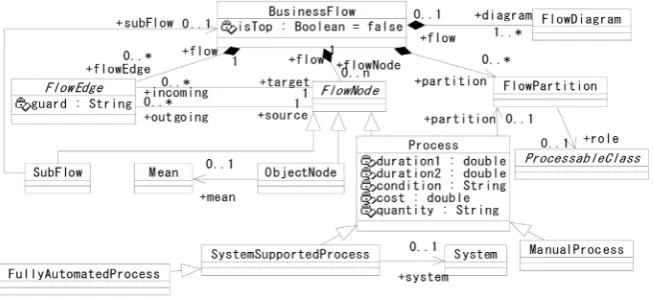
workflow, and difficult to reuse across the organization due to the lack of com-mon understanding. Therefore, the authors propose a BPML metamodel, a me-tamodel to provide a common ground of business process modeling languages and their semantics. Figure 1 shows part of the proposed BPML metamodel. The BPML metamodel is based on the UML 2.4.1 superstructure metaclasses
[13][14], but is extended with our business process profile. Table 1 summarizes the relationship between the classes of the BPML metamodel and those of UML 2.4.1 superstructure. Note that UML 2.4.1 superstructure is a basis of the latest UML 2.5.1 specification [7], which integrates the superstructure within the spe-cification. Therefore, the proposed BPML metamodel is consistent with UML 2.5.1.
The metamodel includes indexes for the evaluation of business process mod-eling. The authors defined the following attributes as the generic evaluation cri-teria of a business process with meta-class name: Process.
DOI: 10.4236/jsea.2018.118023 366 Journal of Software Engineering and Applications Figure 1. BPML metamodel (part).
Table 1. Correspondence between the BPML metamodel and UML 2.5.1 superstructure.
Meta-class for business process modeling Corresponding UML 2.5.1 class
Business Flow Activity
Flow Node Activity Node
Flow Edge Activity Edge
Process Action (stereotype)
Manual Process Action (stereotype)
System Supported Process Action (stereotype)
Fully Automated Process Action (stereotype)
Sub Flow (Sub Activity) Call Behavior Action
Object Node Object Node
Mean Class (stereotype)
Flow Partition (Swimlane) Activity Partition
Flow Diagram (no correspondence)
2) Cost: cost spent.
3) Condition: starting conditions.
On the notations of business process modeling language, it is needed to maintain a consistency with UML at a high level. The business process flow dia-gram explained later is an extension of UML activity diadia-gram with additional icons. The business structure diagram, and business data diagram, and organiza-tion diagram are extensions of the UML class diagram with addiorganiza-tional icons.
2.3. Elements of Business Process Model
busi-DOI: 10.4236/jsea.2018.118023 367 Journal of Software Engineering and Applications
ness data, 4) roles, and 5) BPM properties. 1) Global business structure
A global business structure is modeled with layered structure and relations between businesses processes within a layer. A “Business Structure Diagram” is based on the UML class diagram and package diagram. It is intended to describe the global business structure. Each business process module is expressed as a UML package in the diagram. The details of the business structure diagram is described by the following business processes flow, and business data.
2) Business processes and business process flows within a business module A unit of work is generally called “Business Process” [2]. A business process is structured into an ordered flow of unit of works, hence flow of business processes. It is described by “Business Process Flow Diagram”. A business process flow diagram is based on UML activity diagram.
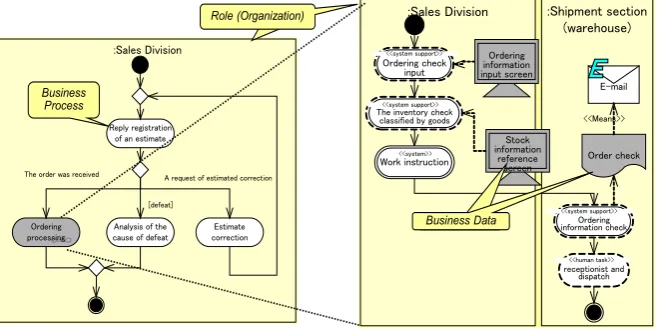
As illustrated in Figure 2, it represents a unit of business process model as a work flow of business processes. The business process is a unit of work done by not only a computing system, but also people. Therefore, each business process can be typed with three stereotypes of <<human task>>, <<system support>>, and <<system>>.
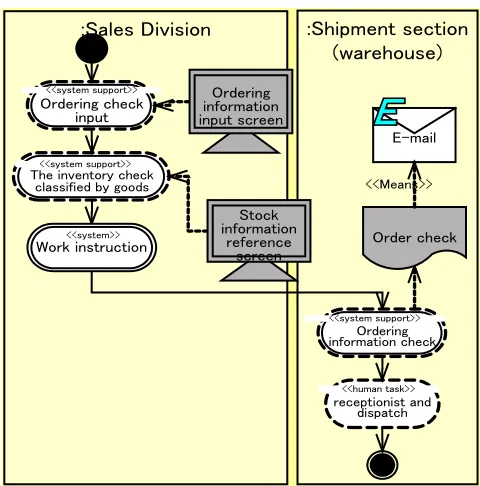
A condition can be associated to a branch of flow to control the flow into multiple parallel flows. Moreover, if the business process flow needs to be fur-ther refined, a process flow showing the details of one business process can be used. Figure 3 illustrates the refined business process flow of “Order Processing” business process shown in Figure 2.
3) Business data
[image:5.595.210.539.544.709.2]Business data is the input and/or output of a business process, and is created and/or changed by the process. A “Business Data Diagram” represents a holistic view of data involving the business process. It is based on the UML class dia-gram with semantic extension of business. Business data are expressed as a “Class” with a set of types specific to business data. A unique icon is used to in-dicate the type of data as exemplified in Figure 3. If necessary, the means of
Figure 2. Example of business process flow.
:Sales Division
Reply registration of an estimate
Ordering processing
Analysis of the cause of defeat
Estimate correction The order was received
[defeat]
A request of estimated correction
:Shipment section (warehouse) :Sales Division Ordering check input <<system support>>
The inventory check classified by goods
DOI: 10.4236/jsea.2018.118023 368 Journal of Software Engineering and Applications Figure 3. Refined business process flow of “Order Processing” in Figure 2.
sending data are described; in Figure 3, an e-mail is used for sending “Order Check”.
4) Roles in an organization
Role is an organizational element which executes a business process. The “Organization Diagram” based on the UML class diagram is used to describe roles in organization. A role is expressed as a “Class” in this diagram.
5) BPM properties
To improve a business process through BPM, it is necessary to provide evalu-ation criteria. The evaluevalu-ation criteria and associated statistics can be defined in a business process, business data, and an organization. For a business process, the time and cost required for completion, pre-conditions, for example, at the first day of every month, are defined.
3. Metamodel-Driven Business Process Modeling
Methodology and Supporting Integrated Environment
3.1. Objectives of BPM Methodology
Based on the goals stated in Section 2.1, the authors set the concrete objectives to elaborate the metamodel-driven BPM methodology and BPM-IE (Business Process Modeling Integrated Environment).
1) BPML metamodel
Through the BPML metamodel, the meaning of each entity described in Sec-tion 2.2 is clarified. Therefore, the metamodel ensures the consistency between entities across different business process models, and makes it possible to reuse a business process model as data shared through the BPM-IE. The metamodel also helps maintainability of business process models by governing the change of
:Shipment section (warehouse) :Sales Division
Ordering check input
<<system support>>
The inventory check classified by goods
<<system>>
Work instruction
<<human task>>
receptionist and dispatch Ordering information check
E-mail Ordering
information input screen
Stock information
reference screen
Order check
<<Means>>
<<system support>>
DOI: 10.4236/jsea.2018.118023 369 Journal of Software Engineering and Applications
models. Especially, the metamodel helps extension of business process models, like UML superstructure, for meeting the demands from customers. By verifying the extension of the models against metamodel, it is possible to ensure consis-tency, completeness and unambiguity of the extended models.
2) Metamodel-driven business process modeling methodology
The metamodel-driven business process modeling means that the entire process of business process modeling is governed by a metamodel through the BPM-IE explained below. The proposed methodology focuses on reuse of busi-ness process, the metamodel can ensure the consistency as mentioned above.
3) BPM-IE (Business Process Modeling Integrated Environment)
The BPM-IE supports the modeling of business processes under the gover-nance of the metamodel. With metamodel, BPM-IE assures the consistency, completeness and unambiguity of the business process created. Therefore, BPM-IE is indispensable to create and reuse the business processes based on the business process modeling methodology.
[image:7.595.210.538.550.707.2]3.2. Business Process Modeling Methodology
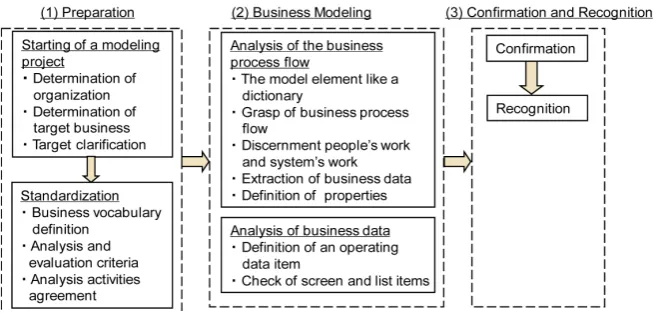
Figure 4 illustrates an outline of three-stage processes of the business process modeling methodology.
1) Preparation
In “Preparation”, the business process modeling project is initiated, followed by determining the context of business process, including target organization, target business process and BPM properties to be clarified. After initiation, we can collect and define the vocabulary used in the organization, set evaluation criteria, and create agreement among stakeholders involving the business process modeling.
2) Business process modeling
“Business Process Modeling” is the central process of the methodology. It consists of two activities of “Analysis of Business Process Flow” and “Analysis of Business Data”. The two activities view two sides, flow and data, of the same business process model, and can be done in an iterative way.
DOI: 10.4236/jsea.2018.118023 370 Journal of Software Engineering and Applications
In “Analysis of Business Process Flow” activity, model elements are elicited, and business process flows are analyzed along with the workflow. The business processes are classified with three execution stereotypes. Then, the business data are elicited as the input and/or output of each business process. Each business process, a set of properties is identified.
After eliciting business data, in “Analysis of Business Data” activity, the data are analyzed and defined the attributes. Finally, the format of the screen page and list, which are input and out of the business process flow are specified.
3) Confirmation and recognition
“Confirmation and Recognition” is a process of verification of business process models and creating of consensus of the model with the stakeholders involving the business process modeling.
The proposed methodology has the following notable features:
1) “Preparation” is important to set the goals and scope of the methodology. Major stakeholders, including customers, i.e. the people conducting the business on the business process, business analysts, and developers set the goals of busi-ness process modeling in advance. Based on the goals, the analysis and evalua-tion criteria can be customized.
2) At the end of “Preparation”, it is expected to create an agreement of the goal and scope of business process modeling. The agreement is important to prevent the scope creek and promote sharing and reuse the business press mod-els. For example, our business process flow diagram includes a set of constraints, so that the scope and execution semantics can be more clearly defined than the UML activity diagram.
3) In “Confirmation and Recognition”, the BPM-IE enables to verify the con-sistency, completeness and unambiguity of the business process models, which is tedious and error prone work.
3.3. BPM-IE (Business Process Modeling Integrated Environment)
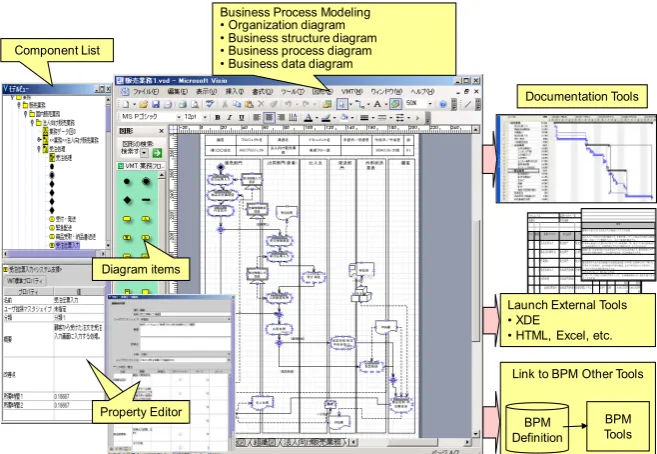
We developed the BPM-IE (Business Process Modeling Integrated Environment) as shown in Figure 5.
The center window shows a business process flow diagram for CRM (Cus-tomer Relationship Management). The upper left window shows the directory of the repository of the business process models. The root directory indicates the whole business. Under the directory, layers of business process models are stored in the repository. The lower left window shows the definition of business data for CRM. Another lower left window shows the BPM properties including the metrics and the target value of a business process performance.
The BPM-IE has the following functions. 1) Business process modeling
DOI: 10.4236/jsea.2018.118023 371 Journal of Software Engineering and Applications Figure 5. Screen view of BPM-IE (Business Process Modeling Integrated Environment).
2) BPM properties design
The BPM-IE supports to create and edit the detailed information on business processes and business data.
3) Verification of business process models
The BPM-IE supports to assure that the business process model is unambi-guous and consistent. It means there is no mismatching in the diagrams of a business process model. Verification is done based on the constraints defined by the metamodel and the notations. For example, if no condition is given at a con-ditional branch in a business process flow diagram, the BPM-IE suggests the problems and possible resolutions.
4) Generating documents of multiple-viewpoints
Documents of multiple viewpoint and notations are generated to support the review and approval of the business process models. For example, a table format document listing the properties of a business process can be generated. In addi-tion, users can customize the format of a document, and the selection of the BPM properties to be presented.
5) Model extension
The model extension function can be used in the “Preparation” process for extending the business process modeling capability by adding user specific BPM properties, or changing the default BPM properties to the meta-class unit of the metamodel.
6) Toole integration through BPM-IE APIs
The BPM-IE provides the functions though the APIs. Other tools/IEs can access the modeling artifacts through the APIs. For example, data from the business process flow are provided to the BPM monitoring tool for monitoring the execution of business processes [15].
Business Process Modeling •Organization diagram •Business structure diagram •Business process diagram •Business data diagram Component List
Diagram items
No.階層業務プロセス担当部署システム名起動 条件コスト 業務処理量所要時間1時間2所要 11受注伝票入力販売部門販売管理システム 50円 2枚0.16667時間 0.16667時 間 21商品別在庫照会販売部門在庫管理システム 50円 0.4166667時
間0.166667時間 31作業指示 販売部門販売管理システム 50円 1枚0.583333時
間0.083333時間 41発注伝票入力出荷部門(倉庫) 在庫管理システム 50円 4.166667時
間0.166667時間 51出荷処理 出荷部門(倉庫) 37.4332997
時間0.8499657時間 62出荷伝票発行 出荷部門(倉庫) 在庫管理システム 50円 2枚8.083333時
間0.083333時間 72ピッキング作業 出荷部門(倉庫) 100円 8.3333時間 0.3333時間 82出荷確認入力 出荷部門(倉庫) 在庫管理システム 50円 1枚8.083333時
間0.083333時間 ドキュメント名
業務名 業務プロセス一覧販売業務 概要 顧客から受けた注文を受注入力画面に入力する処理。 受注入力した商品の在庫を確認する。在庫管理システムの商品別在庫照会画面 を開き、商品コードと個数を入力し、受注可能数を確認する。 作業指示画面から在庫が有る場合には出荷依頼を、無い場合には発注依頼を行 う。出荷処理を行うと、在庫管理システムに情報が行き、引当が行われる。 依頼に基づき在庫切れの商品を発注するために伝票を起こす。販売管理システ ムから来た情報を参照し、発注数や発注先、予定納期を入力する。 販売部門から来た受注情報から出荷伝票を起こす作業。出荷待ちのの一覧から、 作業する行を選択し、表示画面の内容の確認、および担当者の入力等を行い、 ピッキング用の出荷伝票を出力する。 出荷伝票に従って、物を揃える作業。 ピッキングした製品と出荷伝票をチェックし、出荷確認画面から、商品の過不足を 入力する作業。 Documentation Tools
Link to BPM Other Tools Launch External Tools •XDE
•HTML, Excel, etc.
DOI: 10.4236/jsea.2018.118023 372 Journal of Software Engineering and Applications
4. Business Process Reuse Method with BPM Templates
4.1. Principles of the Business Process Reuse Method
Based on the business process modeling methodology mentioned in the previous section, we propose the business process reuse method with BPM templates. By reusing the verified business process models, we can expect to improve the agili-ty, productiviagili-ty, and quality of the business process modeling.
With the methodology and BPM-IE described in Section 3, modeling artifacts can be stored into the repository in a unified form. With the BPM-IE, the busi-ness process models are assured to be complete, consistent and unambiguous.
However, we realized that such artifacts cannot be reused by simply eliminat-ing the customer-specific changes, extensions and information. To facilitate the reuse, we introduced the following two principles based on the principles of se-paration of concerns [16].
1) A unified granularity of a business process and data component must be defined.
2) Separation of commonality and variability: Reusable common information and customer-specific information must be separated [17]. The variation points are specified as hot spots.
Note that the principles are consistent with the basis of OMG RAS (Reusable Asset Specification) [18].
To realize the business process reuse based on these principles, we defined the modularity criteria and levels of abstraction of the hierarchy of the business process flow. In addition, we evaluated the productivity improvement by reusing the business process models.
4.2. Business Process Reuse Method with BPM Templates
To materialize the principles of business process reuse, we defined two levels of the hierarchical BPM (Business Process Model) templates. With the BPM tem-plates, we propose a method of development and application of BPM templates. First, the method enables to describe a reusable business process flow.
We also defined the roles of business process modeling team members to de-velop reusable business process models for actual projects.
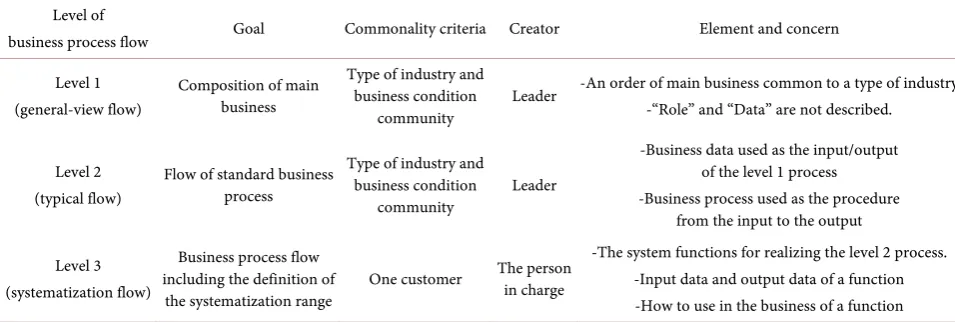
Table 2 outlines the three-level structure of reusable business process models. The business process flows in Level 1 and level 2 are abstraction of business process flows and commonality across the multiple business process flows. Therefore, they are reused as the business process templates. The business process flows in Level 3 define the details of the business process flows specified in Level 2. Therefore, the business process flows in Level 3 represent the varia-bility.
4.3. BPM-IE Functions for Reuse
DOI: 10.4236/jsea.2018.118023 373 Journal of Software Engineering and Applications Table 2. Hierarchy of a reuse-oriented business process model.
Level of
business process flow Goal Commonality criteria Creator Element and concern
Level 1 (general-view flow)
Composition of main business
Type of industry and business condition
community Leader
-An order of main business common to a type of industry -“Role” and “Data” are not described.
Level 2 (typical flow)
Flow of standard business process
Type of industry and business condition
community Leader
-Business data used as the input/output of the level 1 process
-Business process used as the procedure from the input to the output
Level 3 (systematization flow)
Business process flow including the definition of
the systematization range One customer
The person in charge
-The system functions for realizing the level 2 process. -Input data and output data of a function -How to use in the business of a function
business parts from individual customer parts, the BPM-IE provides the follow-ing tool functions.
1) Support to reuse the lower-level business process flows by substitution The lower-level business process flows refine the business process templates defined as the higher-level business process flows. To reuse the business process flows, appropriate sub-activity graphs are substituted to the templates in order to fit the lower level business process flows to the customer’s business.
2) Management of model components through the RAS
We use the “Default Profile” of the RAS [18] to manage the business process model components, which is a set of divided business process flows that are the candidates of a sub-flow of a business process. The RAS specifies the structures of reusable assets and description formats in XML to provide meta-information on the assets.
In our business process model, a subflow object describes a business process instance that has a refined business process flow illustrated in Figure 6.
The refined flow is represented by a Business Flow object that is linked to the subflow object. Our BPM-IE stores the following management information, written in XML, which complies with the RAS:
a) Subflow instances that have, or will have, multiple candidates for the re-fined Business Flow object to be linked with the subflow instance.
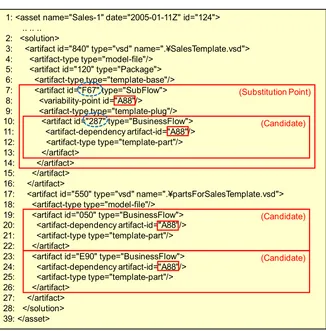
b) Business process flow instances that can be linked to the subflow instances. This management information can be expressed by XML “Artifact” elements and “Artifact-Dependency” elements of the RAS default profile.
For example, the XML descriptions shown in Figure 7 express the relation-ship between subflow objects and Business Flow objects in Figure 6. In Figure 6, the subflow object with Id = “F67” is linked with the Business Flow object with Id = “287” selected from the set of candidates Business Flow objects with Id = “287”, Id = “050”, and Id = “E90”.
3) Selecting model components using the RAS
DOI: 10.4236/jsea.2018.118023 374 Journal of Software Engineering and Applications Figure 6. Object diagram of a business process model.
Figure 7. An XML description of the relationships between objects in Figure 6.
between the business process model components. After importing a model tem-plate, the BPM-IE
Level 3 Business Process Flow (Substitution)
Level 3
Business Process Flow Level 2
Business Process Flow Id=“123”:BusinessFlow
:Process :SubFlow
Id=“F67”
:Proeccss
:BusinessFlow Id=“287”
:Process :Process :Process
subflow
:BusinessFlow Id=“050”
:Process :Proeccss
:BusinessFlow Id=“E90”
:Process :Proeccss
1: <asset name="Sales-1" date="2005-01-11Z" id="124"> .. .. ..
2: <solution>
3: <artifact id="840" type="vsd" name=".¥SalesTemplate.vsd"> 4: <artifact-type type="model-file"/>
5: <artifact id="120" type="Package"> 6: <artifact-type type="template-base"/> 7: <artifact id="F67" type="SubFlow"> 8: <variability-point id="A88"/>
9: <artifact-type type="template-plug"/> 10: <artifact id="287" type="BusinessFlow"> 11: <artifact-dependency artifact-id="A88"/> 12: <artifact-type type="template-part"/> 13: </artifact>
14: </artifact> 15: </artifact> 16: </artifact>
17: <artifact id="550" type="vsd" name=".¥partsForSalesTemplate.vsd"> 18: <artifact-type type="model-file"/>
19: <artifact id="050" type="BusinessFlow"> 20: <artifact-dependency artifact-id="A88"/> 21: <artifact-type type="template-part"/> 22: </artifact>
23: <artifact id="E90" type="BusinessFlow"> 24: <artifact-dependency artifact-id="A88"/> 25: <artifact-type type="template-part"/> 26: </artifact>
27: </artifact> 28: </solution> 39: </asset>
(Substitution Point)
(Candidate)
(Candidate)
DOI: 10.4236/jsea.2018.118023 375 Journal of Software Engineering and Applications
1) highlights the hot-spots, the points where a refined business process flow can be substituted with the customer specific information,
2) shows candidates for substitution when a tool user selects the hot-spots, and,
3) substitutes the refined business process flow if the user requires a use-specific business process by substitution.
The business process flow includes object nodes, business actions, and refer-ences to business data objects. The BPM-IE helps to further refine the objects contained in or referred to the flow.
5. Evaluation in an Actual Enterprise Software Development
Project
5.1. Project Outline and Evaluation Methods
We applied our modeling methodology, BPM-IE, and business process reuse method using BPM templates to an actual enterprise software development project of our customers, and evaluated the effectiveness of the proposed me-thod and BPM-IE.
The customer is a company in the distribution industry. The company has 11 target businesses categories for the process modeling. The project member for business process modeling consists of one project manager, two leaders, and nine members. Another employee is assigned to the “Preparation” process for developing the templates described in Section 4.
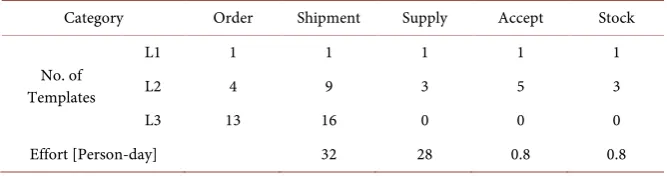
Through the “Preparation” process, the project defined a set of business process templates for five business categories as listed in Table 3. The templates in Level 1, 2, and 3 are defined for two categories of “Order” and “Shipment”. On the other hand, three categories of “Supply”, “Accept”, and “Stock” have on-ly Level 1 and 2 templates. The number of templates and person-days required for the preparation are shown in Table 3. We confirmed that for every project the workload of preparing level 1 and 2 templates was light.
5.2. Quantitative Evaluation of the BPM-IE and Templates
We defined business process flows for the 11 business categories of the project.
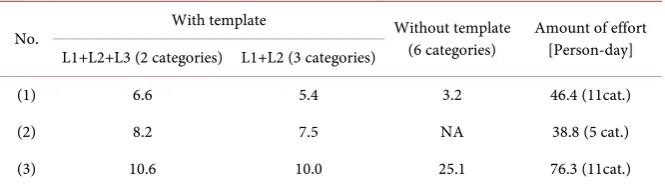
[image:13.595.206.540.634.730.2]Table 4 shows the average development effort in person-day of the business process flow modeling. From the members of the project, we collected the data of the development effort in three use cases: 1) actual development effort; 2)
Table 3. Preparation results.
Category Order Shipment Supply Accept Stock
No. of Templates
L1 1 1 1 1 1
L2 4 9 3 5 3
L3 13 16 0 0 0
DOI: 10.4236/jsea.2018.118023 376 Journal of Software Engineering and Applications Table 4. Development time (days).
No. With template Without template (6 categories) Amount of effort [Person-day]
L1+L2+L3 (2 categories) L1+L2 (3 categories)
(1) 6.6 5.4 3.2 46.4 (11cat.)
(2) 8.2 7.5 NA 38.8 (5 cat.)
(3) 10.6 10.0 25.1 76.3 (11cat.)
estimated effort by using the BPM-IE, but without the templates; 3) estimated effort without using the BPM-IE and templates.
Based on the data collected from modeling 11 business categories, we revealed the following effects.
1) Productivity improvement by BPM-IE: the effort of business process flow modeling was reduced by 24.4% with the use of BPM-IE.
2) Productivity improvement by the combination of BPM-IE and templates: the effort of business process flow modeling was reduced by 45.8% for levels 1 and 2, and 47.1% for levels 1, 2, and 3, by the use of both BPM-IE and templates.
We can conclude that the productivity improvement proves a practical effec-tiveness of reusable business process flow modeling. The combination of the BPM-IE and templates makes the improvement effect double: from 24.4% to 47.1%, therefore, it is strongly recommended to create and use the templates for reusing business process flow. The effect of using templates clearly suggests the effect of business process reuse.
5.3. Qualitative Evaluation of the BPM-IE and Templates
We also evaluated the effects of BPM-IE and templates by collecting opinions from the users in the practice.
1) The BPM-IE is useful for ensuring business process flows, which are writ-ten in a uniform way.
2) The BPM-IE is useful to uniformly represent the elements in business process flows.
In addition, most of the users mentioned to use the BPM-IE and the templates in their future projects.
Thus, we can conclude that the BPM-IE and template are practically useful and effective.
5.4. Evaluation of Business Process Reuse Method
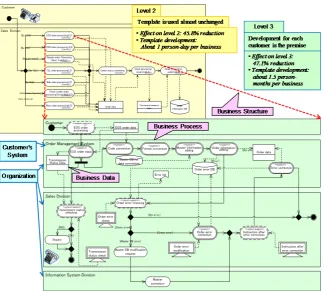
To evaluate the business process reuse method, we analyzed the artifacts for “Or-der” and “Shipment” as shown in Figure 8. Both level 2 and level 3 templates were provided for the two business categories. We analyzed the details on the changes of the business process models for reusing the templates to the CRM software.
DOI: 10.4236/jsea.2018.118023 377 Journal of Software Engineering and Applications Figure 8. Quantitative evaluation of productivity improvement by the BPM-IE and tem-plates.
extension of the business process model did not need to change to the reused component, which indicates a good extensibility of the proposed method.
2) At level 3, the reuse rate was 50% of the business process flows, which were agreed to reuse within the assumed scope of the templates. For refining the tem-plates, many slight modifications were substituted. However, in the case of the agreement was not set, the reuse ratio fell to lower than 20%. The enterprise or-ganization was divided into 39 units and business data were added by 339 enti-ties. This analysis indicates the even level 3 templates are significantly reusable if the scope is defined and agreed. We also found that refinement of the business data had a beneficial effect after the business process definition.
As a conclusion, we are confident that the proposed business process reuse method is effective in the practical business process modeling.
6. Related Work
6.1. Business Process Modeling Techniques
There is a bunch of publications on the business process modeling and business process management.
DOI: 10.4236/jsea.2018.118023 378 Journal of Software Engineering and Applications
modeling method is recommended as a substitute business modeling approach
[20]. However, these approaches focus on only the technique of business process modeling, and missed the reuse of business process modeling artifacts.
ISO/IEC OMG BPMN [8][9] is a standardized and popular business process modeling language. Another notable representation includes EPCs (Event Dri-ven Process Chains) [16]. Both of them have a sub-process that presents the components of a business process, but not include reusable business process model components.
Although ISO/IEC OMG BPMN is a well-accepted standard of business process modeling, there are various problems in the use of the notation in prac-tice [10]. There are still many issues in the business process modeling using BPMN [21][22].
6.2. Variability and Reuse of Business Process Models
For the reuse of business process models, as we discussed, it is necessary to structure the business processes in order to manage the commonality and varia-bility of business process models like product line software engineering [17]. Marshall describes how an activity diagram can be divided and simplified [23]. However, he does not suggest a method for reusing activity diagram.
A decomposition-driven method is proposed for modeling business process family which consists of many variants of business process models [24]. The method suggests to traoff the common parts and variants in a top-down de-composition, and claims to reduce up to 50% of the number of duplication processes from two case studies. Although the concept of this work is in the same direction of our work, the tangible frameworks such as templates of our work are not provided.
6.3. Business Process Modeling Tools
There are a certain number of both academic/open source and commercial tools for business process modeling. However, they are different in terms of functio-nality, models for development, and goals in the use [25]. For example, ARIS toolset provides business process modeling tools with EPCs and BPMN [4]. Other diagramming tools, such as Enterprise Architects [26] and Cacoo [27], support UML and BPMN. Those tools do not support reusable process templates based on standard reusable business process components.
Rational Software Architect can import and export RAS assets [28] [20]. However, it cannot support process template to reduce the efforts of process modeling.
7. Discussions and Contributions of This Research
meta-DOI: 10.4236/jsea.2018.118023 379 Journal of Software Engineering and Applications
model-driven modeling. Most popular notation of business process modeling is
ISO/IEC OMG BPMN [8] [9]. Although the BPMN is well-defined notation,
some limitations and issues in practical use are pointed out [10]. Our research contributes to the issues in the following two techniques of metamodel-driven business modeling methodology.
a) A business metamodel for business process modeling: BPMN comes with a metamodel which is based on UML metamodel, and defines the entity and rela-tionship of BPMN entities for notation. However, it lacks the concrete semantics of business process models. As shown in Figure 1, the authors defined the busi-ness metamodel, starting from “Busibusi-ness Flow”, which can support to define business process models in a more concrete way. Therefore, our approach is considered as an extension of BPMN.
b) A set of supportive techniques to make business process modeling work in practice: BPMN focuses on the BPD (Business Process Diagram), and does not support to define the business vocabulary and organizational structure. The proposed methodology supports to define the business vocabulary, properties of business process, and organizational structure, which is necessary to clearly de-fine the business process models and the operational context. To make business process modeling work in practice, our research suggests that it is necessary to provide further supports besides a business process modeling notation.
2) Contributions of business process reuse method with BPM templates and BPM IE (Integrated Environment).
The proposed business process reuse method contributes to the reuse of busi-ness processes with the following two techniques.
a) A structural decomposition method of business process variability: It is
common to model business process models in a top down manner [2] [3].
However, as pointed out [24], many business process models have some similar-ities. Therefore, like product-line software engineering, it is necessary to identify and separate the commonality and variability among the business process mod-els [16] [17]. This research proposed a three-layer hierarchical framework of business process models to separate the variability with a set of criteria, which is a foundation and guide for reusing business process models.
b) BPM (Business Process Model) templates: To support the reuse of business process models, the authors defined templates based on the three-layer hierar-chical framework. Although some templates might be domain specific in the sense that specific domain needs specific templates, the templates work as con-crete and tangible business process components for reuse. The empirical study proved that the proposed reuse method improved the productivity of business process modeling by 46%. A case study on decomposition-driven approach re-ported that up to 50% of the number of duplication processes were eliminated
[24]. These statistics may suggest a baseline of the reuse in business process modeling.
DOI: 10.4236/jsea.2018.118023 380 Journal of Software Engineering and Applications
task. Therefore, tool support is indispensable. There are many tools for modeling business processes [22]. However, most of the modeling tools focus either draw-ing the models. Few tools support reuse. The BPM IE we developed supports to reuse business process models together with BPM templates and repository. The empirical study proves the productivity improvement by 46%. From the empiri-cal study in the real enterprise software development, the authors confirm the effectiveness of the BPM IE.
8. Conclusions
To facilitate the reuse of business process models, we have developed a business process modeling methodology based on the metamodel, business process reuse method, reusable business process templates, and its supporting integrated en-vironment BPM-IE. The methodology consists of three processes of “Prepara-tion”, “Business Modeling” and “Confirmation and Recognition”. In addition, the BPM-IE together with business process templates supports the creation and reuse of the business process models.
We applied the proposed method and BPM-IE to the real business process modeling of an enterprise software for CRM. From the statistics collected in the application, we confirmed that proposed methodology and BPM-IE contributed to improve the productivity by more than 46%. We also found that the business process templates contributed to improve the productivity of business process modeling when appropriate scope is set and agreed. Therefore, this research work contributes to reuse of business process modeling.
Business analyst and systems engineer in Fujitsu already defined some 12,000 business process flows with this methodology and BPM IE to the business process modeling of internal enterprise control.
From the practice and empirical study, the authors confirm the effectiveness of the proposed methodology and BPM IE.
Our next goal will be to extend the proposed business process modeling me-thodology. We plan to develop a technique for integrating business process modeling methodology with requirements engineering for enterprise software development, especially, with the Web APIs.
Conflicts of Interest
The authors declare no conflicts of interest regarding the publication of this pa-per.
References
[1] Lederer, M., Knapp, J. and Schott, P. (2017) The Digital Future Has Many Names:
How Business Process Management Drives the Digital Transformation. Proceedings
of the 6th International Conference on Industry Technology and Management
(ICITM 2017) of IEEE, Cambridge, UK, 7-10 March 2017, 22-26.
[2] Dumas, M., La Rosa, M., Mendling, J. and Reijers, H.A. (2018) Fundamentals of
DOI: 10.4236/jsea.2018.118023 381 Journal of Software Engineering and Applications https://doi.org/10.1007/978-3-662-56509-4
[3] Weske, M. (2012) Business Process Management: Concepts, Languages,
Architec-tures. Springer, Berlin. https://doi.org/10.1007/978-3-642-28616-2
[4] Davis, R. and Brabander, E. (2007) ARIS Design Platform. Springer, Berlin.
[5] Havey, M. (2005) Essential Business Process Modeling. O’Reilly Media, Sebastopol.
[6] Koschmider, A., Fellmann, M., Schoknecht, A. and Oberweis, A. (2014) Analysis of
Process Model Reuse: Where Are We Now and, Where Should We Go from Here?
Decision Support Systems, 66, 9-19. https://doi.org/10.1016/j.dss.2014.05.012
[7] OMG (2017) Unified Modeling Language (OMG UML). Ver. 2.5.1.
https://www.omg.org/spec/UML/2.5.1/
[8] OMG (2011) Business Process Model and Notation. Ver. 2.0.
https://www.omg.org/spec/BPMN/2.0/
[9] ISO/IEC (2013) Information Technology—Object Management Group Business
Process Model and Notation.
[10] Leopold, H., Mendling, J. and Günther, O. (2016) Learning from Quality Issues of
BPMN Models from Industry. IEEE Software, 33, 26-33.
https://doi.org/10.1109/MS.2015.81
[11] Koschmider, A., Caporale, T., Fillmann, M., Lehner, J. and Oberweis, A. (2015)
Business Process Modeling Support by Depictive and Descriptive Diagrams.
Pro-ceedings of 6th International Workshop on Enterprise Modeling and Information Systems Architecture (EMISA 2015), Innsbruck, Austria, 3-4 September 2015, 31-44.
[12] Mili, H., Tremblay, G., Jaoude, G.B., Lefebbre, É., Elabed, L. and Boussaidi, G.E.
(2010) Business Process Modeling Languages: Sorting through the Alphabet Soup.
ACM Computing Surveys, 43, 4.
[13] OMG (2011) Unified Modeling Language. Ver. 2.4.1.
https://www.omg.org/spec/UML/2.4.1
[14] ISO/IEC (2012) ISO/IEC 19505-2:2012, Information Technology—Object
Man-agement Group Unified Modeling Language (OMG UML)—Part 2: Superstructure.
[15] Yano, K., Nomura, Y. and Kanai, T. (2013) A Practical Approach to Automated
Business Process Discovery. Proceedings of the 17th IEEE International Enterprise
Distributed Object Computing Conference Workshop (EDOCW 2013), Vancouver,
Canada, 9-13 September 2013, 43-62. https://doi.org/10.1109/EDOCW.2013.13
[16] Ceatano, A., Silva, A.R. and Tribolet, J. (2010) Business Process Decomposition: An
Approach Based on the Separation of Concerns. International Journal of
Concep-tual Modeling, 5, 44-57.
[17] Rosa, M.L., van der Aalst, W.M.P., Dumas, M. and Milani, F.P. (2017) Business
Process Variability Modeling: A Survey. ACM Computing Survey, 50, Article No. 2.
https://doi.org/10.1145/3041957
[18] OMG (2005) Reusable Asset. Ver. 2.2.
https://www.omg.org/spec/RAS/About-RAS/
[19] Eriksson, H.-E. and Penker, M. (1999) Business Modeling with UML. John Wiley &
Sons, Inc., New York.
[20] Jacobson I., Booch, G. and Rumbaugh, J. (1999) The Unified Software Development
Process. Addison-Wesley, Reading.
[21] Wohed, P., van der Aalst, W.M.P., Dumas, M., ter Hofstede, A.H.M. and Russell, N.
DOI: 10.4236/jsea.2018.118023 382 Journal of Software Engineering and Applications
the 4th International Conference on Business Process Management (BPM 2006),
Vienna, Austria, 5-7 September 2006, 161-176. https://doi.org/10.1007/11841760_12
[22] Aagesen, G. and Krogstie, J. (2015) BPMN 2.0 for Modeling Business Processes. In:
vom Brocke, J. and Rosemann, M., Eds., Handbook on Business Process
Manage-ment 1, 2nd Edition, Springer, Berlin, 219-250.
[23] Marshall, C. (1999) Enterprise Modeling with UML. Addison-Wesley, Reading.
[24] Milani, F., Dumas, M., Ahmed, N. and Matulevičius, R. (2016) Modelling Families
of Business Process Variants: A Decomposition Driven Method. Information
Sys-tems, 56, 55-72, https://doi.org/10.1016/j.is.2015.09.003
[25] Snoeck, M., de Oca, I.M.-M., Haegemans, T., Scheldeman, B. and Hoste, T. (2015)
Testing a Selection of BPMN Tools for Their Support of Modeling Guidelines.
Pro-ceedings of IFIP Working Conference on the Practice of Enterprise Modeling (PEM
2015), Leuven, Belgium, 22-23 November 2015, 111-125.
[26] SPARX Systems Enterprise Architect. http://sparxsystems.com/
[27] Nulab Cacoo. https://cacoo.com/
[28] IBM Rational Software Architect.