PERFORMANCE EVALUATION OF WLAN NETWORK BASED DSR PROTOCOL USING OFDM
(802.11A) AND EXTENDED RATE PHY (802.11G)
*Deepika
Department of Electronics and Communication
ARTICLE INFO ABSTRACT
Wireless mobile ad
these networks there is no fixed topology due to the mobility of nodes, interference, multipath propagation and path loss. Hence a dynamic routing protocol i
properly. Many Routing protocols have been developed for accomplishing this task. The purpose of this paper is to study, understand, analyze and discuss mobile ad
2011)
route discovery time, Delay, throughput and network load in DSR routing protocol, it is evaluated and analyzed over different data rates
Copyright © 2016, Deepika Madan et al. This is an open access article distributed under the Creative Commons Att use, distribution, and reproduction in any medium, provided the original work is properly cited.
INTRODUCTION
Manet
Stands for "Mobile Ad Hoc Network." A MANET is a type of ad hoc network that can change locations and configure itself on the fly. Because MANETS are
wireless connections to connect to various networks. This can be a standard Wi-Fi connection, or another medium, such as a cellular or satellite transmission (Acrkhe, 2004
Sharma, 2011).
The purpose of the MANET working group is to standardize IP routing protocol functionality suitable for wireless routing application within both static and dynamic topologies with
ISSN: 0975-833X
Article History:
Received 23rd January, 2016
Received in revised form 04th February, 2016
Accepted 05th March, 2016
Published online 26th April,2016
Key words:
MANET, DSR, OPNET.
Citation: Deepika Madan, Jyoti and Kuldeep Vats
extended rate PHY (802.11g)”, International Journal of Current Research
RESEARCH ARTICLE
PERFORMANCE EVALUATION OF WLAN NETWORK BASED DSR PROTOCOL USING OFDM
(802.11A) AND EXTENDED RATE PHY (802.11G)
*Deepika Madan, Jyoti and Kuldeep Vats
Communication, South Point Institute of Engineering and Technology,
Sonipat, Haryana, India
ABSTRACT
Wireless mobile ad-hoc networks are characterized as networks without any physical connections. In these networks there is no fixed topology due to the mobility of nodes, interference, multipath propagation and path loss. Hence a dynamic routing protocol is needed for these networks to function properly. Many Routing protocols have been developed for accomplishing this task. The purpose of this paper is to study, understand, analyze and discuss mobile ad
which is a on demand protocol. Considering the No. of hops, Traffic sent, Traffic received, route discovery time, Delay, throughput and network load in DSR routing protocol, it is evaluated and analyzed over different data rates (Bapuji and Sharma, 2011).
is an open access article distributed under the Creative Commons Attribution License, which use, distribution, and reproduction in any medium, provided the original work is properly cited.
Stands for "Mobile Ad Hoc Network." A MANET is a type that can change locations and configure itself on the fly. Because MANETS are mobile, they use wireless connections to connect to various networks. This can Fi connection, or another medium, such as a 2004; Bapuji and
group is to standardize IP protocol functionality suitable for wireless routing application within both static and dynamic topologies with
increased dynamics due to node motion or other factors Mobile Ad Hoc Networks (MANETs) are an emerging type of wireless networking, in which mobile nodes associate on an extemporaneous or ad hoc basis. MANETs are both self forming and self-healing, enablin
between mobile nodes without reliance on centralized resources or fixed infrastructure
www.wikipedia.com). Routing is an activity or a function that connects a call from origin to destination in telecommunication networks and also play an important role in architecture, design and operation of networks. Ad
networks where nodes communicate with each other using multi-hop links. There is no stationary infrastructure or base station for communication. Each node itself acts as a router for forwarding and receiving packets to/from other nodes. Routing in ad hoc-networks has been a challenging task ever since the wireless networks came into exist
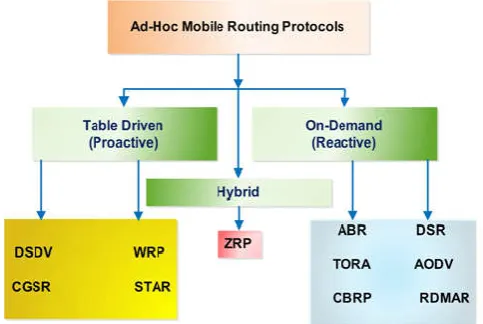
this is the constant change in network topology because of high degree of node mobility. A number of protocols have been developed for accomplish this task which are shown in below Fig. (Bouke, 2011; Vats, and Sachdeva, 2012
International Journal of Current Research
Vol. 8, Issue, 04, pp.29271-29275, April, 2016
INTERNATIONAL
Deepika Madan, Jyoti and Kuldeep Vats, 2016. “Performance evaluation of WLAN network based DSR
International Journal of Current Research, 8, (04), 29271-29275.
PERFORMANCE EVALUATION OF WLAN NETWORK BASED DSR PROTOCOL USING OFDM
, South Point Institute of Engineering and Technology,
hoc networks are characterized as networks without any physical connections. In these networks there is no fixed topology due to the mobility of nodes, interference, multipath s needed for these networks to function properly. Many Routing protocols have been developed for accomplishing this task. The purpose of this paper is to study, understand, analyze and discuss mobile ad-hoc routing protocol DSR (Bouke, demand protocol. Considering the No. of hops, Traffic sent, Traffic received, route discovery time, Delay, throughput and network load in DSR routing protocol, it is evaluated and
ribution License, which permits unrestricted
increased dynamics due to node motion or other factors Mobile Ad Hoc Networks (MANETs) are an emerging type of wireless networking, in which mobile nodes associate on an extemporaneous or ad hoc basis. MANETs are both
self-healing, enabling peer-level communications between mobile nodes without reliance on centralized resources or fixed infrastructure (Kassim and Rahman, 2011; Routing is an activity or a function that l from origin to destination in telecommunication networks and also play an important role in architecture, design and operation of networks. Ad-hoc networks are wireless networks where nodes communicate with each other using stationary infrastructure or base station for communication. Each node itself acts as a router for forwarding and receiving packets to/from other nodes. Routing networks has been a challenging task ever since the wireless networks came into existence. The major reason for this is the constant change in network topology because of high degree of node mobility. A number of protocols have been developed for accomplish this task which are shown in below
Vats, and Sachdeva, 2012)
INTERNATIONAL JOURNAL OF CURRENT RESEARCH
[image:1.595.44.285.624.698.2]DSR
The Dynamic Source Routing protocol (DSR) is based on source routing, which means that the originator of each packet determines an ordered list of nodes through which the packet must pass while traveling to the destination (Mohapatra and Kanungo, 2011; Vats and Sachdeva, 2012). The key advantage of a source routing design is that intermediate nodes do not need to maintain up-to-date routing information in order to route the packets that they forward, since the packet’s source has already made all of the routing decisions.
This fact, coupled with the entirely on-demand nature of the protocol, eliminates the need for any type of periodic route advertisement or neighbor detection packets. The DSR protocol consists of two basic mechanisms: Route Discovery
and Route Maintenance (www.wikipedia.com). Route
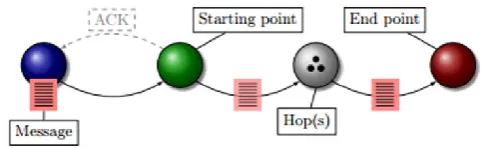
Discovery is the mechanism by which a node S wishing to send a packet to a destination D obtains a source route to D. Route Maintenance is the mechanism by which a packet’s originator S detects if the network topology has changed such that it can no longer use its route to the destination D because some of the nodes listed on the route have moved out of range of each other. Figure 2.1 shows the basic operation of the DSR protocol.
Simulation scenarios
A. Simulation Software The software used in this study is
OPNET Modeler. OPNET is a network and application management software designed and distributed by OPNET Technologies Inc. OPNET provides technologies, protocols, communication devices for academic research, assessment and improvement (Bapuji and Sharma, 2011; www.opnet.com).
B. Simulation Model In our proposed model, we have
simulated a 100 nodes network model. A large geographic location has been divided into various cells of hexagonal shape.
[image:2.595.39.281.56.218.2]29272 Deepika Madan, Jyoti and Kuldeep Vats, Performance evaluation of WLAN network based DSR protocol using OFDM (802.11a) and extended rate PHY (802.11g)
Figure 2.1 Basic operation of the DSR protocol showing the building of a source route during the propagation of a ROUTE REQUEST, the source route’s return in a ROUTE REPLY, its use in forwarding data, and the sending of a ROUTE ERROR upon
forwarding failure. The next hop is indicated by the address in parentheses
WLAN Parameter
Parameters Value
Operation Mode 802.11a/g
Node Position Rectangular
No. of Nodes 100
Speed 100 m/s
Simulation Time 1000 sec
BSS identifier Auto assigned
Data rate 24,36 mbps
Transmit power (W) 0.020
Addressing Mode IPV4
Routing protocol DSR
Buffer Size 1024000
Figure 1. Pollutant concentration vs time, distance = 150m and height = 150m
Figure 3. Pollutant concentration vs time, distance = 400m and height = 150m
Figure 5. Pollutant concentration vs time, distance = 150m and height = 400m
Pollutant concentration vs time, distance = 150m and height = 150m
Figure 2. Pollutant concentration vs time, distance = 200m and height = 150m
[image:3.595.88.517.538.708.2]
Pollutant concentration vs time, distance = 400m and height = 150m
Figure 4. Pollutant concentration vs time, distance = 150m and height = 200m
Pollutant concentration vs time, distance = 150m and height = 400m
Figure 6. CO2 concentration distribution at distance =
150m, wind speed 4.46ms-1, 6.38ms
Pollutant concentration vs time, d height = 150m
Pollutant concentration vs time, distance = 150m and height = 200m
Conclusion
The ability for nodes to form ad hoc networks in the absence of communication infrastructure is a critical area of current
research. There are existing communication needs which ad hoc networks can meet, such as military and commercial applications, and the development of ad hoc network technology will enable new classes of applications. With the 29274 Deepika Madan, Jyoti and Kuldeep Vats, Performance evaluation of WLAN network based DSR protocol using
potential for low cost deployment and high availability, coupled with the dropping costs of wireless transceivers, ad hoc networks are becoming economically and technologically feasible right now. After reviewing the concept of wireless ad-hoc network and DSR routing protocol with respect to seven parameters delay, traffic sent, traffic received, network load , throughput, no of hopes, route discovery time it is conclude that the selection of efficient and reliable protocol is a critical issue. In this simulation work we get simulation graphs and from graphs we can analyze that the performance of DSR routing protocol with respect to different matrices WLAN based IEEE802.11a and IEEE802.11g with data rate of 24mbps and 36mbps in 100 nodes network, but it is not necessary that this perform always better in all the networks, its performance may vary by varying the network.
REFERENCES
Acrkhe, M.J. 2004. ‘‘Performance Analysis of MANET Routing Protocols in large scale scenarios’’, US ARMY RDECOM CERDEC STCD, MILCOM 2004 - 2004 IEEE Military Communications Conference.
Bouke, A. 2011. “Routing protocols in ad hoc networks: A survey”, vol. 55, pp. 3032–3080.
Bapuji, V. and Sharma, S.S.V.N. 2011. “Quality of service
for mobile Ad-Hoc wireless networks”, International
Journal on Computer Science and Engineering, vol. 3, 4,
pp. 1573-1577.
Kassim, M. and Rahman, R.A. 2011. “Mobile Ad Hoc Network (MANET) Routing Protocols Comparison for Wireless Sensor Network”, 2011 IEEE International Conference on System Engineering and Technology (ICSET), pp.148-152.
Mohapatra, S. and Kanungo, P. 2011. “Performance analysis of AODV, DSR, OLSR and DSDV Routing Protocols using NS2 Simulator” Procedia Engineering (Elsevier), vol. 30 (2), pp. 69 – 76.
www.wikipedia.com www.opnet.com
Vats, K. and Sachdeva, M. 2012. “Simulation and performance analysis of OLSR, GRP, DSR Routing protocol using
OPNET”, International Journal of Emerging Trends in
Engineering and Development, Vol. 2, (2), pp.73-78.