Temporal epigenetic modifications differentially
regulate ES cell-like colony formation and maturation
Jong S. Rim1*, Karen L. Strickler1*, Christian W. Barnes1, Lettie L. Harkins1,
Jaroslaw Staszkiewicz1, Jeffrey M. Gimble2, Gregory H. Leno3, Kenneth J. Eilertsen1,2*
1NuPotential Inc., Baton Rouge, USA;*Corresponding Authors: [email protected], [email protected] 2Stem Cell Biology Laboratory, Pennington Biomedical Research Center, Baton Rouge, USA
3Department of Anatomy & Cell Biology, Carver College of Medicine, University of Iowa, Iowa City, USA
Received 8 February 2012; revised 1 March 2012; accepted 13 April 2012
ABSTRACT
Human somatic cells can be directly repro-grammed to induced pluripotent stem (iPS) cells by forced expression of the transcription factors Oct4, Sox2, and either Klf4 and cMyc or Nanog and Lin28, using virus-based systems. However, low reprogramming efficiency and the potential for deleterious virus-induced genomic modification limit the clinical potential of this technology. Recent reports indicate, however, that the generation of iPS cells can be enhanced by the addition of synthetic small molecules, including epigenetic modulators. In this report, we demonstrate that the epigenetic modifiers Valproic Acid (VPA) and 5-azacytidine activate the reciprocal transcriptional regulation of en-dogenous pluripotency transcription factor genes in human dermal fibroblasts and that VPA alone can directly activate endogenous Oct4 in the absence of transgenes. Moreover, using hu- man adipose cells, we demonstrate that histone deacetylase inhibition, prior to reprogramming factor transfection, increases embryonic stem (ES) cell-like colony formation ~2 - 3 fold. In ad-dition, DNA methyltransferase (DNMT) inhibition during human ES cell culture promotes matura-tion of reprogrammed somatic cells, increasing the yield ~4 fold. These data provide proof of principle that reprogramming efficiency can be improved by inhibiting specific repressive epi-genetic regulatory components at the levels of ES cell-like colony formation and maturation. In addition, these studies raise the interesting possibility that a more efficient small mole-cule-based reprogramming system may provide a superior alternative to current virus-based approaches.
Keywords:Epigenetic Modification; Somatic Cell Reprogramming
1. INTRODUCTION
Forced expression of the transcription factors Oct4, Sox2, and either Klf4 and cMyc or Nanog and Lin28 can transform differentiated somatic cells into induced pluri- potent stem (iPS) cells. In many respects, iPS cells are the functional equivalent of pluripotent embryonic stem (ES) cells [1-3] and therefore, hold enormous research and clinical potential. For example, iPS cells may facili-tate mechanistic studies for degenerative diseases, drug discovery and toxicity testing. Indeed, several reports have described and validated “disease-in-a-dish” model systems [4-8]. The prospect for clinical application is lim- ited, however, by reprogramming inefficiency and safety issues associated with viral vector transduction.
The efficiency of iPS cell production is influenced by the reprogramming strategy employed. Indeed, the num-ber and combinations of transcription factors, the origin and developmental stage of the recipient cell, the method of transduction, and the use of small molecule epigenetic modifiers all play a role in determining the degree of iPS cell formation and colony maturation. Several general conclusions can be drawn from these studies. First, ex-pression of pluripotency-related transcription factors while silencing p53 improves reprogramming efficiency [9,10]. Second, somatic cells from early development stages have greater reprogramming potential than mature cells [2]. Third, more efficient transfection methods, such as the polycistronic lentiviral system, improves reprogramming [11]. Finally, exposure to small molecule epigenetic modi- fiers also increases iPS cell production [12].
and proteins [19,20]. Identification of a small molecule or a cocktail of small molecules, to reprogram cells also promises to provide safer iPS cells and enhance opportu-nities for scalability ([21-24] see review, [25]).
Although the molecular mechanisms involved in so-matic cell reprogramming are not well defined, it is clear that epigenetic modification has proven to be critical for de-differentiation of somatic cells. The most well studied example is promoter specific DNA de-methylation and histone acetylation. These changes are required for the re-expression of pluripotency-related genes that are si-lenced during animal development [26]. Recent genome- wide mapping of target promoters for Oct4, Sox2, Klf4 and c-myc, as well as Nanog, Dax1, Rex1, Zpf281, and Nac1 factors, has provided a more detailed and global understanding of the pluripotent epigenome in mouse ES cells [27]. Among the more than 6000 target gene pro-moters analyzed, two categories emerged with respect to transcription factor binding and promoter activity. First, target promoters bound by four or fewer factors are re-pressed while those associated with a higher factor den-sity are active. Remarkably, the transcriptional network of ES cells includes auto- and reciprocal-transcriptional regulation as well as protein-protein interactions that con- tribute to regulate pluripotency gene expression.
We hypothesize that epigenetic modification directly activates an endogenous pluripotent transcription net-work resulting in the increased efficiency of transcription factor-based somatic cell reprogramming. In this report, we used two epigenetic modifying agents, an inhibitor of DNA methyltransferase (DNMT) and a histone deacety-lase (HDAC) inhibitor, to begin to test this hypothesis. We found that both DNMT and HDAC inhibitors acti-vate the endogenous reprogramming factor transcription network in human dermal fibroblasts. In addition, we demonstrated that exposure of human preadipocytes to an HDAC inhibitor, prior to transfection, increases the induction of initial ES-like colony formation and that exposure to a DNMT inhibitor after transfection, facili-tates iPS colony maturation.
2. MATERIALS AND METHODS
2.1. Cell Culture
Human dermal fibroblasts from adult, neonatal and fetal origin (Cell Applications Inc., San Diego, CA) were cultured with fibroblast growth medium (Cell Applica-tions) at 37˚C, 5% CO2 in a humidified incubator.
Hu-man preadipocytes (Cell Applications) were maintained with preadipocyte growth medium (Cell Applications) or Dulbecco’s modified Eagle medium (DMEM) supple-mented with 10% FBS, 50 U/ml penicillin and 50 μg/ml streptomycin at 37˚C, 5% CO2 in a humidified incubator.
Human adipose derived adult stem cells (Stem Cell
Bi-ology Laboratory, Pennington Biomedical Research Cen-ter, Baton Rouge, LA) were maintained with DMEM supplemented with 10% FBS, 50 U/ml penicillin and 50
μg/ml streptomycin at 37˚C, 5% CO2 in a humidified
incubator. The human adipose derived stem cells were obtained from subjects undergoing elective surgery with written informed consent under a protocol reviewed and approved by the Pennington Biomedical Research Center Institutional Review Board (PBRC #23040). Cell culture medium was supplemented with 5 mM VPA (Sigma), 5
μM 5-azacytidine (Sigma), 1 μM TSA (Sigma), 5 μM Scriptaid (BioMol) or 25 - 100 μM Zebularine (Sigma, concentrations as indicated in the figure) for the treat-ment as indicated. Adipose cell derived iPS (AdiPS-Ctl, AdiPS-TSA) cells were generated from human preadi-pocytes (Cell Applications) or human adipose derived adult stem cells as described in the paper, and maintained on an irradiated mouse embryonic fibroblast (MEF) feeder layer from ATCC (Manassas, VA) or on Matrigel coated cell culture plates (BD Biosciences) with mTeSR1 hES culture medium (StemCell Technology). Mel-1 hu-man ES cells were purchased from Millipore (Temecula, CA) and maintained on MEF feeder layer (ATCC, Ma-nassas, VA) with mTeSR1 hES culture medium (Stem-Cell Technology).
2.2. Lentiviral Transduction and Generation of AdiPS Cells
High titer lentivirus, overexpressing human Oct4 or Nanog proteins, was purchased from System Biosciences (San Diego, CA). The day before lentiviral transfection, human dermal fibroblasts were trypsinized, counted, and seeded in 6-well plates at a density of 4 × 10⁵ cells/well.
The next day, culture medium was replaced with pre- warmed medium containing 3 μg/ml polybrene (Sigma) and 5 MOI of lentivirus. Eighteen hours later, culture medium was changed with fresh fibroblast growth me-dium or treated with histone deacetylase inhibitor (HDACi) or DNA methyltransferase inhibitor (DNMTi). After 7 days treatment, total RNA was isolated for gene expres-sion analysis. High titer polycistronic lentivirus STEM-CCA (Oct4, Sox2, Klf4, c-Myc) (Millipore, Temecula, CA) were transfected into human preadipocytes. Briefly, 105 human preadipocytes that had been cultured with or
without HDACi and/or DNMTi, were transfected with 75 MOI of STEMCCA lentivirus overnight. Lentiviral in- fection was repeated the next day, and culture medium was changed with fresh preadipocyte growh medium. When the cells reached confluence, they were trypsinized, counted and seeded on a prepared MEF feeder layer at a density of 5 × 10⁴ cells with mTeSR1 medium (StemCell
2.3. Quantitative Realtime RT-PCR
Total RNA was prepared from cultures using Trizol Reagent (Life Technology) and the RNeasy Mini RNA isolation kit (Qiagen) with DNase I digestion. Total RNA (1 μg) from each sample was subjected to oligo (dT)- primed reverse transcription (Invitrogen) to generate cDNA. Quantitative PCR to measure mRNA expression levels was performed with Taqman gene expression as-says (Applied Biosystems) using a 7300 real-time PCR system in the genomic core facility at Pennington Bio-medical Research Center. Expression levels were com-pared to known standard samples and were normalized to GAPDH.
2.4. Immunofluorescence and Alkaline Phosphatase Staining
Cells were fixed with 4% paraformaldehyde in PBS for 10 min, and incubated for 1 hr with antibodies spe-cific for pluripotency markers Oct4, Nanog, Sox2 (Ab-cam) and TRA1-60 (Millipore). After washing three times with PBS, cells were incubated for 1 hr with fluo-rescent conjugated secondary antibody (Invitrogen). Nu-clei were detected by DAPI staining (Vector shield). Al-kaline Phosphatase staining was performed using the Alkaline Phosphatase Staining kit (Stemgent).
2.5. In Vitro Differentiation
Human AdiPS cells cultured on MEF feeder layers were treated with dispase (StemCell Technology) and transferred to Matrigel coated plates (BD Biosciences) with mTeSR1 culture medium. When attached AdiPS colonies started to contact each other, spontaneous dif-ferentiation was initiated by changing medium with Dul- becco’s modified Eagle medium (DMEM) supplemented with 10% FBS, 50 U/ml penicillin and 50 ug/ml strep-tomycin. Continuously beating (heart) cells were ob-served by microscopy.
2.6. Teratoma Formation
For in vivo teratoma formation, human AdiPS cells were collected with cell recovery solution (BD Biosci-ences). After washing with ice cold PBS, cells were re-suspended at 4 × 10⁶ cells/ml in PBS and mixed with BD
matrigel matrix HC (BD Biosciences) in a final volume of 0.5 ml on ice for each injection. Cell suspensions were injected subcutaneously in athymic nude mice using a 23G needle. Six weeks after the injection, tumors were surgi-cally dissected and each teratoma was evaluated by H&E staining. Experiments involving vertebrate animals were approved by Pennington Biomedical Research Center’s Institutional Animal Care and Use Committee (A3677-01, protocol #624) and conformed to or exceeded NIH
stan-dards.
2.7. Bisulfite Sequencing
DNA was isolated and purified by DNeasy Blood and Tissue kit (Qiagen). Bisulfite conversion was performed using the EZ DNA Methylation kit (Zymo Research). Converted DNA was amplified by PCR using primers for Oct3/4 or Nanog as follows: Oct4 forward primer: 5’-GTTAGAGGTTAAGGTTAGTGGGTG
Oct4 reverse primer: 5’-AAACCTTAAAAACTTAA- CCAAATCC
Nanog forward primer: 5’-TGGTTAGGTTGGTTTT- AAATTTTTG
Nanog reverse primer: 5’-AACCCACCCTTATAAAT- TCTCAATTA
Dlk1 #1 forward primer: 5’-GTTTTTTTGTTTTTGT- TGGTTTT
Dlk1 #1 reverse primer: 5’-ACTAAAAATCTCACA- CATCCCCTAC
Dlk1 #2 forward primer: 5’-AGTTGTATTTGGGTG- AATGGATTAT
Dlk1 #2 reverse primer: 5’-AAAACAAAAAAACC- AAACAAAAAAC
Dlk1 #3 forward primer: 5’-TTTAATAGGAGAGG- GTGGAGATGTA
Dlk1 #3 reverse primer: 5’-CCTTACCTAAAATCA- CAAATCAAAAA.
PCR products were cloned into E. coli using the TOPO TA cloning kit (Invitrogen). Ten clones of each sample were verified by sequencing with SP6 and T7 primers.
2.8. Low Density Microarray
Human TaqMan® low density stem cell pluripotency
arrays (TLDA) which contain 96 embryonic stem cell and post-implantation/differentiated tissue genes, and endogenous control genes were purchase from ABI (Ap-plied Biosystems, Foster City, CA). Total RNA was iso-lated using an RNeasy RNA Isolation Kit (Qiagen, Va-lencia, CA), qualified, and quantified by spectrometry, and 50 ng total RNA was reverse transcribed to cDNA using the High Capacity cDNA Archive Kit (Applied Bio- systems). TLDA qRT-PCR was performed as follows: for each sample, 100 μl of the sample-specific PCR mix (in-cluding 5 μl cDNA) was pipetted into the sample wells of the Micro Fluidic Card. The card was centrifuged, sealed, and run on the Applied Biosystem’s 7900HT Se-quence Detection System using the manufacturer’s SDS 2.3 software. Relative quantification, using the ΔΔ CT
3. RESULTS
3.1. Activation of the Endogenous Reprogramming Factor Network by Inhibition of Histone Deacetylase or DNA Methyltransferase
Differentiation silences pluripotency gene transcrip-tion during development and thereby, limits the genomic potential of the cell. This is partly due to epigenetic mo- difications of promoter regions by DNA methylation and histone modification. Thus, it stands to reason that the acquisition of pluripotency during cell reprogramming should also involve epigenetic modifications that enable pluripotency gene expression. To test this hypothesis, we first determined whether or not treatment of adult human dermal fibroblasts (HDFa) with epigenetic modulators increased expression of the pluripotency gene, Oct4. We found that increased mRNA expression of the endoge-nous Oct4 gene occurred after only three days of treat-ment with the histone deacetylase (HDAC) inhibitor, valproic acid (VPA, 5 mM), and to a lesser extent, with the DNA methyltransferase (DNMT) inhibitor, zebu-larine (Figure 1(a), 25 μM, 50 μM, 100 μM). The effect
of zebularine on expression was concentration dependent. Surprisingly, however, differences in expression between control and zebularine-treated samples were not signifi-cant until day 7 of the incubation at a zebularine concen-tration of 100 mM (Figure 1(a)). Oct4 mRNA levels
remained elevated through 7 days of treatment with ei-ther inhibitor. However, expression levels of the en-dogenous Oct4 gene were much lower than the levels of ectopic expression achieved following transduction of HDFa cultures with a lentivirus expressing the human Oct4 gene (Figure 1(b)).
To determine the effects of VPA, and a second DNMT inhibitor, 5-azacytidine (5-aza), on ectopic expression of Oct4 and Nanog genes, we isolated mRNA from drug- treated HDFa cultures following Oct4 or Nanog lenti-virus transduction. We then performed real-time RT-PCR using a gene specific primer and probes as described in Materials and Methods. We found that both VPA- and 5-aza-treated Oct4 lentivirus-infected cells had higher levels of Oct4 expression than that observed in control, VPA- or 5-aza-treated non-infected, and non-treated Oct4- lentivirus infected cultures (Figure 1(c)). However, the
absolute level of Oct4 mRNA expressed following in-duction was still one-third lower than that observed in human embryonic stem (hES) cells grown under standard conditions (data not shown). Results similar to those in HDFa cells were also observed in human dermal fibro-blasts isolated from neonatal (HDFn) and fetal (HDFf) tissues.
This trend was also revealed with the transcription
factor, Nanog. Specifically, VPA and 5-aza treatments each increased Nanog mRNA expression relative to con-trol cultures (Figure 1(d)). In addition, VPA- and 5-aza-
treatment of cultures infected with Nanog lentivirus in-duced Nanog expression relative to control, VPA- or 5- aza-treated non-infected, and untreated Nanog lentivirus infected cultures (Figure 1(d)). However, unlike Oct4
expression, the absolute level of Nanog expression was 10-fold higher than the levels observed in hES cells. Taken together, these results suggest that the epigenetic modifiers, VPA and 5-azacytidine, activate the auto-tran- scriptional regulation of pluripotency transcription fac-tors Oct4 and Nanog in somatic cells.
We also observed a slight induction of Oct4 (Figure 2(a)) and Nanog (Figure 2(b)) mRNA levels in Nanog-
and Oct4-lentivirus-infected HDFa cells, respectively, following VPA and 5-azaC treatments. Similarly, the low levels of endogenous Sox2 that are normally ob-served in HDFf cells were increased by overexpression of Oct4 or Nanog and 5-azaC treatment (Figure 2(c))
However, VPA treatment did not significantly increase Sox2 expression (Figure 2(c)). These data suggest that
the epigenetic modifiers, VPA and 5-azaC, also activate the reciprocal transcriptional regulation of the en-dogenous pluripotency transcription factors in somatic cells.
3.2. Induction of ES Cell-Like Colony Formation by Pre-Treatment of Human Preadipocytes with an HDAC Inhibitor
The VPA- and 5-azaC-induced expression of Oct4 and Nanog genes raises the interesting possibility that epige-netic modification, prior to lentivirus transduction, may facilitate the reprogramming of somatic cells. Adult hu-man adipose stem cells can be reprogrammed to iPS cells more rapidly and efficiently than human fetal skin fibro-blasts [28] and therefore, we chose to use this system for our studies. Our experimental strategy is outlined in
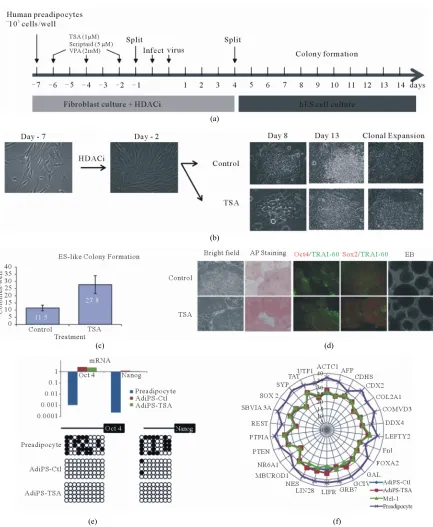
Figure 3(a). We first treated human pre-adipocytes with
various HDAC inhibitors (HDACi) below their cell cycle inhibitory concentrations. Pre- (Day 7) and post-treated (Day 2) cells are shown in Figure 3(b) (left panel) and
illustrate the change in cell density and morphology dur-ing HDACi treatment. These pre-treated cells were then transfected with lentivirus containing mouse Oct4, Sox2, Klf4 and cMyc cDNAs. Lentiviral transfection was re-peated the next day and when the transfected cells reached confluence, they were split and transferred onto mouse embryonic fibroblast feeder layers. Colonies were initially apparent 9 days post-infection (Day 9) and each contained approximately 30 - 40 cells that displayed typical hES morphology (Figure 3(b), right panel). By
(a) (b)
[image:5.595.59.539.90.412.2](c) (d)
Figure 1. Induced expression of the Oct4 and Nanog genes in human dermal fibroblasts. (a) Analysis of Oct4 mRNA expression in
adult human dermal fibroblasts (HDFa) following treatment with HDAC and DNMT inhibitors. Primary cultures from HDFa were treated with the HDAC inhibitor, Valproic acid (VPA, 5 mM), or the DNMT inhibitor, zebularine (25 μM, 50 μM, 100 μM), as indi-cated. Quantitative realtime RT-PCR was performed as described in Materials and Methods. mRNA levels were compared to known standard samples and were normalized to GAPDH. Results are mean values (+/–SEM, n = 5). One-way ANOVA demonstrated a significant difference (p < 0.05) between the control and the treatment; (b) Analysis of Oct4 mRNA expression in HDFa cells fol-lowing Oct4 lentivirus transfection. HDFa were transfected with lentivirus and isolated RNA was subjected to quantitative RT-PCR. mRNA levels were compared to known standard samples and normalized to GAPDH. Results are mean values (+/-SEM, n = 3); (c) Expression of Oct4 mRNA in HDfa cells subjected to Oct4-expressing lentivirus infection and HDAC or DNMT inhibition. HDFa cells were transfected with or without Oct4 lentivirus and treated for 7 days with VPA (5 mM) or the DNMT inhibitor, 5-azacytidine (5-aza, 5 μM)) as indicated prior to RNA isolation. Total RNA was isolated and subjected to quantitative RT-PCR. Expression levels were compared to known standard samples and normalized to GAPDH. Results are mean values (+/–SEM, n = 3). mRNA levels for Control, VPA and 5-aza samples are also presented in numerical form for comparison to lentivirus-infected samples. One-way ANOVA demonstrated a significant difference (p < 0.05) between the control and treatments; (d) Analysis of Nanog mRNA expres-sion in HDFa cells following Nanog lentivirus transfection. HDFa were transfected with lentivirus expressing Nanog and isolated RNA was subjected to quantitative RT-PCR. mRNA levels were compared to known standard samples and normalized to GAPDH. Results are mean values (+/–SEM, n = 3). mRNA levels for Control, VPA and 5-aza samples are also presented in numerical form for comparison to lentivirus-infected samples. One-way ANOVA demonstrated a significant difference (p < 0.05) between the control and the TSA colonies.
were observed and the number of colonies in each well was determined. TSA pre-treatment resulted in a more than 2-fold increase in colony formation relative to un-treated control cultures (Figure 3(c)). Similar results
were observed when comparing Scriptaid- and VPA-pre- treated cultures with their respective un-treated control cultures (data not shown).
AdiPS-Ctl and AdiPS-TSA cell lines were obtained by clonal expansion of the control and TSA colonies,
re-spectively (Figure 3(b), right panel). Cells were
charac-terized with respect to alkaline phosphatase staining, a marker for early ES cell formation, Oct4/TRA1-60 (red/ green) and Sox2/TRA1-60 (red/green) combination stain-ing and by the formation of embryoid bodies (EB) ( Fig-ure 3(d)). TRA1-60 is a surface marker for matured iPS
(a) (b)
[image:6.595.62.538.87.399.2](c)
Figure 2. Reciprocal activation of endogenous pluripotency factor genes in Oct4 or Nanog lentivirus-infected HDF cells by treatment
with HDAC or DNMT inhibitors. (a) Expression of Oct4 mRNA in HDFa cells subjected to Nanog-expressing lentivirus infection and HDAC or DNMT inhibition. HDFa cells were transfected with or without Nanog lentivirus and treated with VPA or 5-aza- cytidine as indicated. Total RNA was isolated and subjected to quantitative RT-PCR. Expression levels were compared to known standard samples and normalized to GAPDH. Results are mean values (+/–SEM, n = 3). One-way ANOVA demonstrated a signifi-cant difference (p < 0.05) between the control and the treatment; (b) Expression of Nanog mRNA in HDFa cells subjected to Oct4-expressing lentivirus infection and HDAC or DNMT inhibition. HDFa cells were transfected with or without Oct4 lentivirus and treated with VPA or 5-azacytidine as indicated. Results are mean values (+/–SEM, n = 3). One-way ANOVA demonstrated a significant difference (p < 0.05) between the control and the treatment; (c) Expression of Sox2 mRNA in HDFa cells subjected to Oct4- or Nanog-expressing lentivirus infection and HDAC or DNMT inhibition. HDFa cells were transfected with or without Oct4 lentivirus and treated with VPA or 5-azacytidine as indicated. Dark bars indicate Sox2 mRNA levels in Oct4 lentivirus infected cells and the light bars Sox2 levels in Nanog-expressing lentivirus-infected cells.
distinguishable from control colonies with respect to the parameters analyzed. Thus, HDACi treatment increases the formation of colonies that are grossly similar to con-trol colonies.
Realtime RT-PCR also revealed a 103 - 104-fold
in-crease in Oct4 and Nanog mRNA levels between preadi-pocyte and AdiPS-Ctl or AdiPS-TSA cells (Figure 3(e),
top panel) consistent with the expected changes associ-ated with cell reprogramming. In addition, bisulfite se-quencing demonstrated extensive demethylation (open circles) of the promoter regions of Oct4 and Nanog genes in AdiPS-Ctl or AdiPS-TSA cells relative to preadipocyte colonies (Figure 3(e), bottom panel).
We next compared pluripotency marker gene expres-sion levels in AdiPS cells with the levels in preadipocyte and hES cells (Mel-1) by low density microarray. As
expected, both AdiPS-Ctl and AdiPS-TSA cells showed similar gene expression patterns to Mel-1 hES cells and strikingly different profiles than preadipocyte cells ( Fig-ure 3(f)). Expression of ectopic pluripotency genes was
not detected in established AdiPS cell lines (data not shown). These data suggest that AdiPS clonal cell lines more closely resemble hES cells than their preadipocyte progenitors with respect to pluripotency gene expression.
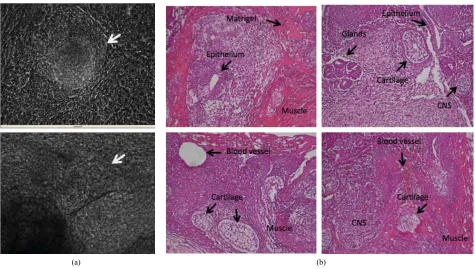
To determine if AdiPS cells display functional simi-larities to hES cells, we next conducted in vitro and in vivo differentiation experiments. Human AdiPS cells were first transferred to Matrigel plates and treated with high-serum, low growth factor medium for 3 to 4 weeks. Live-image microscopy revealed beating cardiomyocytes (white arrows) (Figure 4(a)). AdiPS cells were also
(a)
(b)
(c) (d)
[image:7.595.83.516.80.607.2](e) (f)
Figure 3. Characterization of adipose induced pluripotent stem (AdiPS) cells produced by pre-treatment of preadipocytes
[image:8.595.61.536.82.351.2]
(a) (b)
Figure 4. Differentiation of AdiPS cells in vitro and in vivo. (a) Morphology of beating cardiomyocytes. Human AdiPS cells were
transferred onto a Matrigel plate and treated with high serum/low growth factor medium for 3 to 4 weeks. Live images of in vi-tro-generated beating cardiomyocytes (white arrows) were captured by microscopy; (b) Morphology of formed teratomas. Human AdiPS cells were injected into athymic nude mice and after 6 to 7 weeks, samples were collected and stained with hemotoxylin-eosin (H&E). These four panels represent different sections through a teratoma illustrating tissues of all three embryonic germ layers as indicated; epithelium, muscle, cartilage, glands, central nervous system (CNS).
to assess their capacity for teratoma formation. Teratoma masses were observed 6 - 7 weeks after injection and H&E staining demonstrated tissues representing all three germ layers (Figure 4(b)). Comparison of preadipocytes
with human adipose-derived adult stem cells, isolated from subcutaneous fat, was indistinguishable with re-spect to their responses to HDAC inhibitor pre-treatment (data not shown).
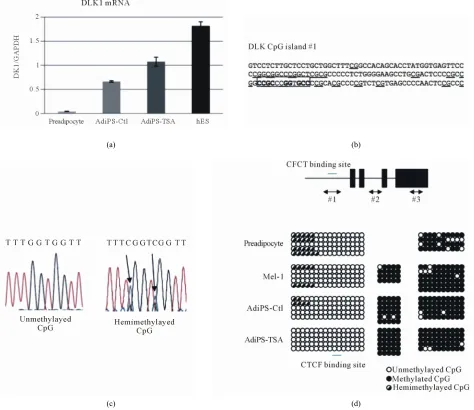
The expression status of the Dlk1-Dio3 imprinted gene cluster reflects the potential for production of high-grade chimaeras and their viability [30]. Interestingly, HDAC inhibitor treatment reactivates Dlk1-Dio3 expression within partially reprogrammed cells resulting in the es-tablishment of fully reprogrammed mouse iPS cells. High levels of Dlk1 (also known as Pref1) mRNA have also been detected in mouse preadipocytes and these levels dramatically decrease during adipocyte differen-tiation [31]. Therefore, we sought to determine the effect of the HDAC inhibitor, TSA, on the Dlk1 gene in our human AdiPS cells. Both types of AdiPS cells and hES cells were found to express high levels of Dlk1 mRNA as compared to human preadipocytes (Figure 5(a)).
How-ever, AdiPS-TSA cells had higher levels of Dlk1 gene expression than AdiPS-Ctl cells. The promoter region of the imprinted Dlk1 gene harbors hemimethylated CpG
dinucleotides [32]. This region also contains a CTCF insulator binding motif (CCGCnnGGnGGg/tC) as indi-cated by the box in Figure 5(b). Analysis of this region
using bisulfite sequencing revealed differential hemi-methylation of CpG dinucleotides between preadipocytes, hES cells and our AdiPS cells in the region of the CTCF binding site (Figures 5(c) and (d)). Specifically, human
preadipocytes showed higher levels of hemi-methylation than Mel-1, AdiPS-Ctl and AdiPS cells (Figure 5(d)).
These results agree well with published reports [30] and suggest that pretreatment of human preadipocytes with a broad range HDAC inhibitor such as TSA, might im-prove the quality of reprogrammed cells.
3.3. Induction of ES Cell-Like Colony Maturation by Post-Treatment of Cells with an HDAC Inhibitor
(a) (b)
[image:9.595.64.538.88.498.2]
(c) (d)
Figure 5. Dlk1 mRNA expression and DNA methylation of the Dlk1 promoter. (a) Dlk1 mRNA levels from human preadipocytes,
hES cells and AdiPS cells (AdiPS-Ctl, AdiPS-TSA) were determined by Real-time RT-PCR and expression was normalized to GAPDH; (b) Nucleotide sequence of the Dlk1 promoter. CpG dinucleotides are underlined and the putative CTCF binding site is shown within the box; (c) Representative chromatograms of unmethylated and hemimethylated CpG dinuleotides within the Dlk1 gene promoter; (d) DNA methylation status of the human Dlk1 gene. Analysis of three genomic regions (#1 - #3) by bisulfite se-quencing. Black boxes and horizontal line denote exons and introns, respectively. Empty circles, unmethylated CpG dinucleotides; filled circles, methylated CpG dinucleotides; half-filled circles, hemimethylated CpG dinucleotides.
with the epigenetic modifier, zebularine, affects this process. Our experimental strategy is outlined in Figure 6(a). TSA (1 μM) or zebularine (50 μM) pre-treated
hu-man preadipocytes were transfected with lentivirus as previously described (see Figure 3(a)). One day after
transferring to a mouse embryonic fibroblast feeder layer, hES culture medium was supplemented with zebularine as indicated. Colonies were first visible 3 days later (Figure 6(b)). These colonies were tracked through
clonal expansion and cell lines were established (Figure 6(b)) as described in our earlier experiment (see Figure 3(a)). Tightly packed colonies growing on the feeder
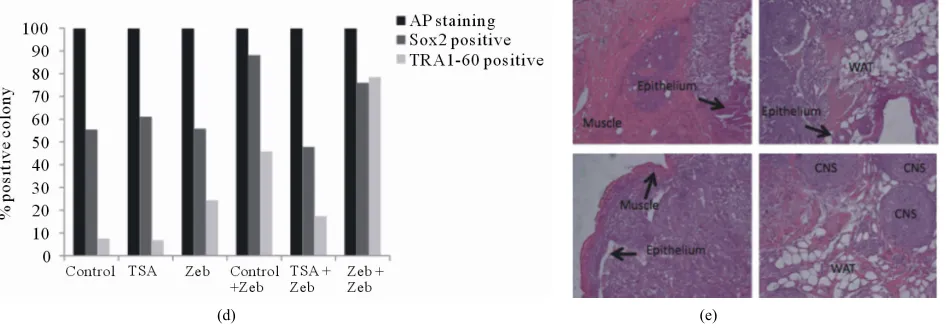
layer were stained with alkaline phosphatase (AP), and double immunostained for Sox2/TRA1-60 (red/green) (Figure 6(c)), markers for colony formation and
matura-tion, respectively. The percentage of positive colonies in each treatment group is shown in Figure 6(d). All
(a)
(b)
[image:11.595.64.537.87.252.2]
(d) (e)
Figure 6. Characterization of adipose induced pluripotent stem (AdiPS) cells produced by pre- and post-treatment of preadipocytes
with epigenetic modulators. (a) Experimental scheme for AdiPS cell production; (b) Morphological progression of ES cell-like col-ony formation in preadipocytes treated with the epigenetic modulators, TSA (1 μM) and/or zebularine (50 μM); (c) Examples of ES cell-like colonies stained for alkaline phosphatase (AP), Sox2 and Sox2/TRA1-60; (d) The percentage of positive-staining colonies observed in each experimental group is shown in Figure 6(c); (e) Teratoma formation in nude mice following AdiPS cell injection.
All three embryonic germ layers are visible by hematoxylin-eosin (H&E) staining; epithelium, muscle, white adipocytes (WAT), central nervous system (CNS).
number of both Sox2 (88%) and TRA1-60 (42%) ex-pressing colonies as compared to colonies from cells pre-treated with TSA (50% - 60% Sox2 and 8% TRA1-60) or zebualrine (50% - 60% Sox2 and 22% TRA1-60). Some-what surprisingly, colonies from cells pretreated with TSA and subsequently post treated with zebularine had reduced Sox2 (~42%) and TRA1-60 (18%) expression compared to colonies from cells only post-treated with zebularine. In contrast, pretreatment and post-treatment of cells with zebularine resulted in greater than 75% of the colonies staining positive for Sox2 and TRA1-60. Realtime RT-PCR of established AdiPS cell lines con-firmed that Sox2 (or Oct4 or Nanog) immunostaining was not due to ectopic gene expression (data not shown). Established AdiPS cells were also injected into Nude mice to assess their potential for teratoma formation. All three germ layers were present in the recovered tissue masses indicating teratoma formation (Figure 6(e)).
4. DISCUSION
We have generated human adipose tissue-derived iPS (AdiPS) cells from primary preadipocytes and adipose- derived adult stem cells using epigenetic modulation combined with lentivirus-induced pluripotency factor ex- pression. Our results demonstrate three important points. First, treatment of cells with HDAC or DNMT inhibitors, either before or after lentivirus transfection, increases pluripotency factor expression. These data sug- gest that epigenetic modification may activate both the auto- transcriptional and the reciprocal transcriptional regula- tion pathways of the endogenous pluripotency factors, Oct4 and Nanog, in adult human cells. Second, epige-
netic modulation of adipose tissue-derived cells, before lentivirus-induced pluripotency factor expression, in- creases the efficiency of ES cell-like colony formation. Third, DNMT inhibition, both before and after ES cell- like colony formation, increases the efficiency of colony maturation. Taken together, these data raise the interest-ing possibility that selective, small molecule-based epi-genetic modulation may promote pluripotency transcrip-tion factor expression and in turn, provide a more effi-cient means for iPS cell production.
Adipose tissue is likely to be an excellent source for cell reprogramming for at least two reasons. First, adi-pose tissue, like bone marrow, maintains adult mesen-chymal stem cells that can differentiate toward the os-teogenic, adipogenic, neurogenic, myogenic, and chon-drogenic lineage [33-35]. Second, it has been demon-strated that adipose derived stem cells express high lev-els of pluripotent transcription factors such as Oct4, Sox2, Rex1, Klf4, cMyc, and Esrrβ [28,35]. Therefore, these cells may provide a more favorable template for repro-gramming to ES-like cells due to their greater plasticity for reprogramming coupled with their broader differen-tiation potential relative to non-adipose-derived tissue sources. Moreover, adipose cells may also provide an avenue for creating model “disease-in-a-dish” systems that exploit natural variations among fat depots associ-ated with divergent metabolic responses.
pathways. Approaches include inhibitors of MEK [36], GSK [37], ROCK [36], and TGFβ[38]. In addition, p53 inhibition has been reported to improve reprogramming [39] as well as the application of a Ca2+ channel activator
[40]. Inhibitors of epigenetic modifications that target DNMT [12,40], HDAC [12], lysine methylase [37], and HMT [40] enable more efficient viral-based reprogram-ming through single-factor (Oct4) or dual-factor (Oct4 and Sox2) over-expression [38,41]. Recently, Yuan and colleagues reported that the protein, arginine methyla-transferase inhibitor (AMI-5), in combination with a TGFβ inhibitor, enabled Oct4 single-factor induced re-programming of mouse embryonic fibroblasts [24]. These and other results indicate that a pure chemical-based re-programming strategy for somatic cells is indeed, feasi-ble.
5. CONCLUSION
In this study, we identified multiple effects of small molecule epigenetic modulators on somatic cell repro-gramming. Primarily, we found that HDAC inhibition, prior to reprogramming factor transfection, increases ES cell-like colony formation up to 3-fold as compared to non-treated controls. Furthermore, DNMT inhibition be- fore and after reprogramming factor induction promotes maturation of partially reprogrammed cells and yields ~4-fold more mature colonies than the control group. Thus, our data demonstrate that small molecule-based epigenetic modulation can be used to augment existing virus-based reprogramming regimens. In addition, our work here may also provide valuable information re-garding the development of virus-independent, small mo- lecule-based reprogramming strategies that target restric-tive epigenetic modifications that are established during differentiation.
6. ACKNOWLEDGEMENTS
The authors thank Dr. David Burk and Ms. Susan Newman for tech-nical advice. This work was funded by the Louisiana Board of Regents Industrial Ties Program Grant LEQSF (2008-11)-RD-B-06 and by NIH Small Business Innovation Research grant (1 R43 HL104977). We also acknowledge the use of Genomics, Cell Biology and Imaging Core facilities that are supported, in part, by COBRE (NIH P20- RR021945) and NORC (NIH 1P30-DK072476) center grants from the NIH.
REFERENCES
[1] Takahashi, K. and Yamanaka, S. (2006) Induction of pluri- potent stem cells from mouse embryonic and adult fibro- blast cultures by defined factors. Cell, 126, 663-676.
doi:10.1016/j.cell.2006.07.024
[2] Park, I.-H., Arora., N., Huo, H.G., Maherali, N., Ahfeldt, T., Shimamura, A., Lensch, M.W., Cowan, C., Hochedlin-
ger, K. and Daley, G. Q. (2008) Disease-Specific induced pluripotent stem cells. Cell, 134, 1-10.
doi:10.1016/j.cell.2008.07.041
[3] Yu, J.Y., Vodyanik, M.A., Smuga-Otto, K., Antosiewicz- Bourget, J., Frane, J.L., Tian, S., Nie, J., Jonsdottir, G.A., Ruotti, V., Stewart, R., Slukvin, I.I. and Thomson, J.A. (2007) Induced pluripotent stem cell lines derived from human somatic cells. Science, 318, 1917-1920.
doi:10.1126/science.1151526
[4] Meng, X.L., Shen, J.S., Kawagoe, S., Ohashi, T., Brady, R.O., et al. (2010) Induced pluripotent stem cells derived from mouse models of lysosomal storage disorders. Pro- ceedings of the National Academy of Sciences of the USA,
107, 7886-7891. doi:10.1073/pnas.1002758107
[5] Ebert, A.D., Yu, J.Y., Rose, F.F. Jr., Mattis, V.B., Lorson, C.L., et al. (2009) Induced pluripotent stem cells from a spinal muscular atrophy patient. Nature, 457, 277-280.
[6] Lee, G., Papapetrou, E.P., Kim, H., Chambers, S.M., Tomishima, M.J., et al. (2009) Modelling pathogenesis and treatment of familial dysautonomia using patient- specific iPSCs. Nature, 461, 402-406.
[7] Rashid, S.T., Corbineau, S., Hannan, N., Marciniak, S.J., Miranda, E., et al. (2010) Modeling inherited metabolic disorders of the liver using human induced pluripotent stem cells. The Journal of Clinical Investigation, 120,
3127-3136. doi:10.1172/JCI43122
[8] Zhang, N., An, M.C., Montoro, D., Ellerby, L.M. (2010) Characterization of human huntington’s disease cell model from induced pluripotent stem cells. PLoS Currents, 2,
RRN1193. doi:10.1371/currents.RRN1193
[9] Zhao, T. and Xu, Y. (2010) p53 and stem cells: New de- velopments and new concerns. Trends in Cell Biology, 20, 170-175. doi:10.1016/j.tcb.2009.12.004
[10] Yu, J.Y., Hu, K.J., Smuga-Otto, K., Tian, S.L., Stewart, R., Slukvin, I.I. and Thomson, J.A., (2009) Human induced pluripotent stem cells free of vector and transgene se- quences. Science, 10, 797-801.
doi:10.1126/science.1172482
[11] Sommer, C.A., Stadtfeld, M., Murphy, G.J., Hochedlinger, K., Kotton, D.N., et al. (2009) Induced pluripotent stem cell generation using a single lentiviral stem cell cassette. Stem Cells, 27, 543-549.
doi:10.1634/stemcells.2008-1075
[12] Huangfu, D.W., Maehr, R., Guo, W.J., Eijkelenboom, A., Snitow, M., Chen, A.E. and Melton, D.A. (2008) Induc- tion of pluripotent stem cells by defined factors is greatly improved by small-molecule compounds. Nature Biotech- nology, 26, 795-797.
[13] Okita, K., Nakagawa, M., H., Hong, Ichisaka, T. and Ya- manaka, S., (2008) Generation of mouse induced pluri- potent stem cells without viral vectors. Science, 322, 949-
953. doi:10.1126/science.1164270
[14] Warren, L., Manos, P.D., Ahfeldt, T., Loh, Y.-H., Li, H., et al. (2010) Highly efficient reprogramming to pluripo- tency and directed differentiation of human cells with synthetic modified mRNA. Cell Stem Cell, 7, 618-630.
doi:10.1016/j.stem.2010.08.012
(2010) Reprogramming of human fibroblasts to pluripo- tent stem cells using mRNA of four transcription factors. Biochemical and Biophysical Research Communications,
394, 189-193. doi:10.1016/j.bbrc.2010.02.150
[16] Anokye-Danso, F., Trivedi, C.M., Juhr, D., Gupta, M., Cui, Z., et al. (2011) Highly efficient miRNA-mediated re- programming of mouse and human somatic cells to pluri- potency. Cell Stem Cell, 8, 376-388.
doi:10.1016/j.stem.2011.03.001
[17] Woltjen, K., Michael, I.P., Mohseni, P., Desai, R., Mileik- ovsky, M., et al. (2009) piggyBac transposition reprograms fibroblasts to induced pluripotent stem cells. Nature, 458,
766-770.
[18] Kaji, K., Norrby, K., Paca, A., Mileikovsky, M., Mohseni, P., et al. (2009) Virus-Free induction of pluripotency and subsequent excision of reprogramming factors. Nature,
458, 771-775.
[19] Kim, D., Kim, C.-H, Moon, J.-I., Chung, Y.-G., Chang, M.-Y., Han, B.-S., Ko, S., Yang, E., Cha, K.Y., Lanza, R. and Kim, K.-S. (2009) Generation of human induced pluripotent stem cells by direct delivery of reprogram- ming proteins. Cell Stem Cell, 4, 472-476.
doi:10.1016/j.stem.2009.05.005
[20] Zhou, H.Y., Wu, S.L., Joo, J.Y., Zhu, S.Y., Han, D.W., Lin, T.X., Trauger, S., Bien, G., Yao, S., Zhu, Y., Siuzdak, G., Scholer, H.R., Duan, L.X. and Ding, S. (2009) Generation of induced pluripotent stem cells using recombinant pro- teins. Cell Stem Cell, 4, 381-384.
[21] Zhu, S.Y., Li, W.L., Zhou, H.Y., Wei, W.G., Ambasudhan, R., et al. (2010) Reprogramming of human primary so- matic cells by OCT4 and chemical compounds. Cell Stem Cell, 7, 651-655. doi:10.1016/j.stem.2010.11.015
[22] Li, Y., Zhang, Q., Yin, X., Yang, W., Du, Y., et al. (2011) Generation of iPSCs from mouse fibroblasts with a single gene, Oct4, and small molecules. Cell Research, 21, 196-
204. doi:10.1038/cr.2010.142
[23] Chen, J.K., Liu, J., Yang, J.Q., Chen, Y., Chen, J., et al. (2011) BMPs functionally replace Klf4 and support effi- cient reprogramming of mouse fibroblasts by Oct4 alone. Cell Research, 21, 205-212. doi:10.1038/cr.2010.172
[24] Yuan, X., Wan, H., Zhao, X., Zhu, S., Zhou, Q., et al. (2011) Combined chemical treatment enables Oct4-in- duced reprogramming from mouse embryonic fibroblasts. Stem Cells, 29, 549-553. doi:10.1002/stem.594
[25] Zhu, S., Wei, W. and Ding, S. (2011) Chemical strategies for stem cell biology and regenerative medicine. Annual Review of Biomedical Engineering, 13, 73-90.
[26] Jaenisch, R. and Young, R. (2008) Stem cells, the mo- lecular circuitry of pluripotency and nuclear reprogram- ming. Cell, 132, 567-582. doi:10.1016/j.cell.2008.01.015
[27] Kim, J., Chu, J.L., Shen, X.H., Wang, J.L. and Orkin, S.H. (2008) An extended transcriptional network for pluripo- tency of embryonic stem cells. Cell, 132, 1049-1061.
doi:10.1016/j.cell.2008.02.039
[28] Sun, N., Panetta, N.J., Gupta, D.M., Wilson, K.D., Lee, A., et al. (2009) Feeder-Free derivation of induced pluri- potent stem cells from adult human adipose stem cells. Proceedings of the National Academy of Sciences of the
USA, 106, 15720-15725. doi:10.1073/pnas.0908450106
[29] Chan, E.M., Ratanasirintrawoot, S., Park, I.-H., Manos, P.D., Loh, Y.-H., et al. (2009) Live cell imaging distin- guishes bona fide human iPS cells from partially repro- grammed cells. Nature Biotechnology, 27, 1033-1037.
[30] Stadtfeld, M., Apostolou, E., Akutsu, H., Fukuda, A., Fol- lett, P., et al. (2010) Aberrant silencing of imprinted genes on chromosome 12qF1 in mouse induced pluripotent stem cells. Nature, 465, 175-181.
[31] Sul, H.S., Smas, C., Mei, B. and Zhou, L. (2000) Func- tion of pref-1 as an inhibitor of adipocyte differentiation. International Journal of Obesity and Related Metabolic Disorders, 24, 15-19.
[32] Wylie, A.A., Murphy, S.K., Orton, T.C. and Jirtle, R.L. (2000) Novel imprinted DLK1/GTL2 domain on human chromosome 14 contains motifs that mimic those impli- cated in IGF2/H19 regulation. Genome Research, 10,
1711-1718. doi:10.1101/gr.161600
[33] Zuk, P.A., Zhu, M., Ashjian, P., De Ugarte, D.A., Huang J.I., et al. (2002) Human adipose tissue is a source of multipotent stem cells. Molecular Biology of the Cell, 13,
4279-4295. doi:10.1091/mbc.E02-02-0105
[34] Zuk, P.A., Zhu, M., Mizuno, H., Huang, J., Futrell, J.W., et al. (2001) Multilineage cells from human adipose tis- sue: implications for cell-based therapies. Tissue Engi- neering, 7, 211-228. doi:10.1089/107632701300062859
[35] Izadpanah, R., Trygg, C., Patel, B., Kriedt, C., Dufour, J., Gimble, J.M. and Bunnell, B.A. (2006) Biologic proper- ties of mesenchymal stem cells derived from bone mar- row and adipose tissue. Journal of Cellular Biochemistry,
99, 1285-1297. doi:10.1002/jcb.20904
[36] Lin, T.X., Ambasudhan, R., Yuan, X., Li, W.L., Hilcove, S., et al. (2009) A chemical platform for improved induc- tion of human iPSCs. Nature Methods, 6, 805-808.
[37] Li, W.L., Zhou, H.Y., Abujarour, R., Zhu, S.Y., Joo, Y.J., et al. (2009) Generation of human-induced pluripotent stem cells in the absence of exogenous Sox2. Stem Cells,
27, 2992-3000. doi:10.1002/stem.240
[38] Ichida, J.K., Blanchard, J., Lam, K., Son, E.Y., Chung, J.E., et al. (2009) A small-molecule inhibitor of tgf-β sig- naling replaces Sox2 in reprogramming by inducing Nanog. Cell Stem Cell, 5, 491-503.
doi:10.1016/j.stem.2009.09.012
[39] Esteban, M.A., Wang, T., Qin, B.M., Yang, J.Y., Qin, D.J., et al. (2010) Vitamin C enhances the generation of mouse and human induced pluripotent stem cells. Cell Stem Cell,
6, 71-79. doi:10.1016/j.stem.2009.12.001
[40] Shi, Y., Desponts, C., Do, J.T., Hahm, H.S., Scholer, H.R., et al. (2008) Induction of pluripotent stem cells from mouse embryonic fibroblasts by Oct4 and Klf4 with small- molecule compounds. Cell Stem Cell, 3, 568-574.
doi:10.1016/j.stem.2008.10.004