
ISSN Online: 2160-889X ISSN Print: 2160-8881
DOI: 10.4236/opj.2018.89025 Sep. 19, 2018 301 Optics and Photonics Journal
Structure Damage Identification via Fiber
Grating Strain Sensing Array Detecting
and Wavelet Analysis
Pei Luo
National Engineering Laboratory for Fiber Optic Sensing Technology, Wuhan University of Technology, Wuhan, China
Abstract
The measuring method of structure damage during vibrating has been devel-oped by applying simple supported beam as object of study, fiber Bragg grat-ing strain sensgrat-ing array as the measurgrat-ing method, and wavelet package analy-sis as signal extracting tools. The damage data of simple supported beam at vibrating state has been collected. The damage characteristic indexes have been extracted based on analyzing and handling the damage data with wave-let analysis. The experiment shows that fiber Bragg grating strain sensing ar-ray can sensitively measure the experimental data of simple supported beam at vibrating state. The fiber Bragg grating strain sensing array measuring is a new method in dynamic measurement.
Keywords
Fiber Grating Strain Sensing Array, Wavelet Package Analysis, Simple Supported Beam, Cracks Detecting, Vibration
1. Introduction
Damage identification of engineering structure will be realized by measuring signal to obtain structural state changes [1]. Beam structure is the primary com-ponent in the engineering structure and also basic comcom-ponent of different structure; it is the most general flexural structure in engineering application; it has been widely applied in the engineering field of machinery, traffic and archi-tecture [2]. The key to the damage identification question which taking vibrant measuring data as basis is: to find a characteristic index or damage index that can response the structural state. Traditional signal analysis is based on the Fourier transform of the stable signal which can’t express the time-frequency How to cite this paper: Luo, P. (2018)
Structure Damage Identification via Fiber Grating Strain Sensing Array Detecting and Wavelet Analysis. Optics and Photonics Journal, 8, 301-308.
https://doi.org/10.4236/opj.2018.89025 Received: September 3, 2018
Accepted: September 16, 2018 Published: September 19, 2018
Copyright © 2018 by author and Scientific Research Publishing Inc. This work is licensed under the Creative Commons Attribution-NonCommercial International License (CC BY-NC 4.0).
http://creativecommons.org/licenses/by-nc/4.0/
DOI: 10.4236/opj.2018.89025 302 Optics and Photonics Journal property of signal. However, in actual structural damage identification, most measuring signals are non-stable and need to be analyzed at frequency of local time. This is called by time-frequency analysis. The wavelet analysis and the wavelet package analysis have favorable localize property at the same time in time and frequency fields [3]. They can focus on arbitrary details of signal, and can easily realize time-frequency analysis of non-stable signal. In addition, the wavelet package analysis is still a finer time-frequency decomposition method and can treat the high frequency part which isn’t subdivided in wavelet analysis.
Researchers have taken amount of research on measuring cracks with various measuring methods such as ultrasonic, rays, acoustic emission, liquid permea-tion coloring, synthetic crack detecpermea-tion method, magnetic powder, vortexing and microwaves. S. Caddemi, I. Calio & M. Marletta [4] have studied nonlinear dynamic response at state of beam cracking. A. Khorram, M. Rezaeian & F. Bakhtiari-Nejad [5] have studied multiple fractures damage detection under a moving load on the beam. Tang Tianguo, Liu Haowu, Chen Chunhua & Liu Xiaosen [6] have studied damage of beam by modal strain energy. Jiang Haibo & Zhao Renda [7] have studied vibration modal analysis on damage simple sup-ported beam. Xu Ping [8] has studied curvature mode of damage simple sup-ported beam. An Yonghui & Ou Jinping [9] have imitated and analyzed the sim-ple supported beam bridge. However, these works have not realized long dis-tance online monitoring due to electronic engineering sensors. Fiber Bragg grating sensing technology is a new type technology [10] [11] [12], which has many ad-vantages such as little structure, convenient to use, immune to electromagnetics, easy to web forming, fitting to online monitoring, and conveying to long dis-tance. At present, many types of fiber grating sensors have been applied to real-time monitoring scene.
In this paper, the fiber Bragg grating strain sensing array is adopted to meas-ure vibration of simple supported beam. The wavelet package analysis is used to acquire vibrating data of simple supported beam structure. The dynamic analysis has taken on the damage data of beam structure. The real-time dynamic moni-toring of simple supported beam has been realized.
2. Wavelet Package Analysis Method
DOI: 10.4236/opj.2018.89025 303 Optics and Photonics Journal further resolved and be analyzed by wavelet method, the process is called as wavelet package analysis. The aim of the wavelet package analysis is to further resolve those non-subdivided high frequencies obtained by multi-resolution analysis. During the wavelet package analysis, choosing self-adaptively relevant frequency band according to characteristic of analyzed signal may realize well- matched frequency spectrum of signal, as a result, the resolution ratio will be greatly increased. Therefore, the wavelet package analysis is a finer time-frequency re-solving method than the wavelet analysis.
Wavelet package is usually composed of linear combinations, which can pro-vide a series of primary functions. Thus, it has the orthogonality and time-frequency local characteristic. One wavelet function
ψ
ij k,( )
t has 3 indexes, i, j, k indicatefrequency, dimension, offset parameters of wavelet package function, respec-tively.
( )
2(
)
, 2 2 , 1,2,3,
i j j
j k t i t k i
ψ = ψ − = (1)
Wavelet function ψi can be solved by the following equation:
( )
( ) (
)
( )
( ) (
)
1 1 2 2 2 2 i k i kt h k t k
t g k t k
φ φ ψ φ ∞ =−∞ ∞ =−∞ = − = −
∑
∑
(2)where φi is dimension function, the primary wavelet function
ψ
i( )
t is knownas mother wavelet, that is:
( )
( )
i t t
ψ
=ψ
(3)
The discreted filter coefficients h(k) and g(k) are the integral acoustic image filter coefficients related to the dimension function and mother wavelet function. The wavelet functions have the same orthogonality, time-frequency localization and so on as these of the corresponding wavelet package. Wavelet package anal-ysis can map any signal onto a group of primary functions formed by wavelet stretching out and drawing back. In order to localize analysis for the non-steady signal, one need to obtain the decomposed array distributed among different frequency band within pass-band. However, the wavelet package energy spec-trum is very sensitive to tiny damages of structure, tiny damages due to the very small changes in structural mass, stiffness and damp may cause large changes in energy spectrum. Therefore, the wavelet package method may analyze the re-sponse signals before and after structure damage. By comparing changes of energy of each stage sub-signal, one can construct indexes of damage and finish the structural damage identification.
3. Experimental Section
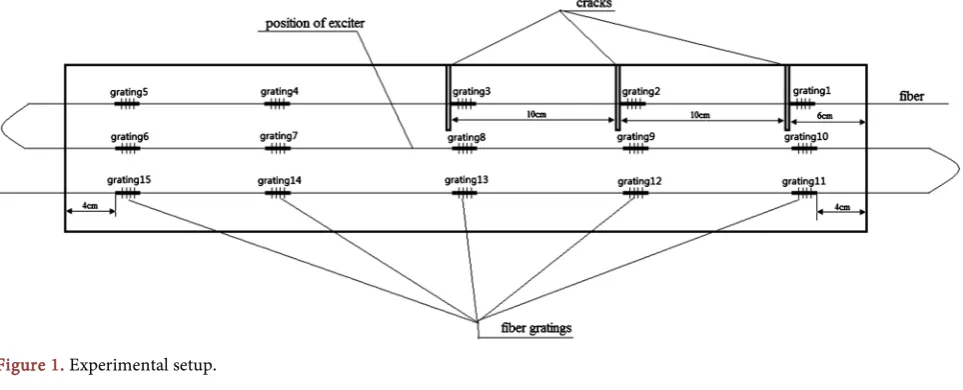
fa-DOI: 10.4236/opj.2018.89025 304 Optics and Photonics Journal bricated, which have no damage, one crack, two cracks, and three cracks, respec-tively. Fifteen gratings are pasted on each stainless-steel plate, as is shown in Figure 1. The paste length of fiber grating is about 20 mm. Fifteen gratings are divided into three groups and pasted into three arrays. For the first array the distance between the head end and the fixed one of beam is about 40 mm. The distance between the terminal of the first grating and the head end of the second grating is about 80 mm, and so on. The distance between the terminal of the fifth grating and another fixed end of the beam is about 40 mm. Other two groups are pasted according to the same pattern as that of the first array. Along the hori-zontal direction of the beam, the first array locates about 15 mm away from the horizontal side, the second one is pasted on center axis, and the third one is symmetrically pasted on another side.
Fifteen Bragg gratings are fiber Bragg gratings array being connected to an optical fiber. These gratings are divided into three groups and pasted on the sur-face of the beam. Before having carried out the pasted experiment, the sursur-face of beam must be first cleaned by alcohol, and then marks a position for accurately pasting the fiber gratings. After having pasted by epoxy-resin glue, the steel plate must be placed quietly 24 hours. The vibration test can be done. Before collect-ing the experimental data, it needs to preload on beam. Namely, the beam is vi-brated in an acceptable range, and each Bragg grating is in working condition.
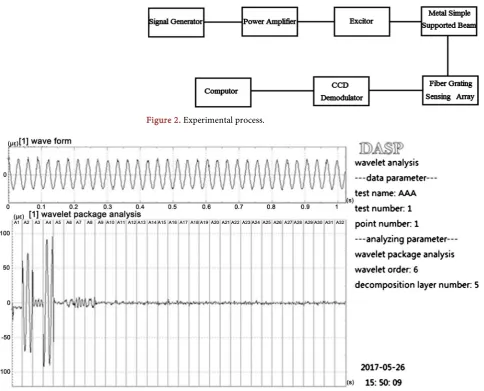
Before experiments, the experimental equipment must be preheated for half an hour. In this experiment, the following equipment must be used; they are ex-citer, signal generator, power amplifier, fiber grating demodulator, and comput-er. Experimental process is shown in Figure 2.
4. Results and Discussion
The experimental process of measuring damage simple supported beam with fi-ber Bragg grating strain sensing array is as following: Firstly, it needs to excite the simple supported beam in turn in the range of 0 - 200 Hz at keeping un-changeable output voltage value of signal generator steadiness. Secondly, we
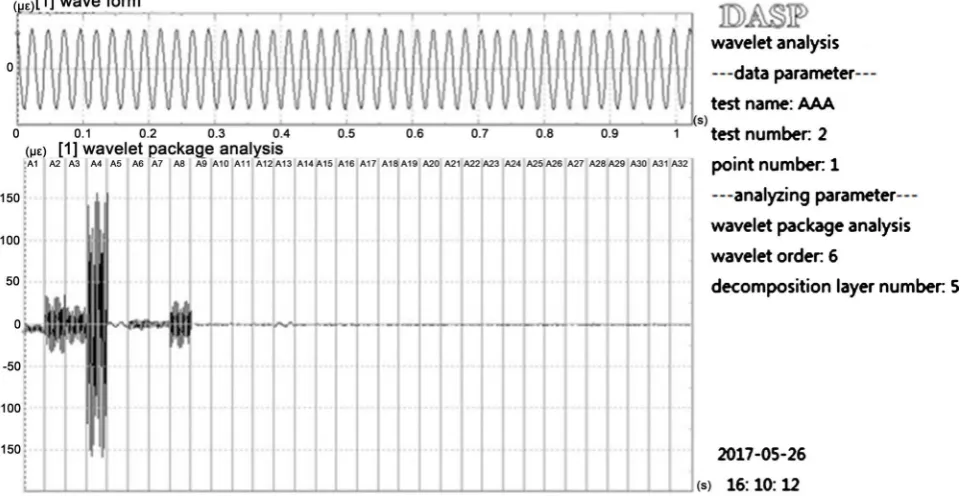
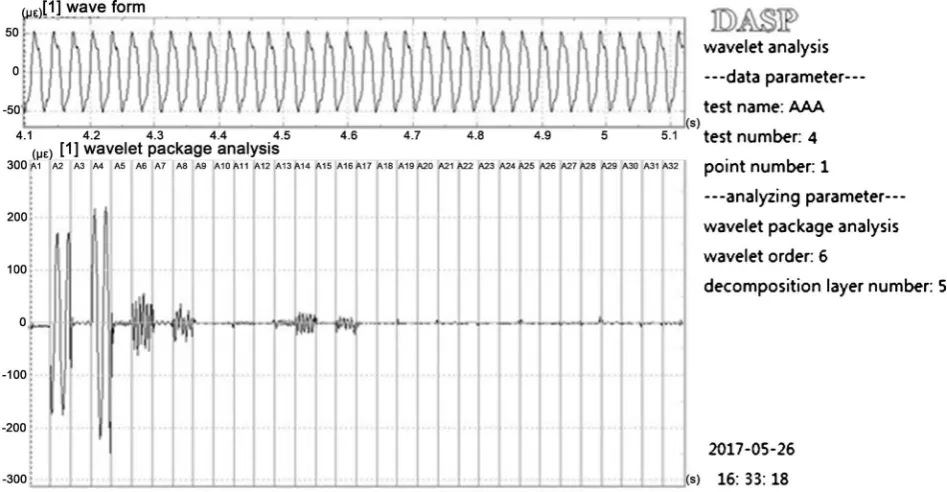
DOI: 10.4236/opj.2018.89025 305 Optics and Photonics Journal found that the collecting signals from the sensor are basically the normal sinu-soidal signals in the range of 10 - 30 Hz, the wave form of signals are changed when the vibrating frequency is more than 30 Hz, and then there are to appear some additional sinusoidal wave signals. Thirdly, when the beam is in resonating state, the measuring signals still keep sinusoidal wave form function for the un-damaged beam, are changed and appear many harmonic waves for those dam-aged beams. This phenomenon is attributed to additional nonlinear signals in-duced by the collision between the two end faces of cracks under the resonation condition. The experimental data of fiber Bragg grating strain sensing array col-lecting are collected and analyzed by data collector, and are demodulated by fi-ber grating demodulator. The wavelet package analysis of all the data has been completed by the wavelet package analysis soft in the collecting analyzer. The wavelet package analysis spectrum figures for these damaged simple supported beams are shown in Figures 3-6.
[image:5.595.60.545.317.708.2]Figure 3 is the wavelet package analyzing figure of fiber Grating detecting vi-bration of undamaged simple supported beam. The engineer spectrums appear
Figure 2. Experimental process.
DOI: 10.4236/opj.2018.89025 306 Optics and Photonics Journal
[image:6.595.60.540.354.603.2]Figure 4. Wavelet package analysis diagram of one-crack simple supported beam at vibrating state.
Figure 5. Wavelet package analysis diagram of two-crack simple supported beam at vibrating state.
DOI: 10.4236/opj.2018.89025 307 Optics and Photonics Journal
Figure 6. Wavelet package analysis diagram of three-crack simple supported beam at vibrating state.
one-crack, the engineer spectrums have obvious difference at A1, A2, A3, A6 and A7 frequency bands. Figure 6 shows the wavelet package analyzing figure of fiber Grating detecting vibration of three-crack simple supported beam. Com-pared with engineer spectrum analyzing figure of two-crack, the engineer spec-trum figure change more at A1, A2, A3, A6, A7 and A8 frequency bands. There are engineer spectrums at A14, A16. This is possible that two beams of crack clap each other. The frequency spectrums at different frequency band will ap-pear various changes as cracks are increasing. Therefore, the different damage states of simple supported beam can be decided according to different of energy index. Obviously, the energy indexes of wavelet package analysis are the strong basis to detect the tiny damages.
5. Conclusion
In this paper, the measuring method of structure damage during vibrating has been studied with simple supported beam as object of study, fiber Bragg grating strain sensing array as the measuring method, and wavelet package analysis as signal extracting tools. The damage data of simple supported beam at vibrating state has been collected. The damage indexes have been acquired after analyzing and handling the damage data. The experiment shows that fiber Bragg grating strain sensing array can sensitively measure the experimental data of simple supported beam at vibrating state. The fiber Bragg grating strain sensing array measuring is a new method in dynamic measurement.
Fund
DOI: 10.4236/opj.2018.89025 308 Optics and Photonics Journal (No. 51308428).
Conflicts of Interest
The author declares no conflicts of interest regarding the publication of this pa-per.
References
[1] Liu, H.P. (2013) Study on the Structural Damage Identification Based on Wavelet Packet and BP Neural Network. Dissertation for the Master Degree of Qingdao Technological University, s42-s55.
[2] Zhuo, D.B. (2011) Research on Structural Damage Identification of Girder Structure Based on Wavelet Packet Analysis. Dissertation for the Master degree of Chongqing University, s25-s34.
[3] Xiao, B.L., Zhen, J.Q. and Deng, Y.S. (2011) Review of Structure Damage Identifica-tion Based on Wavelet Packet Analysis. Highway Engineering, 36, s36-s40.
[4] Caddemi, S., Calio, I. and Marletta, M. (2010) The Non-Linear Dynamic Response of the Euler-Bernoulli Beam with an Arbitrary Number of Switching Cracks. Inter-national Journal of Non-Linear Mechanics, 45, s714-s726.
https://doi.org/10.1016/j.ijnonlinmec.2010.05.001
[5] Khorram, A., Rezaeian, M. and Bakhtiari-Nejad, F. (2013) Multiple Cracks Detec-tion in a Beam Subjected to a Moving Load Using Wavelet Analysis Combined with Factorial Design. European Journal of Mechanics A/Solids, 40, s97-s113.
[6] Tang, T.G., Liu, H.W., Chen, C.H. and Liu, X.S. (2005) Strain Energy Method for Analysis of Beams with Crack Damage and Experimental Study. Engineering Me-chanics, 22, s39-s45.
[7] Jiang, H.B. and Zhao, R.D. (2004) Vibration Mode Analysis of Simply Supported Beam with Damage Boundary Condition. Journal of Vibration and Shock, 23, s72-s76. [8] Xu, P. (2011) Modal Curvature Characteristics of a Simple Beam with a Local
Damaged Crack. Chinese Journal of Solid Mechanics, 32, s717-s715.
[9] An, Y.H. and Ou, J.P. (2013) Experimental and Numerical Studies on Damage Se-verity Identification of Simply Supported Beam Bridges. Journal of Vibration, Mea-surement & Diagnosis, 33, s60-s66.
[10] Lu, Y. and Liu, H. (2007) Experiment Research of Structural Damage Diagnosis Based on Fiber Bragg Grating Sensors. External Building Materials Science and Technology, 28, s17-s20.
[11] Lu, G., et al. (2014) The Low Velocity Impact Localization Based on Optic Fiber Sensing Network for Varied Cross-Section Composites. Chinese Journal of Sensors and Actuators, 27, s1632-s1636.
![Bis(N {bis[methyl(phenyl)amino]phosphoryl} 2,2,2 trichloroacetamide)dinitratodioxidouranium(VI)](data:image/gif;base64,R0lGODlhAQABAIAAAP///wAAACH5BAEAAAAALAAAAAABAAEAAAICRAEAOw==)