Adaptive Resource Allocation for
Wireless Body Sensor Networks
A thesis submitted in partial fullment of the requirements for the degree of Doctor of Philosophy
presented by
Ehsan Tabatabaei Yazdi
Supervising Committee:
Dr. Andreas Willig (Senior Supervisor)
Professor Krys Pawlikowski (Associate Supervisor)
Examining Committee:
Associate Professor Nevil Brownlee (Oral Examiner)
Professor Ahmet Sekercioglu (International Examiner)
Abstract
Wireless Body Sensor Network (WBSN) technologies are one of the main research elds in the health care and entertainment industry. These technologies aim to one day become mature enough to improve the quality of human life. For example, WBSN technologies are able to control and monitor the health status of a patient at all times, alert patients or practitioners about abnormal physical health status that otherwise would have been ignored or remained unnoticed by the patient, give enough time to the patient to seek medical care, and thus help to cure illness before symptoms become visible or the physical health of the patient becomes critical. They allow elderly and chronically ill people to maintain their independence without need for constant supervision or the presence of caregivers.
WBSNs are an attractive proposal for such scenarios due to the ease of instal-lation, their small size, low cost, low power consumption and low maintenance. Although WBSNs have signicant benets, their characteristics create numerous challenges, namely: network mobility in urban environments, interference caused by other technologies sharing the same frequency band, and most importantly, limited resources such as nite power supply, computational power, storage capacity and communication capabilities.
pro-tocol running on the WBSN to be not only energy-ecient, robust and reliable, but also adapt to an ever changing interference background. To achieve these goals, an adaptive scheme embedded into real WBSN nodes to cope with interference changes within a variety of interference conditions is introduced.
All proposed schemes in this thesis are compared in dierent case studies, demon-strating the behaviour of each scheme under varying levels of interference source density and interference trac intensity. Issues and challenges pertaining to relia-bility, energy-eciency and robustness are addressed and investigated by conducting comprehensive simulation studies. Beyond this, some of the most promising of the proposed schemes are also evaluated via an experimental implementation to further validate the simulation results in a real life scenario and to assess the feasibility of embedding the proposed schemes on existing WSN nodes.
In the rst stage, the IEEE 802.15.4 standard is compared with the so-called genie scheme. The genie scheme is a hypothetical scheme designed to illustrate the upper bounds of what is achievable in terms of successful data transmission when a WBSN is faced with an ever changing interference background and when all the WBSN nodes have global information of the channel quality for all available frequencies. An important conclusion from this study is that frequency adaptation can lead to an 80% increase in the fraction of successfully delivered data packets when compared with the no-adaptation scheme (IEEE 802.15.4 standard).
discovery schemes lead to insignicant improvements in the overall successful data communication rates and energy consumption of the WBSNs. The relative perfor-mance trends between the IEEE 802.15.4 standard, a periodic adaptation scheme and the Lazy scheme are also conrmed experimentally by measurements. For these experiments an implementation of these schemes has been developed.
Finally, after implementation of the proposed Lazy scheme on existing WSN nodes, the eects of power variation and coupling variation of transmit-power with frequency adaptation is evaluated for interference mitigation in WBSNs. The simulation results showed that the upper bound of transmit-power adaptation alone has a signicantly lower performance improvement than the frequency adapta-tion in environments with high WiFi interference. Furthermore, coupling maximum transmit-power with frequency adaptation, increases the data communication re-liability and also reduces the overall energy consumption of the sensor nodes, by lowering the orphaning time, for scenarios with high WiFi interference.
Publications
Related Journal and Conference Publications:
Yazdi, E.T. and Willig, A. and Pawlikowski, K., Frequency Adaptation for Inter-ference Mitigation in IEEE 802.15.4-Based Mobile Body Sensor Networks. Com-puter Communications, volume 53, number 0, pages 102-119, 2014.
URL http://www.sciencedirect.com/science/article/pii/S014036641400245X
Yazdi, E.T. and Moravejosharieh, A. and Willig, A. and Pawlikowski, K., Cou-pling Power and Frequency Adaptation for Interference Mitigation in IEEE 802.15.4 Based Mobile Body Sensor Networks: Part II, In 2014 IEEE International Con-ference on Australasian Telecommunication Networks and Applications ConCon-ference (ATNAC), 2014. (Accepted)
Yazdi, E.T. and Willig, A. and Pawlikowski, K., Coupling Power and Frequency Adaptation for Interference Mitigation in IEEE 802.15.4 Based Mobile Body Sen-sor Networks, In 2014 IEEE 9th International Conference on Intelligent Sensors,
Sensor Networks and Information Processing (ISSNIP), pages 1-6, April 2014. Yazdi, E.T. and Willig, A. and Pawlikowski, K., Shortening Orphan Time in IEEE 802.15.4: What can be Gained?, In 201319th IEEE International Conference
on Networks (ICON), pages 1-6, December 2013.
Yazdi, E.T. and Willig, A. and Pawlikowski, K., On channel adaptation in IEEE 802.15.4 mobile body sensor networks: What can be Gained?, In 2012 18th IEEE
Other Publications:
Moravejosharieh, A. and Yazdi, E.T. and Willig, A. and Pawlikowski, K., Adap-tive Channel Utilisation in IEEE 802.15.4 Wireless Body Sensor Networks: Con-tinuous Hopping Approach, In IEEE International Conference on Australasian Telecommunication Networks and Applications Conference (ATNAC), 2014. (Ac-cepted)
Yazdi, E.T. and Moravejosharieh, A. and Kumar Ray, S., Study of Target Track-ing and Handover in Mobile Wireless Sensor Network, In IEEE 28th International
Conference on Information Networking (ICOIN), pages 120-125, 10th of February
2014.
Moravejosharieh, A. and Yazdi, E.T. and Willig, A., Study of Resource Utili-sation in IEEE 802.15.4 Wireless Body Sensor Network, Part II: Greedy Channel Utilisation, In19th IEEE International Conference on Networks (ICON), pages 1-6.
11th of December 2013.
Moravejosharieh, A. and Yazdi, E.T., Study of Resource Utilisation in IEEE 802.15.4 Wireless Body Sensor Network, Part I: The need for enhancement, In IEEE
16th International Conference on Computational Science and Engineering (CSE),
pages 1226-1231,3rd of December 2013.
Ali, S. and Yazdi, E.T. and Willig, A., Investigations on passive discovery schemes for IEEE 802.15.4 based Body Sensor Networks, In IEEE International Confer-ence on Australasian Telecommunication Networks and Applications ConferConfer-ence (ATNAC), pages 89-94. 20th of November 2013.
Abbasnejad, I and Zomorodian, M.J. and Yazdi, E.T., Combination of multi-class SVM and multi-class NDA for face recognition, In19thInternational Conference on
Mechatronics and Machine Vision in Practice (M2VIP), pages 408-413, November 2012.
IEEE Symposium on Wireless Technology and Applications (ISWTA), pages 152-155, September 2011.
Participation and Presentation in Local Conferences:
New Zealand Computer Science Research Student Conference (NZCSRSC), 24th
of April 2014. (Awarded the best paper award by a panel of academic judges.) New Zealand Computer Science Research Student Conference (NZCSRSC), 15th
of April 2013.
Post Graduate Conference, 29th of August, 2013.
Post Graduate Conference, 23rd of August, 2012.
Post Graduate Conference, 1st of September, 2011.
New Zealand Computer Science Research Student Conference (NZCSRSC), 18th
of April 2011.
Dedications
I dedicate this thesis to my parents, Dr. Hossein Tabatabaei Yazdi and Mahnaz Boroukhiyan, who are always supporting and encouraging me, and my sisters, Golsa and Nazi Tabatabaei Yazdi for their constant love, spiritual support and
Acknowledgements
I wish to express my sincere gratitude and indebtedness to Dr. Andreas Willig for his supervision, guidance and encouragement throughout this study. His invaluable
suggestions and constructive criticism from time to time during the preparation of this thesis enabled the author to present the thesis in this form. My sincere gratitude is also due to Krzysztof Pawlikowski for his supervision and valuable
suggestions throughout this study.
Thanks are due to Mr Peter Glassenbury, Professor Timothy David, Dr. Francois Bissey, Mr Phil Holland, Mr Jore Horlor, Mr Adrian White, Mr Steven Sykes, Mr Dan Sun and Mr Tony Dale for their assistance they provided in the laboratory at
various stages of the work.
I would like to thank my other committee members including but not limited to, Professor Antonija Mitrovic, Professor Tim Bell, Associate Professor Richard Green, Dr. Dong Seong Kim, Dr. Richard Lobb, Associate Professor Ray Hunt,
Dr. Steve Weddell, Mrs Gillian Clinton and Mrs Alex Forster.
Finally, I would like to also thank my colleagues and dear friends including but not limited to, Mr Amirhosein Moravejosharieh, Mr Amir Shareghi Najar, Mr Dominic Winkler, Mr Masood Mansoori and Mr Jay Holland for their patience, support and
Table of Contents
Abstract i
Publications v
Dedications xiii
Acknowledgments xv
Table of Contents xvii
List of Figures xxiii
List of Tables xxv
List of Terms and Abbreviations xxvii
List of symbols xxxiii
1. Introduction 1
1.1. Wireless Sensor Networks . . . 1
1.2. Wireless Body Sensor Networks . . . 2
1.3. Problem statement . . . 4
1.4. Proposed solution . . . 8
1.5. Methodology and Contribution . . . 11
Table of Contents
1.5.2. Hypotheses . . . 12
1.5.3. Methodology and Contributions . . . 13
2. Background and Literature Review 17 2.1. Background . . . 17
2.1.1. IEEE 802.15.4 . . . 17
2.1.2. IEEE 802.11 . . . 25
2.2. Impact of Interference on IEEE 802.11 systems . . . 27
2.3. Impact of Interference on IEEE 802.15.4 systems . . . 31
2.4. Cognitive Radio . . . 33
2.5. Channel Adaptation . . . 36
2.5.1. Coordinator discovery schemes . . . 47
2.6. Transmit-Power Adaptation . . . 52
2.7. Other Approaches . . . 58
2.7.1. IEEE 802.15.6 . . . 60
3. System Model 63 3.1. Network software and tools . . . 63
3.2. Network Scenario and Topology . . . 64
3.3. Propagation Model . . . 66
3.4. WiFi Interference trac model . . . 66
3.5. WBSN model . . . 69
3.6. Energy model . . . 71
4. Frequency Adaptation 75 4.1. Baseline Schemes . . . 75
4.1.1. No-Adaptation Scheme . . . 75
4.1.2. Genie Scheme . . . 76
4.2. Frequency Adaptation Schemes . . . 77
Table of Contents
4.2.2. Lazy Schemes . . . 82
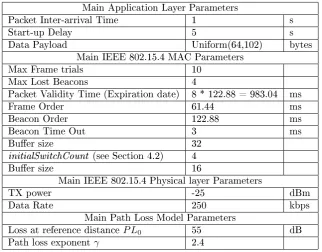
4.3. Simulation-based Performance Evaluation . . . 83
4.3.1. Performance Metrics . . . 84
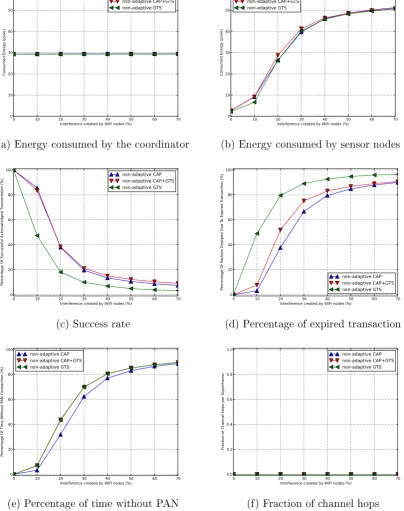
4.3.2. Non-adaptive schemes . . . 85
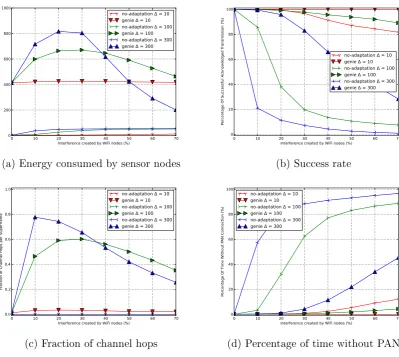
4.3.3. No-Adaptation and Genie Scheme . . . 89
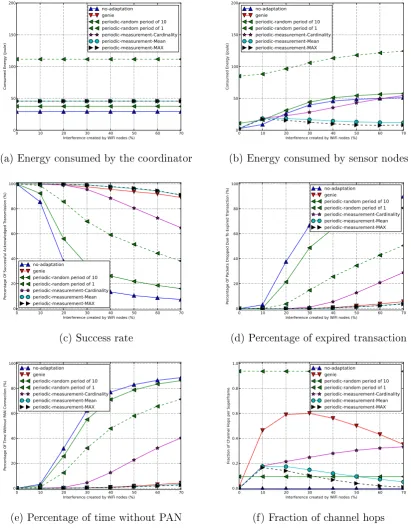
4.3.4. Periodic Scheme . . . 91
4.3.5. Lazy Scheme . . . 95
4.3.6. Impact of Shadowing by the Human Body . . . 96
4.4. Discussion . . . 99
5. Orphan Recovery 103 5.1. Considered Schemes . . . 103
5.1.1. Baseline Schemes . . . 103
5.1.2. Discovery Support Schemes . . . 104
5.2. Performance Metrics . . . 106
5.3. Simulation-Based Performance Evaluation . . . 107
5.4. Discussion . . . 110
6. Experimental Results 111 6.1. Overview of Implementation . . . 111
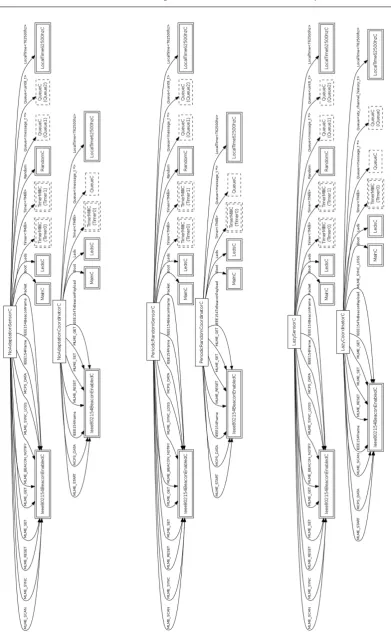
6.2. Implementation in the nesC-TinyOS Environment . . . 113
6.2.1. Component Diagrams . . . 114
6.3. Experimental Setup . . . 116
6.3.1. Experimental Scenarios . . . 116
6.3.2. Experimental Components . . . 117
6.3.3. Performance Metrics . . . 120
6.4. Results . . . 121
Table of Contents
7. The Inuence of Transmit-Power on Performance 135
7.1. Considered Schemes . . . 135 7.1.1. Baseline Schemes . . . 135 7.1.2. Transmit-Power Variation Schemes . . . 136 7.1.3. A Joint Transmit-Power and Frequency Adaptation Scheme . 138 7.2. Simulation-Based Performance Evaluation . . . 139 7.2.1. Performance Metrics . . . 140 7.3. Performance Benets of Transmit-Power Variation in Isolation . . . . 140 7.4. Performance Benets of Coupling Transmit-Power with The Lazy
Scheme . . . 143 7.5. Transmit-Power Variation Schemes . . . 146 7.6. A Joint Transmit-Power and Frequency Adaptation Scheme . . . 148 7.7. Discussion . . . 152
8. Conclusions 153
8.1. Results and Findings . . . 153 8.2. Evaluation of The Hypotheses . . . 157 8.3. Future Works . . . 157
REFERENCES 161
A. Re-generating the IEEE 802.11 Transmit Spectral Mask 189
B. Consumed energy calculations and examples 193
List of Figures
1.1. Failed IEEE 802.15.4 transmissions at dierent power levels while walking along an urban shopping street [66]. . . 6
2.1. An example of an IEEE 802.15.4 super-frame structure [97, Sec. 5.1.1.1] 22 2.2. IEEE 802.15.4 and IEEE 802.11 spectrum usage in the 2.4 GHz ISM
band. . . 26 2.3. An example of one WiFi channel overlapping the IEEE 802.15.4
spec-trum. . . 27 2.4. Experimental testbed adopted by [19]. . . 30 2.5. The results for the percentage of failed transmission in [66]. . . 40 2.6. Noise oor, RSSI and LQI measurements of channel 18 [66]. . . 41 2.7. Noise oor within a window of±2minutes around heavy transmission
failures (starting at 0s) [66]. . . 42
3.1. WBSN and Interferer Deployment . . . 65 3.2. IEEE 802.11 transmit spectral mask in the 2.4 GHz ISM band[2]. . . 68
4.1. Comparison of the three non-adaptive schemes where ∆ is equal to 10 86
4.2. Comparison of the three non-adaptive schemes where∆ is equal to 100 87
4.3. Comparison of no-adaptation and genie schemes for ∆∈10,100,300 . 90
4.4. Comparison of the periodic scheme where ∆ = 100 . . . 92
List of Figures
4.6. Comparison of no-adaptation, periodic-measurement-MAX and Lazy scheme for ∆ = 100 . . . 96
4.7. Comparison of no-adaptation, periodic-measurement-MAX and Lazy scheme for ∆ = 300 . . . 97
4.8. Comparison of no-adaptation and Lazy scheme for∆ = 100and with
additional node-dependent path loss . . . 98
4.9. Comparison of no-adaptation and Lazy scheme for∆ = 200and with
additional node-dependent path loss . . . 99
4.10. Comparison of no-adaptation and Lazy scheme for∆ = 300and with
additional node-dependent path loss . . . 100
5.1. Comparison of the no-adaptation scheme with the dierent proposed coordinator discovery schemes added to the Lazy scheme where∆ = 300108
6.1. NesC Component diagram for no-adaptation, periodic-random and Lazy schemes. . . 115 6.2. Scenario one. . . 118
6.3. Scenario two. . . 118
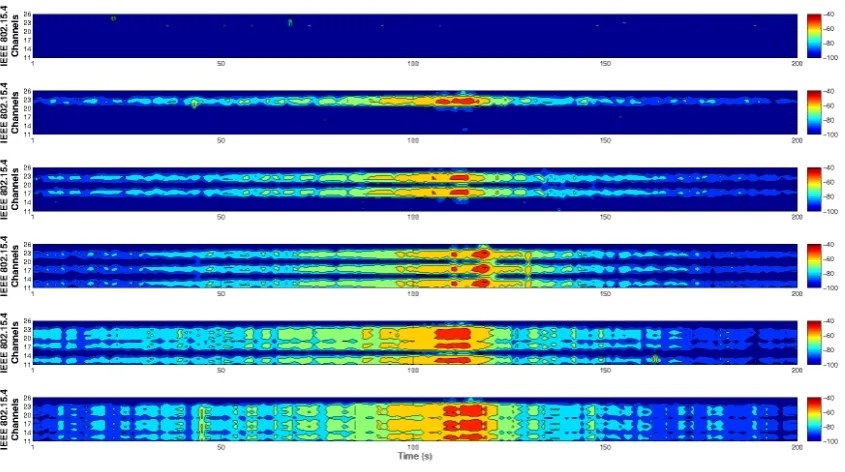
6.4. Spectrum utilisation over time for scenario one and for varying num-bers of access points, from zero (top gure) to ve (bottom gure). . 119
6.5. Spectrum utilisation over time for scenario two. . . 119
6.6. Summary experimental results for both scenarios. . . 121
6.7. Behaviour of the no-adaptation scheme for zero interferers, rst sce-nario. . . 124
6.8. Behaviour of the no-adaptation scheme for one interferer, rst scenario.125
6.9. Behaviour of the periodic-random-1 scheme for zero interferers, rst scenario. . . 126 6.10. Behaviour of the periodic-random-1 scheme for one interferer, rst
List of Figures
6.11. Behaviour of the Lazy scheme for one interferer, rst scenario. . . 128 6.12. Behaviour of the Lazy scheme for one interferer, rst scenario. . . 129 6.13. Behaviour of the no-adaptation scheme with three interferers, second
scenario. . . 130 6.14. Behaviour of the periodic-random-1 scheme with three interferers,
second scenario. . . 131 6.15. Behaviour of the Lazy scheme with three interferers, second scenario. 132
7.1. Transmit-power variation scheme where data is generated every 1 s . 142 7.2. Transmit-power variation scheme where data is generated every 0.5s . 143 7.3. Transmit-power variation scheme where data is generated every 0.25s 144 7.4. Transmit-power variation scheme where data is generated every 0.125s 145 7.5. Comparison of Lazy_High with Lazy_Low where∆ = 10,50,100,200
and 300 . . . 146
7.6. Comparison of Lazy_High with Lazy_Low where data packets are generated every 0.5 second and ∆ = 10,50 and 100 . . . 147
7.7. Comparison of Lazy_High with Lazy_Low where data packets are generated every 0.25 second and ∆ = 10,50 and 100 . . . 148
7.8. Comparison of Lazy_High with Lazy_Low where data packets are generated every 0.125 second and ∆ = 10,50and 100 . . . 149
7.9. Percentage of energy consumed with respect to the Lazy_High scheme150 7.10. Comparison of the Adaptive_Lazy scheme when data rate is 0.125 s . 151
A.1. Re-generated IEEE 802.11 transmit spectral mask with fc= 2412. . . 190
A.2. A close-up of the IEEE 802.11 transmit spectral mask with fc= 2412. 192
List of Tables
3.1. Simulation Parameters. . . 67 3.2. CC2420 parameter specication. . . 72
6.1. Lines of nesC code for implementation of dierent frequency adapta-tion schemes . . . 114
7.1. Node lifetime . . . 144
List of Terms and Abbreviations
A
ACI Adjacent Channel Interference.
AMR Automatic Meter Reading.
AP Access Points.
ARA Adaptive Resource Allocation.
ATPS Adaptive Transmit Power Scheme.
B
BCC Body Channel Communication.
BO Beacon Order.
BS Base Station.
C
CACCA Coexistence Aware Clear Channel Assessment.
CAP Contention Access Period.
CAPD Coordinator Assisted Passive Discovery.
List of Terms and Abbreviations
CCK Complementary code keying.
CFP Contention Free Period.
CS Carrier Sense.
CSMA Carrier Sense Multiple Access.
CSMA-CA Carrier Sense Multiple Access with Collision Avoidance.
D
DMMA Dynamic Multi-radio Multi-Channel media Access control.
DSSS Direct Sequence Spread Spectrum.
DTPC Dynamic Transmission Power Control.
E
ED Energy Detection.
F
FAN Fabric Area Networking.
FFD Full Function Device.
FHSS Frequency Hopping Spread Spectrum.
FID Fast on-line model IDentication.
FTPS Fixed Transmit-Power Scheme.
List of Terms and Abbreviations
Genie The name Genie was selected for this scheme since the nodes in this network had to only ask the Genie to know which channel has the best quality at that given time with out delay costs. The Genie with its oracle knowledge of all 16 channels held time to calculate the channel quality of all existing channels and pick out the best channel.
GTS Guaranteed Time Slot.
H
HBC Human Body Communications.
Hyper-frame A hyper-frame is a set of subsequent super-frames, were at the end of the hyper-frame a decision is carried out.
I
IID Independent and Identically Distributed.
ISM Industrial, Scientic and Medical.
ITA Interferer-aware Transmission Adaptation.
L
LQI Link Quality Indicator.
LR-WPAN Low-Rate Wireless Personal Area Network.
M
MAC Medium Access Control.
N
List of Terms and Abbreviations
P
PAN Personal Area Network.
PER Packet Error Rate.
PHY Physical.
PI-AW Proportional-Integral with the Anti-Windup.
PLL Phase Locked Loop.
PLR Packet Loss Ratio.
PRR Packet Reception Rate.
PU Primary User.
Q
QoS Quality of Service.
R
RFD Reduced Function Device.
RFID Radio-Frequency IDentication.
RFS Random-Frequency-Selection.
RSSI Received Signal Strength Indication.
RX Receive.
S
SA-MAC Spectrum Agile Medium Access Control.
List of Terms and Abbreviations
SINR Signal to Interference plus Noise Ratio.
SIR Signal to Interference Ratio.
SNR Signal to Noise Ratio.
SO super-frame Order.
SU Secondary User.
T
TATPC Temperature-Aware Transmission Power Compensation.
TDMA Time Division Multiple Access.
TX Transmit.
U
UWB Ultra-Wide-Band.
W
WBAN Wireless Body Area Network.
WBSN Wireless Body Sensor Network.
WiFi Wireless Fidelity.
WLAN Wireless Local Area Network.
WRAN Wireless Regional Area Network.
List of symbols
∆ In this study, Delta is a parameter used in the
Pois-son point process that indicates the density of the interferer devices.
λ Lambda indicts the average intensity interferer
1. Introduction
This chapter introduces the main idea of this thesis. First, an overview of Wire-less Sensor Networks (WSNs) will be presented. Next, a discussion about WireWire-less Body Sensor Networks (WBSNs) and their dierences to WSNs is given. Then, the problem statement is presented, followed by a discussion of the solution approach. Finally, the methodology and thesis contributions are described, followed by the thesis outline.
1.1. Wireless Sensor Networks
1. Introduction
this area Radio-Frequency IDentication (RFID) systems are also commonly used) [110, 136, 140, 156, 167, 186]; (v) Surveillance and Tracking: sensors are also being used for detecting moving objects, and in security systems [27, 85, 107, 121, 122, 153].
WSNs consist of nodes that are wirelessly connected to each other, forming a network (typically multi-hop). Each node is able to connect to one or more nodes, depending on the type of node, its functionality, the application, and protocols used. The main components of a typical WSN node consist of digital circuitry, microcon-troller, wireless transceiver, power source, and optional sensors and/or actuators. The size of WSNs varies from just a few to hundreds or thousands of nodes. De-pending on the application and the protocols used, WSNs can form a simple single-hop star topology or more advanced multi-single-hop mesh topologies. Some of the challenges that need to be considered while designing and developing a WSN are scalability, robustness, network lifetime, energy consumption, fault tolerance, and mobility.
1.2. Wireless Body Sensor Networks
WBSNs target applications related to monitoring and processing of human vital signs for health and well-being, entertainment and tracking applications [31, 34, 98, 158]. The ultimate goal of WBSNs is to improve the quality of human life. For example, WBSN technologies could be used to seamlessly monitor the health status of elderly and chronically ill people without the need for constant supervision or presence of caregivers, allowing them to maintain their independence and freedom.
1.2. Wireless Body Sensor Networks
node and the coordinator [14, 111, 171]. Another signicant property of WBSNs is their group mobility. This means that, although each node in a WBSN has limited independent internal mobility, all sensor nodes and the coordinator node move as a whole, along with the movement of their human carrier [98]. This is also known as network or group mobility. Contrary to WBSNs, WSNs are usually static, medium to large-scale and multi-hop networks with very few mobile nodes [144, 157].
There are many protocols and standards that are used for WSNs and WBSNs [7, 16, 93, 97]. The IEEE 802.15.6 standard [7] is a standard specically designed for WBSNs in 2012 which has been recently released. Although this is a very promising standard for WBSN applications, to the best of the authors knowledge, no WBSN node compatible following the specication of this standard is commercially avail-able, both at the start and completion date of this thesis. A more popular, mature and well-established standard is the IEEE 802.15.4 standard [97]. The IEEE 802.15.4 standard is a Low-Rate Wireless Personal Area Network (LR-WPAN) standard that aims to increase the simplicity and reduce the network communication costs. This standard supports a wide range of applications such as WSNs and Personal Area Networks (PANs), for example WBSNs. The specication of this standard is lim-ited to the Physical (PHY) and Medium Access Control (MAC) layers only. Due to its simplicity and popularity, the IEEE 802.15.4 standard is expected to remain a serious contender for WSNs and WBSNs. Thus, in this thesis, the IEEE 802.15.4 is considered as the benchmark protocol and further enhancements and genuine contributions are compared with this standard.
1. Introduction
Having to share the spectrum with other technologies such as IEEE 802.11, IEEE 802.15.1 and other IEEE 802.15.4-based networks implies that data trans-mission in WBSNs can be impacted by external interference, as documented in several publications addressing coexistence of IEEE 802.15.4-based networks with such technologies (See Section 2.3).
1.3. Problem statement
Both in WSNs and in WBSNs, scalability, robustness, network lifetime, fault toler-ance, latency, throughput, and mobility are all important requirements that need to be addressed. However, the order of priority of some of these requirements is often dierent in WBSNs in comparison to WSNs. One of the most important criteria for a WBSN is to establish and maintain reliable and timely data transfer between the sensor nodes and the coordinator node, since these networks mainly deal with human vital signs. Being unable to send or receive critical human vital signs, or receiving the information with long delays, might be the dierence between life and death. For example, it might be necessary to provide constant patient care and monitoring for an elderly or a chronically ill person. In order to maintain their in-dependence without the need for constant supervision or the presence of caregivers, WBSNs provide a reasonably safe and low-cost solution with minimal maintenance. In such scenarios, the patients are free to go about their daily routines and, since many people live in densely populated urban environments such as shopping malls, hospitals, oces and residential communities, WBSNs are constantly being faced with an ever-changing interference background.
1.3. Problem statement
other; or (ii) other networks using dierent protocols and modulations, causing interference. In both of these cases, it is assumed that all included networks are using the same or overlapping frequency bands, and the distance between nodes of these two dierent networks is smaller than their radio transceiver's range. This thesis focuses entirely on the second case, i.e. external interference. In particular, the interference caused by stationary IEEE 802.11b-based Wireless Fidelity (WiFi) access points on IEEE 802.15.4 WBSN is considered. One of the consequences of sharing the same spectrum with other technologies is data transmission failure caused by external interference, which eventually results in network performance degradation as a whole [71, 95, 117, 129, 134, 166].
As an example, the eect of WiFi interference on WBSNs was measured in [66]. In one of the experiments conducted in this study, a WBSN was carried by a human carrier in an urban shopping street (see Figure 1.1). This gure illustrates the per-centage of failed transmissions during a 26 minute period for dierent transmit power levels. The results reveal that the interference landscape changes signicantly on time-scales of tens of second to minutes. This means that any radio and/or protocol parameter that was initially good may become sub-optimal in a matter of a few second.
1. Introduction
Figure 1.1.: Failed IEEE 802.15.4 transmissions at dierent power levels while walk-ing along an urban shoppwalk-ing street [66].
coordinator node again. All this not only reduces the reliability and timely data transfer, it also reduces the network lifetime.
A basic IEEE 802.15.4-based WBSN is currently not able to avoid the interference caused by a WiFi device in the same coverage area. This is mainly due to the following factors: i) Transmit-power: a common transmit-power of a WiFi device is around 20 dBm, whereas the maximum available transmit-power for an IEEE 802.15.4-based WBSN device is in the order of 0 dBm1, ii) Bandwidth: according
to the 802.11 standard, the bandwidth of a WiFi channel in the 2.4 GHz ISM band is 22 MHz, which covers four frequency channels of IEEE 802.15.4. iii) Coverage range: because of the high transmit-power of WiFi devices their coverage area reaches 100 meter or more (in line of sight).
Therefore, it is logical for WBSNs to adapt by obtaining measurements of its surroundings (e.g. the current interference situation) and to adjust some of its operational parameters accordingly, in order to mitigate the interference problem. Within the scope of the IEEE 802.15.4 standard, there are physical and MAC layer parameters that can be adjusted.
The main adjustable parameters on the physical layer are the frequency channel
1This is the maximum transmit-power level available for popular and commonly used IEEE
1.3. Problem statement
and the transmit-power. This layer also provides performance measures for the higher layers, such as Received Signal Strength Indication (RSSI), Energy Detection (ED) and Link Quality Indicator (LQI). These parameters could be used to evaluate the channel quality or the link quality. Based on the information gathered from the physical layer, higher layers of the WBSN could make changes to the network parameters and settings to try to minimise and/or avoid interference.
According to the IEEE 802.15.4 standard, on the MAC layer two operation modes are available, namely the beacon-enabled and non-beacon-enabled modes. This layer also provides two dierent access schemes, namely Time Division Multiple Access (TDMA) and Carrier Sense Multiple Access (CSMA) schemes. Guaranteed Time Slot (GTS) allocation is a TDMA technique used by the IEEE 802.15.4 standard to eliminate mutual interference caused by sensor devices in the same network. To minimise possible co-channel interference, this thesis uses Clear Channel Assessment (CCA) for Carrier Sense Multiple Access with Collision Avoidance (CSMA-CA), however this method of channel access does not prevent external interference from other technologies.
The relatively small time-scale of interference changes and group mobility of the network in harsh urban environments brings two main diculties. The rst obstacle is the small amount of time available for channel measurements. This increases the impact of faulty (or noisy) measurements, which can result in poor decision making. The second barrier is energy consumption. The energy consumed for these measurements, which may involve switching to various channels and listening on each one to estimate the energy or trac load present, is non-negligible, and it is not a priori clear whether the energy spent for such measurements will pay o (for example by increasing the probability of successful data transmission and reducing the number of re-transmission attempts).
1. Introduction
and some nodes in the network have low connectivity when the change is made. Wherever the decision is made within the WBSN, this decision the time of switch-ing and the newly selected frequency channel must be communicated to the other nodes in the network. In a scenario with intense interference, some sensor nodes may not be able to receive the necessary information. These members, which in this thesis are referred to as orphaned nodes, can spend a signicant amount of time and energy for searching and re-establishing connection to their corresponding coordinator.
To sum up, this thesis considers some of the current challenges for WBSNs coming from interference, such as reliable and timely data transfer, long node-orphaning du-rations caused by interference and the nite power source available for the network. We aim to investigate the feasibility of embedding an Adaptive Resource Allocation (ARA) scheme more specically, physical layer resources, such as transmit-power and frequency channel into IEEE 802.15.4-based WBSNs. We investigate the re-liability, energy eciency, and robustness of the ARA as well as its implementation issues. Such an adaptive scheme aims to provide reliable and timely data transfer despite the presence of WiFi interference, and to increase at the same time the overall lifetime of the network.
1.4. Proposed solution
This thesis explores two possible physical-layer-based resource allocation approaches, namely, frequency adaptation and transmit-power variation. Setting a given frequency channel of a WBSN to a channel with no or less interference is a promising way to increase the reliability and timeliness of data transfer. In order to achieve this, a WBSN needs to consider the following steps:
1.4. Proposed solution
human carrying the WBSN could be moving in densely populated urban environ-ments with an ever-changing interference landscape. This stage needs quick and agile detection of the current channel status. If the human carrier enters the cov-erage area of an overlapping WiFi device in the vicinity, it is necessary that the WBSN recognises this interference source as early as possible before data transfer between the WBSN nodes is no longer possible.
2) Searching other channels: After the network is aware of the approaching interference source, it is important to scan all or a subset of available frequency channels to nd the next working channel with the lowest interference level. In both phases (monitoring and searching phases), the time and energy it takes to estimate the channel quality and interference level is a major issue. An important question that needs to be answered is whether or not these extra costs pay-out in the long run to improve the performance of WBSNs. Choosing the appropriate link quality estimation methods is important. Commonly used methods are built on the following metrics: RSSI [10, 60, 105, 133], ED [25, 79, 148], LQI [5153, 60], Packet Reception Rate (PRR) [60, 130, 170], Signal to Noise Ratio (SNR) [45, 59, 141, 161] and Signal to Interference plus Noise Ratio (SINR) [61, 87, 89, 139, 164]. All these link quality estimation methods need time to evaluate and give a valid estimation. Broadly speaking, the more time spent on channel evaluation, the more accurate the results can get. Although having accurate measurements aids to improve the channel selection process, it comes with higher costs. The longer the time spent scanning, the more energy is consumed and the longer it takes to nd the next possible best channel. In a rapidly changing environment, WBSNs are then more at risk of packet loss or, in the worst case, connection loss. Finding the best link quality estimation method is out of the scope of this thesis and is left as one of the future work explorations.
1. Introduction
working channel. This decision could be made in a distributed or centralised fash-ion. This thesis selects the centralised approach where the decision is made by the coordinator node. This assumption is made mainly to minimise the complexity and communication required for a decision making process. Furthermore, it is assumed that the coordinator is equipped with more resources compared to its sensor nodes. This decision if made at a single point then needs to be conveyed quickly to all devices in the WBSN network, before the interference levels increase so that com-munication between nodes is no longer possible. Some of the challenges that need to be addressed in this phase are: 1) Reducing the overall time for reaching this decision. 2) Coordinating all network devices to change their network parameters (Frequency channel and/or Transmit-Power) according to the chosen decision.
Actively monitoring the current state of the working channel and selecting the best channel with the lowest interference, when the current channel is no longer usable (because of high-interference), is one promising way to increase the reliability and timeliness of data transfer. However, this is not the only solution. Another possible solution is to modify or adapt the transmit-power of the nodes, which increases the SNR and thus increases the reliability of data transfer. This is a simpler solution in terms of implementation when compared to channel adaptation, but comes with potentially damaging side eects. One of the side eects of increasing the transmit-power is the increased signal strength and range. Although this increase benets the current network in terms of improved SNR, it also causes interference for other nearby networks. This increase in the interference might result in neighbouring technologies reacting by increasing their transmit-power, respectively. The nal outcome is not going to be satisfactory for the WBSN since the maximum transmit-power (0 dBm) of these devices is much less than the competing technologies such as WiFi (20 dBm). In addition, increasing the transmit-power could drain the battery, resulting in a shorter network lifetime.
mon-1.5. Methodology and Contribution
itoring, decision making and execution steps. The aim of this thesis is to study:
Whether and how energy constrained WBSNs can reliably communi-cate in the unlicensed 2.4 GHz ISM band by avoiding and/or mitigating radio frequency interference caused by other technologies sharing the same spectrum, in particular WiFi interference, via frequency channel adaptation and transmit-power variation.
1.5. Methodology and Contribution
The objective of this research is to explore and investigate the possibilities of embed-ding adaptive resource allocation techniques to the existing well-established IEEE 802.15.4 standard, with the aim of enhancing the reliability and timely data transfer and improving the overall network lifetime of WBSNs.
This thesis consists of both primary and secondary research. The secondary re-search ndings are presented in Chapter 2 and the primary rere-search ndings are presented in Chapters 4, 5, 6, and 7. Each chapter investigates a particular hypoth-esis (to be later explained in detail). This thhypoth-esis considers a simple but realistic scenario where a WBSN connected to a moving human carrier experiences interfer-ence from stationary WiFi access points.
1.5.1. Performance measures
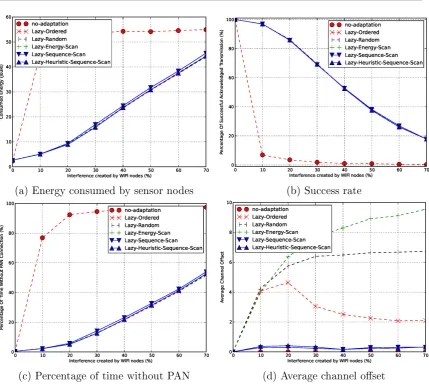
In order to evaluate and compare the dierent proposed schemes with each other and with the existing IEEE 802.15.4 standard, this thesis considers the following main performance measures:
1. Introduction
is only considered as successfully transmitted when an acknowledgement packet is received by the sensor node.
ii) Consumed Energy: The average energy consumption of the sensor nodes and the coordinator node is calculated and compared separately. This thesis focuses on the energy consumption of the transceiver, the energy consumed by other components of a node is ignored.
iii) Percentage of Time without PAN: This is the percentage of time when the sensor nodes have lost synchronisation and connection to their PAN coordinator node. This performance measure is very important since during this time the sensor nodes need to spend considerable amount of energy to scan the whole spectrum and nd their correspondent coordinator node, and during this time they are not able to transmit their data packets.
Other secondary performance measures are also considered that will be introduced in detail in later chapters.
1.5.2. Hypotheses
In the past decades, researchers have shown the eects of interference on both WSNs and WBSNs. This thesis explores the benets of using ARA in WBSNs. This thesis uses simulation and experimentation to evaluate the following hypotheses:
• Hypothesis 1: By adaptively changing the current operating frequency of
the WBSN to a channel with lower interference in environments with rapidly changing interference background, despite the energy costs of adaptation and the increasing risk of node orphaning, it is expected that the performance measures would be improved signicantly.
• Hypothesis 2: By introducing channel adaptation schemes, the risk of node
1.5. Methodology and Contribution
environments, WBSNs are expected to experience a shorter average node-orphaning duration. Shortening the orphan period enhances the network per-formance.
• Hypothesis 3: Frequency adaptation schemes can perform better when faced
with external interference, in comparison to any ideal transmit-power adapta-tion schemes in isolaadapta-tion.
• Hypothesis 4: By coupling transmit-power with frequency adaptation in
en-vironments with varying WiFi interference, signicant improvement of network performance could be gained, in comparison to either of them individually.
1.5.3. Methodology and Contributions
This thesis provides ve main contributions:
1. The performance of the existing IEEE 802.15.4 standard (also referred to as the non-adaptive scheme) in a scenario where a pedestrian carrying a WBSN moves through a densely populated urban environment with high WiFi in-terference is explored. The non-adaptive scheme is then compared with an idealised frequency adaptation scheme called the genie scheme. Comparing the results of the non-adaptive and genie scheme illustrates the lower and up-per bounds of what is achievable when frequency adaptation is added to the existing IEEE standard.
1. Introduction
2. Several frequency adaptation schemes are proposed in this thesis, amongst which the Lazy scheme is particularly attractive. This scheme not only achieves similar success rates as the genie scheme, but also increases the over-all life-time of the network. Another attribute of this scheme is its simplicity, which makes it ideal for implementation on real WBSN devices. The Lazy scheme follows a simple approach: 1) The network remains on the same op-erating channel as long as it is good enough; 2) However, once the channel quality falls below a given threshold, the network searches all the available channels and selects the channel with the lowest interference level.
3. This thesis explores the node-orphaning problem in depth, which is the main cause of battery drainage and drop in success rate. In particular in the Lazy scheme when a new operating channel is selected and the network switches to the new operating channel, some sensor nodes might not get informed about this decision, due to high-interference levels. Hence, these nodes lose their syn-chronisation with their coordinator node and become orphans. In the absence of this information, sensor nodes have to scan all eligible channels. Currently the no-adaptation scheme does not provide much information for the orphan nodes to speed up the process of nding and associating with their network. According to the IEEE 802.15.4 standard, orphan nodes are to start scanning the subset of predened channels specied by higher layers until they nd and associate with their corresponding coordinator device.
This study explores coordinator discovery schemes to reduce the orphan dura-tion time of the Lazy scheme in high-interference scenarios. By providing the sensor nodes with additional information to make better decisions about the channels on which to search for the coordinator, this study proposes schemes that aim to help orphan nodes to shorten their orphan duration time.
1.5. Methodology and Contribution
of channels to be scanned before nding the right operating channel, to our surprise, the average overall time spent in the orphan state is not signicantly reduced in scenarios with high-interference and/or interferer density. This was mainly due to orphan nodes failing to successfully receive the beacons of their corresponding coordinator on the new channels as well.
In the light of these ndings concerning the node-orphaning problem, and since the orphaning duration in low-interference or low-interferer-density scenarios is negligible, this thesis concludes that additional mechanisms to rectify the node-orphan problem are not required to be included in any implementation.
4. To validate our simulation results, three schemes are implemented on commer-cially available IEEE 802.15.4-compatible WBSN devices and are compared with each other using real measurements. The Lazy scheme is compared with a blind frequency-hopping and the non-adaptive scheme. All three schemes use the available IEEE 802.15.4 stack [66] under the TinyOS operating system [67, 100]. The behaviour of these schemes is evaluated under two dierent WiFi interference scenarios.
The results obtained not only conrm the relative performance trends already discovered in our simulations, but also substantiate the claim that the Lazy scheme in particular achieves excellent performance when faced to a changing interference background. Moreover, the feasibility of implementing the pro-posed schemes with minimal changes to the given IEEE 802.15.4 MAC protocol implementation is demonstrated. The proposed scheme is implemented with minor modication to the actual protocol implementation.
1. Introduction
the transmit-power of the network both sensor and coordinator nodes is set to the highest (0 dBm) and the lowest (-25 dBm) value according to the IEEE 802.15.4-compatible ChipCon CC2420 transceiver [149]. This is done to better emphasise the eect of transmit-power in isolation. The results estab-lish the performance bounds for transmit-power variation when WBSNs move through densely populated urban environments with high WiFi interference.
However, while maximising transmit-power improved the performance of both the non-adaptive and the Lazy scheme, transmit-power variation schemes alone do not outperform the Lazy scheme with minimum transmit-power. Our re-sults suggest that in densely populated environments with high-interference, the coupling of maximum transmit-power with frequency adaptation schemes such as the Lazy scheme not only improves the success rate, but also, surpris-ingly, reduces the overall consumed energy of the network.
This nding motivated us to experiment with non-uniform allocation of transmit-power between sensor nodes and their corresponding coordinator node. In-teresting results were observed, namely for schemes where sensor nodes were congured with maximum transmit-power the success rate was increased. Fur-thermore, for schemes where the coordinator node was congured with max-imum transmit-power the consumed energy of the sensors was reduced while maintaining an acceptable high success rate.
2. Background and Literature
Review
2.1. Background
2.1.1. IEEE 802.15.4
The IEEE 802.15.4 [97] standard is a mature and popular technology designed for LR-WPANs. This standard was rst released in 2003 [96]. Since its release, this standard has had many amendments, the most recent being the IEEE 802.15.4k, approved in August, 2013 [9]. This standard has recently attracted attention in the WBSN area. This thesis expects that due to the availability and variety of low-cost commercially available components the IEEE 802.15.4 standard will remain a serious contender in the WBSN area for quite some time to come despite the recent approval of the IEEE 802.15.6 standard [7]. The specication of this standard is limited to the physical and MAC layers.
2. Background and Literature Review
a coordinator, repeater or a gateway node. In this thesis, we use the term Sensor node and Coordinator node for RFD and FFD devices, respectively. Accord-ing to the specications, WSN nodes are able to connect to each other and form a network using either a star or peer-to-peer topology. Furthermore, in a network, multiple sensors and coordinator nodes may exist, however, there can only be one PAN coordinator.
Physical Layer
The physical layer supports a total of 27 non-overlapping frequency channels, oper-ating in three dierent bands. One channel is available in the European 868-868.6 MHz band, 10 channels are available in the 902-928 MHz ISM band, and 16 channels are specied in the 2400-2483.5 MHz ISM band. On the latter band, each channel is 2 MHz wide, and their centre frequencies are separated by 5 MHz. The channels are numbered from 11 to 26. This thesis is mainly interested in the 2.4 GHz ISM band, which is arguably the most popular and widely used frequency band. The other two frequency bands are restricted to certain countries or regions. At this fre-quency band, IEEE 802.15.4 oers a bandwidth of 250 kbps per channel and uses the Oset Quadrature Phase-Shift Keying O-QPSK modulation. It oers interference mitigation mechanisms, namely the Direct Sequence Spread Spectrum (DSSS) and the CSMA-CA scheme to co-exist with other technologies using the same frequency band.
This layer provides two measured parameters: RSSI/ED and LQI. RSSI is the estimated RF power received by the transceiver antenna. This value is reported as an 8-bit integer, giving it a dynamic and linear range between -100 to 0 dBm. RSSI and ED are used interchangeably in the CC2420 specications. According to the CC2420 data-sheet the RSSI accuracy of this transceiver is ±6dB. RSSI could be
2.1. Background
with the chip error rate. For the CC2420, the LQI value is calculated over the 8 symbols following the start frame delimiter [97, 149]. A similar process could be used to calculate the RSSI value. The calculated RSSI and LQI values are reported with every received frame. The RSSI value is used in CCA. According to the IEEE 802.15.4 standard CCA can be carried out in three dierent modes: 1) Channel is clear when the received energy is below the programmed threshold1. 2) Channel is
clear when not receiving valid IEEE 802.15.4-based signals. 3) Finally, channel is clear when not receiving valid IEEE 802.15.4-based packets and the received energy is below the programmed threshold. This thesis uses the latter CCA mode for its channel assessments.
Medium Access Control Layer
The MAC layer allows or denies access to the physical medium (frequency channel) at a given time. This layer is responsible for device conguration, synchronisation, state transition (RX, TX and sleep mode) and re-transmission (if an immediate acknowledgement is not received), association and dis-association to the PAN coor-dinator, assigning GTS, and employing security mechanisms (to some extent).
The IEEE 802.15.4 only allows one PAN coordinator per network. The PAN coordinator is the primary controller responsible for determining network-wide pa-rameters that are used for device synchronisation, coordination and addressing. Two network topologies are specied in the IEEE 802.15.4 standard, namely Star and Peer-to-Peer topology. In the peer-to-peer topology, FFDs may send and receive packets from any node that is within its communication range. In such networks, RFDs are only allowed to connect to FFDs that are within their communication range. Nodes may form a multi-hop network in which a set of nodes cooperatively maintains network connectivity. Peer-to-Peer networks are infrastructure-less and very exible. Such networks may be used in applications such as search-and-rescue
2. Background and Literature Review
or data acquisition in farm and forests. In the star topology, nodes exchange packets via the coordinator node. Similar to peer-to-peer network, a sensor node is only able to connect to a PAN coordinator or a coordinator node that is within its communication range; no direct packet exchange is allowed between sensor nodes. If a data packet is required to be sent from one sensor node to another, this packet needs to be transferred through a coordinator node. These infrastructure-based net-works are simpler in terms of control and management, making them suitable for WBSN applications. This thesis uses the star topology to connect the sensor nodes to the coordinator node. An extension of our approaches to multi-hope networks is part of future works.
The IEEE 802.15.4 standard species two operation modes: beacon-enabled and non-beacon-enabled mode. In the non-beacon-enabled mode, nodes use the un-slotted CSMA-CA mechanism to send their packets after a random back-o periback-od. They perfback-orm a Carrier Sense (CS) back-operatiback-on back-on the current back-operating channel before sending a packet. If the channel is detected as busy, the node listens again after a random back-o period. In this mode, the destination node needs to be constantly listening or obtain some sort of synchronisation, which is not specied in the scope of the IEEE 802.15.4 standard. In scenarios where a star topology is used and the network is operating in the non-beacon-enabled mode, the coordinator node needs to be constantly listening for up-link trac or down-link request packets. Since network lifetime is important in WBSNs, this thesis does not consider the non-beacon-enabled mode; instead the alternative non-beacon-enabled mode is employed.
2.1. Background
information and an indication of whether downlink data packets are pending. A beacon packet may also have a payload eld. A super-frame is subdivided into two regions, namely active and inactive period. The active period is further divided into 16 time slots. Based on the MAC layer conguration, these time slots are di-vided into a Contention Access Period (CAP) and a Contention Free Period (CFP). During the CAP, nodes compete to send up-link packets to, and request pending down-link packets from their corresponding coordinator using a slotted variation of the CSMA-CA mechanism or by employing the ALOHA scheme. This thesis uses the CSMA mechanism.
The CFP is optional and follows the CAP. The CFP is further divided into smaller slots called GTSs. GTSs are dynamically assigned by the coordinator to a sensor node. A maximum of seven GTSs could be assigned, out of which more than one GTS may be allocated to a sensor node. During a GTS, a node can attempt to transmit and receive packets in a contention-free fashion without the need for CS. Following the CFP is the inactive period. During this time, all nodes including the coordinator node can turn o their transceivers to save energy.
In this thesis, sensor nodes are mainly restricted to send up-link packets using CSMA-CA in the CAP period only. Preliminary studies discussed in Section 4.3.2 reveal that scenarios with external interference networks using CSMA in the up-link direction achieve higher packet success rates than networks using allocated GTSs. The networks using GTSs consumed marginally less energy as compared to networks using CSMA. Nevertheless, with interference the networks using allocated GTS are punished for not using carrier-sensing, with CSMA it becomes possible to avoid transmissions during interference bursts to some extent. For similar reasons, this thesis, ignores the use of the ALOHA scheme. Furthermore, the inactive period is used in some of the proposed schemes in this thesis by the coordinator for channel measurements.
2. Background and Literature Review
Figure 2.1.: An example of an IEEE 802.15.4 super-frame structure [97, Sec. 5.1.1.1]
congurable via two parameters: Beacon Order (BO) and super-frame Order (SO). According to the IEEE 802.15.4 standard, the inter-arrival time between beacon packets is calculated via Equation 2.1 [97, Sec. 5.1.1]:
BI =aBaseSuperf rameDuration×2BO,0≤BO≤14 (2.1)
where BI is the Beacon Interval and aBaseSuperframeDuration is equal to 60 channel symbols if using the 2.4 GHz physical layer this duration is equal to 15.36 ms. The duration of the active period, also referred to as super-frame Duration (SD), is calculated using the following Equation 2.2 [97, Sec. 5.1.1]:
SD =aBaseSuperf rameDuration×2SO (2.2)
where 0 ≤ SO ≤ BO ≤ 14. Figure 2.1 illustrates a simple example of a
super-frame structure. In this example, SO is considered to be one unit smaller than BO; this implies that the SD is half the BI duration. Furthermore, two GTSs are assigned to sensor nodes.
In the beacon-enabled mode, sensor nodes are required to wake-up before the start of the super-frame and receive the beacon packet. When a sensor node does not receive aMaxLostBeacons2 consecutive beacon packets, the sensor node may
consider its synchronisation lost and change its state to an orphan node. An orphan
2.1. Background
node needs to re-associate with its corresponding PAN coordinator node before it is allowed to transmit or receive further data packets.
Sensor nodes are generally required to rst discover beacon packets sent by their corresponding coordinator node before associating to a network. In scenarios where the network switches channels in order to mitigate external interference, sensor nodes are required to search all or a subset of available frequency channels and listening on them (see [84, 163]). In cases where nodes possess additional information that aids in narrowing down channels into which the PAN coordinator may have hopped, higher layers can elect a subset of channels, to both reduce the time spent in orphan state and the energy consumption (see Chapter 5). For non-adaptive networks, the higher layers may choose to conne the search to only the current operating frequency channel, in order to save time and energy.
After receiving the beacon packet, nodes then need to send association request control packets during the CAP. The coordinator may or may not grant the sensor node's association request. The same discovery process is repeated every time the sensor becomes orphaned. When an association request is granted, an associated node may choose to stay synchronised with its corresponding coordinator and track its beacons [97, Section 5.1.4.1]. In such cases, sensor nodes wake up shortly before the start of a super-frame and attempt to receive the beacon packet. Every time a beacon packet is successfully received, network parameters such as BO/SO, PAN ID, and other pending information in the beacon payload if any are forwarded to higher layers. In scenarios where a node has lost four beacon packets in a row, it concludes that synchronisation is lost and the higher layers are informed. This thesis assumes that nodes choose to maintain synchronisation. This is required when the higher layers adapt the BO/SO settings for realigning a PAN, or for adaptive schemes such as frequency adaptation schemes described in Chapter 4.
2. Background and Literature Review
corresponding coordinator node. The higher layers decide to either re-set the MAC layer completely forcing the node to start a new association procedure or chang-ing the nodes status to orphan mode. One way of ndchang-ing neighbourchang-ing networks is by channel scanning orphan channel scan. Another way for orphan nodes to re-locate their corresponding coordinator after losing synchronisation is by send-ing orphan-notication command packets and waits for a response from its PAN coordinator [97, Sec. 5.3.6]. This method is mainly used for non-beacon enabled networks, since it requires the coordinator to be active at all times. After send-ing the orphan-notication command packet, the sensor node listens at most for macResponseWaitTime. If it successfully receives a coordinator realignment com-mand during the specied time, the sensor node would continue its normal routines as an associated sensor node. This approach is not used in this thesis, instead or-phan nodes perform channel scanning and listen on every channel for the duration of one beacon period3. After re-locating the PAN coordinator, the node associates
and continues track its beacon packets. This thesis refers to the time between losing four successive beacon packets and the next received beacon as the time spent in orphan state or orphan duration time.
To sum-up, this section provided a brief overview of the well-established IEEE 802.15.4 standard. The popular IEEE 802.15.4-compatible CC2420 transceiver that operates in the 2.4 GHz ISM band has been selected as the physical layer. Fur-thermore, the MAC layer uses the beacon-enabled mode to communicate and save energy by sleeping during the inactive periods. According to the specications of this standard, CSMA-CA is a mechanism that aids with the co-existence issues in the 2.4 GHz band. Nevertheless, due to extensive usage of this frequency band by other technologies (e.g. WiFi), WBSNs that are being used in densely populated
3This is done to circumvent a problem in the standard: in the beacon-enabled mode there is the
2.1. Background
urban environments may experience an ever-changing interference landscape [66]. The following section gives an overview of the popular IEEE 802.11 standard also known as WiFi.
2.1.2. IEEE 802.11
IEEE 802.11 is a Wireless Local Area Network (WLAN) standard [2], also referred to as WiFi. In the 2.4 GHz ISM band it operates in a total of 14 overlapping channels, each with a bandwidth of 22 MHz and a channel separation of 5 MHz in IEEE 802.11b. A common transmit-power used by WiFi systems is 20 dBm, which leads to an approximate communication range of 100 metres (in a line of sight). Users of this technology connect to each other via Access Points (AP) or in an ad-hoc manner. The IEEE 802.11b version [2] supports DSSS for its spreading and Complementary code keying (CCK) as its modulation technique, with a data rate between 1 and 11 Mbps. IEEE 802.11g [4] is backwards compatible and supports DSSS; the main modulation scheme used in IEEE 802.11g is OFDM, which supports data rates between 6 to 54 Mbps. Another dierence introduced in the IEEE 802.11g standard is the 20 MHz wide channel bandwidth. This allows up to four conict-free WiFi networks to operate at the same location when choosing channels 1, 5, 9 and 13.
2. Background and Literature Review
Figure 2.2.: IEEE 802.15.4 and IEEE 802.11 spectrum usage in the 2.4 GHz ISM band.
made to introduce interference on a larger portion of the bandwidth and to generate interference where the interference bursts lasts longer using conventional WiFi APs. An example of channel interference caused by overlapping of only one IEEE 802.11 channel over the IEEE 802.15.4 spectrum in the 2.4 GHz ISM band is shown in Figure 2.3. This gure presents a more detailed view of the interference caused by a single WiFi device over an IEEE 802.15.4 network. In other words, when a WiFi AP is operating on channel 7 and transmits at full capacity, and the IEEE 802.15.4 network is in close proximity to the interferer source (AP), four of the 16 IEEE 802.15.4 channels would perceive noticeable disturbance caused by the AP's spectral mask creating a shadow over channels 7, 8, 9 and 10, shown in red. Furthermore, out of the remaining channels, four channels would also suer from partial interference caused by Adjacent Channel Interference (ACI) [23]: channels 5, 6, 11 and 12 shown in orange. In other words, one WiFi channel overlaps directly with four IEEE 802.15.4 channels, and creates side band interference or ACI for the neighbouring two channels on either side [23, 62, 160]. The impact of ACI on IEEE 802.15.4-based networks is presented in [152]. This study shows that ACI has a noticeable negative impact on IEEE 802.15.4-based network PRR. Nevertheless, to simplify the analysis, ACI is ignored in our simulation model.
chan-2.2. Impact of Interference on IEEE 802.11 systems
Figure 2.3.: An example of one WiFi channel overlapping the IEEE 802.15.4 spec-trum.
nels with no interference. The eects of external interference on IEEE 802.15.4-based devices are later presented in Section 2.3.
2.2. Impact of Interference on IEEE 802.11
systems
Howitt and Gutierrez studied the impact of IEEE 802.15.4 on 802.11.b devices [71]. They proposed an analytical method based on [70] to analyse the coexistence impact of these two technologies. In this study, the collision probability is considered to be the probability of one IEEE 802.11b packet getting impacted by one or more IEEE 802.15.4 packets. Nevertheless, collision of IEEE 802.11b packets with IEEE 802.15.4 packets does not necessarily result in packet loss because of the vastly dierent transmit-power levels. This probability represents the Packet Error Rate (PER) of IEEE 802.11.b devices. This study was limited to a special scenario where only the packets transmitted from IEEE 802.11b-based APs were assumed to have an impact on neighbouring WSN nodes. Their study proved that unless the 802.11 Base Station (BS) is also located near the IEEE 802.15.4 devices (with high activity levels), IEEE 802.15.4 networks have minor to no impact on the performance of IEEE 802.11b devices.
2. Background and Literature Review
would use both these technologies on the same hardware device. They assume that the distance between the two radio transceivers would be less than one metre. In their simulation analysis they looked at PER, transmission delay and throughput as their performance measures. The performance of both these technologies (on each other) was analysed based on their distance and the centre-frequency-oset between them. In their simulation scenarios the transmit-power used by IEEE 802.11b and IEEE 802.15.4 devices was set to 30 mW (≈ 14.77 dbm) and 1 mW (= 0 dbm),
respectively. Based on the simulation results they obtained, if the distance of an IEEE 802.15.4 device is more than eight metres to an IEEE 802.11b device, the PER of the IEEE 802.15.4 is less than 10−5. Similarly, the distance between these two
networks needs to be less than four metres so that the PER of the IEEE 802.11b goes above 10−5. The simulation results also showed that if the
centre-frequency-oset between the two technologies is more than 7 MHz at a seven metre distance, the PER of IEEE 802.15.4 is less than 10−5. The authors clearly show the IEEE
802.15.4-based devices have less impact on the performance of WiFi devices than vice versa.
A very similar simulation-based study was conducted by Yoon et al. in 2006, that looked at PER of 802.11b networks under the inuence of WSNs [181]. They showed that if the distance between these heterogeneous networks is more than four metres, the measured PER measured of IEEE 802.11b-based networks would be over 10−4.
They also proposed optimal packet lengths for dierent distances between the two networks. Performance analysis of the IEEE 802.11b network under the inuence of multiple WSN devices was conducted using simulation by Yoon et al. in 2007 [182]. In this study, they used PER and throughput as their performance metrics. The results show that, regardless of the number of WSN interference sources, the performance of the IEEE 802.11b devices is not aected if the distance between the two technologies is greater than six metres.
2.2. Impact of Interference on IEEE 802.11 systems
information about coexistence issues between IEEE 802.11b and IEEE 802.15.4 net-works [19]. Their ultimate goal in this experimental study was to deduce useful in-formation to optimise the network design and setup in common real-life coexistence conditions. By taking into account the coexistence issues of these two technolo-gies and adopting appropriate interference avoidance solutions (such as frequency or transmit-power adaptation), interference eects could be drastically reduced. The authors of this research considered the eects on the Packet Loss Ratio (PLR) when WiFi is aected by IEEE 802.15.4 interference and vice versa. This study is a con-tinuation of their previous work, where they used cross-layer measurements to assist with the coexistence of these two technologies [18].
Figure 2.4 illustrates the adopted testbed used in this experimental study. In this experiment, Tmote Sky sensor nodes were randomly distributed in a circle with a radius of r=2 metres. At the centre of this circle a notebook equipped with a WiFi adapter was placed. This notebook was connected to an AP placed at a d=13 metre distance. Many interesting ndings were derived from these experiments. Some of these ndings are as follows: The WiFi's PLR has a direct relationship with WiFi's duty cycle λW iF i. It is shown that for λW iF i greater than 70% the PLR remains
2. Background and Literature Review
Figure 2.4.: Experimental testbed adopted by [19].
from IEEE 802.11 based networks to IEEE 802.15.4 technologies.
Contrary to the research presented so far in this section, where all results suggest that because of the vast dierence between the transmission powers of these two technologies the impact of IEEE 802.15.4 on IEEE 802.11 is negligible, Pollin et al. proved that in many cases IEEE 802.15.4 has signicant impact on the performance of IEEE 802.11b devices [128]. One of the key points that the authors of this measurement-based study consider is the listen-before-send mechanism that both these networks employ as their interference mitigation mechanism. This research shows that because of the vast dierence between the duration of channel sensing 20µs for WiFi and more than 320 µs for WSN the IEEE 802.15.4-based networks
have a greater impact on the performance of WiFi networks. They experimentally tested this hypothesis and proved that even in cases where listen-before-send is enabled in IEEE 802.15.4-based networks, the WiFi network suers from over 80% throughput degradation. Moreover, this research also illustrates the importance of validation through experimentation.
2.3. Impact of Interference on IEEE 802.15.4 systems
experimental studies done by Angrisani et al. in [19], the duty cycle and distance of WBSNs need to be fairly high and near, respectively, to have serious eect on the performance of WiFi devices.
2.3. Impact of Interference on IEEE 802.15.4
systems
Shin et al. in 2005 analysed the impact of IEEE 802.11b interference on the IEEE 802.15.4 performance [142]. They looked at the PER of WSN devices as their performance measure. In their simulation analysis they used two WiFi and two WSN devices all placed at a one metre distance from each other. The distance between the two networks was varied. The results revealed that if the distance between the two networks goes beyond eight metres the interference of IEEE 802.11b network on WSNs is negligible and the PER is smaller than10−6. Furthermore, if the centre
frequencies of these two technologies are 7 MHz apart from each other at a four metre distance, the interference of the WiFi network on IEEE 802.15.4-based networks is negligible and could be ignored.
![Figure 2.5.: The results for the percentage of failed transmission in [66].](https://thumb-us.123doks.com/thumbv2/123dok_us/9041167.400431/76.595.89.512.75.282/figure-results-percentage-failed-transmission.webp)