JOURNAL OF FOREST SCIENCE, 60, 2014 (9): 353–362
Forest fires were described as a real disaster from ecological, physical and environmental standpoints (Rajaeev et al. 2002; Böhm et al. 2011), and so it is important to accurately assess and carefully man-age their impacts whenever and wherever they oc-cur; they represent one of the most critical issues that concern forest resources globally (Kandya et al. 1998; Tuia et al. 2008).
The forest managers in many areas of the Hyr-canian forests have increasingly been focusing on efforts to mitigate damage from forest fires. Many researchers including Giglio (2005) employed GIS (Geographical Information System, ESRI, Redmont, USA) based predictive models for for-est fire behaviour. Demagistri et al. (1995) used the capability of RS (Remote Sensing) forest fire simulator software in order to investigate active data defined as physical parameters such as land cover, topography and wind, as well as inactive data associated with maps, aerial photos, SPOT
and Landsat satellite images. They improved the software capability using a diffusion model and intermediate graphics.
Jaber et al. (2001) applied intelligent software to prevent fire in forest after data formulation. The built-in capabilities of the software included initial routing, danger evaluation and appearance, simulation, recommendation for initial program-ming and fire suppression. A simulation system of forest fire using ESRI ArcSDE was introduced by Qizhi et al. (2004).
In an earlier work in Slovakia, a method was presented for the forest fire modelling using FAR-SITE software. In this research, vegetation type and moisture level were also introduced as the two most important variables to investigate forest fire behaviour.
Reinhaedt and Crookston (2003) reported that the Fire and Fuel Extension (FFE) to the For-est Vegetation Simulator (FVS) simulated fuel
Modelling and analyzing the surface fire behaviour
in Hyrcanian forest of Iran
H. Aghajani
1, A. Fallah
1, S. Fazlollah Emadian
21Department of Forestry, Faculty of Natural Resources, Sari Agricultural Sciences
and Natural Resources University, Sari, Iran
2Department of Forestry, Faculty of Natural Resources, Gorgan Agricultural Sciences
and Natural Resources University, Gorgan, Iran
ABSTRACT:The purpose of this study was to assess the forest fire behaviour and investigate the impact of different
parameters on the spread of surface fire in the Hyrcanian forest of Iran. Surface fire was simulated using mathematical models in Microsoft Visual Basic 6.0 environment during a 30-minute time period. Several parameters that contrib-uted to the speed of surface fire such as slope, wind velocity and litter thickness in the forest floor and various types of forest litter associated with hornbeam (Carpinus betulus L.), Persian ironwood (Parrotia persica C.A.M), beech (Fagus orientalis L.) and maple (Acer velutinum L.) were investigated. The results indicated that the maximum burned area was associated with beech litter. Forest surface fire demonstrated similar behaviour for the litter types of beech and Ironwood, whereas in the case of maple and hornbeam litters, the fire spread parallelly and perpendicularly to contour lines, respectively. The burned area increased in an irregular pattern as the forest floor slope gradient was increased. Moreover, the skewed pattern of the burned area for the forest floor composed of maple, beech, ironwood andhornbeam litter was described as high, low, moderate and low, respectively. The fire spread angle in forest floor associated with maple and beech litters changed with litter thickness. Finally, litter thickness had a significant effect on the direction of fire spread and this was more prominent with hornbeam litter.
dynamics and potential fire behaviour over time, in the context of stand development and manage-ment. After a brief review of fire spread models Ferragut et al. (2010) focused on physical mod-els. These models took into account some of the main variables impacting fire spread, namely wa-ter content of the litwa-ter, radiation, wind and to-pography effects.
Muge et al. (2008) used Lidar and Farsite simu-lator for modelling the forest fire behaviour. He used specific data such as elevation, slope gradi-ent, slope direction, surface fuel model, canopy cover and wind velocity and inserted them into the software. It was demonstrated that fuel distri-bution was an important factor for the prediction of fire occurrence. Perminov (2010) developed a mathematical model for describing heat and mass transfer processes at crown forest fire initiation, taking into account their mutual influence. Lee et al. (2010) simulated and visualized forest fire to estimate forest damage. They reported that fuel models and climate data in regional fires were useful for simulation.
The use of satellite imagery to measure the im-pact of forest fire on vegetation communities has become a popular topic of discussion in recent years. It was demonstrated that a relationship be-tween fire severity and soil damage could be de-duced in eucalypt forests (Shakesby et al. 2007). Smith et al. (2005) showed that, in the case of Sa-vanna fires, surface spectral reflectance increased with increasing fire severity due to the forma-tion of increasing quantities of white mineral ash. Moreover, they studied linear relationships be-tween fire duration and post-fire surface spectral reflectance. Conedra et al. (2011) utilized Monte Carlo simulation to examine the relative likeli-hood of forest fire initiation as a function of veg-etation type, forest land physiography and prox-imity to the wilderness-urban interface (WUS).
Banj Shafiei et al. (2010) conducted a study in the Chelir forest of northern Iran in order to investigate the impact of fire on forest struc-ture, tree species quality, and regeneration com-position. Their results showed that forest fires changed the structure and had different effects on the tree species composition between burned and control areas. Thin barked species such as orien-tal beech (Fagus orientalis Lipsky) and coliseum maple (Acer cappadocicum Gled.) have been af-fected more than those with thick bark, like horn-beam (Carpinus betulus L.) and chestnut-leaved oak (Quercus castaneifolia C.A. Mey). The densi-ty of oriental beech regeneration in the unburned
area was greater than in the burned area, while the quantity of regeneration of hornbeam, coliseum maple and velvet maple (Acer velutinum Boiss) was higher in the burned area.
Hyrcanian forests of Iran are primarily com-posed of deciduous species and a major type of forest fire occurring there is actually surface fire (Jazirehi 2010; Marvie-Mohadjer 2011). However, most of the models for predicting for-est fires have been developed by other research-ers for crown fires of conifresearch-ers in countries other than Iran. Obviously, these models could not be applied for predicting the surface fire behaviour in Hyrcanian forests of Iran.
This study attempted to assess forest fire behav-iour and investigated the effects of different pa-rameters in relation to the spread of surface fire based on parameters such as slope, wind velocity and litter thickness, and litter types associated with species such as hornbeam (Carpinus betulus L.), Persian ironwood (Parrotia persica C.A.M), beech (Fagus orientalis L.) and maple (Acer velutinum L.) were investigated.
The main objectives of this study were to (1) provide the simulator mathematical models which were developed based on factors influencing sur-face fire and (2) investigate the sursur-face fire behav-iour specifically for some of the main species of Hyrcanian forest.
MATERIAL AND METHODS
Study area. The study was conducted in
Da-rabbkola forest. The forest covers an area of 2,612 ha and is located in watershed district No. 74. The site is located on the southeastern edge of the city of Sari in Mazandaran province. The latitude, lon-gitude and elevation ranges of this forest are 36° 33'20'' to 36°33'30''N, 52°14'40'' to 52°31'55''E and 180–800 m a.s.l., respectively. Due to increasing occurrence and high frequency of surface fires in Hyrcanian forests in recent years, it became ben-eficial to investigate the forest fire behaviour in these forests (Fig. 1).
Mathematical models and numerical
meth-ods. The impact of wind velocity was produced
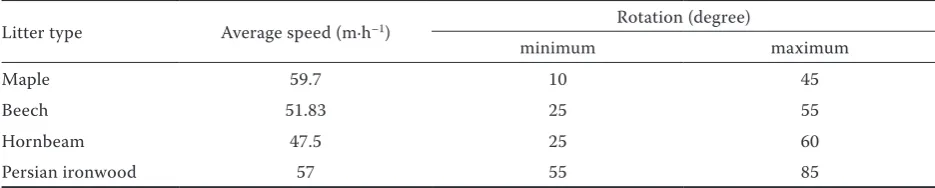
and litter thicknesses (Nasiri et al. 2012). These measurements were used to develop mathemati-cal and numerimathemati-cal models. The models were then used as source codes and fed into a simulator in order to obtain the associated simulated surface fires (Tables 1 and 2).
Surface fire was simulated using mathematical models in Microsoft Visual Basic 6.0 environment. The simulator was actually a supplementary pro-gram designed to be used with FORENG 1.0.0, for-est engineering software. The software simulated the behaviour of forest fires at different times, spread, direction and angle shown by 3D visualization sys-tem. Each of the proposed functions had several variables. So, a combo box was used to provide a re-alistic and distinct investigation for each of the func-tions (Fig. 2).
Using a combo box. To investigate the effect of litter type and slope classes on the burned area, some factors such as litter thickness (3–4 cm) and wind velocity (4–8 m·s–1) were considered fixed.
Assuming the fire spread time of 30 min, aver-age fire speed (Table 2), rotation of fire (Table 2), mathematical equations (Table 1) and burned area were calculated with changing combo box options (Fig. 2) for litter type, litter thickness and slope class at any given time. When litter thickness and slope classes were considered fixed at 5–6 cm and 15–30%, respectively, wind velocity impacts on the direction of fire spread and fire progression were calculated. Alternatively, when litter thick-ness was considered as variable, the wind veloc-ity and slope classes were kept fixed at 9–12 m·s–1
and 15–30%, respectively. Using a combo box, 256 different probable forms of fire occurrence (4 litter types × 4 slope classes × 4 wind speed classes × 4 litter thicknesses) were considered probable. In many cases, fire behaviour was the same. Ac-cordingly, with repeated testing, the combo box technique showed significant differences be-tween many of the possible cases of surface fire behaviour.
Caspian sea
IRAN
Caspian
sea
Low risk High risk
[image:3.595.79.521.56.214.2]0 1 1.5 2 km
Fig. 1. Maps showing the geographical location of the study area
Table 2. Fire progression angle and mean spread speed of controlled surface fire in different litter types
Litter type Average speed (m·h–1) Rotation (degree)
minimum maximum
Maple 59.7 10 45
Beech 51.83 25 55
Hornbeam 47.5 25 60
[image:3.595.61.533.549.627.2]Persian ironwood 57 55 85
Table 1. Mathematical models for the effects of wind velocity and litter thickness on controlled fire
Wind velocity (m·s–1) Mathematical models R2 Litter thickness (cm) Mathematical models R2
1–3 y = 11.39 × x0.637 0.96 1–2 y = 42.47 × ln(x) – 50.64 0.87
4–8 y = 12.84 × x0.747 0.92 3–4 y = 86.72 × ln(x) – 133.4 0.78
9–12 y = 61.04 × x0.614 0.99 5–6 y = 70.54 × ln(x) – 106 0.91
[image:3.595.63.531.662.756.2]Data analysis. Completely Randomized Block (CRB) Design was used for the analysis of the experi-ments in this study and the data were analyzed us-ing SPSS (Sciences Statistical Package for the Social, IBM, New York, USA) computer program. The effects of litter type and slope classes on burned areas were investigated using univariate linear regression along with Tukey’s HSD mean comparison test. In order to examine the effect of wind speed and litter thick-ness on the fire spread angle, multivariate regression analysis was used together with Tukey’s HSD mean comparison test.
RESULTS
Surface fire spread
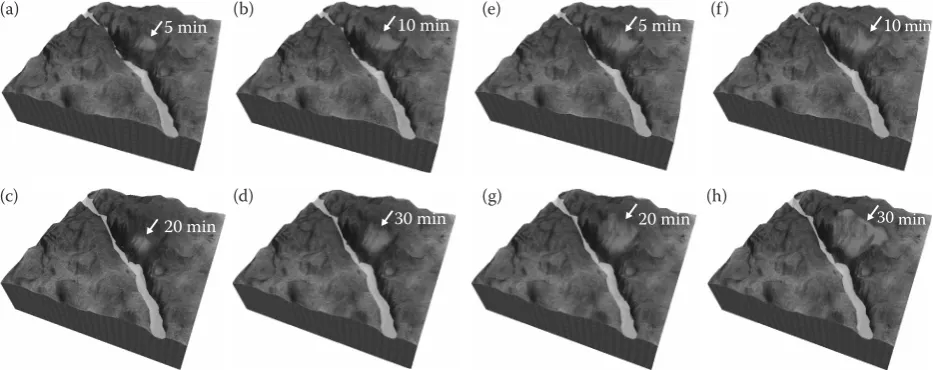
Mathematical models were computer simulated to determine the size of burned area during a 30 min period at a fixed topographic condition. Results indicated that the maximum burned area was
as-sociated with beech litter (Fig. 3). The type of fire spread in beech and Persian ironwood was ap-proximately the same (Fig. 3e–h and Fig. 4a–d). Surface fire on the forest floor with beech litter remained steady after spreading for a short period of time, whereas under Persian ironwood litter the fire spread continuously. Fire spread in the case of maple (Fig. 3a–d) and hornbeam (Fig. 4e–h) lit-ters was linear and perpendicular to the contour lines, respectively.
Surface fire behaviour Maple litter
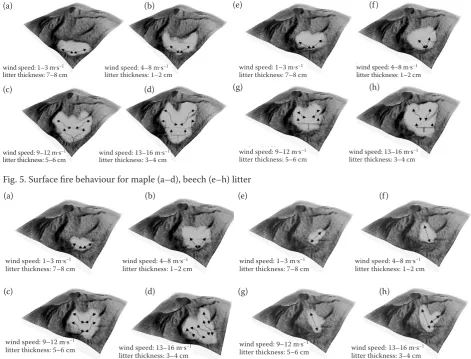
As for the forest floor with maple litter, the re-sults indicated that a small change occurred in the spread angle. Initially, the forest fire was spreading slowly in an upward direction with 10–25 degree angle. However, later the spread angle of the fire and wind velocity were increased. As a result, the fire moved in the upward direction of the slope. When the surface fire was simulated on maple lit-ter, the fire seemed to spread easily around the trees. The angle of fire spread changed as the litter thickness changed. The minimum and maximum angles of fire spread were observed in litter thick-nesses of 7–8 cm and 3–4 cm, respectively (Fig. 5). Beech litter
[image:4.595.64.291.55.219.2]In the case of the forest floor with beech litter, the fire spread upward at an angle of 45 degrees. The spread angle increased to 55 degrees outward with increasing wind speed. A small change in fire spread was observed with beech litter forest floor and the spread was apple-shaped. Also, the fire spread angle changed as the litter thickness
Fig. 2. Simulator software (FORENG 1.0.0) of surface fire
Fig. 3. Fire spread and burned area for forest floors with maple (a–d) and beech (e–h) litters
(a) (b) (e) (f)
(c) (d) (g) (h)
5 min 10 min
20 min 30 min
5 min 10 min
[image:4.595.64.531.551.736.2]changed. When the litter thickness increases from 1–2 cm to 3–4 cm, the spread angle of fire was lowered by 20 degrees (Fig. 5).
Persian ironwood
For the forest floor with Persian ironwood, the spread angle of fire changed suddenly from 25 de-grees to 60 dede-grees outward with increasing wind
ve-locity. Moreover, in this case the fire spread around the trunks of the trees somewhat easily and the angle of fire spread changed slowly from 30 to 45 degrees with decreasing litter thickness (Fig. 6).
Hornbeam
As for the forest floor with hornbeam litter, the re-sults showed that a small change occurred in the fire (a) (b) (e) (f)
(c) (d) (g) (h)
5 min 10 min
20 min
30 min
5 min 10 min
[image:5.595.59.529.59.230.2]20 min 30 min
[image:5.595.61.533.376.735.2]Fig. 4. Fire spread and burned area for forest floors with Persian ironwood (a–d) and hornbeam (e–h) litters
Fig. 5. Surface fire behaviour formaple (a–d), beech (e–h) litter
wind speed: 1–3 m·s–1
litter thickness: 7–8 cm wind speed: 4–8 m·s
–1
litter thickness: 1–2 cm
wind speed: 9–12 m·s–1
litter thickness: 5–6 cm wind speed: 13–16 m·s
–1
litter thickness: 3–4 cm
(a) (b)
(c) (d)
wind speed: 1–3 m·s–1
litter thickness: 7–8 cm wind speed: 4–8 m·s
–1
litter thickness: 1–2 cm
wind speed: 9–12 m·s–1
litter thickness: 5–6 cm wind speed: 13–16 m·s
–1
litter thickness: 3–4 cm
(e) (f)
(g) (h)
wind speed: 1–3 m·s–1
litter thickness: 7–8 cm wind speed: 4–8 m·s
–1
litter thickness: 1–2 cm
wind speed: 9–12 m·s–1
litter thickness: 5–6 cm wind speed: 13–16 m·s–1 litter thickness: 3–4 cm
(a) (b)
(c) (d)
wind speed: 1–3 m·s–1
litter thickness: 7–8 cm wind speed: 4–8 m·s
–1
litter thickness: 1–2 cm
wind speed: 9–12 m·s–1
litter thickness: 5–6 cm wind speed: 13–16 m·slitter thickness: 3–4 cm–1
(e) (f)
(g) (h)
spread angle. The fire spread upward with 55 to 85 degree outward angle. A small change was observed during the burning of hornbeam litter in the forest floor. In most cases the surface fire was also simulated in a general upward slope direction. Ironically in this case, the fire spread angle did not change as the litter thickness changed (Fig. 5).
Numerical results and statistical analyses
Burned area
There was a significant difference between burned area sites with hornbeam, beech and Per-sian ironwood litters (Table 4).It was demonstrat-ed that the slope had a significant effect on the surface fire spread. In similar topographic condi-tions, the burned area increased irregularly with increasing slope gradient (Table 3). The burned areas in slope classes of 15–30% and greater than 45% increased two and four times, respectively compared to those in the slope class of 0–15% (Ta-ble 3). The burned areas associated with the slope class of 15–30% to 30–45% were not significantly different from one another and this was caused by irregularity in the progression of burned area. With the exception of the slope class > 45%, there were no significant differences between burned areas in the remaining slope classes of 0–15%, 15–30% and 30–45% (Table 4).
Fire progression angle
[image:6.595.63.526.87.180.2]The spread angle of surface fire increased with increasing wind velocity (Table 5). There was no significant difference between Persian ironwood and beech stands in terms of the fire spread angle
Table 3. Numerical results of burned area with different forest floor litter types and slope classes (fixed parameter: litter thickness = 3–4 cm, wind velocity = 4–8 m·s–1)
Slope (%) Litter type of burned area (ha)
maple beech persian ironwood hornbeam
0–15 0.3 0.34 0.23 0.08
15–30 0.48 0.54 0.38 0.2
30–45 0.52 0.56 0.46 0.23
45 < 0.9 1.26 0.71 0.44
Table 4. Statistical test for litter type impact on the burned area
Treatment Litter type Slope classes (%)
hornbeam persian ironwood maple beech 0–15 15–30 30–45 45 < Burned area 0.237c* 0.445b 0.55ab 0.672a 0.23b* 0.4b 0.4b 0.827a
a–c mean parameters, *significantly different at 0.05 probability level
on their litter under a fixed slope and fixed wind velocity condition (Table 6).Moreover, the statisti-cal analysis showed that there were no significant differences between Persian ironwood, maple and beech stands in terms of their litter thickness effect on the spread angle of surface fire, whereas litter thickness had a significant effect on the spread an-gle of surface fire in hornbeam stand as compared with the other three species (Tables 5 and 6).
DISCUSSION
Mapping fire risk zones and simulation of surface fire dynamics and fire spread behaviour provides im-portant information for decision-making (Nasiri et al.2011). In recent years, frequent forest fires with high rates of tree mortality have inflicted extensive damage to Hyrcanian forests of Iran. The new meth-ods of forest fire modelling provide very useful infor-mation for improving the forest fire prediction ac-curacy and fire management planning (Catchpole et al. 1998). Simulation programs are potentially ca-pable of facilitating information about dynamics of forest fire behavioural forecasts that may occur in forest stands. Most of tree species in northern forest regions of Iran are broadleaved deciduous species and the type of fire is usually surface fire (Marvie-Mo-hadjer 2011). So, the model presented in this study is believed to suit the forest areas with more or less similar vegetation types.
[image:6.595.65.533.691.737.2]Fire behaviour
The shape of leaves had significant effects on the fire spread behaviour. The similarities observed in the surface fire behaviour of beech and Persian ironwood stand on the one hand, and different be-haviour observed in the surface fire of maple and hornbeam strands on the other hand may be at-tributed to the shape and structure of the leaves of these species. The types of leaf litter influence the spread angle of fire, as thinner leaves like those in beech and wide like those in maple facilitated the fire transmission to the adjacent litter by bend-ing and decreasbend-ing the spread angle of fire. How-ever, smaller leaves, like those in hornbeam, in-creased the spread angle of fire due to the lack of rapid transmission of fire to the neighbouring lit-ter (Wotton et al. 1999; Jazirehi 2010). Also, the shape of leaf had a great impact on the fire spread
angle. So, hornbeam with tiny and nearly strip-shaped leaves caused the linear fire spread. But the species like maple with wider leaves had a lower fire spread angle.
Sometimes surface fires are controlled by using non-living or living firebreaks (Jazirehi 2010). The exact location for establishing firebreaks de-pends on the species itself. For instance, in the case of maple stands with wider leaves and trans-verse manner of fire spread, the fire break needs to be established in a transverse manner as well.
Burned area
The influence of fuel properties on the fire behaviour and fire regime is a critical research theme in relation to the ecology and management of fire-prone vegeta-tion types. The complementary studies of Ganteau-me et al. (2011) contributed to the topic in forests of southeastern France, woodland and shrub-land types, namely in cork oak (Quercus suber), mixed oak, pine-oak and Aleppo pine (Pinus halepensis) stands. The fire-carrying ability of undisturbed litter was ad-dressed experimentally in controlled conditions to compare flammability, both between vegetation types and past fire frequency.
In this study, the maximum burned area in a given duration was recorded for beech litter type forest floor (Fig. 7a). Leaf thickness and area were the key factors to determine the intensity and duration of litter burn-ing in beech forest floor. Long leaves of broadleaved species were more sensitive to fire than short leaves (Scarff, Westboy 2006). Because of having the leaf areas large enough, maple and Persian ironwood lit-tersallowed to spread fire rather rapidly around their main trunks. The fire spread rate in hornbeam was low. This situation, however, did not occur for beech litter despite the relatively large size of its leaves.
[image:7.595.64.290.89.366.2]Simulations showed that the burned areas were larger in higher slope classes (Fig. 7b). It was demon-strated that the effect of slope on the spread of low intensity surface fires was more pronounced than for higher intensity surface fires (Swanson 1978). As low intensity surface fires are rather common in Hyr-canian forests of Iran, the slope impact on the spread rate of surface fire has an important applicability in northern forest regions of Iran. The wind velocity had a smaller impact on the rotation angle for sur-face fires associated with beech and hornbeam litter, whereas the slope gradient had a significant effect on fire spread and rotation. In gentle slopes, the spread speed of surface fire decreased with increasing litter thickness, whereas the speed of fire increased as the
Table 6. Statistical test for the impact of wind speed and litter thicknesson the fire progression angle
Treatment Litter type
hornbeam ironwood maple beech Wind speed 71.25a* 43.75b 28.75c 46.25b
Litter thickness 62.5b* 35a 27.5a 36a
[image:7.595.62.292.669.739.2]*significantly different at 0.05 probability level
Table 5. Numerical results of the fire progression angle at different wind speed, litter thicknesses
Wind speed (m·s–1)
(fixed parameter: litter thickness = 5–6 cm, slope classes = 15–30%)
Litter type (degree)
maple beech persian ironwood hornbeam
1–3 10 35 25 55
4–8 25 45 40 60
9–12 35 50 50 85
13–16 45 55 60 85
Litter thickness (cm)
(fixed parameter: slope classes = 15– 30%, wind velocity = 9–12 m·s–1)
Litter type (degree)
maple beech ironwoodpersian horn-beam
1–2 10 25 30 60
3–4 40 45 45 65
5–6 35 45 35 65
slope became steeper. In a given slope class, the speed of surface fire initially increased and then it decreased (Nasiriet al. 2012).
Fire progression angle
Wind and slope are commonly known to be ma-jor factors affecting the manner in which wildfires progress. Most wildfire behaviour models and fire behaviour prediction systems take into account the wind velocity and slope effects in estimat-ing the rate of fire spread. The US, Canadian and Australian fire behaviour prediction systems are based on semi-empirical or empirical fire models which take into account the combined effects of wind and slope (Pimont et al. 2010).
The progression angle of fire changed with in-creasing wind speed (Fig. 8a). The fire showed uncommon behaviour when increasing the wind velocity (Morandini et al. 2006). When the wind velocity reached 13–16 m·s–1, the mean fire
spread rate changed from 630 m·h–1 to 1,832 m·h–1
(Nasiri et al. 2012). Under low wind velocity, maple and ironwood litters due to their relatively larger size of leaves allowed fire to revolve easily around the tree trunks. Besides, the revolving rate decreased with increasing wind velocity. Under these conditions the fire was spread in a straight-forward manner (Weise, Biging 1996; Bobou-los, Purvis 2009).
The role of forest floor litter in relation to surface fire has been studied by many researchers (Brad-stock, Cohn 2002; Scarff, Westboy 2006). Sev-eral factors such as type of plant debris, moisture and thickness of forest floor litter have an impact on how it is burnt. Morandiniet al. (2001)reported that the spread rate of fire will be different in dependence on the composition of organic matter in litter layer.
Contrary to hornbeam where litter thickness had a low effect on the fire spread angle, in the case of maple, litter thickness had a significant impact on the spread angle of fires (Fig. 8b). This may be due to the relatively higher speed of fire spread observed in maple litter as opposed to that in hornbeam (Table 2). The spread rate of fire increased with increasing litter thicknesses up to as much as 4 cm after which it decreased (Nasiri et al. 2012). This would have important implications in the Hyrcanian vegetation zone where the thickness of forest floor litter varies in different seasons (Marvie-Mohadjer 2011). Ex-cessive thickness of litter, however, can prevent oxy-gen to reach to the bottom layer and it may eventu-ally cause the fire to suffocate (Ormeno et al. 2009; Jazirehi 2010).
CONCLUSIONS
[image:8.595.61.501.55.205.2]Computer simulation of mathematical models indi-cated that this approach is useful in prediction of sur-face fire speed, spread angle and rotation. The results
Fig. 7. Comparison of burned areas in dif-ferent species (a) and slope classes (b)
Fig. 8. Comparison of the fire spread progression angle at different wind speed (a) and litter thick-ness (b)
(a) (b)
Bur
ne
d ar
ea (ha)
1.25 1 0.75 0.5 0.25 0
Fagus Acer Parotia Carpinus Species type
0–15 15–30 30–45 > 45 Slope (%)
1.25 1 0.75 0.5 0.25 0
(a) (b)
Evolution ang
le (
de
gr
ee)
100 80 60 40 20 0
1–3 4–8 8–12 13–16
Wind speed (m·s–1) 1–2 2–3 3–4
4–5 Litter thickness (cm) 70
[image:8.595.65.529.624.772.2]obtained from a simulation can be used to build a da-tabase in which the surface fire could be spread with-out any attempt to suppress it. These mathematical models may be used to evaluate critical conditions for forest floor fire initiation and spread and thus provide effective means to better understand the behaviour of surface forest fire, which could be helpful in prevent-ing fires in Hyrcanian forests of Iran.
Acknowledgment
Special acknowledgements go to Mr. Nasiri, who presented new models in FORENG software that can be used to simulate the surface fire be-haviour according to the Hyrcanian forest con-ditions. Thanks again for his technical support throughout the course of this project.
References
Banj Shfiei A., Akbarinia M., Jalali G.H., Hosseini M. (2010): Forest fire effects in beech dominated mountain forest of Iran. Forest Ecology and Management, 259: 2191–2196. Bobulos M., Purvis M.R.I. (2009): Wind and slope effects
on ROS during the fire propagation in East-Mediterra-nean pine forest litter. Fire Safety Journal, 44: 764–769. Böhm C.H., Quinkenstein A., Freese D. (2011): Yield
pre-diction of young black locust (Robinia pseudoacacia L.) plantations for woody biomass production using allo-metric relations. Annals of Forest Research, 54: 215–227. Bradstock R.A., Cohn J.S. (2002): Fire regimes and bio-diversity in semi-arid mallee ecosystems. In: Bradstock R.A., Williams J.E., Gill A.M. (eds): Flammable Aus-tralia: The Fire Regimes and Biodiversity of a Continent. Cambridge, Cambridge University Press: 238–258. Catchpole W.R., Catchpole E.A., Butler B.W.,
Ro-thermel R.C., Morris G.A., Latham D.J. (1998): Rate of spread of free-burning fires in woody fuels in a wind tunnel. Combust Science Technology, 131: 1–37. Connedra C., Torriani D., Neff C., Ricotta C.,
Ba-jocca S., Pezzatti G.B. (2011): Using Monte Carlo simulations to estimate relative fire ignition danger in a low-to- medium fire-prone region. Forest Ecology and Management,261: 2177–2178.
Demagistri L., Laurore P.L. (1995): Use of remote sens-ing data in a forest fire simulation software – GEOfeu. EARSeL advances in remote sensing, 4: 71–77.
Dimitrakopoulos A.P., Panov P.I. (2001): Pyric proper-ties of some dominant Mediterranean vegetation species. International Journal of Wildland Fire, 10: 23–27. Ferragut L., Asensio M.I., Simon J. (2010): Forest fire
simulation: mathematical models and numerical
meth-ods. Monograf´ıas de la Real Academia de Ciencias de Zaragoza, 34: 51–71.
Ganteaume A., Jappiot M., Lampin-Maillet C., Curt T., Borgnet L. (2011): Effects of vegetation type and fire regime on flammability of undisturbed litters in Southeastern France. Forest Ecology and Management, 261: 2223–2231.
Giglio L. (2005): MODIS collection 4 active fire product user’s guide version 2.2. Science systems and application, inc. Lanham, University of Maryland.
Jaber F., Guarnieri J.L. (2001): Intelligent software agents for forest fire prevention and fighting. Safety Science, 39: 3–17. Jazirehi M.H. (2010): Forest Protection. Teheran,
Univer-sity of Tehran: 231.
Kandya A.K., Kimothi M.M., Jadhav R.N., Agrawal J.P. (1998): Application of GIS in identification of fire prone areas – a feasibility study in parts of Junagarh (Gujrat, India). Indian Forester, 124: 531–535.
Lee H., Lim S. Paik H. (2010): An assessment of fire-dam-aged forest using spatial analysis techniques. Journal of Spatial Science, 55: 289–301.
Majlingova A., Vida T. (2008): Possibilities of Forest Fire Modeling in Slovak Conditions. In: GIS Ostrava 2008. Ostrava, 27.–30. January 2008. Ostrava, VSB: 1–10.
Marvei-Mohadjer M.R. (2011): Silviculture. Teheran, University of Tehran: 418.
Morandini F., Santoni P.A. Balbi J.H. (2001): The contribution of radiant heat transfer to laboratory-scale respread under the influences of wind and slope. Fire Safety Journal, 36: 519–543.
Morandini F., Silvanii X., Rossi L., Santoni P.A., Simeonii A., Balbi J.H., Rossi J.L., Marcelli T. (2006): Fire spread experiment across Mediterranean shrub: Influence of wind on flame front properties. Fire Safety Journal, 41: 229–235.
Muge M., Sorin C., Popescu K.Z. (2008): Sensitivity analysis of fire behavior modeling with LIDAR-derived surface fuel maps. Forest Ecology and Management, 256: 289–294. Nasiri M., Sorkhi A. Hojjati S.M. (2011):Determining
high risk zone of surface fire using the GIS. In: 1st
Inter-national Conference on Wildfires in Natural Resources Lands. Gorgan, 26.–28. October 2011. Gorgan, Gorgan University: 1–9.
Nasiri M., Hojjati S.M, Tafazol M. (2012):Simulation of surface fire to study the spread rate of it’s distribution in mixed hardwood forest. Iranian Journal of Forest and Poplar Research, 20: 50–62.
Nelson R.M., Adkins C.W. (1986): Flame characteristics of wind-driven surface fires. Canadian Journal of Forest Research, 18: 391–403.
Environment’s Sake. In: 5th Biennial Meeting. Ottawa,
5.–8. July 2010. Ottawa, IEMS Publication: 1–8.
Pimont F., Dupuy J.L., Linn R.R. (2010): Slope effect on fire rate of spread as influenced by wind force and fire width: a numerical study using FIRETEC. In: 6th
Interna-tional Conference on Forest Fire Research. Rome, 15.–18. November 2010. Rome, Universidade de Coimbra: 1–10. Ormeno E., Cĕspeds B., Sánchez I.A., Velasco-García
A., Moreno J., Fernandeze C., Baldy V. (2009): The relationship between terpenes and flammability of leaf litter. Forest Ecology and Management, 257: 471–482. Qizhi Y., Chongcheng C., Zhigeng P., Jianwei. L.
(2004): A Gis-Based Forest Visual Simulation System. In: Proceedings of the Third International Conference on Im-age and Graphics. Hong Kong, 18.–20. December 2004. Washington, DC, Computer Society Washington: 1–4. Rajaeev K.J., Saumitra M., Kumaran D.R., Rajesh S.
(2002): Forest fire risk zone mapping from satellite im-agery and GIS. International Journal of Applied Earth Observation and Geoinformation, 4: 1–10.
Reinhardt E.D., Crookston N.L. (2003) The Fire and Fuels Extension to the Forest Vegetation Simulator. Fort Collins, United States Department of Agriculture, Forest Service: 207.
Scarff F.R., Westoby M. (2006): Leaf litter flammability in some semi-arid Australian woodlands. Functional Ecology, 20: 745–752.
Shakesby R.A.,Wallbrink P.J., Doerr S., English P., Chafer C.J., Humphreys G., Tomkins K. (2007): Dis-tinctiveness of wildfire effects on soil erosion in southeast Australian eucalypt forests assessed in a global context. Forest Ecology and Management, 238: 347–364. Swanson F.J. (1978): Fire and geomorphic processes. In:
Proceedings on Fire Regimes and Ecosystem Properties. Honolulu, 11.–15. December 1978. Washington, DC, USDA Forest Service: 401–421.
Smith A.M.S., Wosster M.J., Drake N., Dipostso F., Falkowski M., Hudak A.T. (2005): Testing the poten-tial of multi-spectral remote sensing for retrospectively estimating fire severity in African Savanna environments. Remote Sensing of Environment, 97: 92–115.
Tuia D., Ratle F., Lasaponara R., Telesca L., Kanevski M. (2008): Scan statistics analysis of forest fire clusters. Communications in Nonlinear Science and Numerica l Simulation, 13: 1689–1694.
Weise D.R. Biging G.S. (1996): Effects of wind velocity and slope on flame properties. Canadian Journal of Forest Research, 26: 1849–1858.
Wotton B.M., Mcalpine R.S. Hobbs M.W. (1999): The effect of fire front width on surface fire behavior. Interna-tional Journal of Wildland Fire, 9: 247–253.
Received for publication August 19, 2014 Accepted after corrections December 9, 2013
Corresponding author: