The antibacterial activity of honey was first pub-lished by Ketel in 1982 (Molan, 1992a) and since then a number of other scientists have dealt with this issue, trying to find the principle of the mecha-nism of its effect (Molan, 1992a, 1992b; Armstrong and Otis, 1995; Weston, 2000). These studies proved that all types of honey did not have the same antimicrobial activity (Molan, 1992a). There are several factors participating in the
antimicro-bial activity: osmolarity, acidity, hydrogen peroxide activity, botanical origin of honey and other so far not described factors.
Honey is a supersaturated solution of saccharides and the mean value of water activity for honey rang-es from 0.562 to 0.620 (Tysset et al., 1980). With the exception of osmotic kinds of yeasts, this environ-ment is unsuitable for the survival of microorgan-isms (Molan, 1992a). Some authors claim that the
Supported by the Ministry of Education, Youth and Sports of the Czech Republic (Grant MSM 6215712402).
The antimicrobial activity of honeys produced
in the Czech Republic
L. VORLOVÁ
1, R. KARPÍŠKOVÁ
2, I. CHABINIOKOVÁ
3, K. KALÁBOVÁ
1, Z. BRÁZDOVÁ
4 1Department of Milk Hygiene and Technology, Faculty of Veterinary Hygiene and Ecology,University of Veterinary and Pharmaceutical Sciences, Brno, Czech Republic
2Centre for the Hygiene of Food Chains, Brno, National Institute of Public Health, Prague, Czech Republic
3Pharmaceutical Faculty,University of Veterinary and Pharmaceutical Sciences, Brno, Czech Republic
4Department of Preventive Medicine, School of Medicine, Masaryk University of Brno, Czech Republic
ABSTRACT: The aim of this project was to determine the antimicrobial activity of honeys produced in the Czech Republic to some bacteria (Listeria monocytogenes, Staphylococcus aureus, Salmonella typhimurium and Escherichia coli). Another aim was to find out whether there are correlations between the antimicrobial activity of honeys and their physicochemical parameters. All honeys included in the study were directly obtained from beekeepers in Southern and Northern Moravia from the summer load of 2001. The project contains 20 honeys which were determined according to their conductivity as blossom (6), blends (10) and honeydew (4). The deter-mination of physical and chemical parameters such as content of water, conductivity, pH, water activity, invertase and diastase activities was carried out in accordance with the methods described in Harmonised methods of the European Honey Commission. The determination of the antimicrobial activity of honey was done by the MIC (minimal inhibitory concentration) method. Statistically significant relations between the antimicrobial activity and the conductivity of honey (P < 0.05), the diastase (P < 0.05) and invertase (P < 0.001) activities were found out in the observed physicochemical parameters. The study proved that honey produced in the Czech Republic is antimicrobially effective with the highest effect in honeydew honeys (P < 0.01).
Czech J. Anim. Sci., 50, 2005 (8): 376–384 Original Paper
cause of the antimicrobial effect of honey solution is its high osmolarity, thus it is not different from a normal solution of saccharides and the antimicro-bial effect results from the physical not chemical character of honey (Condon, 1993; Grobler and Basson, 1996). However, the results of a number of studies show that more factors contribute to the antimicrobial character of honey (Molan, 1992a). Sugar solutions and pastes have a high osmolarity but they are therapeutically inefficient. The low pH of honey, ranging from 3.2 to 4.5, further explains its antimicrobial activity. Acidity is primarily de-termined by the content of gluconic acid, which results from the enzyme reaction while nectar is ripening (Molan, 1992a). The influence of hydrogen peroxide on the antibacterial activity of honey was first described by Adcock (1962), and then White et al. (1963) proved a direct relation between the produced hydrogen peroxide and the antimicrobial activity of various types of honey. He also found out that glucose oxidase produces hydrogen peroxide efficiently only after dissolution of honey, which explains the paradoxical finding that the antibac-terial effect of honey is produced when honey is dissolved. The antibacterial activity does not fully correlate with the amount of hydrogen peroxide in the samples of honey, which indirectly proves the presence of other non-peroxide antimicrobial components (Molan, 1992b). The antibacterial ac-tivity with very high stability to heating was found in some New Zealand honeys, inthe honey from vipers bugloss (Echium vulgare) and inJamaican honeys where the botanical source and the compo-sition of accessory antimicrobial components were not specified (Molan, 1992a). The taste, colour and aroma of honey are also directly influenced by the botanical source (Yaniv and Rudich, 1996), some kinds of honey contain accessory antimicrobial components such as flavonoids and aromatic ac-ids (Floris and Prota, 1989; Ferrese et al., 1993) of botanical origin. The origin and the composition of honey thus significantly influence the antimicrobial activity of honeys.
The aim of this project was to determine the antimicrobial activity of honeys produced in the Czech Republic to some positive and Gram-negative bacteria. Another aim was to find out how important is the role of osmolarity caused by a high content of saccharides in honey and whether there is a correlation between the antimicrobial activity of honeys and their physicochemical pa-rameters.
MATERIAL AND METHODS
Material
Samples of honey. The honeys were obtained
di-rectly from beekeepers in Southern and Northern Moravia from the summer load of 2001. The project contains 20 honeys which were determined accord-ing to their conductivity as blossom (6), blends (10) and honeydew (4) ones. Our division was based on the valid legislation of that time. The samples were kept in well-sealed glass containers, in shade at a room temperature and they were analysed within 5 months from extracting.
Methods
Physical and chemical parameters.The
deter-mination of physical and chemical parameters such as content of water, conductivity, pH and invertase and diastase (according to Schade) activities was carried out in accordance with the methods de-scribed in Harmonised methods of the European Honey Commission (Bogdanov et al., 1997).
pH determination. The pH value was
deter-mined in a solution containing 10 g of honey in 75 ml of distilled water free of CO2. Determination of pH was done with a ROSS combination spear-tip pH electrode and pH-meter model 250A (Orion Research Inc., USA). Every sample was analysed in three parallel determinations.
Water activity (aw). Water activity was determined
with the help of aw-meter Thermoconstanter TH 200 (Novasina, Switzerland) instrument. Every sample was analysed in three parallel determinations.
Antimicrobial activity. The determination of
antimicrobial activity of honey was done using the MIC (minimal inhibitory concentration) modified method according to Cooper et al. (1999).
me-dium growth and 1 dagger small growth of colonies. If any colony did not grow, we marked it as 0. To check the influence of the osmotic effects we used a saccharide solution containing 38.2% of fructose, 31.3% of glucose, 1.3% of sucrose and 7.3% of mal-tose (Belitz and Grosch, 1992).
Tested bacterial strains. We used the strainsListe-
ria monocytogenes CCM 4699 (LM), Staphylococcus aureus CCM 3953 (SA), Escherichia coli CCM 4787 (EC) and Salmonella typhimurium F 8332 (STM) to demonstrate the antibacterial activity of honey.
The prepared suspensions contained about 103
and 108 CFUper 1 ml.
Statistical evaluation of results. Statistical
evalu-ation of the physicochemical parameters was done using the basic statistical characteristics of the Microsoft Excel programme. The difference in the strength of antimicrobial effect of individual groups of honey was analysed by STAT Plus
statisti-cal programme using the Mann-Whitney non-para-metrical test for unpaired selections (Matoušková et al., 1992). The relations between the physicochemi-cal parameters and the antimicrobial activity were tested by UNISTAT programme, with Spearman’s rank correlation coefficient.
RESULTS AND DISCUSSION
Physicochemical parameters of honeys
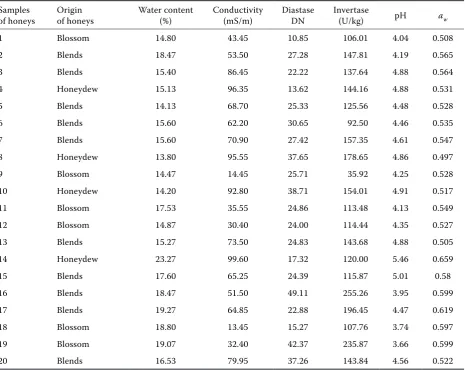
[image:3.595.65.531.368.738.2]The results of the determination of physicochemi-cal parameters of honeys for individual samples are shown in Table 1. Table 2 summarises basic statisti-cal evaluation of honeys divided into three groups. The observation of the water activity did not show any significant differences between the types of hon-eys. The found values ranged between 0.497 (13.8%
Table 1. Physicoche mical parameters of honeys
Samples
of honeys Origin of honeys Water content (%) Conductivity (mS/m) Diastase DN Invertase (U/kg) pH aw
1 Blossom 14.80 43.45 10.85 106.01 4.04 0.508
2 Blends 18.47 53.50 27.28 147.81 4.19 0.565
3 Blends 15.40 86.45 22.22 137.64 4.88 0.564
4 Honeydew 15.13 96.35 13.62 144.16 4.88 0.531
5 Blends 14.13 68.70 25.33 125.56 4.48 0.528
6 Blends 15.60 62.20 30.65 92.50 4.46 0.535
7 Blends 15.60 70.90 27.42 157.35 4.61 0.547
8 Honeydew 13.80 95.55 37.65 178.65 4.86 0.497
9 Blossom 14.47 14.45 25.71 35.92 4.25 0.528
10 Honeydew 14.20 92.80 38.71 154.01 4.91 0.517
11 Blossom 17.53 35.55 24.86 113.48 4.13 0.549
12 Blossom 14.87 30.40 24.00 114.44 4.35 0.527
13 Blends 15.27 73.50 24.83 143.68 4.88 0.505
14 Honeydew 23.27 99.60 17.32 120.00 5.46 0.659
15 Blends 17.60 65.25 24.39 115.87 5.01 0.58
16 Blends 18.47 51.50 49.11 255.26 3.95 0.599
17 Blends 19.27 64.85 22.88 196.45 4.47 0.619
18 Blossom 18.80 13.45 15.27 107.76 3.74 0.597
19 Blossom 19.07 32.40 42.37 235.87 3.66 0.599
20 Blends 16.53 79.95 37.26 143.84 4.56 0.522
Czech J. Anim. Sci., 50, 2005 (8): 376–384 Original Paper
of water) and 0.659 (19.3% of water), (0.545 ± 0.032). The increased water activity (from the value 0.73) influences the shelf life of honey and supports the growth of undesirable microflora, especially of os-motolerantyeasts. The highest valueaw (0.659) of samples analysed in this study was established in honeydew honey. However, this value is safe from the aspect of possible growth of microorganisms.
The statistical significance of measured pH values was variable in the groups of honey. The highest values were found in the group of honeydew hon-eys (4.88 ± 0.02) and the lowest in blossom honhon-eys (4.03 ± 0.25). It is in accordance with bibliographic references which also state that the pH value is in-fluenced by organic acids and by the concentration of mineral substances (Crane, 1990).
The values of the activity of the two most impor-tant enzymes diastase and invertase, which are used in some countries as the legislative criteria of honey qual-ity (Bogdanov et al., 1997), proved differences between blossom and honeydew honeys, which is in accordance with bibliographic references (Krauze and Zalewski, 1991; Vorlová and Přidal, 2002). No differences were proved between blends and blossom honeys.
Antimicrobial activity of honey
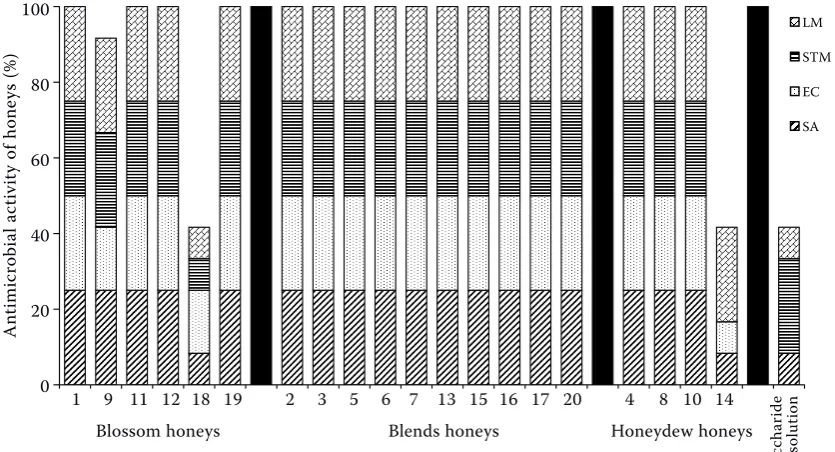
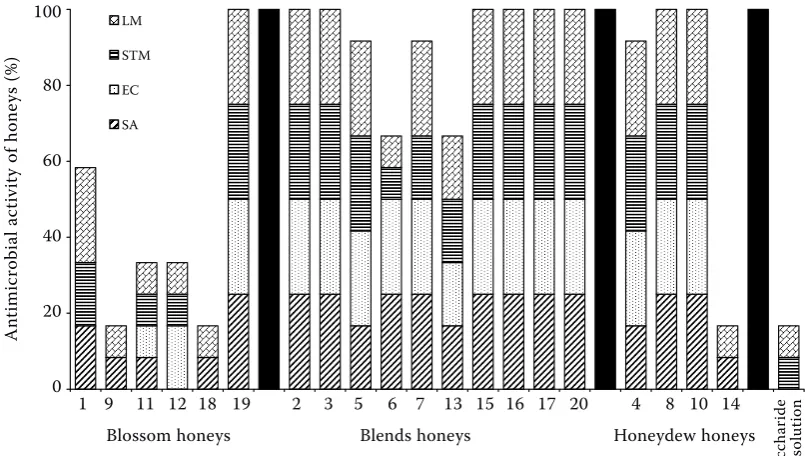
The highest antimicrobial activity was recorded in honeydew honeys both at 10% and 20%
[image:4.595.63.534.115.340.2]concen-trations of honeys as well as both at higher and lower density of bacterial strains (Figures 1–4). However, one sample of honeydew honey was an exception that showed an extremely high content of water, high water activity and deviations in orga-noleptic tests. The honey was probably immature or spoiled. The difference between the intensity of antimicrobial activity of honeydew honeys and that of the other groups of honeys was statistically highly significant (P < 0.01). The antimicrobial ac-tivity of the honey solutions was always higher than that of the saccharide solution used as a control (Table 3, Figures 1–4). The study proved that the antimicrobial activity of honey is also caused by other factors, not just by a mere osmotic effect of the high concentration of saccharides in honey. The results of particular honeys are listed in Table 3. When comparing antibacterial effects on the tested microorganisms with antimicrobial effects of hon-ey, we could observe higher sensitivity of Gram-negativebacteria (E. coli and S. typhimurium). This trend was mostly kept in honeydew honeys, but it was not statistically significant. The study proved that honey produced in the Czech Republic is anti-microbially effective with the highest effect in hon-eydew honeys (P < 0.01). The activity of honey was also recorded in the diluted solution of honey to compare it with a saccharide solution. It signalizes that there are also other factors, not just the osmot-ic effect caused by a high content of saccharides,
Table 2. Statistical evaluation of physicochemical parameters of honeys (–x = average, SD = standard deviation,
n = sample size)
Group of honey Water content (%) Conductivity (mS/m) Diastase (DN) Invertase (U/kg) pH aw
Blossom n = 6
–x 16.59 28.28 23.84 118.91 4.03 0.551
max 19.07 43.45 42.37 235.87 4.35 0.599
min 14.47 13.45 10.85 35.92 3.66 0.508
SD 2.12 11.96 10.86 64.66 0.28 0.038
Blends n = 10
–x 16.63 67.68 29.14 151.60 4.55 0.556
max 19.27 86.45 49.11 255.26 5.01 0.619
min 14.13 51.50 22.22 92.50 3.66 0.505
SD 1.71 10.83 8.27 45.42 0.32 0.036
Honeydew n = 4
–x 16.60 96.08 26.83 149.21 5.03 0.551
max 23.27 99.60 38.71 178.65 5.46 0.659
min 13.80 92.80 13.62 120.00 4.86 0.497
participating in the antimicrobial activity of honey. The finding is also supported by foreign studies from many parts of the world. Scientists have found out that secondary metabolites from nectar are car-ried to honey by a bee and in this way honey with its specific chemical composition is produced. In Brazil Cortopasii-Laurino and Gelli (1991) revealed
the strongest antimicrobial characteristics in pollen from the mimosa (Melipona subnitida) and euca-lyptus (Eucalyptus globulus). In Poland honeys from the blackberry and the lime tree were found out the therapeutically most effective (Leszcynska, 1993). In Egypt they also studied a direct influence of feed-ing extracts from medical herbs to bees on the
[image:5.595.99.503.84.344.2]anti-Figure 1. Antimicrobial activity of 20% honey solution at 108 cfu density of strains
Figure 2. Antimicrobial activity of 20% honey solution at 103 cfu density of strains
1 9 11 12 18 19 2 3 5 6 7 13 15 16 17 20 4 8 10 14 Blossom honeys Blends honeys Honeydew honeys
Sa cc ha ri de so lu tio n A nt im ic ro bi al a ct iv ity o f h on ey s (% ) 100 80 60 40 20 0 Samples 0% 20% 40% 60% 80%
1 11 18 3 6 13 16 20 4 10 blossom honeys blends honeys honeydew h.
A nt im ic ro bi al a ct iv ity o f h on ey s �ada1 LM STM EC SA
1 9 11 12 18 19 2 3 5 6 7 13 15 16 17 20 4 8 10 14 Blossom honeys Blends honeys Honeydew honeys
Sa cc ha ri de so lu tio n A nt im ic ro bi al a ct iv ity o f h on ey s (% ) 100 80 60 40 20 0 Samples 0% 20% 40% 60% 80% 100%
1 11 18 3 6 13 16 20 4 10 blossom honeys blends honeys honeydew h.
[image:5.595.86.504.505.731.2]Czech J. Anim. Sci., 50, 2005 (8): 376–384 Original Paper
[image:6.595.102.497.78.318.2]bacterial character of honey. Camomile, marjoram and geranium extracts were given to a bee colony once during a period of 8 weeks. At the end of the period the antimicrobial activity of honey was analysed. Honey from colonies fed medical herb extracts had a higher antimicrobial activity than honey from control colonies. Camomile showed the highest antimicrobial activity (Mishref et al., 1989). The presence of the flavonoid hesperidin was
Figure 3. Antimicrobial activity of 10% honey solution at 108 cfu density of strains
Figure 4. Antimicrobial activity of 10% honey solution at 103 cfu density of strains
found in citrus honeys, particularly in honey from an orange extract (Ferreres et al., 1993). Honeydew honey from coniferous forests of the mountains of central Europe has a relatively high peroxide anti-microbial activity. Manuka honey from the plant
Leptospermum scoparium grown in New Zealand also has a high antimicrobial activity being of the phytochemical origin. This kind of honey has a high non-peroxide activity (50%) (Molan, 1992a). Thus
Samples 0% 20% 40% 60% 80% 100%
1 11 18 3 6 13 16 20 4 10 blossom honeys blends honeys honeydew h.
A nt im ic ro bi al a ct iv ity o f h on ey s �ada1 LM STM EC SA
1 9 11 12 18 19 2 3 5 6 7 13 15 16 17 20 4 8 10 14 Blossom honeys Blends honeys Honeydew honeys
Sa cc ha ri de so lu tio n A nt im ic ro bi al a ct iv ity o f h on ey s (% ) 100 80 60 40 20 0 Samples 0% 20% 40% 60% 80% 100%
1 11 18 3 6 13 16 20 4 10 blossom honeys blends honeys honeydew h.
A nt im ic ro bi al a ct iv ity o f h on ey s �ada1 LM STM EC SA
1 9 11 12 18 19 2 3 5 6 7 13 15 16 17 20 4 8 10 14 Blossom honeys Blends honeys Honeydew honeys
[image:6.595.101.504.504.732.2]Table 3. Growth of bacterial strains on culture medium [Staphylococcustaureus CCM3953 (SA), Escherichia coli CCM4787 (EC) and Salmonella typhimurium F8332 (STM), Listeria monocytogenes CCM4699 (LM)]
Concentrations
of honeys (%) of strainsDensity Samples of honeys SA EC STM LM Samples of honeys SA EC STM LM
10 108
1 blossom
+++ +++ +++ +++
11 blossom
+++ +++ +++ +++
103 + +++ + 0 ++ ++ ++ ++
20 108 ++ +++ +++ +++ +++ +++ 0 ++
103 0 0 0 0 0 0 0 0
10 108
2 blends
+++ +++ +++ +++
12 blossom
+++ +++ +++ +++
103 0 0 0 0 +++ + ++ ++
20 108 +++ 0 0 +++ +++ +++ +++ +++
103 0 0 0 0 0 0 0 0
10 108
3 blends
+++ +++ +++ +++
13 blends
+++ +++ +++ +++
103 0 0 0 0 + + + +
20 108 +++ 0 +++ +++ +++ +++ 0 +++
103 0 0 0 0 0 0 0 0
10 108
4 honeydew
+++ +++ +++ +++
14 honeydew
+++ +++ +++ +++
103 + 0 0 0 ++ +++ +++ ++
20 108 +++ 0 0 0 +++ +++ +++ +++
103 0 0 0 0 ++ ++ +++ 0
10 108
5 blends
+++ +++ +++ +++
15 blends
+++ +++ +++ +++
103 + 0 0 0 0 0 0 0
20 108 +++ +++ 0 ++ +++ +++ 0 0
103 0 0 0 0 0 0 0 0
10 108
6 blends
+++ +++ +++ +++
16 blends
+++ +++ +++ +++
103 0 0 ++ ++ 0 0 0 0
20 108 +++ +++ +++ +++ +++ +++ 0 0
103 0 0 0 0 0 0 0 0
10 108
7 blends
+++ +++ +++ +++
17 blends
+++ +++ +++ +++
103 0 0 + 0 0 0 0 0
20 108 +++ 0 0 +++ +++ ++ 0 0
103 0 0 0 0 0 0 0 0
10 108
8 honeydew
+++ +++ 0 +++
18 blossom
+++ +++ +++ +++
103 0 0 0 0 ++ +++ +++ ++
20 108 +++ 0 0 ++ +++ +++ +++ +++
103 0 0 0 0 ++ + ++ ++
10 108
9 blossom
+++ +++ +++ +++
19 blossom
+++ +++ +++ +++
103 ++ +++ +++ ++ 0 0 0 0
20 108 +++ +++ +++ +++ +++ +++ 0 0
103 0 + 0 0 0 0 0 0
10 108
10 honey-dew
0 +++ +++ +++
20 blends
+++ +++ +++ +++
103 0 0 0 0 0 0 0 0
20 108 0 0 0 0 0 0 0 0
103 0 0 0 0 0 0 0 0
10 108
saccharide solution
+++ +++ +++ +++
103 +++ +++ ++ ++
20 108 +++ +++ +++ +++
Czech J. Anim. Sci., 50, 2005 (8): 376–384 Original Paper
it appears that honeys of some botanical origins have a higher antimicrobial character than others. Various kinds of honey significantly differ in their antimicrobial strength. As we tested honey chosen at random it could happen that its antimicrobial character would be just a bit higher than in a sac-charide solution. There could even be a great dif-ference in the antimicrobial activity of honeys of the same botanical origin.
Statistical analysis
The statistical results of the relation between the antimicrobial activity and physicochemical param-eters of honey are summarised in Table 4.
The content of water does not influence the an-timicrobial activity statistically significantly, but it holds good the lower the content of water in honey, the higher the antimicrobial activity.
Water activity does not have a statistically sig-nificant influence on antimicrobial activity. There seems to be a trend that the lower the aw value, the higher the antimicrobial activity.
The pH value (active acidity of honey) does not have a statistically significant influence on antimi-crobial activity. It is to state here the higher the pH, the higher the antimicrobial activity. It does not correlate with data from literature which consider the low pH of honey solution as one of the factors contributing to the antimicrobial effect of honey (Molan, 1992a).
Conductivity of honey is a common criterion of honey classification into groups. It was found out that the higher the conductivity of honey (honey-dew and blends honeys), the higher the antimicro-bial activity, which was shown in two cases by the statistically significant coefficient of correlation (P < 0.05).
The correlation between the enzyme activity and the antimicrobial activity of honey was statistically most indicative. The relation between the invertase activity and the antimicrobial activity was statisti-cally highly significant (P < 0.001) in the observed parameters; the significance with the diastase ac-tivity was lower (P < 0.05). It has not been clear so far what relation is between the invertase activity and the bacterial growth. However, to be an active invertase, it needs the action of one of the co-en-zymes which are necessary for bacterial growth, or otherwise it influences the bacterial cell activity.
The statistically significant relations between the antimicrobial activity and the conductivity of honey (P < 0.05), the diastase (P < 0.05) and invertase (P < 0.001) activities were found out in the observed physicochemical parameters.
REFERENCES
Adcock D. (1962): The effect of catalase on the inhibine and peroxide values of various honeys. J. Apicult. Res., 1, 38–40.
Armstrong S., Otis G.W. (1995): The antibacterial
prop-erties of honey. Bee Culture, 123, 500–502.
Belitz H.D., Grosch W. (1992): Lehrbuch der Lebensmittel-chemie. 4. Auflage. Springer-Verlag, Berlin. 966 pp. Bogdanov S., Martin P., Lüllman C. (1997): Harmonised
methods of the European Honey Commission. Apid-ologie. Extra Issue, 1–59.
Condon R.E. (1993): Curious interactions of bugs and bees. Surgery, 133, 234–235.
Cooper R.A., Molan P.C., Harding K.G. (1999): Antibac-terial activity of honey against strains of Staphylococcus aureus from infected wounds. J. Royal Soc. Med., 92, 283–285.
[image:8.595.63.532.103.199.2]Coropassi-Laurino M., Gelli D.S. (1991): Pollen analysis, physico-chemical properties and antibacterial action Table 4. The correlation between antimicrobial activity and physicochemical parameters of honeys
Concentrations
of honeys (%) of strains Density Water content (%) Conductivity (mS/m) Diastase DN Invertase (U/Kg) pH aw
10 10
8 –0.4917* 0.4047* 0.4047* 0.3179 0.3184 –0.4628*
103 0.0606 0.3507 0.5026* 0.7567*** 0.1696 0.0565
20 10
8 –0.0436 0.4733* 0.4114* 0.7532*** 0.2512 –0.1045
103 –0.2653 0.1852 0.3232 0.4358* 0.0509 –0.3162
of Brazilian honeys from Apis mellifera. Apidologie, 22, 61–73.
Crane E. (1990): Bees and Beekeeping: Science Practice and World Resources. Comstock Pru. Assoc., Ithaca, N.Y. 614 pp.
Ferrese F., Garcia-Viguera C., Lorentse F., Tomas-Barberan F.A. (1993): Hesperetin: a marker of the flo-ral origin of citrus honey. J. Sci. Food., 61, 121–123. Floris I., Prota R. (1989): The bitter honey of Sardinia.
Apiculture-Moderno, 80, 55–67.
Grobler S.R., Basson N.J. (1996): The Effect of Honey on Human Tooth Enamel and Oral Bacteria. Bee Products. Plenum Press, New York. 65–67.
Krauze A., Zalewski R.I. (1991): Classification of honeys by principal component analysis on the basis of chemical and physical parameters. Z. Lebensm. Unters. Forsch., 192, 19–23.
Leszynska A. (1993): Antibacterial properties of various types of honey and the effect of honey heating on bac-terial activity. Med. Weter., 49, 415–419.
Matoušková O., Chalupa J., Cígler M., Hruška K. (1992): Statistic programme STAT Plus – Manual, version 1.01. Veterinary Research Institute, Brno, CR. 168 pp. Mishref A., Magda S.A., Ghazi I.M. (1989): The effect of
feeding medicinal plant extracts to honeybee colonies on the antibacterial activity of honey produced. In:
Proc. 4th Int. Conf. Apiculture in Tropical Climates,
Cairo, Egypt, 80–87.
Molan P.C. (1992a): The antimicrobial activity of honey 1. The nature of the antibacterial activity. Bee World, 73, 5–28.
Molan P.C. (1992b): The antimicrobial activity of honey 2. Variation in the potency of the antibacterial activity. Bee World, 73, 59–76.
Tysset C., Durand C., Rousseau M. (1980): Microbism and wholesomeness of commercial honey. Apiacta, 15, 51–60.
Vorlová L., Přidal A. (2002): Invertase and diastase activ-ity in honeys of Czech provenience. Acta Univ. Agric. et Silvic. Mendel. Brun., L, 57–66.
Weston R.J. (2000): The contribution of catalase and other natural products to the antibacterial activity of honey: A review. Food Chem., 71, 235–239.
White J.W., Subers M.H., Schepartz A.I. (1963): The iden-tification of inhibine, the antibacterial factor in honey, as hydrogen peroxide and its origin in a honey glucose-oxidase system. Biochim. Biophys. Acta, 73, 57–70. Yaniv Z., Rudich M. (1996): Medicinal herbs as a
poten-tial source of high quality honeys. In: Mizhrai A., Len-sky Y. (eds.): Bee Products. Plenum Press, New York. 77–79.
Received: 04–04–16 Accepted after corrections: 05–04–01
Corresponding Author

![Table 3. Growth of bacterial strains on culture medium [Staphylococcustaureus CCM3953 (SA), Escherichia coli CCM4787 (EC) and Salmonella typhimurium F8332 (STM), Listeria monocytogenes CCM4699 (LM)]](https://thumb-us.123doks.com/thumbv2/123dok_us/427566.540401/7.595.64.534.114.766/bacterial-strains-staphylococcustaureus-escherichia-salmonella-typhimurium-listeria-monocytogenes.webp)