warwick.ac.uk/lib-publications
A Thesis Submitted for the Degree of PhD at the University of Warwick
Permanent WRAP URL:
http://wrap.warwick.ac.uk/89503
Copyright and reuse:
This thesis is made available online and is protected by original copyright.
Please scroll down to view the document itself.
Please refer to the repository record for this item for information to help you to cite it.
Our policy information is available from the repository home page.
M A
E
G
NS I
T A T MOLEM
U N
IV ER
SITAS WARWICEN
SIS
Performance Engineering Unstructured Mesh,
Geometric Multigrid Codes
by
Richard Arthur Bunt
A thesis submitted to The University of Warwick
in partial fulfilment of the requirements
for admission to the degree of
Doctor of Philosophy
Department of Computer Science
The University of Warwick
Contents
Acknowledgements vi
Declarations viii
Sponsorship and Grants ix
Abstract x
Abbreviations xii
List of Figures xvi
List of Tables xviii
List of Listings xix
1 Introduction 1
1.1 Motivation . . . 3
1.2 Problem Statement . . . 5
1.3 Contributions . . . 6
1.4 Thesis Overview . . . 9
2 Parallel Computing and Performance Engineering 11 2.1 The Composition of a Parallel Machine . . . 11
2.1.1 Core . . . 12
2.1.2 Central Processing Unit (CPU) . . . 14
2.1.3 Accelerators . . . 15
2.1.4 Compute Node . . . 16
2.2 Parallel Data Decompositions . . . 16
2.2.2 Unstructured Mesh . . . 18
2.3 Parallel Programming Laws and Models . . . 19
2.3.1 Speedup . . . 20
2.3.2 Parallel Efficiency . . . 20
2.3.3 Amdahl’s Law . . . 21
2.3.4 Gustafson’s Law . . . 22
2.4 Performance Engineering . . . 23
2.4.1 Profiling and Instrumentation . . . 24
2.4.2 Benchmarks, Mini- and Compact-Applications . . . 25
2.4.3 Modelling Parallel Computation . . . 27
2.4.4 Analytical Modelling . . . 31
2.4.5 Simulation . . . 33
2.5 Alternative Methods . . . 34
2.6 Summary . . . 37
3 Computational Fluid Dynamics, HYDRA and Tools 38 3.1 Computational Fluid Dynamics . . . 38
3.1.1 Uses of Computational Fluid Dynamics (CFD) . . . 39
3.1.2 HYDRA . . . 41
3.1.3 Multigrid . . . 42
3.1.4 OPlus . . . 43
3.1.5 Datasets . . . 46
3.1.6 Mesh Partitioning Libraries . . . 47
3.2 Parallel Machine Resources . . . 48
3.3 Auto-instrumentation . . . 50
3.3.1 Instrumentation Process . . . 51
3.4 Auto-instrumentation Case Studies . . . 54
3.4.1 Effect of Power8 SMT Degree on Runtime . . . 55
3.4.2 Highlighting Historical Performance Differences . . . 57
3.5 Summary . . . 60
4 Model-led Optimisation of an Unstructured Multigrid Code 62 4.1 Experimental Setup . . . 62
4.2 Single-Level Model . . . 63
4.2.1 Model Construction . . . 63
4.2.2 Validation . . . 67
4.3 Model Analysis . . . 69
4.3.1 Communication in OPlus . . . 69
4.3.2 Communication Optimisations . . . 72
4.4 Multigrid Model . . . 74
4.4.1 Model Construction . . . 74
4.4.2 Validation . . . 76
4.5 Summary . . . 81
5 Enabling Model-led Evaluation of Partitioning Algorithms at Scale 84 5.1 Runtime Model for Multigrid Applications . . . 86
5.1.1 Model of Solver Steps . . . 87
5.1.2 Model Integration . . . 88
5.1.3 Generalisation to W-Cycles . . . 89
5.2 Additional Performance Model Detail . . . 90
5.2.1 Experimental Setup . . . 91
5.2.2 Region Grind-time Data . . . 92
5.2.3 Complete Loop Coverage . . . 93
5.2.4 Buffer Pack Cost . . . 94
5.2.5 Performance Model Validation (ParMETIS) . . . 96
5.3 Set and Halo Size Generation . . . 98
5.3.1 Partitioning Mini-Driver and Mini-Application . . . 99
5.3.2 Validation . . . 100
5.4 Summary . . . 104
6 Developing Mini-HYDRA 106 6.1 Developing Mini- and Compact-HYDRA . . . 106
6.1.1 Mini-HYDRA . . . 106
6.1.2 Compact-HYDRA . . . 111
6.1.3 Supporting Tools . . . 111
6.2 Mini-HYDRA Validation . . . 113
6.2.1 Experimental Setup . . . 115
6.2.2 Validation . . . 115
6.3 Impact of Intel Haswell on mini-HYDRA . . . 116
6.4 Summary . . . 119
7 Conclusions and Future Work 122 7.1 Research Impact . . . 124
7.2 Limitations . . . 125
7.3 Future Work . . . 127
7.4 Final Word . . . 129
Acknowledgements
Throughout the duration of my Ph.D., I have received assistance, advice and
encouragement from many people. In this section I would like provide my
warmest thanks to the most notable of these individuals.
To begin, I would like to thank my supervisor, Prof. Stephen Jarvis for
his efforts in setting this project up and most of all for his invaluable advice.
Additionally, I would like to thank him for his appearances prior to this Ph.D. –
most notably for his energetic delivery of lectures and for supervising my third
year project during my undergraduate course.
I would like to thank all the members (past, present and honorary) of the
High Performance and Scientific Computing Group at the University of
War-wick: Dr. David Beckingsale, Dr. Robert Bird, Dr. Adam Chester, James Davis,
James Dickson, Dr. Simon Hammond, Dr. Matthew Leeke, Tim Law, Dr. John
Pennycook, Stephen Roberts, Dr. Phillip Taylor and Dr. Steven Wright for their
comments and suggestions on the research presented in this thesis. I would like
to reiterate my thanks to Dr. Steven Wright for all his hard work managing the
High Performance and Scientific Computing Group.
Without the Herculean effort of the administrative staff at the Computer
Science department, it would not run nearly as smoothly. Therefore I must offer
my thanks to Dr. Roger Packwood (specifically for, but by no means limited to
loaning out an external drive bay for three years), Dr. Christine Leigh, Catherine
Pillet, Lynn McLean, Ruth Cooper, Gillian Reeves-Brown and Jane Clarke.
The work in this thesis was conducted in collaboration with Rolls-Royce, so
I would like to take this opportunity to thank the brilliant individuals that I
encountered during various conference calls and visits to Derby. I would like
to offer special thanks to Dr. Yoon Ho and Matthew Street for their questions
The experiments presented in this thesis were conducted on a variety of
computers in the United Kingdom and here I would like to acknowledge their
use:
• Access to Minerva and Tinis was provided by the Centre for Scientific
Computing at the University of Warwick.
• This work used the ARCHER UK National Supercomputing Service (http:
//www.archer.ac.uk).
• We acknowledge use of Hartree Centre resources in this work. The STFC
Hartree Centre is a research collaboratory in association with IBM
provid-ing High Performance Computprovid-ing platforms funded by the UK’s
invest-ment in e-Infrastructure. The Centre aims to develop and demonstrate
next generation software, optimised to take advantage of the move towards
exa-scale computing.
Finally, I would like to offer my greatest thanks to Nick, Elaine, Stephanie
and my sister Rachel for their support throughout this Ph.D., most notably for
forcing me to take a break, by either taking me somewhere without a laptop or
Declarations
This thesis is submitted to the University of Warwick in support of my
appli-cation for the degree of Doctor of Philosophy. It has been composed by myself
and has not been submitted in any previous application for any degree. The
work presented (including data generated and data analysis) was carried out by
the author except in the cases outlined below:
• The performance model in Chapter 4 was in part formulated and described
by Dr. John Pennycook.
Parts of this thesis have been previously published in the following
publica-tions:
Chapter 4 R. A. Bunt, S. J. Pennycook, S. A. Jarvis, L. Lapworth, and Y. K.
Ho. Model-Led Optimisation of a Geometric Multigrid Application. In
Proceedings of the 15th High Performance Computing and
Communica-tions & 2013 IEEE International Conference on Embedded and Ubiquitous
Computing 2013 (HPCC&EUC’13), pages 742–753, Zhang Jia Jie, China,
November 2013. IEEE Computer Society, Los Alamitos, CA [23]
Chapter 5 R. A. Bunt, S. A. Wright, S. A. Jarvis, M. Street, and Y. K. Ho.
Predictive Evaluation of Partitioning Algorithms Through Runtime
Mod-elling. InIn Proceedings of High Performance Computing, Data, and
An-alytics (HiPC’16), pages 1–11, Hyderabad, India, December 2016. IEEE
Sponsorship and Grants
The research presented in this thesis was made possible by the following
bene-factors, sources and research agreements:
• The University of Warwick Postgraduate Research Scholarship (2012-2015).
• The Royal Society Industry Fellowship Scheme (IF090020/AM).
• Bull/Warwick Premier Partnership (2012-2014).
• Sponsored Research Agreement between University of Warwick and
Abstract
High Performance Computing (HPC) is a vital tool for scientific simulations;
it allows the recreation of conditions which are too expensive to produce in
situ or over too vast a time scale. However, in order to achieve the
increas-ing levels of performance demanded by these applications, the architecture of
computers has shifted several times since the 1970s. The challenge of
engineer-ing applications to leverage the performance which comes with past and future
shifts is an on-going challenge. This work focuses on solving this challenge for
unstructured mesh, geometric multigrid applications through three existing
per-formance engineering methodologies: instrumentation, perper-formance modelling
and mini-applications.
First, an auto instrumentation tool is developed which enables the collection
of performance data over several versions of a code base, with only a single
definition of the data to collect. This information allows the comparison of
prospective optimisations (e.g. reduced synchronisation), and an assessment of
competing hardware (e.g. Intel Haswell/Ivybridge).
Second, this work details the development and use of a runtime performance
model of unstructured mesh, geometric multigrid behaviour. The power of the
model is demonstrated by i) exposing a synchronisation issue which degrades
total application runtime by 1.41× on machines which have poor support for
overlapping communication with computation; and, ii) accurately predicting the
negative impact of the geometric partitioning algorithm on executions using 512
partitions.
Third, a mini-application is developed to provide a vehicle for optimising
and porting activities, where it would be prohibitively time consuming to use
a large, legacy application. The use of the mini-application is demonstrated
extension instructions on performance. It is found that significant code
modifi-cations would be required to benefit from these instructions, but the architecture
Abbreviations
AOA Angle of Attack.
API Application Programmer Interface.
BSP Bulk Synchronous Parallel.
CFD Computational Fluid Dynamics.
CPU Central Processing Unit.
DoE Department of Energy.
FLOP/s Floating Point Operations per Second.
FMA Fused Multiply-Add.
GPU Graphics Processing Unit.
HDF5 Hierarchical Data Format 5.
HPC High Performance Computing.
I/O Input/Output.
ILP Instruction Level Parallelism.
IMB Intel MPI Benchmark.
MLP Memory Level Parallelism.
MPI Message Passing Interface.
OPlus Oxford Parallel Library for Unstructured Solvers.
PAL Performance Architecture Laboratory.
PAPI Performance Application Programming Interface.
PPN Processors Per Node.
PRAM Parallel Random Access Machine.
RIB Recursive Inertial Bisection.
SAXPY Single-Precision AX Plus Y.
SMP Symmetric Multiprocessing.
SMT Simultaneous Multithreading.
SST Structual Simulation Toolkit.
List of Figures
1.1 Visualisation of top supercomputer performance over time (uses
data from [118, 145]) . . . 3
2.1 An abstract representation of a parallel machine configuration . . 12
2.2 1-, 2- and 3-D structured mesh decompositions . . . 17
2.3 Partitioning an unstructured mesh . . . 18
2.4 Amdahl’s Law and Gustafson’s Law for varying values offp . . . 21
2.5 Hardware and software life cycle (adapted from [11]) . . . 23
3.1 3D Bypass duct with Mach number contours [119] . . . 40
3.2 Interaction between HYDRA, OPlus and MPI . . . 42
3.3 Level transition pattern for (a) two V-cycles and (b) one W-cycle 43
3.4 Abstract representation of an unstructured mesh dataset over two
multigrid levels . . . 46
3.5 HYDRA’s per OPlus loop speedup when compared to SMT1 on
Power8 (FLUX2,FLUX6,UPDATE12, UPDATE8) . . . 55
3.6 HYDRA’s per OPlus loop speedup when compared to SMT1 on
Power8 (FLUX8,FLUX27, FLUX3,FLUX4) . . . 56
3.7 Per loop comparison between HYDRA 6.2.23 and HYDRA 7.3.4
on Napier for independent compute and comms+sync (FLUX2,
FLUX6,UPDATE12,UPDATE8,FLUX8) . . . 58
3.8 Per loop comparison between HYDRA 6.2.23 and HYDRA 7.3.4
on Napier for halo and execute compute (FLUX2,FLUX6,UPDATE12,
UPDATE8,FLUX8) . . . 59
3.9 Per loop comparison between HYDRA 6.2.23 and HYDRA 7.3.4
on Napier for independent compute and comms+sync (FLUX27,
3.10 Per loop comparison between HYDRA 6.2.23 and HYDRA 7.3.4
on Napier for halo and execute compute (FLUX27, BCS7, FLUX3,
FLUX25,FLUX4) . . . 61
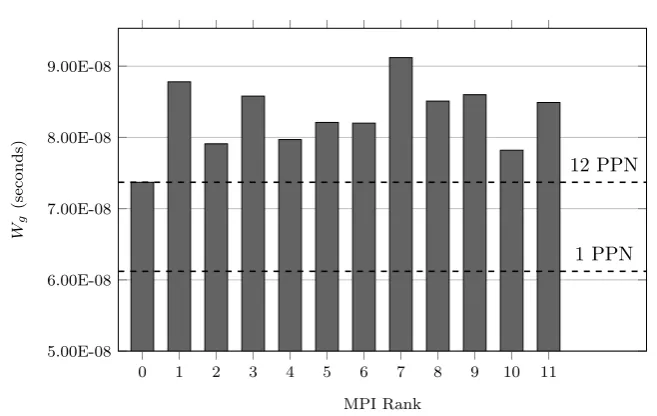
4.1 Comparison ofifluxWgvalues for 1 and 12 PPN on a single node 64
4.2 Comparison of recorded and predicted execution times for
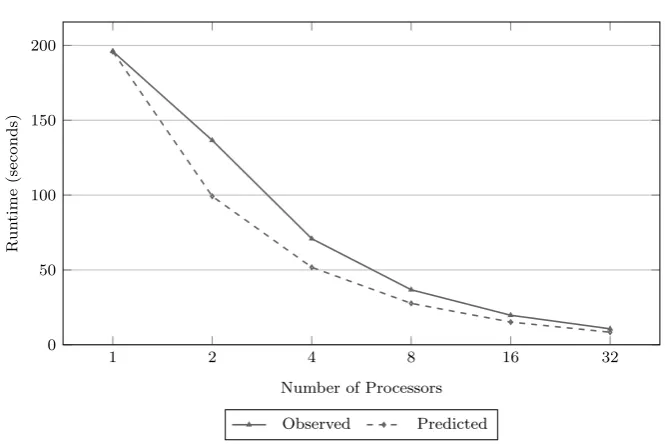
single-level runs of the original HYDRA using 1 PPN . . . 67
4.3 Comparison of recorded and predicted execution times for
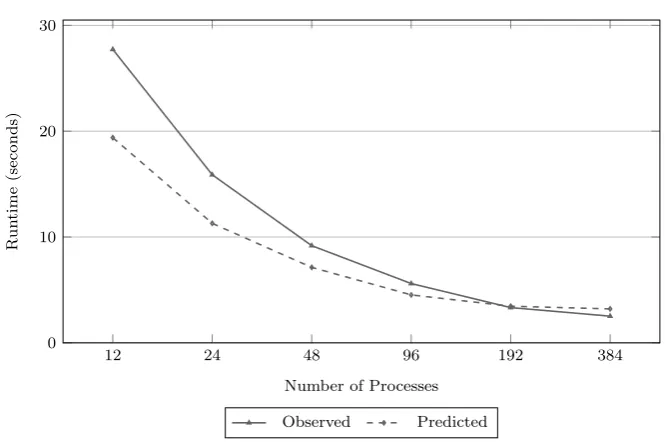
single-level runs of the original HYDRA using 12 PPN . . . 68
4.4 Best-case performance behaviours for the OPlus communication
routines on two processors . . . 69
4.5 Worst-case performance behaviours for the OPlus communication
routines on two processors . . . 70
4.6 Compute/communication/synchronisation breakdown for the
orig-inal and optimised HYDRA, as: (a) time in seconds; and (b)
percentage of execution time . . . 71
4.7 Comparison of observed and predicted execution times for
single-level runs of the optimised HYDRA, using 1 PPN . . . 73
4.8 Comparison of observed and predicted execution times for
single-level runs of the optimised HYDRA, using 12 PPN . . . 74
4.9 Comparison of observed and predicted execution times for
multi-grid runs of the optimised HYDRA using 1 PPN . . . 77
4.10 Comparison of observed and predicted execution times for
multi-grid runs of the optimised HYDRA using 12 PPN . . . 78
5.1 Trace of solver iteration events (ncycles = 3) . . . 86
5.2 Comparison of actual and predicted compute time (Rotor37, 8
million nodes; geometric partitioning; Tinis) . . . 91
5.3 Predicted compute time percentage error (Rotor37, 8 million
5.4 Comparison of actual and predicted runtime (Rotor37, 8 million
nodes; geometric partitioning; Tinis). See Table 5.2 for
confi-dence intervals. . . 93
5.5 Total predicted time percentage error (Rotor38, 8 million nodes;
geometric partitioning; Tinis). . . 94
5.6 Comparison of HYDRA’s actual and predicted runtime (Rotor37,
8 million nodes, ParMETIS; Tinis) See Table 5.2 for confidence
intervals. . . 96
5.7 Percentage error for model costs (Rotor37, 8 million nodes, ParMETIS;
Tinis) See Table 5.2 for confidence intervals. . . 97
5.8 Percentage error ofWgcalculation techniques for max edge
com-pute (Tinis) . . . 98
5.9 Impact of partitioning data source on model (Tinis) . . . 100
5.10 Predicted effect of partitioning algorithm on HYDRA’s runtime
and the speedup from using ParMETIS over a geometric
parti-tioning . . . 102
6.1 Comparison between the runtime and parallel efficiency of
Compact-and Mini-HYDRA for each level of the multigrid . . . 112
6.2 Comparison between Mini- and Compact-HYDRA in terms of
the correlation of PAPI counters with parallel inefficiency . . . . 114
6.3 Comparison between OpenMP strong scaling behaviour between
Intel Ivybridge and Intel Haswell for both Compact- and
Mini-HYDRA . . . 117
6.4 Impact of using the Intel Fused Multiply-* instructions with and
without auto-vectorisation on both Compact- and Mini-HYDRA 118
6.5 Performance impact of using auto-vectorisation on both
List of Tables
3.1 Hardware/software configuration of Napier . . . 48
3.2 Hardware/software configuration of Power8 . . . 48
3.3 Hardware/software configuration of ARCHER . . . 49
3.4 Hardware/software configuration of Minerva . . . 49
3.5 Hardware/software configuration of Tinis . . . 50
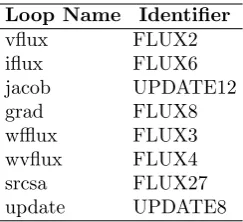
3.6 Mapping between loop names and the identifiers assigned by the auto-instrumentation tool . . . 54
3.7 Confidence intervals for HYDRA’s runtime on Power8 at different Simultaneous Multithreading (SMT) levels . . . 56
3.8 Confidence intervals for HYDRA’s Runtime on Napier . . . 57
4.1 Description of compute and communication model terms for a single-level HYDRA run . . . 63
4.2 Confidence intervals for HYDRA’s runtime on Minerva when us-ing the LA Cascade dataset . . . 68
4.3 Description of additional model terms required to support multi-grid HYDRA runs . . . 75
4.4 Confidence intervals for HYDRA’s runtime on Minerva when us-ing the Rotor37 dataset . . . 76
4.5 Model validation for multigrid runs of HYDRA on the LA Cas-cade dataset (Confidence intervals are in Tables 4.2 and 4.4) . . . 79
4.6 Model validation for multigrid runs of HYDRA on the Rotor37 dataset . . . 82
5.2 Confidence intervals for HYDRA’s runtime on Tinis when using
either a Geometric Partitioning or ParMETIS to partition the
input deck. . . 95
6.1 Confidence intervals for Compact- and Mini-HYDRA’s runtime
on Tinis . . . 113
6.2 Confidence intervals for Compact- and Mini-HYDRA’s runtime
Listings
3.1 Pseudo-code for HYDRA’s smooth loop . . . 41
3.2 Code-snippet fromvflux, a typical OPlus parallel loop . . . 44
3.3 An example auto-instrumentation rule which matches the entry
to an OPlus parallel loop, and action, to insert timers and gather
the set name associated with this loop . . . 52
6.1 Pseudo-code skeleton of the mini-application . . . 108
CHAPTER
1
Introduction
Simulation is an important cornerstone of scientific experimentation and has
found widespread use in a variety of domains including engineering, physics and
economics. This is because simulations can be constructed to represent
environ-ments that would be prohibitively expensive, impossible or simply against the
law to physically create. Additionally, simulations can allow the measurement
of variables which would be challenging to record in practice. Furthermore,
simulation techniques are able to emulate processes faster than they occur in
realtime, allowing the outcome of these processes to be predicted ahead of time.
While some scientific simulations can be run on a computer which might be
found under an office desk, achieving the level of detail required for state of the
art applications in a time frame where the results are still of value, typically
requires execution on large parallel computers.
These parallel computers are housed not under desks, but in dedicated
facil-ities with their own cooling and power systems, and the most powerful are
sev-eral orders of magnitude more performant than any desktop computer. Floating
Point Operations per Second (FLOP/s) are one standard metric for quantifying
the performance of parallel computers – this metric indicates how many
calcula-tions (e.g. addition, multiplication) can be performed on floating point numbers
per second. The TOP500 list has been tracking the computing power available
on the fastest 500 computers from the last decade; from this it can been seen
that the computational power of machines has been increasing exponentially
since recording started in 1994, to the point where the most performant of these
machines can perform 93 petaFLOP/s (1015 FLOP/s) [118]. This regular
greater capacity and capability.
The scientific simulations which run on these machines are the product of
years of research and are invaluable for their respective use cases, therefore
keeping them functioning on modern hardware is of paramount importance.
However, while hardware has progressed rapidly over the last four decades,
these simulations have largely remained unchanged and are often still written
using the programming languages around at the time of their inception. This,
along with their size makes adding new features, moving the applications to
up-coming parallel architectures, and running with larger degrees of parallelism a
significant time investment. It is therefore necessary to further the development
of performance engineering techniques, such as performance modelling (models
which allow reasoning about performance) and mini-applications (distilled
ver-sions of larger codes which are more tractable to experiment with) to aid with
overcoming these challenges.
This thesis represents over three years of performance engineering work on
HYDRA, a geometric multigrid, unstructured mesh code developed by
Rolls-Royce. HYDRA exemplifies the aforementioned challenges; it has existed through
over four decades of advances in parallel hardware and supporting tool chains;
it is written in FORTRAN77; and, it is tens of thousands of lines of code in size.
This work sees the construction of a runtime performance model of HYDRA,
which has primarily been used to i) validate HYDRA’s performance on several
machines at supercomputing centres around the United Kingdom, and ii) to
assess the continued suitability of competing partitioning algorithms.
Addition-ally this work presents the development of a mini-application; a smaller code
capturing only HYDRA’s primary computational behaviours. This is used to
assess the impact of the hardware features available from the next generation
1,975 1,980 1,985 1,990 1,995 2,000 2,005 2,010 2,015 10−1
100
101
102
103 104
105
106
107
108
Year
P
erformance
[image:23.595.128.436.123.385.2](GFLOP/second)
Figure 1.1: Visualisation of top supercomputer performance over time (uses data from [118, 145])
1.1
Motivation
Since the introduction of the TOP500 list [118] in 1994, the performance of the
world’s fastest computers has been increasing exponentially, from just under
100 gigaFLOP/s (109) to almost 100 petaFLOP/s in 2016 (see 1994 to 2016 in
Figure 1.1). Up until 2006, this increase in performance was primarily enabled
by increases in transistor densities, which was predicted to double every 18-24
months [120]. These performance increases were courtesy of Dennard scaling: as
the size of a transistor is reduced, power consumption is also reduced meaning
that a chip with double the density of transistors, can operate using the same
power as one with half the density (but the same area) [43]. Additionally,
shrinking transistors also reduces the switching delay which results in higher
clock speeds [51]. What this meant for the custodians of scientific simulations, is
that a reduction in time to solution could be expected every time new hardware
However, post 2006 Dennard scaling began to breakdown due to physical
limits being reached (e.g. size of the transistor). This caused CPU designers
to shift their attention to optimising the execution architecture to maximize
the amount of instructions per cycle. This has resulted in a transition to using
CPUs with multiple execution cores, which allows the CPU to run at a lower
clock speed while being able to process the same number of instructions. In
ad-dition to this, the execution cores have become more complex with many more
opportunities for exploiting parallelism such as wide vector units and
Simul-taneous Multithreading (SMT). Further to this, the recent trend has been to
use many-core architectures, which trade a few complex cores for many simple
cores. Unfortunately, performance increases from these architectural changes
are not free; therefore application developers must actively invest time
perfor-mance engineering their application to take advantage of them [146].
These, and future architectural shifts, coupled with the fact that many
scien-tific simulations were originally written for the vector machines of the 1970s (see
1977 in Figure 1.1), has made it increasingly difficult to continuously evaluate
and prepare a code for performant future use. Many High Performance
Comput-ing (HPC) centres are therefore turnComput-ing to performance engineerComput-ing tools and
methodologies, such as predictive performance modelling and mini-applications
to facilitate system evaluation, to aid in the comparison of multiple candidate
machines, to investigate optimisation strategies, and to act as a vehicle for
port-ing codes to novel architectures. This thesis focuses on the application of
in-strumentation, the extension of runtime performance modelling techniques and
mini-applications (a relatively new form of performance engineering) to support
the shift of large, legacy, unstructured mesh, geometric multigrid applications
1.2
Problem Statement
This thesis builds upon both the performance engineering techniques of
run-time performance modelling and mini-applications in the context of
unstruc-tured mesh, geometric multigrid codes; applications which represent their input
geometries at varying resolution. An unstructured mesh can be represented as
a graph (G = (V, E)), where V is a set of nodes and E ={(a ∈ V, b ∈ V)}
is a set of edges, which are arbitrary pairs of nodes. The class of simulation
which is examined by this thesis, performs computation by iterating overEand
accessing the nodes aand b as defined by the pair. Further to this, geometric
multigrid applications operate on a list of these graphsM = [G0, ..., Gn], where
the results of computation over the edges of one graph of propagated to the
others. In this thesis the aim is to overcome some of the challenges associated
with performance engineering this class of code.
Theaand b of any edge in any G are accessed indirectly (i.e. through the
edges) and are unlikely to be contiguous in memory; this posses a challenge to
computers which rely on this to achieve consistent performance. This
uncer-tainly in performance is a barrier predicting the runtime of computations over
edges, as the processing time of each edge can vary. This thesis aims to quantify
the impact of this uncertainty on model accuracy and propose a solution.
Unstructured meshes pose an additional challenge to modelling when
at-tempting predict runtime at large scale. This is because selecting an optimal
partitioning of a graph is an NP-Hard problem, and the generation of these
partitions must be performed by a partitioning algorithm to approximate the
solution [20]. This means that in order to obtain a representative partitioning
for a particular scale of execution, a partitioner must first be run at that scale.
This severely limits the predictive power of any performance model of
unstruc-tured mesh codes. This thesis aims to develop methods to gather representative
partitioning data which can be used by performance models of unstructured
The development and validation of mini-applications is a challenging
pro-cess, as it is not well defined in the literature and differs depending on the
intended use case of the application. This thesis contributes to this gap, by
de-tailing the experience of developing, validating and using a geometric multigrid,
unstructured mesh mini-application.
The research presented in this thesis is performed as part of a project to
support the continued development of HYDRA, a geometric multigrid,
unstruc-tured mesh code developed by Rolls-Royce. This code has been developed over
the last four decades and as such it contains a vast amount of company
knowl-edge. This thesis demonstrates the impact of the developed tools, performance
model and mini-application by aiding Rolls-Royce with the continuing challenge
of moving HYDRA onto machines with more modern architectures and larger
degrees of parallelism.
1.3
Contributions
Specifically, this thesis and its products make the following contributions:
• The development of an automatic instrumentation process is presented
which allows for unprecedented flexibility in terms of implementation
lan-guage, the language to be instrumented and the instrumentation to be
in-serted. This process is implemented and then demonstrated by applying a
common set of instrumentation to three different variants of HYDRA: two
being chronological releases and the third being optimised to reduce
syn-chronisation costs. The data from which is then used to compare historical
changes in performance and to quantify the impact of the optimisation.
In work that is not presented in this thesis, the auto-instrumentation tool
has been used in support of collecting performance data from HYDRA
on a variety of platforms, such as Intel Haswell/Ivybridge, IBM Power 8,
BlueGene/Q so that their potential may be compared. It is expected that
in the future;
• The development of a runtime performance model of an unstructured mesh
code is detailed, which is able to capture the expected scaling behaviour of
HYDRA, and its proprietary communications library, the Oxford Parallel
Library for Unstructured Solvers (OPlus), when running on a grid with
one level. Through the introduction of a small number of additional model
terms, this model is generalised to multigrid simulations. The simple
re-lationship between these two models significantly reduces the complexity
of benchmarking a new platform, as it enables the extrapolation of
com-plete production runtimes using data collected from the execution of small
single-level datasets. The use of the performance model is demonstrated
by identifying a synchronisation issue which degrades performance by up
to 29.22% on machine configurations that exhibit poor support for
over-lapping computation with communication. An optimisation is then
ap-plied which decreases the cost of communication and synchronisation by
3.01×and total runtime by up to 1.41×. That it is possible to accelerate
HYDRA to such a degree demonstrates both the accuracy of the model
and the importance of reassessing whether an application’s original design
assumptions still hold on new hardware/software configurations. Given
this accuracy, the model has been put into use by Rolls-Royce to confirm
the correct strong scaling behaviour of HYDRA on small-scale evaluation
hardware;
• The analytical runtime model for multigrid applications is further
gen-eralised to support multiple cycle types (e.g. V-Cycle, W-Cycle) and a
variable number of time steps per iteration. Additional details are
incor-porated in to the performance model: buffer pack/unpack costs, runtime
costs from all 300+ loops in the code base, and performance
informa-tion for different memory access patterns. These addiinforma-tional details are
geometric partitioning algorithm and ParMETIS to partition the NASA
Rotor37 input deck, with a maximum absolute error of 12.63% and 11.55%
respectively. Additionally, the performance model’s accuracy is reported
on 1,008 cores of an Ivybridge-based cluster (ARCHER). These additions
to the model allow a wider range of workloads to be successfully modelled;
• Moses, an unstructured domain decomposition mini-application, is
devel-oped which is able to convert partitioning data from multiple
algorithm-s/libraries (ParMETIS, METIS, Scotch) at varying scale (up to 100,000
partitions) for use with the runtime performance model. This data allows
predictions to be made at scale without first running HYDRA at scale to
collect set sizes. Runtime predictions made using this data have an error
in runtime of at most 7.31% over 512 processes, when compared against
predictions made with empirically collected partitioning data. The use
of Moses is demonstrated in conjunction with the runtime performance
model to predictively compare the relative effect on HYDRA’s runtime of
using Scotch, ParMETIS, METIS and a geometric partitioning algorithm
on up to 30,000 cores. Using the runtime model in conjunction with Moses,
predicts that the geometric partitioning algorithm will cause reduced
per-formance in HYDRA at 512 processes when compared to ParMETIS;
• Finally, a mini-application is introduced which operates on datasets with
the following properties: i) unstructured mesh, ii) geometric multigrid,
and iii) a variable number of neighbours per node. It is validated
us-ing two previously developed techniques which have not previously been
applied to this class of code. These techniques provide evidence of the
sim-ilarity between the mini-application and the parent code in terms of their
shared memory scalability. To conclude, the use of the mini-application
is demonstrated by quantifying the impact of the new hardware features
introduced to the Intel Haswell platform over Intel Ivybridge for geometric
instruc-tions and the AVX2 features have a limited impact on performance, but
there is potential for Intel Haswell to deliver application results at a much
lower total energy. At the time of writing this thesis, this mini-application
is being used as part of procurement exercises, and it is hoped that this
mini-application will be used in the future as a vehicle for optimisation,
porting and execution on machines where HYDRA is not cleared for use.
1.4
Thesis Overview
The remainder of this thesis is structured as follows:
Chapter 2 contains knowledge of parallel computing essential to
understand-ing the field: the lexical set, the opportunities for parallelism provided by
the hardware, and the software which enables the usages of this hardware.
This chapter continues by providing historical background to performance
engineering techniques (the primary focus of this research) up to state of
the art techniques and their relative merits and shortcomings.
Chapter 3 introduces the context for this research – unstructured mesh,
ge-ometric multigrid applications, specifically Rolls-Royce HYDRA, an
in-stance of this class of code. The features and structure, and their
associ-ated performance challenges, of these codes and those specific to HYDRA
are described. This introduction also details the challenges associated
with collecting data from HYDRA and other unstructured mesh
applica-tions and how these were overcome using newly developed instrumentation
tools. Finally this chapter presents performance information collected
us-ing these instrumentation tools, which serves as an overview of HYDRA’s
performance and a demonstration of the instrumentation tool’s flexibility.
Chapter 4 presents the initial development of a runtime performance model of
HYDRA, first for single level execution and then for multigrid execution.
cores. The value of this model is then demonstrated by identifying
detri-mental communication behaviours through a discrepancy in the predicted
(expected) and actual contribution to total runtime from synchronisation
costs.
Chapter 5 generalises the runtime performance model to support a variable
number of time steps per iteration, arbitrary multigrid cycle types and
all datasets which rely solely on loops. This chapter then identifies the
challenge of generating representative partitioning data for use in large
scale runtime predictions, to which the construction of a partitioning
mini-application is presented as a solution. The use of this mini-mini-application is
demonstrated by performing a predictive evaluation of the effect various
partitioning libraries have on application runtime.
Chapter 6 details the construction, validation and use of mini-HYDRA, a
mini-application designed to compliment the performance model
devel-oped in previous chapters. The mini-application is used to quantify the
impact the new instructions introduced as part of Intel Haswell (Fused
Multiply-Add (FMA) and AVX2) on HYDRA’s inviscid flux kernel.
Chapter 7 concludes this thesis with a summary of the work carried out and a
discussion of the impact this research has had on the individuals involved
in this project. Additionally the limitations of this work and possible
future research directions to either rectify these limitations or broaden
CHAPTER
2
Parallel Computing and Performance Engineering
Parallel computing was born from the need to run algorithms of i) increasing
complexity to completion in a time frame such that the result is still of value,
and ii) over increasingly larger input domains. As the name suggests, parallel
computing enables this by running the independent computational parts of an
algorithm simultaneously (in parallel), as apposed to performing calculations
one by one (serially). One classical example of this involved human computers,
rather than the electronic computers available today, who performed engineering
calculations at the Langley Memorial Aeronautical Laboratory in the 1940s [31].
Groups of human computers existed at this laboratory in order to field these
calculations in parallel, and in some cases if a group reached capacity, the
cal-culations were sent to a secondary group.
The purpose of this chapter is to present the foundation of knowledge which
the work in this thesis builds upon. Not only does this foundation give the
thesis context, it also details the lexicon and concepts which are used
through-out. Specifically, this foundation consists of i) a description of the physical
hardware and software which comprise the domain of High Performance
Com-puting (HPC); ii) the laws and abstract models which capture the behaviour of
HPC applications; and, iii) an introduction to modelling and benchmarking the
performance of HPC applications and the relative merits of these techniques.
2.1
The Composition of a Parallel Machine
Today’s parallel computers often consist of electrical circuits, fibre interconnects
and large cooling apparatus. These electrical computers allow many
Parallel Machine
Compute Node (1)
CPU (1)
Core (1) Core (n)
Accelerator (1)
CPU (n) …
…
Core (1) … Core (n)
…
… Accelerator(n)
Compute Node (n)
CPU (1)
Core (1) Core (n)
Accelerator (1) CPU (n)
…
Core (1) … Core (n)
…
[image:32.595.156.437.135.340.2]… Accelerator(n)
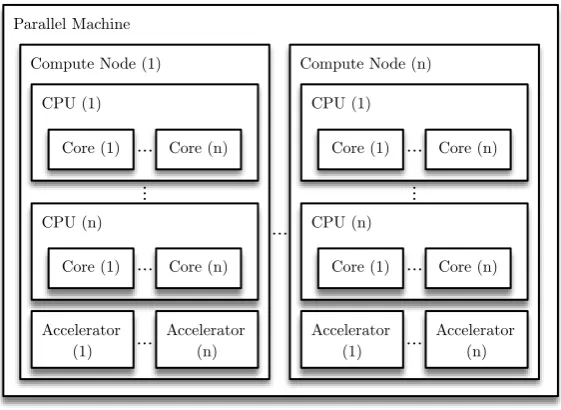
Figure 2.1: An abstract representation of a parallel machine configuration
will be exploited in order to achieve maximum benefit [144]. Opportunities for
parallelism are exposed throughout all the hardware components of a parallel
machine (see Figure 2.1) from the bit-level in a single Central Processing Unit
(CPU) core, to the data-level where datasets are partitioned across groups of
compute nodes.
2.1.1
Core
Bit-level parallelism allows the CPU core (see Figure 2.1) to push more bits
around per clock cycle, typically by increasing the size of the registers.
Histori-cally, this increase in bits has moved from 4 up to 64 bits [38]. As an example
of how this change can improve performance consider a CPU core which
oper-ates on 32-bit registers and needs to perform an operation on 64-bit numbers –
it must perform the calculation in two parts, thereby taking two clock cycles.
However, a CPU capable of operating on 64-bit registers is able to complete the
same calculation in a single clock cycle.
At a slightly higher level of parallelism in the CPU core, there is Instruction
which allow data independent instructions to progress through the CPU core in
parallel. ILP is achieved through a variety of mechanisms in order to maximise
the use of the CPU core under a variety of workloads. The first ILP mechanism
to mention is pipelining; this involves separating the handling of instructions
into distinct stages, with separate hardware for each [148]. The most basic
pipeline has separate fetch, decode and execute units. This decomposition allows
the decoding of an instruction to occur in parallel with the fetch of the next
instruction.
Further parallelisation can occur at each of the stages in the pipeline by
duplicating and providing specialised execution units – this is known as a
su-perscalar architecture [148]. An example of this is the Intel Haswell CPU core
which, has two execution units capable of performing an Fused Multiply-Add
(FMA) instruction. In order to maximise the use of these additional execution
units, techniques are employed such as dynamic [87] and speculative
execu-tion [148]. The combinaexecu-tion of these techniques allows the CPU core to begin
two FMA operations simultaneously [103] and would benefit the computation
defined by Equation 2.1 as the partial resultsaandehave no data dependencies
and can therefore be performed simultaneously.
a=b∗c+d;
e=f∗g+h;
r=a+e;
(2.1)
In the case of the decoder, not only can they fetch and decode multiple
instructions simultaneously, they can also employ macro-fusion to exploit
paral-lelism at the micro-operation level (the sub-operations which form instructions).
This is achieved by fusing the micro-operations from different instructions into
a single, but more complex micro-operation [62]. Given a decoding unit which
of macro-fusion can increase the number of decodes from four to five per cycle,
thereby reducing the pressure on this unit.
Another opportunity for parallelism in the CPU core is provided by the
pres-ence of vector units. These enable data level parallelism by handling dispatched
vector instructions that apply the same operation to several data items in
paral-lel [38]. One such example of a vector instruction isvaddpd, which adds two sets
of 64-bit doubles [90]. The number of operations these instructions perform in
parallel depends on the width of the registers they use. While in the past, vector
lengths were large [145], the trend at the time of writing this thesis is for CPU
cores to have vector lengths of four or eight 64-bit doubles [89]. In addition to
enabling arithmetic in parallel, vector instructions exist to push data, such as
thevmovapdinstruction, which moves packed and aligned 64-bit floating point
values [90].
Parallelism is not limited to arithmetic operations; there are also
oppor-tunities in the CPU core for Memory Level Parallelism (MLP) [148]. This
mechanism allows multiple memory operations to occur simultaneously or
over-lap. CPU cores with MLP often exploit this by prefetching data elements from
slower to faster access memory before the data is required by an instruction,
in the hope it will decrease cache misses and increase achieved memory
band-width. MLP is important as it helps maximize the use of the available memory
bandwidth, which can be a bottleneck for performance [165, 167]. Essentially,
as a higher percentage of an application’s arithmetic is parallelised, the more
memory bandwidth is required to feed the calculations until this becomes the
bottleneck.
2.1.2
CPU
At the next level of the hardware hierarchy (Figure 2.1) there is Symmetric
Multiprocessing (SMP), a configuration consisting of multiple CPU cores. This
configuration is capable of exposing thread and task level parallelism [131] by
detailed in Section 2.1.1. At the most basic level, a CPU core offers Simultaneous
Multithreading (SMT) (multiple threads of execution per core) to increase the
use of a superscalar architecture, by increasing the sources of instructions [131]
e.g. Intel Hyperthreading [153]. At the other end of the spectrum there are
SMP systems with multiple CPUs, each with multiple cores, which can in turn
support multiple threads of execution. At this point, it becomes important to
consider the arrangement of these components as this impacts the efficiency of
communicating data between them.
There are two classes of SMP system: Non-uniform Memory Access (NUMA)
and Uniform Memory Access (UMA). In an UMA system, CPU cores can access
their local shared memory at the same latency and bandwidth as the shared
memory located on other cores. In a NUMA system CPU cores can access
their local memory faster than the local memory of other CPU cores [131].
The configuration shown in Figure 2.1 gives rise to two CPU NUMA regions:
communication between cores on the same CPU and between cores on different
CPUs. Due to the difference in communication time between NUMA regions,
locating data close to the CPU core which is operating on it can make a huge
difference to performance [15, 168]. Typically parallel machines use NUMA due
to its favourable memory size scaling over UMA [131].
2.1.3
Accelerators
The inclusion of accelerator cards in parallel machines has become increasingly
popular in recent years and in fact two of current top three in the TOP500 list
(Tianhe-2 and Titan) feature them (using Intel Xeon Phis and Nvidia Teslas
respectively) [118]. This increase in popularity is due to the potential of
ac-celerator cards to deliver power efficient computations [133], in an attempt to
overcome one of the challenges in HPC as outlined by the Department of Energy
(DoE) [76].
The basic concept behind the Graphics Processing Unit (GPU) and the
amount of fine-grained parallelism to computing applications. This is in
con-trast to a CPU which contains fewer general purpose cores. In the case of the
Intel Xeon Phi (Knights Corner) it has 61 cores, whereas an equivalent CPU,
the Intel Xeon E5-2670 has 8 [75]. The trade-off is that the cores on the Intel
Xeon Phi are simpler (e.g. they use in-order execution) and are lower clocked
compared to their CPU counterparts. The strength of the simpler cores is that
they have a larger degree of SMT, longer vector registers, they are greater in
number and have increased memory bandwidth [75]. The potential for
individ-ual applications to benefit from this configuration is usindivid-ually non-obvious and
must be assessed by way of an in-depth performance study on a per accelerator
basis.
2.1.4
Compute Node
At the final level of the hardware hierarchy (see Figure 2.1) there are
multi-ple connected physical machines, each containing multimulti-ple CPUs thus further
scaling the capacity for thread and task level parallelism. This configuration is
known as a distributed memory system [131].
As with the CPU level of the hierarchy, it is important to consider the
ar-rangement of the components (compute nodes) and additionally the medium by
which they are connected as this impacts performance [131]. Another
consider-ation is the method by which a problem is partitioned between the distributed
memory as this influences factors such as idle time due to load imbalance and
time spent communicating data.
2.2
Parallel Data Decompositions
Many HPC applications simulate physical processes such as heat transfer and
fluid flow; examples of such applications include LAMMPS [137], a molecular
dynamics simulation, and OpenFOAM [92], a fluid dynamics simulation.
3-D Decomposition
Full 3x3 Structured Mesh Domain
1-D Decomposition 2-D Decomposition
Dataset Element Communication Bidirectional Decomposition Process
i
[image:37.595.135.462.134.382.2]j k
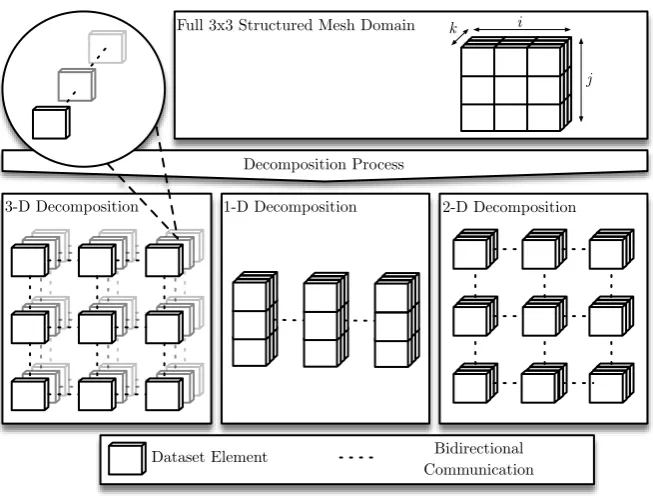
Figure 2.2: 1-, 2- and 3-D structured mesh decompositions
mesh which must be partitioned between compute nodes prior to execution on a
distributed memory machine (Section 2.1.4). The process used for partitioning
can impact performance because it influences both the ratio of computation to
communication and the quality of the load balancing. Furthermore, the
selec-tion of partiselec-tioning process depends on whether it is to be used on a structured
or unstructured mesh.
2.2.1
Structured Mesh
A structured mesh is a regular arrangement of points with a topology that is
apparent from their position in space. An example demonstrating this is given in
the top pane of Figure 2.2, where the quantities of the simulation are represented
as averages over each sub-cuboid.
Decomposing a structured mesh is achieved using either a 1-, 2- or 3-D
de-composition, as visualised by the lower set of three panes in Figure 2.2. The
num-u
j k
b
a
f
v i
Mesh Node
Edge Partition Boundary
Figure 2.3: Partitioning an unstructured mesh
ber of threads available. Each of these decompositions achieves a perfect load
balance, although in practice this only occurs when the number of processors
is an exact divider of one of the domains sides (i, j or k), a square number
or a cubic number, in the case of 1-, 2- and 3-D decompositions respectively.
However, the ratio of communication to computation does change depending
on the chosen decomposition, with a 3-D decomposition theoretically being the
most favourable [105].
2.2.2
Unstructured Mesh
An unstructured mesh (see Figure 2.3) is a collection of nodes (e.g. j and u),
edges (e.g. betweenuandv) and faces (f), with the nodes being at an arbitrary
position in space. The flexibility of the unstructured mesh allows complex
ge-ometries to be represented and the simulation resolution can be increased (and
also the computation time) only in regions of importance by altering the density
of mesh points [114].
The neighbours of a node in an unstructured mesh are not implicitly defined,
using offsets to the array indices. This means that an explicit list of neighbours
must be maintained, so that when computation over nodes is performed (e.g. the
accumulation of fluxes) data can be read from the required locations. This has
implications for the spacial and temporal locality of accesses when gathering
unstructured mesh features from memory, as a mesh node’s neighbours can
appear at arbitrary strides either side of its memory location.
Unlike a structured mesh, which can often be divided using algebra, an
unstructured mesh must be load balanced between distributed memory
loca-tions using specialised algorithms which are the result of numerous bodies of
research [63, 97, 128, 152, 164]. These algorithms are necessary to partition
unstructured meshes because it is not immediately clear how the mesh should
be divided, due to the arbitrary position and the number of neighbours of its
nodes. For example in Figure 2.3, mesh nodesuandbare in partition zero and
mesh nodesv,aandiare in the first partition, with a total of two edges cut on
level zero. However, some other arbitrary line could be drawn to partition the
mesh nodes.
Ideally both the number of edges cut and the load imbalance between the
number of nodes in each partition should be minimised, as a high value of the
former means increased communication time, and an high value of the latter
results in increased processor idle time. Finding an optimal partition is
NP-Hard and therefore these algorithms serve to find approximations to the optimal
solution [20].
2.3
Parallel Programming Laws and Models
When running and developing HPC applications it is only natural to want to
quantify their performance (e.g. time to results, use of parallelism). This
sec-tion covers the most basic performance metrics and laws which govern their
2.3.1
Speedup
S(n) = Ra Rb
(2.2)
Speedup (S(n) in Equation 2.2) is the ratio of two performance values,Ra and
Rb, wherenis the variant between these values [131]. TypicallyRa andRb are
application runtimes from either, two different variants of the same application,
or the same variant run using different degrees of thread level parallelism. In
the latter case, n would be the number of threads Rb was executed with. As
an example, consider an application that can exploit thread level parallelism
which has had its runtime recorded using both a single thread and four threads.
Applying Equation 2.2 to these runtimes, with Ra being the single threaded
runtime andRb being the runtime when using four threads, will yield the value
S(4) which indicates how many times faster (or slower) the multi-threaded
ex-ecution was compared to the serial run. While this is a useful summary metric,
especially when comparing the effectiveness of different code optimisations (e.g.
with and without using vector units) care must be taken when reporting speedup
in the case where multiple code optimisations have been applied, as it becomes
unclear which optimisation the speedup came from.
2.3.2
Parallel Efficiency
Pe(n) =
S(n)
n (2.3)
Parallel efficiency (Pe(n) in Equation 2.3) codifies the extent to which an
ap-plication utilises opportunities for parallelism as opportunities are increased
(n) [131]. Equation 2.3 has speedup as one of its constituents. This captures
the performance change when using different degrees of thread level parallelism.
This speedup value is normalised by the degree of thread level parallelism used
as this is the speedup expected from an application which fully uses the available
0 21 23 25 27 29 211 213 215
0 21
23
25
27
29
Number of Processes
Sp
eedup
Both lawsfp = 1.0 Amdahl’s Lawfp = 0.99
Amdahl’s Lawfp= 0.95 Gustafson’s Lawfp= 0.5
[image:41.595.127.438.122.393.2]Gustafson’s Lawfp= 0.3
Figure 2.4: Amdahl’s Law and Gustafson’s Law for varying values of fp
applications, or quantify whether the cost of additional resources required to
make additional parallelism available to the application is worth the increase in
performance.
2.3.3
Amdahl’s Law
St(s) =
1 fs+fps
!
, St(s)≤
1 fs
(2.4)
While the metrics of speedup (S(n)) and parallel efficiency (Se(n)) capture
ob-served performance, neither attempt to bound performance, whereas Amdahl’s
law [6] (Equation 2.4) can provide an upper bound on speedup. It does this for
an entire application run (St) in terms of the fraction of parallel code (fp) and
serial code (fs), by pushing the speedup of the parallel region (s) to infinity. By
priming Equation 2.4 with various fractions (fpequal to 1.0, 0.99 and 0.95), the
that given an application where all of the code can be parallelised, the
maxi-mum achievable speedup is linear in the number of threads. For example, with
a fixed work load a single thread must perform all the work, but two threads can
perform half of all the work simultaneously; this is known as strong scaling. It
should be noted that this bound on speedup is not strictly true, as super linear
speedups can be observed in practice due to the degree of available parallelism
not being the only factor influencing application performance; typically super
linear speedups are observed as a result of the decreasing data associated with
each thread fitting into successively smaller (but faster) levels of cache.
Equa-tion 2.4 further indicates that for a given fracEqua-tion of parallel code, the runtime
will approach the runtime of the serial region as the degree of parallelism tends
to infinity. Even by having a serial region of 1% vastly impacts the overall
parallel efficiency of the application.
2.3.4
Gustafson’s Law
St(s) =fs+s(1−fs) (2.5)
Gustafson’s law [69] considers the bound on speedup for an entire application
(St) from a different perspective. Gustafson argued that in practice strong
scaling was not the norm, and that the problem size increased with increasing
degrees of parallelism (weak scaling); this behavior is codified in Equation 2.5
and plotted for varying proportions of parallel code in Figure 2.4. From this
figure it can be seen that even at much lower proportions of parallel code (fp
equal to 0.3 and 0.5), the predicted bound on speedup is much more optimistic
than the bound predicted by Amdahl’s law for considerably higher proportions
Requirements and Specification
Hardware Cycle Software Cycle
System Design
Tuning
Mid-life Upgrade Protoyping
Implementation
Installation and Acceptance
Requirements and Specification
Code Updates Implementation
Design
Optimisation Performance
Analysis Porting to System Codesign
[image:43.595.147.447.138.456.2]Feedback
Figure 2.5: Hardware and software life cycle (adapted from [11])
2.4
Performance Engineering
HPC applications are complex pieces of software which are often tens of
thou-sands of lines of code long, developed over several decades, and are run with
hundreds of thousands of degrees of parallelism. These codes are of high utility
and therefore it is important to continually assess and improve their
perfor-mance on current hardware through optimisation and code updates, and also
prepare for future hardware (see Figure 2.5).
The hardware upon which HPC applications are run is just as complex as
the applications themselves, so it is also important to continually assess the
is necessary to replace it (see Figure 2.5). At this time is essential to have a tool
box of methods which allow the comparison of candidate replacement hardware
at the lowest level of parallelism, to indicate how well a particular application
will perform on a new architecture and/or use finer grained parallelism, and can
validate the performance of an application on new hardware.
Performance engineering is a field which encompasses many mature
tech-niques (e.g. benchmarking, mini- and compact applications, profiling and
ana-lytical performance modelling) developed to support each stage of this complex
cycle of developing and maintaining HPC systems and applications.
2.4.1
Profiling and Instrumentation
Profiling an application is the act of extracting performance data from a
run-ning application. Examples of data which can be collected about an application
include: the time duration and frequency of code blocks (e.g. gprof [68]), cache
hits and number of floating point operations (e.g. Performance Application
Pro-gramming Interface (PAPI) [18]), power draw (e.g. RAPL [39]) and memory
usage (e.g. Valgrind massif [129]). These metrics can be used to identify targets
for optimisation and parallelisation. For example, a routine which uses memory
inefficiently may demonstrate a high memory watermark or a high cache miss
rate, and a routine which would benefit the most from parallelisation efforts
would dominate runtime.
There are two main classes of profiling: statistical and tracing. Statistical
profiling periodically samples performance values whereas tracing collects all
data relating to a particular value (e.g. gprof [68]). This means that while the
statistical profiler collects incomplete data, and may even overlook performance
values entirely, it has the potential to exhibit lower overhead when running
at scale than a tracer (e.g. Sun Studio [91]). In the case of determining the
frequency and duration of code regions, a statistical profiler will periodically
sample data at the position of execution and then compile these samples in to
regions.
Another consideration to take into account is the method of instrumentation
by which values are collected. There are three main approaches to
instrumen-tation (as mentioned by Chittimalli and Shah [33]), these are binary, byte code
and source code instrumentation. The use of byte code instrumentation is
im-mediately ignored, as it applies to code running in a virtual machine, which
does not apply to the codes in this thesis. Source code based instrumentation
requires the augmentation of an applications source code, which can happen
before (e.g. PAPI [18]) or during compilation (e.g. gprof [68]). Static binary
instrumentation (e.g. Dyninst [160]) augments the compiled binary, naturally
this technique does not require the code to be recompiled. Similarly, dynamic
binary instrumentation (Intel PIN [106] and Valgrind [129]) does not require a
recompilation but may introduce runtime overheads.
2.4.2
Benchmarks, Mini- and Compact-Applications
The comparison of hardware choice and software optimisation approaches is
an-other core part of performance engineering. To enable such comparisons a vast
number of benchmarks, mini- and compact applications have been developed.
Benchmarks are applications which exercise and subsequently quantify the
per-formance of a particular subsystem, or group of subsystems belonging to a
par-allel machine, under a defined workload. Benchmarks come in a variety of forms.
At the lowest level, benchmarks can exercise and measure the performance of a
single subsystem (e.g. main memory [115], cache [121] and inter-compute node
interconnect [88]) and at the highest level, there are benchmarks which
cap-ture and asses the performance of common computational patterns, for example
Single-Precision AX Plus Y (SAXPY) [45, 122], or even the behavior of a specific
parent application (mini- and compact-applications) [110, 134, 140, 156].
There are several benchmarks which facilitate comparison of computational
power between different machines or single CPUs, but the most famous has to be
LINPACK benchmark solves dense systems of linear equations and is therefore
Floating Point Operations per Second (FLOP/s) heavy. While this makes it an
excellent compute benchmark, doubts about its usefulness have been raised as it
is only representative of a single class of code. This has led to the development
of further benchmarks [46, 47, 109]. Other compute benchmarks include the
Livermore Loops [54] and the Thirteen Dwarfs [7].
Power is another metric by which to compare machines and individual CPUs,
and is becoming an increasingly important concern. The FIRESTARTER
bench-mark can be used extract “near-peak power consumption” from a particular
CPU [70]. However, in the case of a machine comparison, the amount of useful
work done needs to be taken into consideration, meaning FLOP-per-Watt [53]
is a better method of comparing two architectures in terms of power.
As with the CPU, several benchmarks exist for characterising the different
levels of a memory system. For measuring the peak memory bandwidth from
main memory, the STREAM benchmark can be used [115]. This delivers result
in MB/s for four common memory access patterns: copy, scale, add and triad.
A second benchmark exists, Cachebench, for measuring the memory bandwidth
from individual levels of cache to the CPU [121]. Both of these benchmarks
can be used to compare the memory bandwidth of several candidate machines
and can give an indication of how well a code which is bottlenecked by memory
bandwidth will perform (Section 2.1.1).
Benchmarks also exist to quantify the performance of shared and distributed
memory computations. At the shared memory level there is OpenMP for which
there is a benchmark to measure the overhead from using various operations
such as loop iteration scheduling and synchronisation [8, 21, 22, 58]. On the
distributed memory side, benchmarks such as Intel MPI Benchmark (IMB) [88]
and SKaMPI [142, 143] collect bandwidth and latency figures for various
mes-sage sizes. These Mesmes-sage Passing Interface (MPI) benchmarks can be used to
compare different MPI implementations (e.g. MPICH2, Intel MPI, OpenMPI)
A more recent trend has been to develop so called mini-applications, which
capture a subset of the key performance characteristics (e.g. memory access
pat-terns) from a class of applications or a parent code. Numerous mini-applications
have been developed, some of which have been released as part of projects such
as the Mantevo Project [77] and the UK App Consortium [158].
Mini-applications from these repositories and other standalone mini-Mini-applications have
been used in a variety of contexts: i) exploring the suitability of new
archi-tectures for molecular dynamics codes [134], ii) examining the scalability of a
neutron transport application [156], iii) to aid the design an development of a
domain specific active library [140] and, iv) exploring different programming
models [110].
2.4.3
Modelling Parallel Computation
The formation of Amdahl’s law in 1967 was a just a starting point for the
development of further abstract and concrete models governing and describing
the performance of both parallel hardware and applications. While Amdahl’s
law contains just a few parameters to represent both the software (fraction of
parallel code) and the hardware (number of processors), newer models have
potentially hundreds, characterising compute, communication behaviour and
synchronisation behaviour. The increase in parameters allows more complex
hardware and software behaviours, but brings with it a decrease in tractability.
However, performance models still provide a useful platform from which to
perform analyses.
Parallel Random Access Machine (PRAM)
In 1978, PRAM was proposed as one of the first models of parallel computing.
It was developed due to the need for a framework with which to develop parallel
algorithms while avoiding the nuances of real hardware [56]. This model has the
follow constituent parts: an unbounded set of processors P =p0, p1, ... which
instructions; an unbounded global memory and processor local memory, both
ca-pable of storing non-negative integers; a set of input registerI0, I1, ..., In; a
pro-gram counter; a per processor accumulator, also capable of storing non-negative
integers; and, a finite program A comprising the aforementioned instructions.
Computation then proceeds as follows:
1. The input is placed in the input registers: one bit per Ik.
2. All memory is cleared and the length of the program (A) is placed into
the accumulator ofP0.
3. Instructions are then executed simultaneously by eachp∈P.
4. The FORK instruction can be used to spawn computation on an idle
pro-cessor.
5. Execution stops when either aHALTinstruction is executed byP0or a write
instruction is executed on the same global memory location simultaneously
by multiple processors.
There are several deficiencies with PRAM, the first of which is the lack of
cost associated with communication. This prevents the model from being an
accurate representation for NUMA machines which have multiple
communica-tion layers (core-to-core, socket-to-socket and node-to-node). This lack of cost
associated with communication time additionally prevents the scaling behaviour
of an application from being modelled when run at large scale, where
commu-nication costs can dominate.
Bulk Synchronous Parallel (BSP) Computation Model
BSP was developed in 1990 by Leslie Valiant with the same underlying goal as
PRAM [150, 161], to provide a model which allows researchers to independently
develop parallel algorithms and hardware. BSP overcomes the primary flaw
with PRAM: there was no cost parameter for communication events, which
![Figure 1.1: Visualisation of top supercomputer performance over time (usesdata from [118, 145])](https://thumb-us.123doks.com/thumbv2/123dok_us/9489966.455016/23.595.128.436.123.385/figure-visualisation-supercomputer-performance-time-usesdata.webp)

![Figure 2.5: Hardware and software life cycle (adapted from [11])](https://thumb-us.123doks.com/thumbv2/123dok_us/9489966.455016/43.595.147.447.138.456/figure-hardware-software-life-cycle-adapted.webp)