ISSN: 1816-949X
© Medwell Journals, 2019
Efficient Solar Radiation Estimation Method based on a Curve Fitting Approach
Zahra’a Talib Almosawy, Mahmoud Shaker Nasr and Shamam Alwash
Department of Electrical Engineering, College of Engineering,
University of Babylon, Hillah, Iraq
Abstract: This study presents an accurate solar radiation estimation method based on the relationship between the solar radiation and the short circuit current of the PV panel. In order to avoid the interruption of the generated power of the PV panel during the solar estimation period an auxiliary PV panel fixed in the same alignment with other PV panels is used to estimate the solar radiation. The proposed method is implemented and tested using a 3W poly-crystalline PV panel PSP3 and a microcontroller (Arduino Uno). Test results verified the accuracy of the proposed method for several solar radiation cases.
Key words:Curve fitting, photovoltaic modeling, pyranometer, short circuit current, solar radiation, solar radiation estimation
INTRODUCTION
Recently, many countries have used the solar energy in the production of electricity due to the large benefits which can be obtained (Varshney et al., 2014). Two important factors that play a key role in determining the efficiency of the solar system are the temperature and the solar radiation. The temperature represents the negative factor which decreases the system efficiency whilst the positive factor is the solar radiation.
The Earth gets solar energy through solar radiation which is the most important element in solar systems. For Photovoltaic (PV) systems, it is very important to measure or estimate the solar radiation used to determine output system performance, efficiency and energy production for the system (Rahman et al., 2011). It is therefore, important to develop low-cost instruments that can be used to measure solar radiation in the photovoltaic system accurately.
The Solar Radiation Research Laboratory (SRRL) carried out the first solar radiation measurement in the National Renewable Energy Laboratory (NREL) in 1978 (Tan et al., 2013). The most popular device that has been used to measure the solar radiation is the pyrometer device. It is distinguished by its precision and high efficiency for measuring solar radiation. However, this device is very expensive because it needs additional equipment which must be available for measuring and recording the readings of solar radiation. Moreover, the installation and maintenance costs of this device are also very high.
In order to avoid the use of pyranometer, some researches have been developed to estimate the value of solar radiation. Tan et al. (2013) presented a solar
radiation estimation method which is based on the mathematical model of the PV panel. In this method, the short circuit current and the open circuit voltage measured at the terminal of the PV panel is used to estimate the values of the PV equivalent circuit parameter. The equivalent circuit parameters and the short circuit current measured at the operation time are then used to estimate the solar radiation. However, this method utilizes an approximate mathematical model of PV module which affects the estimation accuracy. In addition, the service power continuity of the load should be interrupted when the solar estimation is required.
Husain et al. (2011) utilized the relationship between the measured open circuit voltage of the PV module and the value of solar radiation to develop a mathematical model. The developed model is then used to estimate the solar radiation. However, the open circuit voltage of the PV module is inversely related to the temperature (Loper et al., 2012) which is not considered in the developed model. Therefore, this model may not accurate enough to estimate the solar radiation.
Another method is developed to measure the solar radiation using a smartphone sensor. However, this method cannot be used for applications that require good accuracy (Tan et al., 2013) as well as the interface with complex hardware devices which is the case of PV system control circuit.
In this study, an accurate solar radiation estimation method based on the relationship between the solar radiation and the short circuit current of the PV panel is presented. In the proposed method, an auxiliary PV panel fixed in the same alignment with other PV panels is used to estimate the solar radiation. Thus, the interruption of the PV generated power during the estimation period is avoided.
Lo
ad
Rs I I
Isc
VD
Di
o
d
e
V
T and
G
70
60
50
60
40
30
20
10
0
0 20 40 60 80 100 120 140 160 180 200 Voltage (V)
C
urr
ent
(
A
) 75, 50, 20°C
70
60
50
60
40
30
20
10
0
0 20 40 60 80 100 120 140 160 180 200 Voltage (V)
C
ur
re
n
t (
A
)
1000 W/m2
800 W/m2
600 W/m2
MATERIALS AND METHODS
Photovoltaic module model: A typical PV cell can be represented by the parallel diode with an ideal DC current source that proportional to the solar radiation of sun (Khabou et al., 2018). The equivalent electrical circuit of the PV module is presented in Fig. 1.
In this circuit, Rs is a very small series resistance which represents the contact resistance while Rsh is a very
large shunt resistance which represents the resistance of the high-conductivity path across the junction of the solar cell (Khabou et al., 2018). By neglecting the current in Rsh, the expression of the current supplied by the
photovoltaic module is Rahman et al. (2012):
(1)
.n.k.T D
PV sc o o
V I I -I e- +I
q
Where:
IPV: Photovoltaic module current (A)
Isc : Short circuit current of PV cell (A) Io : Diode reverse saturation current (A)
VD: Voltage through a diode (V)
q : Electron charge (1.6×10⁻¹⁹C)
K : Boltzmann constant (1.381×10⁻²³JK-1))
T : Junction temperature (K)
n : Ideality factor of the diode (1<n<2)
In order to illustrate the effect of the temperature and the solar radiation on the open circuit Voltage (Voc) and
the short circuit current (Isc) of the PV module, the
current-voltage characteristic curves for a PV module at different temperature values and solar radiation are presented in Fig. 2 and 3, respectively. It can be seen from Fig. 2 that the temperature has significant effect on the value of the open circuit voltage (Prakash et al., 2014). The open circuit voltage decreases with increasing the temperature. On the other hand, there is no significant change in the short circuit current value when the temperature changes (Prakash et al., 2014; Diab et al., 2012).
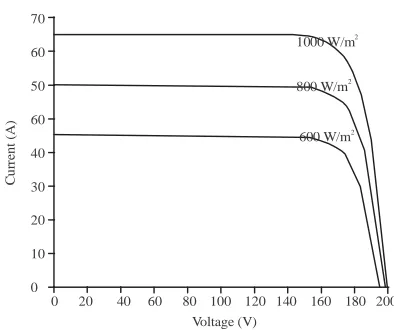
On the contrary, Fig. 3 shows that the change in solar radiation directly affects the short circuit current while there is no significant impact on the open circuit voltage (Bharath et al., 2016; Selmi et al., 2014). Accordingly, the approximate short circuit current at any solar radiation (G) can be given as Tan et al. (2013) and Rahman et al. (2012):
(2)
sc sc r
r
G I (G) I (G )
G
Where:
Isc(Gr) : Short circuit current at the solar radiation
(1000 W/m2)
Gr : Solar radiation (1000 W/m 2)
[image:2.612.326.525.124.347.2]G : Solar radiation (W/m2)
[image:2.612.323.520.388.553.2]Fig. 1: The solar cell equivalent circuit
Fig. 2: Current-voltage characteristic curve for a PV module at different temperature values
Fig. 3: Current-voltage characteristic curve for a PV module at different solar radiation levels It is evident from the previous discussions that the short circuit current represents an excellent factor which can be utilized to estimate the solar radiation required for monitoring and controlling of the PV system.
PV source
Dc-Dc converter
Isc
Radiation estimation
MPPT control algorithm
Lo
a
d
600
500
400
300
200
100
0
0 0.1 0.2 0.3 0.4 Short circuit current (A)
S
o
la
r r
a
d
iat
io
n
(
W
/m
)
[image:3.612.82.287.85.210.2]2
Fig. 4: Practical connection between the Arduino Uno and computer
required to formulate the proposed model, the solar radiation and the short circuit current of the PV panel are measured experimentally at different time periods. The measured data is then sent to MATLAB environment to determine the proposed model using the curve fitting method.
In this research, the relationship between the solar radiation and the short circuit current is formulated as a first-order-polynomial function that is given in Eq. 3:
(3)
1 sc 0
Ga I +a Where:
a0 and a1: Polynomial coefficients
Isc : Short circuit current of the PV panel (A)
G : Solar radiation (W/m2)
After determining the values of the polynomial coefficients a0 and a1 using the measured data, Eq. 3 can be used to estimate the solar radiation. Since, the short circuit current which is not affected by the temperature is utilised in the proposed method, it is more accurate than other methods which utilize the open circuit voltage.
In order to avoid the interruption of the service power during the estimation period of the solar radiation, a small size of the PV panel fixed in the same alignment with other panels is used in the proposed method to estimate the solar radiation.
For the practical purposes, Eq. 3 is implemented using a microcontroller (Arduino Uno) to estimate the solar radiation based on the short circuit current measured at the terminal of the PV panel. The estimated value can be sent to the control circuit of the PV system or to the computer for monitoring and recording purposes. Figure 4 shows the practical connection between the solar panel and the computer.
Due to the prices of the Arduino Uno and the utilized PV panel for estimating the solar radiation, the proposed method is considered cheaper than other methods. In addition, the proposed solar radiation estimator can be used in the algorithm of MPPT controller. Figure 5 shows
[image:3.612.319.522.98.214.2]Fig. 5: Block diagram for solar panel control
Fig. 6: Measured solar radiation
Fig. 7: Solar radiation and the short circuit current of the auxiliary PV panel
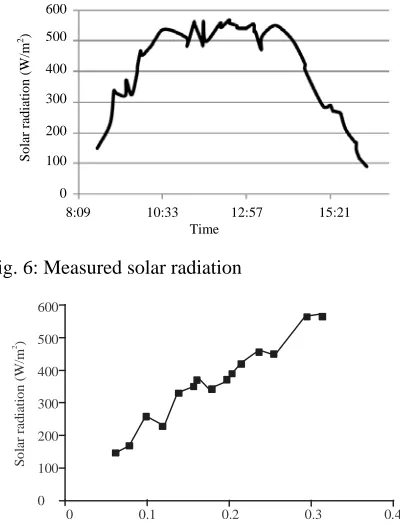
the block diagram for the control panel of the solar system. Figure 6 shows the recorded solar radiation that has been measured by a pyranometer device in. The solar radiation and the short circuit current of the auxiliary PV panel are presented in Fig. 7.
RESULTS AND DISCUSSION
The proposed method is tested and evaluated using a 3W poly-crystalline PV panel PSP3. This panel is fixed in the same alignment with other panels that are used to generate the electrical power as shown in Fig. 8. For several solar radiation cases, the short circuit current is measured at the terminal of the 3W PV panel. The solar
600
500
400
300
200
100
0
Solar ra
dia
tion (W/m
2)
[image:3.612.322.522.246.509.2] [image:3.612.330.520.250.360.2]Table 1: Short circuit current of PV panel at different solar radiation
levels (100-1000 W/m2
)
Solar radiation (W/m2) Short circuit current (A)
1000 0.56.0
900 0.5029
800 0.4471
700 0.3913
600 0.3355
500 0.2796
400 0.2238
300 0.1679
200 0.1119
[image:4.612.71.297.113.223.2]100 0.05599
Table 2: Polynomial equation constants
Polynomial equation constant Values
α0
-4×10G12
[image:4.612.313.540.114.293.2]α1 1788.9
Fig. 8: 3W Poly-crystalline PV panel
Fig. 9: Estimated solar radiation with respect to measure short circuit current of PV panel
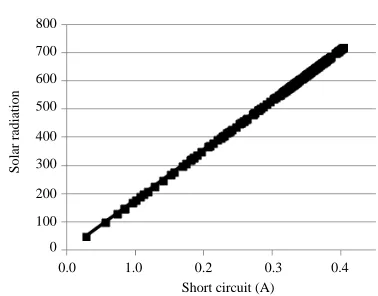
radiation is also measured using pyranometer. Some of these data are illustrated in Table 1. Using MATLAB curve fitting tool box, the first order polynomial equation that represents the relationship between the solar radiation and the short circuit current of the PV panel is determined (Fig. 9). The constants of the polynomial equation
Table 3: Comparison between the measured and estimated solar radiation
Measured solar Short circuit Estimation solar Error
radiation (W/m2
) current (A) radiation (W/m2
) (W/m2
)
130 0.0727 129.9994 0.0006
149.31 0.0835 149.3093 0.0007
392.63 0.2195 392.6281 0.0019
400 0.2236 399.9980 0.0020
430 0.2404 429.9979 0.0021
440 0.2460 439.9978 0.0022
569 0.3181 568.9972 0.0028
599 0.3348 598.9971 0.0029
620 0.3466 619.9970 0.0030
721 0.4030 720.9965 0.0035
733 0.4098 732.9964 0.0036
761 0.4254 760.9963 0.0037
830 0.4640 829.9959 0.0041
884 0.4942 883.9957 0.0043
897 0.5014 896.9956 0.00439
898 0.5020 897.9956 0.00440
900 0.5031 899.9956 0.00441
obtained from the curve fitting are presented in Table 2. In order to demonstrate the accuracy of the proposed method to estimate the solar radiation, a comparison between the measured and the estimated values of the solar radiation are presented in Table 3. It can be seen from these results that the error between the measured and estimated values of the solar radiation is very small. These results verify the accuracy of the proposed method.
CONCLUSION
Many scientific applications require knowledge of solar radiation value. One of these application is the photovoltaic power systems. Therefore, it is very important to provide a device for estimating the solar radiation with high accuracy and low cost. This study presented an accurate solar radiation estimation method based on the relationship between the solar radiation and the short circuit current of the PV panel using curve fitting approach. It is very cheap as compared with other methods. The proposed method was implemented and tested using an auxiliary PV panel (3W poly-crystalline PV panel PSP3 type). The results demonstrated the accuracy and the ability of the proposed method to estimate the solar radiation with high accuracy and low cost.
REFERENCES
Bharath, K.R. and P. Kanakasabapathy, 2016. Implementation of enhanced perturb and observe maximum power point tracking algorithm to overcome partial shading losses. Proceedings of the 2016 International Conference on Energy Efficient Technologies for Sustainability (ICEETS), April 7-8, 2016, IEEE, Nagercoil, India, ISBN:978-1-5090-1534-4, pp: 62-67.
800
700
600
500
400
300
200
100
0
So
lar rad
iati
on
0.0 1.0 0.2 0.3 0.4 Short circuit (A)
[image:4.612.74.292.239.439.2] [image:4.612.88.277.466.614.2]Diab, H., H. El-Helw and H. Talaat, 2012. Intelligent maximum power tracking and inverter hysteresis current control of grid-connected PV systems. Proceedings of the International Conference on Advances in Power Conversion and Energy Technologies, August 2-4, 2012, Mylavaram, Andhra Pradesh, India, pp: 1-5.
Husain, N.S., N.A. Zainal, B.S.M. Singh, N.M. Mohamed and N.M. Nor, 2011. Integrated PV based solar insolation measurement and performance monitoring system. Proceedings of the 2011 IEEE International Conference Colloquium on Humanities, Science and Engineering, December 5-6, 2011, IEEE, Penang, Malaysia, ISBN:978-1-4673-0021-6, pp: 710-715.
Khabou, H., M. Souissi and A. Aitouche, 2018. MPPT implementation on boost converter by using T-S fuzzy method. Math. Comput. Simul., Vol. 1, 10.1016/j.matcom.2018.05.010
Loper, P., D. Pysch, A. Richter, M. Hermle and S. Janz et al., 2012. Analysis of the temperature dependence of the open-circuit voltage. Energy Procedia, 27: 135-142.
Prakash, R., B. Meenakshipriya and R. Kumaravelan, 2014. Modeling and design of MPPT controller using stepped P&O algorithm in solar photovoltaic system. World Acad. Sci. Eng. Technol. Intl. J. Electr. Comput. Energetic Electron. Commun. Eng., 8: 609-615.
Rahman, R.A., S.I. Sulaiman, A.M. Omar, Z.M. Zain and S. Shaari, 2011. Performance analysis of 45.36 kWp grid-connected photovoltaic systems at Malaysia green technology corporation. Proceedings of the 2011 3rd International Symposium & Exhibition in Sustainable Energy & Environment (ISESEE), June 1-3, 2011, IEEE, Melaka, Malaysia, ISBN:978-1-4577-0340-9, pp: 1-3.
Rahman, S., N.S. Oni and Q.A.I. Masud, 2012. Design of a charge controller circuit with Maximum Power Point Tracker (MPPT) for Photovoltaic system. BSc Thesis, BRAC University, Dhaka, Bangladesh. Selmi, T., M. Abdul-Niby and A. Davis, 2014. Pand O
MPPT Implementation using MATLAB/Simulink. Proceedings of the 2014 9th International Conference on Ecological Vehicles and Renewable Energies (EVER), March 25-27, 2014, IEEE, Monte-Carlo, Monaco, ISBN:978-1-4799-3787-5, pp: 1-4. Tan, R.H., P.L. Tai and V.H. Mok, 2013. Solar irradiance
estimation based on photovoltaic module short circuit current measurement. Proceedings of the 2013 IEEE International Conference on Smart Instrumentation, Measurement and Applications (ICSIMA), November 25-27, 2013, IEEE, Kuala Lumpur, Malaysia, pp: 1-4.