warwick.ac.uk/lib-publications
Original citation:
Wright, Daniel B., Patterson, Joseph P., Pitto-Barry, Anaïs, Cotanda, Pepa, Chassenieux,
Christophe, Colombani, Olivier and O'Reilly, Rachel K.. (2015)
Tuning the aggregation
behavior of pH-responsive micelles by copolymerization.
Polymer Chemistry, 6 (14). pp.
2761-2768.
Permanent WRAP URL:
http://wrap.warwick.ac.uk/78259
Copyright and reuse:
The Warwick Research Archive Portal (WRAP) makes this work of researchers of the
University of Warwick available open access under the following conditions.
This article is made available under the Creative Commons Attribution 3.0 International
license (CC BY 3.0) and may be reused according to the conditions of the license. For more
details see:
http://creativecommons.org/licenses/by/3.0/
A note on versions:
The version presented in WRAP is the published version, or, version of record, and may be
cited as it appears here.
Chemistry
PAPER
Cite this:Polym. Chem., 2015,6, 2761
Received 22nd December 2014, Accepted 13th February 2015
DOI: 10.1039/c4py01782j
www.rsc.org/polymers
Tuning the aggregation behavior of pH-responsive
micelles by copolymerization
†
Daniel B. Wright,
aJoseph P. Patterson,
aAnaïs Pitto-Barry,
aPepa Cotanda,
aChristophe Chassenieux,*
bOlivier Colombani*
band Rachel K. O
’
Reilly*
aAmphiphilic diblock copolymers, poly(2-(diethylamino)ethyl methacrylate-co-2-(dimethylamino)ethyl methacrylate)-b-poly(2-(dimethylamino)ethyl methacrylate), P(DEAEMA-co-DMAEMA)-b-PDMAEMA with various amounts of DEAEMA have been synthesized by RAFT polymerization. Their micellization in water has been investigated by scattering measurements over a wide pH range. It appeared that the polymers self-assembled into pH sensitive star like micelles. For a given composition, when the pH is varied the extent of aggregation can be tuned reversibly by orders of magnitude. By varying the copolymer compo-sition in the hydrophobic block, the onset and extent of aggregation were shifted with respect to pH. This class of diblock copolymer offers the possibility to select the range of stimuli-responsiveness that is useful for a given application, which can rarely be achieved with conventional diblock copolymers consisting of homopolymeric blocks.
Introduction
In a selective solvent, above a critical aggregation concen-tration (CAC), amphiphilic block copolymers aggregate by the association of the solvophobic blocks into micellar cores sur-rounded by a corona made of the solvated solvophilic blocks.1,2Vast reports and reviews demonstrate both theoreti-cally and experimentally that the physical and chemical nature of the solvophobic and solvophilic blocks influence the aggre-gation behavior of the block copolymers.3–5 However, the extensive library of block copolymer micelles has focused on homopolymeric blocks, these homopolymeric blocks severely restrict self-assembly behavior as it is intrinsically limited to the associative block. Although these homopolymeric diblocks are used successfully for a range of applications, for each new application a new polymer has to be synthesized.
A method to overcome this is to use a copolymer for the associative block; as such, the associative block properties can be tailored dependent on the copolymer composition. It is well established in the literature that to tune the behavior of
stimuli responsive polymers an option is to copolymerize stimuli responsive units with non-responsive or differently responsive ones. For example, it was exhibited that statistical copolymers of pH sensitive and inert monomers exhibited
ionization behavior dependent on the non-responsive
monomer content.6Lutzet al.showed that lower critical solu-bility temperature (LCST) values could be selectively targeted by controlling the statistical copolymer composition.7,8 However, only a few reports exist where a stimuli responsive copolymer block forms the solvophobic block(s) of the polymer.9–16These novel copolymer diblocks resulted in block copolymers whose aggregation and dynamics of self-assembly could be controlled by pH allowing equilibrated structures to form.
Note that many amphiphilic homopolymeric block copoly-mers form out-of-equilibrium “frozen” structures, a con-sequence of either a glass transition temperature (Tg) above
experimental conditions, restricting core block mobility, or large solvophobicity of the core forming block, producing a large activation energy barrier for molecular exchange regard-less ofTg. As such the behavior of these“frozen”micelles also
depends to some extent on the way the polymer was dispersed and show little or an irreversible response to external stimuli.17–19Furthermore, by copolymerizing responsive units into the associative block the effective solvophobicity is reduced and these novel copolymer diblock polymers can over-come kinetic obstacles and are thermodynamically controlled. This offers improved behavior over conventional frozen homo-polymeric blocks as no preparation pathway dependence exists allowing the formation of reproducible equilibrium structures. †Electronic supplementary information (ESI) available: Reactivity ratio data,
relaxation distributions of polymer3, additional light scattering data of poly-mers1–4, SAXS profiles of polymer3and cryo-TEM images of polymers2,3and
4. See DOI: 10.1039/c4py01782j
a
University of Warwick, Department of Chemistry, Gibbet Hill Road, Coventry CV4 7AL, UK. E-mail: [email protected]
bLUNAM Université, Université du Maine, IMMM UMR CNRS 6283, Département
PCI, Avenue Olivier Messiaen, 72085 Le Mans Cedex 09, France.
E-mail: [email protected], [email protected]
Open Access Article. Published on 25 February 2015. Downloaded on 04/04/2016 15:14:16.
This article is licensed under a
Creative Commons Attribution 3.0 Unported Licence.
View Article Online
These copolymer associative blocks have vast improvements over conventional homopolymeric blocks as a range of respon-sive behavior can be achieved with subtle changes to the com-position. Moreover, the ability to select the responsive behavior opens up the scope of applications for a single block copolymer system in comparison to synthesizing new block copolymers for each application as known for homopolymeric block copolymers.
PDEAEMA, poly(diethylaminoethyl)methacrylate diblock copolymers are used widely in the literature as pH-responsive diblock copolymers in aqueous media, as a consequence of the increase in hydrophobicity upon deprotonation.20–22Gast and co-workers have studied poly(dimethylaminoethyl)meth-acrylate-block-poly(diethylaminoethyl)methacrylate, PDMAEMA-b-PDEAEMA, polymers in depth and shown that these poly-mers form spherical micelles in aqueous solution depending on the degree of ionization of the polymer.23,24On the other hand, P(DMAEMA) diblock copolymers also show a pH response, but in this case these polymers are permanently hydrophilic and only show a decrease in hydrophilicity upon deprotonation.6,11,25,26Therefore, introducing solvophilic units into the solvophobic block, a P(DEAEMA-co-DMAEMA)-b -PDMAEMA diblock copolymer with a moderately responsive PDEAEMA containing block was targeted. Accordingly, the pH region where the micelles exist can be shifted with respect to the relative copolymer composition of the associative block. Furthermore, the extent of aggregation can be tuned over larger orders of magnitude by slight variations in stimulus, owing to the ultra pH sensitivity of the assemblies. The objec-tive of this work was to both tune the pH region and extent of aggregation for responsive copolymer diblocks into highly sensitive pH responsive micelles using a copolymerization approach. We propose that such a versatile approach increases the scope of the application and understanding of the solution behavior of responsive polymeric micelles.
Experimental
Materials
Monomers were filtered through a plug of silica prior to use and stored at 4 °C. AIBN (2,2′-azo-bis(isobutyronitrile)) was recrystallized from methanol and stored in the dark at 4 °C. All other materials were used as received from Aldrich, Fluka, and Acros. HCl (1 M) and NaOH (1 M) were calibrated and standar-dized using tris(hydroxymethyl)-aminomethane and potass-ium hydrogen phthalate respectively.
General procedure for copolymerization of DMAEMA with DEAEMA
A solution of 40 equivalents of a combination of the two monomers (DMAEMA =x, DEAEMA = 40-x), 0.2 equivalents of AIBN and 1 equivalent of 2-cyano-2-propyl dithiobenzoate (CPDB) in 1,4-dioxane (1 : 1 volume compared to monomer) was added to a dry ampoule containing a stirrer bar. The solu-tion was degassed using at least 3 freeze–pump–thaw cycles,
back filled with nitrogen, sealed and placed in a pre-heated oil bath at 70 °C. After 7 hours the polymerization was quenched by liquid nitrogen, dioxane removedin vacuoand the resultant polymer diluted with H2O. The solution was transferred to a
dialysis membrane tube with the appropriate molecular weight cut-off (MWCO 3.5 kDa) and dialyzed against 18.2 MΩ cm water (1.5 L) with 3 water changes. Lyophilization resulted in a pink copolymer which is further extended in the next synthesis step.1H NMR (400 MHz, CDCl3):δ( ppm) 7.85 (d,J= 8.1 Hz,
1H Ar end group), 7.55 (t,J= 7.4 Hz, 2H end group), 7.41 (t,J= 8.1 Hz, 2H, end group), 4.20 (br t, 2H, OCH2CH2N), 2.50 (br s,
2H, OCH2CH2N), 2.30 (br t, 4H, OCH2CH2N(CH2)2(CH3)2), 2.10
(br s, 6H, OCH2CH2N(CH3)2), 1.94 (s, 6H, end group), 1.10
(br t, 6H, OCH2CH2N(CH2)2(CH3)2), 1.00–2.00 (br m, backbone)
(See Table 1 for molecular weight data).
General procedure for chain extension of the copolymers with DMAEMA
Macro chain transfer agent (Macro-CTA) (1.0 eq.), AIBN (0.2 eq.) and DMAEMA (40 eq.) were dissolved in DMF (1 : 1 volume com-pared to the monomer) and were added to a dry ampoule con-taining a stirrer bar. The solution was degassed using at least 3 freeze–pump–thaw cycles, back filled with nitrogen, sealed and placed in a pre-heated oil bath at 70 °C. After 7 hours the polymerization was quenched by liquid nitrogen, DMF was removedin vacuo and the resultant polymer diluted with H2O
and transferred to a dialysis membrane tube with the appropriate molecular weight cut off(MWCO 6–8 kDa) and dia-lyzed against 18.2 MΩcm water (1.5 L) with 3 water changes. Lyophilization resulted in a pink polymer.1H NMR (400 MHz,
CDCl3):δ(ppm) 7.85 (d,J= 8.1 Hz, 1H end group), 7.55 (t,J=
7.4 Hz, 2H end group), 7.41 (t, J = 8.1 Hz, 2H, end group), 4.20 (br t, 2H, OCH2CH2N), 2.50 (br s, 2H, OCH2CH2N),
2.30 (br t, 4H, OCH2CH2N(CH2)2(CH3)2), 2.10 (br s, 6H,
OCH2CH2N(CH3)2), 1.94 (s, 6H, end group), 1.10 (br t, 6H,
OCH2CH2N(CH2)2(CH3)2), 1.00–2.00 (br m, backbone) (see
Table 1 for molecular weight data).
Reactivity ratios of DMAEMA and DEAEMA
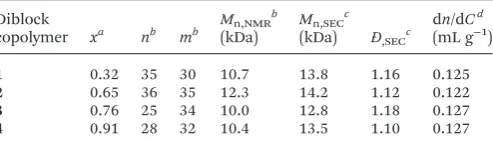
[image:3.595.306.553.64.135.2]DMAEMA and DEAEMA at different molar ratios, CPDB and AIBN were dissolved in 1,4-dioxane. The ratio of [monomers] : [CTA] : [AIBN] was 40 : 1 : 0.2, the solution was degassed using at least 3 freeze–pump–thaw cycles, back-filled with nitrogen, Table 1 Characteristics of the diblock copolymers
Diblock
copolymer xa nb mb Mn,NMR b
(kDa)
Mn,SECc (kDa) Đ,SECc
dn/dCd
(mL g−1)
1 0.32 35 30 10.7 13.8 1.16 0.125
2 0.65 36 35 12.3 14.2 1.12 0.122
3 0.76 25 34 10.0 12.8 1.18 0.127
4 0.91 28 32 10.4 13.5 1.10 0.127
aDetermined by1H NMR spectroscopy using the signals at 4.20 ppm
and 2.10 ppm. bDetermined by end-group analysis from 1H NMR spectroscopy.cFrom SEC based on poly(methyl methacrylate) standards. dBy differential refractometry.
Paper Polymer Chemistry
Open Access Article. Published on 25 February 2015. Downloaded on 04/04/2016 15:14:16.
This article is licensed under a
Creative Commons Attribution 3.0 Unported Licence.
sealed and placed in a pre-heated oil bath at 70 °C. The conversion was kept below 10% and the reaction was quenched by liquid nitrogen. Aliquots were taken and charac-terized by1H NMR spectroscopy in CDCl3.
1H nuclear magnetic resonance (NMR) spectroscopy
1H NMR spectra were recorded on a Bruker DPX-400
spectro-meter in CDCl3. Chemical shifts are given in ppm downfield
from TMS.
Size exclusion chromatography
Size exclusion chromatography (SEC) measurements were per-formed with HPLC grade solvents (Fisher), dimethylform-amide (DMF) with 1.06 g L−1of LiCl at 40 °C as an eluent at a flow rate of 1 mL min−1, on a set of two PLgel 5μm Mixed-D columns, and one guard column. The molecular weights of the synthesized polymers were calculated relative to poly (methyl methacrylate) (PMMA) standards from refractive index traces.
Potentiometric titration
Potentiometric titration was performed at room temperature with an automatic titrator (Mettler Toledo G20) controlled by LabX software. 40 mL of solution (approximately 2.3 × 10⁻⁴M) was used for each potentiometric titration experiment. The polymers were first dissolved atα = 1 with 1.1 excess of 1 M HCl and then back-titrated with 0.1 M NaOH. We defineαas the degree of ionization following eqn (1),
α¼ ½NR2HþCl
½NR2total ð
1Þ
where complete protonation of the amine units corresponds to α= 1 and complete deprotonation of amine units toα= 0.
The addition of NaOH 0.1 M titrant was added at volume increments of 5–50μL and spaced with 180 s intervals. From the raw titration data the total amount of titratable amine units was calculated.27Therefore, the change of pH could be
plotted as a function of the degree of ionization,α.
Refractive index increment
The specific refractive index increment (dn/dC) of the polymers were measured on a refractometer (BischoffRI detector) oper-ating at a wavelength of 632 nm.
Sample preparation
Two methods for the preparation of the solutions were used in the following. Method 1 consisted of diluting polymer stock solutions that were prepared at 20 g L−1 by dispersing the polymer in 18.2 MΩ CM water containing the appropriate amount of HCl to reachα= 1. After one night of stirringαwas lowered with the required amount of 1 M NaOH and the solu-tions were stirred again overnight, after which time the NaCl concentration was adjusted to 0.1 M by the addition of 4 M NaCl. The solutions were further stirred overnight before use. Samples at lower concentrations were subsequently diluted
with 0.1 M NaCl to reach the desired concentrations (10 g L−1– 0.5 g L−1).
For reversibility tests method 2 was used. Method 2 con-sisted of making a polymer solution atα= 1 as for method 1 at a concentration of 2.5 g L−1. Subsequently this solution was split in two. One half of the solution was brought to lowerα values by the addition of 1 M NaOH (this will be referred to as Pathway A). The second half was first brought toα= 0 from the addition of 1 M NaOH, knowing the chemical structure of the polymers and considering that all units are ionizable as veri-fied by potentiometric titration. Thenαvalues were raised by the addition of 1 M HCl (referred to as Pathway B). Each change inαwas spaced by at least one night of stirring.
Laser light scattering
Measurements were performed at angles of observation ranging from 20° up to 150° with an ALV CGS3 setup operating atλ0= 632 nm and at 20 ± 1 °C. Data were collected in
dupli-cate with 240 s run times. Calibration was achieved with fil-tered toluene and the background was measured with filfil-tered solvent (NaCl 0.1 M).
Dynamic light scattering (DLS)
The intensity autocorrelation functions g2(t) obtained from
dynamic light scattering were related tog1(t) (the normalized
electric field autocorrelation functions) via the so-called Siegert relation. Theng1(t) was analyzed in terms of a
continu-ous distribution of relaxation times (eqn (2)) using the REPES routine28without assuming a specific mathematical shape for the distribution of the relaxation times (A(τ)).
g1ðtÞ ¼
ð1
0
Að Þτ expðt=τÞdτ ð2Þ
The apparent diffusion coefficient D was calculated from (eqn (3)) given that the average relaxation rates Γof the scat-terers wereq2dependent, whereqis the scattering vector given byq= (4πn/λ0)sin(θ/2) withθthe angle of observation andn=
1.333 the refractive index of the solvent (water).
D¼Γ=q2 ð3Þ
Its concentration dependence is given byD = D0(1 + kDC)
where kD is the dynamic second virial coefficient andD0 the
diffusion coefficient used for computing the hydrodynamic radius (Rh) of the scatterers according to the Stokes–Einstein
equation (eqn (4))
D0¼
kT
6πηRh ð
4Þ
withηthe solvent viscosity,kthe Boltzmann’s constant andT the absolute temperature. Values ofRhgiven in the following
are then obtained after extrapolation to zero concentration.
Static light scattering (SLS)
The Rayleigh ratio of the solutions have been measured using toluene as a reference according to:Rθ= (Isolution(θ)−Isolvent(θ))/
Open Access Article. Published on 25 February 2015. Downloaded on 04/04/2016 15:14:16.
This article is licensed under a
Itoluene(θ)Rtol where Ii represents the intensity scattered by
species i and Rtol is the Rayleigh ratio of the reference. In
dilute solutions ifRgq< 1 whereRgis the radius of gyration,
theqand concentration dependence ofRθis given by (eqn (5)).
KC Rθ ¼
1 Mw þ
2A2C
1þ q
2R g2
3
ð5Þ
where A2 is the second virial coefficient and Mw the weight
average molecular weight. K is an optical constant given by (eqn (6)):
K¼ 4π
2n o2
λ4N A
dn dC
2
ð6Þ
where no = 1.496 is the refractive index of the reference
liquid (toluene), dn/dC is the specific refractive index incre-ment determined by differential refractometry (see Table 1) andNAis Avogadro’s number. Values ofMware then obtained
after extrapolation to zero concentration and zero angle and used to derive the aggregation number of the micellar aggre-gates Nagg = Mw/Mw,unimers. For spherical morphologies, it is
possible to deduce the core radius,Rc, from the aggregation
number, using eqn (7) assuming the core block is dehydrated and the density matches that of the bulk value,ρ.29
4ρRc3
3 ¼Nagg
Mw Hydrophobic block
NA ð
7Þ
When in some cases two modes of relaxation were observed by DLS measurements, Rθ was described as the sum of two
contributions according to (eqn (8)).
Rθ¼Rθfþ Rθs ð8Þ
where f and s stand respectively for fast and slow and using (eqn (9)):
Rθfð Þ ¼q
Afð Þq
Afð Þ þq Asð Þq
ð ÞRθ ð9Þ
whereAfandAsare the relative amplitudes of the fast and slow
modes obtained by DLS. The slow mode of relaxation when observed can be attributed to spurious aggregates with a negli-gible weight fraction but larger scattering intensity.30–32
Small angle X-ray scattering (SAXS)
Measurements were performed at the Australian Synchrotron facility at a photon energy of 11 keV. The samples in solutions of 0.1 M NaCl were collected at a sample to detector distance of 3.252 m to give aqrange of 0.004 to 0.2 Å−1. The scattering from a blank (aqueous solution of NaCl 0.1 M) was measured in the same location as the sample collection and was sub-tracted for each measurement. Data were normalized for total transmitted flux using a quantitative beamstop detector and absolute scaled using water as an absolute intensity standard. The two-dimensional isotropic SAXS images were converted into one-dimensional SAXS scattered intensity profiles (I(q) versus q) by circular averaging. The functions used for the fitting from NCNR package33were“Guinier-Porod”,34,35“Core–
Shell”35and“Debye”.36Scattering length densities (SLD) were calculated using the “Scattering Length Density Calculator”37 provided by the NIST Center for Neutron Research.
Cryogenic transmission electron microscopy samples (cryo-TEM)
3.5μL of sample was added to freshly glow discharged Quanti-foil R2/2 TEM grids. The grids were blotted with filter paper under high humidity to create thin films and rapidly plunged into liquid ethane. The grids were transferred to the micro-scope under liquid nitrogen and kept at <−175 °C while imaging.
Results and discussion
Synthesis and molecular characterization of the diblock copolymers
The polymer synthesis must be controlled to allow for similar block lengths, to allow us to understand the effect of compo-sition for the responsive block, whilst being tolerant to the responsive functionality. Therefore, reversible addition
frag-mentation chain transfer, RAFT, polymerization was
selected.6,38,39 Various macro-CTAs were synthesized by RAFT (Scheme 1) which consisted of copolymers of DMAEMA and DEAEMA with various amounts of each comonomer. To confirm the microstructure of the macro-CTAs, reactivity ratios were calculated using a non-linear least-squares fitting method, developed by van Herk.40 Both F1 (mol fraction of
DMAEMA in the copolymer) andf1(mol fraction of DMAEMA
in the monomer feed) values were used to determine the reac-tivity ratio of the monomers shown in Scheme 1. The gener-ated values forr1andr2were as follows; DMAEMA,r1= 1.140
and DEAEMA,r2= 0.824, leading tor1r2= 0.939 (ESI, Fig. S1†),41
which shows a near ideal copolymerization. The macro-CTA copolymers can therefore be considered as statistical copoly-mers. The macro-CTA copolymers were chain-extended with DMAEMA, Scheme 1, which gave diblock copolymers with a controlled incorporation of responsive monomer, known mole-cular weights and low dispersities as summarized in Table 1. Note that similar block lengths were targeted for all polymers.
Ionization behavior
For diblock copolyelectrolytes it has been concluded that ionization behavior is different to that of simple homopolye-lectrolytes.27 Moreover, for the system studied herein both monomers in both blocks can be ionized. Therefore, we explored how the microstructure of the diblock copolymers
Scheme 1 Copolymerization of DMAEMA and DEAEMA and chain extension with DMAEMAviaRAFT polymerization.
Paper Polymer Chemistry
Open Access Article. Published on 25 February 2015. Downloaded on 04/04/2016 15:14:16.
This article is licensed under a
Creative Commons Attribution 3.0 Unported Licence.
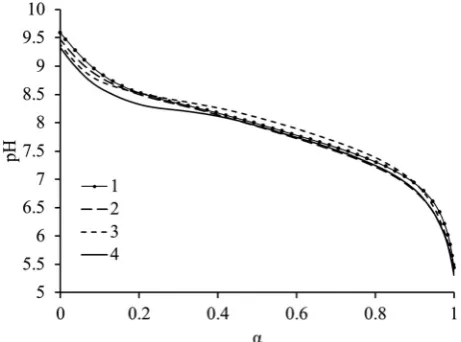
altered their ionization behavior via potentiometric titration experiments. Diblock copolymers were soluble in water with a 1.1 stoichiometric excess of 1 M HCl with respect to ionizable units. Subsequently these solutions were back titrated with 0.1 M NaOH to allow for the determination of the evolution of ionization degree, α, with respect to pH.27,42 Comparing the
ionization behavior of the diblock copolymers (from1to4) we observe the pH range in which ionization occurs (Fig. 1). It was observed that ionization of all the amine units can occur, regardless of their location in the polymer chain whether they are in a core or coronal forming block as ionization may be facilitated by the presence of NaCl salt which can screen charges along the polymer chain. Additionally we note that although the copolymer composition differs greatly between all polymers, ionization behavior does not. This indicates that the relationship of composition, that is the incorporation of DEAEMA, to ionization is relatively weak for this series of diblock copolymers despite being structurally different to homopolyelectrolytes.
Aqueous solution properties: pathway dependence on the self-assembly
Although a system may reorganize after a change in pH this does not mean the change is reversible or that the system is in equilibrium. As shown by both Bendejacq15 and Jacquin43 respectively with poly(styrene)-block-poly(acrylic acid) and poly-(n-butyl acrylate)-block-poly(acrylic acid) diblock copolymers, irreversible morphological changes of the aggregates can occur upon variation of the degree of ionization of the polyelectro-lyte. Therefore, to establish whether the pH-sensitivity is reversible or not is highly relevant in being able to assess the relationship of copolymer composition with aggregation be-havior. Indeed, non-reversible pH-sensitivity implies that the aggregates are out-of-equilibrium “frozen” structures whose characteristics strongly depend on the method used to dis-perse them in solution, which will lead to an array of different macro scale properties for one polymer system.4,19To assess if
irreversible reorganization had occurred, initial reversibility tests using LLS (see the Experimental section for details of sample preparation, method 2 (ESI, Fig. S2†)) were under-taken. Briefly, method 2 consists of reaching a given ionization degree either from a higher ( pathway A) or a lower ( pathway B) ionization degree.
As can be seen in Fig. 2,Naggvaries both upon increasing
or decreasingα(respectively through decreasing or increasing the pH of the solution) and varies with the copolymer compo-sition. Although pathways A and B do not lead exactly to the sameNagg(Fig. 2), especially at the lowestαvalues for polymer
4 (91% DEAEMA), the differences between the two pathways remain small. These results confirm that the reorganization of the system observed as a function of the ionization degree (respective of the pH) is reversible. Nevertheless, this behavior is highly interesting from an applicative point of view as the structures formed show no pathway dependence. Moreover, it is possible to alter the chemical structure to the target appli-cation such as tumour targeting44 and polymer delivery agents,45where decisive structure and response is needed, by copolymerizing two types of monomers to form a moderately hydrophobic core block. Furthermore, the reversible nature of these polymers suggests that the hydrophobic blocks exchange in a dynamic way between hydrophobic cores thus indicating the system is not frozen and is under thermodynamic control. Further analysis such as rheology,12time-resolved SANS3,17or fluorescence46,47 could be used to probe quantitatively the exchange dynamics.
Aqueous solution properties: influence of DEAEMA incorporation
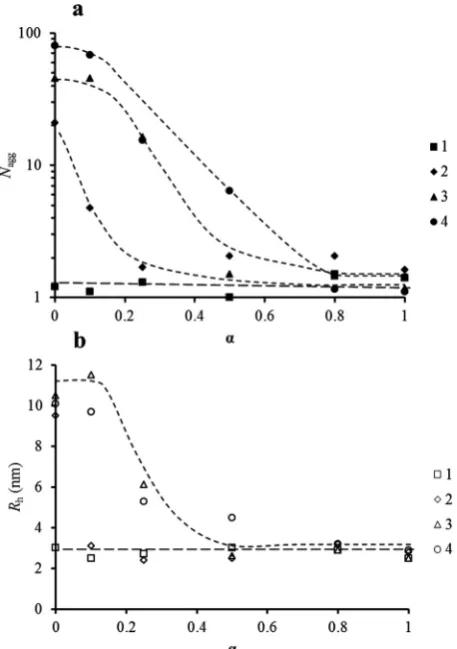
While this system is believed to be under thermodynamic control with no pathway dependence, in the following section all polymer solutions were prepared using method 1 as described in the Experimental section. For all polymers a second slow mode of relaxation is observed by DLS in some instances which can be attributed to spurious aggregates with a negligible weight fraction but larger scattering intensity.30–32 However, these only occur at high degrees of ionization which is when the scattering of the polymer aggregates is relatively low (ESI, Fig. S7†). Fig. 3a and b represent respectively the evol-Fig. 1 Evolution of ionization degreeα, with pH for the diblock
copoly-mers,1–4.
Fig. 2 Evolution of Nagg with increasing ( pathway B) or decreasing ( pathway A) the ionization for2,3and4at 2.5 g L−10.1 M NaCl solution.
Open Access Article. Published on 25 February 2015. Downloaded on 04/04/2016 15:14:16.
This article is licensed under a
[image:6.595.308.548.49.187.2] [image:6.595.53.284.50.221.2]ution of the aggregation number and the hydrodynamic radius of the polymers with the ionization degree as measured by light scattering. For polymer 1 (that is the polymer with the lowest incorporation of hydrophobic monomer incorporated within the hydrophobic block), we observe no change in both RhandNaggwithin experimental error irrespective ofα. AsNagg
remains equal to 1, we can conclude that polymer1does not aggregate.
Moreover, theRhvalues can then be used to serve as a
refer-ence for unimers (unaggregated chains) for other compo-sitions since they exhibit the same block length. In contrast to 1, all experiments indicate that bothRhandNaggincrease
[image:7.595.55.284.49.374.2]sig-nificantly fromα= 1 toα= 0 for polymers2–4. These polymers exhibit pH-sensitive aggregation behavior as the large changes in αare produced from slight changes in pH as observed in Fig. 1. Interestingly, the ionization degree at which aggregation starts is shifted toward higher values as the content of hydro-phobic monomer (DEAEMA) within the statistical hydrohydro-phobic block increases. Polymer2 self-assembles only at low ioniza-tion values, below 0.1. Moreover,2does not reach a plateau or limit for its aggregation in the ionization region studied. For polymers3and4similar behavior is detected, where a gradual
increase inRhandNaggwith decreasingαwas observed. Both3
and4reach a plateau region in their aggregation behavior, but the aggregation of4starts below 0.8, whereas it must be lower than 0.5 for polymer3.
The relationship between the chemical composition of the polymers and the α-sensitivity of their aggregation may seem expected but polymer aggregation is a result of both kinetic and thermodynamic factors, consequently many polymers will not follow such aggregation trends. This subtle balance between more charges along the polymer backbone (which gave increased hydrophilicity to the polymer from electrostatic repulsions from charged units) versusthe aggregation of the hydrophobic DEAEMA units from tailoring the chemical struc-ture allows easy tuning of aggregation over a wide range. Specifically, as the DEAEMA incorporation is reduced the effective hydrophobicity of the polymer is reduced. This in turn leads to a lowerαvalue being needed for the polymers to aggregate. Indeed, using the potentiometric titration exper-iments described above, the evolution of the aggregation number and hydrodynamic radius of the polymer assemblies could be plotted as a function of pH rather than as a function ofα(Fig. 4). Fig. 4 reveals the wide pH range where aggregation occurs can be controlled by tuning the composition of the
Fig. 3 (a) Evolutions ofNaggwithαfor polymers1,2,3and4. (b) Evol-utions ofRhwithαfor polymers1,2,3and4. Values ofNaggandRh given are obtained by extrapolation to zero concentration. Lines are included as a guide for the reader.
Fig. 4 (a) Evolutions of Naggwith pH for polymers 1,2,3and 4. (b) Evolutions ofRhwith pH for polymers1,2,3and4. Values ofNaggand Rhgiven are obtained by extrapolation to zero concentration. Lines are included as a guide for the reader.
Paper Polymer Chemistry
Open Access Article. Published on 25 February 2015. Downloaded on 04/04/2016 15:14:16.
This article is licensed under a
Creative Commons Attribution 3.0 Unported Licence.
[image:7.595.309.546.342.673.2]statistical hydrophobic block alone offering great potential over conventional homopolymeric diblock copolymers.
The values ofNaggandRhare compatible with a spherical
core shell micelle morphology, involving a dense core sur-rounded by a partially extended corona (ESI, Tables S2–5 and for calculations, Fig. S9†) for all the polymer micelles.45–47 This assembly of polymers into a spherical morphology can be corroborated with cryo-TEM images for polymers2,3and 4(ESI, Fig. S9†). To further explore this spherical core-shell micelle morphology3was further examined with SAXS, here the DEAEMA incorporation is constant but the ionization degree was varied. Additionally with SAXS the core of these particles can be probed (ESI, Table S5 and Fig. S8†), however, we do observe a larger core from SAXS in comparison to a theoretical value obtained from SLS. This difference in core sizes can be attributed to the contrast difference between the core and corona; due to the similarities between the two the corona is partially seen. Nevertheless, the trends with chan-gingα are identical to those observed from LLS, an increase inαcauses the micelles to disassemble and smallerNaggand
micelle radius values are obtained. Therefore SAXS confirms the highly pH sensitive behavior of these diblock copolymers with a copolymer associating block (ESI, further analysis†).
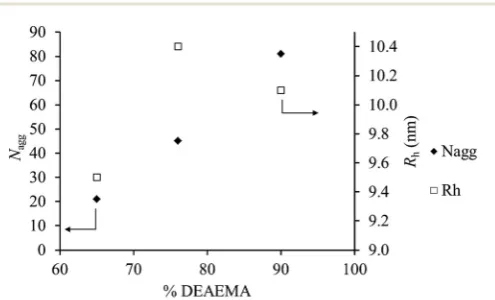
Since all polymers have similar block lengthsNaggandRhat
α= 0 can be represented as a function of DEAEMA incorpor-ation in the core for the polymers which self-assemble (Fig. 5). It can be shown that the Nagg value is independent of Rh
within experimental error. Indeed theRhvalues show a change
of <1 nm across an incorporation range of 25%, whilst theNagg
values differ up to approximately 4 times. Fig. 5 highlights the strong relationship between the core hydrophobicity and the nature of the aggregates formed, highlighting that even low incorporations of monomers with different solvophobicity into the core may have significant impact on the final structure formed. This behavior is especially vital in self-assembled nanostructures in catalysis48and nanomedicine,49where mod-erating the cores of micelles has been shown to vastly change performance in nanostructures.50
Conclusions
A series of P(DEAEMA-co-DMAEMA)-b-PDMAEMA diblock copolymers have been synthesized with varying degrees of DEAEMA in the core block. In aqueous media, below a given ionization degree, the polymers self-assemble into pH sensi-tive star like micelles, similar to the behavior of its analogous PDEAEMA-b-PDMAEMA diblock copolymer. However, contrary to what was observed for the analogous diblock, the pH region of aggregation for these P(DEAEMA-co-DMAEMA)-b-PDMAEMA diblock copolymers can be shifted by modifying the compo-sition of the statistical hydrophobic block. In comparison to the analogous PDEAEMA-b-PDMAEMA diblock copolymer by decreasing the ionization the aggregation of the polymers shows an exponential relationship to the aggregation number. The apparent aggregation number was shown to change rever-sibly for the micelles irrespective of the preparation pathway, which indicates that there is reorganization of the system. This makes it suitable from an applicative point of view, whereby a single polymer can be used to access a wide range of aggre-gates in a desired pH region. Moreover the aggregation number of these star-like micelles can be increased up to 4 times by varying the incorporation of DEAEMA (from 65% to 91%) in the core block, whilst maintaining equal block lengths and micelle sizes in solution. The ability to selectively tune the aggregation behavior of responsive polymers from subtle differences in polymer composition stresses the great sensitivity and ability to decisively tune diblock copolymer assemblies.
Acknowledgements
The ESF P2M, EPSRC and BP, are thanked for financial support. Dr Annhelen Lu and Prof. Taco Nicolai are thanked for helpful discussions. The authors thank Prof. Nathan C. Gianneschi for help with cryo-TEM. The SEC equipment used in this research was obtained through Birmingham Science City: Innovative Uses for Advanced Materials in the Modern World (West Midlands Centre for Advanced Materials Project 2), with support from Advantage West Midlands (AWM) and part funded by the European Regional Development Fund (ERDF).
Notes and references
1 I. W. Hamley,The Physics of Block Copolymers, OUP Oxford, 1998.
2 I. W. Hamley,Block Copolymers in Solution: Fundamentals and Applications, Wiley, 2005.
3 S.-H. Choi, T. P. Lodge and F. S. Bates, Phys. Rev. Lett., 2010,104, 047802.
4 S. Y. Choi, F. S. Bates and T. P. Lodge, J. Phys. Chem. B, 2009,113, 13840.
5 N. Petzetakis, D. Walker, A. P. Dove and R. K. O’Reilly,Soft Matter, 2012,8, 7408.
Fig. 5 Effect of the DEAEMA loading on theNaggandRhfor polymers2, 3and4atα= 0. Values of NaggandRhgiven are obtained by extra-polation to zero concentration.
Open Access Article. Published on 25 February 2015. Downloaded on 04/04/2016 15:14:16.
This article is licensed under a
[image:8.595.44.292.532.682.2]6 P. Cotanda, D. B. Wright, M. Tyler and R. K. O’Reilly, J. Polym. Sci., Part A: Polym. Chem., 2013,51, 3333.
7 J.-F. Lutz,J. Polym. Sci., Part A: Polym. Chem., 2008,46, 3459. 8 J.-F. Lutz, Ö. Akdemir and A. Hoth,J. Am. Chem. Soc., 2006,
128, 13046.
9 A. Shedge, O. Colombani, T. Nicolai and C. Chassenieux, Macromolecules, 2014,47, 2439.
10 C. Charbonneau, M. M. D. Lima, C. Chassenieux, O. Colombani and T. Nicolai, Phys. Chem. Chem. Phys., 2013,15, 3955.
11 F. Dutertre, O. Boyron, B. Charleux, C. Chassenieux and O. Colombani,Macromol. Rapid Commun., 2012,33, 753. 12 C. Charbonneau, C. Chassenieux, O. Colombani and
T. Nicolai,Macromolecules, 2011,44, 4487.
13 E. Lejeune, C. Chassenieux and O. Colombani, Prog. Colloid Polym. Sci., 2011,138, 7.
14 E. Lejeune, M. Drechsler, J. Jestin, A. H. E. Muller, C. Chassenieux and O. Colombani,Macromolecules, 2010, 43, 2667.
15 D. D. Bendejacq and V. Ponsinet, J. Phys. Chem. B, 2008, 112, 7996.
16 D. D. Bendejacq, V. Ponsinet and M. Joanicot, Langmuir, 2005,21, 1712.
17 R. Lund, L. Willner, D. Richter and E. E. Dormidontova, Macromolecules, 2006,39, 4566.
18 T. Nicolai, O. Colombani and C. Chassenieux,Soft Matter, 2010,6, 3111.
19 R. C. Hayward and D. J. Pochan,Macromolecules, 2010,43, 3577.
20 J. Hu, G. Zhang, Z. Ge and S. Liu,Prog. Polym. Sci., 2014, 39, 1096.
21 J. Hu and S. Liu,Macromolecules, 2010,43, 8315.
22 X. Jiang, Z. Ge, J. Xu, H. Liu and S. Liu,Biomacromolecules, 2007,8, 3184.
23 A. S. Lee, V. Bütün, M. Vamvakaki, S. P. Armes, J. A. Pople and A. P. Gast,Macromolecules, 2002,35, 8540.
24 A. S. Lee, A. P. Gast, V. Butun and S. P. Armes, Macro-molecules, 1999,32, 4302.
25 H. Lee, S. H. Son, R. Sharma and Y.-Y. Won,J. Phys. Chem. B, 2011,115, 844.
26 P. van de Wetering, N. J. Zuidam, M. J. van Steenbergen,
O. van der Houwen, W. J. M. Underberg and
W. E. Hennink,Macromolecules, 1998,31, 8063.
27 O. Colombani, E. Lejeune, C. Charbonneau, C. Chassenieux and T. Nicolai,J. Phys. Chem. B, 2012,116, 7560.
28 J. Jakes,Collect. Czech. Chem. Commun., 1995,60, 1781. 29 J. P. Patterson, M. P. Robin, C. Chassenieux, O. Colombani
and R. K. O’Reilly,Chem. Soc. Rev., 2014,43, 2412.
30 C. Chassenieux, T. Nicolai and D. Durand,Macromolecules, 1997,30, 4952.
31 M. Sedlak,J. Chem. Phys., 1997,107, 10805. 32 M. Sedlak,J. Chem. Phys., 1997,107, 10799. 33 S. Kline,J. Appl. Crystallogr., 2006,39, 895.
34 O. Glatter and O. Kratky, Small-Angle X-Ray Scattering, Academic Press, 1982.
35 A. Guinier and G. Fournet,Small-angle scattering of X-rays, John Wiley & Sons, New York, 1955.
36 R.-J. Roe,Methods of X-ray and Neutron Scattering in Polymer Science, Oxford University Press, New York, 2000.
37 NIST SLD calculator http://www.ncnr.nist.gov/resources/ sldcalc.html.
38 D. J. Keddie,Chem. Soc. Rev., 2014,43, 496.
39 G. Moad, E. Rizzardo and S. Thang,Macromolecules, 1998, 31, 5559.
40 A. M. Van Herk and T. Dröge, Macromol. Theory Simul., 1997,6, 1263.
41 P. J. Flory,Principles of Polymer Chemistry, Cornell Univ Pr, 1953.
42 M. S. Picidn,Makromol. Chem., 1985,186, 111.
43 M. Jacquin, P. Muller, R. Talingting-Pabalan, H. Cottet, J. F. Berret, T. Futterer and O. Theodoly,J. Colloid Interface Sci., 2007,316, 897.
44 Y. Wang, K. Zhou, G. Huang, C. Hensley, X. Huang, X. Ma, T. Zhao, B. D. Sumer, R. J. DeBerardinis and J. Gao,Nat. Mater., 2014,13, 204.
45 R. Haag,Angew. Chem., Int. Ed., 2004,43, 278.
46 J. van Stam, S. Creutz, F. C. De Schryver and R. Jerome, Macromolecules, 2000,33, 6388.
47 S. Creutz, J. van Stam, F. C. De Schryver and R. Jerome, Macromolecules, 1998,31, 681.
48 A. Lu and R. K. O’Reilly,Curr. Opin. Biotechnol., 2013,24, 639.
49 J. H. Park, S. Lee, J.-H. Kim, K. Park, K. Kim and I. C. Kwon,Prog. Polym. Sci., 2008,33, 113.
50 A. Lu, D. Moatsou, D. A. Longbottom and R. K. O’Reilly, Chem. Sci., 2013,4, 965.
Paper Polymer Chemistry
Open Access Article. Published on 25 February 2015. Downloaded on 04/04/2016 15:14:16.
This article is licensed under a
Creative Commons Attribution 3.0 Unported Licence.