Effective Capacity and Interference Analysis in Multiband
Dynamic Spectrum Sensing
Mohamed Elalem, Lian Zhao
Electrical and Computer Engineering Department, Ryerson University, Toronto, Canada Email: [email protected], [email protected]
Received February 11, 2013; revised March 11, 2013; accepted April 11, 2013
Copyright © 2013 Mohamed Elalem, Lian Zhao. This is an open access article distributed under the Creative Commons Attribution License, which permits unrestricted use, distribution, and reproduction in any medium, provided the original work is properly cited.
ABSTRACT
In this paper, the performance of multichannel transmission in cognitive radio is studied. Both constraints and interference limitations are considered. The activities of the primary users (PU)s are initially detected by cognitive users (CU)s who perform sensing process over multiple channels. They transmit in a single channel at variable power and rates depending on the channel sensing decisions and the fading environment. The cognitive operation is modeled as a state transition model in which all possible scenarios are studied. The constraint of the cognitive users is inves- tigated through statistical analysis. Analytical form for the effective capacity of the cognitive radio channel is found. Optimal power allocation and optimal channel selection criterion are obtained. Impact of several parameters on the transmission performance, as channel sensing parameters, number of available channels, fading and other, are identified through numerical example.
QoS
QoS
QoS
. QoSQoS QoS
QoS
QoS Keywords: Effective Capacity; Cognitive Radio; Multiband Sensing; Interference
1. Introduction
Much interest in cognitive radio systems is raised due to their ability to utilize the available spectrum much more effectively. In addition to efficient spectrum utilization, it is more important in wireless systems to provide reliable communications while preserving a certain level of qual- ity-of-service In cognitive radio systems, chal- lenges in providing assurances increase due to the fact that cognitive users should operate under constraints on the interference levels that they produce to primary users. For the secondary users, these interference con- straints lead to variations in transmit power levels and channel accesses. This discontinuing in accessing the channels due to the activity of primary users make it dif- ficult for the cognitive users to satisfy their own requirement. The authors in [1] proposed a con- strained power and rate allocation scheme for spectrum sharing systems in which it was guaranteed a minimum- rate to the primary user for a certain percentage of time. The same authors, in [2], considered variable-rate vari- able-power modulation employed under delay con- straints over spectrum-sharing channels. Various capac- ity metrics, e.g., ergodic, outage, and minimum-rate ca- pacity for the cognitive channels with interference con- straints in Rayleigh fading environments, have been stud-
ied in these papers.
In this paper, the effective capacity of cognitive radio channels is studied where the cognitive radio detects the activity of the primary users in a multichannel case, and it performs data transmission in one of these channels using both rate and power adaptation that depends on the channel conditions and the activity of the primary users. An average interference constraint on the cognitive users is formulated. Maximum throughput formula is obtained through the effective capacity approach. Optimal power allocation is derived and investigated through numerical results.
The rest of the paper is organized as follows. In Sec- tion 2, the system model and assumptions are given. Channel capacity and state transition model are formu- lated and constructed in Section 3. Section 4 discusses outage constraints and interference limit. In Section 5, the effective capacity for the cognitive user is formally defined in terms of constraints and then formu- lated and optimized. Channel selection criterion is pro- posed in Section 6. Numerical results are provided in Section 7, and the paper is concluded in Section 8.
2. System Model and Assumptions
The considered system model consists of cognitive radio
network in which the cognitive users sense M c
amon em t
hannels with a bandwidth Bm for eac here m1, 2,,M
he cognitive users choose a channel for data transmission. The channel sensing and data trans- mission are performed in frames of duration T. It is
sumed that
h, w g th
as secon s is allocated for channel sensing while the remaining
d
T sec are allocated for data transmission. The primary user activity influences the transmission power and rate levels. If all of the channels are detected as busy, the cognitive transmitter selects one channel according to a certain criterion, and sets the transmission power and rate to
onds
,b m and ,
b m , where denotes the time index in the transmission frame. In the contrary, if at least one chan- nel is sensed to be idle, data transmission is sent with power
S i
1, 2,
i
i r
, d mS i at rate d m, . In the case of multiple channels are detected as idle, one idle channel is selected according to a certain policy explained later.
i r
The channel fading coefficient between the cognitive transmitter and the receiver with an arbitrary distribution is assumed as g im
2
. A block-fading channel model is assumed in which the fading coefficients stay constant in the frame, and they may change from one block to an- other independently in each channel. The active primary user’s signal arriving at the cognitive receiver is assumed to have zero mean and a variance m. The background
noise at the receivers is modeled as a zero-mean, circu- larly symmetric, complex Gaussian random variable with variance n2m.
Perfect Channel State Information (CSI) is assumed at each receiver. It is further assumed that each channel has a bandwidth that is equal to the coherence bandwidth c. With this assumption, it can be supposed that independ- ent flat fading is experienced in each channel.
B
2
3. Channel Capacity and State Transition
Model
In order to further simplify the setting, it is considered a symmetric model in which fading coefficients are identi- cally distributed in different channels. Moreover, the background noise and primary users’ signals are also as- sumed to be identically distributed in different channels and hence their variances n and 2 do not depend
on m. So the subscript m can be omitted. The probability of each channel being occupied by the primary users is assumed to be the same and equal to In channel sensing process, the same energy threshold is assumed in each channel.
.
q
Due to possible error in channel sensing, we may have the following possible cases:
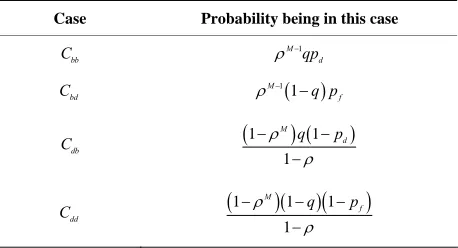
Cbb: M bands are sensed as busy, and the selected channel is actually busy.
Cbd: M bands are sensed as busy, and the selected channel is actually idle.
Cdb: Md band(s) is sensed as idle, and the selected channel is actually busy.
Cdd: Md band(s) is sensed as idle, and the selected channel is actually idle, where Md 1,,M1.
By the assumption of that the state transitions occur every frame, the probability of the channel detected as busy can be written as
qpd
1 q p
f
,
p
(1) where d, and pf are the probabilities of detection and false alarm. The probabilities of being in each of the above cases are summarized in Table 1.
In each of the above cases, we have two states, namely either state in which the instantaneous transmis- sion rate exceeds the instantaneous channel capacity, or state if it does not. Assuming the interference caused by the primary users
ON
OFF
i as additional Gaus- sian noise, the instantaneous channel capacities for the above four cases can be expressed as follows
log 12
,l c l
R i B i (2)
, , ,
l bb bd db dd refers to the possible case and where
l represents the for the corresponding case in the channel which is given by
i
SNIR
th i
,, ,
b b
bb bd
b d
d d
db dd
b d
S i g i S i g i
i i
N N
S i g i S i g i
i i
N N
(3)
2 2
Nb n N 2 and d n
where
C C
represent the to- tal noise when a channel is busy and idle respectively.
For the cases bb and bd, the cognitive transmitter detects all channels as busy and transmits with rate
log 12
b c bb
r i B i
C C
. (4) While for the cases db and dd, at least one chan- nel is sensed as idle and the transmission rate is
log 12
,d c dd
[image:2.595.309.538.612.736.2]r i B i (5) whereas the transmitter assumes the channel as idle, it
Table 1. The probability of being in each four cases.
Case Probability being in this case
bb
C M1
d
qp
bd
C M11
f
q p
db
C
1
1 1
M d
q p
dd
C
1
1
1
1
M
f
q p
sets the power level to d
and it supposes that no interference from the primary transmissions will be pro- duced as seen by nonexistence ofS i
2
in the denomina- tor of dd.
The transmission rate for the cases bb and bd is less than or equal to the instantaneous channel capacity. Reliable transmission at rate
C C
b is achieved and cha- nnel is in the state. Similarly, the channel is in the state in the case Cdd in which the transmission rate is r i ON ON
d r OFF
i . While in the case db, the channel is in the state because the transmission rate exceeds the instantaneous channel capacity (i.e.,
C
d db ).
Hence, reliable communication cannot be established. r i R i
M2
Referring to the above discussion, the cognitive trans- mission model can constructed as depicted in Figure 1. We have states model, consisting of
M1
states and one state. The first state re- presents the states in the cases bb and , in both of which the transmission power and rate are
ON OFF ON
ON C Cbd
b andS i
b respectively. All channels are sensed as busy in this state. The remaining states from 2 to
r i
ON
1
3, ,
m
M
2,
can be represented as the expansion of the state in the cases dd in which at least one channel is sensed as idle and the selected channel for transmission is really idle. More specifically, the state for
is the state in which ON ON C
1 M th m
ON
m1
channels are sensed as idle and the channel selected for transmission is actually idle. The transmission power and rate for these states are S id
and r id
respectively.The single state represents the case db in which transmission rate exceeds the instantane- ous channel capacity.
M2
OFF C [image:3.595.311.541.206.529.2]The state transition probabilities can be analyzed as-
Figure 1.
M2
ON M
p p
1, 2,
, , 2
p m M
p m2, 3,,M 1,
ON states and one OFF state for the
cognitive radio channel and their corresponding state tran- sition probabilities.
suming that the PU’s activity is independent among the channels and also from one frame to another as men- tioned above. The probability of staying in the first state in which all channels are sensed as busy can be eas- ily expressed as 11 1. Again with this assump- tion of independence over the frames, the state transition probabilities are independent on the originating state, so the transition probabilities m1 are
similar and equal to 1. For the
transition probabilities are obtained as
1 1 2 1 1 1 2 2Pr 1 out of chs are sensed idle Pr selected ch is idle it is sensed as idle
1 1
1
1 1
, 1 1 1 1
m m m M m M m
f m M m m M m f m M q p M
p p p p p
m
C M m q p
(6)where , !
! !
k C k l
l k l
is the Binomial coefficient.
The transition probabilities for the OFF state are
2 1 2 2 2 1 2
1 1 2 2 1 1 1 1
, 1 1
1
1 ,
1
M M M M M
M m M M m M m M m d m M d
p p p p
p p
C M m q p
q p
(7)where we use the power series relation in [3,4].
11
! 1
1
! ! 1
M M m M m m M a a a
M m m a
M 2
M2
C C C
S
b cp
S g cp
(8)
From the above definitions, it can be seen that the state transition probability matrix is with a rank of 1.
4. Outage Constraints and Interference
Limit
To adapt the transmission powers of the CRs and ensur- ing not producing any harmful on the primary users, in- terference power constraints is analyzed in this section. From the considered system model, it can be included that the interference to the primary users is caused only in the cases bb and db. Where, in the case bb, the channel is actually busy, and the cognitive user, detecting the channel as busy, transmits at power level b. The instantaneous interference power introduced on the pri- mary user is , where g is the fading coefficient
[image:3.595.59.287.498.690.2]C
S S g
S S
of the channel between the cognitive transmitter and the primary user.
For the case db, although the channel is actually busy, the secondary user, detecting the channel as idle, trans- mits at power d. The instantaneous interference power is d cp in this case. Since power adaption is consid- ered, transmission power levels b and d in general vary with gcp and g, which is the power of the fading coefficient between the secondary transmitter and sec- ondary receiver in the chosen transmission channel.
In the cases: and , the instantaneous interfer-
ence power levels depend on both gcp and g whose distributions depend on number of available channels from which the selection is performed. For this reason, it is necessary in the case db to separately consider the individual cases with different number of idle-detected channels. For instance, in the case for
C
th m
1, 2, ,
m M
bb
C Cdb
m
m
th m I
, there are channels detected as idle and the channel chosen out of these channels is ac- tually busy.
The average interference has to be constrained to the value . This can be formulated as
P ng i average interf . in Pr being in average interf . in .
th
b bb db db
Im r bei nCb C C C
This yields to
1 1 1 1 .
1
M
f
th M
m d b cp m d cp
q p
I qp S g S g
(9)
The expectations should be taken over the distributions
of g and gcp and over the probabilities of different
cases. The term m d cp in Equation (9) depends onthe number of idle-detected channels, . S g
m
5. Effective Capacity for Cognitive User
The Effective Capacity C
(or Effective Bandwidth) theory is a powerful approach to evaluate the capability of a wireless channel to support data transmissions with diverse statistical quality of service Qo guarantees [5-7]. It is defined as the maximum constant arrival rate that can be supported by a given channel service process while meeting the requirement [5]. In particular, the statistical guarantee can be characterized by a metric called exponent denoted byE
QoS QoS
QoS , 0
S
[5]. The QoS exponent characterizes the exponen- tially decaying rate of the violation probability against the queue-length threshold. With the pair (Effective Ca- pacity EC and QoS exponent ), it can be observed insight tradeoff between the delay requirement and the system throughput. Higher
QoS
represents more stringent delay QoS requirements, and vice versa.
The effective capacity for a given θ is defined in [5] as
1
lim log exp
t t R t
(10)
where lim log1
exp
R t
is a function ttthat depends on the natural logarithm of the moment ge- nerating function of R t
r
, and
is the1
t
i
R t r i
time-accumulated service process. is the expecta- tion with respect to .
It can be noticed that the service rate is
r m r m Tb
if the cognitive user is in state 1 at band m. Similarly, the service rate is r m r Td
in states between 2 and
M1
OFF
. In the remained state i.e., state, reliable connection can not be achieved because the instantaneous transmission rate exceeds the instantaneous channel capacities, so the service rates in this state is zero.
The normalized effective capacity (in bits/s/Hz or 1/nat) under the average interference power constraint Equation (9) can be formulated as the following optimi- zation problem
1 1 2
, 0, , 0 1
max log e b e d ,
b d b d
M
T r T r
c r r S S e m m M
m c
E p p p
M
d
1
TB
(11)
s.t. Equation (9) holds, where m for
are the state transition probabilities defined in Section 3. The maximization operator is with respect to the power adaptations and .
p
b
S S
e T rb
1, 2,
m , 2
above optimization problem are with respect to the joint distribution of
g,gcp
e T rd
m
of the channel selected for transmission when all channels are sensed busy. The ex-
Note that the expectation in the objec- tive function and S gb cp in the constraint of the
pectations mS gd cp
and are with
g, cp respect to the joint distribution of g
m
sensed as idle.
To identify the optimal power allocation that the cog- nitive users should employ, the problem in Equation (11) can be converted to a minimization problem using the fact that logarithmic function is a monotonic function (Equation (12)). s.t. Equation (9) holds.
This objective function is strictly convex and the con- straint function in Equation (11) is linear with respect to b and d. This can be concluded from the fact that strict convexity follows from the strict concavity of b and d in Equations (4) and (5) with respect to b and
d, strict convexity of the exponential function, and the fact that the weighted sum of strictly convex functions is strictly convex [8,9]. Using Lagrangian method, the power allocation can be expressed as
S S r r S S 1 1 1 , 0, b b b N
S g w
1; otherwise, b z z w (13) and 1 1 1 , 0, d d d N
S g w
1; otherwise, d z z w (14)
where
,log 2 c B T w , b d b N qp
and 1 . 1 1 d d f p q p d N q w Using these optimal transmission powers, the effective capacity can be expressed in integral form as Equation (15).
6. Selection Criterion in Rayleigh Fading
Channel
We aim present a criterion with which the transmission channel is selected from a set of available channels. Since the terms
1.b z w
and
1 d z w
z
g functions
z
z
in Equation (13) are monotonically decreasing functions of . The term:
loge monotonically decreasin
is increasing function. It can be observed from Equation (15) that the effective capacity depends only on the chan- nel power ratio , and it is increasing with increaseing this power ratio. Therefore, the criterion for choosing the transmission band among multiple busy bands unless there is no idle band detected, or among multiple idle bands if there are idle bands detected should be based on this ratio of the channel gains. Clearly, the policy that maximizes the effective capacity is to choose the channel with the highest ratio of . This also intuitively leads to a result that as we want to maximize g to improve the secondary transmission and at the same time minimize
cp
g to diminish the interference caused to the primary users. Maximizing provides us the problem key in the channel selection algorithm.
z
Let
,
max m , 1, , ,
cp m g
w m M
g
where ,
m cp m g g the r is
atio of the gains in the mth band channel. All these ep
cally if
ratios are assumed to be ind endent and identical dis- tributed.
Statisti Y max
X1,,Xn
, where Xi are independent and identically distributed random va ables ri with pdf of f xx
then the cdf and pdf of Y are given as (Theo .7 in [10])
F y F
rem 5
,
n
Y X y (16)
d
1. d
n Y
Y X X
F y
f y nf y F y
y
(17)
Using this fact, we can express the pdf of w as
z z 18)
where
M 1f w Mf w F w ( fz and Fz are the pdf and cdf
ha iv
(15) can be evalu- at
of the gain ratio z in one c nnel, respect ely.
Now, the first integral in Equation ed with respect to this distribution.
Similarly, Let 1,2, , ,
max j
m j m
cp j g w
g
for
1, 2, ,
m M . The pdf of wm can be expressed as follows:
1, 1, 2, , m
m
z zf w mf w F w m M (19) The second integral of Equation (15) can be evaluate
1 1 2
, min0, , 0 e , min0, , 0 e ,
b b
b d b d b d b d
T r T r
c r r S S r r S S M
E p p p (12)
d
1 1
1 1 2
1 1
log d d
b b
M
c e m m M
m
c w b w b
z z
E p f z z p f z z p
TB w w
(15)using this distribution, and by using the power series property [3]:
1 1
1 !
1 1
M M
m
M m m
mM
x M x
noise power. As pd increases, the effective capacity increases due to the fact that more reliable detection the activity primary users leads to
It can also be seen that the highest effective capacity is 1
1 !
m M m
n the preceding sections applies for arbi- trary joint distributions of
The analysis i
g and gcp. Channel fading is assumed her to be Re ayleigh fading in which the pow- er gains g and gcp are exponentially distributed. We fu
S all
rther assume that these fading are mutually independ- ent and each has unit-mean. tatistic y, if there are two independent exponentially distributed variables X and Y, the random variable Z X
Y
has the pdf
21
, 0.
1
z
f z z
z
(2 ) 0
uation 1 can
x d as
So, the pdf of w in Eq s (18) and ( 9) be e presse
1
2
2 1
M
m
M w
f w
m w
f w
w w
Using Equations (6), (7), (15), (21), the effective ca- pacity formula for Rayleigh fading ch
ten as in (22), where
1
1
m w w
(21)
annel can be writ-
1 1 , 2 2
era
1 1
. The impact of sev-
eters and the average lustrated. The frame dura- l parameters on the effective capacity is investigated through the following numerical example (Equation (22)).
7. Numerical Example
In this section, several numerical results for the obtained effective capacity expression will be investigated. The impact of channel sensing param
interference constraints are il
tion is T1s with 10% of this time is conserved for sensing process. The prior probability of the channel be- ing busy is the same for all channels and set to q0.1. All variances are set to unity. The channel bandwidth is
[image:6.595.59.535.657.734.2]10 KH B
Figure 2, shows the effective capacity vs detection probabilitypd, for different number of chann l
z.
of fewer miss-detection. attained when M . Hence, the cognitive users does not benefit from the availability of multiple channels. This is especially pronounced for high values of pd. Although several parameters affect the value of the ef- fective capacity explanation for this observation is that the probabilities of the cases Cbb and Cbd , in which the cognitive users transmit with power Sb, e- crease with increasing
, one
d M, while the probabilities of the cases Cdb and Cdd in which the cognitive users trans- mit with p ower Sd, increase.
In Figure 3, the effect of the primary user’s occupancy q on the effective capacity is investigated for different numbe of sensed channels. This effect is observable for relatively small det tion probability. While for higher ( i
r
ec it
.e. ,pd 0.8), the improvement in the effective capac- y decreases. This is most likely true for all M 1. For
1
M , higher q attached with higher pd indicate to most likely of the presence of the primary user and hence less capacity can be achieved by the cognitive user as can be seen from the figure.
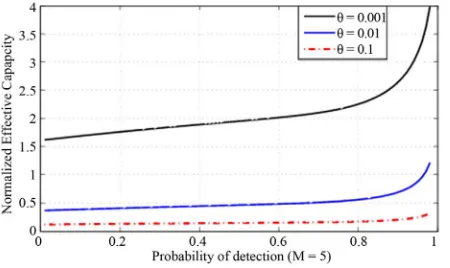
ure 4 examines the impact of the QoS exponent values,
Fig
for M 5. This figure confirms that sig- nificant capacity gains can be achieved for lossy QoS constraints (i.e., small ). While the capacity decreases dramatically for highly strength QoS co ints.
In Figure 5, th ctive capacity is plotted versus the interference threshold Ith for different number of cha - nels. The probability of etection is sit at pd 0.8
nstra e effe
n
d . The
figure shows that as the interfere ets more strict i.e. t
I nce g ( ,
old h
becomes smaller), a higher number of channels is needed to maximize the effective capacity.
As an example, if the interference thresh
20
th
I d, then five channels are needed to reach maxi- m capacity, while if the interference threshold
0 dB th
I , one channel is enough to ge mu
t the highest
th sing the
number of
even degrade th
roughput. As it is mentioned before, increa
available channels from which the transmis- sion channel is selected provides no benefit or can
e performance of the cognitive users. On the other hand, it always provides benefits to the primary users in the sense of lowering the probability of interfer- ence.
e s M when the interference constraint is normalized by the
1 2
1
1 1
log
1 b
M
M 1 1 1 ,
M
2
1
1 1
2
d
1
1 d
1 d
M M m
f d
q p w mC M m
c e b
c w
E M w w
TB w
mm
m m
M w
w
w w p
w
(22)
Figure 2. Effective capacity vs probability of detection for different number of channels in the Rayleigh fading chan- nel.
Figure 3. Normalized effective capacity vs probability of detection for different number of channels and different primary probabilities q, 0.1. Dashed curves
repre-case and solid curves represent the ors.
sent for the 0.2 q
0.4 q
[image:7.595.59.283.90.238.2]relevant col case
Figure 4. Effective capacity vs probability of detection fo
ifferent QoS e ,M5,q0.2
r
d xponent delay .
8. Conclusion
The performance of cognitive transmission under
and interference constraints users
[image:7.595.61.286.293.435.2]QoS is studied. Cognitive
Figure 5. Effective capacity vs th
I for different number of channels in the Rayleigh fading channel, Pd = 0.8
0.2, 0.1
q .
are assumed to perform sensing in multiple channels and then select a single channel for transmission with rate and power that depend on both sensing outcomes and fading distribution. A state transition model for this cog- nitive operation has been constructed. All possible cases and states are considered and analyzed. Interference con- straint is statistically analyzed and formulated. Maximum throughput formulas for the cognitive users are obtained. Selection criterion that maximizes the capacity is pro- posed for arbitrary channel fading then it is applied for
tim
only under strict interference requirements and it
[4] Wolfram Mathematica, the Web’s Most Extensive Ma- thematics Recourses. http://mathworld.wolfram.com [5] D. Wu and R. : A Wireless Link
ch, “Effec- Rayleigh distribution. The op al power allocation is also determined. Sensing multiple bands brings advan- tages
reduces the probability of a primary user to be interfered.
REFERENCES
[1] L. Musavian and S. Aissa, “Quality-of-Service Based Power Allocation in Spectrum-Sharing Channels,” IEEE Global Communication Conference GOLBCOM, New Orleans, 30 November-4 December 2008.
[2] L. Musavian and S. Aissa, “Adaptive Modulation in Spec- trum-Sharing Systems with Delay Constraints,” IEEE In-ternational Conference on Communications ICC, Dres- den, 14-18 June 2009.
[3] W. Magnus, F. Oberhettinger and F. Tricomi, “Higher Transcendental Functions,” McGraw Hill, New York, 1982.
Negi, “Effective Capacity
Model for Support of Quality of Service,” IEEE Transac- tions on Wireless Communication, Vol. 2, No. 4, 2003, pp. 630-643.
[6] E. Jorswieck, R. Mochaourab and M. Mittelba
tive Capacity Maximization in Multi-Antenna Channels with Covariance Feedback,” IEEE Transactions on Wire- less Communication, Vol. 9, No. 10, 2010, pp. 2988-
[image:7.595.62.287.518.652.2]2993. doi:10.1109/TWC.2010.080210.091060
[7] L. Musavian, S. Aïssa and S. Lambotharan, “Effective
mmunication, Vol. 9, No. 5, 2010, pp. 1698-1707. Capacity for Interference and Delay Constrained Cogni- tive Radio Relay Channels,” IEEE Transactions on Wire- less Co
doi:10.1109/TCOMM.2010.05.090600
[8] S. Boyd and L. Vandenberghe, “Convex Optimization,” Hoboken, 2005, pp. 257-264. 7th Edition, Cambridge University Press, Cambridge,
2009.
[9] D. Bertsekas, “Convex Analysis and Optimization,” Athena Scientific, Belmont, 2003.