Field Manual No. 19-30
*FM 19-30
Headquarters Department of the Army Washington, D.C. 1 March 1979
You, the user of this manual, are the most important element in keeping this publication current and viable. You are encouraged to submit any comments or recommendations pertinent to this field manual. Comments should be keyed to the specific page and line of the text in which you feel an improverment is needed. You should provide reasons for each comment made to insure complete understanding and evaluation Make your comments on DA Form 2028 (Recommended Changes to Publications) and forward to the Commandant, USAMPS/TC, ATTN: ATZN-TDP-C, Fort McClellan, AL 36205. Every comment will be considered.
FM 19-30
1 MARCH 1979
By Order of the Secretary of the Army:
BERNARD W. ROGERS
General, United States Army Chief of Staff
Official:
J. C. PENNINGTON
Major General, United States Army The Adjutant General
DISTRIBUTION:
Active Army, USAR and ARNG: To be distributed in accordance with DA Form 12-11A,
Requirements for Physical Security (Qty rqr block no. 142).
Additional copies can be requisitioned from the US Army Adjutant General Publications Center, 2800 Eastern Boulevard, Baltimore, MD 21220.
Chapter 1
Formulating
Section I
1-1
System Design
You should formulate and imple-ment your basic physical security design from a total system approach. It should be organized in depth and contain mutually supporting elements and be coordinated to prevent gap or overlap in responsibilities and performance.
a. Total system approach is based on: (1) Thoughtful and continuing analysis of
existing protective measures.
(2) Determination of the possibility of
interference with the operational capabili-ties of the installation or facility from any or all sources.
(3) Careful evaluation of the measures
necessary and practicable that maintain security at a desired level.
(4) Tailored to the needs and local condi-tions of each installation or activity.
b. Mutually supporting elements
in-clude:
(1) (2) (3) (4) (5)
Physical perimeter barrier(s).
Clear zones.
Protective lighting.
Entry control facilities.
Detection, including the use of sensors and assessment systems.
(6) Warning systems.
(7) Perimeter defensive positions, if
ap-propriate.
Note: Selection and use of means beyond minimum requirements:
■ Established by command directives.
■ Coordination and cooperation be-tween physical security officers and facilities engineers is a necessity.
■ Wherever threat indicates need for increased security.
1-2
Design Considerations
a. Available resources must be used
in the most efficient manner to achieve adequate protection for an entire installation.
b. Emphasis goes to the operational requirements of the installation in
determining the type and extent of physical protection. The physical security manager should consider the following pertinent factors in the indicated sequence.
(1) Mission assignment— importance of
the installation or unit to the mission of the Army.
(2) The area to be protected, including the
nature and arrangement of the activity; classification of information, data, activi-ties; the number of personnel involved; monetary and/or strategic value of mate-riel located therein; or other important features inherent to the problem, such as existing threats, either natural or human.
(3) Criticality and vulnerability of
information, materiel and personnel.
(4) Integration of operating,
(5) Environment, such as political and
economical aspects, legal considerations, terrain, weather, climate, etc.
(6) Feasibility, effectiveness, and
desira-bility of various possible methods of providing adequate protection.
(7) Costs of materiel and equipment to be
installed as well as availability of finds to provide at least minimum protection for all critical areas and activities This mini-mum may be less than the desirable degree of physical protection; therefore, the pro-gram must be flexible so that refinements can be added as additional resources become available.
(8) Possible changes in operation,
such as expansion, relocation and re-trenchment. Coordination must be main-tained with appropriate staff offices so that changes may be projected as far in advance as possible, and necessary supple-mental personnel and/or funds can be requested.
c. Changes in mission and activities of
an installation or activity may also require adjustments in security. Physical security
planning and programing must be a continuing process if security managers
are to provide the best protection possible.
d. All security measures should be
employed so that they complement and supplement each other. Lack of integration of security measures may result in a waste of money, equipment, and manpower. But more important, the security of an installation may be placed in jeopardy. By the considerations outlined, a sound physical security program should evolve.
e. The formulating procedure is sound
whether it is applied to changes on existing installation or the construction of a new facility.
1-3
Assessment
Of Security Posture
The degree of protection desired on any installation is predicated upon an analy-sis of two factors-criticality and vulnerabil-ity.
a. Resource Criticality
(1) Determination
(a) Importance to the national defense
structure.
(b) Effect of its partial or complete loss. (2) Evaluation
(a) Installation. High criticality-great
effect on national defense structure.
(b) Command/activity. High
critical-ity—partial or complete loss— immediate and serious impact to per-form its mission for a considerable period of time.
b. Resource Vulnerability
(1) Determination
(a) Susceptibility to threats that result
in damage, loss, destruction or disrup-tion.
(b) Type Of installation or activity
involved, industrial or other processes performed, physical layout and con-struction.
(2) Evaluation
(a) High vulnerability—one or more
threats easily causing sufficient loss, damage, or destruction to affect the mission of the whole installation or its subordinate commands/activities.
(b) Decreased vulnerability—existing
threats not likely to cause interference with the mission.
protective measures in terms of equip ment and manpower may not allow for optimum security for the entire installa-tion. Also, determination of security priority based on criticality and vulnera-bility is essential to proper allocation of resources.
c. Security in depth (guards, physical
barriers, and systems) is always the goal of those individuals responsible for the security of an installation or activity. No object is so well protected that it cannot be stolen, damaged, destroyed, or compromised. There-fore, access must be made so difficult that an intruder will be deterred from committing a
criminal act or will be detected and appre-hended before he can successfully complete the criminal act. Accumulated delay time
for the intruder must be built into a system for protection in depth. This
protection results from the security in-depth ring (see figure 1).
d. Physical security is only part of the
overall defense plan of an installation. It does not include dispersion of facilities, continuity of operations, civil defense structures, con-struction specifications, or plans formulated to cope with natural or human threats that happen. The formulating process must allow for the integration of all these measures.
Security Threats
Section II
Security threats are acts or conditions that may result in the compromise of information; loss of life; damage, loss, or destruction of property; or disruption of the mission of the installation or facility. Before the physical security manager can develop an effective security program, he must determine the possibility of interference with the opera-tional capabilities of the installation or facility from any and all sources. Recognition of all risks is mandatory if he is to make recommendations for physical security mea-sures to control or eliminate them. The sever-it y of secursever-ity threats depends on such varia-bles as the type of installation or facility involved, mission or processes performed, physical layout, and construction. The geo-graphical location, the enemy situation, and the existing state of law and order are most important factors.
1-4
Definition
a. Security threats are acts or
condi-tions, which include human threats, that may result in:
(1) Disruption of the installation or
facil-ity.
(2)
ty.
(3) (4)
Damage, loss or destruction of
proper-Personal injury or loss of life.
Compromise of defense information.
b. Threat severity depends on such
vari-ables as:
(1) Type of installation or facility. (2) Mission or processes performed.
(3) (4) (5) (6) (7)
1-5
Physical layout and construction.
Geographical location.
Stability of the situation.
Existing state of law and order.
Protection measures in effect.
Categories
Security threats are classified as either natural or human.
a. Natural Threats
(1) Usually the consequence of natural
phenomena.
(2) Normally not preventable by physical
security measures.
(3) May greatly affect security operations
in one or more of these ways.
(a) Require an increase in protective
measures.
(b) May reduce the effectiveness of
existing security measures by such occurrences as:
● Collapsed perimeter fences.
● Inoperable protective lighting.
● Damaged patrol vehicles.
● Poor visibility.
Examples of natural threats are:
Floods— flooding of the installation with
Storms— high winds or rain causing
nui-sance alarms and short circuiting in IDS, and limiting visibility of security personnel.
Earthquakes— causing nuisance alarms,
possible fires from broken gas mains, build-ings weakening and falling down.
Winds— disrupting power lines, setting off
nuisance alarms, causing safety hazards with flying debris.
Snow and Ice— blocking patrol roads,
increasing response time to alarms, and freezing of locks and alarm mechanisms.
Fires— damage/destruction of perimeter
barriers or buildings.
Fog— causing reduced visibility for security
forces and increased response time to alarms and may require additional security person-nel.
b. Human Threats
These threats are the result of a state of mind, attitude, weakness, or character trait on the part of one or more persons. They include acts of commission or omission— overt and covert—which could disrupt or destroy the operation or mission of an installation or facility.
Examples of human threats are:
❑ Pilferage (appendix A).
❑ Sabotage (appendix B).
❑ Espionage (appendix C).
❑ Bombing (appendix D).
❑ Pilferage in Consumer Outlets (appendix A).
❑ Attacks on Key Persons (chapter 14).
❑ Carelessness and accidents in perfor-mance of official duties.
❑ Disaffection and disloyalty of employees.
❑ Safety hazards from equipment malfunc-tion.
❑ Human Intelligence Threat (HUMINT).
1-6
Risk Analysis
This process is invaluable to the security manager in establishing priorities of protection of assets. Basically, it consists of
a. Identifying items and functions in
terms of:
(1) Total replacement (2) Temporary replacement (3) Unrecoverable costs (4) Allied and related costs.
b. Conducting a hazards and vulnerability
study of personnel, facilities, items, and functions.
c. Conducting a probability of occurrence
assessment through indicators, such as:
(1) Documented records
(2) Insurance claims or adjustments (3) Weather, etc.
d. Establishing a range of losses based on
experience involving specific items (mini-mum to maxi(mini-mum in terms of dollar value), and assessing the losses over a 3-5 year period.
e. Correlating the degree of loss
experi-enced with the ranges of losses or functions.
f. Comparing the low against high ele-ments of ranges for all items and functions; then averaging weight against risk value in terms of criticality (Defense Industrial Secu-rity Institute, DSA).
1-7
Evaluation of Risks
The actual degree of risk involved depends on two factors:
■ Extent to which the installation or activity ❑ All determinable threats.
will be affected by the threat(s). ❑ Continuing activity beginning in peace-time and expanding to meet the particulari-Security threats significantly impact on a ties of formal hostilities.
physical security program by requiring the ❑ Coordination and integration with other incorporation of the following considera- protective programs, such as crime
Chapter 2
Planning, Programing, and
Budgeting
o insure that the security responsi-bility of an installation or activity receives maximum emphasis, the security manager must be totally aware and involved in the installation planning, programing, and budgeting process. This involvement in-cludes preparation of manpower reports and appropriate submissions.
Planning
Section I
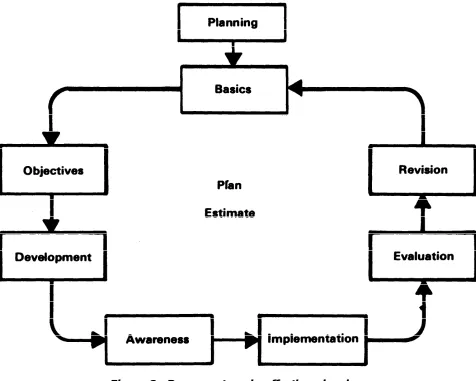
Planning for the security defense of an installation must remain constant, practical, flexible to the mission and certainly respon-sive to the needs of the commander. Only through adequate planning can we provide an effective counter response to security threats-as outlined in chapter 1.
2-1
Planning Basis
a. Implementation of Department
of the Army (DA) policy, AR 190-13, and those supplemental directives by installation and higher commanders is imperative to having a sound security, program.
b. The following must be considered when
planning security measures for an installa-tion:
(1) (2) (3) (4) (5)
2-2
Mission.
Vulnerability.
Impact on operations.
Budget limitations.
Personnel and equipment limitations.
Objectives
To be effective, planning must in-volve a phased approach, be flexible in incorporating changes, and have clearly defined courses of actions. It must be con-cerned with realistic protection in depth and be based on:
a. Relative standards.
b. Personnel, materiel and equipment
available.
c. Probability of the most serious incident. d. Implementation in the interest of
conti-nuity of all security operations.
2-3
Pre-operational Phase
(Estimate)
a. Sound prior estimates of the
security operational situation will reap big dividends when planning is ongoing. As a minimum, the preoperational estimate should be concerned
(1) Security Anal
Estimate (SAVE)
with the latest
ysis and Vulnerability
(2) Security Vulnerability Assessment
(SVA)
(3) Operational Security (OPSEC).
b. The estimate must involve
determina-tion of all available resources and acts as the basis for developing a sound security plan.
c. The estimate should entail maximum
use of existing organizational structures, supervisors, materiel and equipment, and available technical skills.
(1) Identification of unknown factors and
limitations.
(2) Identification of the necessary
2-4
Operational Phase
Planning for the operational phase must be all inclusive. It involves training programs concerning duties and responsibili-ties prior to, during, and after the operational phase. As a minimum, this phase should cover:
a. Employment of assigned and attached
personnel.
b. Serviceable equipment.
2-5
Awareness Phase
To insure that the operational phase is sound and that the plan is workable and practical, all personnel must be aware of their duties and responsibilities. Contents of the plan must dictate requirements and courses of action to include the interface of security personnel.
Extracts of the plan must be provided to key personnel and supervisors to insure areas of responsibility are executed. Also, supervisors must brief their personnel on appropriate duties and responsibilities, and monitor their actions to insure a successful plan exists.
2 - 6
Development
Developing a sound security plan must involve an integrated approach as to who, what, when, where and how. Specifi-cally, the development should be in accor-dance with appendix F of this manual.
2-7
Evaluation
a. This is an important element of
any plan to insure the plan’s overall appropri-ateness and workability. Sound evaluation
procedures will identify plan deficiencies and allow for necessary corrections and adjust-ments.
b. Evaluation of the plan will actually
acquaint personnel with their duties and responsibilities as well as the mechanics of the plan.
c. The methods of evaluation should
in-clude:
(1) Testing techniques in which all
por-tions of the plan are exercised individually and collectively.
(2) Testing conditions which are as close
as possible to real world conditions and which simulate security threats as appro-priate.
(3) Quality control through selecting
eval-uators who can provide a complete critique of the workability and appropriateness of the plan. Evaluators should be instructed to place special emphasis on personnel actions, both individually and collectively as a team, when weaknesses in training are evident. The evaluator should make note. An essential element of the evalua-tion is the feedback by evaulators. This feedback acts as a procedure for revising and modifying the plan. Revision should be immediate and all personnel must be made aware of the changes.
(4) Evaluation Frequency:
(a) The plan must be evaluated at
irregular intervals based on published directives and as deemed necessary by . the responsible commander.
(b) Mechanics involving development
Figure 2—Process steps in effective planning.
Programing and Budgeting
Section II
It is essential, in the management of installation security measures and require-ments, that the security manager knows the working relationships and necessary require-ments involving budget formulation and execution of the following:
❑ Command Budget and Manpower Guid-ance (BMG).
❑ Program Budget Advisory Committee (PBAC).
❑ Command Operating Budget Estimate (COBE).
❑ Major Activity Directors (MAD).
❑ Budget Requests.
❑ Manpower Procedures.
❑ Justification for Additional Security Per-sonnel and Equipment.
2-8
Budget and Manpower
Guidance (BMG)
a. Budget and manpower guidance
is generated at Headquarters, DA, to insure that Army responsibilities spelled out in the FYDP are passed down to major commands and agencies.
b. Through this guidance DA spells out for
each major command and agency precisely what will be required and what limitations are to be imposed. Based on this guidance, major commands and agencies update their 5-year programs and generate budget esti-mates for the budget year. The document each command or agency develops is its budget and manpower guidance (BMG).
b. This document provides higher
head-quarter’s approval for use of all assigned resources for a specific period. The document is an extract from the Army portion of the FYDP of those resources that have been contemplated for allocation and contains goals and workloads that such resources are designed to support.
2-10 Concepts
a. Major command/agency 5-year
programs, written in terms of appropriations, budget programs, and elements of expense, are detailed statements of the planned application of the resources (based on DA guidance) to accomplish assigned missions, goals, and workloads of the command for 5 years.
b. DA’s budget and manpower guidance
for major commands and agencies does not constitute authority to obligate finds. Rather, it is guidance to which recipients respond with their budget estimates and, finally their command operating budget estimates (COBE). This guidance document from Headquarters, DA, is formally updated three times a year.
c. Each successive headquarters
trans-lates the guidance it receives from above into expanded guidance for its subordinate com-mands. This action carries guidance from Headquarters, DA, down to the operating levels where, in response, the COBE is gener-ated.
2-11 Command Operatin
Budget Estimate (COBE)
2-9
BMG Objectives
estimate (COBE) is the field commander’sa. The command operating budget estimate of resource requirements for thefield commands of their approved operating budgets through four interrelated actions.
(1) June update of program and budget
guidance.
(2) DA issuance of the resources guidance. (3) Issuance of approved operating
bud-get.
(4) Command operating budget markup.
b. Missions are assigned and resources are
allocated to the installation commander in the command operating program of higher headquarters. The allocation is expressed in terms of the Army management structure, AR 37-100 (basic fiscal code), and AR 37-100-XX (FY fiscal code). Within this broad frame-work the installation commander develops a more detailed description of activities to be performed during the year. When approved, the COBE becomes the plan of action for ex-ecutors of the program.
c. The COBE is a command, agency or
installation plan of action for a specific fiscal year covering the activities for which it was responsible.
Installation Management
2-12 Purpose of COBE
a. To record in one place the
activi-ties to be conducted for a given year and the resources for their support. These are the activities necessary to achieve objectives assigned by higher authority based on guidance extracted from the Army portion of the FYDP.
(1) Identify that portion of the budget to
be accomplished by each subordinate ele-ment in terms of objectives, policies, priori-ties, and resources available.
(2) Establish a basis against which
ac-complishments and resource utilization can be measured.
b. Each command, agency, and
installa-tion in the Army establishment prepares an annual COBE covering operations for which it receives funds. These COBEs are prepared in sufficient detail to identify
(1) What has to be done. (2) When it must be done.
(3) What resources are available.
c. The COBE is prepared by each
com-mand and developed in response to program and budget guidance received from higher headquarters.
Section Ill
We have already noted that the resource much higher portion of the DOD budget will management system requires installation be reflected annually in Army installation commanders to identify the costs of their budgets.
2-13 Budget Formulation
At the installation level, you will be concerned with a budget cycle divided into two phases—formulation and execution.
a. The budget cycle for operation and
maintenance, Army, appropriation which finances most of the day-to-day operating costs of the Army, actually starts 18 months ahead of the target budget year (BY). Most installations do not become formally in-volved in the actual budget until 6 to 8 months before the beginning of the target BY. As soon as the annual Army budget estimate has been finalized [following joint DOD/Office of Management and Budget (OMB) hearings on the Army budget estimate], DA revises its guidance by sending to all of its major commands revised budget and manpower guidance (BMG) in January (about 6 months before the target BY). Based on this revised guidance, each subordinate command makes necessary changes in its local plans and programs.
b. On receipt of the guidance document at
the installation in October—six months prior to the BY—it is sent to the Directorate of Resource Management (DRM), who is the primary staff officer charged with financial management responsibility. After briefing the installation commander and adding the commander’s desires, the DRM breaks down the guidance into terms and segments that are meaningful at the installation level. He then distributes guidance with a minimum of delay to the major activity directors (MADs).
c. The DRM develops a time-phased
sched-ule of actions necessary for completion of the installation budget. This is similar to a suspense-date calendar.
prepares the draft installation BMG.
e. To facilitate and coordinate preparation
of program/budgets, the staff forms a pro-gram budget advisory committee (PBAC) to serve as atop management advisory group to the commander. The Chief of Staff is nor-mally chairman. Other members are the principal staff officers responsible for the functional areas of personnel, operations, and logistics, and other representatives as desired by the commander.
f. The committee considers all aspects of
the internal management of the command.
g. Each member insures that his area of
staff responsibility is accorded full considera-tion by the committee.
h. The use of financial data (that is,
expressions of resource requirements in dollar terms) permits comparison of total input, using a common unit of measure.
i. The goals and requirements of
individ-ual areas are coordinated and molded into overall goals and requirements for the com-mand.
j. Recommendations of the PBAC
repre-sent the consensus of the top management officials of the command.
k. The comptroller presents the draft BMG
to the PBAC along with any unresolved differences that could not be settled by staff coordination.
2-14 PBAC Functions
a. Interpretation of BMG from
higher authority and integration of the local commander’s guidance.
c. Application of judgment and experience
to specific program areas.
d. Achievement of reasonable balance and
coordination between proposed missions, activities, and resources assigned to subordi-nate commands and agencies.
e. Presentation of a staff-coordinated
pro-posed command operating budget estimate (COBE) to the commander.
f. Review of the reports of program/budget
execution and preparation of recommended revisions to the operating program/budget based on the results of operations.
g. Principal members of the PBAC are
assisted by their subordinates who function as a junior or working PBAC. Representation in this junior group is expanded to include at least one representative of each category within each functional area. For example, the DPCA represents the provost marshal (secu-rity officer). The program/budget officer from the comptroller’s office also participates as a working member. Much of the detailed work for the senior PBAC is done by the junior PBAC prior to the senior PBAC’s being convened. The junior PBAC works up de-tailed alternative courses of action for consid-eration of the senior PBAC.
h. Action agencies receiving the BMG are
the major activity directors (MADs). They are also frequently called program directors. Specific determinations of what is a major activity and of the designation of the MAD depend on the installation and its mission. However, primary staff officers are normally designated MADs for activities falling in their areas of primary staff responsibility. Major activities usually follow the break-down of the Army management structure.
2-15 Major Activity Directors
For example, the director of indus-trial operations (DIO), is responsible for the central supply and maintenance program.
Also, the Guard and Reserve forces program would belong to the director of plans and training. Physical security equipment (pro-vost marshal’s office) belongs to the director of personnel and community activities (DPCA).
a. At the installation level, organization
more clearly reflects the functional manage-ment requiremanage-ments, but does not clearly ad-dress the program as a whole. The installa-tions have subdivided their programs by functional area responsibilities. The name coined for the subdivisions is “key accounts.”
b. One rule that must be followed in this
subdivision is that the data collected for the accounts must be identifiable to insure that when this data is combined with data concerning other key elements in the pro-gram, it does not lose its identity with the major programs that it supports.
c. Guidance is analyzed by the major
activity directors and passed down to the activity chiefs who report to them. The activity chiefs analyze their guidance and pass appropriate guidance down to subactiv-ity chiefs who report to them. For example, the DPCA is the MAD for G-641. Under him there are normally activity chiefs and subac-tivity chiefs (physical security managers).
d. When the guidance finally gets down to
the activity/subactivity chief, it is translated into budget requirements. This is the turna-around point. Detailed budget segments are prepared by subactivity chiefs; reviewed, and consolidated by activity chiefs; again re-viewed and consolidated by major activity chiefs; until the draft installation COBE is consolidated by the DRM. Requirements are justified by use of performance factors (PF) listed for budget codes in the Army manage-ment structure.
e. The basic program/budget document
type (element of expense), manpower by man-years and type, and work output in terms of PF. Data is projected for each quarter of the fiscal year. The same three types of data are provided for unfinanced requirements; that is, the workload considered essential for mission accomplishment and its associated resource requirements that cannot be per-formed within the cost guidance received. The activity budget schedule establishes a stan-dard cost per unit of output, composed of la-bor, supply equipment, and other costs at the programed level of output.
f. The activity budget schedule is normally
supported by schedules of temporary duty travel, supply requirements, contracts, and unfinanced requirements and a narrative statement by the activity manager. When automatic reimbursements are expected to be earned by the activity, a list of sources and anticipated amounts is also prepared.
g. Activity budget schedules are reviewed
by functional category managers. Particular attention is paid to the balance of unfinanced requirements of activities having similar priorities. When balance has been achieved among activities of the same functional category, functional category managers, acting now as the working PBAC, propose adjustments in activity cost ceilings to achieve balance installation wide among all functional categories and activities.
h. The PBAC will review and make
neces-sary modifications to the draft COBE before submitting it to the commander with its recommendations. Those items that the installation feels are necessary for the accom-plishment of its mission, but cannot afford within the dollar guidance received from higher headquarters, are included in the COBE as unfinanced requirements. Unfi-nanced requirements are listed in order of priority with justification and impact state-ments supporting the installation’s request for additional funds.
i. The installation COBE is a plan of
action for a specific fiscal year and has a threefold purpose:
● Record activities to be conducted and
resources needed for the installation’s sup-port.
● Identify action to be accomplished by each
subordinate element.
● Establish basis to measure
accomplish-ment and resource consumption.
j. Of special interest in the COBE is section
I, Commander’s Narrative Analysis. In this section, the commander is provided the opportunity to defend his views on the adequacy or inadequacy of his COBE which has been developed in response to guidance received from parent headquarters.
k. After review and approval, the COBE is
submitted to the major command which reviews all COBEs submitted to determine consistency with guidance, magnitude, and type of resources requested and also the urgency of unfinanced requirements.
l. Major command COBEs are reviewed,
adjusted, and consolidated at Headquarters, DA, and form the basis of the Army’s annual apportionment request, which is submitted through DOD to OMB.
2-16 Budget Execution
a. The installation budget
execu-tion phase begins 1 October with receipt of the approved operating budget (AOB) or marked up COBE indicating the action taken in response to the DA-approved COBE. The markup of the installation COBE at this point reflects all changes to the installation’s COBE resulting from budget reviews at all levels of DOD, OMB, and Congress. As such, it represents the approved installation plan of execution for the BY.
b. An approved budget establishes annual
limitations and/or objectives to include the amount of expense or obligations that maybe
incurred for a specific program (or other classification) for the BY.
c. The installation marked up COBE and
the AOB for the first quarter of the fiscal year are sent to the DRM for action. The DRM reviews and analyzes these documents, determines adjustments required, and in-forms major activity directors concerned of pertinent adjustments.
d. Through the coordinated efforts of the
DRM and the working PBA, the installation program is updated. The DRM sends the original of the AOB to the finance and accounting office. Authority to obligate the Government comes to the installation in the form of a Funds Authorization Document (FAD). This authority is provided on a quarterly basis.
e. If the magnitude of changes warrants,
the PBAC meets to review the revised installation program for balance in re-sources, levels and workloads. When satisfied with the plan of operation, the PBAC recom-mends that the plan be approved by the installation commander. The commander either approves the recommended program or directs that changes be made. After final approval, the program is returned to the installation DRM. The DRM finalizes, pub-lishes, and distributes the approved installa-tion operating program which serves as the overall plan of operations for the fiscal year.
f. The budget execution review (BER) is the
midyear review report and provides the basis for funding adjustments by higher headquar-ters during the latter half of the current fiscal year. In preparing the BER, program and activity directors should carefully review all resource requirements to insure that esti-mates are accurate, and that the unfinanced requirements are completely justified to insure that no mission-essential activities are hampered by the lack of resources.
2-17 First-half-year Data
a. Actual data (experience) on
ex-penses incurred and performance (workload) accomplished for the first 3 months (that is 1 October through 31 December).
b. Cumulative projected data for the first 6
months that include the first 3 months of actual data plus 3 months (1 October through 31 March) of projections of the expense to be incurred and the performance (workload) to be accomplished.
c. Cumulative projected data for the entire
fiscal year. The last half estimated data are included in the cumulative projections or expenses to be incurred and performance to be accomplished for the entire fiscal year.
d. Segments of the BER are submitted
similar to sections of the COBE; they are reviewed, analyzed, and consolidated by activity chiefs and the major activity direc-tors, and finally, the draft installation COBE is composed of five sections.
e. Section I, Commander’s Narrative
An-alysis, is the one in which the installation commander informs higher headquarters of major problems involved in performing assigned missions, programs, and workloads within existing resources. It is the highlight feature of the BER on which all reviews are finally focused for decision and action. It is developed under the management-by-exception concept and oriented to facilitate budget execution, management, review, and analysis processes at each succeeding level of command. See section IV, chapter 2, AR 1-1, for a more detailed explanation of the Army budgeting system.
as a result of an annual unprogrammed and un- mander on installation vulnerability, equip financed request, by providing the necessary ment criticality, and need. This will also justification for input to the command op- assist the commander in preparing section I erating budget estimate (COBE). of the commander’s narrative analysis.
d. Coordinate with necessary installation
primary staff elements and solicit docu-mented support.
2-18 Security Equipment
Procurement Procedure
e. Prepare the installation budget forms a. Security manager conducts an and a security equipment decrement list to be inspection to determine the need. submitted to the comptroller. (The decrement list is a priority list for items to be removed
b. Determine requirement authority from the program if resource guidance is (DOD/DA letter, AR, directive, etc.). reduced. As such, the document list goes from lowest priority to highest priority in terms of
c. Brief provost marshal/installation com- the critical needs of the installation.)
Sample Budget Request
Budget requests provide for police services, maintenance of order, traffic control, crim-inal investigations, correctional facility, and
physical security services, equipment,
and inspections. The physical security man-ager must review the design of Military Con-struction Army (MCA) projects and provide recommendations.
The cost estimate must be submitted with the appropriate transmittal document, ac-cording to local policy. DA Pamphlet 140-series explains this subject in great detail.
Section IV
The samples included in the next 15 pages are physical security oriented (6 pages for COBE and 9 for SPE funding).
Manpower Procedures
Section V
Review and revision of tables of organiza-tion and equipment (TOEs) is accomplished on a recurring basis, coinciding with HQDA planning requirements and the Army imple-mentation of the Five-Year Defense Program (FYDP) as discussed earlier.
The TOE Documentation Program is con-trolled by the TOE program letter and schedule. This letter specifies the TOE to be developed or revised during the fiscal year, and is published in July and updated in January. Security managers are not involved in the revision and development of TOEs. This action depends on the TOE proponent agency within the TRADOC school system. It is based upon and in concert with, DA approved doctrine and concepts, etc. (See AR 310-31.)
2-19 Security Manager’s
Interface
a. Security managers, at various
times, must be involved with revision of modification tables of organization and equipment (MTOEs) and tables of distribu-tion and allowances (TDAs)-mainly the latter. This involvement usually requires an interface with the supporting force develop-ment officer or the next higher headquarters operation section (S3) to prepare documents in accordance with the Army Authorization Documents System (TAADS) which is a system used for:
❑ Developing organizational structures ❑ Requirements
❑ Personnel authorizations and equipment.
b. The final product of this system is a
unit’s authorization documents (MTOE/ TDA), which provide for subsequent person-nel and equipment transactions. The MTOE provides the commander with the means to modify or adjust the DA approved TOE to meet specific operational requirements. The TDA, on the other hand, establishes its own organizational structure to meet the needs of each specified unit. A flow chart showing the processing of a TAADS authorization docu-ment is at figure 5. Authorizations to support this document are as follows:
• MTOE • TDA
• Augmentation TDA • Mobilization TDA.
c. TDA security units organized to support
the Army’s peacetime posture may not be sufficient in terms of personnel strength and equipment. The requirements column of the TDA must be based on requirements recog-nized in an approved manpower survey. Adjustments by the survey authority maybe made when changes in mission, function, or workload occur between manpower surveys. Requirements for a new TDA unit must be based on the mission, projected workload, and applicable staffing guides.
d. The manpower authorizations column
* Security manager involvement
e. Grades of DA civilian personnel
posi-tions in the TDA must be established by application of civil service and DA civilian personnel policies, regulations, and proce-dures.
f. Organizational structures of TDA units
must adhere to applicable DA regulations governing organization of specific units; or in the absence of such regulations, they must adhere as closely to the appropriate DA staffing guide as local conditions permit.
g. Military and civilian manpower
utiliza-tion policies in AR 570-4 must be followed when organizing and staffing TDA units to perform security missions.
2-20 Manpower Management
The objective is to achieve optimum use of manpower in accomplishing the security mission.
a. The security manager must realize that
the two primary constraints on manpower are:
(1) Man-years generated during a fiscal
year.
(2) Strength at the end of a fiscal year.
b. The total strength of an activity at any
given time in the year is important because it is the basis for computing man-years.
c. As security strengths change during a
fiscal year, adjustments must be made to:
(1) Total man-years and, if appropriate, (2) End-year strengths.
Manpower planning and allocation docu-ments, as discussed previously, are as an-nounced in Chapter IV of the Program and Budget Guidance (PBG) provided to major activity directors (MADs).
2-21
tain the
Establishing Manpower
Requirements
-a. The security manager must
ob-following documents to prepare his requirement: (1) (2) (3) (4) (5) (6)
TOE manpower authorization criteria
DA staffing criteria
DA staffing guides
Manpower surveys
Various work measurements
The physical security plan.
b. The civilian personnel officer will
ac-tively participate in TDA development in-volving civilian security positions. Civilian position structures in the TDA will be in accordance with regulations of:
(1) The office of management and budget (2) Civil Service Commission (CSC) (3) HQDA.
2-22
Grade and Position
Change
a. To change security grade level
or position at the local level, unless instructed otherwise, must be done IAW the following:
(1) Civilian Personnel Regulation 501. (2) Job reengineering.
(3) Civil Service Commission Research &
Development Engineering Grade Evalua-tion Guide.
(4) Civil service classification guidance.
b. Grade levels and position structure of
as proponent-approved, unless HQDA in-structs otherwise.
c. Evaluation of civilian personnel officer
positions are subject to the provisions of Civilian Personnel Regulation (CPR) 501.
d. Application of job evaluation decisions
of the CS or HQDA is mandatory. Action on such mandatory decisions must be taken in accordance with civilian personnel regula-tions and instrucregula-tions, even though applica-tion results in grade levels that exceed the current approved TDA.
e. Prior approval requirements. The
secu-rity manager must realize that successive echelons of command are not authorized to establish prior approval requirements be-yond the provisions of CPR 501, unless determined to be necessary to improve position management and the civilian posi-tion structure. The HQDA policy of decentral-izing authority for civilian personnel man-agement and for position classification to the lowest practicable level must. be observed both in principle and in practice.
f. Civilian grades listed in DA-approved
TDA. Civilian grades listed in DA-approved TDAs are not authorized until finalized by the security element’s supporting civilian personnel office in accordance with the above paragraphs. DA review normally will be accomplished on a post audit basis. Com-ments addressing civilian positions in ap-proved TDAs, if any, will be furnished separately by DAPE-CPP.
2-23 Proponent-Initiated
Changes
a. The organization structure of
security units and activities may be changed at the initiative of commanders. Changes may be necessary to respond to changes in mission or to realine resources and
organiza-tional elements for greater security mission efficiency.
b. Proponent-initiated changes must
com-ply with organizational policies, as set forth in chapter 2, AR 310-49.
c. Changes in the organization and
man-ning of units and activities must conform to the manpower management policies in AR 310-49, and to information on position catego-ries, classifications, and grading.
d. Requests for additional security
person-nel spaces required because of increased workload or similar factors must be made in accordance with AR 570-4.
2-24 Justification
For Personnel Changes
a. Justification is an explanation of
the situation and circumstances which re-quire personnel changes to cope with the security mission.
(1) Your justification is the major basis on
which the Army staff forms its judgment regarding the request.
(2) Explanations must be sufficiently
clear, well-organized, concise, and com-plete to allow an analyst who is unfamiliar with the unit and local conditions to understand the rationale for the proposed action.
b. Organization charts and diagrams help
to clarify the reasons for a justification proposal.
c. A citation of Army directives, previously
obtained approval of actions, and approved manpower survey reports frequently are adequate justification.
d. Section VI shows conditions that
re-quired by changes.
e. When
ments are
proponents to justify specific
new security organizational ele-formed, an explanation of the mission or functions of the newly formed organization and an estimated workload will often suffice to justify positions, grades, and MOSs of members.
(1) Job descriptions provided must be fully
explained to assist in the justification.
(2) To further substantiate the
require-ment for a position, the grade and MOS or civilian series code, workload data, and an indication why the work is performed, must be included in the justification.
f. Guidance for preparation and sub
mission of justification for security personnel changes in TAADS is reflected in AR 310-49.
2-25 Justification for Security
Personnel and Equipment
a. The security manager must
docu-ment necessary justification in accordance with:
(1) AR 570-2 (2) AR 611-1 (3) AR 611-101 (4) AR 310-34 (5) AR 310-49 (6) AR 750-43.
b. As a security manager, you realize that
TDA units rely primarily on manpower to establish manpower requirements. There-fore, between surveys, manpower survey forms must be used and documented to assist in developing changes in requirements caused by changes in the activity’s security mission and/or workloads.
c. To increase the personnel strength level
of the local security office in an effort to
supplement the TDA, you will be required to justify the increase IAW DA Pamphlet 570-4, The Manpower Procedures Handbook. Act-ing as a check and balance to strength levels, manpower surveys by specialized teams are conducted on a programed basis; therefore, as a security representative of the commander, the burden of proof that additional manpower is needed to accomplish the security mission rests with assessment of individual capabili-ties and documentation of normal workloads.
d. In accomplishing this documentation,
there are several survey documents that present data about the operation of the security office in terms of:
(1) (2) (3) (4) Organization Manpower utilization Workloads
Estimated manpower requirements in relation to existing guides.
e. The security manager, when preparing
for manpower surveys, must take a two-prong approach—(1) strong justification must be documented to prevent loss of existing manpower, and (2) strong detailed justifica-tion must be documented to obtain addijustifica-tional manpower spaces. Survey documentation involves the following forms:
(1) DA Form 140-1 (Remarks)
(2) DA Form 140-2 (Schedule A -
Man-power Inventory)
(3) DA Form 140-3 (Schedule
T-Identifica-tion of Manpower)
(4) DA Form 140-4 (Schedule X -
Man-power and Workload Data)
(5) DA Form 140-5 (Schedule A -
Man-power Inventory Continuation Sheet).
f. Initial entries on the forms must be made
2-26 Staffing Guides
Appropriate staffing guides must be used in preparing TDAs. It is essential that the security manager use the correct yard-stick for manpower appraisals and require-ments to accomplish the following:
(1) Indicate the total number of positions
required to perform a security function.
(2) Consider:
(a) Annual leave (b) Sick leave (c) Training (d) Orientation
(e) Other activities not contributing
directly to the performance of the desig-nated function.
2-27 Yardstick Examples
a. The following yardstick
determi-nation for 8-hour-day/7- and 5-day-week positions involve basic man-years (BMY) and nonavailable time (NAT) computations for security positions. The computations are a modified version of those outlined in DA PAM 570-4; however, they have been accepted by various manpower survey teams as unique to a security unit or depot.
b. Eight-Hour-Day-Week Position
(1) Determine nonavailable time (NAT): (a) Days off (2 days per week)=2 x 8 x 52
= 832 hours.
(b) Leave (30 days per year)=30 x 8 = 240
hours.
(c) Sick (1/3 day per month) = 1/3 x 8 x
12 = 32 hours.
(This should be based on historical records taken from sick slips but in lieu of accurate data, 1/3 day per month is acceptable average per man.)
(d) Training (3 days per month) = 3 x 8 x
12 = 288 hours.
(Again, this number must be based on actual and programed training, includ-ing time for SQTs, SQT preparation, actual job training, and mandatory unit training such as RR/EO, etc., per man.)
(e) Total nonavailable time = 1,392
hours.
(2) Determine available time (AT):
AT= BMY - NAT 2,920 - 1,392 = 1,538
(3) Determine yardstick (YS):
YS = BMY divided by AT
2,920 divided by 1,528 = 1.9 men per required position.
(a) For a 24-hour-7-day-week position,
multiply the basic yardstick by 3 (5.7).
(b) For a 16-hour-day-7-day-week
posi-tion, multiply the basic yardstick by 2 (3.8).
(c) For less than a 7-day position,
multiply the proper yardstick by the number of days required and divided by 7 (such as, 24-hour day, 6 days per week = 1 . 9 x 3 x 6 = 4.9).
7
c. Eight-Hour-Day-5-Day-Week Position (1) It is necessary to determine basic
man-years.
(2) Determine nonavailable time without
considering days off, since it is a 5-day week position:
(a) Leave (30 days per year) = 30 x 8 = 240
hours.
(b) Sick (1/3 day per month) = 1/3 x 8 x
12 = 32 hours (determined the same as for 7-day week position).
(c) Training (3 days per month)= 3 x 8 x
12 = 288 hours (determined the same as for 7-day week position).
(d) Total nonavailable time= 560.
(3) Determine available time:
2,920-560 = 2,360
(4) Determine yardstick:
Chapter 3
Education
3-1
Program Considerations
a. It is obvious from a review of
the security threats as presented, that a security education program must approach s e c u r i t y f r o m a t o t a l p a c k a g e , comprehensive-360-degree viewpoint. It must be concerned not only with physical security measures designed to prevent such purely criminal acts as pilferage; but just as impor-tant, with counterintelligence measures de-signed to provide security of classified intelli-gence information and materials. The close relationship of the two types of security is made evident from a review of the Coun-terintelligence Survey Checklist in FM 30-17, Counterintelligence Operations. The rela-tionship and importance of physical security to all other security is also well documented in DA Pam 380-1. Both of these documents are highly recommended reading for the physical security manager.
b. It is also essential that the security
education program include all pertinent aspects of the crime prevention program (ARs 190-31, 190-33, 195-10, and FM 19-20). Many aspects of this program have a direct per-sonal application to all installation person-nel.
c. The individual and collective concern of
every soldier and Department of the Army (DA) civilian is involved in protection efforts. Security education must be designed to supplement mission accomplishment and be considered essential to the successful imple-mentation of a physical security program.
d. Your educational program should
en-courage prompt reporting of security breaches and attempt to:
■ Reduce security infractions and violations. Act as a communications feedback for improved protective measures.
■ Reduce vulnerabilities.
■ Instill security consciousness, which will solicit potential-threat information.
e. The essential interrelationship of both
types of security, plus the need for close coordination between Military Police and Army Counterintelligence personnel in the formulation and operation of a security education program were considered in pre-paring this chapter.
3-2
Program Formulation
To insure integration of security education, your plan must be developed at the installation level, which will require actions by the major commands. Based upon vulnera-bility and criticality, statistical data of incidents and criminal information formula-tion must complement both crime prevenformula-tion and military intelligence educational efforts.
3-3
Program Objectives
a. The objectives of a security
edu-cation program are to acquaint all personnel with the reasons for security measures and to insure their cooperation. The assumption by installation personnel (military and civilian) that they are not concerned with security unless they work with classified matter or in a restricted area must be overcome. It must be impressed upon them and be continually reiterated that a locked gate or file cabinet does not constitute an end in itself, but is merely an element in the overall security plan.
b. A continuous program should be
pre-sented to selected audiences (primarily super-visors and other key personnel) on timely and applicable topics to develop and foster a high degree of security consciousness.
3-4
Educational Requirements
inclined to accept things at face value, Desirable as these characteristics are, they are not conducive to vigilance or security consciousness. Structural and mechanical aids to security are valueless without the active support of all personnel. All installa-tion personnel must be made aware of the constant threat of breaches of security and of their individual responsibilities to detect and thwart such threats. A continuous and forceful education program provides the constant awareness that successful security demands.
3-5
Personal Presentations
Very effective at commander’s call. Requires formal instruction at the unit and activity level.
Technical advice may be presented by the provost marshal or security manager.
Security content is presented in accordance with the 190-series Army regulations.
3-6
Graphic Media Aids
Posters –are effective since they
may be large in size, brief and to the point, and impact their message at a glance. Posters should be displayed in locations where the majority of people pass and/or congregate.
Placards –used where attention is
neces-sary and people are expected to loiter and have time to read, such as bulletin boards, telephone booths, vending machines and recreation areas.
Leaflets –are economical and are usually
pocket size for easy carrying. Distribution of leaflets is determined by the commander or activity chief.
3-7
Indoctrination
AR 380-5 requires the commander to establish security indoctrination and
educa-tion programs within his command and insure the following:
a. Each individual is indoctrinated and
kept proficient in the particular security procedures which apply to him in the per-formance of his duties.
b. All personnel are aware of their security
responsibilities.
c. All newly assigned personnel must be
given security indoctrinations. The reading of printed security regulations is not suffi-cient to insure complete understanding. Indoctrination should consist of a general orientation on the need for and dangers to security, and the individual’s responsibility in preventing infractions. It should include a discussion of those hazards common to all personnel, with emphasis on the dangers of loose talk and operational carelessness. It should define general security measures in effect, such as the pass system, private vehicle control, and package inspection. The security indoctrination is an introduction to the subject as applied to the particular installation. Further instruction should be applicable to the individual’s duty assign-ment.
d. Further orientation, on an initial and
annual basis, is prescribed by AR 381-12, Subversion and Espionage Directed Against the US Army and Deliberate Security Viola-tions.
e. AR 360-81, The Command Information
Program, discusses news media that can be used in security education programs, includ-ing those prescribed by AR 381-12.
3-8
Crime Prevention
neutralizing factors that cause individuals to commit criminal acts and that remove or minimize opportunities for committing such acts.
FM 19-20 provides detailed guidance on conducting a crime prevention program. Such a program includes both the conduct of crime prevention surveys for the purposes mentioned in above paragraph, and an education program to emphasize security consciousness on the part of all personnel, and to educate them in the importance of securing and protecting both military and personal property.
A security education program, therefore, provides an excellent means of disseminating crime prevention information, and of encour-aging the active participation of all personnel in observing and reporting security deficien-cies, violations, or hazards of any nature.
3-9
Program of Instruction
a. The security manager is
responsi-ble for planning an effective program of instruction. Profitable use of the limited time normally available for such instruction demands the techniques of a competent instructor. The security manager should give the more important portions of the instruc-tion. Other competent instructors may be used for less important phases or for phases which concern their areas of responsibility, training, and experience.
b. FM 30-17 provides an excellent
discus-sion of the planning and implementation of a security education program. While the pro-gram outlined is directed primarily to intelli-gence security, a review will indicate many points at which physical security and crime prevention education can be integrated.
c. Each of the offices listed here can assist
in the formulation of the program by
contrib-uting materials from its own areas of re-sponsibility, knowledge, and interest. Each can also assist by presenting security brief-ings within those areas.
Staff judge advocate Chaplain
Special services officer Safety director
Information officer Post surgeon CID representative
Character guidance council representative Major organizational command represent-atives
Local police and allied agencies
d. The program should be based on an
evaluation of the total security posture of the installation. It should begin with an explana-tion of the program, its aims and objectives— the WHY.
e. It should then develop the necessary
tools to reach those aims and objectives—the WHAT.
f. It should proceed to delineate methods of
education by which the program will be conducted-through individual and group conferences, meetings, speeches, use of news media, posters, placards, leaflets, etc.—the HOW.
g. Each program must provide for initial
and refresher training. It will also provide for debriefing of appropriate personnel upon their reassignment, retirement, departure on leave, and at other appropriate times.
h. The program must, above all, stress the
absolute requirement for the support of every individual, regardless of any security clear-ance he mayor may not have, and regardless of his work assignment.
i. As a minimum, each program should
apparent in the security posture of the instal-lation.
3-10 Scheduling and Testing
Frequent short periods of instruction are more effective than less frequent long periods. The ideas contained in four well-planned weekly 15-minute classes are more readily absorbed than those contained in a 1-hour lecture once a month-regardless of how well the latter is planned and delivered. Instruction that infringes on the free time of
the audience is seldom well received. Short periods of instruction to selected groups are easier to schedule without disrupting the operation.
Chapter 4
cards and badges, badge exchange proce- ing efficient operations. Properly organized dures, and personnel escorts contribute to the and administered, a personnel and move-effectiveness of movement control systems.
The best control is provided when systems ment control system provides a means not only of positively identifying those who have incorporate all these elements. Simple,
under-standable, and workable identification and the right and need to enter or leave an area, movement control procedures should be used but also of detecting unauthorized personnel to achieve security objectives without imped- who attempt to gain entry.
Identification of Personnel
Section I
4-1
Purpose of Movement
(6) Using identification codes.Control and Identification
(7) Using duress codesa. Prevent introduction of harmful
devices, materiel, or components.
4-2
Employee Screening
b. Prevent misappropriation, pilferage, or
compromise of materiel or recorded informa-tion by means of:
● Package ● Materiel
● Property Movement Control.
c. This prevention is accomplished
through:
(1) Initially determining who has a valid
requirement to be in an area.
(2) Limiting access to those persons who
have that valid requirement.
(3) Establishing procedures for positive
identification of persons within, and of persons authorized access into, areas.
(4) Issuing special identification cards or
badges to personnel authorized access into restricted areas.
(5) Using access lists.
a. Screening job applicants and
employees to eliminate potential espionage and sabotage agents and other security risks is important in peacetime and is extremely important in time of a national defense emergency. For such screening to be most effective, it should be incorporated into standard personnel policies for peacetime as well as for times of emergency.
b. Personnel Security Survey Ques-tionnaire. The use of a personnel security
questionnaire is essential in the investigation of both applicants and employees. The security questionnaire should be screened for completeness and, in the case of applicants, obvious undesirables eliminated from further consideration. A careful investigation should be conducted to assure that the applicant’s or employee’s character, associations, and suit-ability for employment are satisfactory.
sources may be helpful in securing employ-ment investigative data:
(1) State and local police, to include
national and local police in overseas areas.
(2) Former employers.
(3) References (including those not
fur-nished by applicant or employee. These are known as throw-offs, and their names are obtained during interviews of references furnished by applicants or employees).
(4) Public records. (5) Credit agencies. (6) Schools (all levels).
(7) Others as appropriate. (These may
include the FBI, the US Army Criminal Records Repository, etc.). In requesting investigative data from any of the above sources, enough information should be furnished to properly identify the appli-cant or employee and avoid error in identity.
4-3
Identification System
a. An identification (ID) system
should be established at each installation or facility to provide a means of identifying all military personnel, civilian employees, and visitors. The system should provide for the use of security identification cards or badges to aid in control and movement of personnel into, within, and out of specified areas or activities.
b. The standard identification media, DD
Form 2A (Military) or DA Form 1602 (Civil-ian Employee), may be prescribed for person-nel by installation or facility commanders as valid identification for access to areas that are basically administrative in nature, con-tain no security interest, and are not in the restricted area category.
c. Personnel requiring access to restricted
areas should be issued a security identifica-tion card or badge as prescribed in AR 606-5.
The identification card or badge should be designed as simply as possible and still provide for adequate control of the movement of personnel.
d. Provisions for identification by card or
badge control at an installation or facility should be included as part of the physical security plan.
4-4
Use of Identification Media
a. Designation of the various areas
where media are required.
b. Description of the various types in use
plus authorizations and limitations placed upon the holder.
c. Required presentation at times of
enter-ing and leaventer-ing each area, includenter-ing nonop-erational hours.
d. Details, of where, when, and how worn,
displayed, or carried.
e. Procedures to be followed in case of loss
or damage.
f. Disposition on termination of
employ-ment or as a result of investigations and personnel actions.
g. Prerequisites for reissue.
4-6
Card and Badge System
a. A security identification card or
badge system should be established to admit and control the movement of all persons admitted to restricted areas employing 30 or more persons per shift. However, the com-mander may at his discretion authorize a card or badge system in restricted areas where less than 30 persons per shift are employed.
b. Of the several identification systems
used in access control, three of the most commonly used are the single card or
badge system, the card or badge ex-change system, and the multiple card or badge system. These ID systems may be
used either for cards carried on the person or for cards or badges worn on outer clothing.
c. A system may be established (in an
appropriate situation) for issuance of identifi-cation cards or badges at the main entrance to an installation. Such a system can be used for visitors and similar personnel.
4-7
Single Card or Badge
a. With this system, permission to
enter specific areas is shown by letters, numerals, or colors. It has a major limitation-loose control. The opportunity for alteration or duplication is high.
b. This system gives comparatively loose
control and is not recommended for security areas. Permission to enter does not always go with the need to know, and the fact that ID cards and badges frequently remain in the bearer’s possessi